Case Summary: Cumulus Media Chapter 11
Cumulus Media filed for a prepackaged Chapter 11 to deleverage its balance sheet by $592 million, driven by advertising declines from digital competition, macroeconomic pressures, and a network tying dispute with Nielsen over access to ratings data, supported by an RSA with 72% of 2029 debt holders.

Business Description
Headquartered in Atlanta, GA, Cumulus Media Inc. ("Cumulus Media"), along with its Debtor⁽¹⁾ and non-Debtor affiliates (collectively, "Cumulus" or the "Company"), is an audio-first media company and one of the largest commercial radio broadcasters in the United States. Cumulus reaches a quarter of a billion people every month through 394 owned-and-operated radio stations across 84 U.S. markets, the Westwood One national audio network, the Cumulus Podcast Network, one of the largest U.S. streaming audio advertising networks, and a fast-growing digital marketing services division.
- Westwood One, a leading national audio network in America, delivers nationally syndicated sports, news, talk, and entertainment programming across more than 7,800 affiliated stations. The network holds exclusive radio broadcast rights to marquee properties including the NFL (39 consecutive seasons as exclusive network audio partner), the NCAA (Men's and Women's Basketball Tournaments, College World Series, and other championship events), The Masters golf tournament, U.S. Soccer, AP News, and the Academy of Country Music Awards.
- The Company's digital marketing services ("DMS") division — its fastest-growing segment — offers email marketing, geo-targeted display, video solutions, search engine marketing and optimization, website building and hosting, social media management, and reputation management. DMS revenue grew 27% YoY in FY 2024 and 34% YoY in Q3 2025.
- The Cumulus Podcast Network ranks as a top-10 U.S. podcast network, with podcasting revenue growing 15% year-over-year in Q3 2025 (excluding the impact of certain podcasts). Streaming audio impressions increased 15% in 2024.
For full-year 2024, total net revenue was $827.1 million, comprising broadcast radio revenue of $564 million (68% of total; split between approximately $397 million in spot and $167 million in network), digital revenue of $154.2 million (19%), and other revenue of $108.9 million (13%). Digital revenue's share of total revenue has risen from 15% in 2022 to 19% in 2024. Adjusted EBITDA collapsed from $166.0 million in 2022 (17.4% margin) to $82.7 million in 2024 (10.0% margin) — a 50% decline in just two years. The Company reported a net loss of $283.3 million in 2024, driven in large part by a $224.5 million non-cash FCC license impairment charge.
As of the Petition Date, the Company employed approximately 3,000 people, including approximately 2,000 full-time employees, with roughly 100 employees covered by eight collective bargaining agreements. All broadcast radio licenses are held through certain non-Debtor subsidiaries.
Cumulus Media Inc. and certain affiliates filed for Chapter 11 protection on March 5, 2026 (the "Petition Date") in the U.S. Bankruptcy Court for the Southern District of Texas, reporting $1 billion to $10 billion in both assets and liabilities.
⁽¹⁾ For a complete list of Debtor entities, see organizational structure chart below.
Corporate History
Cumulus Media was founded in 1997 in Milwaukee, Wisconsin, by Lewis W. Dickey Jr. and Richard Weening. Cumulus conducted its IPO on June 26, 1998, selling 7.6 million shares at $14 per share on Nasdaq (ticker: CMLS) and raising approximately $391 million in total alongside preferred stock and senior subordinated bonds.
Following the IPO, the Company grew significantly through acquisitions, owning or operating over 100 stations in 31 markets. By late 1999, Cumulus owned or had pending acquisitions for 246 stations in 45 markets. Its operating strategy centered on acquiring clusters of stations in mid-sized markets, using format diversification and shared infrastructure to drive scale benefits.
Acquisition-Driven Expansion
A series of transformational acquisitions built Cumulus into a national platform over the following decade:
- Aurora Communications (2002): Added stations from BA Capital's portfolio.
- Susquehanna Radio (2006): A $1.2 billion acquisition of 33 stations in eight markets, backed by affiliates of Bain Capital, Blackstone Group, and Thomas H. Lee Partners.
- Citadel Broadcasting Corporation (2011): A transformational $2.4 billion enterprise value acquisition that gave Cumulus 570+ stations across approximately 120 markets, financed with $500 million in equity from Crestview Partners Macquarie Capital, and UBS, plus over $3 billion in debt. Citadel's assets included the former ABC Radio Networks — acquired from The Walt Disney Company in 2007 — which significantly expanded Cumulus's national network footprint. The U.S. Department of Justice conditioned the deal on divestitures in two local radio advertising markets.
- Dial Global/Westwood One (2013): A $260 million cash acquisition completed December 12, 2013, bringing the iconic Westwood One brand and its sports and news programming rights under the Cumulus umbrella. To fund the deal, Cumulus sold 53 stations to Townsquare Media.
First Bankruptcy and Reorganization (2017–2018)
Under CEO Mary Berner, the Company's predecessor entity — now known as CM Wind Down Topco Inc. ("Old Cumulus") — filed for Chapter 11 on November 29, 2017 in the U.S. Bankruptcy Court for the Southern District of New York (Case No. 17-13381, Judge Shelley Chapman), with approximately $2.34 billion in debt and RSA support from approximately 69% of term loan holders.
The plan was confirmed on May 10, 2018, and became effective on June 4, 2018, eliminating more than $1 billion in debt and reducing total indebtedness from $2.34 billion to approximately $1.30 billion. Term lenders received 83.5% of reorganized equity plus $1.3 billion in new term loan debt. Paul, Weiss, Rifkind, Wharton & Garrison LLP served as debtor's counsel and Alvarez & Marsal as restructuring advisor. The "New" Cumulus Media Inc. was organized in 2018 as a Delaware corporation, succeeding Old Cumulus as the reorganized entity. As of the Petition Date, there were 17,128,043 shares of Class A and 312,041 shares of Class B outstanding, with 5,815,111 shares held in treasury. Class A shares traded on Nasdaq under "CMLS" until May 2, 2025, when the stock subsequently moved to the OTCQB market.
Organizational Structure

Operations Overview
Cumulus operates one reportable segment, centralizing management of executive, administrative, and support functions — including finance, accounting, legal, human resources, revenue management, marketing, and information technology — while delivering content and advertising solutions.
Broadcast Radio and Advertising Sales
The Cumulus Radio Station Group generates the majority of the Company's revenue through the sale of terrestrial broadcast radio advertising time. Stations are classified by on-air format — country, rock, adult contemporary, news/talk, and others — with each format targeting specific listener demographics. Local and regional spot advertising is sold by Cumulus-employed in-market sales personnel; national spot advertising is marketed by both an internal national sales team and Katz Media Group, Inc. under an outsourced arrangement; and network advertising is monetized through the Westwood One syndication model, whereby affiliates carrying network programming remit a portion of their advertising time to Cumulus, which packages the inventory into demographic-targeted bundles and sells it to national advertisers. Major advertiser categories include automotive, entertainment, financial services, home products, restaurants, retail, and telecommunications/media.
Westwood One
Westwood One, acquired through the 2013 Dial Global purchase, is a leading national audio network in America, distributing content to more than 7,800 affiliated stations. The network's exclusive radio broadcast rights to the NFL, NCAA, The Masters, U.S. Soccer, AP News, and the Academy of Country Music Awards provide meaningful enterprise value for the reorganized entity. In late 2025, Westwood One launched the Westwood One Sports 24/7 Network in partnership with Audacy.
Digital Platforms
The Company's digital platforms represent its primary growth engines. Digital marketing services — offering email marketing, geo-targeted display, video, SEM, SEO, website building, social media management, and reputation management — grew 27% in FY 2024 and 34% in Q3 2025, driven by growth in new accounts (up 88% in Q3 2025) and higher average campaign order size (up 8% in Q3 2025). The DMS revenue run rate reached approximately $70 million with a stated target of $100 million or more. The Cumulus Podcast Network saw podcasting revenue grow 15% year-over-year in Q3 2025.
Regulatory Framework
Cumulus's broadcast operations are regulated by the Federal Communications Commission, which exercises jurisdiction over licensing, license transfers, technical operations, and public-interest obligations. All FCC licenses are held through non-Debtor subsidiaries, including Cumulus Licensing LLC and Radio License Holdings LLC. Under FCC rules, broadcast licenses cannot be transferred without regulatory approval, making FCC clearance a critical gating item for emergence from Chapter 11.
Audience Measurement
Cumulus relies on Nielsen Audio as the exclusive provider of national radio audience measurement data and the dominant provider of local market ratings, holding substantial market share in 75 of 80 measured local markets. Advertisers and agencies depend on Nielsen data to evaluate proposals and allocate budgets, making access to complete national ratings essential for Westwood One's advertising sales.
Prepetition Obligations

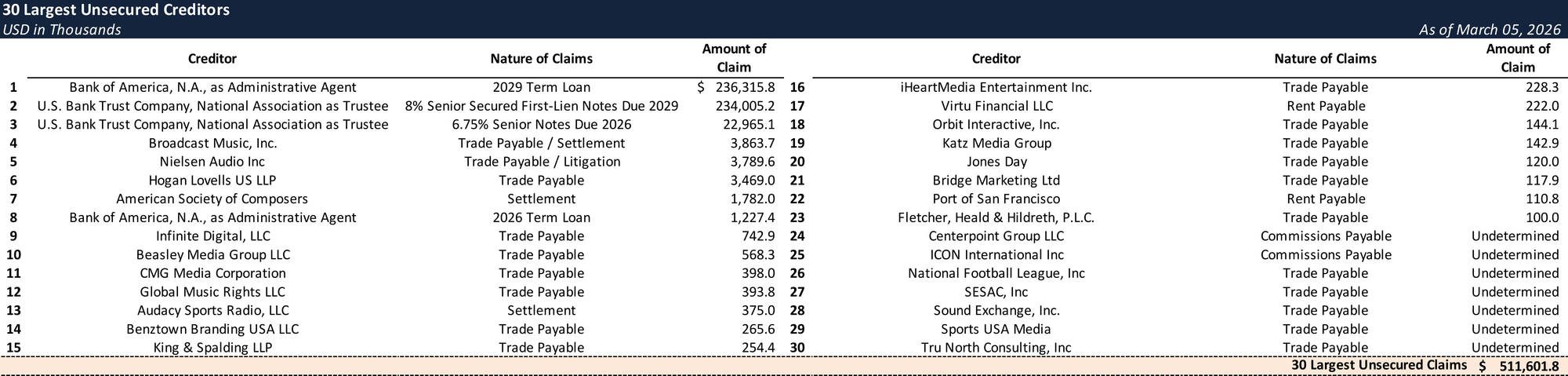
Top Unsecured Claims
Events Leading to Bankruptcy
Structural Decline of Broadcast Radio and Macroeconomic Headwinds
The filing occurred against the backdrop of a secular decline in broadcast radio that has persisted for two decades. Competition from digital audio platforms — Spotify, Apple Music, Amazon Music, YouTube Music, SiriusXM, and the rapidly growing podcast ecosystem — has eroded both listenership and advertising revenue. The migration toward programmatic and performance-based advertising further disadvantaged traditional radio's manual, relationship-driven sales model.
The COVID-19 pandemic delivered a devastating blow to radio in 2020, crashing industry revenues as commuting and drive-time listening collapsed. While there was a partial recovery in 2021, hybrid and remote work patterns permanently reduced commuter audiences and annual listening declines have persisted, particularly in the large markets where Cumulus operates.
Elevated interest rates disproportionately burdened the Company, with annual interest expense consuming an increasing share of declining cash flows. Persistent inflation drove up operating costs while key advertiser categories, particularly automotive and retail, pulled back spending amid consumer uncertainty.
Accelerating Financial Deterioration
Cumulus's financial trajectory illustrates the compounding pressures of structural decline and unsustainable leverage. Total net revenue fell from $953.5 million in 2022 to $827.1 million in 2024, a 13.3% decline, with broadcast radio revenue declining 20.5% (from $709.6 million to $564.0 million). National network revenue fell the most steeply at 27.3%. Adjusted EBITDA halved from $166.0 million to $82.7 million over the same period, while cash flow from operations turned negative at a loss of $3.1 million in 2024, compared to $31.7 million in 2023 and $78.5 million in 2022. Free cash flow was a deficit of $22.6 million in 2024.
- The decline accelerated into 2025: nine-month revenue of $553.6 million represented a 9.0% decline versus the prior-year period, with Q3 2025 broadcast radio revenue falling 17.2% (spot advertising down 13.1%, network revenue down 26.5%). The loss of programming relationships with The Daily Wire and The Dan Bongino Show further weighed on results.
Asset Monetization and Debt Reduction
Since emerging from its prior bankruptcy in 2018, Cumulus aggressively monetized non-core assets, generating approximately $510 million in total proceeds — including approximately $210 million from the sale of roughly 250 tower locations across 32 states to Vertical Bridge (approximately two-thirds structured as sale-leasebacks), approximately $120 million from surplus land sales, and approximately $180 million from divestitures of non-strategic stations in New York, Washington, Atlanta, San Jose, and other markets. Combined with approximately $120 million in cash from operations directed toward debt reduction, these efforts drove a gross debt reduction of approximately $630 million (~50% from June 2018 levels).
The 2024 Exchange Transactions
In May 2024, Cumulus executed a series of exchange transactions to extend debt maturities, pursuant to a transaction support agreement with holders of approximately 97% of existing term loans and approximately 80% of existing notes. Under the exchanges, $328.3 million of 2026 Term Loans were swapped for $311.8 million of new 2029 Term Loans (SOFR + 500 bps), and $323.0 million of 2026 Notes (6.75% coupon) were exchanged for $306.4 million of new 2029 Notes (8.00% coupon). The ABL Facility was simultaneously extended to March 2029 and upsized from $100 million to $125 million. Stub amounts of $1.2 million in 2026 Term Loans and $23.2 million in 2026 Notes remained unexchanged.
The exchange reduced total principal by approximately $33.1 million and eliminated substantially all restrictive covenants and certain events of default. However, the transactions did not significantly reduce the Company's overall debt burden. Operating results and liquidity continued to deteriorate in the months that followed.
The Nielsen Audio Dispute
In September 2024, Nielsen Audio announced a "Network Policy" conditioning access to its national radio ratings product on the mandatory purchase of local market ratings in every market where a broadcaster operates — effectively a tying arrangement that forced Cumulus to buy uneconomic local products in order to access the national data critical to advertising sales. After unsuccessful negotiations, Cumulus filed a complaint in October 2025 in the U.S. District Court for the Southern District of New York challenging the Network Policy.
On December 30, 2025, the district court granted Cumulus a preliminary injunction. However, on February 3, 2026, the Second Circuit granted Nielsen a stay pending appeal, suspending the injunction at a critical moment when 2026 advertising contracts were being negotiated. The stay restored commercial uncertainty for Westwood One and increased the risk of losing advertising customers and market share. On February 2, 2026, Nielsen filed counterclaims against Cumulus. As of the Petition Date, the litigation remains pending.
Nasdaq Delisting and Stock Price Collapse
Cumulus's stock decline was precipitous. In December 2024, Nasdaq notified the Company that its stock had closed below $1.00 for 30 consecutive business days; in March 2025, Nasdaq issued an additional non-compliance notice for failure to meet the $10 million minimum stockholders' equity requirement. On May 2, 2025, the Company's shares were delisted from Nasdaq and moved to the OTCQB market. The stock reached an all-time low of $0.0482 on December 18, 2025, and traded at approximately $0.08 per share at the time of filing — giving the Company a market capitalization of roughly $1.37 million against approximately $697 million in funded debt.
Retention of Professionals and Governance Changes
The sequential retention of restructuring professionals signaled the trajectory toward filing: Moelis & Company was retained as investment banker in September 2025; Paul, Weiss, Rifkind, Wharton & Garrison LLP as restructuring counsel in November 2025; and Alvarez & Marsal North America, LLC as financial advisor in December 2025.
In January 2026, the Board appointed Carol Flaton as an independent director. The Board formed a Special Restructuring Committee and an Investigation Committee (with Flaton as sole member) charged with reviewing potential claims against insiders and equity holders. On March 4, 2026, the Special Restructuring Committee was disbanded, and a Transaction Committee was formed, consisting of Elizabeth Abrams, David Tolley, and Steven M. Galbraith, with authority over M&A transactions, material contracts, financing, and litigation strategy during the Chapter 11 cases.
The RSA and Prepackaged Filing
In the last quarter of 2025, the Company and its advisors entered into discussions with an Ad Hoc Group of secured lenders, represented by Gibson, Dunn & Crutcher LLP (legal counsel) and Guggenheim Securities (financial advisor). While Cumulus originally aimed to complete the restructuring out of court, ongoing industry pressures led it to pivot to a prepackaged Chapter 11 filing in early 2026.
On March 4, 2026, the Debtors executed a Restructuring Support Agreement with the Ad Hoc Group, representing approximately 72.05% of 2029 Debt Claims. The RSA contemplates deleveraging ~$592 million of debt and a reduction of annual cash interest expense by approximately $49 million.
- Plan Treatment & Recoveries:
- ABL Claims (Class 3): Impaired; Holders receive pro rata share of New Exit ABL Facility.
- 2029 Secured Claims (Class 4): Holders receive 95% of New Common Stock plus their pro rata share of $50 million in Exit Convertible Notes.
- Other Funded Debt Claims (Class 5): Holders receive the remaining 5% of New Common Stock.
- General Unsecured Claims (Class 6): Unimpaired; paid in full in the ordinary course.
- Existing Equity (Class 9): Cancelled and extinguished; holders receive no recovery.
- Exit Capital Structure:
- Exit ABL Facility: Up to $100 million, replacing the existing ABL facility, committed by Fifth Third Bank.
- Exit Convertible Notes: $50 million, issued to Class 4 creditors as part of their recovery.
As of the Petition Date, the Company held approximately $46 million in cash on hand. The filing was structured as a consensual cash collateral arrangement, avoiding the need for debtor-in-possession financing at the outset (however, the Plan expressly authorizes the Debtors to obtain a contingent DIP facility if the Debtors determine, with the consent of the Required Consenting 2029 Holders, that such financing becomes necessary).
- Contingent DIP: A pre-authorized but undrawn $25 million DIP facility is available if needed during the case, backstopped by certain 2029 Debt Claim holders at SOFR + up to 10.0%.
The Company targets plan confirmation within approximately 55 days and emergence up to 75 days after confirmation, pending FCC regulatory approvals with the Company being taken private.
Key Parties
- Paul, Weiss, Rifkind, Wharton & Garrison LLP (restructuring counsel); Porter Hedges LLP — John F. Higgins (local counsel); Moelis & Company LLC (investment banker); Alvarez & Marsal North America, LLC (financial advisor); Kurtzman Carson Consultants LLC d/b/a Verita Global (claims and noticing agent).
Explore Bondoro Insights for live case dockets and comprehensive coverage of material filings from petition to plan confirmation.
Stay informed on every Chapter 11 bankruptcy case with liabilities exceeding $10 million. Subscribe for free to have our coverage delivered directly to your inbox, and explore our full archive of past summaries.
Subscribers can also opt in to timely filing alerts by updating their email preferences in Account Settings.


