Case Summary: Hawthorne Race Course Chapter 11
Hawthorne Race Course filed for Chapter 11 amid a liquidity crisis driven by a Churchill Downs judgment, frozen operating accounts at its senior lender, terminated simulcast agreements, and a suspended harness racing license, pursuing a Section 363 sale backed by $16 million in DIP financing.

Business Description
Headquartered in Stickney, IL, Hawthorne Race Course, Inc. ("Hawthorne" or "HRC"), along with its Debtor affiliates — Carey Heirs Properties, LLC ("CHP"), Suburban Downs, Inc. ("SDI"), and Post Time Catering, Inc. (collectively, the "Debtors" or the "Company") — operates the only racetrack in northern Illinois and one of the oldest continually family-owned racetracks in North America. The Company's platform combines live pari-mutuel and simulcast wagering, advance deposit wagering, retail sportsbook operations, an 10-location off-track betting network (Illinois' largest), and on-site food and beverage services through its wholly owned catering subsidiary.
The racetrack occupies approximately 119 acres at 3501 S. Laramie Avenue, roughly 10 miles from downtown Chicago, featuring a one-mile dirt oval, a seven-furlong turf course, and a 1,320-foot home stretch — the third-longest of any dirt track in the United States. CHP owns the underlying real estate and leases the premises to HRC for thoroughbred meets and SDI for harness meets.
Since 2016, Hawthorne has operated as the country's only dual-breed racetrack, regularly running both thoroughbred and harness racing on the same surface after absorbing displaced horsemen from the shuttered Balmoral and Maywood facilities. The 2021 closure of Arlington International Racecourse left Hawthorne as the sole track serving the entire Chicago metropolitan area.
As of the Petition Date, the Company employed over 250 people, with its longest-tenured employee having spent more than 52 years at the track. The racetrack's "backside" — the stable area where horsemen and their families reside — houses between 290 and 500+ people depending on the season, including approximately 100 children. These families live rent-free and receive medical and dental care funded almost entirely by Hawthorne.
Hawthorne Race Course, Inc. and its affiliates filed for Chapter 11 protection on February 27, 2026 (the "Petition Date") in the U.S. Bankruptcy Court for the Northern District of Illinois, reporting $50 million to $100 million in assets and $100 million to $500 million in liabilities.
Corporate History
Hawthorne Race Course predates the Carey family. Edward Corrigan, a Chicago businessman who owned 1890 Kentucky Derby winner Riley, opened the track in Cicero, IL, on May 20, 1891. Only Saratoga, Churchill Downs, Fair Grounds, and Pimlico are older among North American racetracks. A grandstand fire in 1902 and a 1905 Illinois legislative ban on Chicago horse racing left the facility dormant.
Thomas Carey, a Chicago alderman and attorney who founded the Carey Brick Company (later American Brick Company), purchased the shuttered racetrack on May 19, 1909, from the near-bankrupt Corrigan for $2,000 in cash and a $26,000 note. Early attempts to revive racing met police resistance, and permanent operations did not resume until 1922. Upon Thomas Carey's death in 1925, ownership passed in eight equal interests — one to each of his seven children and one to his wife's family. Over time, because two children died unmarried and without heirs, ownership consolidated into six family groups, where it remains today.
The Carey family's multi-generational stewardship proceeded through distinct eras. Robert F. Carey (second generation) managed the track from 1947 until his death in 1980. His successor, Thomas F. "Tom" Carey (third generation), faced the track's defining crisis: a devastating November 1978 fire that destroyed the grandstand and gutted the clubhouse. Tom Carey rejected a buyout offer and instead secured $10 million in industrial development bonds from the Stickney Village Board, leading a $16 million reconstruction that produced an ultramodern, glass-enclosed 15,000-seat grandstand. The rebuilt track reopened for harness racing in February 1980 and thoroughbred racing by September 1980. Prior to HRC's incorporation in 1979, the racetrack was owned and operated by the Estate of Thomas Carey, an Illinois general partnership. Timothy "Tim" Carey became President and CEO in 2005.
Organizational Structure
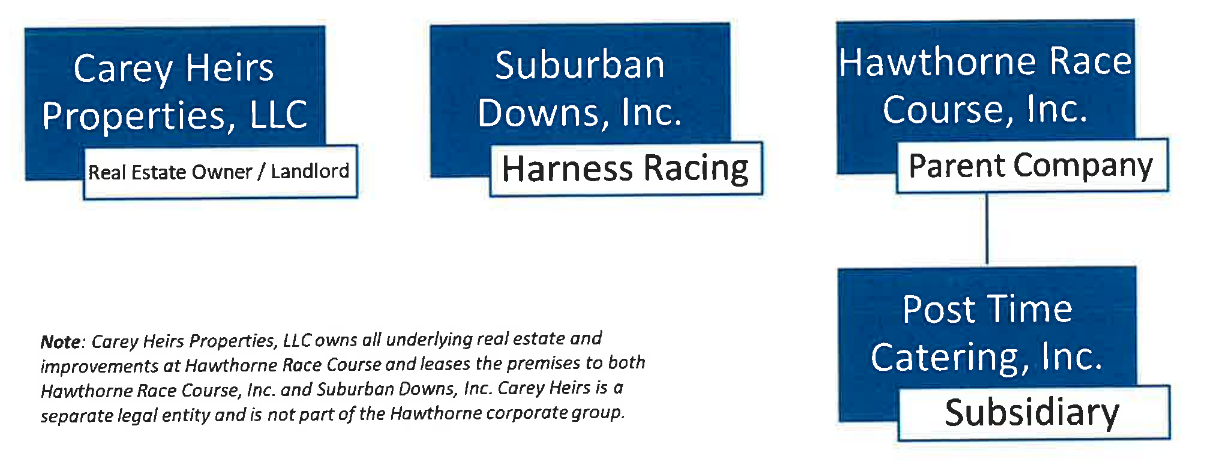
The debtor group separates real estate ownership from racing operations:
- Carey Heirs Properties, LLC: Owns the underlying racetrack real estate and leases the premises to HRC and SDI. CHP has 77 members and is governed by a three-manager board. It is a separate legal entity outside the Hawthorne corporate group.
- Hawthorne Race Course, Inc.: The primary operating entity, governed by a nine-director board. Owned by 58 shareholders plus four trusts across six family groups, with the largest holders being the Lucille Marie Mueller Trust (7.2%), Maeve Carey Mueller Trust (7.2%), Thomas G. Finn (5.7%), and Margaret B. Jacob (5.7%), and 56 other individuals collectively holding 74.3%.
- Suburban Downs, Inc.: Conducts harness racing and simulcast wagering when HRC is not holding a thoroughbred meet. Governed by a 10-director board, with 58 shareholders including five trusts.
- Post Time Catering, Inc.: Wholly owned subsidiary of HRC providing food and beverage services.
Operations Overview
Hawthorne operates under the oversight of two state regulators — the Illinois Racing Board ("IRB") for racing and the Illinois Gaming Board ("IGB") for casino and sports wagering licensure.
Racing Operations and Industry Context
Hawthorne conducts both thoroughbred and harness meets on the same surface. At one time, Chicago boasted six racetracks; currently only Hawthorne and FanDuel Sportsbook & Horse Racing in Collinsville now operate statewide. Illinois' total racing handle has declined from $514 million (2022) to $478 million (2024), a 40-year low.
Real Estate
- Race Course Property (Stickney/Cicero, IL): Approximately 119 acres across four parcels. A land-only appraisal by Woodland Valuation Services valued the property at $95 million as of August 2025, excluding going-concern value and gaming licenses.
- Crestwood Property (Crestwood, IL): An approximately 20,400-square-foot OTB and restaurant facility.
Gaming and Sports Wagering Licenses
Illinois' 2019 gaming expansion law (P.A. 101-0031) authorized racetracks to add slot machines and table games, creating "Racino" facilities. Hawthorne was authorized for up to 1,200 gaming positions and received a statutory veto over any new racetrack within 35 miles. In July 2020, the IGB unanimously found HRC preliminarily suitable for an organizational gaming license and issued a Master Sports Wagering License; key person suitability findings followed in July 2021. The IGB renewed the Master Sports Wagering License in September 2024 through July 2028.
HRC's sportsbook was operated initially by PointsBet USA. Following Fanatics' acquisition of PointsBet's U.S. operations, HRC and Fanatics signed a letter-of-intent framework in May 2023. On January 26, 2026, Fanatics terminated the mobile and internet portion of the agreement — subsequently transferring its Illinois mobile wagering license to Argosy Casino (PENN Entertainment) — while continuing retail services at the racetrack and eligible OTBs.
The Unbuilt Racino
Hawthorne demolished portions of its grandstand in 2020 to prepare for construction, but financing repeatedly fell through amid COVID-19, inflation, elevated interest rates, and the Carey family's decision not to partner with an established casino operator. Despite annual assurances that a deal was imminent, no construction had commenced as of the Petition Date. The half-demolished grandstand remains the most visible symbol of the delay.
Prepetition Obligations
Top Unsecured Claims
Events Leading to Bankruptcy
Structural Pressures
The Company's financial performance deteriorated over several years under the weight of structural pressures facing the Illinois horse racing industry — initially from the expansion of casino gaming and later compounded by an increasingly competitive sports betting market. Rising costs and increased regulatory fees associated with simultaneously operating a strained racing business and pursuing a new casino development further eroded the Company's resources, even as it bore sole responsibility for underwriting northern Illinois racing after Arlington's closure.
The Churchill Downs Judgment and Account Freeze
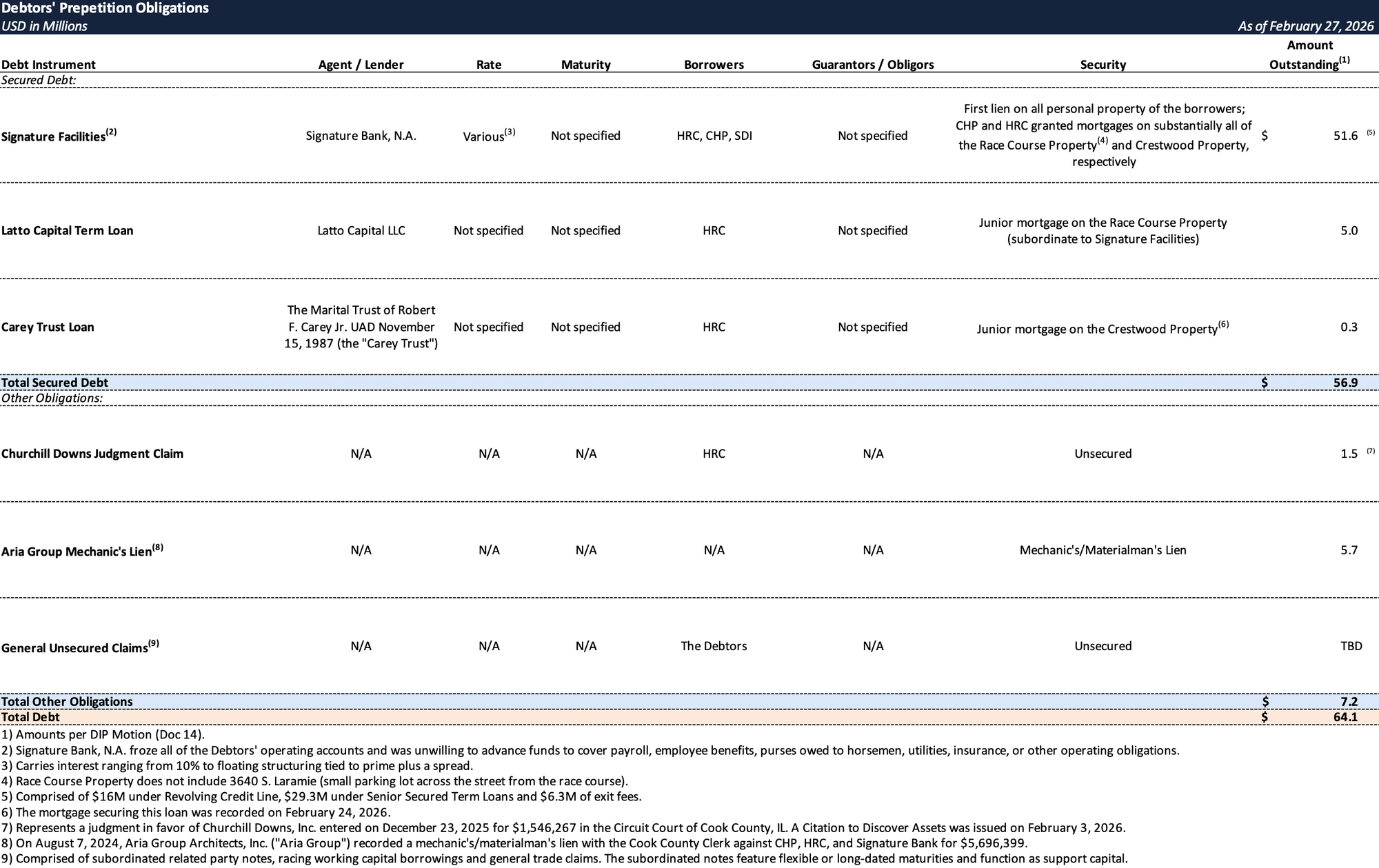
The immediate trigger for the filing was a $1,546,267 judgment by confession entered December 23, 2025, in Cook County Circuit Court in favor of Churchill Downs Inc. for unpaid simulcast settlement fees. CDI had already severed simulcast signals from its tracks in fall 2024 due to significant arrears.
Following the judgment, a Citation to Discover Assets was issued on February 3, 2026, which prevented the Debtors from utilizing their revenue stream. Meanwhile, Signature Bank, N.A. — the Company's senior secured lender with approximately $51.6 million in outstanding obligations — froze all of the Debtors' operating accounts and was unwilling to advance funds to cover payroll, employee benefits, purses owed to horsemen, utilities, insurance, or other operating obligations.
Operational Cascade
The account freeze triggered a rapid chain reaction across the Company's operations:
- Horsemen's purse crisis: Purse checks issued before the freeze could not be deposited once accounts were frozen.
- Harness season cancellation: On December 28, 2025, the Company cancelled the remaining race dates of the 2025–2026 harness season due to liquidity constraints.
- Regulatory suspension: On January 26, 2026, the IRB suspended SDI's organization license, citing failure to demonstrate financial integrity and violations for unreported bounced purse checks.
- Sportsbook termination: On the same date, Fanatics terminated the mobile and internet portions of its sportsbook agreement, subsequently transferring its Illinois mobile wagering license to Argosy Casino (PENN Entertainment).
- Simulcast disruptions: Additional providers severed signals as the Company fell behind on settlement payments.
DIP Financing and Path Forward
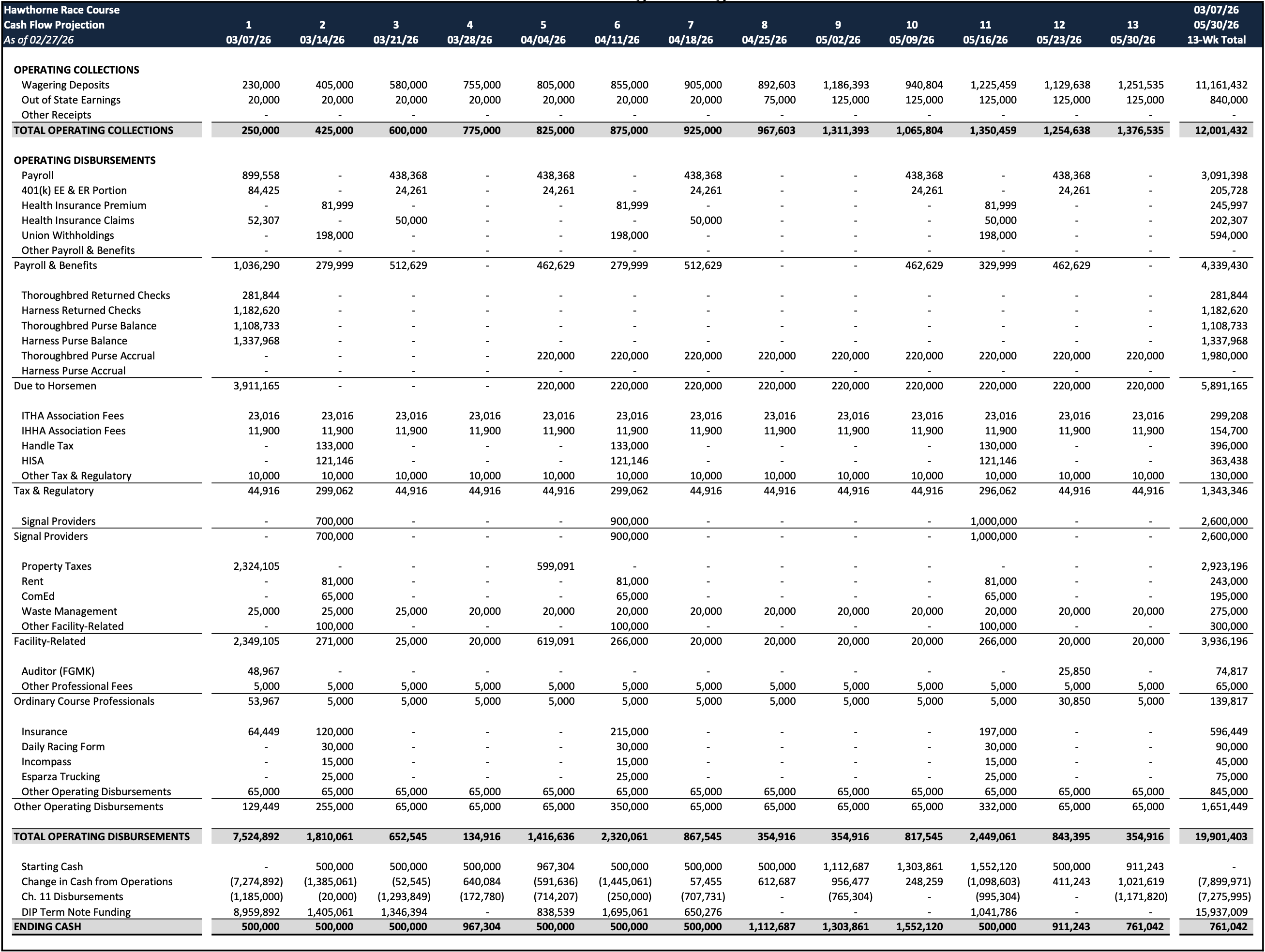
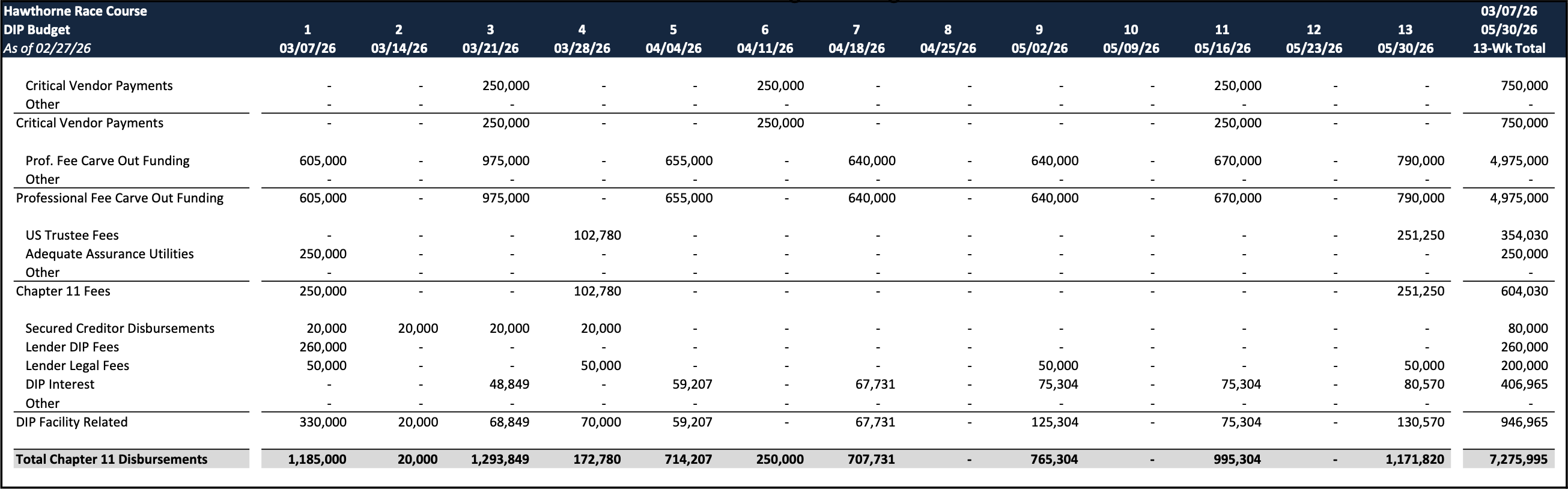
- To fund ongoing operations and the restructuring process, the Debtors obtained a DIP facility of up to $16 million from JDI Loans LLC, composed entirely of new-money DIP loans.
- The DIP Facility bears interest at approximately 13% per annum and has a 120-day maturity.
- Proceeds of the DIP financing are expected to be used primarily to stabilize operations and support the restructuring process, including:
- Approximately $3.91 million in week-one payments to cure horsemen’s purse arrearages, a regulatory prerequisite to commencing the March 29, 2026 thoroughbred meet and maintaining the Debtors’ racing licenses.
- Approximately $750,000 in payments to host tracks and simulcast providers to restore suspended simulcast signals.
- Funding ordinary-course operating expenses and administrative costs associated with the Chapter 11 cases.
- Restoration of simulcast agreements is expected to significantly increase wagering activity, with management projecting that monthly wagering collections could recover to approximately $4 million once major signals are reinstated.
- The Debtors’ professional team includes Saul Ewing LLP (bankruptcy counsel), Getzler Henrich & Associates LLC (financial advisor), Carey White Boland Murnighan & Murray, LLC (corporate counsel), Greenberg Traurig LLP (regulatory counsel), and Omni Agent Solutions (claims and noticing agent).
- Prior to selecting the DIP facility, the Debtors and their financial advisor contacted 35 potential lenders, resulting in 14 expressions of interest, five executed nondisclosure agreements, and three formal term sheets, ultimately leading to the selection of the JDI financing proposal.
- The Company's restructuring strategy centers on a Section 363 sale of substantially all assets, with a going-concern sale or recapitalization as alternative paths. Multiple parties have executed NDAs and reviewed materials through a data room. Interested parties have indicated willingness to proceed only within the context of a bankruptcy process.
Cash Flow Projection
DIP Budget
Explore Bondoro Insights for live case dockets and comprehensive coverage of material filings from petition to plan confirmation.
Stay informed on every Chapter 11 bankruptcy case with liabilities exceeding $10 million. Subscribe for free to have our coverage delivered directly to your inbox, and explore our full archive of past summaries.
Subscribers can also opt in to timely filing alerts by updating their email preferences in Account Settings.


