Case Summary: IPIC Theaters Chapter 11
IPIC Theaters has filed for Chapter 11 bankruptcy under subchapter V, its second restructuring since its predecessor’s 2019 filing, as the company grapples with persistently depressed box office revenue, a reduced slate of theatrical releases, and intensifying competition from streaming platforms.

Business Description
Headquartered in Boca Raton, FL, iPic Theaters, LLC (the "Debtor"), wholly owned by Retirement Systems of Alabama ("RSA"), is a pioneer and operator of premium dine-in movie theaters, combining luxury cinema exhibition with chef-driven dining and craft cocktail hospitality under a single-destination entertainment model.
- The Debtor operates 13 dine-in theater locations with approximately 100 screens across eight states — Florida, California, Georgia, Maryland, New Jersey, New York, Texas, and Washington — along with eight standalone or adjacent restaurant locations. A subsidiary, IPIC Marketing, LLC, handles marketing and promotional activities.
- All 13 theater locations are leased properties with key landlords including entities associated with Howard Hughes Corporation and Federal Realty Investment Trust.
The Debtor's concept occupies the ultra-premium end of the theatrical exhibition market, featuring two seating tiers: Premium seats (leather chaise-lounge recliners with counter-service dining) and Premium Plus seats (fully reclining leather "pod" seats in paired configurations with shared swivel tables, push-button "ninja" server service, and complimentary pillows and blankets). Ticket prices range from approximately $14 to $29+ per person — substantially above the national average of approximately $16.
- The company estimates that more than 50% of its revenue derives from food and beverage sales, distinguishing it from traditional exhibitors where concessions typically account for 30–35% of revenue.
- iPic operates four branded dining concepts: IPIC (in-theater dining), City Perch Kitchen + Bar (seasonal American cuisine), The Tuck Room (cocktail-focused dining), and Serena Pastificio (upscale Italian). The culinary program was developed under James Beard Award-winning Chef Sherry Yard, who served as COO of the restaurant division.
For the fiscal year ended December 31, 2025, the Debtor reported approximate gross income of $112.5 million alongside a net loss of approximately $19.4 million. Through January 31, 2026, the Debtor generated approximate gross income of $12.9 million.
As of the Petition Date, the Debtor employed approximately 1,300 workers (400 full-time and 900 part-time), including executive and managerial personnel, site-level management, event sales staff, front-of-house employees (waiters, bartenders), and back-of-house staff (chefs, theater technicians, maintenance).
iPic Theaters, LLC filed for Chapter 11 protection under subchapter V on February 25, 2026 (the "Petition Date") in the U.S. Bankruptcy Court for the Southern District of Florida, reporting $10 million to $50 million in assets and $1 million to $10 million in liabilities.
Corporate History
iPic's corporate history is rooted in the vision of founder Hamid Hashemi, an entrepreneur who entered the movie exhibition business in 1984 when he founded Muvico Theaters in South Florida. Hashemi grew Muvico to over 100 screens before selling to Regal Cinema in 1995, then built a second generation of Muvico megaplexes before departing the company in 2005.
- In 2006, Hashemi formally founded iPic Entertainment. The first iPic theater opened in 2007 at Bayshore Town Center in Glendale/Milwaukee, Wisconsin.
Expansion Through Acquisition
- A pivotal expansion came in September 2010, when iPic acquired a majority stake in Village Roadshow Gold Class Cinemas USA from Australian entertainment conglomerate Village Roadshow (which retained 30% interest). Village Roadshow Gold Class had opened six U.S. luxury cinema locations but Village Roadshow acknowledged the U.S. operation had been "financially disappointing from the outset." The combined entity became iPic-Gold Class Entertainment, LLC, a Delaware limited liability company. iPic rebranded the Gold Class locations, reconfigured seating, reduced ticket prices, and outsourced restaurant services.
- RSA entered the picture as a major lender to iPic beginning around 2010, through the Teachers' Retirement System and Employees' Retirement System of Alabama. RSA eventually became iPic's largest shareholder (holding 39.2% of equity as Class A stock prior to the company's public offering).
Public Listing and Financial Strain
- In February 2018, iPic Entertainment Inc. completed a Regulation A+ "mini-IPO" on the NASDAQ under the ticker symbol IPIC, selling 818,429 shares of Class A common stock at $18.50 per share and raising approximately $15.1 million — well below the maximum target of $40 million. The stock quickly declined, trading around $8 by mid-2018 before collapsing below $2 as financial distress intensified.
- By 2017, iPic operated 16 locations with 121 screens across ten states, but its business plan calling for 25 locations in four to five years had fallen far behind schedule. Revenue peaked at approximately $148 million in fiscal year 2018, but same-store sales declined 21.7% by Q1 2019 as corporate overhead increased significantly relative to 2015 levels.
The 2019 Bankruptcy and RSA Credit Bid
- iPic-Gold Class Entertainment, LLC and five affiliated entities filed for Chapter 11 protection on August 5, 2019, in the U.S. Bankruptcy Court for the District of Delaware (Case No. 19-11737, jointly administered before Judge Laurie Selber Silverstein). The debtors were represented by Pachulski Stang Ziehl & Jones LLP, with Aurora Management Partners serving as financial advisor and PJ Solomon as investment banker.
- At the time of filing, the debtors operated 16 theaters with 123 screens, employed approximately 2,010 workers, and listed $290.9 million in total debts — including approximately $205 million in secured obligations owed to RSA. The filing was precipitated when iPic missed an interest payment in July 2019.
- The predecessor's first-day declaration attributed the financial distress to intensifying competition as other exhibitors rolled out reclining-seat formats at lower price points, rising construction and buildout costs that tightened liquidity, and the IPO's failure to raise sufficient capital for the company's expansion plan, compounded by public-company compliance costs.
- RSA provided $16 million in DIP financing at 10.5% interest. PJ Solomon contacted 64 potential acquirers; 31 signed non-disclosure agreements. At an October 17, 2019 auction, iPic Theaters, LLC — a newly formed RSA affiliate — prevailed as the winning bidder at $51.8 million (structured as a credit bid), defeating a $48.8 million competing bid from Cinemex Holdings USA. The sale closed in November 2019, less than four months after the petition date.
- On November 15, 2019, Hashemi and three other executives resigned. M. Hunter Harrell, RSA's Director of Private Placements, became managing member of iPic Theaters, LLC. The new entity emerged with no legacy debt and fresh working capital from RSA. Patrick Quinn was subsequently named CEO in approximately May 2022.
Operations Overview
The Debtor's business model integrates three core guest areas — polished-casual restaurant, full-service bar, and luxury auditoriums with in-theater dining — designed to drive "crossover" between dining, drinking, and moviegoing during a typical multi-hour visit. This concept design ties cinema attendance directly to food-and-beverage throughput and labor scheduling, making the revenue model meaningfully more complex than a traditional concession-only theater.
Theater Locations
The 13 active theater locations at the time of filing are:
- Mizner Park (Boca Raton, FL): Flagship and headquarters location with 8 screens; features Serena Pastificio restaurant.
- Delray Beach, FL: Four-level destination with 8 screens; opened March 2019.
- North Miami Beach, FL: 8 screens; features The Tuck Room restaurant.
- Pasadena, CA: Intimate format with 6 screens and paired-pod auditoriums.
- Westwood (Los Angeles, CA): 6 screens on Wilshire Boulevard.
- Colony Square (Atlanta, GA): 9 screens; opened December 2020; slated for closure April 28, 2026.
- Fulton Market (New York, NY): 8 screens at South Street Seaport; opened October 2016.
- Hudson Lights (Fort Lee, NJ): 8 screens; features City Perch Kitchen + Bar.
- River Oaks District (Houston, TX): 8 screens; features The Tuck Room restaurant.
- The Domain (Austin, TX): 6 screens.
- Stonebriar Centre (Fairview, TX): 8 screens; originally a Gold Class Cinema location.
- Redmond Town Center (Redmond, WA): 8 screens; originally a Gold Class Cinema location.
- Pike & Rose (North Bethesda, MD): 8 screens; features City Perch Kitchen + Bar.
Revenue Model and Cost Structure
- The Debtor's premium dine-in format generates a revenue mix heavily weighted toward food and beverage — accounting for more than 50% of gross income.
- This model amplifies both the upside and downside of attendance fluctuations: lower foot traffic suppresses not only admissions but also food-and-beverage volume, while a significant portion of labor, occupancy, and food inventory costs remain relatively fixed in the short term.
Membership Program
- The iPic Access membership program, launched in March 2018, offers four tiers: Silver (free), Gold ($45/year, providing 10% off food and beverage and up to 40% off tickets), Platinum (earned via accumulated spending), and Platinum Elite (invitation-only). The program had over 2 million members by 2019.
Prepetition Obligations
- The Debtor's prepetition obligations are remarkably modest compared to the 2019 filing, reflecting the clean balance sheet achieved through RSA's credit bid, which eliminated the prior $205 million in secured obligations. The Debtor reports no traditional secured debt (with limited exceptions such as a UCC-1 financing statement filed by Konica Minolta Premier Finance with respect to a leased piece of equipment) and approximately $2.7 million in total prepetition obligations:
- Wages and employee benefits: approximately $2.1 million.
- Trade debt (vendors/suppliers): approximately $409,000.
- Taxes (sales and use taxes, New York City commercial rent taxes): approximately $141,000.
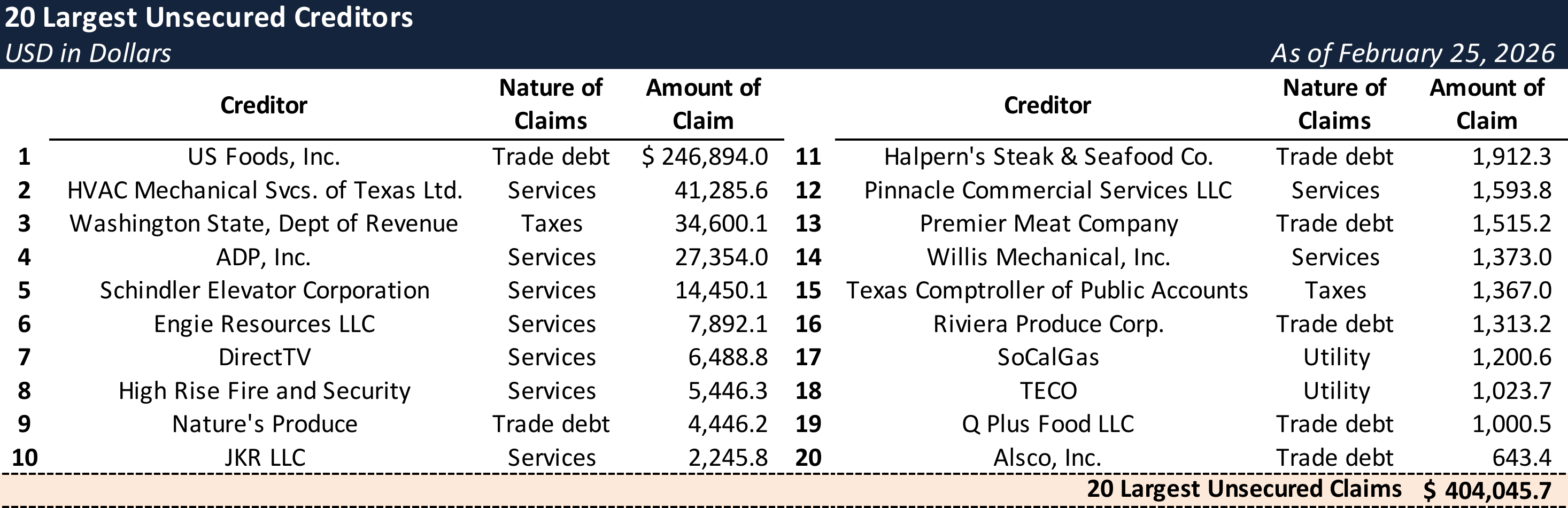
Top Unsecured Claims
Events Leading to Bankruptcy
COVID-19 Pandemic and Structural Industry Disruption
- Less than six months after the 2019 post-bankruptcy acquisition, the COVID-19 pandemic brought the movie theater industry to an abrupt halt. Nearly all U.S. theaters shuttered by mid-March 2020, with major markets remaining closed for approximately 12–15 months.
- The 2020 domestic box office collapsed to $2.11 billion — an 81.4% decline from 2019's $11.36 billion. Recovery has been painfully slow: the domestic box office reached $7.37 billion in 2022 and $8.91 billion in 2023, but stalled at $8.57 billion in 2024 and $8.66 billion in 2025 — remaining approximately 24% below pre-pandemic levels. An estimated 5,700 screens have permanently closed since the pandemic began.
- Attendance has declined far more sharply than revenue figures suggest. Rising ticket prices (from approximately $8.40 in 2015 to over $16.00 in 2025) have masked a collapse in admissions from approximately 1.23 billion in 2019 to roughly 716 million in 2025. Monthly habitual moviegoing dropped from 39% of U.S. adults in 2019 to approximately 17% in 2025.
Streaming Competition and Content Contraction
- The rapid expansion and widespread availability of streaming platforms — including Disney+ (November 2019), HBO Max (May 2020), Peacock (July 2020), and Paramount+ (March 2021) alongside Netflix and Amazon Prime Video — fundamentally altered consumer viewing behavior, compressing the standard exclusive theatrical window from 90 days to approximately 30–45 days.
- Consumer surveys show only 32% of Americans prefer watching movies in theaters versus 45% who prefer streaming, with 68% citing cost as the biggest barrier to theater attendance.
- The disappearance of mid-budget theatrical releases has disproportionately harmed premium venues. Box office revenue has become increasingly concentrated in franchise tentpoles: in 2024, franchise films represented 42% of wide releases but captured 82.5% of Hollywood's worldwide gross. The "middle class of cinema" — adult dramas, comedies, and original stories — that once drew audiences to premium theaters during non-blockbuster periods has largely migrated to streaming, leaving theaters like iPic with fewer films capable of driving the regular patronage their cost structure demands.
Structural Vulnerability of the Premium Dine-In Model
- Many major U.S. theater chains have filed for bankruptcy or permanently closed since 2020, underscoring the structural crisis facing the premium segment:
- Studio Movie Grill: Chapter 11 in October 2020; emerged with only 19 of 34 locations.
- Alamo Drafthouse Cinema: Chapter 11 in March 2021; ownership sought sale in 2024.
- ArcLight Cinemas/Pacific Theatres: Permanently closed all 300+ screens in April 2021.
- Cineworld/Regal Cinemas: Chapter 11 in September 2022; emerged after closing 50+ locations.
- CMX Cinemas: Chapter 11 in April 2020; filed again in mid-2025.
- LOOK Dine-In Cinemas: Chapter 11 in late 2024; shuttered California locations in February 2026.
- Metropolitan Theatres: Chapter 11 in February 2024.
- The attendance erosion is particularly devastating for high-overhead dine-in operations like iPic that depend on consistent foot traffic — not just tentpole-weekend surges — to cover kitchen staff, full-service labor, premium real estate leases, and food inventory costs.
iPic-Specific Financial Deterioration
- The Debtor's financial condition was further strained by its contractual obligations to remit a specified percentage of weekly box office revenues to film studios pursuant to master licensing agreements and additional film-specific distribution terms. Rising labor costs and rents further exacerbated the financial challenges.
- iPic contracted from 16 locations and 123 screens at its 2019 peak to 13 locations and 100 screens by early 2026, closing properties in Arizona, Illinois, and Wisconsin. Despite opening one new location (Atlanta, December 2020) under RSA ownership, the chain generated a net loss of approximately $19.4 million on gross income of $112.5 million in 2025 — a loss margin exceeding 17%.
Filing and Path Forward
- The Debtor elected to proceed under subchapter V of the Bankruptcy Code. Through the subchapter V case, the Debtor intends to conduct an orderly liquidation of its assets and business operations to maximize value for creditors.
- WARN Act notices were issued to all approximately 1,300 employees concurrent with the filing.
- First-day motions were filed to authorize continued use of the cash management system, honor employee wage and benefit obligations, pay prepetition taxes and fees, maintain insurance coverage, continue customer programs, ensure utility service continuity, and pay obligations to critical vendors. No DIP financing arrangement has been disclosed.
Key Parties
- The Debtor is represented by Burr & Forman LLP as proposed counsel, with Development Specialists, Inc. ("DSI") serving as financial advisor and Stretto serving as claims and noticing agent.
Explore Bondoro Insights for live case dockets and comprehensive coverage of material filings from petition to plan confirmation.
Stay informed on every Chapter 11 bankruptcy case with liabilities exceeding $10 million. Subscribe for free to have our coverage delivered directly to your inbox, and explore our full archive of past summaries.
Subscribers can also opt in to timely filing alerts by updating their email preferences in Account Settings.


