Case Summary: Bitcoin Depot Chapter 11
Bitcoin Depot filed for Chapter 11 as escalating state regulatory actions, compliance-driven revenue deterioration, and significant legal exposure left the largest Bitcoin ATM operator in North America with no viable path forward.

A deck version of this summary is also available HERE.
Business Description
Headquartered in Sandy Springs, GA, Bitcoin Depot Inc. ("Bitcoin Depot," and, together with its Debtor⁽¹⁾ and non-Debtor subsidiaries, the "Company") owns and operates the largest network of Bitcoin ATMs ("BTMs" or "Kiosks") across North America, providing customers access to Kiosks that facilitate one-way cash-to-Bitcoin exchanges.
- Per Coin ATM Radar tracker data, Bitcoin Depot held a ~23.8% global share of active BTM locations as of March 2026 (~9,246 of 38,928 worldwide); its own Q4 2025 investor presentation reported a 28% U.S. share.
The Company's core product is the Kiosk network, complemented by BitAccess — a BTM device and transaction-processing system that provides the software and operational capabilities for the BTMs, and BDCheckout program (“BDCheckout”), which allows customers to purchase Bitcoin at retail checkout counters via a transaction initiated on the Bitcoin Depot mobile app (the “BD App”).
- As of December 31, 2025, the Company operated a portfolio of approximately 9,700 owned and leased kiosks across 48 U.S. states, 10 Canadian provinces, and 6 Australian states.⁽²⁾
- Kiosks generated $613.6 million of revenue for FY 2025, roughly 99.8% of total Company revenue, implying average revenue per kiosk of ~$63,100/year.
Bitcoin Depot Inc. and certain affiliates filed for Chapter 11 protection on May 18, 2026 (the "Petition Date") in the U.S. Bankruptcy Court for the Southern District of Texas, reporting $11.3 million in assets and $26.9 million in liabilities (as of March 31, 2026).
⁽¹⁾ For a complete list of Debtor entities, see organizational structure chart below. ⁽²⁾ As of the Petition Date, the entire Kiosk fleet has been taken offline and is not operating.
Corporate History
The Company was founded by Brandon Mintz through Lux Vending, LLC ("Lux"), a Georgia LLC formed on June 7, 2016, and wholly owned and managed by BT Assets, Inc. ("BT Assets"). In July 2021, Lux expanded by acquiring a controlling interest in BitAccess Inc., a Canadian corporation, via a business combination. BitAccess software was deployed across all of the Company's then-existing fleet of approximately 7,000 kiosks, with the full software conversion completed in February 2023.
To take the business public, Lux and BT Assets agreed to merge with GSR II Meteora Acquisition Corp., a Delaware-based SPAC. When that transaction closed on June 30, 2023, the combined entity was reorganized into a new public parent company — Bitcoin Depot Inc. — with the pre-existing operating business continuing underneath it as Bitcoin Depot Operating LLC, an indirect wholly-owned subsidiary.
Post de-SPAC Acquisitions
Bitcoin Depot acquired Pelicoin in June 2025 and National Bitcoin ATM in October 2025, collectively integrating over 500 kiosks across 27 states and consolidating its domestic BTM footprint. In January 2026, the Company closed the acquisition of Instant Coin Bank, further strengthening its presence in Texas and Oklahoma and reinforcing its position as the leading BTM operator in North America. On February 27, 2026, Bitcoin Depot acquired Kutt, Inc., a peer-to-peer social betting platform that allows users to wager directly with one another on publicly verifiable outcomes across sports, entertainment, and other real-world events for $4.5 million.
Organizational Structure
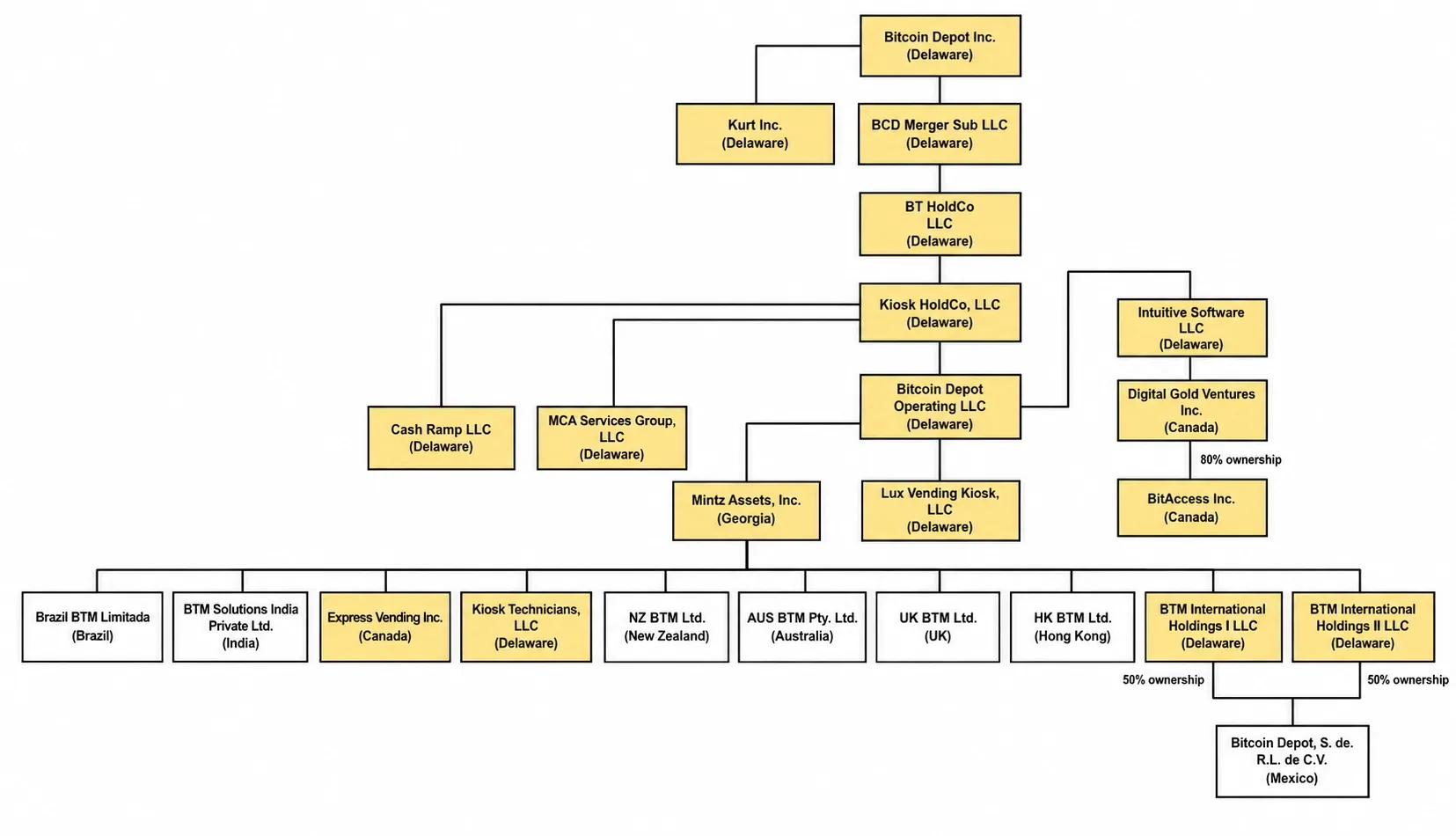
The corporate family comprises 24 entities, 17 of which are Debtors in these jointly-administered cases, including the borrower and every guarantor under the Silverview Credit Facility. The remaining 7 entities are all foreign subsidiaries winding down concurrently with the U.S. proceedings.
The most material foreign operation is AUS BTM PTY LTD, which operates approximately 140 kiosks in Australia and is pursuing a separate insolvency process under Australian law. The three Canadian Debtors — Digital Gold Ventures, BitAccess, and Express Vending — are the intended subject of CCAA Part IV recognition proceedings to be commenced in the Ontario Superior Court of Justice (Commercial List), with Bitcoin Depot Inc. authorized to act as foreign representative.
Operations Overview
The Company runs three Bitcoin-centered product lines — Kiosks, BDCheckout, and BitAccess — all supported by the Bitcoin Depot mobile app (the "BD App"). It also owns Kutt, Inc., a peer-to-peer social betting platform, and ReadyBucks, a standalone online platform offering business advances to small businesses and gig and contract workers. Bitcoin Depot does not custody customer Bitcoin — a distinction that materially separates this estate from prior crypto bankruptcies like Voyager, Celsius, and BlockFi, where stranded customer assets drove massive unsecured creditor pools. Here, Bitcoin is purchased on a just-in-time basis and held only briefly between purchase and blockchain delivery. Once the transaction completes, the Bitcoin is gone from the estate's balance sheet. There are no customer Bitcoin deposits sitting on the Company's books.
Kiosks
The Kiosk network is Bitcoin Depot's core business, generating $613.6 million in revenue for FY2025 — roughly 99.8% of total company revenue. As of December 31, 2025, the Company operated approximately 9,700 owned and leased kiosks across 48 U.S. states, 10 Canadian provinces, and 6 Australian states, placed in convenience stores, gas stations, pharmacies, grocery chains, and shopping malls — covering zip codes that reach approximately 69% of the U.S. population. Texas was the highest-concentration state in the six months prior to filing, and Texas Kiosks had the second-highest numbers of individual customers and total dollar spend. Within Texas, the highest concentration of active Kiosks were operating in Houston, and Houston Kiosks had the second-highest numbers of individual customers and total dollar spend. As of the Petition Date, the entire kiosk fleet has been taken offline.
The transaction price for the customer is the price of the cryptocurrency based on the real-time exchange value, plus a markup and a flat fee. Cash collected from kiosks is transported by armored courier, either on a set schedule or once a kiosk hits a specified cash threshold, which the Company monitors in real time. According to the Company's FY2025 10-K report, the markup percentage for BTM kiosk transactions ranged between 15% and 50% of the USD amount of the transaction, and the Company charges a flat fee of $3.00 on all transactions at BTM Kiosk.
BDCheckout
Launched in June 2022, BDCheckout is Bitcoin Depot's kiosk-free alternative for purchasing Bitcoin, available at approximately 16,300 retail locations across North America as of December 31, 2025. Transactions are initiated through the BD mobile app, with customers loading cash at a retail checkout counter via a cashier rather than interfacing with a machine. Those funds are then used within the app to purchase Bitcoin, which is delivered to the customer's digital wallet upon blockchain confirmation — the same completion standard applied to kiosk transactions. The product has carried an average markup of 15% since its launch in 2022.
BitAccess
BitAccess is the Company's proprietary BTM device and transaction-processing system (its kiosk operating software); it runs the Company's own kiosks and historically provided software and operational capabilities to third-party BTM operators (and more recently to BitAccess affiliates). While BitAccess has not been an independent source of revenue while providing software capabilities to Company-owned BTMs, the Company believes BitAccess holds value for third-party buyers and intends to pursue a sale of the system through the Chapter 11 process, either standalone or bundled with the kiosk assets.
BD App
The BD App serves as a complementary platform across all Company product lines. It offers users the ability to locate points-of-transaction (Kiosks and BDCheckout retailers), create an un-hosted non-custodial digital wallet, transfer Bitcoin between digital wallets, and initiate BDCheckout transactions. The BD App also includes a buy-online feature that connects consumers to a third-party service that allows consumers to buy Bitcoin without going to a Kiosk or using BDCheckout. The Company receives a 12% commission on website transactions facilitated through this feature.
Diversification: Kutt and ReadyBucks
On February 27, 2026, Bitcoin Depot acquired Kutt, Inc. for $4.5 million ($850,000 cash plus 651,786 Class A shares). Founded in 2019, Kutt is a peer-to-peer social betting platform that allows users to wager directly against one another on publicly verifiable outcomes across sports, entertainment, and other markets. Unlike traditional sportsbooks, Kutt does not act as a counterparty to bets — it simply provides the platform connecting users. As of the Petition Date, Kutt remains operational.
Launched on March 10, 2026, ReadyBucks is a standalone business advance platform offering working capital to small businesses, gig workers, and independent contractors. The platform provided advances ranging from $500 to $2,000, structured not as traditional loans but as revenue-based funding arrangements in which customers sell a fixed portion of future revenue in exchange for immediate capital, repaid over a fixed term, with no credit pull required. As of the Petition Date, ReadyBucks has stopped issuing new advances and is operating solely to collect payments on outstanding balances.
Floorspace Agreements
Since 2020, the Company has secured retail kiosk locations through Floorspace Agreements to secure space for the Company’s Kiosks in high-traffic retail locations, under which it pays either a flat monthly fee or a per-transaction fee per site. As of the Petition Date, approximately 7,700 such agreements were in place. In November 2025 the Company announced retail-expansion partnerships, including an agreement with GPM Investments, LLC (a wholly owned subsidiary of ARKO Corp.) covering 188 initial locations and a 10-store pilot with Wild Bill's Tobacco.
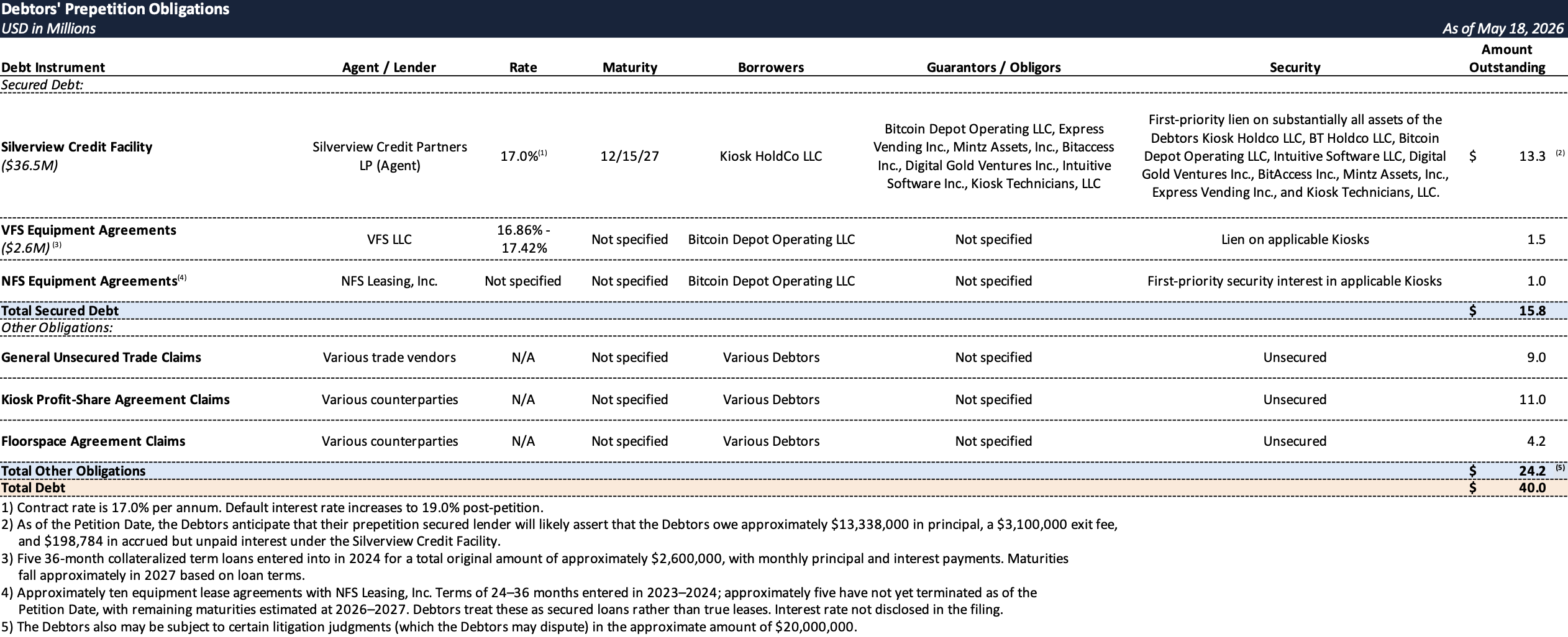
The Company is subject to claims in the approximate amounts of $4.23 million on account of the Floorspace Agreements.
Kiosk Profit Share Agreements
Throughout 2024 and 2025, the Company entered into approximately a dozen Kiosk Profit-Share Agreements with third-party counterparties. Under these arrangements, the counterparty pays the Company an upfront sum consisting of two components: a nonrefundable portion used to purchase the kiosks, and a refundable "float" payment to cover incidental costs, which is returned upon termination of the agreement. In exchange, the counterparty receives a share of the profits generated by the specific kiosks identified in their agreement for a defined period of time. Throughout the arrangement, the Company retains full ownership of the kiosks and remains responsible for their maintenance and servicing.
The Company is subject to claims in the approximate amounts of $10.97 million on account of the Kiosk Profit-Share Agreements.
Prepetition Obligations
Top Unsecured Claims
Events Leading to Bankruptcy
Regulatory Cascade and State Bans
Since 2024, Bitcoin Depot has faced mounting legal and regulatory pressure, including lawsuits and investigations from 11 state agencies alleging that its platforms were exploited by third parties to commit fraud and violate anti-money laundering laws. The Company is also the subject of a voluntary information request by the Securities and Exchange Commission and an investigation by the Federal Trade Commission based on similar allegations. Certain actions from state agencies include:
- Iowa AG Brenna Bird's Feb. 26, 2025 Polk County civil complaint quantifies at least $7.2 million in confirmed scam transactions through its Iowa kiosks.
- Massachusetts AG Andrea Joy Campbell's Feb. 3, 2026 complaint alleges that over 80% of Massachusetts customers spending $10,000+ used the kiosks for scam-related transactions, that almost 60% of Massachusetts revenue was scam-derived, that Bitcoin Depot "knowingly facilitated crypto scams" causing more than $10 million in consumer harm, and that it "deceived investors".
- Connecticut Department of Banking Commissioner Jorge L. Perez's March 9, 2026 order — summarily suspending Bitcoin Depot Operating LLC's money transmission license and issuing a temporary cease-and-desist, restitution and disgorgement orders, and a notice of intent to revoke that license finds fee-cap violations on 1,015 transactions totaling $150,426 in excess fees and refund-statute violations — a partial refund to a documented scam victim who was owed a full one, and two further customers told no refund was available — against a backdrop of seven scam victims detailed in the order.
- Maine Bureau of Consumer Credit Protection reached a $1.9 million settlement agreement with Bitcoin Depot on Jan. 5, 2026 to make payments to Mainers who lost money in scams perpetrated at Bitcoin Depot kiosks throughout the State.
- Missouri AG Catherine Hanaway issued Civil Investigative Demands to five operators Dec. 17, 2025, including Bitcoin Depot Operating LLC.
Indiana, under Governor Braun, became the first U.S. state to ban crypto kiosks entirely on March 9, 2026, with the law also extending liability to property owners under the Indiana Deceptive Consumer Sales Act. Tennessee followed in April 2026, passing a law effective July 1, 2026, that makes operating or even hosting a kiosk a criminal offense — property owners who knowingly allow one on their premises can be charged with a Class A misdemeanor alongside the operators. Minnesota rounded out the trio in May 2026, with Governor Walz signing a ban effective August 1, 2026.
Beyond the outright bans, the broader legislative wave has been sweeping. More than a dozen states enacted virtual-currency-kiosk legislation in 2025 — Arizona, Arkansas, Colorado, Illinois, Iowa, Louisiana, Maine, Maryland, Missouri, Nebraska, North Dakota, Oklahoma, Rhode Island, and Vermont — generally imposing daily transaction caps of roughly $1,000–$2,500 for new customers and up to approximately $10,500 for established ones, fee caps ranging between 3% and 18%, fraud-victim refund rights tied to a defined new-customer window (commonly 72 hours) with claims filed within 14–90 days, and new licensing requirements. Wisconsin, Virginia, Wyoming, and South Dakota added further kiosk-regulation enactments in 2026.
Cash Cloud / BitAccess Arbitration
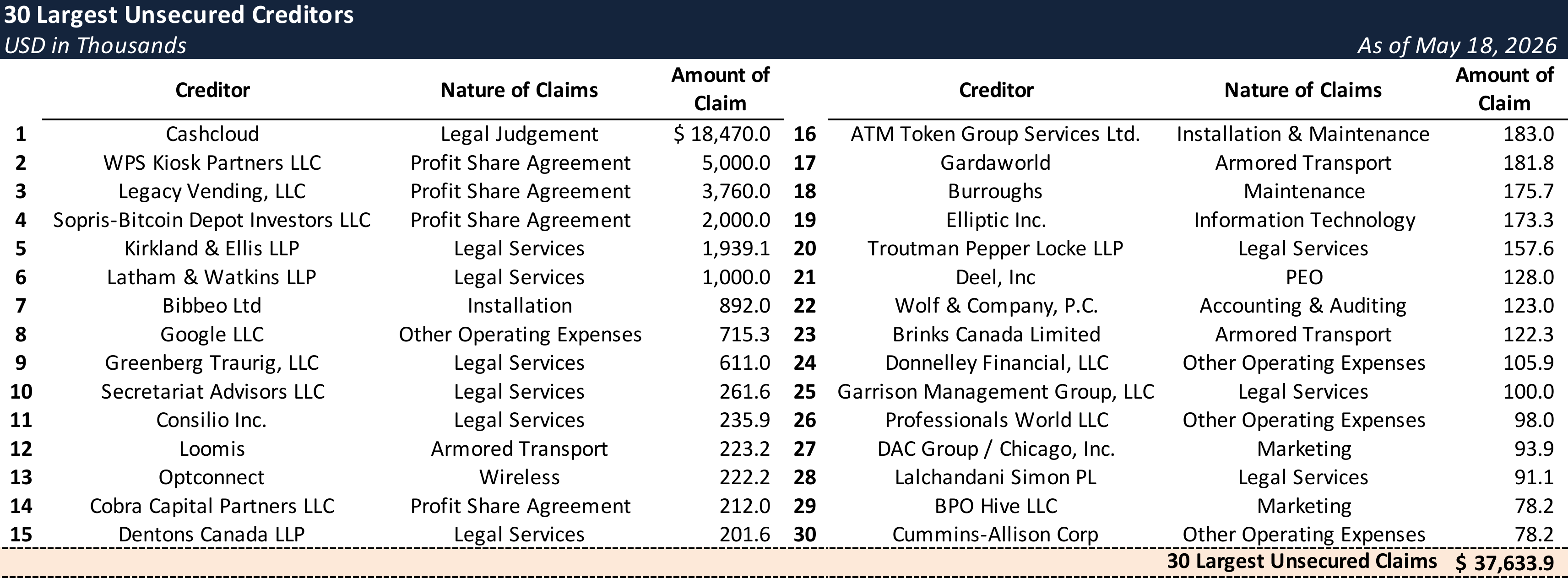
The dispute traces to the January 23, 2020 Master Purchase Agreement, under which BitAccess supplied kiosk hardware and cloud-based software to Cash Cloud's approximately 5,700-kiosk Coin Cloud fleet. The relationship unraveled when BitAccess sent a termination letter on August 4, 2022, threatening to deactivate Cash Cloud's software and permanently delete its stored customer data — prompting Cash Cloud to file for arbitration just twelve days later. The Canadian Arbitration Association conducted hearings in December 2024 and March, April, and October 2025, ultimately awarding Cash Cloud the full $18.5 million in claimed damages shortly before the November 24, 2025 disclosure. Cash Cloud is now listed at face value on the Top 30 List as the single largest unsecured claim.
BitAccess "is seeking to have the award set aside" (8-K) in the Ontario Superior Court (Commercial List) under § 46 of the Ontario Arbitration Act, 1991, S.O. 1991, c. 17. The Supreme Court of Canada trilogy — Sattva (2014 SCC 53), Teal Cedar (2017 SCC 32), Wastech (2021 SCC 7) — applies a deferential reasonableness standard, with set-aside characterized as "a tall order." Estimated set-aside probability is 10–25%.
The $18.5 million award runs against BitAccess — the Canadian subsidiary — rather than Bitcoin Depot as a whole. BitAccess's principal assets are software IP, and because it also guaranteed the Silverview loan, Silverview's claim primes Cash Cloud's in any recovery there. Absent substantive consolidation, which has not yet been sought, Cash Cloud's standalone recovery from BitAccess would be de minimis. If consolidated, its claim represents approximately 29% of the combined unsecured pool.
Compliance Rollouts & Revenue Deterioration
The Board moved to shore up compliance before the petition. In October 2025, Bitcoin Depot implemented a KYC verification process requiring customers to provide identification before transacting at any Kiosk. The compliance system routinely rejected and banned users flagged for suspicious activity, representing approximately 4% of monthly transaction volume. The impact on revenue was severe — the Company swung from net income of $5.4 million in Q4 2024 to a net loss of $24.9 million in Q4 2025, and from net income of $12.2 million in Q1 2025 to a net loss of $9.5 million in Q1 2026. Revenue fell $80.7 million, or 49.2%, year-over-year in Q1 2026.
Leadership Turnover and Goodwin Procter Investigation
In November 2025, the Company announced a leadership transition effective January 1, 2026: Brandon Mintz moved from CEO to Executive Chairman, Scott Buchanan (then COO) was elevated to CEO, and Elizabeth Simer succeeded Buchanan as COO. The new structure unraveled quickly. On February 13, 2026, CLO and Corporate Secretary Christopher Ryan and CCO Philip Brown both resigned, explicitly citing concerns about the Company's compliance practices. Simer resigned on March 11, 2026 with no reason stated, followed by Buchanan, who resigned as CEO and director effective March 23, 2026, and Mintz, who stepped down as Executive Chairman — though he remained on the Board.
On March 23, 2026, the Board appointed Alex Holmes as Chairman and CEO, and rehired Ryan as General Counsel and Corporate Secretary effective March 30, 2026. On April 8, 2026, Anthony "Tony" Gagliardi III was appointed CCO, bringing experience as Global Head of Sanctions at OKX, Director of Compliance Oversight at Paxos, and Global Head of Financial Crimes Compliance Governance at Coinbase. Shortly after joining, Gagliardi raised concerns about the Company's business model and customer composition and resigned pre-petition — the second compliance-related CCO departure within 90 days.
In response to the February 13, 2026 resignations of Ryan and Brown, a special committee of independent directors — Bradley Strock, Daniel Stabile, and Alex Holmes — engaged Goodwin Procter to investigate the Company's compliance practices and identify necessary remedial measures. Goodwin presented its initial findings and recommendations to the committee in April 2026.
Contingency Planning and Going Concern
On May 1, 2026, the Board authorized management and its advisors to begin contingency planning for a potential Chapter 11 filing. Around the same time, management reduced consumer transaction thresholds to further combat third-party fraud, which as anticipated drove revenue down further. The Company also undertook cost-cutting measures, including switching certain Floorspace Agreements from fixed monthly payments to percentage-based payments to reduce expenditures on underperforming Kiosks.
On May 12, 2026, the Company filed a Form 12b-25 (NT 10-Q) and a parallel 8-K announcing it could not timely file the Q1 2026 Form 10-Q, citing an unresolved cash-in-transit reconciliation material weakness. The filings disclosed substantial doubt regarding the Company's ability to continue as a going concern, attributed to state and municipal kiosk regulation/bans, fee caps, transaction-size limits, and the Company's own enhanced KYC measures; and over $20 million of legal judgments accrued in the fourth quarter of 2025, with the Company continuing to allocate substantial resources to ongoing litigation matters.
Prepetition Retention Bonuses
On May 6, 2026, the Company signed retention agreements with CFO David Gray and GC Christopher Ryan, paying lump sums of $600K and $550K respectively by May 8. Both superseded March 30 letters that had scheduled $900K for Gray and $300K for Ryan in three installments over twelve months. The first installments under those original letters had already been paid and were not clawed back, bringing Gray's total pre-petition cash to approximately $900K and Ryan's to approximately $650K. The bonuses vest permanently nine months from May 6 or upon a qualifying change of control.
The payments carry meaningful avoidance risk. Gray and Ryan are statutory insiders, which extends the clawback lookback period from the standard 90 days to a full year for preference claims and two years for fraudulent transfer claims — giving a creditors' committee or trustee a wide window to pursue recovery.
Retention of Advisors and Formation of Restructuring Governance
In April 2026, the Company retained Vinson & Elkins LLP as restructuring counsel and Portage Point as financial advisor to evaluate potential strategic alternatives. On May 13, 2026, Ivona Smith was appointed to the Board as an independent director. The following day, the Board appointed Thomas Studebaker as CRO and formed a Restructuring Committee consisting of Alex Holmes and Ivona Smith, tasked with advising the Board on strategic alternatives and approving conflict matters. Smith was also named sole member of an Investigation Subcommittee, with authority to investigate and evaluate potential estate claims against current or former officers, directors, insiders, or third parties. If viable claims are identified, the Debtors expect to establish a litigation trust through the Chapter 11 process for the benefit of creditors.
Path Forward and 363 Sale Strategy
The Company resolved to take its BTMs offline and pause most operations to focus on asset monetization through the Chapter 11 process. At the May 19, 2026 First-Day Hearing, debtors' counsel said the Debtors would run a sale-and-plan process in tandem, targeting confirmation of a Chapter 11 liquidating plan within 45–60 days; a bidding-and-sale-procedures motion is to be filed within days and heard on emergency notice, and counsel said the Debtors intended to engage an investment banker, none having been retained as of the hearing. The Silverview Credit Facility is expected to be paid in full; the entered Interim Cash Collateral Order requires the Debtors to deposit and segregate $17.2M — the alleged amount of the Term Loan claim — into an Adequate Protection Account at People First Bank. No bid procedures motion or stalking horse existed as of the First-Day Hearing, and the cash collateral order fixes a Final Hearing no later than the week of June 22, 2026. A separate first-day order extended the deadline for the Schedules of Assets and Liabilities and Statements of Financial Affairs to June 30, 2026. By final order entered May 19, 2026, Bitcoin Depot Inc. is authorized under § 1505 to serve as Foreign Representative for Canadian CCAA recognition, a Part IV proceeding in the Ontario Superior Court of Justice, Commercial List; no other foreign proceedings are contemplated.
- The most probable sale structure is an asset-by-asset sale. Taking the kiosks offline eliminated any going-concern value for the combined business, and a credible buyer is unlikely to acquire the entire enterprise given the active state AG litigation, a customer database that triggers mandatory Privacy Ombudsman requirements, approximately $15 million in floorspace and profit-share claims, and over $20 million in contingent (and disputed) litigation liabilities. The assets will most likely be marketed in discrete buckets: kiosk routes sold on a state-by-state or regional basis, BitAccess software and IP, the Kutt platform, the ReadyBucks collection book, BDCheckout retail integrations, the BD App, and the customer database.
Cash Collateral Budget
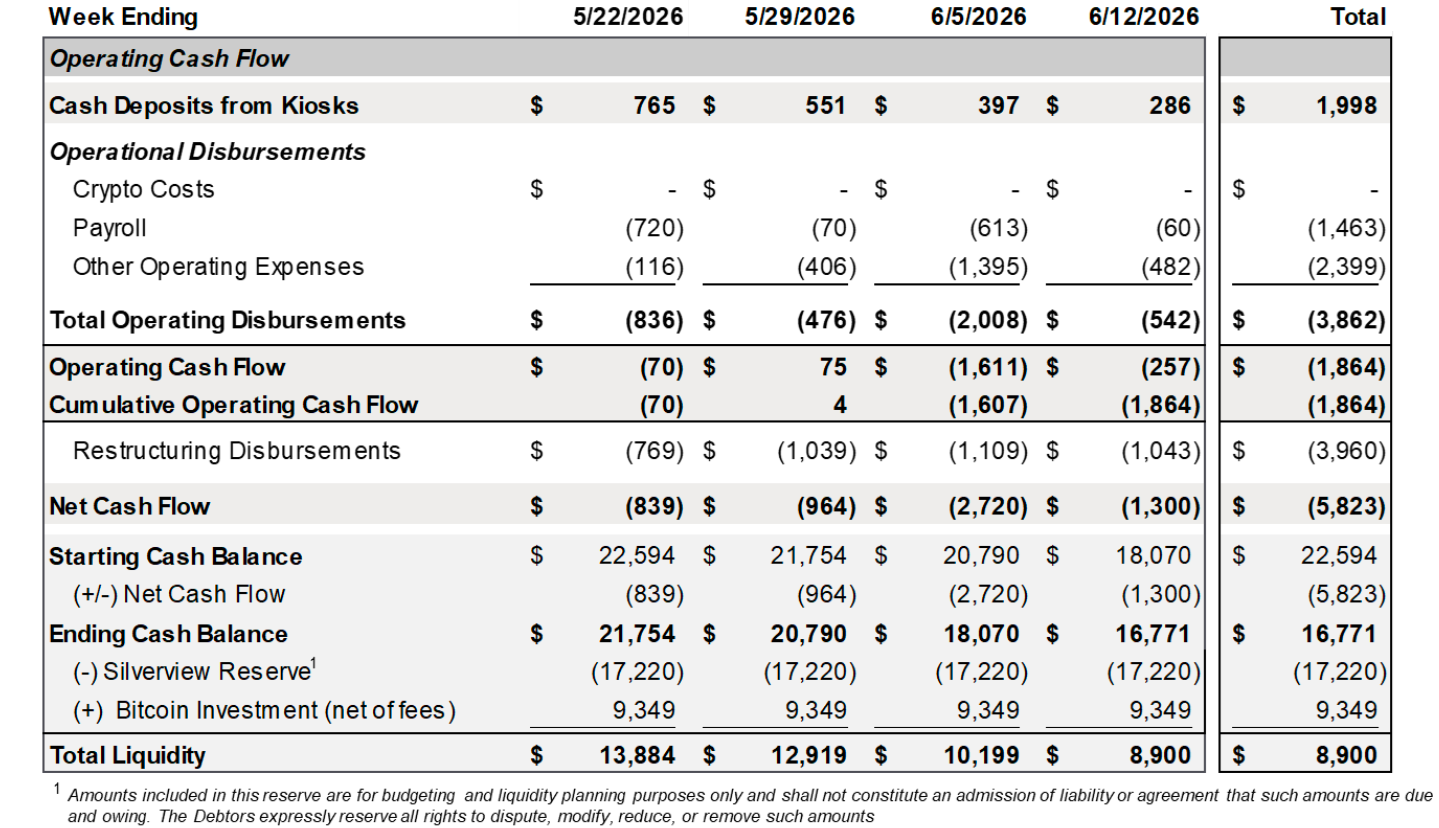
The Debtors entered Chapter 11 with $22.6 million in cash, enough to fund the case without a DIP loan. The case is running on cash collateral, and the Interim Cash Collateral Order entered May 19, 2026 is notably favorable to the Debtors. It contains no DIP facility, no Debtor stipulations as to the validity, perfection, or amount of Silverview's claim during the interim period, and no waivers of the estate's surcharge, equitable subordination, or marshaling rights. There are also no sale-process milestones imposed on the Debtors. Critically, avoidance actions and foreign equity interests are excluded from Silverview's adequate protection collateral entirely, preserving those assets for the benefit of unsecured creditors.
The interim order does impose a formal challenge regime with two separate windows. The Debtors' Challenge Period runs to the later of 30 days after entry (on or about June 18, 2026) or the Final Hearing. A separate 75-day challenge period for non-Debtors and any creditors' committee runs to the earlier of plan confirmation or 75 days after entry, falling on or about August 2, 2026. Once the Debtors' Challenge Period expires, the Debtors must enter customary stipulations as to the priority, validity, extent, and amount of the Silverview term loan debt, liens, and collateral — subject to any pending Debtor challenge and the non-Debtor period — and any unasserted challenge is forever waived, released, and barred. That window is the primary vehicle for any committee challenge to Silverview's $3.1 million exit fee. Adequate protection consists of a $17.2 million segregated reserve held at People First Bank, capped replacement liens, superpriority claims, and a $100,000 cap on Silverview's professional fees during the interim period.
Explore Bondoro Insights for live case dockets and comprehensive coverage of material filings from petition to plan confirmation.
Stay informed on every Chapter 11 bankruptcy case with liabilities exceeding $10 million. Subscribe for free to have our coverage delivered directly to your inbox, and explore our full archive of past summaries.
Subscribers can also opt in to timely filing alerts by updating their email preferences in Account Settings.


