Case Summary: 777 Partners Chapter 11
777 Partners, 600 Partners and affiliates filed for Chapter 11 after a two-year wind-down of their investment platform, amid lender fraud litigation, SEC and criminal proceedings, and an involuntary petition. The Debtors are seeking a $24.95 million DIP facility from existing lenders.

A deck version of this summary is also available HERE.
Business Description
Signal National LLC ("Signal National"), 777 Partners LLC ("777 Partners"), 600 Partners LLC ("600 Partners") and twenty affiliates (collectively, the "Debtors") are the residual of the specialty-finance and investment enterprise assembled by Joshua Wander and Steven Pasko. Formed as a Delaware limited liability company in 2015, 777 Partners is owned by Wander and Pasko through JARM Capital LLC and MTCP LLC, which hold interests in its direct parent, SuttonPark Acquisition LLC. 600 Partners, an affiliated Delaware holding company formed in 2017, is owned by Pasko through MTCP LLC and SPA II LLC. Fifteen of the Debtors, Signal National among them, sit beneath 777 Partners and six beneath 600 Partners. The Debtors historically maintained principal offices in Miami, but their operations have been directed from Dallas for the past two years. Signal National, the lead case, is a Texas limited liability company organized in February 2026 to consolidate administrative functions including payroll and employee benefits.
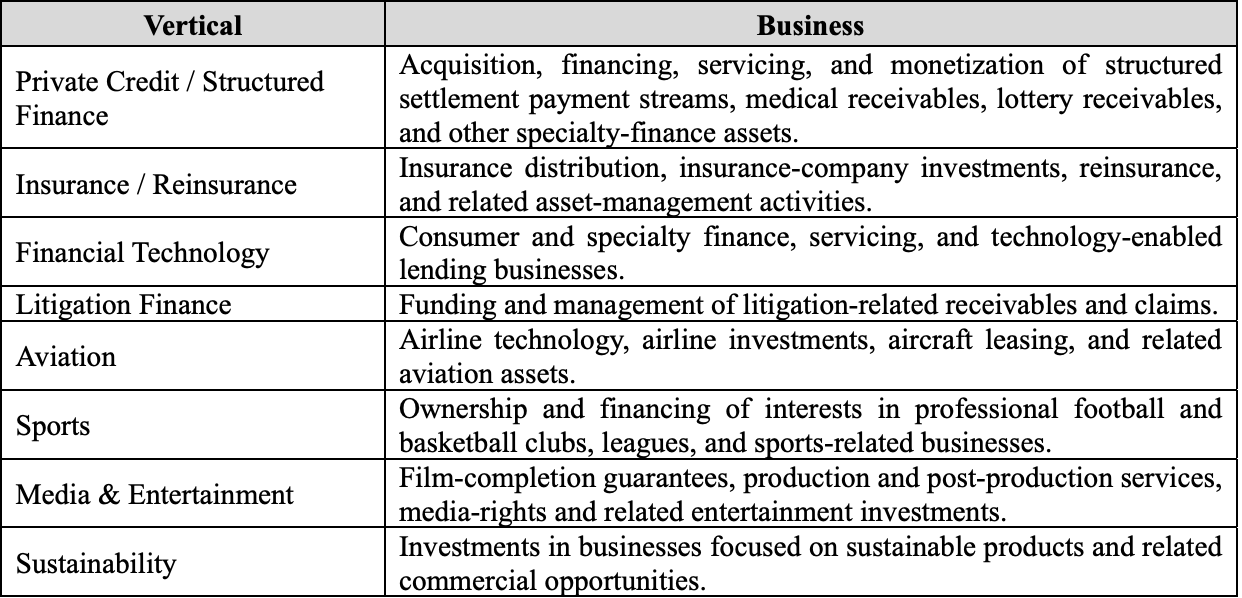
The business traces to structured-settlement and receivables finance: the enterprise's original operations underwrote and financed structured-settlement portfolios and other non-traditional receivables, including medical-lien receivables, structured-settlement payment streams and annuity-backed receivables. Beginning around 2018, it expanded into consumer and commercial finance, insurance distribution, insurance and reinsurance, litigation finance, aviation and airlines, media and entertainment, sustainability, and ownership interests in professional sports clubs and leagues, operating through a network of subsidiaries, special-purpose vehicles and portfolio companies across the United States, Canada, Europe, South America, Australia and the Caribbean. According to the First Day Declaration, at its peak in 2023, the 777 Partners and 600 Partners enterprise had invested more than $10 billion in assets and was a major employer worldwide.
These Chapter 11 cases formalize a restructuring already two years old. Since May 2024, the enterprise has been winding down out of court under the direction of independent restructuring professionals, though certain subsidiaries were placed into insolvency or administration proceedings in other jurisdictions. Most of the portfolio has since been sold or surrendered, in several cases by senior secured lenders exercising remedies against already-pledged collateral.
On July 16, 2026, three Vida funds — creditors holding a $26 million New York judgment against 777 Partners and three affiliates — filed an involuntary Chapter 7 petition against 777 Partners in the U.S. Bankruptcy Court for the Southern District of Florida, accelerating the commencement of these Chapter 11 cases.
Signal National and certain affiliates⁽¹⁾ filed for Chapter 11 protection on August 9, 2026 (the "Petition Date") in the U.S. Bankruptcy Court for the Northern District of Texas, Fort Worth Division, reporting $100 thousand to $500 thousand in assets and $1 million to $10 million (with affiliates reporting liabilities of up to $1 billion to $10 billion) in liabilities.
⁽¹⁾ Twenty-three Debtors filed in this first wave; a listing of the Debtors and their ultimate parent (777 Partners or 600 Partners) is attached as Exhibit A to the First Day Declaration. The Debtors state that additional affiliates are expected to file their own Chapter 11 petitions within approximately sixty days.
Corporate History
Founding and Original Business (2015 – 2017)
Joshua Wander and Steven Pasko founded 777 Partners in September 2015 as a Delaware limited liability company and private investment company headquartered in Miami, later operating from three locations — Miami, London and New York. Its original business was purchasing and financing structured-settlement payment streams, medical-lien receivables and annuity-backed receivables. In 2017, Pasko formed 600 Partners, whose business lines overlapped several of 777 Partners'.
Expansion (2018 – 2023)
Beginning in 2018 and accelerating through 2023, the firm expanded well beyond receivables finance into soccer, basketball, aviation and media, assembling the portfolio across the United States, Canada, Europe, South America and Australia that would later define its collapse.
- Soccer — The firm's first soccer investment was a minority stake in Sevilla FC, a Spanish La Liga club, purchased in 2018. In September 2021, the company acquired Italian Serie A Club Genoa CFC for an estimated €150 million. In 2022, 777 Partners acquired 4 teams - (i) Brazilian CR Vasco da Gama in February for R$700 million - the largest transaction in Brazillian soccer history, (ii) Belgian Standard Liège for €55 million in March, (iii) French Red Star FC in April, and (iv) a minority stake in Australian Melbourne Victory for AU$8.7 million in October. In March 2023, 777 Partners acquired a 65% stake in Germany's Hertha BSC club from long term majority owner Lars Windhorst. In September 2023, 777 agreed to buy English Premier League's Everton FC.
- Basketball — In 2019 the firm bought the London Lions, London's only men's professional basketball team, and subsequently invested £7 million for 45% of the British Basketball League, then the country's top-tier competition.
- Aviation — In 2019, 777 Partners acquired a 25% stake in Canadian low-cost Flair Airlines. In October 2021, 777 became the inaugural investor and backer of Bonza, an Australian low-cost carrier founded that month by former Virgin Blue executive Tim Jordan, owning the airline from inception.
- Media — The firm invested in STX Entertainment, a Burbank, CA based global film studio whose credits include Molly's Game and The Irishman, in 2022.
Distress Emerges
Beginning in 2023 and through the first half of 2024, strain was showing across the portfolio:
- Everton FC (Premier League, England) — As mentioned previously, in September 2023, 777 agreed to buy Farhad Moshiri's 94.1% stake in Everton FC, subject to Premier League approval. By April 2024 the deal remained unclosed; the club engaged insolvency advisers and the Everton Shareholders' Association wrote to Moshiri asking him to terminate. The deadline expired on June 1, 2024 with the transaction never completed.
- Flair Airlines (Canada) — Airborne Capital seized four leased Boeing aircraft operated by Flair in March 2023 over alleged non-payment. By January 2024, lessors had filed claims in the UK High Court for costs, with $1.8 million reported outstanding on the four aircraft when notice of default was served.
- Standard Liège (Belgium) — In December 2023, Belgian authorities imposed an indefinite transfer ban over alleged delays in paying taxes, salaries and transfer fees. In May 2024, Bruno Venanzi — from whom 777 had bought the club — demanded seizure of 777's Belgian assets over alleged non-payment, and a court authorized it.
- Bonza (Australia) — The airline entered voluntary administration in April 2024. Its administrators later stated that funding provided by 777 was insufficient for the level of debt incurred, which had continued to increase particularly from November 2023.
Management Transition, Creditor Control and Divestitures
Wander and Pasko resigned as managers on May 6, 2024 while remaining owners. The First Day Declaration identifies their replacements as GlassRatner Advisory & Capital Group LLC, engaged that month, with Ian Ratner and Ronald Glass appointed independent managers and Mark Shapiro as chief operating officer. Also in May 2024, Advantage Capital Holdings LLC ("A-CAP"), a prepetition lender, engaged Moelis & Company to review the portfolio, and British Basketball moved to terminate the license of the British Basketball League's operating company over financing concerns.
In July 2024, A-CAP wrote to the soccer clubs stating that it had assumed ownership stakes. The disposals began soon after and ran through the following year, club by club.
- Belgium's Standard Liège went up for sale in September 2024 and transferred to Giacomo Angelini in June 2025, alongside a €28.7 million capital increase.
- Italy's Genoa CFC's board announced in December 2024 that Dan Șucu had acquired 77% for €45 million; A-CAP stated the next day that it still owned the club, while the board maintained the sale was final.
- Germany's Hertha BSC went unsold at a New York auction of 777's pledged assets in June 2025. No bids were received, and A-CAP subsidiary ACM Delegate LLC took the collateral on a credit bid — converting the debt owed to A-CAP into outright ownership of stakes it had until then only controlled. Exhibit B to the First Day Declaration records the corresponding disposition of Nutmeg Acquisition LLC's equity that month in satisfaction of $157 million.
- The London Lions were sold to Tesonet in August 2024 by administrators, following British Basketball's revocation of the British Basketball League operator's license.
- Canadian Flair Airlines 777's holding fall to 10% by August 2024, and its involvement described as principally that of a lender.
Operations Overview
777 Partners and 600 Partners functioned less as operating companies than as a capital-allocation, financing, shared-services and holding platform layered above hundreds of subsidiaries, special-purpose entities and portfolio holding companies. Brickell Insurance Holdings LLC, a separate non-Debtor holding company, was the platform for the enterprise's insurance and reinsurance investments, and the funding model ran through A-CAP-affiliated insurance capital.
Historical Business Verticals
Structured Receivables and the Servicing Platform
The Company's earliest and most significant operations were in structured finance, and they remain the source of most of its going-concern value. Special-purpose entities originated, purchased, financed and serviced structured-settlement payment streams, lottery receivables, medical and healthcare-provider receivables and insurance-commission receivables, funded through asset-backed lending facilities and securitization vehicles with borrowing bases tied to the value of eligible receivables. Many of those borrowing entities are not themselves Debtors, so much of the collateral sits outside these estates. The assets self-liquidate as the underlying payment streams are collected over a period of years.
The model depends not on asset ownership but on continuous servicing — tracking legal payment rights, reconciling collections, identifying the correct owner or secured party, and distributing cash through the appropriate lender waterfall. A portfolio can be economically sound in isolation and still generate severe creditor problems where two lenders each believe they hold first-priority rights in the same payment stream.
The remaining verticals were held through holding entities, in each case with the underlying operating businesses sitting below the Debtor level:
- Consumer and Commercial Finance — Through Debtor F3EA Holdings LLC and its subsidiaries, including Debtors F3EA Capital LLC, F3EA Servicing LLC, Employee Funding of America, LLC and Tactical Marketing Partners LLC, the Company originated and serviced consumer and commercial finance receivables, including consumer installment loans and related lending products marketed through a network of merchant and lead-generation channels.
- Litigation Finance and Legal Services — Through Debtor Lex Capital Holdings LLC and non-Debtor Scout Law Group Holdings LLC, the Company held interests in a vertical that originated and acquired litigation-related receivables and funded claims through platforms operated under the JusticeFunds business.
- Aviation — Through Debtors Phoenicia LLC and Daedalus I LLC, the Company held its aviation investments, comprising both aviation-technology platforms and airline investments, including a minority interest in Flair Airlines in Canada and the start-up Australian carrier Bonza.
- Media and Entertainment — Through Debtors Lumiere Financing LLC and Lumiere Acquisitions Company LLC, the Company held its interest in the Film Finances business, a film completion-guarantee and production-services enterprise.
- Insurance Distribution — Through Debtor Thresher Acquisition LLC, the Company held interests in entities related to an insurance-distribution and technology platform that marketed and administered life and annuity insurance products.
777 Re and The Funding Mechanism
777 Re Ltd. was a Bermuda Class E long-term reinsurer, 98% owned by Brickell Insurance Holdings LLC, which was itself a consolidated subsidiary of 777 Partners. Its business was assuming life and annuity liabilities from other insurers — long-dated obligations, and with them the assets set aside to pay them.
Those assets never moved. Every treaty was written on a funds-withheld basis, meaning the ceding insurer kept the supporting assets in an account it continued to own, and 777 Re booked a receivable measured against that account. The effect on its balance sheet was stark: at December 31, 2022, $2.98 billion of $3.0 billion in total assets — 98.3% — was that single receivable. Direct investments came to $43.8 million. The reinsurer's balance sheet was a claim on somebody else's account.
What made the structure a funding engine was who chose the investments inside that account. 777 Asset Management LLC — a 777 Partners subsidiary and one of the Debtors in these cases — held investment management agreements directly with the ceding insurers covering the funds-withheld accounts backing the treaties. So the entity deciding where the cedants' money went sat inside the same enterprise as the reinsurer holding the claim against it, and as the companies that money was lent to. Related-party exposure inside and alongside the receivable totalled $1.5 billion at year-end 2022, including $232.7 million to Triple 7 Finance Leasing, $103.0 million to Nutmeg Acquisition LLC, the vehicle holding the football clubs, and $58.1 million to Flair Airlines, alongside positions in the structured-settlement vehicles, Film Finances, Employee Funding of America and STX Financing. Annuity assets went in one end; loans to airlines, football clubs and a film studio came out the other.
The arrangement held only so long as the ceding insurers stayed in it. Recapture is neither a default nor a claim: a cedant simply terminates the cession and takes back its liabilities and, with them, the assets in the withheld account. Where half of that account consists of loans to the sponsor's own companies, that becomes a problem — the reinsurer must either return those loans at the values carried on its books or fund the difference in cash.
Debtor Prepetition Obligations
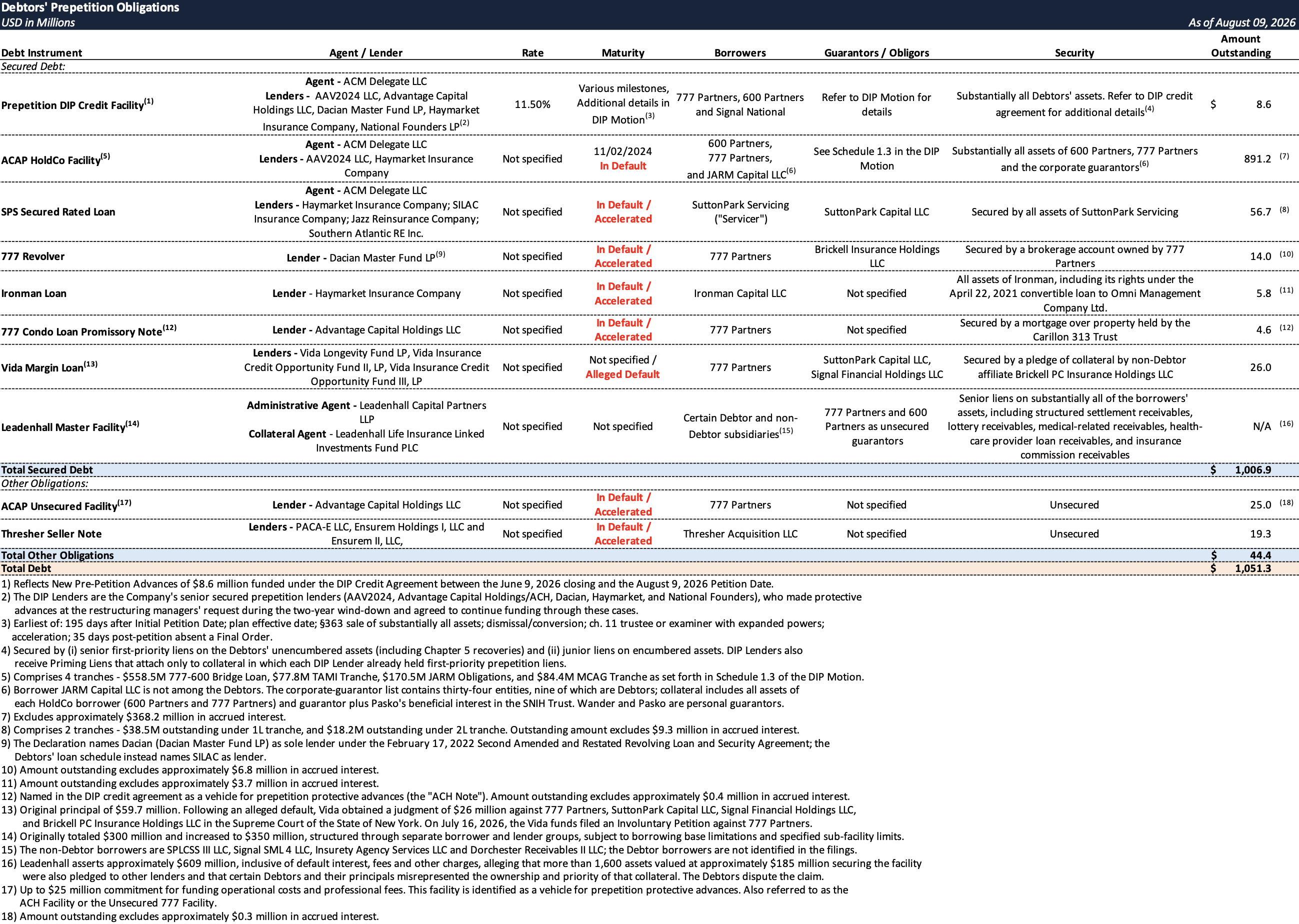
The table below presents the Debtors' prepetition obligations on an obligor basis — facilities under which at least one Debtor is a borrower or direct obligor. It therefore differs from the summary of prepetition capital structure in the First Day Declaration, which is organized by facility and reports approximately $2.71 billion across twelve facilities. The $5.8 million Ironman Loan in the cap table below appears in the schedule of prepetition obligations attached to the DIP Motion but not in the First Day Declaration.
The Debtors state that the amounts reported in the Declaration are estimated and subject to reconciliation, and should not be construed as an admission of any balance owed. Amounts sourced from the schedule of prepetition indebtedness attached to the DIP credit agreement are stated as of June 30, 2026 and are subject to revision by the DIP Lenders.
Three of the prepetition facilities listed in the First Day Declaration are excluded because no Debtor is a borrower under them. In each case the Debtors' exposure runs through a guaranty, a pledge, litigation, or — in the case of the EFOA Loan — a receivable rather than an obligation.
- The $1.19 billion Knightsbridge (National Founders) Facility — Borrowed by non-Debtor Volans 2018 LLC, a subsidiary of Debtor SuttonPark Capital LLC, with National Founders LP as administrative agent and initial lender. 777 Partners and 600 Partners guarantee alongside seven non-Debtor special purpose entities, and SuttonPark Capital has pledged the borrower's equity, with the collateral package extending to all assets of the borrower and each guarantor and cross-collateralized with a related $162.9 million repurchase facility that the same three Debtors guarantee. The facility is in default but has not been accelerated.
- The $28 million ING Capital Facility — Sierra 2016, LLC, a non-Debtor special purpose entity, is the borrower under a credit agreement with ING Capital LLC as sole lender and administrative agent, secured by a first-priority lien on substantially all of the borrower's assets. The claim against the Debtors arises instead from litigation: ING alleges that 777 Partners, 600 Partners, Wander, Pasko and others defrauded it by pledging more than $28 million in assets the borrower did not own, a claim the Debtors dispute. The procedural history is described under Material and Pending Litigation below.
- The $76.4 million EFOA Loan — Under an April 26, 2019 credit agreement, Debtor Employee Funding of America, LLC ("EFOA") lent on a secured basis to six non-Debtor law firm entities affiliated with Martin Phipps. EFOA is the lender under that facility, so the reported balance is a receivable owed to the estate. EFOA sold participations in those loans to Haymarket Insurance Company ("Haymarket") in February 2020 and February 2023, pledging all of its right, title and interest in the loans and their proceeds. On February 16, 2024, 777 Partners and 600 Partners entered into a Payment of Guaranteed Return Agreement in favor of Haymarket, secured by all personal property of each obligor. The Debtors report the loan at $76.4 million and the guaranteed-return obligation at $74.4 million of principal and accrued interest.
Non-Debtor Prepetition Obligations
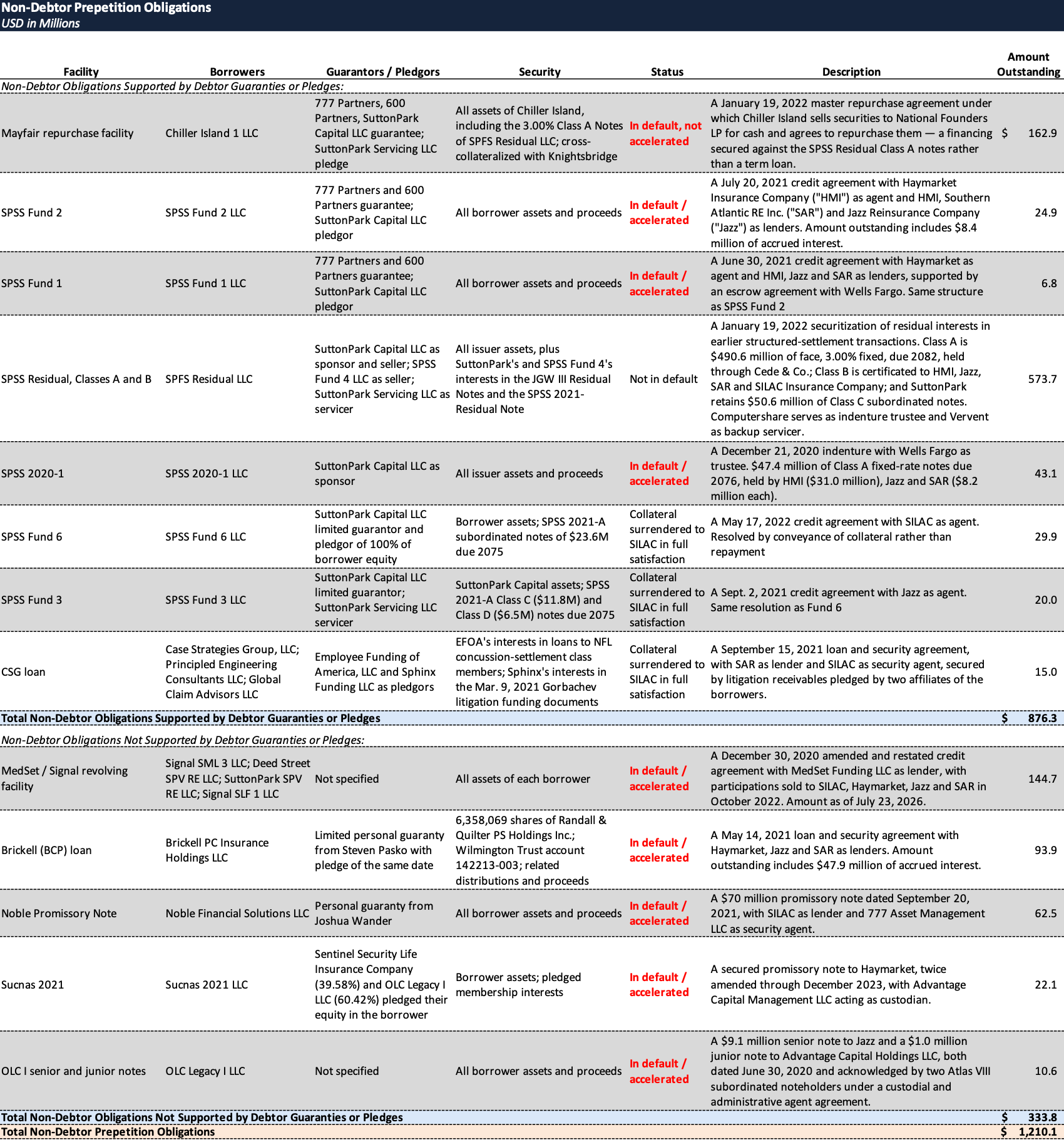
Schedule 1.3 in the DIP motion also lists out other non-Debtor obligations, which are summarized in the table below. Excluding SPSS Fund 6, SPSS Fund 3 and the CSG loan — each of which was reported as having been resolved by surrender of collateral in full satisfaction — the total obligations at the Non-Debtor level is approximately $1.145 billion, inclusive of principal and accrued interest.
Top Unsecured Claims
Material and Pending Litigation
Litigation with Leadenhall
- The Parties — Leadenhall is a London-based asset manager specializing in insurance-linked investments, acting with its Irish fund affiliate as agent for nine lender funds. Debtors 777 Partners and 600 Partners are defendants as guarantors of the facility, alongside Wander and Pasko. A-CAP, controlled by Kenneth King, is 777's largest creditor and, Leadenhall alleges, its de facto controller.
- The Leadenhall Facility — A May 7, 2021 Loan and Security Agreement funded four special-purpose borrowers — SPLCSS III, Dorchester Receivables II, Signal SML 4 and Insurety Agency Services — each pledging first-priority interests in all of its assets. Sub-facility limits totaled $300.0 million, later raised to $350.0 million. Two features drive everything that follows. First, it was a borrowing base facility: each borrower could draw only up to a limit derived from the receivables it owned, and an uncured shortfall was an event of default. Second, the collateral had to be owned free and clear, a representation renewed on signing, on every draw, and in every monthly Compliance Report. 777 Partners and 600 Partners guaranteed the debt as unsecured guarantors, so Leadenhall held no lien on the parents. Their guaranty is conditional on a "Trigger Event" having occurred and continuing, and by its terms the SuttonPark and Dorchester exposure is guaranteed in full while the Insurety and Signal exposure is subject to unspecified "Guaranty Limits." The agreement also obligated each borrower to maintain interest-rate protection through hedge transactions with qualifying counterparties.
- The Reporting — Monthly Compliance Reports itemized every pledged asset and calculated the borrowing base. Allocation was tracked in a proprietary system called MP Fin, which assigned each receivable a file number and recorded the borrower it belonged to. Two employees, Nicholas Bennett and Alexander Adnani, prepared the reports; Leadenhall alleges they did so at Wander's direct instruction, communicating in person or by FaceTime to avoid a paper trail.
- The Anonymous Tip — On September 19, 2022, Leadenhall managing partner Craig Gillespie received an anonymous email stating that the assets did not exist — that Wander had either never bought them or already pledged them elsewhere — and calling the conduct criminal. Leadenhall exercised its audit rights, and in November 2022 Gillespie, CFO Chris Learmonth and vice president Tom Foot visited 777's Miami offices and inspected MP Fin directly. With tens of thousands of assets in the system, only a spot check was possible; it turned up roughly $7.0 million misallocated at Dorchester, which 777 characterized as the extent of the problem. That proved wrong. In March 2023, another 777 lender, Credigy, sent Leadenhall its own collateral inventory and asked for confirmation of no overlap. More than 1,600 receivables worth roughly $185.0 million appeared on both lenders' books. By late 2023 Leadenhall had concluded that the borrowers had additionally pledged assets they never purchased at all, and had sold collateral without paying down principal. A November 29, 2023 Notice of Breach calculated deficiencies of roughly $310.0 million at SPLCSS III and $41.0 million at Dorchester Receivables II.
- The Falsified Screenshots — The November 2022 Compliance Report showed roughly $4.3 million in the SPLCSS III collection account and $4.6 million in its reserve account. As backup, the borrower sent screenshots purporting to be Wells Fargo statements showing exactly those balances. The actual monthly statements later showed roughly $0.3 million in the collection account and nothing at all in the reserve. An insider told Leadenhall in early 2024 that statements had been photoshopped and that MP Fin records were altered ahead of the November 2022 meetings.
- Acceleration — A December 2023 amendment imposed additional interest on the "uncollateralized portion" of the debt retroactive to March 2023. Revised reports issued the following month restated the March 2023 SPLCSS III borrowing base from roughly $188.0 million down to $64.0 million, against $350.0 million outstanding at that borrower alone. A February 2024 agreement to repay $26.0 million produced only half on time, and Leadenhall was later told A-CAP had funded 777's payroll that same day. Leadenhall declared default on March 12, 2024, and on March 15 accelerated across all four borrowers, making the entire outstanding balance immediately due at $609.5 million. Forbearance talks collapsed over the following weeks, with Wander unable to produce even $15.0 million against that figure and stating that A-CAP would default 777's holding-company loan if 777 signed anything without A-CAP's consent.
- New York Action — Leadenhall sued on May 3, 2024 (Leadenhall Capital Partners LLP v. Wander, No. 24-cv-3453 (S.D.N.Y.)). The operative amended complaint names fourteen defendants, including Wander, Pasko, King and A-CAP, and pleads twelve claims: breaches of the loan, sale, servicing and guaranty agreements; civil RICO and RICO conspiracy; fraud, conspiracy and aiding and abetting; unjust enrichment; and actual and constructive fraudulent transfer.
- The Fraudulent Transfer Claims — In December 2020, A-CAP affiliate Haymarket lent roughly $170.0 million to JARM Capital — Wander's personal vehicle — to fund his buyout of Pasko and early shareholders, secured by Wander's own assets. On March 4, 2024, a month before suit, King notified Leadenhall that the JARM security interests would be "consolidated into the HoldCo facility." The obligation moved onto 777 Partners, backed by a claimed first lien on 777's own assets, without consideration. Leadenhall characterizes this as an "up-tiering" transaction that converted a near-worthless equity pledge into a $170.0 million holdco debt ranking ahead of its guaranty claim, and asks that both the obligation and the lien be voided.
- The Second Circuit — Leadenhall obtained a TRO on June 7, 2024, converted to a preliminary injunction on July 8, freezing both borrower collateral and the guarantors' assets. On March 23, 2026, the Second Circuit vacated it as to the guarantors, holding that the district court lacked authority to freeze 777's and 600's property because Leadenhall asserted no lien on or equitable interest in it — the rule of Grupo Mexicano v. Alliance Bond Fund, which generally bars prejudgment freezes on unencumbered assets in damages suits. Restraints on borrower collateral survived. The companies intend to pursue the injunction bond for damages from the twenty-one months the freeze was in place.
- The $1 Foreclosures — In May 2025, Leadenhall foreclosed under Article 9 on three of the four borrowers — Signal SML 4, SPLCSS III and Dorchester, leaving Insurety untouched — credit bidding $1 per pool for portfolios it had itself valued at more than $170.0 million. Under the UCC, a secured party must dispose of collateral in a commercially reasonable manner, and the price obtained sets the deficiency the guarantors owe. The companies contend the sales failed that standard and were engineered to inflate Leadenhall's guaranty claims, and on February 5, 2026 filed a verified amended complaint in New York state court seeking a declaration of no deficiency liability. Separately, Leadenhall exercised rights under the facility to appoint independent managers at each borrower: Insurety in December 2024, and SPLCSS III, Signal SML 4 and Dorchester in December 2025.
The Enforcement Wave
The SEC sued Wander, Pasko, 777 Partners, 600 Partners and former CFO Damien Alfalla on October 16, 2025 in the Southern District of New York. The complaint alleges that between January 2021 and May 2024 the defendants misled investors about the companies' financial condition and fraudulently induced investments in a $237 million preferred equity offering, raised from thirteen investors, by representing that the businesses were earning and would continue to earn net income sufficient to support a 10% annual dividend. Central to the allegations is the misuse of a credit facility that produced a $300 million overdraw — the borrowers being subsidiaries of SuttonPark Capital LLC, 600 Partners' largest subsidiary — which the complaint says Wander and Alfalla concealed from investors. The SEC seeks injunctive relief, disgorgement with prejudgment interest and civil penalties. Wander's motion to dismiss remains pending.
An indictment unsealed the same day charged Wander with conspiracy to commit wire fraud, wire fraud, conspiracy to commit securities fraud and securities fraud, arising from an alleged scheme to defraud 777 Partners' lenders and investors of more than $500 million. Prosecutors allege that Wander directed restricted lender funds toward acquisitions in breach of the credit facility terms, then concealed the resulting shortfalls by pledging more than $350 million of assets as collateral that 777 Partners either did not own or had already pledged to other lenders, and by directing employees to digitally alter bank statements to show cash the firm did not hold. Alfalla was charged on the same four counts and pleaded guilty to an information on October 14, 2025.
ING Capital Litigation
As stated previously in the Prepetition Obligations section, ING Capital sued 777 Partners, 600 Partners, Wander, Pasko and others in the Southern District of New York in October 2024, alleging that the Debtors defrauded it by pledging more than $28 million in assets the borrower did not own. That action was voluntarily dismissed for lack of subject matter jurisdiction, and ING Capital refiled a substantially similar complaint in the Circuit Court for Miami-Dade County, Florida on January 27, 2025. The United States moved on May 20, 2026 to intervene and stay the case pending Wander's criminal trial, and the court granted the stay on June 1. ING Capital sought reconsideration the following day on the ground that the order had issued before its opposition was due; at an August 6, 2026 hearing the court reconsidered and is allowing expert discovery to proceed. No trial date has been set.
The Vida Judgment and the Involuntary Petition
777 Partners borrowed approximately $59.7 million under an amended and restated margin loan agreement dated July 14, 2020, secured by a pledge from non-Debtor Brickell PC Insurance Holdings LLC and guaranteed by SuttonPark Capital LLC and Signal Financial Holdings LLC. Following an alleged default, the Vida funds sued in the Supreme Court of the State of New York, New York County. On July 13, 2026 the parties consented to an amended judgment of $26 million, entered without trial or adjudication of any issue of fact or law and allocated among the three funds in proportion to their holdings under the margin loan agreement; the plaintiffs agreed to discontinue the action on execution.
Three days later, on July 16, 2026, Vida Longevity Fund, LP, Vida Insurance Credit Opportunity Fund II, LP and Vida Insurance Credit Opportunity Fund III, LP filed an involuntary Chapter 7 petition against 777 Partners in the Bankruptcy Court for the Southern District of Florida.
The Debtors state that they had been planning a coordinated Chapter 11 filing on a longer timeline, that Vida declined to work toward a consensual resolution, and that the involuntary petition accelerated the commencement of these cases. They do not intend to contest entry of an order for relief in Florida, and will seek to convert that case to Chapter 11 and transfer venue to this Court — a step the DIP credit agreement requires as a milestone.
Other Events Leading to Bankruptcy
The Liquidity Mismatch and the Collateral Problem
According to the First Day Declaration, beginning in 2022, sharply rising interest rates increased the cost of financing and affected the valuation and economics of a number of rate-sensitive assets and financing structures. At the same time, the aviation and professional sports investments were operating through the extended effects of the COVID-19 pandemic, which had materially disrupted both industries. Together these pressures increased the liquidity required to support certain portfolio companies and reduced the availability and attractiveness of external financing.
Separately, issues emerged by 2022 concerning the ownership, eligibility, valuation and allocation of receivables supporting certain specialty-finance facilities — including instances in which assets were reported as collateral under more than one facility, or were not available to the borrower in the manner reflected in lender reporting. The Debtors state that later forensic work has shown these issues predated the 2024 management transition, and that they created disputes among 777-related entities and their lenders and materially complicated the Company's financing position.
The Regulatory Unwind of 777 Re
The reinsurance platform came under pressure from two directions in the same month. On November 8, 2023, AM Best downgraded 777 Re's financial strength rating to B from A- and its issuer credit rating to "bb" from "a-", putting both under review with negative implications. The agency pointed to a sharp fall in the reinsurer's risk-adjusted capital, driven by how much of its portfolio sat in assets originated by 777 Partners, and said its concerns were compounded by uncertainty about the parent's finances, since 777 Partners had not produced audited accounts in two years. Any upgrade, it said, would depend on the reinsurer divesting most of those affiliated holdings.
The Bermuda Monetary Authority was moving at the same time. That month it imposed a series of regulatory requirements on 777 Re, citing serious concerns about its governance, risk management and decision-making, and its inability to secure enough capital and liquidity from its parent. Among other things, the board was reconstituted. On November 20 the regulator went further, appointing an investigator to examine the company and report back.
The Authority then issued urgent directions. It had concluded that the reinsurer's investments in affiliated assets breached the prudent person principle, that weak governance and imprudent conduct put it in breach of the criteria for holding a licence, and that it had missed its capital requirements because the parent failed to make contributions it had committed to — none of it, the regulator said, in policyholders' interests. The reinsurer was barred from writing new business without permission and ordered to cut its affiliated exposure through a program of asset sales and restructuring. In February 2024 AM Best downgraded it again, to C-, calling its balance sheet very weak and noting it could no longer write new business while working through what it already owed.
Run by its independent directors, the company complied. It told the regulator on May 24, 2024 that the sell-down was finished, and stopped writing insurance altogether. The Authority cancelled its licence on four grounds: failing to meet a condition of registration, failing to run its business on sound insurance principles, failing to meet the criteria for holding a licence, and having ceased to trade. The company did not appeal. The cancellation took effect on September 6, 2024.
A-CAP Under Supervision in Utah and South Carolina
The pressure was not confined to Bermuda. By April 2024, regulators in Utah and South Carolina were pressing five insurance subsidiaries of A-CAP to cut their exposure to 777-related entities. Three are domiciled in Utah — Sentinel Security Life, Haymarket and Jazz Reinsurance — and two in South Carolina: Atlantic Coast Life and Southern Atlantic Re.
The constraint at issue is a basic one in insurance regulation. Both states cap how much of an insurer's claims-paying assets can be tied to any single borrower — three percent in South Carolina, ten percent in Utah, measured against the assets regulators count toward solvency. Across the five subsidiaries, $2.9 billion of $11.5 billion in assets sat in 777-related positions, roughly $1.8 billion beyond what those limits allowed.
South Carolina moved first. Its insurance department placed Atlantic Coast Life and Southern Atlantic Re under confidential supervision in April 2024, then issued a cease-and-desist order on December 11 that would have halted sales of new policies and annuities from the end of the year. The subsidiaries appealed, and in February 2025 the state's Administrative Law Court reversed, calling the order contrary to law and unsupported by the facts. The judge said he was satisfied with the progress the two had made in reducing their exposure to 777 since being placed under supervision, noted 2024 statements showing surplus and capital of nearly $101 million, and found that the order had damaged their credibility in the market.
Utah's regulator reached the opposite conclusion. In December 2024 it ordered the three Utah subsidiaries to stop writing new business by year-end, following a financial examination that identified a collective deficit exceeding $520 million and cited their investment practices, including significant 777-linked holdings, as a source of financial risk. An independent valuation by Harvest Investments put expected recoveries on certain of those loans at between zero and eleven cents on the dollar. Insurance Commissioner Jon Pike petitioned in March 2025 to place the three into rehabilitation, alleging insolvency, regulatory violations and failure to comply with department directives. The department subsequently agreed to pause the litigation and enter mediation with A-CAP, and the court dismissed the petition without prejudice. The three remain authorized to sell policies, and A-CAP has resumed writing new business on a phased basis.
Prepetition Restructuring Efforts
Following the departures of Wander and Pasko in May 2024, GlassRatner Advisory & Capital Group LLC was engaged and the enterprise began winding down. The process was funded from the outset by the existing lenders: from May 3, 2024, certain prepetition lenders and their affiliates made protective advances at the restructuring managers' request to cover working capital and allow the wind-down to proceed, including advances under the ACAP Unsecured Facility and a promissory note effective May 28, 2025. Substantially all of the operating businesses were disposed of over the period that followed, by three routes the Debtors distinguish: negotiated sales, consensual non-cash resolutions, and collateral dispositions by secured lenders, in which the Debtors' ability to direct or negotiate terms was limited. Exhibit B to the First Day Declaration schedules the completed transactions.
On the Debtors' account, what remains is concentrated in self-liquidating structured-receivables portfolios and the servicing operations required to realize them, together with residual equity interests, contract rights, litigation claims, and avoidance and other estate causes of action.
The Chapter 11 Filing
Twenty-three Debtors filed voluntary Chapter 11 petitions in the United States Bankruptcy Court for the Northern District of Texas, Fort Worth Division, under lead case Signal National. The group is filing in two waves, with further affiliates expected to file within approximately sixty days.
The DIP Financing
The cases will be funded by the Debtors' own prepetition lenders - AAV2024 LLC, A-CAP, Dacian Master Fund LP, Haymarket and National Founders LP have committed a priming superpriority DIP facility of up to $24.95 million, with ACM Delegate LLC as administrative agent. The borrowers are 777 Partners, 600 Partners and Signal National.
- Size and availability — $6.24 million of new-money loans and up to $18.71 million of roll-up loans. Of that, $2.30 million is available on an interim basis ($0.58 million new money, $1.73 million roll-up), with the remaining $5.66 million of new money released only on entry of a final order. A further $8.63 million was advanced under the same credit agreement before the Petition Date, under the Prepetition DIP Facility described in the cap table previously. Those advances are prepetition obligations rather than part of the facility, and are the first tranche the roll-up refinances.
- Pricing — 11.5% fixed, paid in kind, rising to 14.5% on an event of default, alongside a 1.0% upfront fee, a 1.0% arrangement fee and a 0.50% unused line fee, each also paid in kind and due at maturity.
- Roll-up — Three dollars of prepetition debt convert to superpriority postpetition debt for every dollar of new money actually funded, deemed effective on entry of the interim order and binding thereafter subject only to a successful challenge. Proceeds are applied in a fixed order: first to each lender's new prepetition advances — the $8.63 million funded under this agreement before the Petition Date — then to its existing prepetition advances, being the protective advances made at the restructuring managers' request since May 2024, then to general prepetition indebtedness, with any remainder applied pari passu across the lenders' outstanding prepetition debt until the roll-up capacity is exhausted.
- Liens — First-priority liens under section 364(c)(2) on unencumbered assets, including Chapter 5 recoveries on entry of a final order, and junior liens under section 364(c)(3) on encumbered assets. Priming liens under section 364(d)(1) are structured so that each lender primes only collateral in which it already held a first-priority prepetition lien. All liens are subject to the carve-out.
- Maturity — The earliest of 195 days after the initial Petition Date; a plan effective date; a section 363 sale of substantially all assets; dismissal or conversion; appointment of a Chapter 11 trustee or examiner with expanded powers; acceleration on an event of default; or 35 days after the Petition Date absent a final order.
- Stipulations and Challenge Period — The interim order binds the estates and all parties in interest to the Debtors' stipulations as to the validity, priority and amount of the prepetition debt and liens, subject to a challenge period running thirty days from formation of a creditors' committee and in no event more than ninety days after the Petition Date. A committee would have $25,000 of DIP proceeds available to investigate. A trustee appointed before the period expires receives the greater of its remainder or ten days from appointment. A standing motion filed during the period tolls it only as to the specific challenges pleaded in the draft complaint, and the period is deemed expired if standing is denied.
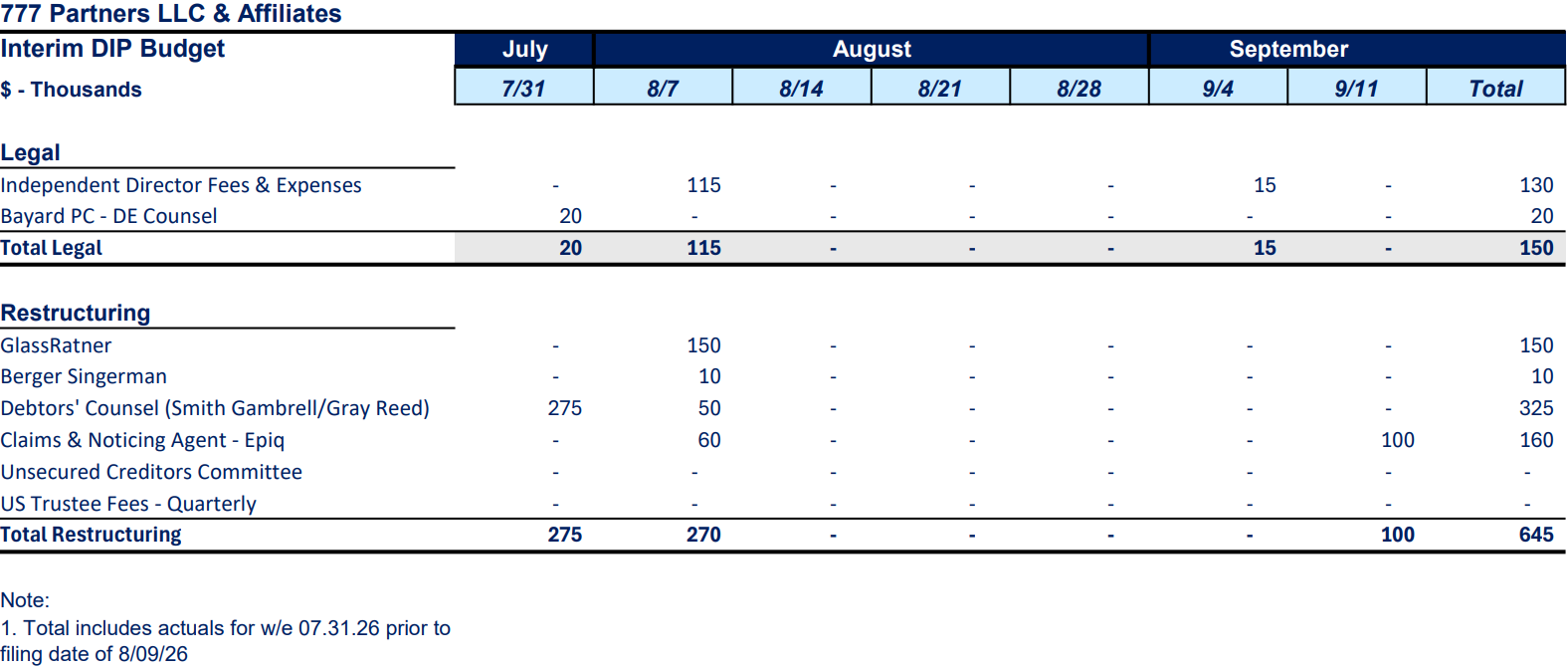
- Carve-Out — Professional fees are protected at the per-professional amounts in the approved budget, with fees incurred after a carve-out trigger notice capped at $200,000 in the aggregate across all professionals. The carve-out also covers statutory fees and a $50,000 cap for a Chapter 7 trustee.
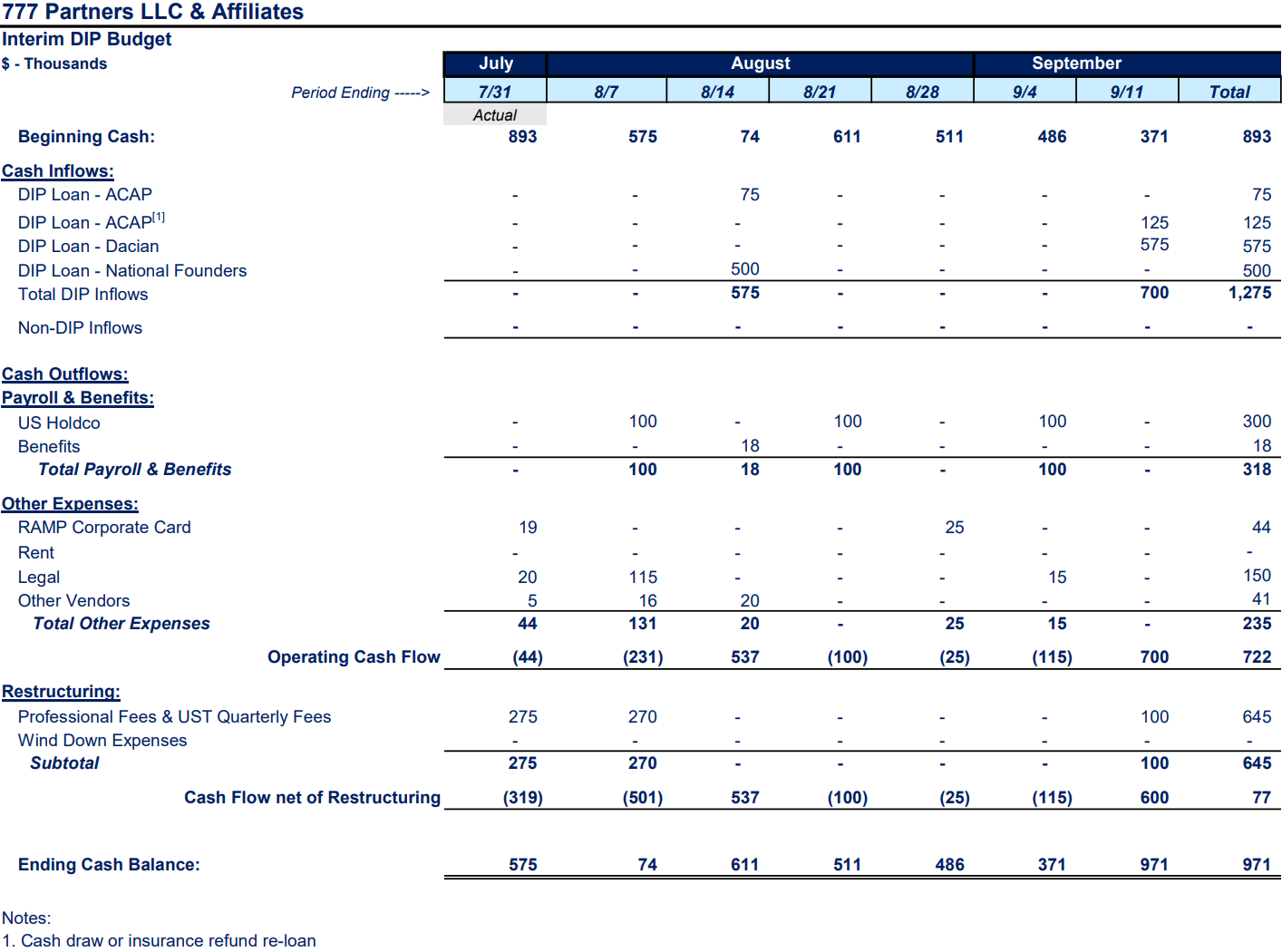
Proposed DIP Budget
Leadenhall Objection
Leadenhall filed a preliminary objection at 10:06 a.m. on August 11, 2026, roughly three hours before the first-day hearing, directed at the DIP motion and at certain other first-day relief. It is supported by a 1,091-page appendix containing the corrected amended New York complaint, three deposition transcripts — Mark Shapiro individually and as Rule 30(b)(6) designee, and former independent manager Ian Ratner — and supporting declarations and briefing from the New York action.
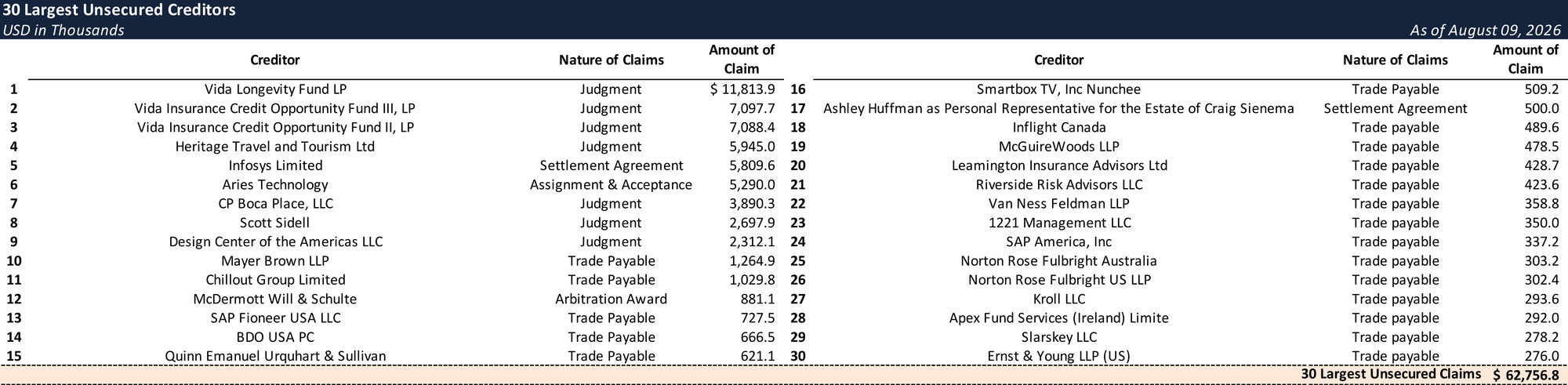
The objection asserts that Leadenhall is the Debtors' largest unsecured creditor and notes that it does not appear on the consolidated list of thirty largest unsecured creditors, citing Shapiro's testimony that the collateral shortfall stood at approximately $320 million as of March 2024. It characterizes the New York action as a $1.8 billion civil RICO case and describes the proposed financing as furnishing $575,000 in immediate-term money in exchange for releases of estate claims against insiders.
On the legal standard, Leadenhall argues that the business-judgment test does not govern where financing comes from an insider, and that heightened scrutiny or entire fairness applies with the burden of proving fairness and good faith shifting to the insider. It argues separately that no emergency exists: the Debtors' own cash management motion states approximately $1.2 million is available for operations and expenses, and the proposed budget directs borrowings principally to payroll and professional fees, the latter of which cannot be paid before retention orders are entered.
Its specific objections include the section 364(e) good-faith finding, on the ground that the DIP lenders are not good-faith lenders and no evidence supports the finding; the roll-up of prepetition obligations and the grant of liens on Chapter 5 avoidance-action proceeds; the milestones, which can be extended only with lender consent and which Leadenhall says do not permit adequate investigation of the prepetition transactions; the automatic joinder of unspecified subsequent debtors as DIP guarantors without further court approval. On the challenge period, Leadenhall asks for the later of 90 days after formation of a creditors' committee or 120 days after the Petition Date, and objects to requirements that a challenging party file a standing motion with a draft complaint and obtain a final, non-appealable order before expiry.
Leadenhall also seeks adequate protection under sections 361 and 363, stating it has identified at least $2.7 million in collateral proceeds that, as of the Petition Date, have not been located. And it objects to the wages, schedules-extension, noticing-agent and cash-management motions on the view that the matter should proceed under Chapter 7.
Vida Objection
Vida funds object on venue grounds, invoking Bankruptcy Rule 1014(b), which places the venue determination with the court where the first petition was filed. It has moved in Florida to stay the Texas cases pending resolution of the Debtors' motion to transfer the Florida case, and notes that the Debtors' own transfer motion states that the financing commitments are predicated on Texas venue — which in Vida's view makes the first-day relief part of the venue dispute rather than relief that can be granted while the first-filed court decides the forum. It points to an April 2026 filing signed by Shapiro with the Florida Secretary of State stating that 777 Partners' principal place of business is its Miami office, and states this was not disclosed to the Texas court. Vida asks that the first-day relief be denied or continued, and separately filed a joinder to Leadenhall's DIP objection.
First-Day Relief and the Continued Hearing
The court entered final orders on the consolidated creditor list and notice procedures, on insurance, on wages, and on the retention of the claims agent. Redaction relief was limited to the home addresses of individual creditors. The cash management motion was granted on an interim basis only, with a final hearing to follow. The financing hearing opened with the other first-day matters and was continued twice. The continued hearing on the DIP is set for August 19, 2026 and the final hearing on cash management is set for September 8, 2026.
Explore Bondoro Insights for live case dockets and comprehensive coverage of material filings from petition to plan confirmation.
Stay informed on every Chapter 11 bankruptcy case with liabilities exceeding $10 million. Subscribe for free to have our coverage delivered directly to your inbox, and explore our full archive of past summaries.
Subscribers can also opt in to timely filing alerts by updating their email preferences in Account Settings.


