Case Summary: Leslie's Chapter 11
Pool and spa retailer Leslie's filed Chapter 11 after adjusted EBITDA fell from $292M to $61M in three years, leaving its $757M term loan unsustainable. The plan cuts over $685M of debt and hands the company to the term lenders who will fund a $90M DIP and a $60M equity infusion at emergence.

A deck version of this summary is also available HERE.
Business Description
Headquartered in Phoenix, Leslie's, Inc. ("Leslie's") and its nine subsidiaries (together, the "Debtors" or the "Company"), sell pool and spa chemicals, equipment and parts, and provide pool and spa services. The Debtors serve residential pool and spa owners and professional pool operators, ranging from hotel and apartment owners to municipal, county and state governments.
The Company operates more than 900 retail locations across 38 states⁽¹⁾, e-commerce channels (LesliesPool.com, a mobile app and marketplaces such as Amazon), an in-field network of more than 200 service technicians, two manufacturing facilities that make proprietary chemicals, and five distribution centers. Leslie's is a holding company with no employees or independent operations. Its wholly owned subsidiary Leslie's Poolmart, Inc. ("Leslie's Poolmart") is the main operating company and owns substantially all of the Debtors' operating assets. For the twelve months ended July 4, 2026, the Company generated $1.180 billion in sales and approximately $33.8 million in adjusted EBITDA.
Leslie's, Inc. and certain affiliates⁽²⁾ filed for Chapter 11 protection on September 30, 2026 (the "Petition Date") in the U.S. Bankruptcy Court for the Southern District of Texas, reporting $722.2 million in assets and $1.2 billion in liabilities (on a consolidated basis).
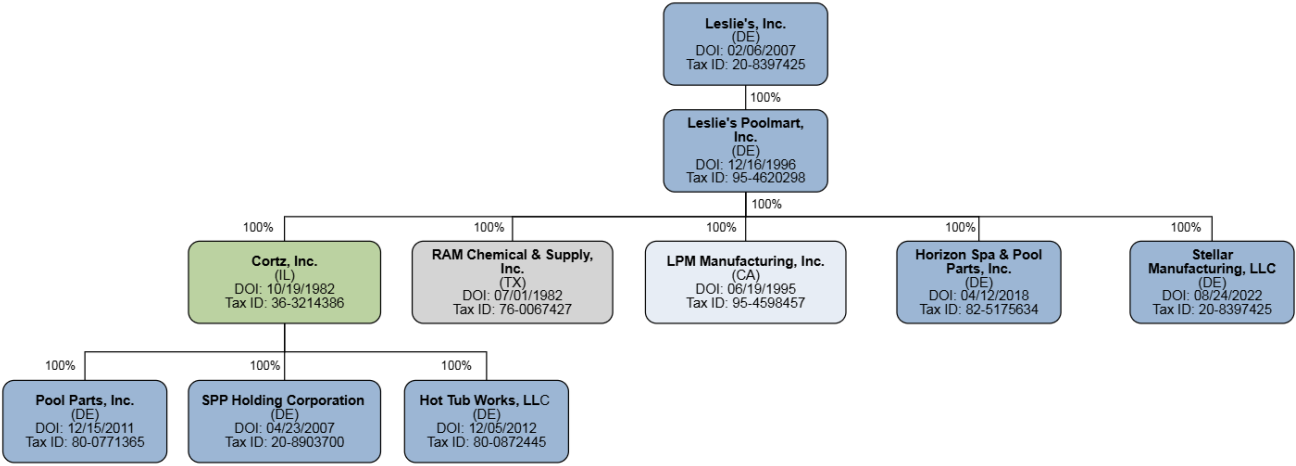
⁽¹⁾ 76 store closures were announced immediately before the Petition Date. ⁽²⁾ For a complete list of Debtor entities, see organizational structure chart below.
Corporate History
Founding and Early Ownership
Phil Leslie, Jr. founded Leslie's Poolmart in North Hollywood, California in 1963. With his partner Raymond Cesmat, he built it into a chain of pool supply stores across the Greater Los Angeles area, and it kept growing through new openings and acquisitions of local and regional retailers. The business then passed through a series of financial sponsors. A Hancock Park Associates-led group bought it in a 1988 leveraged buyout and took it public in 1991, according to its 1997 Form 10-K. Hancock Park and Leonard Green took it private again in 1997, and Leonard Green affiliates recapitalized it in 2005. In 2007 it was reorganized under a new holding company, Leslie's Holdings, Inc. (now Leslie's, Inc.).
By 2015 the Company operated approximately 910 stores nationwide. The following year it moved into online sales by acquiring Cortz, Inc., operator of the In The Swim e-commerce brand, from Audax Private Equity. Cortz entities remain as Debtors in the Chapter 11 case.
L Catterton Ownership
In January 2017, a group led by L Catterton agreed to acquire Leslie's Holdings, with an affiliate of GIC, Singapore's sovereign wealth fund. L Catterton became the majority shareholder and oversaw two leadership changes. Steven Ortega, the Company's longtime CFO and President, succeeded Larry Hayward as CEO in October 2017. In February 2020, former Eddie Bauer CEO Michael Egeck took over, and Ortega became Executive Chairman.
The new owners also expanded Leslie's into hot tubs. It bought Pittsburgh-area Valley Pool & Spa in 2018 and Seattle-area Aqua Quip in January 2019. In fiscal 2020 it added a six-store hot tub retailer in Portland, Oregon, and kept running these chains under their local banners. By late 2020, Leslie's also owned Horizon Spa & Pool Parts, a Tucson-based parts distributor that is now one of the Debtors.
Return to the Public Markets and Sponsor Exit
In October 2020, Leslie’s, Inc. completed its initial public offering on the Nasdaq Global Select Market under the ticker symbol “LESL”. A parent entity controlled by L Catterton and GIC also sold shares in the offering.
As a public company, Leslie's continued to expand through acquisitions. In fiscal 2021 it spent $8.9 million on three hot tub retailers in Denver, southern Oregon and the Washington, D.C. area. The following year it spent $107.7 million on six businesses, adding 27 locations and reaching 990 by fiscal year-end. Those six included regional chains such as Philadelphia-area Spring Dance Hot Tubs and the Texsun Pools and One Stop Pools chains, as well as Stellar Manufacturing, a chemical processor outside St. Louis that Leslie's bought in September 2022.
The sponsors sold down over the same period. In a December 2021 secondary offering, Leslie's also bought 7.5 million shares directly from L Catterton and GIC. L Catterton's stake fell to 4.8% by December 2022. Marc Magliacano, the last L Catterton representative on the board, resigned at the March 16, 2023 annual meeting, according to the Company's 2024 proxy.
Corporate Organizational Structure
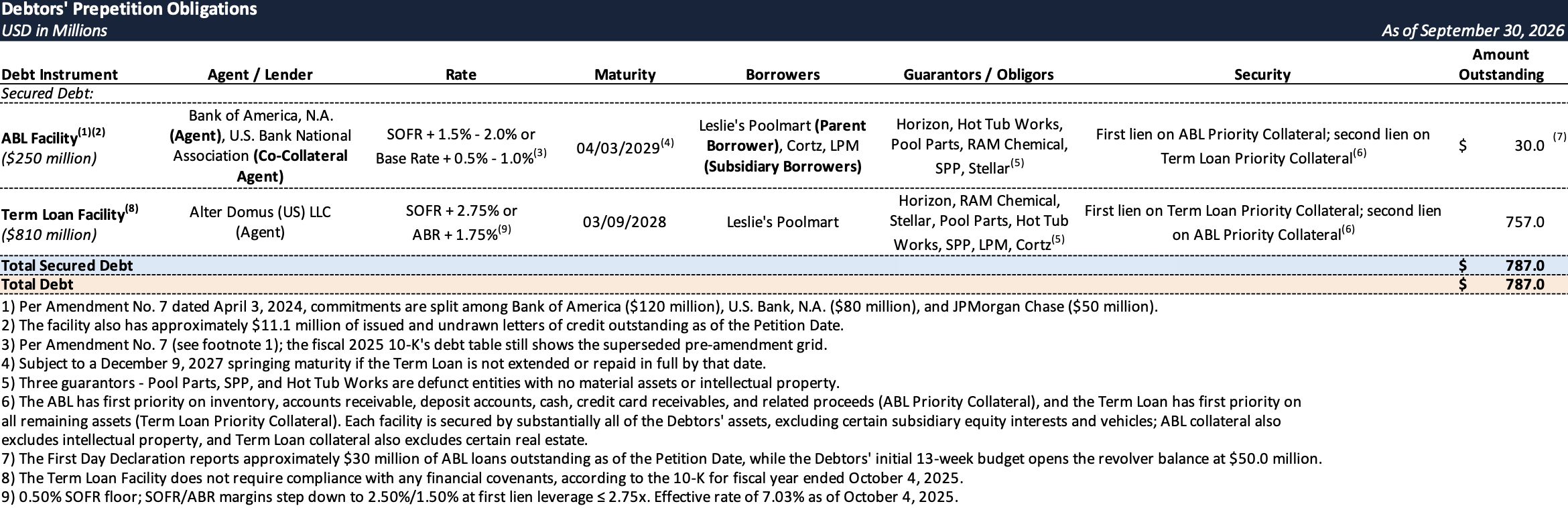
Leslie's owns 100% of Leslie's Poolmart, which runs the stores and distribution centers, LesliesPool.com, the mobile app and the In The Swim website. Its operating assets include leases, inventory and trademarks, and it holds all employment agreements and is the borrower under both prepetition credit facilities. The remaining Debtors sit below Leslie's Poolmart:
- Cortz entities — Cortz, Inc. formerly operated In The Swim, the Debtors' e-commerce brand for pool chemicals, equipment and accessories. It still holds the In The Swim trademarks, website domain and Amazon and Walmart agreements, along with select specialty chemical and pool supply trademarks. It also owns Hot Tub Works, LLC, Pool Parts, Inc. and SPP Holding Corporation, three defunct entities with no material assets or intellectual property.
- RAM Chemical & Supply, Inc. — A Texas corporation that is the tenant on certain of the Debtors' leases.
- LPM Manufacturing, Inc. — Manages the proprietary branded chemicals produced by Stellar and at Leslie's Poolmart's other manufacturing facility.
- Horizon Spa & Pool Parts, Inc. — The Debtors' wholesale specialty pool and spa parts distributor, which also offers a technical support team.
- Stellar Manufacturing, LLC — Acquired in September 2022, this entity runs the Debtors' chemical tolling and contract manufacturing business, specializing in chlorine tablet production and compact granulation. Its products have also been sold for janitorial sanitization, industrial chemical and municipal water treatment uses.
Operations Overview
The Company reports a single segment. Chief Financial Officer Jeff White's first-day declaration (the "First Day Declaration") describes four business lines (chemicals; equipment, parts and accessories; the Hot Tubs division; and services). The Company offers more than 25,000 products, down from more than 30,000 at the 2020 IPO, and exclusive and proprietary brands make up more than 55% of sales and 82% of chemical sales.
Operating Segments
- Chemicals — About 50% of sales. The range includes chlorine sanitizers and shocks, pH adjusters, specialty chemicals and filter cleaners, made and packaged at both company-operated facilities and third-party contract packagers. The distribution centers support the process from manufacturing through to sale.
- Equipment, Parts and Accessories — About 40% of sales, mostly through the retail stores and supplemented by the Company's website and third-party marketplaces. The assortment covers pumps, filters, heaters and heat pumps, salt chlorination systems, LED lighting, automation and control systems, and suction, pressure and robotic pool cleaners. Through Debtor Horizon, Leslie's also sells filter elements, pump components, heater parts and hard-to-find replacement items wholesale to pool service companies and retailers nationwide.
- Hot Tubs Division — The segment operates about 50 stores across 10 states through eight portfolio companies: Aqua Quip, Oregon Hot Tub, International Hot Tubs, Spring Dance Hot Tubs, Capital Hot Tubs, Valley Pool & Spa, Pool City, and Splash Pools and Spas. Revenue comes mainly from hot tubs, swim spas, saunas, modular pools and cold plunges. Delivery, installation, repair, maintenance and water treatment services add to it, along with chemicals, filters, parts, covers and accessories.
- Services — In-field technicians install, maintain and repair equipment for homeowners and professional pool operators, and the PRO Partner program is building an affiliated network of pool professionals under the Leslie's brand.
Customers
Leslie's serves three customer segments: residential pool owners, residential spa owners and pool professionals.
- Residential pool customers fall into two groups: do-it-yourself (DIY) owners, who maintain their pools themselves, and do-it-for-me (DIFM) owners, who rely on professionals for that work. Many visit the Company's stores regularly for complimentary in-store water testing through its proprietary AccuBlue system, which screens for 10 water quality criteria and generates a customized treatment plan, as well as for expert advice and product purchases; they also shop through the Company's websites and mobile app.
- Residential spa customers are owners of spas and hot tubs, to whom the Company sells aftermarket chemicals and equipment.
- Pool professionals comprise two groups. Pool service professionals specialize in maintenance and equipment repair for DIFM homeowners, businesses and government entities, while professional pool operators manage pools at hotels, motels, apartment complexes and water parks. The Company's professional relationships range from major hotel and apartment owners and municipal, county and state governments to sole proprietors.
Workforce
Leslie's Poolmart employs the Debtors' workforce of about 3,500 people. About 2,400 are full-time and 1,100 part-time or seasonal; about 2,500 are paid hourly and 1,000 salaried. Most work in the store network (about 3,000), with roughly 300 in the corporate office, 200 in the distribution centers and 200 as in-field service technicians. The Debtors also use about 18 temporary workers sourced through staffing agencies and two independent contractors. None of the employees were covered by collective bargaining agreements as of October 4, 2025, according to the Company's 2026 proxy.
Manufacturing Facilities and Real Estate
The Debtors operate two manufacturing facilities that produce their proprietary chemical products, one run by Stellar Manufacturing, LLC ("Stellar") and the other by Leslie's Poolmart. LPM Manufacturing, Inc. manages the proprietary branded chemicals produced at both.
As of July 4, 2026, the Company owned 27 of its 943 locations and leased the rest, typically on initial five-year terms with options to renew for successive five-year periods, and it is generally responsible for taxes, insurance and maintenance on leased property. The Phoenix headquarters lease runs through February 28, 2027, with two five-year renewal options.
Prepetition Obligations
Top Unsecured Claims
Events Leading to Bankruptcy
The First Day Declaration attributes the Debtors' distress to a "pronounced contraction" of the U.S. pool and spa care industry from 2023, citing normalizing pandemic demand, cost inflation, higher interest rates, unfavorable weather and big-box and online retailers "particularly aggressive on pricing."
Post-COVID Demand Correction
Pandemic-era demand was temporarily elevated. Consumers invested in home improvement, outdoor living and new pools, and an August 2020 fire at a chlorine production facility prompted customers to buy chemicals ahead of need. Demand corrected sharply beginning in 2023. Leslie's FY2025 Form 10-K notes that stockpiling lifts revenue above normal and is followed by below-normal sales, that this may have hurt fiscal 2023 results, and that sales and profitability declined from fiscal 2023 through fiscal 2025.
Macroeconomic Headwinds
The Federal Reserve's rate increases beginning in 2022 slowed housing activity and limited consumers' access to favorable credit, reducing new pool installations and demand for start-up chemicals and equipment. Economic conditions also reduced the number of households eligible for new residential pools. Weaker purchasing power and consumer confidence further limited demand, and many existing customers chose repairs over replacements. Additionally, inflation raised Leslie's own costs for chemicals, energy and transportation, while escalating tariff exchanges with China disrupted supply chains and added further cost.
Unfavorable Weather Conditions
Leslie's generates most of its sales and earnings from April through September and has historically relied on cash generated in those months to fund operations and service its debt, which leaves it more exposed to adverse events during the season. Weather is the principal external factor affecting the business. Cool weather or heavy rain in peak season reduces chemical consumption and purchases, and early or late warm weather can change the season's length. In fiscal 2024 and 2025, cooler-than-normal temperatures and above-average rainfall in key markets shortened pool seasons and suppressed chemical usage.
Heightened Competition
The aftermarket pool and spa care industry is fragmented, with competition from regional and local independents, home improvement retailers, mass-market, club and marketplace retailers, and wholesale distributors. Big box and online marketplace retailers have priced aggressively despite softer demand, pressuring Leslie's pricing and market share. Mass merchants and online competitors have greater scale and bargaining power, some independents may sell maintenance products at a loss, and some of Leslie's suppliers also sell through competitors. Customers' low switching costs further add to the pricing pressure.
Operational Initiatives
Beginning in October 2024, Leslie's undertook a series of cost-reduction and efficiency measures. These included closing underperforming stores, cutting corporate headcount and restructuring the organization, renegotiating vendor contracts, and tightening inventory management to reduce working capital needs. Leslie's also deferred and reduced capital spending and introduced pricing and promotional strategies aimed at stabilizing comparable-store sales. Leadership changed over the same period. Between 2024 and 2025, the board replaced nearly the entire C-suite, including the appointment of Jeff White as CFO effective October 5, 2025.
The largest of these measures came on November 25, 2025, when management committed to closing about 80 underperforming stores and one distribution center. The closures were substantially completed by January 2026 and cut the distribution network from six facilities to five.
Deteriorating Financials and Unsustainable Debt
Leslie's sales have declined every year since fiscal 2022, falling from $1.562 billion to $1.451 billion in fiscal 2023 and $1.330 billion in fiscal 2024. Fiscal 2025 sales were $1.242 billion over a 53-week year. Adjusted EBITDA fell faster over the same period, from $292.3 million to $168.1 million, $108.7 million and then $61.4 million in fiscal 2025. The First Day Declaration separately states, without defining the measure, that the Debtors' EBITDA declined from a peak of approximately $270 million in the third quarter of 2021 to $40 million in the first quarter of 2026. The bottom line swung from $159 million of net income in fiscal 2022 to a $237 million net loss in fiscal 2025, which included a $180.7 million goodwill write-off.
The decline continued into fiscal 2026. For the nine months ended July 4, 2026, sales were $790.4 million, down from $852.7 million a year earlier. Leslie's reported an $87.7 million net loss and negative $11.4 million of adjusted EBITDA, compared with $16.2 million in the prior-year period. Cleansing materials show fiscal 2026 adjusted EBITDA of about $14 million, a 1.3% margin.
Cash generation weakened alongside earnings. Operating cash flow was $6.5 million in fiscal 2023, $107.5 million in fiscal 2024 and $8.8 million in fiscal 2025, against capex of $38.6 million, $47.2 million and $25.5 million. It was negative $37.6 million for the first nine months of fiscal 2026. Cash fell from $108.5 million at the end of fiscal 2024 to $64.3 million a year later and $45.9 million as of July 4, 2026, when $30 million was drawn on the ABL.
The debt load stayed largely unchanged. The $757 million term loan matures on March 9, 2028, and Leslie's made no principal payments on it during the first nine months of fiscal 2026. Interest expense was $62.9 million in fiscal 2025 and $42 million for the nine months ended July 4, 2026. The ABL matures in April 2029 but springs to December 2027 if the term loan is not extended or repaid. The term loan's reported fair value fell from $534.4 million as of June 28, 2025 to $208.6 million as of October 4, 2025, before recovering to $292.8 million as of July 4, 2026. Leslie's disclosed substantial doubt about its ability to continue as a going concern. It stated that it expected to need to refinance, restructure or extend the term loan, or seek relief under applicable reorganization laws, before maturity.
Ratings Downgrade
S&P cut Leslie's Poolmart from B to B- in May 2025, citing weak consumer spending on pool-related merchandise and projecting adjusted leverage in the mid-5x area. By August 21, 2026, the rating had fallen to CCC- with a negative outlook. S&P cited heightened risk of a distressed debt restructuring before the term loan becomes current in March 2027. The term loan was then trading at about 20 cents on the dollar. S&P said it expected to lower the issuer rating to SD (selective default) and the term loan rating to D if Leslie's completed a distressed transaction.
Restructuring Negotiations
The Debtors hired Centerview Partners LLC ("Centerview") as investment banker in July 2025 and Berkeley Research Group, LLC ("BRG") as financial advisor. Around August 2025, the Debtors began talks with an ad hoc group of term lenders about an out-of-court maturity extension and new capital. In parallel, Centerview contacted 29 prospective third-party lenders and investors, 20 of which signed nondisclosure agreements. Several submitted indications of interest, but none provided a viable path to refinancing the term loan by its maturity.
After weak results in the early months of the 2026 pool season, the term lenders were no longer willing to pursue an out-of-court solution, and in July 2026 Leslie's began negotiating a comprehensive restructuring with the ad hoc group. Liquidity tightened during those talks: the same month, the ABL lenders imposed a $25 million restructuring reserve that reduced borrowing availability under the facility. Centerview also went back to participants from its earlier process to seek DIP financing, but none were interested. With no outside capital available, Leslie's filed for Chapter 11 on the Petition Date.
Chapter 11 Filing
Restructuring Support Agreement and Transaction Overview
The Debtors filed with a restructuring support agreement (the "RSA") signed by holders of approximately 81% of the claims under the $757 million Prepetition Term Loan Facility. Those holders, together with any other Prepetition Term Loan Lenders that later join the RSA, are the "Consenting Term Loan Lenders." The RSA supports a plan of reorganization (the "Plan") that the Debtors state would reduce funded debt by more than $685 million, and it requires the Plan to go effective within 110 days of the Petition Date (the "Effective Date").
The cases will be financed with:
- a $90 million new-money DIP term loan facility (the "DIP Term Loan Facility"), offered pro rata to the Consenting Term Loan Lenders; and
- a $225 million DIP ABL facility from the Prepetition ABL Lenders that rolls up the Prepetition ABL Facility.
Upon emergence, a $60 million equity infusion (the "Equity Financing") will be funded by the Consenting Term Loan Lenders that elect to participate in the DIP Term Loan Facility (the "Restructuring Financing Parties"). Participation is paired: each Restructuring Financing Party must fund its pro rata share of both the DIP Term Loan Facility and the Equity Financing. A Consenting Term Loan Lender that declines to participate receives only its share of the equity allocated to Prepetition Term Loan claims.
Separate groups of Consenting Term Loan Lenders, listed on RSA schedules that are not publicly filed, backstop the new-money DIP Term Loan Facility and the Equity Financing:
- DIP Backstop Parties — Commit to the full $90 million DIP Term Loan Facility, with their commitments reduced as Restructuring Financing Parties take up their allocations. They earn a 7% backstop premium, and all DIP lenders earn a 9.5% upfront premium, both paid in additional DIP term loans (the "DIP Premium Loans").
- Equity Backstop Parties — Subscribe for their own shares of the $60 million equity infusion in full and purchase any equity left unsubscribed. In exchange they receive a premium equal to 7.5% of the Equity Financing, or $4.5 million. This premium is paid in new equity at the Equity Financing price, which equals 4.20% of the reorganized equity.
Post-Emergence Capital Structure and Treatment of Claims
On the Effective Date, the reorganized Debtors' funded debt will consist of:
- New Term Loan — $75 million of DIP term loan claims roll dollar for dollar into a new five-year first-lien term loan bearing interest at Term SOFR plus 6.5% paid in kind, or plus 4% if paid in cash; and
- Exit Revolver — The DIP ABL Facility, together with any Prepetition ABL claims not rolled up during the case, converts into a $225 million exit revolver or is repaid in full in cash through a refinancing.
The remaining DIP term loan claims, including the DIP Premium Loans and accrued interest, convert into equity. Subject to dilution from a management incentive plan of up to 10%, the reorganized equity is allocated:
- 55.8% to the Restructuring Financing Parties for the $60 million Equity Financing;
- 30% to DIP term loan claims above the $75 million rollover;
- 10% to all holders of Prepetition Term Loan claims, pro rata, whether or not they participate in the DIP Term Loan Facility and the Equity Financing;
- 4.2% to the Equity Backstop Parties for their premium.
Taken together, participants in the DIP Term Loan Facility and the Equity Financing would receive the New Term Loan Facility and 90% of the reorganized equity: 55.80% for the Equity Financing, 30% for DIP claims above the rollover and 4.20% as the equity backstop premium. All holders of Prepetition Term Loan claims, including participants, would share the remaining 10%. Because only Consenting Term Loan Lenders may participate, term lenders would hold all of the reorganized equity before management incentive plan dilution.
General unsecured claims share a $500,000 cash pool. Existing equity and Section 510(b) claims are cancelled with no recovery. Other secured and other priority claims are unimpaired, and intercompany claims and interests are reinstated or cancelled.
$90 Million DIP Term Loan Facility
Leslie's Poolmart, Inc. is the borrower under the DIP Term Loan Facility, the remaining Debtors are guarantors, and Alter Domus (US) LLC serves as administrative and collateral agent. The facility funds in two $45 million draws, the first on entry of the interim order (the "Interim DIP Order") and the second on entry of the final order (the "Final DIP Order").
- Funding — Jefferies Capital Services, LLC funds each draw as fronting lender. The Restructuring Financing Parties then buy their allocated loans from Jefferies at par within 15 business days, and the DIP Backstop Parties buy any unpurchased allocation by the next business day.
- Interest and Fees — The loans bear interest at Adjusted Term SOFR plus 6.5% (ABR plus 5.5%), paid in kind, with a 2% default rate increase. The agent receives a $40,000 annual fee.
- Premiums — In addition to the 7% backstop premium, which is calculated on DIP commitments, earned on entry of the Interim DIP Order and paid at closing, all DIP lenders receive a 9.5% upfront premium paid on each funding date.
- Maturity — The DIP motion lists maturity as the earliest of six months after closing, the effective date of a confirmed plan, acceleration, and dismissal or conversion of the cases. Holders of more than 60.01% of DIP term loans and unused commitments (the "Required DIP Lenders") may extend maturity by up to two months.
- Liens and Priority — The facility holds superpriority claims and first-priority priming liens on term priority collateral, junior to the Carve-Out. It holds liens junior to the DIP ABL Facility on ABL priority collateral. Subject to the Final DIP Order, it also holds liens on avoidance-action proceeds, shared pro rata with the DIP ABL Facility.
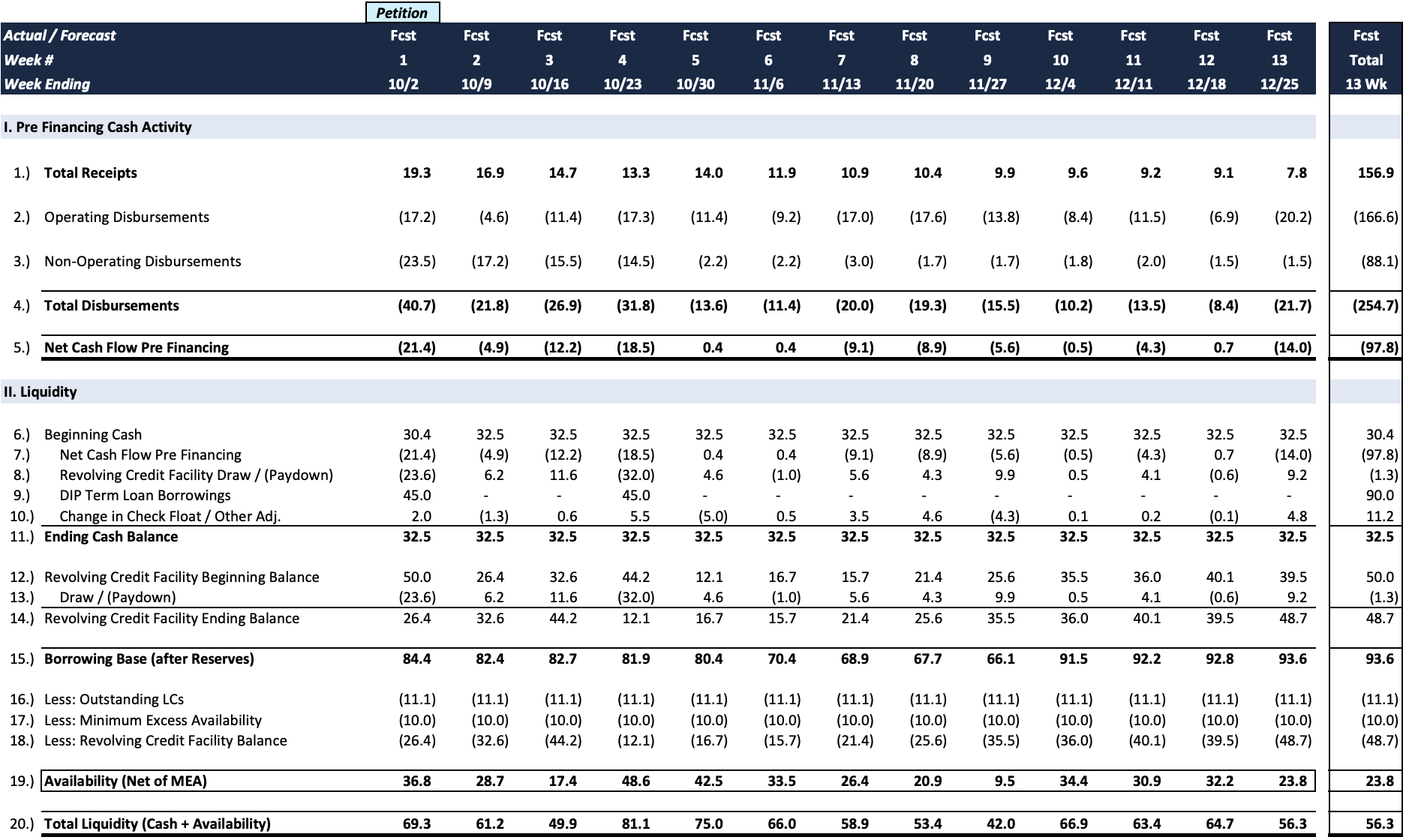
- Budget and Liquidity — Updated 13-week budgets are delivered every four weeks. Each takes effect only if the Required DIP Lenders find it satisfactory "in their sole discretion." Liquidity, measured as unrestricted cash plus DIP ABL excess availability, must be at least $25 million at the end of each week.
- Variance — Tested over rolling four-week periods. Cumulative receipts may not fall more than 20% below budget, and cumulative disbursements, excluding professional fees, may not exceed budget by more than 15%.
- Challenge Period — The Debtors' stipulations to the prepetition debt and liens bind other parties unless a party with court-granted standing files a challenge by the earlier of 75 days after entry of the Interim DIP Order and the plan-objection deadline.
- Investigation Budget — A committee may spend up to $75,000 investigating, but not prosecuting, a challenge to the prepetition secured parties.
$225 Million DIP ABL Facility Roll-Up
Leslie's Poolmart, Inc., Cortz, Inc. and LPM Manufacturing, Inc. are the borrowers under the $225 million DIP ABL Facility, and the remaining Debtors are guarantors. Bank of America, N.A. serves as administrative agent and co-collateral agent, and U.S. Bank National Association as co-collateral agent.
- Roll-Up — On entry of the Interim DIP Order, prepetition letters of credit and bank product obligations are deemed issued under the DIP ABL Facility. Collections from ABL priority collateral then repay prepetition revolver loans dollar for dollar and are deemed reborrowed as DIP ABL loans. On entry of the Final DIP Order, the remaining Prepetition ABL obligations convert into DIP ABL obligations. The roll-up remains subject to the challenge rights reserved in the Interim DIP Order.
- Restructuring Reserve — On the closing date, the credit agreement removes the $25 million restructuring reserve imposed in July 2026 and bars reinstating it.
- Interest and Fees — Term SOFR plus 3.25% (base rate plus 2.25%), with a 2% default rate increase. Bank of America receives a 0.5% upfront fee on aggregate commitments, a $250,000 arrangement fee and a $100,000 annual administration fee.
- Maturity — The earliest of six months after closing (extendable by one month up to three times with the consent of the lenders' Required Lenders), the DIP term loans' maturity, a plan effective date, a sale of substantially all assets, and acceleration.
- Liens and Priority — The facility holds superpriority claims and first-priority liens on ABL priority collateral, junior to the Carve-Out. It holds liens junior to the DIP Term Loan Facility on term priority collateral.
- Availability and Liquidity — Excess availability must remain at least $10 million at all times, and weekly liquidity must be at least $25 million. Each borrowing is conditioned on unrestricted cash not exceeding $32.5 million. Cash dominion springs upon any continuing Event of Default or if excess availability falls below the greater of 12.5% of the line cap and $15.625 million.
- Variance — Similar to DIP Term Loan Facility's.
- Events of Default — Events of default include a cross-default to the DIP Term Loan Facility, termination of the RSA other than through a DIP term lender's breach, and the filing or confirmation of a plan other than an acceptable plan.
- Adequate Protection — Until the Prepetition ABL obligations are rolled up, the Prepetition ABL Lenders receive current cash interest at the non-default rate, along with replacement liens, § 507(b) claims and payment of their advisors' fees.
Initial Budget
Financial Projections
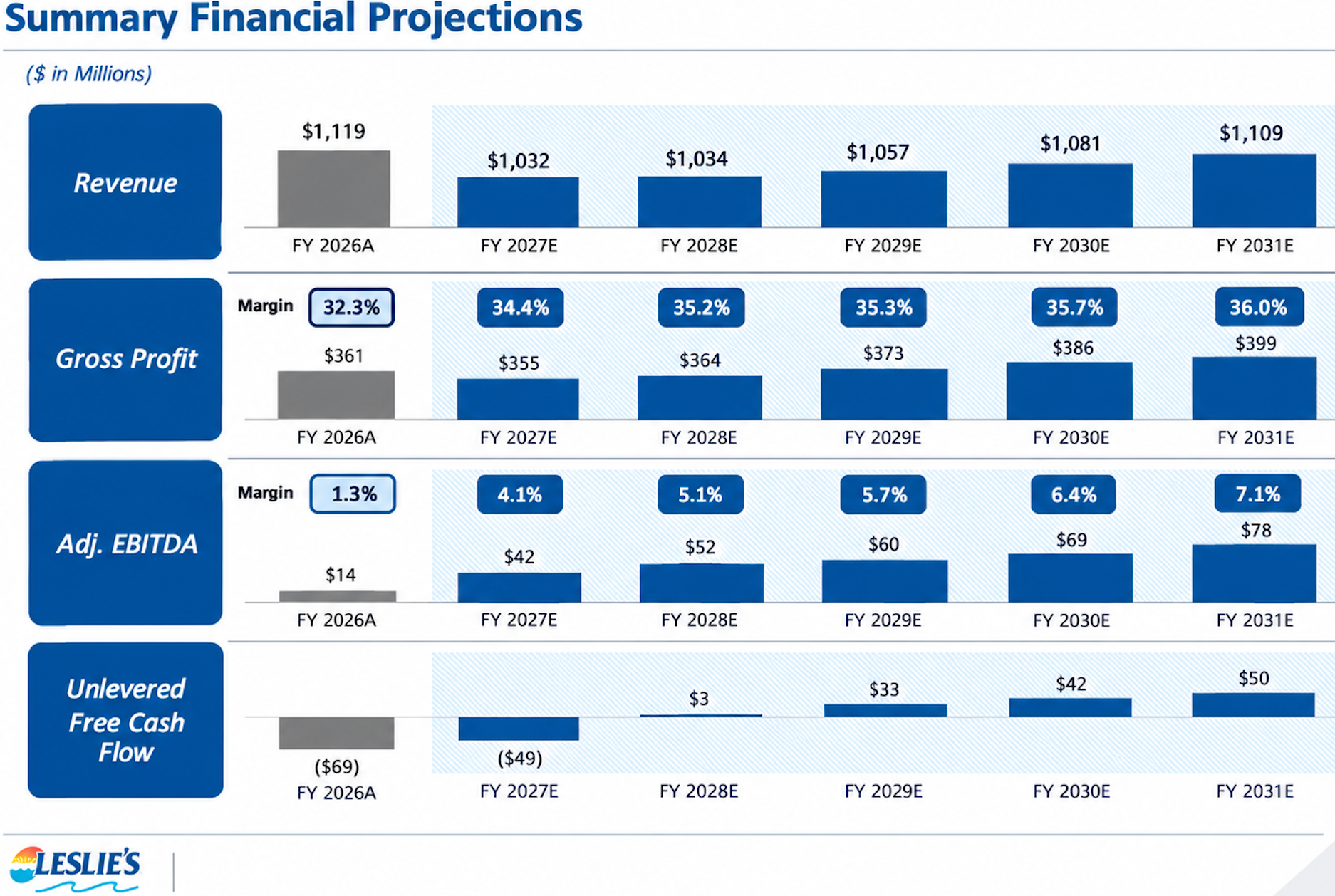
Cleansing materials dated September 30, 2026, which Leslie's furnished to the SEC, set out the Debtors' long-range plan through fiscal 2031. The Debtors project revenue falling to $1.032 billion in fiscal 2027 as they close up to 200 stores. Revenue then recovers to $1.109 billion by fiscal 2031, near the fiscal 2026 level of $1.119 billion. Adjusted EBITDA margin is projected to rise from 1.3% to 7.1% over the period, lifting adjusted EBITDA from $14 million to $78 million. The increase is driven mainly by about $53 million of cost initiatives, the midpoint of a $40 million to $66 million range, which are fully realized by fiscal 2029:
- Store footprint and marketing optimization: $17 million to $27 million;
- Other SG&A savings: $23 million to $39 million.
The plan also assumes a return to comparable-sales growth after fiscal 2027 and about $46 million of capital expenditures on store refreshes and the Stellar manufacturing business. Unlevered free cash flow is projected to turn positive in fiscal 2028 and reaches $50 million by fiscal 2031.
Other First-Day Relief
- Cash Management (Doc. 11) — The Debtors seek authority to keep operating their existing system of 45 bank accounts at 11 banks. They also seek authority to pay prepetition obligations, including about $97,400 in payment processing fees and about $33,700 in corporate card balances, as well as bank fees that average about $36,500 per month.
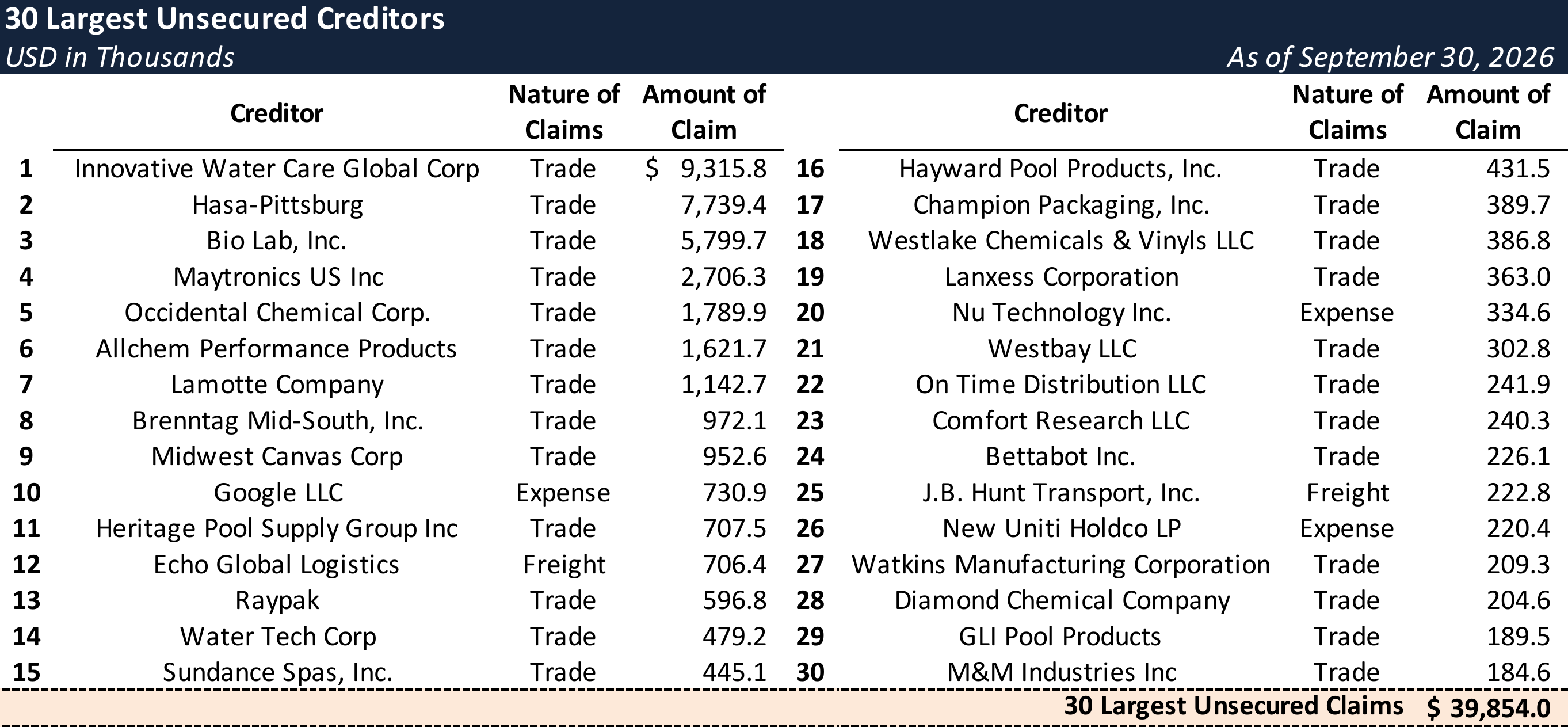
- Critical Vendors (Doc. 12) — The Debtors seek authority to pay up to $36.1 million in prepetition trade claims on an interim basis and $48.7 million on a final basis.
- Customer Programs (Doc. 13) — The Debtors seek authority to continue their customer programs and honor about $19.6 million in prepetition obligations. The programs include loyalty points, gift cards, customer deposits, rebates and returns.
- Insurance (Doc. 14) — The Debtors seek authority to maintain their insurance program, pay up to $8.6 million in premiums, and continue their surety and customs bond programs.
- Wages (Doc. 15) — The Debtors seek authority to pay approximately $16.1 million in prepetition wages and benefits for about 3,500 employees and to continue their benefit programs. The largest items are $8.1 million in time-off obligations and $3.3 million in workers' compensation. Before filing, the Debtors paid out a $4.2 million KERP pool in full and paid $235,000 from a $325,000 discretionary pool. The motion seeks authority to pay the remaining $90,000 to non-insiders, subject to notice requirements.
- Utilities (Doc. 16) — The Debtors propose an $802,500 adequate assurance deposit, about half of their average monthly utility cost.
- NOL/Equity Trading (Doc. 17) — The Debtors have $0.3 million in federal NOLs, $2.6 million in state NOLs and $96 million in disallowed interest carryforwards as of Oct. 4, 2025. They seek notice and hearing procedures for transfers of Leslie's equity by holders of 4.5% or more and for worthless-stock deductions by 50-percent holders.
- Taxes (Doc. 18) — The Debtors seek authority to pay up to $6 million in prepetition taxes and fees, inclusive of fees owed to tax service providers.
- Lease Rejections (Doc. 25) — The Debtors seek to reject 87 nonresidential real property leases, covering 11 previously closed locations and 76 stores slated for closure, effective as of the later of the Petition Date and the date they surrender each premises. They also seek to abandon any personal property remaining at those locations.
Explore Bondoro Insights for live case dockets and comprehensive coverage of material filings from petition to plan confirmation.
Stay informed on every Chapter 11 bankruptcy case with liabilities exceeding $10 million. Subscribe for free to have our coverage delivered directly to your inbox, and explore our full archive of past summaries.
Subscribers can also opt in to timely filing alerts by updating their email preferences in Account Settings.


