Case Summary: AirBaltic Chapter 11
AirBaltic, Latvia's majority state-owned airline, filed for Chapter 11 after engine shortages grounded aircraft, lost Russian and Ukrainian routes cut revenue and a 2026 jet fuel spike drained liquidity; it plans to return about 20 surplus aircraft and reprofile its remaining leases.

A deck version of this summary is also available HERE.
Business Description
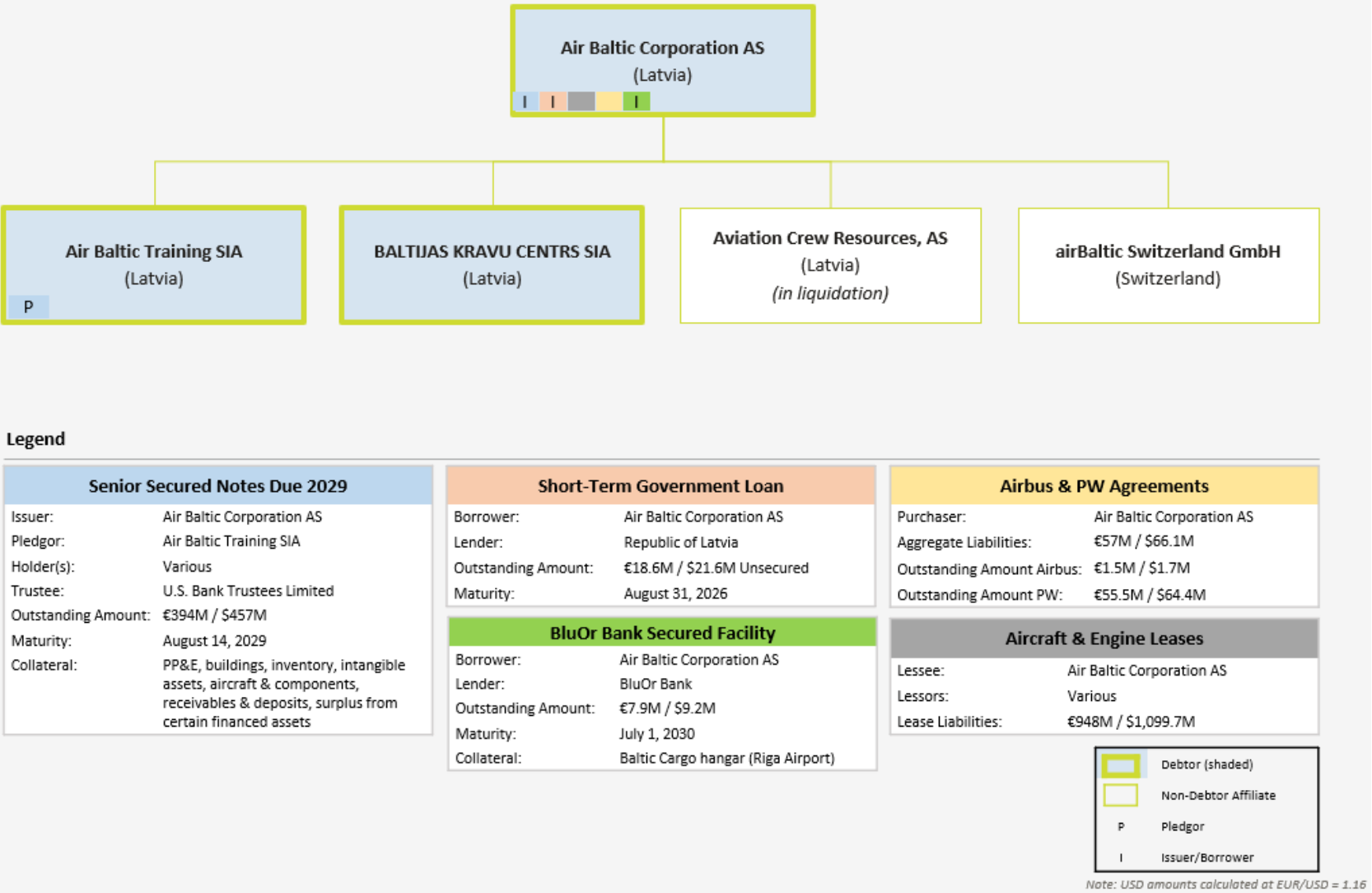
Based at Riga, Latvia, Air Baltic Corporation AS ("Air Baltic AS"), a Latvian joint stock company, together with its Debtor subsidiaries Air Baltic Training, SIA ("Air Baltic Training") and Baltijas Kravu Centrs SIA ("BKC") (collectively, the "Debtors"), and its non-Debtor affiliates (collectively with the Debtors, the "Company"), operates an airline with 54 Airbus A220-300 aircraft and approximately 3,000 employees. The Company serves more than 70 destinations in 40 countries across Europe, the Middle East, North Africa and the Caucasus. Air Baltic AS is majority owned by the Latvian state through its Ministry of Transport, and German airline Deutsche Lufthansa AG ("Lufthansa") holds approximately 10% of voting rights.
Besides passenger flights, the Debtors earn revenue from aircraft, crew, maintenance and insurance ("ACMI") wet-leasing, in which they lease their aircraft with crews, maintenance support and insurance to other airlines, including Lufthansa Group carriers. They also fly charters and carry cargo and mail. The Company runs a pilot and crew training school through debtor Air Baltic Training.
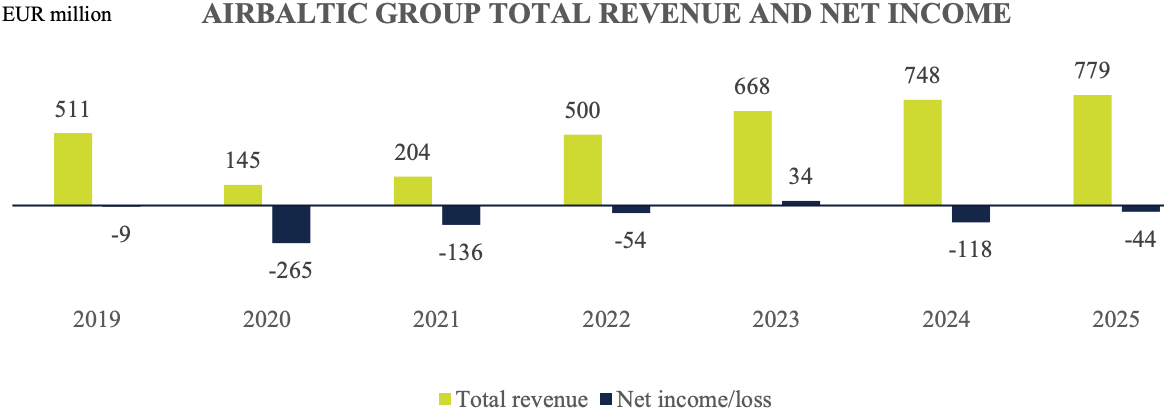
In 2025, the Company carried 5.2 million passengers, and generated €779.3 million in total revenue. Net loss for 2025 was €44.3 million, compared with €118.2 million in the prior year. Adjusted EBITDAR for 2025, the Company's measure of profit before finance costs and income, net foreign exchange gains and losses, depreciation, amortization, aircraft and similar lease costs, and claims compensation, fell 21.8% year-over-year to €143.9 million.
Air Baltic Corporation AS and certain affiliates⁽¹⁾ filed for Chapter 11 protection on September 14, 2026 (the "Petition Date") in the U.S. Bankruptcy Court for the Southern District of New York, reporting $1 billion to $10 billion in both assets and liabilities.
⁽¹⁾ For a complete list of Debtor entities, see organizational structure chart below.
Corporate History
Founding and Early Ownership
Air Baltic AS was founded in February 1995, as a joint venture between the Latvian state, which initially held 51.03%, and Scandinavian Airlines ("SAS"). The airline grew in the early 2000s after Latvia joined the European Union, but the 2008 financial crisis hit the Company severely. In January 2009, SAS sold its entire 47.2% stake to Baltijas aviācijas sistēmas ("BAS"), a private company wholly owned by Bertolt Flick, who served as president and CEO of Air Baltic AS until November 2011.
2011 State Rescue
Financial difficulties persisted into 2011. By June, Latvia's economy minister was describing the airline as close to bankruptcy, and in October the state and BAS agreed to lend it money in proportion to their stakes. BAS, however, had pledged its shareholding to Latvijas Krājbanka, Latvia's oldest commercial bank. According to information Latvia later provided to the European Commission, BAS defaulted on its obligations to the bank, and on November 30, 2011, the bank sold all but one of BAS's shares to the Ministry of Transport, raising the government's stake at the Company to 99.8%.
2016 Private Investment
In 2016, German financier Ralf-Dieter Montag-Girmes acquired approximately 20% of Air Baltic AS through Aircraft Leasing 1 SIA, investing €52 million alongside an €80 million contribution from the Latvian state to fund fleet modernization and the Company's Horizon 2021 business plan. This investment reduced the Latvian government's stake in Air Baltic AS to approximately 80%.
In April 2017, Danish businessman Lars Thuesen acquired Aircraft Leasing 1 SIA and joined the Supervisory Board. His vehicle held approximately 2% of Air Baltic AS as of the Petition Date.
COVID-19 Recapitalization
In Early 2020, Latvia suspended international air traffic and as a result, the Company was facing financing issues. On July 3, 2020, the European Commission approved a €250 million recapitalization of Air Baltic AS. At the time, the state owned 80% of the airline, and Lars Thuesen's Aircraft Leasing 1 SIA owned the remaining 20%. Aircraft Leasing 1 SIA declined to participate, so the state funded the injection alone in July 2020. It provided another €90 million across 2021 and 2022, lifting ownership to 97.97%.
Lufthansa Investment
In January 2025, Lufthansa agreed to pay €14 million for a convertible instrument representing about 10% of voting rights, converting at the valuation of a planned IPO into a stake that could be diluted to no less than 5%. The transaction closed on August 21, 2025, alongside a matching €14 million investment by the Latvian state, effectively reducing the state's stake from 97.97% to 88.37%.
Organizational Structure
Operations Overview
Route Network and Partnerships
The Company operates from its hub in Riga (Latvia), with point-to-point bases in Tallinn (Estonia), Vilnius (Lithuania) and Gran Canaria (Spain). In 2025, its network comprised 140 routes, 77 of them from Riga, and new services included Riga to Faro (Portugal) and Tallinn to Barcelona (Spain) and Reykjavik (Iceland).
The Debtors describe themselves as the only airline in the Baltics with substantial transfer traffic, handled through Riga, and report a combined seat share of approximately 40% at the Riga, Tallinn and Vilnius airports. Separately, Aviation Week, citing OAG schedule data, put the Company's share of departure seats across Latvia, Lithuania and Estonia at 37.5% for summer 2026, down from 38.8% a year earlier, as the wider Baltic market grew faster, led partly by Wizz Air.
The Company has 26 codeshare and 32 interline relationships, with partners including Air France-KLM, Delta Air Lines, British Airways, SAS, Lufthansa Group, Qatar Airways, Air Canada, United Airlines and Etihad Airways. Codeshare agreements account for approximately 6% of total revenue.
2025 Revenue Split
Passenger Operations
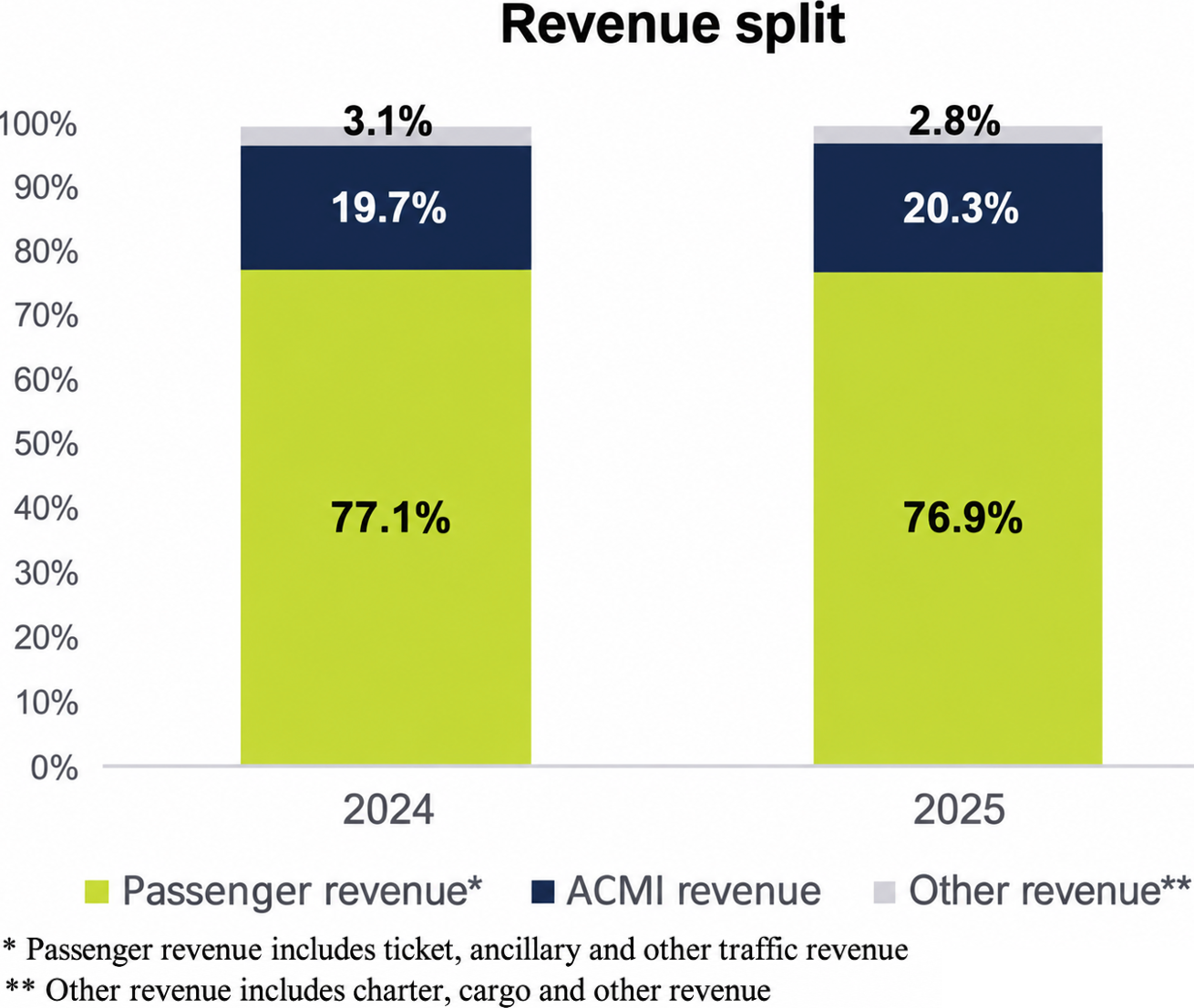
Passenger operations are the Company's core business. In 2025, this segment accounted for €593 million ($687.9 million), or approximately 76.9% of total revenue. Approximately 92.5% of passenger revenue, or €549 million ($636.8 million), was generated from ticket sales, including tickets redeemed with loyalty points, and the remaining €44 million ($51 million) was generated from ancillary charges such as onboard sales, change fees and excess baggage. Travel agencies accounted for about 26% of passenger sales.
The airBaltic Club loyalty program, with more than 1.74 million members, contributes approximately 32% of passenger revenue. Members earn points on airBaltic and partner-airline tickets, add-on services, an airBaltic-branded credit card, and purchases from hotel, car rental and travel insurance partners. The Company earns revenue as points are redeemed or expire.
ACMI Wet-Leasing
The ACMI wet-leasing segment generated approximately €157 million ($182.1 million) and accounted for approximately 20.3% of 2025 revenue. The Company deployed an average of 14.1 aircraft under ACMI arrangements in 2025, and its ACMI fleet peaked at 20 aircraft that year. The segment is underpinned by Lufthansa Group airlines, including Lufthansa, SWISS, Austrian Airlines and Brussels Airlines. In September 2024, Lufthansa Group extended the partnership for three years beyond summer 2025, allowing its airlines to deploy up to 21 of the Company's A220-300s in summer and five in winter.
Beyond Lufthansa Group, the Company signed a two-year agreement with Air Serbia under which it has operated two A220-300s since November 1, 2025, rising to up to four in summer 2026. The contract lifted fourth-quarter 2025 ACMI production 43% year-over-year. The Company also flies short-term ad-hoc contracts for carriers including Air France and Transavia France, and operated for Arkia Israeli Airlines until March 2026.
Cargo and Charter Operations
Charter services, cargo and mail transportation and other commercial activities account for the remaining approximately 3% of the Company's revenue. Most cargo revenue comes from carrying cargo and mail on scheduled passenger flights and from cargo handling at Riga International Airport, where BKC, which the Debtors describe as the airport's largest cargo handler by cargo turnover and flights handled, has operated since 2001. In 2025, the Company generated cargo revenue of approximately €6.2 million ($7.2 million).
The Debtors also charter certain of their aircraft, primarily to tour operators but also to aviation brokers, the military, corporate clients and athletic teams. As of the Petition Date, they had sold approximately €11.9 million ($13.8 million) in charter reservations for flights to be operated after the filing.
Fleet
The Company operates a single-type fleet of 54 Airbus A220-300 aircraft and has flown only that type since 2020. It became the world's launch customer for the aircraft, then the Bombardier CS300, in November 2016, and is the largest A220 operator in Europe. The fleet was acquired mainly under purchase agreements with Bombardier and Airbus Canada dating back to 2012, with many aircraft financed through sale-and-leaseback tenders.
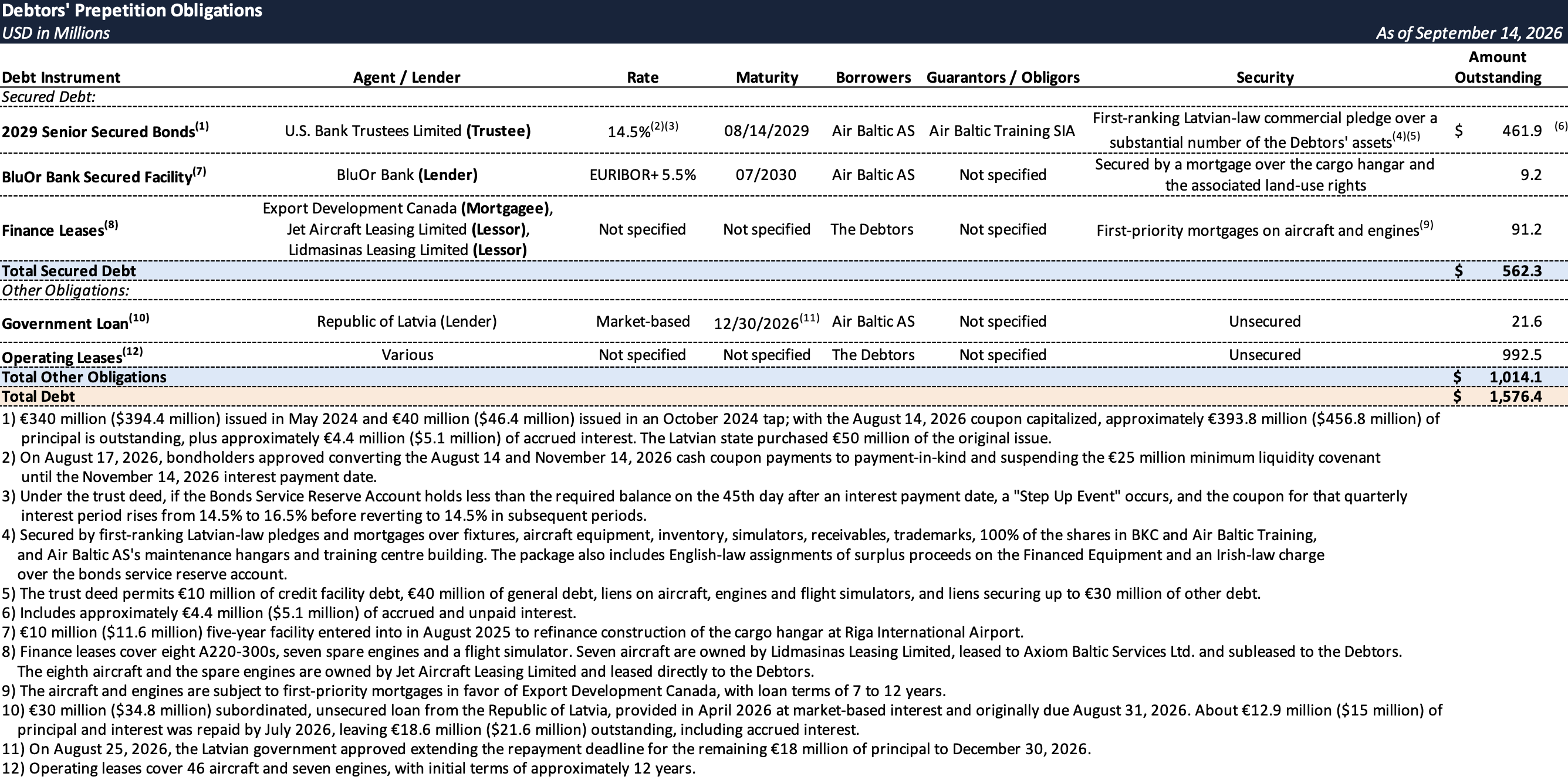
None of the aircraft is owned by the Debtors. Forty-six aircraft and seven engines are held under operating leases with initial terms of approximately 12 years. The remaining eight aircraft, along with seven spare engines and a flight simulator, are held under finance leases. Every aircraft is powered by Pratt & Whitney's PW1500G, the only engine certified for the A220-300.
The Company has 40 firm A220-300 orders outstanding with Airbus, with an aggregate list price of approximately €3 billion ($3.5 billion), and a commitment of approximately €92 million ($106.7 million) for additional Pratt & Whitney engines. It has agreed with Airbus to defer deliveries beyond 2026.
Workforce
The Company employs approximately 3,000 people, of whom about 506 work part time. Approximately 93% are based in Latvia, with the remaining 198 employees in Estonia and Lithuania. Roughly 10% of the Debtors' employees, most of them crew members, belong to four trade unions covered by two collective bargaining agreements, and the Debtors state that employees have never initiated a work stoppage. The Company also develops much of its own flight crew: graduates of Air Baltic Training's Pilot Academy account for half of its first officers.
Prepetition Obligations
Top Unsecured Claims
Events Leading to Bankruptcy
COVID-19 Pandemic
The pandemic sharply reduced the Company's operating performance. In the first half of 2020, revenue fell 62% year-over-year to €82.5 million ($95.7 million) and passengers fell 64% to 0.8 million, producing a net loss of €184.8 million ($214.4 million). From 2020 through 2022, the Company lost approximately €455 million ($527.8 million). As discussed in the Corporate History section, the Latvian state supported the airline through the crisis with a €250 million recapitalization in 2020 and a further €90 million across 2021 and 2022.
Geopolitical Headwinds
Russia's invasion of Ukraine in 2022 forced the Company to suspend all routes to Russia, Belarus and Ukraine, which the Debtors say had been significant sources of revenue and of transfer traffic through Riga. The suspensions cut 2022 passenger revenue by an estimated €40 million ($46.4 million), and flights that had crossed Russian, Belarusian or Ukrainian airspace required longer routings, raising fuel and other operating costs.
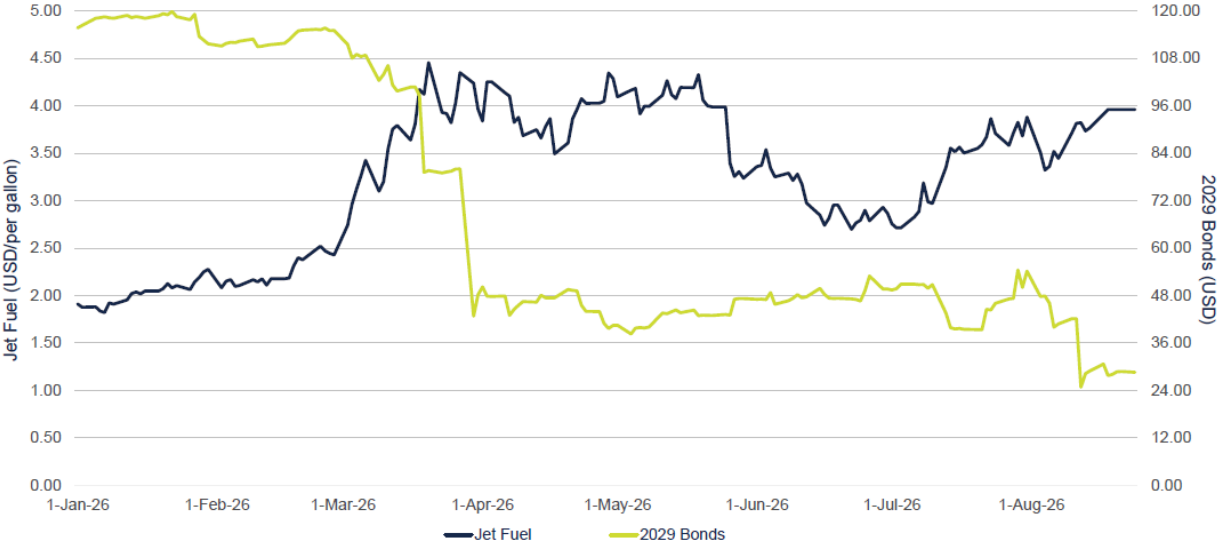
The 2026 surge in jet fuel prices following the outbreak of the Iran-U.S. conflict added further pressure to the Company's liquidity crisis. Fuel has historically represented 20% to 27% of total operating expenses, and jet fuel prices rose approximately 109% at their peak from January 2026 levels. Based on expected consumption of 165,000 tons from April through December 2026, each $100 per ton increase added approximately $16.5 million to the Company's costs. The actual average price over the first eight months of 2026 was $1,168 per ton, $454 higher than a year earlier.
In March 2026, the Company sold its remaining fuel hedges for approximately €5.7 million ($6.6 million) to avoid breaching the 2029 Bonds' minimum-liquidity covenant, leaving its fuel needs for April through December fully exposed to spot prices. The Debtors state that many competitors had hedged their fuel costs at lower prices and could keep fares steady, so the Debtors could not raise ticket prices to offset their higher fuel costs without losing passengers. The conflict also forced the Company to temporarily suspend service to Tel Aviv (Israel) and Dubai (United Arab Emirates), and Dubai service had not resumed as of the Petition Date.
Ratings Downgrade and Bond Price Collapse
In late January 2026, the 2029 Bonds were quoted in the mid-93s. On March 19, they fell about 16 cents to around 67 cents on the euro, their largest single-day decline since issuance. On April 10, 2026, Fitch downgraded Air Baltic AS to CCC–, and six days later Latvia's parliament approved a €30 million short-term government loan as discussed under the Prepetition Obligations section above.
On July 7, 2026, Fitch placed its CCC– ratings on Rating Watch Negative, citing increasingly weak financial flexibility and acute liquidity pressure, and warned that, absent additional external support, the company faced a high likelihood of a payment default or debt restructuring in 2026. By August 2026, the bonds were quoted in the 20s, a decline the Debtors attribute to the rise in jet fuel prices and say effectively foreclosed an out-of-court refinancing or extension.
Engine Shortages
Because the A220-300 has no alternative engine, the Company was left exposed when spare PW1500G engines became scarce beginning in 2022. In July 2023, Pratt & Whitney disclosed a rare condition in the powdered metal used to make certain engine parts.
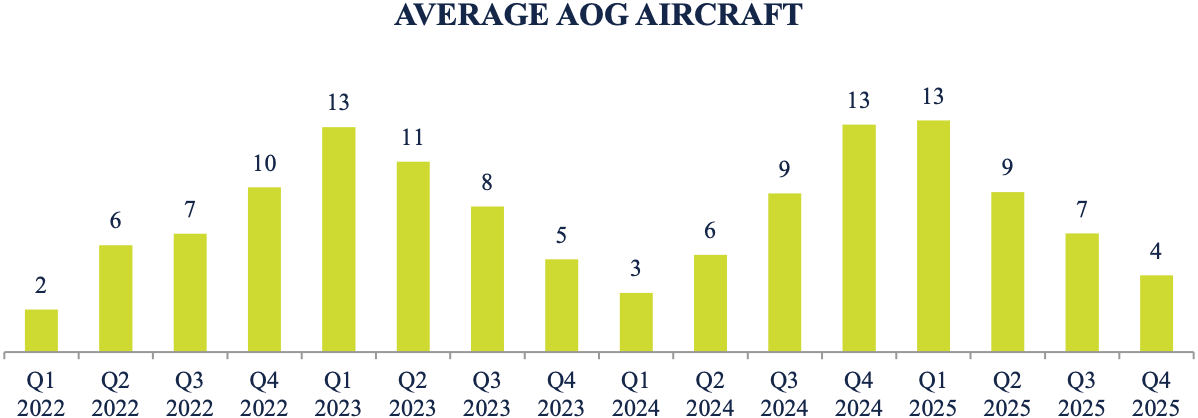
The shortage left an average of 8.0 aircraft on the ground ("AOG") in summer 2024 and 7.7 in summer 2025. Groundings reached an average of 13 aircraft in the first quarter of 2025, and the Company announced in January 2025 that it would cancel 4,670 flights for the summer season. The Debtors say the shortage forced flight cancellations, route suspensions and frequency reductions, required costly ACMI capacity from other operators and limited new route development at Riga, weighing on operating margins.
Aircraft and Engine Order Book
As noted in the Operations Overview, the Company has 40 firm A220-300 orders outstanding with Airbus, with an aggregate list price of approximately €3 billion ($3.5 billion), and a commitment of approximately €92 million ($106.7 million) for additional Pratt & Whitney engines. The Debtors state that these orders were placed to support a growth plan they can no longer fund, and their revised Business Plan contemplates canceling or indefinitely deferring the deliveries.
2024 Bond Refinancing and Suspended IPO
In the years before the filing, the Debtors pursued several initiatives to raise capital and support growth, beyond the state recapitalizations and Lufthansa investment described. In 2024, the Debtors issued the 2029 Bonds, using the proceeds to repay the €200 million ($232 million) 6.75% Eurobonds due July 2024 and a €36.1 million ($41.9 million) loan from the government of Latvia, and to fund operations and capital expenditures. Additionally, as a condition of the 2020 COVID-19 recapitalization, the government committed to an exit strategy centered on an eventual IPO, through which it would reduce its stake without falling below its pre-pandemic level of approximately 80.05%.
The IPO was planned as a listing of ordinary shares on Nasdaq Riga (Baltic Main List) and the Frankfurt Stock Exchange (Prime Standard), targeting a primary raise of an estimated €250 million ($290 million), later cited at up to approximately €264 million to €300 million ($306 million to $348 million). The Debtors repeatedly pushed back the timeline as European airline share prices declined and their own financial performance made it difficult to support the valuation needed. They then stopped relying solely on the IPO and pursued interim, non-IPO sources of capital to bridge to an eventual offering.
August 2026 Business Plan
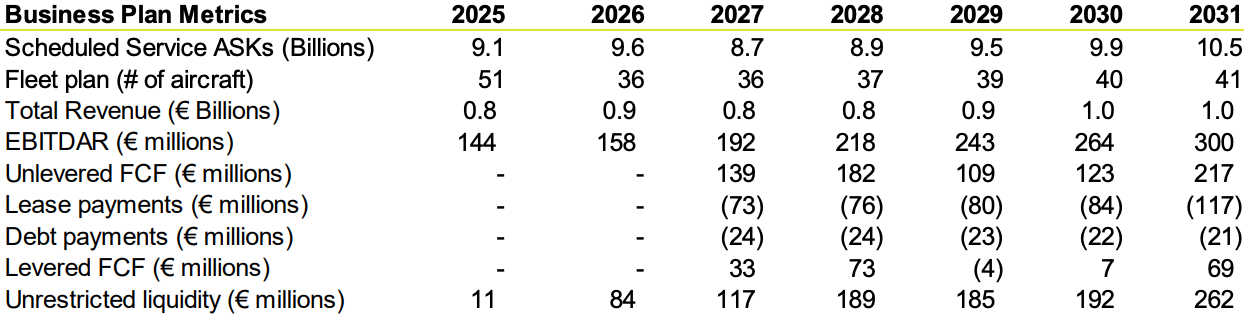
Working with its advisors, including Seabury Securities LLC, the Debtors' proposed investment banker, the Company developed a revised business plan (the "Business Plan"), which it outlined on August 11, 2026 in a Euronext Dublin cleansing statement. The plan replaced a prior strategy, developed for the planned IPO, that envisaged expansion toward a 100-aircraft fleet.
- Fleet and Network — Return approximately 20 surplus aircraft, operating about 36 aircraft at the end of 2026 and around 40 by 2031, and center the network on Riga as the primary hub.
- Costs and ACMI — Achieve approximately €45 million ($52.2 million) of annual cost savings, obtain lower lease rates and concessions from key counterparties, and strengthen ACMI partnerships to deploy capacity year-round and reduce winter fixed costs.
- Targets — EBITDAR of approximately €192 million ($222.7 million) in 2027 and €300 million ($348 million) in 2031. Net leverage of approximately 4.8x following a recapitalization at year-end 2026, declining to 1.6x by year-end 2031.
Prepetition Negotiations
The Debtors state that executing the Business Plan required a significant liquidity infusion and a recapitalization, and that obtaining the necessary stakeholder consents was not practicable before late 2026. As a result, the Debtors sought interim financing and received term sheets from four prospective lenders in summer 2026, including an ad hoc group of 2029 bondholders (the "Ad Hoc Group"). The Debtors proposed to the Ad Hoc Group a framework of €225 million ($261 million) of interim financing, €225 million ($261 million) of new long-term debt and €100 million ($116 million) of new equity, plus a partial equitization of the 2029 Bonds with up to €125 million ($145 million) of take-back debt.
In August 2026, bondholders approved the PIK conversion and covenant suspension described above, and Latvia's parliament authorized the state to buy up to €30 million ($34.8 million) of interim financing bonds and convert its loan and bond claims into equity. After jet fuel prices rose again in late summer, the Debtors say they concluded the Ad Hoc Group proposal likely would not provide sufficient liquidity. They solicited bids for approximately €350 million ($406 million) of DIP financing and began receiving proposals in late August.
Without a binding DIP commitment, the Company on September 3, 2026 called a bondholder meeting on the Ad Hoc Group's proposed interim financing, which the Debtors describe as the only committed proposal then available. Backed by Polus Capital Management and Klirmark Capital 4, the proposal would raise up to €257 million ($298.1 million) through super senior bonds due February 26, 2027, issued at 95% of face value and accruing 25% annual interest, capitalized monthly. The new bonds would rank ahead of all 2029 Bonds, and the €77 million second tranche was conditional on a lock-up for a UK restructuring. On September 8, Latvia's Cabinet backed the Company's stabilization without deciding on state participation, and the meeting was postponed to September 15.
Ultimately, when the DIP proposal from funds managed by Strategic Value Partners, LLC ("SVP") reached committed terms, the Executive Board concluded it offered a more favorable and deliverable outcome than the interim bond financing proposed by the Ad Hoc Group. Following approvals from Latvia's Cabinet and the Supervisory Board on September 10 and from shareholders on September 11, the Debtors signed a commitment letter for the €350 million ($406 million) DIP Facility on September 12. The September 15 bondholder meeting was canceled.
Chapter 11 Filing
The First Day Declaration lists the case's goals as obtaining DIP financing, returning surplus aircraft and reprofiling leases, reaching agreements with lessors and aircraft and engine manufacturers, and securing exit financing. The Company said it chose Chapter 11 because its obligations are international in nature. The Debtors expect to complete the restructuring around June 2027.
DIP Facility
The Debtors sought approval of a €350 million ($406 million) superpriority senior secured term loan DIP Facility arranged by SVP. According to the commitment schedule, SVP funds committed €220 million, Barclays Bank Ireland €50 million, and Hayfin and Oaktree funds €40 million each. Barclays will initially fund the loans as fronting lender. GLAS USA LLC is administrative agent, and GLAS Americas LLC is collateral agent. Decisions generally rest with the "Majority DIP Lenders," defined as lenders holding more than 50% of commitments, excluding insiders; SVP funds hold about 62.9%.
- Structure — Air Baltic AS is the borrower, along with any owner of the finance-leased aircraft collateral after the payoff described below. Debtors Air Baltic Training and BKC are guarantors.
- Availability — Tranche 1 is €175 million ($203 million), of which €140 million ($162.4 million) is available on entry of the proposed interim order (the "Interim Order") and the rest on entry of the final order (the "Final Order"). Tranches 2 and 3 provide up to €125 million ($145 million) and €50 million ($58 million), respectively, each reduced euro-for-euro by any third-party financing. They require the Final Order, case milestones and an order or bondholder resolution permitting DIP liens to rank ahead of the bondholders' liens (the "Priming Order"). The Debtors are not seeking that order in the DIP Motion.
- Pricing — 12-month Term SOFR plus 8.00%, payable monthly and paid in kind unless the Debtors elect cash, plus 3.00% on default.
- Fees — (i) 5% backstop and 5% upfront fees on the full €350 million, paid in kind; and (ii) a 5% exit fee on the full commitment, paid in cash on repayment.
- Make-Whole — Subject to the Final Order, a make-whole on any repayment before exit, covering the interest and fees that would have been payable through maturity on the full €350 million, whether or not drawn.
- Maturity — The earlier of nine months after the Petition Date and 250 days after the initial Tranche 1 funding, extendable once by three months for a 0.75% fee.
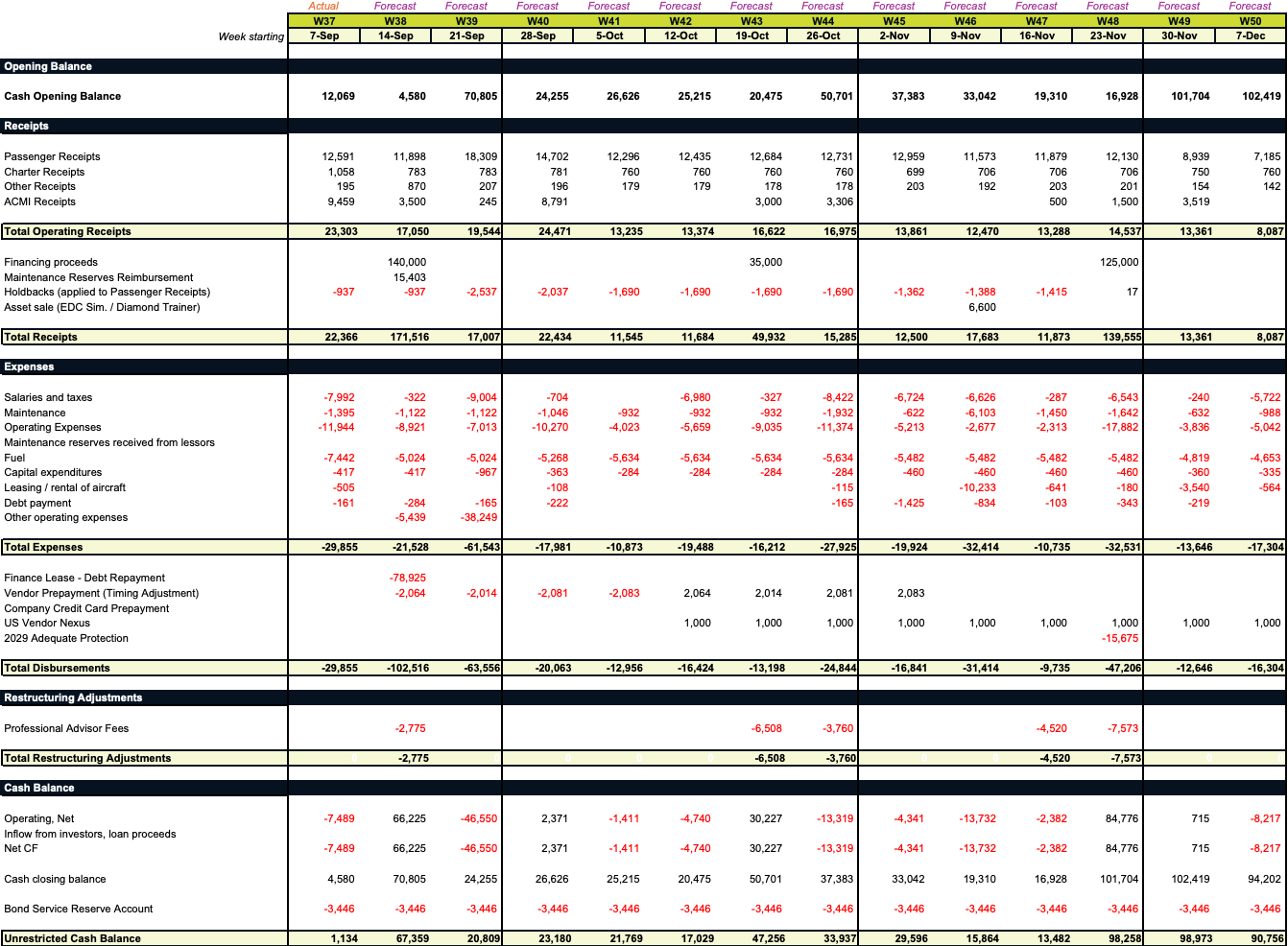
- Use of Proceeds — Tranche 1 would first repay about €71.7 million ($83.1 million) of principal on the EDC- and Axiom-financed aircraft and engines, plus accrued interest, fees, make-whole amounts and the EDC simulator debt. That would transfer title to the Debtors, and the DIP Motion says it would give access to about €170 million ($197.2 million) of unencumbered value. The remaining proceeds fund working capital, interest and fees, professional fees and case costs under an approved budget.
- Minimum Liquidity — After Tranche 1 is funded, the Debtors must keep unrestricted cash of at least €10 million ($11.6 million), rising to €20 million ($23.2 million) once Tranche 2 is funded, until maturity.
- Variance — On a cumulative basis, receipts may not fall more than 15% below budget, and disbursements, excluding professional fees, may not run more than 15% above budget.
- Aircraft Collateral — Unless waived, the finance-leased aircraft collateral must be moved within 30 days to a new Cayman Islands entity that becomes a debtor and borrower.
- Key Milestones — Entry of the Interim Order within five days of the Petition Date and the Final Order within 35 days; assumption of the Lufthansa wet-lease agreements within 30 days; an aircraft lease rejection motion within 59 days; delivery of the Business Plan within 60 days; binding term sheets with lessors covering 75% of the fleet and with Pratt & Whitney, Airbus and Lufthansa, plus filing of a plan and disclosure statement, within 100 days; equity and exit financing commitments and a commitment from the government of Latvia to support the plan within 120 days; plan confirmation within 210 days; and a plan effective date by the earlier of nine months after the Petition Date and 250 days after the initial funding.
Collateral, Priming and Adequate Protection
The Tranche 1 collateral consists of the eight aircraft and seven spare engines being bought out of the finance leases, plus the flight simulator, unencumbered property and a lien on the cargo hangar junior to the BluOr Bank facility. The collateral securing the 2029 Bonds is excluded until the Priming Order is entered. That order can be obtained through a court hearing under section 364(d)(1) of the Bankruptcy Code, which requires showing that credit is unavailable otherwise and that the existing lienholders are adequately protected, or through an Extraordinary Resolution of bondholders. Under the August 24, 2026 supplemental trust deed, the quorum for such a resolution is 25% of outstanding principal at a first meeting and no minimum at an adjourned meeting, while approval still requires 75% of votes cast.
The DIP Motion describes the bondholders as undersecured and therefore entitled to adequate protection only up to the value of their collateral. As adequate protection, it points to:
- Unencumbered Value — The roughly €170 million unlocked by the finance lease payoff.
- Cash Interest — An offer to pay interest in cash, including the November 14, 2026 coupon bondholders had agreed to take in kind.
- Going-Concern Value — Preservation of going-concern value, including the trademarks and brand IP it calls the most valuable piece of the bond collateral.
Under the DIP term sheet, the bondholders' replacement liens would be silent and junior to the DIP liens and would take effect only once Tranche 2 is funded. Cash interest and trustee counsel fees would be at the Debtors' discretion, payable only after Tranche 2 and only while the minimum cash levels are met. The Company's August 11, 2026 announcement estimated the going-concern value of the bond collateral at €506 million ($587 million), including aircraft and engines appraised at €255 million ($295.8 million) as of June 2026.
Initial Budget
Ad Hoc Group Objects to DIP Financing
The Ad Hoc Group, whose members include Klirmark Capital, filed a limited objection to the DIP Motion and the Critical Vendors Motion on September 15, 2026. The group asked the Court to defer interim relief for several days, arguing that the 181-page DIP Motion was docketed at 7:18 p.m. Eastern the night before, or 2:18 a.m. in Latvia, leaving European creditors no meaningful opportunity to review it.
The group contends that the Debtors ran a parallel DIP marketing process while soliciting bondholder consents on the group's out-of-court financing. It says that proposal drew 94% support among bondholders voting, including the Latvian government, and was "very similar" to the DIP Facility. The Debtors signed the DIP commitment letter on September 12, nine days after calling that meeting. According to the group, it was never invited to compete. It also argues that the euro-for-euro reduction of Tranches 2 and 3 for third-party financing is designed to foreclose competing proposals.
On adequate protection, the group calls the Debtors' offer illusory, arguing that the cash payments and replacement liens described above are discretionary or contingent on Tranche 2 and provide no protection during the Tranche 1 period. The group also rejects the Debtors' characterization of Tranche 1 as non-priming. It points to the proposed Interim Order's statement that the exclusion of bond collateral does not apply to the Aircraft Collateral, and argues that repaying the EDC and Axiom finance debt would bypass the bondholders' surplus proceeds assignments and move that equipment's value to the DIP Lenders. The group puts the value transferred at more than €250 million; the DIP Motion estimates about €170 million of unencumbered value. It further argues that the 5% backstop and 5% upfront fees, about €35 million combined, were earned when the commitment letter was signed, creating a barrier to any replacement DIP.
The group also objects to the Critical Vendors Motion's roughly $200 million of proposed prepetition payments, including $45.2 million on an interim basis, as excessive before a creditors' committee is formed. As conditions to any interim relief, it asks for:
- replacement liens on the financed aircraft and engines;
- a bar on the finance lease payoff until the final order;
- narrower non-interference and credit bid provisions; and
- a reduced vendor cap.
The group reserved the right to seek dismissal under section 1112(b) or abstention under section 305(a). It cites the Debtors' limited U.S. connections, the Latvian state's roughly 88% ownership and role in selecting the DIP lenders, and the filing's timing on the eve of Latvian parliamentary elections. It also questions whether any Debtor is a "governmental unit" ineligible for Chapter 11 relief.
Other First-Day Relief
- Critical Airline Agreements Motion (Doc 6) — The Debtors seek authority to assume, at their discretion, their interline, codeshare, frequent flyer, IATA Clearinghouse, ACMI and other industry agreements, without counterparties demanding deposits. The ACMI agreements include wet-lease contracts with Lufthansa, SWISS, Austrian Airlines, Brussels Airlines and Air Serbia; separately, the DIP Facility requires the Debtors to assume the Lufthansa wet-lease agreements within 30 days of filing. The Debtors also seek authority to pay about $1.3 million of net prepetition obligations settled through the Clearinghouse and to enter into new airline agreements.
- Insurance Motion (Doc 7) — The Debtors seek authority to maintain their approximately 18 insurance policies, which cost about $3.9 million a year in premiums. The authority would also cover renewing or buying coverage, entering into premium financing agreements, and paying related obligations, including brokerage fees. The Debtors estimate that no prepetition premiums are outstanding and seek payment authority as a precaution, noting that EU aviation rules and their lease and financing agreements require coverage.
- Customer Programs Motion (Doc 8) — The Debtors seek authority to continue and honor prepetition obligations under their customer programs. These include the airBaltic Club loyalty program, the corporate incentive program, lounge access, ticket refunds, EU261 and Montreal Convention claims, about $2 million of outstanding gift cards, travel agency commissions, charter bookings and cargo services. The motion also asks to modify the automatic stay so travel agencies, settlement systems, cargo counterparties and card processors can continue netting refunds, chargebacks and other undisputed amounts.
- Cash Management Motion (Doc 10) — The Debtors seek authority to keep using their centralized cash management system, 30 existing bank accounts and business forms, and to continue intercompany transactions and pay bank fees of about $12,000 a month. Postpetition intercompany claims would receive administrative expense status. Because 29 accounts are held at banks outside the U.S. Trustee's approved list, the Debtors request a 60-day extension on an interim basis, and then a waiver, of section 345's deposit requirements.
- Critical Vendors Motion (Doc 11) — The Debtors seek authority to pay prepetition claims of about $52 million to foreign vendors, $102.4 million to outside maintenance providers, shippers and contractors that may hold liens, and $46.6 million for goods delivered within 20 days before filing or ordered prepetition. Payments to foreign vendors and lien claimants would be capped at $45.2 million on an interim basis.
- Taxes Motion (Doc 13) — The Debtors seek authority to pay about $122.9 million of accrued prepetition taxes and fees, with $96.5 million payable before the final order. The largest items are about $102 million of airline taxes and fees, including a $49.2 million EU Emissions Trading System obligation for 2025, and $20.8 million of payroll taxes. The motion also seeks authority to continue Latvian tax installment plans, citing risks of air operator certificate suspension, tax liens and personal liability for directors if taxes go unpaid.
- Wages Motion (Doc 16) — The Debtors seek authority to continue employee compensation and benefit programs and to pay about $15 million of prepetition employee obligations, with about $2.05 million payable before the final order.
Explore Bondoro Insights for live case dockets and comprehensive coverage of material filings from petition to plan confirmation.
Stay informed on every Chapter 11 bankruptcy case with liabilities exceeding $10 million. Subscribe for free to have our coverage delivered directly to your inbox, and explore our full archive of past summaries.
Subscribers can also opt in to timely filing alerts by updating their email preferences in Account Settings.


