Case Summary: Noble Supply & Logistics Chapter 11
Noble Supply & Logistics, a longtime U.S. government supply and logistics contractor, filed for Chapter 11 after DLA contract non-renewals, a capital-intensive ramp-up and a government shutdown drained liquidity, pursuing a dual-track going-concern sale or orderly wind-down.

A deck version of this summary is also available HERE.
Business Description
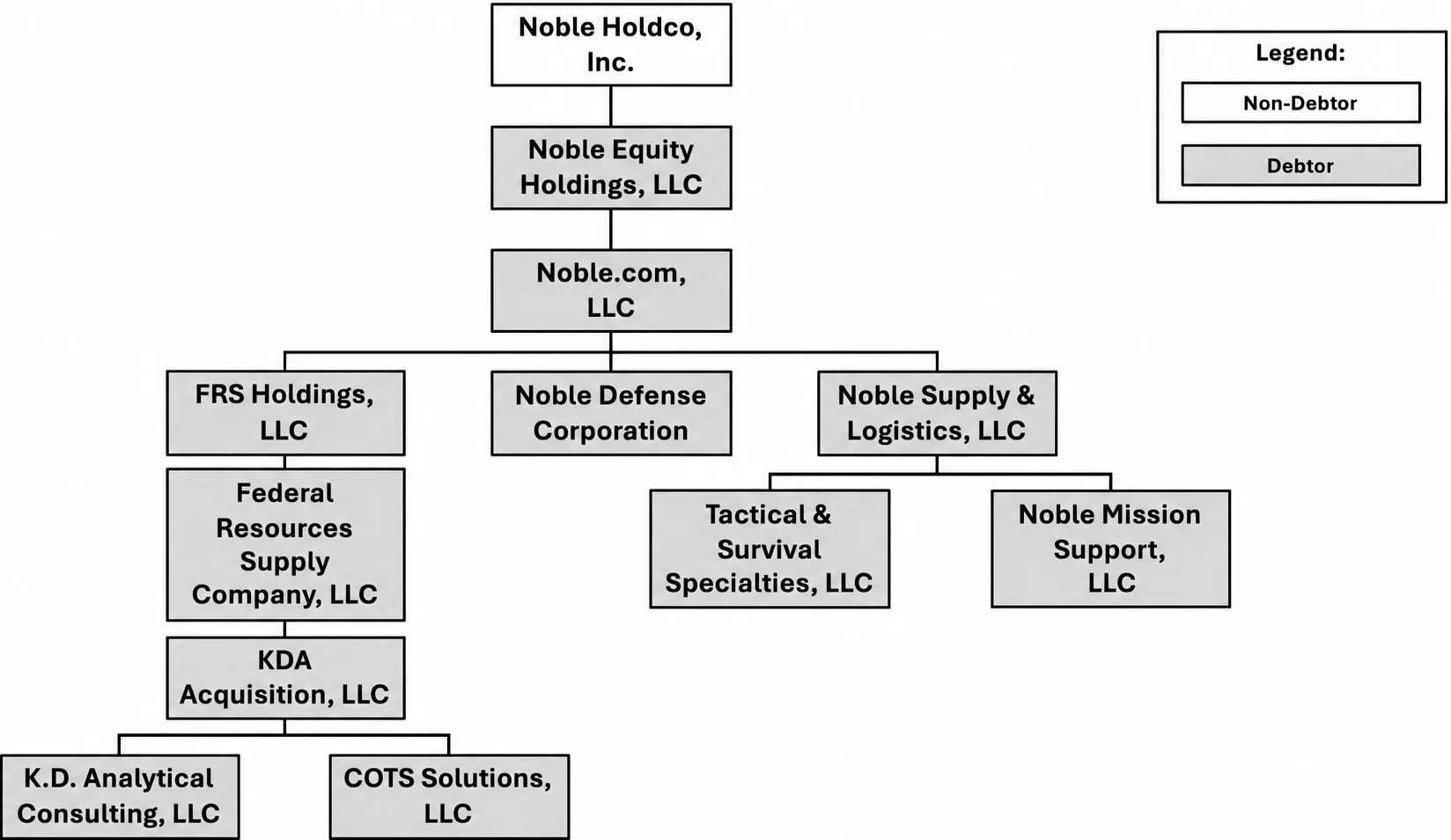
Headquartered in Boston, MA, Noble Supply & Logistics, LLC, together with ten affiliated Debtors (collectively, "Noble" or the "Debtors"), is a government supply, logistics and product-solutions enterprise. It has supplied non-lethal military equipment and services to the U.S. Department of War — the current designation of the Department of Defense — for more than twenty years. The Debtors' principal customers are the Defense Logistics Agency ("DLA") and the General Services Administration ("GSA"), the two organizations managing the supply chain for the U.S. military, in addition to other federal agencies including the Federal Bureau of Investigation, the Secret Service and the Army Corps of Engineers.
Noble competes for orders under its contract vehicles, sources product from its vendor network, and administers the resulting procurement, with fulfillment varying by program. Under multi-award contracts, vendors typically drop-ship directly to the end user while Noble provides operational support between customer and vendor. Under the programs on which it is the sole awardee, Noble procures, warehouses, and distributes the goods itself.
Noble's product range extends from tactical, survival, and safety equipment and communications gear to hardware and abrasives used in aerospace weapons systems. It also delivers specialized training, safety monitoring, and calibration and repair services that enable first responders and warfighters to detect and protect against hazardous threats.
In 2025, the Debtors generated approximately $1.03 billion in revenue across four operating business lines, and as of the Petition Date the Company employed approximately 272 people, roughly 237 of them in the United States and the balance in Germany, Japan, Kazakhstan, and Poland. Notwithstanding that scale, Noble qualifies as a small business under the Small Business Act and performs under several small business set-aside contracts ("SBSAs").
Noble Supply & Logistics, LLC and certain affiliates⁽¹⁾ filed for Chapter 11 protection on August 30, 2026 (the "Petition Date") in the U.S. Bankruptcy Court for the District of Delaware, reporting $100 million to $500 million in assets and $500 million to $1 billion in liabilities.
⁽¹⁾ For a complete list of Debtor entities, see organizational structure chart below.
Corporate History
Founding and Organic Growth, 2003–2020
Thomas W. Noble, III founded the business in 2003 as an e-commerce provider to the U.S. military and government, and it grew primarily through organic expansion until 2021. Proprietary in-house software linked the company to its suppliers and automated the ordering process, carrying the catalog from roughly 25,000 products to more than 600,000 and establishing the drop-ship model that still serves the majority of Noble's contracts. Through the first half of the 2010s the company embedded itself in the DLA prime vendor system, became the agency's first prime vendor in Djibouti, and grew its storefront network to 32 military installations worldwide. Expansion continued over the second half of the decade, when Noble opened fulfillment centers in Oklahoma City, Norfolk, and Frankfurt, supplied personal protective equipment to the Department of Defense and state governments during the COVID-19 pandemic, and reported sales exceeding $300 million in 2018.
The 2021 Acquisitions
In 2021 Noble closed two acquisitions that transformed both the enterprise and its balance sheet. On March 24, 2021, it announced the acquisition of Tactical & Survival Specialties, Inc. ("TSSi"), a supplier of tactical equipment with an early-stage aerospace business. Seven months later, on October 26, 2021, it closed on Federal Resources Supply Company, LLC ("Federal Resources"), a supplier of chemical, biological, radiological, nuclear and explosives ("CBRNE") products with growth potential in the command, control, computers, communications, cyber, intelligence, surveillance and reconnaissance ("C5ISR") sector.
Both targets were Noble's direct competitors. In January 2021, the DLA had selected six suppliers from a field of 29 bidders to share a contract worth up to $33 billion, covering tactical and specialized operations equipment. The winners were ADS, Federal Resources, Noble, Tactical & Survival Specialties, SupplyCore and W.S. Darley & Co. Within ten months Noble had bought two of them, leaving half the winning field under one roof. Its own share of that contract became Noble's largest source of revenue, generating $630 million in 2025.
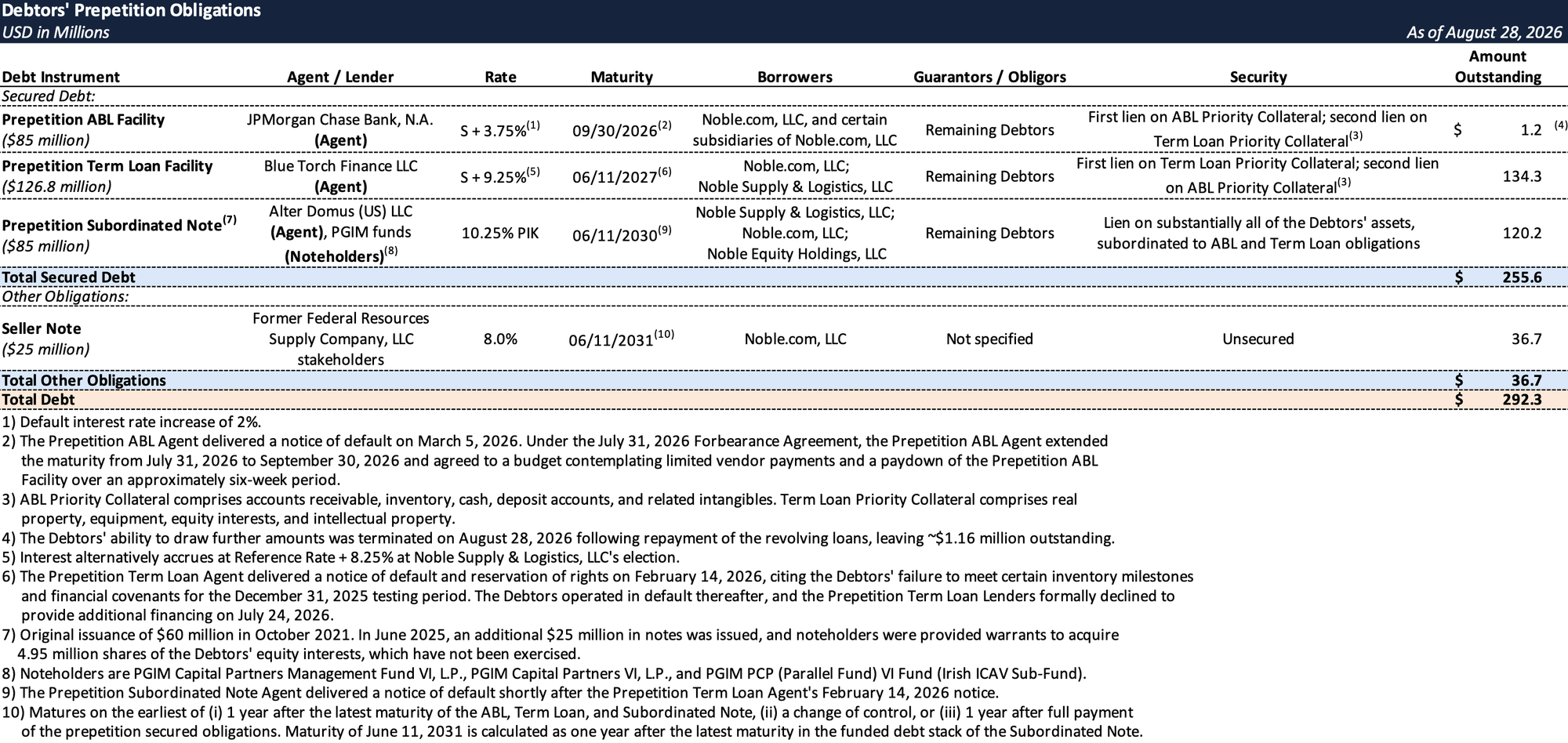
To finance the acquisition of Federal Resources, the Debtors entered into a $126.8 million term loan facility, a $60.0 million subordinated note and a $25.0 million seller note, each dated October 26, 2021. These facilities are further described under Prepetition Obligations below. As of the Petition Date, the three instruments together carry approximately $291.2 million, or 99.6% of the $292.3 million in funded debt outstanding.
Organizational Structure
Operations Overview
Contract Types
Noble's contracts fall into two core types. Both are indefinite delivery, indefinite quantity ("IDIQ") vehicles — long-term agreements that establish terms without committing the government to any particular volume. What separates them is how Noble earns revenue under each: on one, it holds a place among several approved suppliers and competes for every order that comes through; on the other, it is the only company allowed to supply, but must build and fund the operation that delivers.
- High Touch Customer Solutions ("HTCS") — Represents approximately 70% of the business and comprises over 100 multi-award IDIQ contracts running one to ten years. Each is awarded to multiple parties, who then compete for the individual task orders issued under it, so the work is sales-force driven and turns on securing competitive supplier pricing to win bids. Products include unmanned aerial vehicles, communications equipment, safety equipment, and tactical gear. Because vendors typically drop-ship directly to the end customer, Noble never takes possession of the product and the segment requires little capital investment.
- Global Supply Chain Programs ("GSCP") — Represents the remaining 30% of the business and comprises twelve five- or ten-year single-award IDIQ contracts on which Noble is the sole awardee, and under which it procures, warehouses, and distributes the specified products itself, requiring significant investment in physical locations and working capital. Through GSCP, Noble is the exclusive provider of maintenance, repair and operations ("MRO") services for two of eighteen MRO zones within the United States and holds MRO contracts covering U.S. military and allied customers in Europe, Asia, and the Middle East. The portfolio also included, prior to its termination in June 2026, the $1.2 billion FSG-53 Contract to supply the DLA with hardware and abrasives used in multiple aerospace weapons systems.
Business Lines
Noble organizes itself into four revenue-generating lines as follows. Alongside these four revenue-generating lines, Corporate Services comprises Noble's shared administrative and back-office functions — finance and accounting, legal, human resources, and information technology. These support the other four business lines but do not themselves generate third-party revenue.
- Defense & Federal Solutions ("DFS") — Noble's largest business line, generating approximately $674 million, or 66% of 2025 revenue. Provides tactical, survival, and support equipment and services to the U.S. Department of War and other federal agencies, including commercial off-the-shelf products ("COTs") and special operations equipment ("SOE") such as tactical gear and safety equipment. Transactions consist of higher-margin "mix-driven" opportunities requiring significant engagement with the end customer and vendors, and lower-margin "face-off opportunities" through which customers purchase ready-to-ship material primarily through an online catalog. Noble's SOE contract with the DLA is its largest by revenue, at $630 million in 2025.
- Noble International — Accounted for approximately $198 million, or 19.3% of 2025 revenue. Encompasses Noble's supply business conducted outside the continental United States, supporting overseas U.S. military operations and other customers from operations based principally in Germany and Japan. This segment is substantially similar to DFS except that it supplies product outside the United States. It operates almost exclusively through a low-margin drop-shipment structure, with Noble providing operational support between the customer and vendor. Revenues are typically more stable than those of the domestic lines.
- Supply Chain Services ("SCS") — Generated approximately $139 million, or 13.5% of 2025 revenue. This segment accounts for the vast majority of Noble's GSCP contracts and provides full-service program and contract management for fulfillment and storefront contracts, including warehousing, transportation, and outsourced distribution center management under long-term, single-awardee programs with the DLA. Services key fulfillment operations to the GSA, DLA Weapons Support, and other branches of the federal government.
- Noble IQ — Approximately $15 million of 2025 revenue. Noble's smallest but fastest growing line, delivering specialized training, technical, and sustainment services — including equipment training, safety monitoring, and calibration and repair — that enable first responders and warfighters to detect and protect against hazardous threats. The specialized knowledge required generally yields higher margins than Noble's other segments. Serves federal, state, and local agencies domestically, as well as foreign law enforcement organizations in multiple countries.
Footprint and Workforce
Noble's workforce shrank measurably in the weeks before filing. A July 24, 2026 census recorded approximately 294 active employees across 19 locations, led by the Boston headquarters (60) and the Olive Branch, MS distribution warehouse (46), with further personnel at Lexington and Harrisonburg, VA; Holly Springs, MS; Kaiserslautern, Germany; and government depot and warehouse sites including Letterkenny and Anniston Army Depots. Two Mississippi warehouses serve customer inventory needs, while operations centers run from Poland to Kazakhstan to Okinawa.
By the Petition Date the headcount stood at approximately 272 — 269 full-time and three part-time — of whom roughly 237 work primarily in the United States and 35 abroad: sixteen in Japan, nine each in Germany and Kazakhstan, and one in Poland. Sixteen independent contractors, split evenly between training delivery and back-office consulting, and approximately nine staffing agency workers based in the Philippines supplement the payroll.
Government Investigations
Noble is subject to three federal investigations, which the Debtors state they do not believe are material to the business. All three concern Noble's role as a prime vendor — the middleman through which the DLA buys from a wider pool of suppliers.
- MRO/TLS Civil Investigative Demand — Covers Noble's maintenance, repair and operations and Tailored Logistics Support contracts with the DLA for the Northeast and Southeast regions and European Command, concerning prompt pay discounts and how bids were solicited. Noble has entered an ability-to-pay process with the Department of Justice, a track used when a company expects to owe money it cannot pay in full, and is negotiating a settlement.
- Grand Jury Subpoena (November 2023) — Sought information on bidding practices under the same contracts and overlaps considerably with the civil demand. Noble and the DOJ's Antitrust Division have agreed to a deferred prosecution agreement, which holds criminal charges in abeyance pending the outcome of the ability-to-pay negotiations.
- Federal Resources Civil Investigative Demand (September 2024) — Asks whether Federal Resources complied with a DLA contract for nitrile gloves delivered during the COVID-19 pandemic. Federal Resources provided information voluntarily and has not been required to answer interrogatories, give testimony or produce further documents.
False Claims Act Exposure
Under its MRO contracts, Noble is required to gather genuinely competitive quotes before sending a bid package to the DLA — two independent suppliers for purchases under $25,000, three at or above. The government pays on the understanding that the winning price was tested against real competitors. Two of Noble's vendors have now settled False Claims Act allegations describing that process as staged rather than run.
- Buscema entities (January 3, 2025) — S.A.F.E. Structure Designs, U.S.A. Manufacturing and their owner Johnny Buscema Jr. agreed to pay $1 million, entirely as restitution, across eleven Noble MRO contracts in the Northeast and Southeast. They admitted that from 2016 to 2023 they filed more than 100 "courtesy bids" at Noble's request — quotes they never intended to win, priced at figures Noble supplied — so that another vendor would take the award. When the award was meant for them, the arrangement ran the other way: the settlement agreement records that they paid two other contractors $200 to $250 per quote to submit at least 60 losing bids, and that on at least fifteen solicitations they submitted quotes from both of Buscema's companies after telling Noble he owned both.
- Berg Companies (July 14, 2025) — Berg, a Spokane maker of rigid wall shelters, agreed to pay $3.3 million, including $2.0 million in restitution, across Noble's European Command contracts. It admitted that from 2019 to 2021 it deliberately quoted above a designated vendor on 28 solicitations so that vendor would win, and agreed to cooperate in the government's continuing investigation of parties it did not release, Noble among them. Its settlement agreement names the five Noble European Command contracts at issue, and the remainder of the case stays under seal.
Prepetition Obligations
Top Unsecured Claims
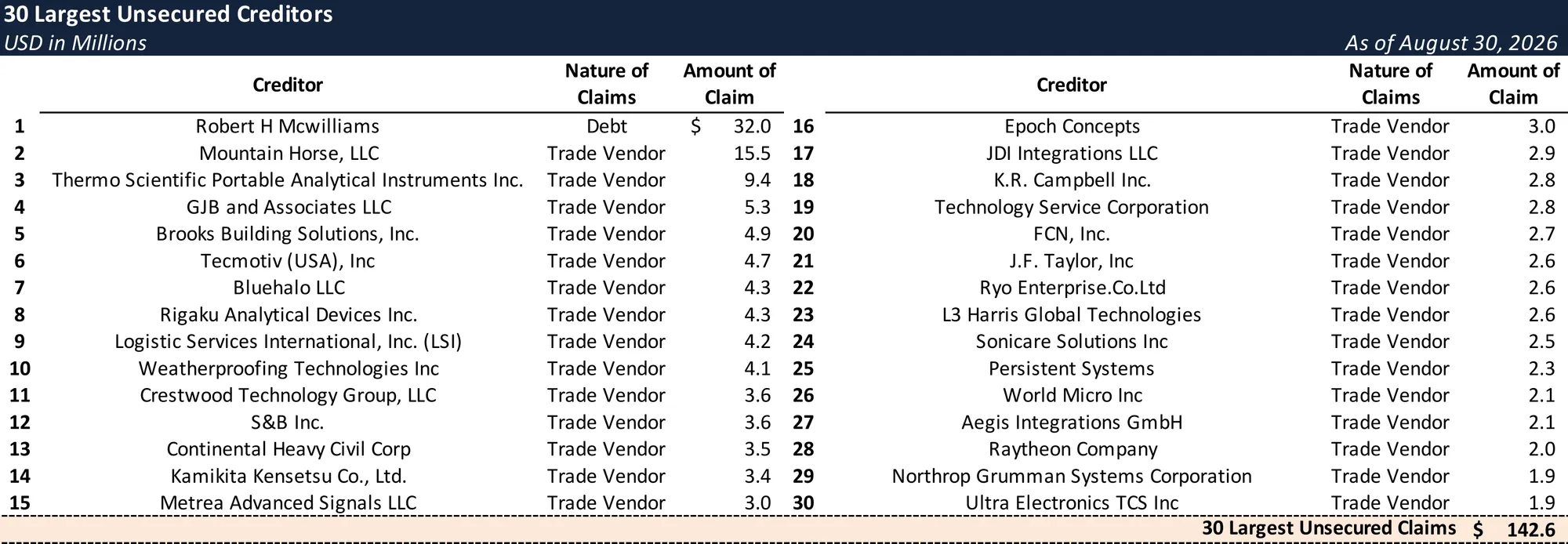
The thirty largest unsecured claims total approximately $142.6 million. The largest is not a trade claim. Robert H. McWilliams holds $32.0 million, recorded as debt rather than trade, more than double the next claim and equal to 87.3% of the seller note balance. McWilliams led the 2015 buyout of Federal Resources and served as its chief executive and later president and chairman. The public record supports the inference that the estate's largest unsecured creditor holds the majority of the unsecured seller note in the capital structure.
Events Leading to Bankruptcy
The FSG-53 Ramp-Up and the Working-Capital Inversion
The DLA's aviation arm awarded FSG-53 to Noble as sole supplier in June 2021, a contract the Debtors describe as worth $1.2 billion over ten years. It covered hardware and abrasives used as spare parts across multiple weapons systems — the commodity fasteners, fittings and finishing materials that keep military aircraft in service, purchased by the Army, Navy, Air Force and Marine Corps. The announced value at award was $263.4 million, covering only the three-year base and one-year transition period through June 27, 2025; the two three-year option periods extending the term to 2031, and the balance of the $1.2 billion, remained at the agency's discretion.
FSG-53 was a large expansion of the capital-intensive side of Noble's portfolio. Where HTCS work relies on vendors shipping directly to customers, FSG-53 required Noble to buy the inventory, warehouse it and distribute it itself, against stringent on-time delivery requirements. Noble spent tens of millions of dollars leasing a warehouse in Olive Branch, MS, training employees, deploying automation technology and purchasing inventory, expenditures the Debtors state were made in reliance on the contract's ten-year term and the DLA's demand forecast. On the Debtors' account it did not receive its first order until July 2023, and it received no additional lender capital during the transition period. Long lead-time materials and delivery requirements produced a lag as long as eighteen months between Noble's inventory purchases and the DLA's payment.
The DLA Non-Renewals
In December 2024 the DLA wrote to Noble stating that it did not intend to renew FSG-53, while asking for a two-year base extension so the agency could locate a replacement supplier. The decision effectively cut the contract's term from ten years to four and significantly devalued the capital investments Noble had made to support it. The DLA then declined to follow the contract's 24-month closeout procedures or honor its end-of-contract inventory buyback, leaving Noble with over $70 million in inventory and purchase obligations made in support of the program.
The agency's non-renewals subsequently reached a second program. In January 2026 the DLA sent notice of its intent to renew Noble's Fire and Emergency Services Equipment ("FESE") contract, only to reverse course with a notice of non-renewal on March 13, 2026. Further non-renewal notices on other critical contracts followed in May, and Noble's attempts to repair the relationship through in-person meetings with DLA personnel were largely unsuccessful. According to the Debtors, these actions deepened Noble's financial distress and undermined its stakeholders' confidence in the business.
The Government Shutdown
On October 1, 2025, Congress failed to pass a budget or continuing resolution and the federal government shut down for seven weeks. Unlike the non-renewals, which reached one contract at a time, the shutdown affected Noble's entire customer base at once: customers across every program stopped placing orders and stopped paying, while existing orders still required expenditure on material and shipping. The collection problems persisted past the November 12 reopening into a holiday season historically slow for government payments.
Defaults and Forbearance
On February 14, 2026, the term loan agent sent Noble a notice of default and reservation of rights, citing failures to meet inventory milestones and to comply with financial covenants for the December 31, 2025 testing period. The subordinated note agent followed days later and the ABL agent on March 5. Noble operated in default of its loan agreements from that point forward.
The ABL's own maturity was the next pressure point. On July 31, 2026, Noble and the ABL agent entered into a forbearance agreement extending the ABL maturity to September 30, 2026. The extension came with conditions: the parties agreed to a budget contemplating only limited vendor payments and other critical disbursements, structured to effect a paydown of the ABL facility over a six-week period. Noble's ability to draw further amounts under the facility terminated on August 28, 2026.
Refinancing Efforts
Noble's search for capital predated the defaults. From early 2024 it explored refinancing the term loan to escape burdensome covenants, approaching various interested parties including Bain Special Situations; those discussions failed to close over concerns about anticipated levels of future federal defense spending, among other challenges. Following the DLA's non-renewal notice, Noble redoubled its efforts in early 2025, this time turning to its existing lenders. In June 2025 the subordinated noteholders provided an additional $25 million, taking warrants for approximately 4.95 million shares of the Debtors' equity, and the term loan agent consented to the factoring of receivables.
In April 2026 Noble turned to the ABL, seeking to refinance it ahead of the July 31 maturity. Seventeen of the nineteen parties contacted signed non-disclosure agreements and several provided indications of interest, but ongoing operational challenges, tight liquidity and onerous contract obligations kept any transaction from closing. Working capital demands intensified through the summer, compounded by approximately $4.9 million paid to the Internal Revenue Service on 2024 income tax liabilities, alongside rising professional fees from the lender negotiations and reduced availability under the JPMorgan credit card program. Ultimately on July 24, 2026, the term loan lenders formally declined to provide additional financing, closing the last lender avenue.
Appeals to the DLA and the Pentagon
On July 29 Noble held a telephonic conference with key DLA personnel, sharing sensitive financial information and requesting an expedited review for financial support, however, the agency gave no indication it would engage. On or about August 11 the Debtors' outside counsel previewed a Contract Disputes Act claim of approximately $86 million against the DLA over FSG-53, without resolution. On August 19 chairman and CEO Thomas Noble wrote to Defense Secretary Pete Hegseth describing the company as on "the brink of collapse" and warning it might file within 60 days. The letter said the DLA had proposed a one-year extension of FSG-53 in October, that Noble kept buying inventory on that basis, and that the agency then declined the extension and imposed a hard stop in June, leaving roughly $72 million in inventory and commitments. It urged binding deadlines for termination decisions and inventory buybacks.
The answer ultimately came on August 27, when the DLA terminated approximately $400 million of orders under the SOE contract. The Debtors state they are evaluating options regarding this termination and currently intend to appeal the DLA's decision.
Chapter 11 Filing
The Dual-Track Sale and Liquidation
The Debtors are pursuing two paths in parallel: a court-supervised marketing and sale process for some or all of the assets on a going-concern basis, targeted for completion in approximately 75 days, and an orderly monetization of inventory, receivables and other assets structured to run in concert with that process rather than to foreclose a sale. In the cash collateral motion the Debtors put it more plainly — they commenced these cases to pursue a sale, and intend to pivot to an orderly wind-down if the process does not yield an acceptable bid.
Portage Point, the Debtors' financial advisor, gauged market interest prepetition in both a going-concern sale and financing. Eight parties executed non-disclosure agreements and received data room access or met with Noble and Portage Point, and neither effort produced a purchaser or a financing source. Portage Point's retention was itself a concession Noble made to its term loan lenders in the course of emergency-financing discussions. It was the third approach to the market after the term loan refinancing and the ABL refinancing described above, and the only one aimed at a sale rather than new capital.
The asset base pulls in two directions. A strategic buyer could value the contract vehicles, vendor network, systems and overseas infrastructure above liquidation value, but preserving those intangibles requires paying employees and critical vendors and maintaining contract performance, while waiting erodes the cash and inventory that underpin the liquidation floor.
Noble's own history offers one reference point for where a strategic bid might come from. Its 2021 acquisitions of TSSi and Federal Resources took out two of the five other winners on the SOE program within ten months of that award, consolidating three of six positions on a shared vehicle into one enterprise. Whether that logic runs in reverse is untested, but the companies holding positions alongside Noble on the SOE and FESE vehicles are among the parties for whom acquiring a co-awardee would be a direct route to a larger share of the same program.
Cash Collateral Key Terms
The Debtors are funding these cases through consensual use of cash collateral rather than DIP financing. They entered chapter 11 with approximately $20,000 of available cash, subject to the prepetition secured parties' liens. On September 1, the Court authorized the use of cash collateral on an interim basis.
- Directing Agent — The interim order splits authority by collateral type. Blue Torch directs as to term loan priority collateral, while JPMorgan directs as to ABL priority collateral until the ABL obligations are paid in full and the letters of credit are cash collateralized, at which point that role passes to Blue Torch. By the Petition Date the ABL had been reduced to roughly $759,000 in letters of credit and $210,000 outstanding on a $362,000 credit card line against an $85 million commitment, with drawing terminated and a zero ending balance budgeted in every week of the forecast.
- Letters of Credit — Cash collateralized at 105% after the ABL obligations are repaid. No new letters of credit without the ABL lenders' consent.
- Milestones — Six milestones run from the Petition Date: entry of the interim order within 3 days; commencement of negotiations with the DLA over the FSG-53 contract and inventory within 10 days; an executed asset purchase agreement or a filed plan and disclosure statement within 14 days; entry of the final order and of a bid procedures order within 35 days; and a consummated sale or confirmed plan within 75 days.
- Credit Bidding — Subject to the intercreditor agreements, the prepetition agents may credit bid up to the full amount of the prepetition secured debt and the adequate protection obligations in any sale, without further court order. Adequate protection obligations must be fixed by court order before being bid.
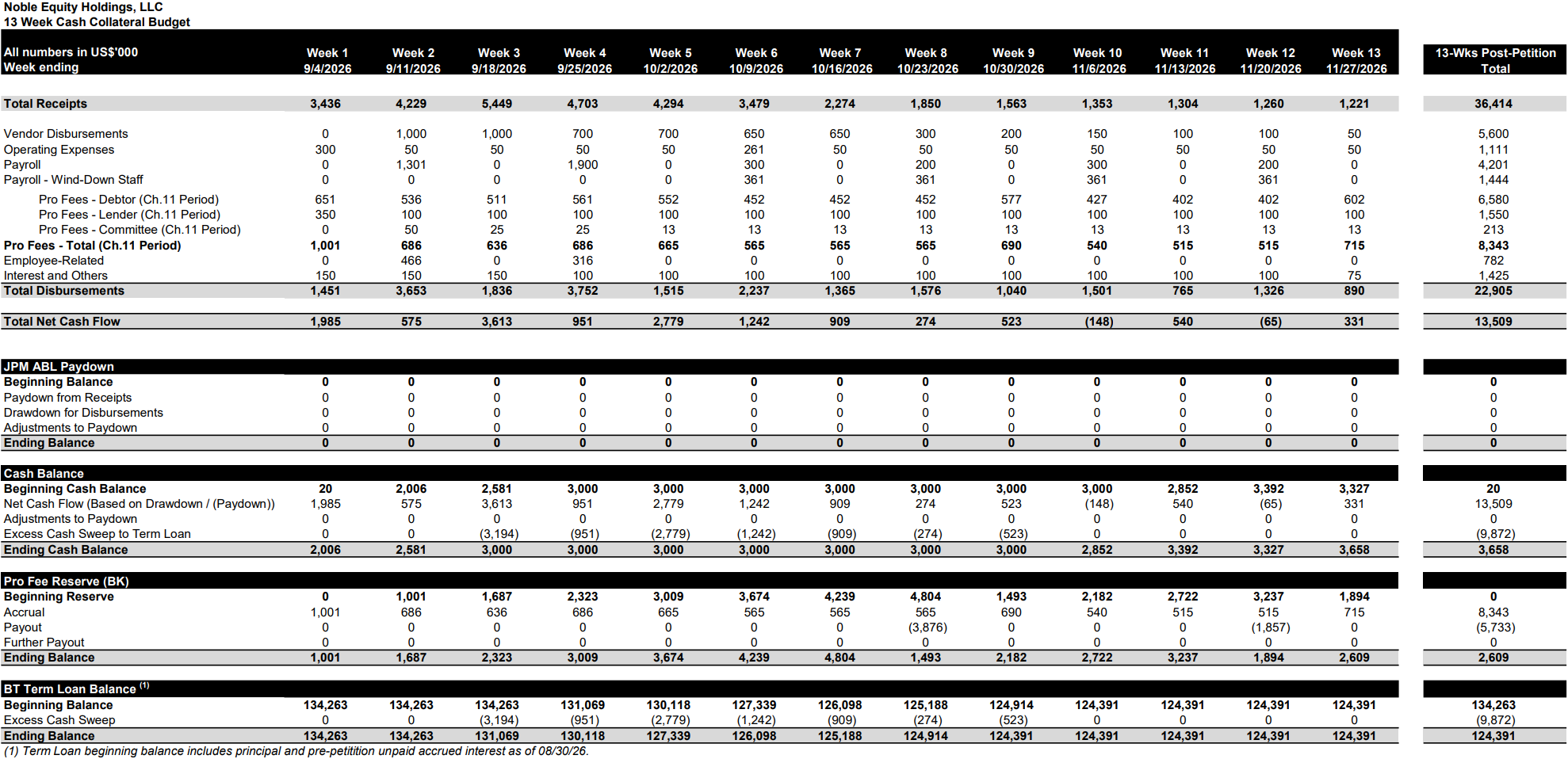
- Professional Fees Carve-out — On a Carve Out Trigger Notice, post-trigger professional fees for the Debtors and any committee are capped at $500,000, against $8.3 million of fees in the thirteen-week budget. The reserve is funded weekly; surplus reverts to the lenders.
- Committee Budget — $50,000 to investigate liens securing roughly $255.6 million. No committee has been appointed as of the interim order.
- Challenge Period — The challenge period runs 75 days from entry of the interim order, two days past the day 75 deadline for a consummated sale or confirmed plan. On the sale track, the assets could change hands before the window to challenge the liens over them closes.
- Variance Testing — Rolling two-week periods beginning September 3, with permitted deviations of 15% on receipts and 10% on disbursements. A failed test is a termination event. Budgeted receipts fall from $5.4 million in week three to $1.2 million by week thirteen.
The thirteen-week initial budget projects receipts of $36.4 million against disbursements of $22.9 million, of which professional fees account for $8.3 million against $5.6 million of vendor disbursements. The term loan balance is swept from $134.3 million to $124.4 million over the period, and an excess-cash sweep holds operating cash near $3.0 million.
Key Issues to Watch
- Claims Against the DLA — Noble has pursued a Contract Disputes Act claim for approximately $86 million on FSG-53 and states that it currently intends to appeal the cancellation of roughly $400 million of SOE orders. Neither has been adjudicated, and neither had been formally submitted as of the Petition Date. What the estate ultimately recovers is subject to setoff: under Cherry Cotton Mills v. United States, the government's agencies are not separate creditors for setoff purposes, so amounts the DLA owes Noble may be netted against amounts Noble owes elsewhere in the government.
- Contract Transferability — Contract transferability is the second constraint. 41 U.S.C. § 6305 prohibits transferring a government contract to a third party. Under FAR 42.1204, the government may recognize a successor in interest where the transfer covers all of the contractor's assets or the entire portion used to perform the contract, but that recognition rests on the contracting officer's determination of the government's interest. Where the government declines, the original contractor remains bound and may be terminated for default; where it agrees, the standard novation agreement provides that the transferor guarantees the transferee's performance. Bankruptcy does not displace the framework: section 365(c)(1) bars assumption or assignment where applicable law excuses the counterparty from accepting performance from another entity, and in In re West Electronics the Third Circuit applied that bar to a chapter 11 defense contractor seeking to assume an Air Force contract over the government's objection. A purchaser would need the government's consent, contract by contract.
Explore Bondoro Insights for live case dockets and comprehensive coverage of material filings from petition to plan confirmation.
Stay informed on every Chapter 11 bankruptcy case with liabilities exceeding $10 million. Subscribe for free to have our coverage delivered directly to your inbox, and explore our full archive of past summaries.
Subscribers can also opt in to timely filing alerts by updating their email preferences in Account Settings.


