Case Summary: BFG Supply Chapter 11
BFG Supply, a lawn, garden and greenhouse products distributor, filed for Chapter 11 after sales force turnover drove customer attrition and suppliers tightened trade credit, pursuing a going-concern sale alongside an already-underway inventory liquidation, funded by a DIP facility of up to $55M.

A deck version of this summary is also available HERE.
Business Description
BFG Supply Co., LLC ("BFG") and sixteen Debtor affiliates (collectively, the "Debtors") distribute lawn and garden products, greenhouse supplies, nursery products, controlled-environment agriculture products, greenhouse structures and related equipment to professional customers across the United States and Canada. The Debtors' revenue splits across three end markets — Lawn & Garden at approximately 52%, Commercial Grower at approximately 27%, and Hydroponics at approximately 21%.
Alongside distribution, the Debtors operate greenhouse manufacturing, greenhouse construction, installation and related horticultural support businesses, and sell direct-to-customer through the Greenhouse Megastore eCommerce platform acquired in December 2021. The Debtors operate nineteen facilities across the United States and Canada, seventeen of which are distribution centers spanning more than 1.5 million square feet of warehouse space.
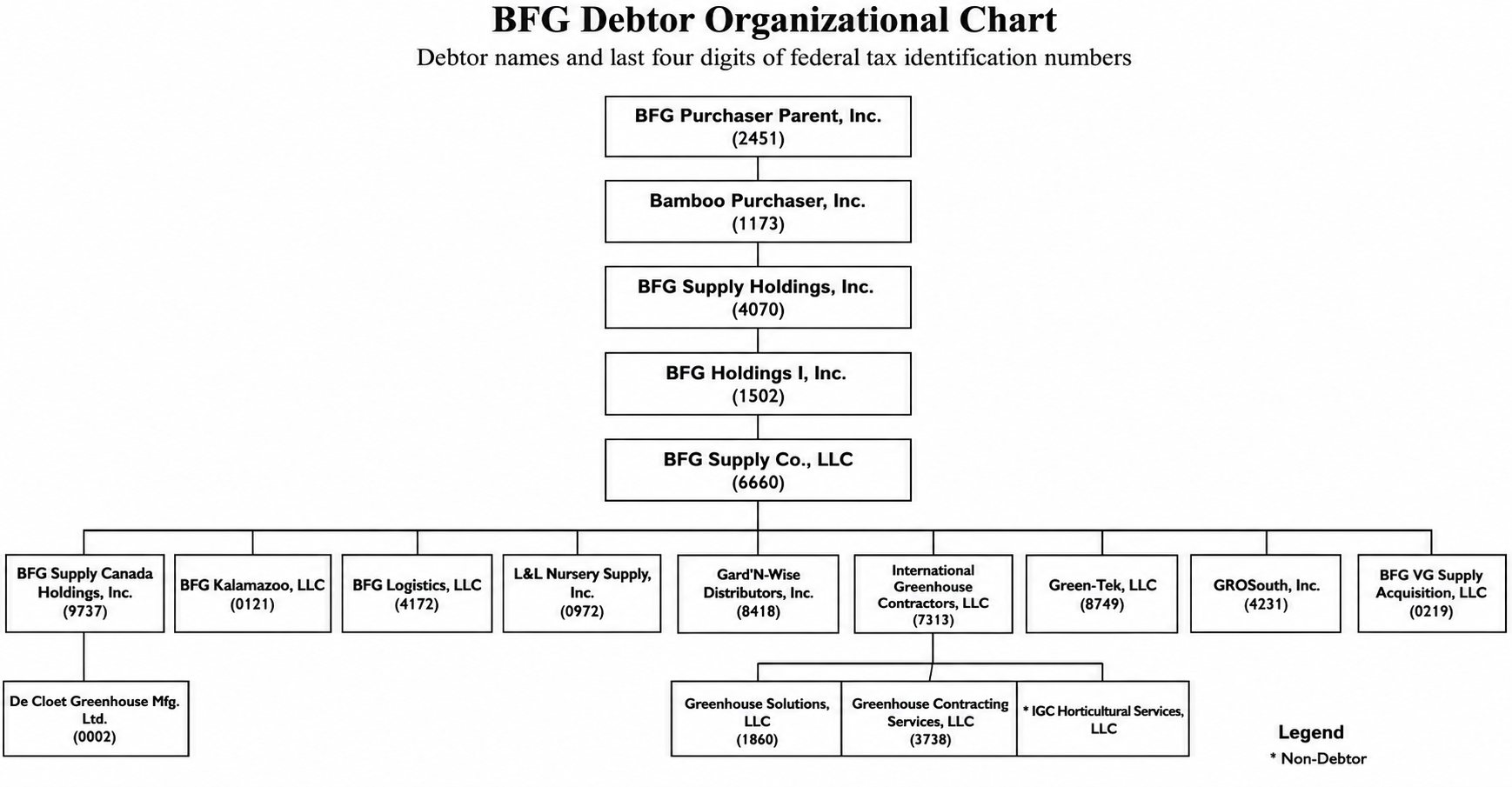
BFG Supply Co., LLC and certain affiliates⁽¹⁾ filed for Chapter 11 protection on August 18, 2026 (the "Petition Date") in the U.S. Bankruptcy Court for the District of Delaware, reporting $100 million to $500 million in both assets and liabilities.
⁽¹⁾ For a complete list of Debtor entities, see organizational structure chart below.
Corporate History
Founding and Early Expansion (1972–2010)
BFG Supply was founded in 1972 by John Gander, who saw a need for a horticultural distributor in the Great Lakes region and ran the business out of a local barn in Burton, OH, distributing to area greenhouse growers and staffing with friends and family. A warehouse followed, then gradual expansion into new territories.
Institutional capital arrived in 2000, when Indianapolis private equity firm Cardinal Ventures LLC became principal owner. The decade that followed established the acquisition pattern that would define the enterprise: J.G. Smith & Co. of Batavia, IL in 2002 opened the Illinois, Wisconsin, Iowa and Missouri markets, Brighton By-Products in 2003 broadened coverage of western Pennsylvania growers, and MDM Horticultural Supplies of Minneapolis in 2006 pushed the territory to the Dakotas. BFG built alongside its acquisitions, opening service centers in De Forest, WI and Louisville, KY and acquiring the Kalamazoo Co-op in 2007, which became the third hub in its warehouse chain.
Tricor Pacific and Scale, 2010–2020
Vancouver private equity firm Tricor Pacific Capital acquired BFG in September 2010, by which point the company ran 14 service centers across 17 states and called itself the largest horticultural distributor in the Midwest. The transformative deal came a year later with Wetsel Inc., a century-old business carrying 17,000 stocked items from 275 manufacturers, which extended coverage to 23 states and added Lawn and Garden and Turf to a company built on the professional grower; JR Johnson followed later in 2011. In January 2013 BFG took a 200,000 square foot lawn and garden warehouse in Grand Rapids, MI.
Two Sponsors, Eight Acquisitions, 2020–2024
Tricor Pacific Capital, renamed Parallel49 Equity in 2015, sold BFG to Incline Equity Partners in January 2020. Incline held the company for roughly 22 months, exiting to Pamplona Capital Management in November 2021. Under Incline's ownership, BFG completed three acquisitions:
- Gard'N-Wise Distributors (December 2020) — extended BFG into the Midwest, Southwest and Mountain West.
- L&L Nursery Supply (March 2021) — San Bernardino, CA distributor whose West Coast warehouses took the combined company to 14 sites and more than 1.0 million square feet.
- De Cloet Greenhouse Manufacturing (July 2021) — Ontario greenhouse structure manufacturer and the origin of BFG's Canadian operations.
Pamplona remains the company's principal equity investor as of the Petition Date. Under Pamplona ownership the acquisitions continued, moving beyond distribution into manufacturing and e-commerce. BFG completed five more transactions under Pamplona's management:
- Greenhouse Megastore (December 2021) — Danville, IL distributor of hobby and commercial greenhouse structures founded in 1993, adding an e-commerce channel and taking the combined company to 17 warehouses and more than 1.2 million square feet.
- Green-Tek (April 2022) — Clinton, WI manufacturer of shade cloth, films and polycarbonate coverings, lifting the network to 20 warehouses and more than 1.3 million square feet.
- GROSouth (July 2022) — Montgomery, AL lawn and garden distributor founded in 1945, serving eight Southeastern states and bringing the platform to 21 warehouses and more than 1.4 million square feet.
- Central Garden & Pet's Independent Garden Center Distribution Business (July 2023) — acquired for approximately $20 million; Central's Form 10-K describes divesting the business because it could not find a path to profitability.
- VG Supply (June 2024) — upper Midwest lawn, garden and outdoor living distributor whose Munster, IN distribution center stayed open post-close.
Corporate Organizational Structure
The Debtors' organizational structure reflects the series of acquisitions and financing transactions undertaken over many years, with certain holding companies existing principally to facilitate ownership and financing arrangements. BFG Supply Investment Holdings, LP sits at the top, with Pamplona Equity Partners, L.P. as principal equity investor alongside certain other investors, followed by a series of intermediate holding companies. Those upstream entities have not filed; the Chapter 11 cases begin at BFG Purchaser Parent, Inc., which owns Bamboo Purchaser, Inc., BFG Supply Holdings, Inc. and BFG Holdings I, Inc. in a straight chain down to BFG Supply Co., LLC.
Operating assets are concentrated at BFG Supply Co., LLC, the principal operating entity for substantially all wholesale distribution activity, which in turn owns nine direct subsidiaries. Two branches run a level deeper. BFG Supply Canada Holdings, Inc., a Delaware holding company, owns De Cloet Greenhouse Mfg. Ltd., an Ontario corporation and the Debtors' only Canadian entity, which is expected to commence ancillary proceedings under Part IV of the Companies' Creditors Arrangement Act before the Ontario Superior Court of Justice seeking recognition of the Chapter 11 cases as a foreign main proceeding. International Greenhouse Contractors, LLC owns Greenhouse Solutions, LLC and Greenhouse Contracting Services, LLC, along with IGC Horticultural Services, LLC — the only non-Debtor entity appearing on the organizational chart.
Operations Overview
Fulfillment and Seasonality
Sales run through two channels. Approximately 60% of revenue comes from warehouse fulfillment, where products are purchased, warehoused and distributed through the Debtors' own network; the remaining approximately 40% ships directly from suppliers to customers under vendor-direct arrangements the Debtors coordinate. The Declaration describes the combination as a way to offer broad product availability while managing inventory levels across thousands of products.
The business is seasonal. Inventory must be built well in advance of the spring selling season, so revolver borrowings historically rose during periods of inventory accumulation and fell as seasonal receivables were collected.
The seasonality is a channel-wide feature rather than a BFG-specific one. Central Garden & Pet, which sold BFG its independent garden center distribution business in 2023, reports in its FY2025 Form 10-K that approximately 64% of Garden segment net sales fell in its second and third fiscal quarters, with substantially all of the segment's operating income generated in that window, and that its working capital needs and borrowings peak in the second fiscal quarter because it is generating lower revenues while incurring expenses ahead of the spring selling season.
Facilities and Footprint
Three of the Debtors' nineteen facilities are owned — Danville, IL; Kalamazoo, MI; and Simcoe, Ontario — and sixteen are leased across Pennsylvania, Michigan, Minnesota, Virginia, Wisconsin, Georgia, Indiana, Illinois, Colorado, California, Washington and Texas. The two that are not distribution centers are a greenhouse manufacturing facility in Simcoe and a customer showroom in Marietta, Georgia. A fleet of approximately 15 leased trucks and trailers ships product from certain warehouse locations, complementing the broader freight and logistics infrastructure.
Customers and Suppliers
The Debtors sell wholesale to commercial growers, nurseries and independent garden centers, alongside regional greenhouse operators, hydroponic retailers, commercial cultivators and greenhouse contractors. Roughly 11,000 commercial customers generate approximately 270,000 orders annually. Several programs sit atop those relationships: annual volume rebates paid as credit against future purchases, a return and shortage policy covering damaged goods and short shipments, a defective allowance giving high-volume customers a proactive discount in lieu of per-item credits, customer deposits tied largely to greenhouse orders at De Cloet, and a co-op advertising program in which the Debtors act as intermediary between vendors and customers.
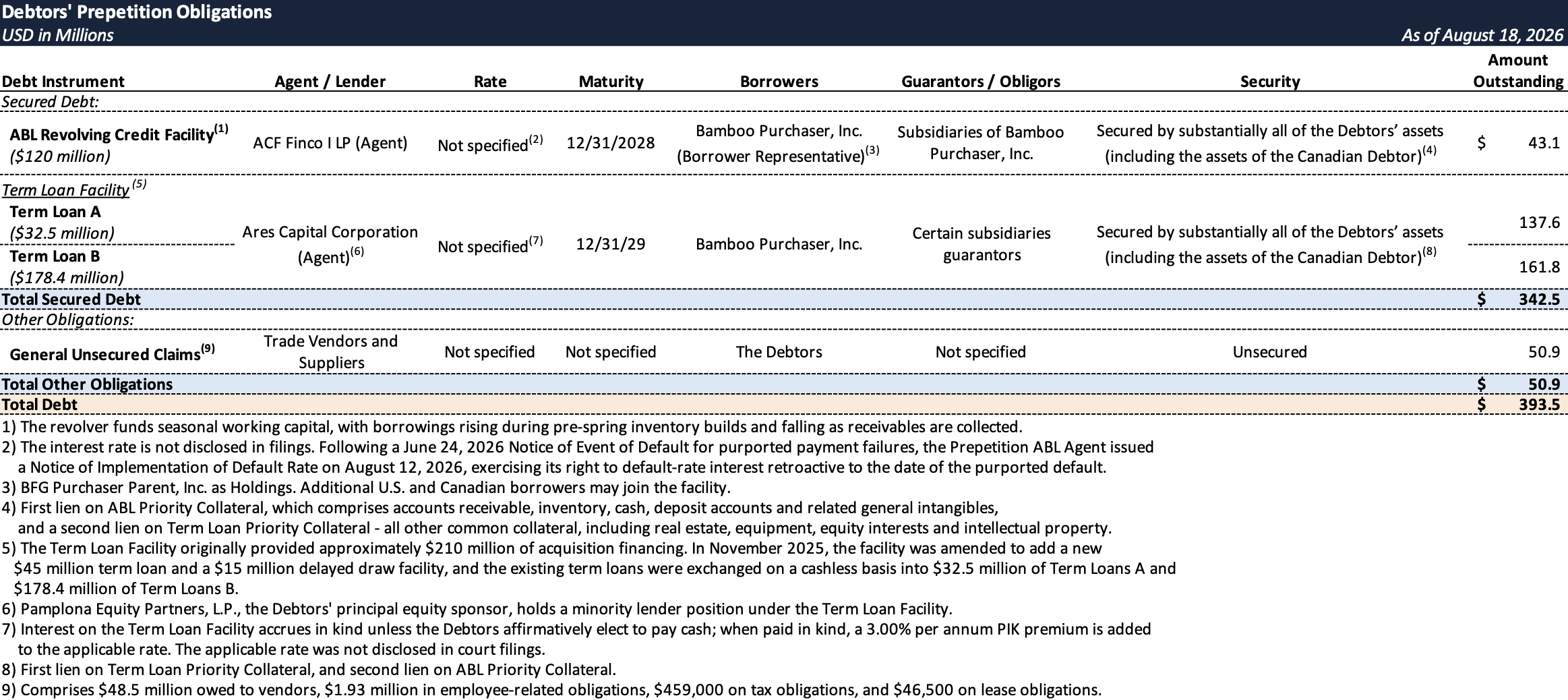
On the supply side, the Debtors maintain relationships with approximately 1,100 active suppliers and offer more than 100,000 SKUs, a scale the First Day Declaration describes as making them an important distribution channel for manufacturers serving a fragmented industry. Suppliers provide machinery and equipment, information technology, billing and invoicing, customs, shipping and transportation services among other goods. Accounts payable owing to vendors stood at approximately $48.5 million at the Petition Date.
Workforce and Shared Functions
The Debtors' headcount peaked at approximately 700 across distribution, manufacturing, logistics, sales and administrative functions. As of the Petition Date the Debtors employed approximately 461 full-time employees, 31 of them at De Cloet Greenhouse Mfg. Ltd., the Ontario-incorporated Canadian Debtor, alongside roughly seven independent contractors providing sales representative, information technology, and greenhouse building and subcontracting services. Payroll runs approximately $4.5 million a month, paid biweekly and two weeks in arrears, with withholdings of approximately $1.2 million per pay period. Accrued but unpaid prepetition wages stood at approximately $0.6 million at filing.
The Debtors operate through seventeen legal entities but function as a single commercial enterprise, serving many of the same suppliers and customers through common management, coordinated purchasing, shared logistics and centralized administrative functions. The operating subsidiaries report to a common executive leadership team, including a single Chief Executive Officer and a single Chief Financial Officer, and disbursements run through a centralized cash management system funded from a main operating account held by BFG Supply Co., LLC.
Prepetition Obligations
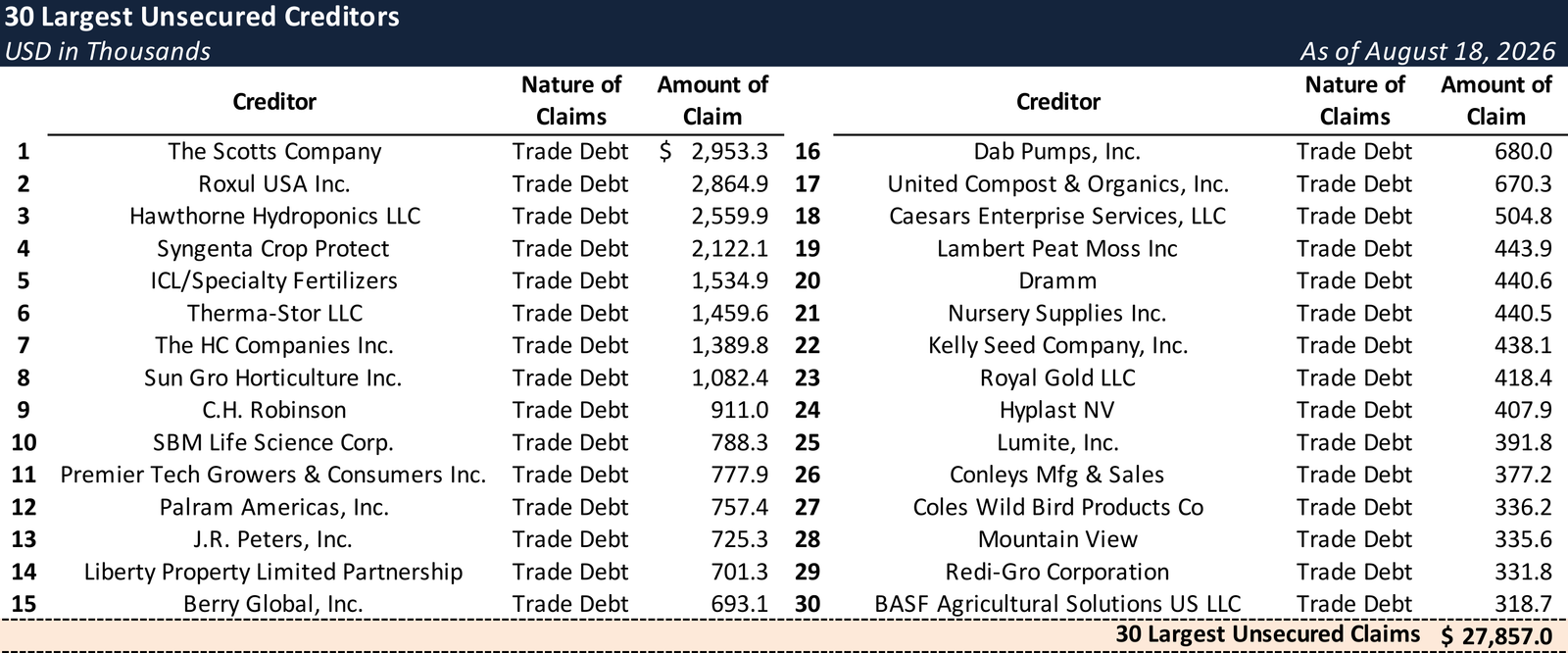
Top Unsecured Claims
Events Leading to Bankruptcy
Revenue Deterioration and Escalating Operating Expenses
Consolidated revenue held roughly flat at approximately $573.7 million in fiscal 2024 and $581.5 million in fiscal 2025 before falling approximately 8% to approximately $536.5 million in fiscal 2026. The Declaration attributes the decline principally to customer attrition during fiscal 2026 stemming from turnover in the sales organization: the departure of numerous experienced representatives cost the company relationships those individuals had historically managed, and while replacements were recruited, new representatives required time to establish relationships and rebuild the lost business.
Against declining revenue, the Debtors' cost structure remained elevated. Acquisitions completed between 2021 and 2024 — including Central Garden & Pet's independent garden center distribution business in July 2023 and VG Supply roughly a year later — arrived with separate facilities, distinct customer bases and multiple legacy operating and technology systems requiring rationalization. Those businesses were never fully integrated, perpetuating duplicative costs across the combined platform and constraining capacity to reduce the debt raised to finance them. The Debtors implemented cost-reduction initiatives, but the savings from these programs proved insufficient to offset the declines in revenue and gross margin over the same period.
Liquidity Constraints
Falling revenue reduced operating cash flow and, because the revolver is asset-based, cut borrowing availability with it: availability was tied to a borrowing base of eligible receivables and eligible inventory, so fewer sales meant fewer receivables, a smaller maximum draw, and less cash for payroll, vendor obligations and other operating expenses. That left the Debtors increasingly reliant on vendor credit to maintain inventory.
Suppliers had historically extended substantial trade credit, financing inventory purchases in the ordinary course. As liquidity deteriorated, certain suppliers reduced available credit, shortened payment terms or limited availability, impairing the Debtors' ability to buy the products needed to fill customer orders. Customer demand remained relatively healthy through portions of this period; the constraint was obtaining inventory, not generating orders.
The cycle then became self-reinforcing. Thinner inventory drove lower sales volumes, which further reduced cash flow and prompted additional suppliers to tighten credit, while the asset-based structure contracted the borrowing base alongside the declining inventory. Reduced purchasing flexibility, changing product mix and pricing pressures compressed gross margins through much of fiscal 2025 and 2026, and the cycle became increasingly difficult to reverse outside a comprehensive restructuring.
Prepetition Restructuring Efforts
On the operational side, the Debtors pursued workforce reductions, facility rationalization and other cost-reduction measures, adopted liquidity management procedures to allocate limited cash among competing demands, and engaged lenders, suppliers and business partners around access to vendor trade credit.
Restructuring efforts extended to the capital structure as well. In November 2025 the parties added new term loan capacity, extended the maturities of the existing instruments, exchanged the existing term loans into two classes, and shifted the Term Loan Facility to interest paid in kind unless the Debtors affirmatively elect cash. Management approached existing lenders about further amendments in the months that followed, sought additional sources of capital, evaluated strategic transactions and weighed other out-of-court alternatives. None produced the liquidity or consensual financing needed to fund working capital. On June 24, 2026 the ABL Agent issued a Notice of Event of Default, followed by a Notice of Implementation of Default Rate on August 12, six days before the petition.
The Chapter 11 Filing
The Debtors entered Chapter 11 with three sale processes already in motion, each under a dedicated advisor, funded by a $55 million superpriority asset-based DIP facility:
- SSG Advisors marketing the businesses and assets on a going-concern basis;
- A joint venture of SB360 Capital Partners and Tiger Capital Group monetizing inventory, receivables and equipment, a program already underway at filing; and
- A&G Realty Partners marketing the three owned properties and the Debtors' interests in sixteen leases.
The $55 Million Revolving DIP Facility
The Debtors received interim approval for a superpriority senior secured asset-based revolving DIP facility of up to $55 million, with up to $22 million permitted to be outstanding at any one time prior to entry of the final order. Both figures cap the balance at a given point rather than cumulative advances: because the facility revolves, collections pay it down and the Debtors re-borrow, so total draws over the case will exceed either number without ever breaching it. ACF FinCo I LP — the prepetition ABL agent — serves as DIP Agent and Collateral Agent, and the DIP Lenders are the prepetition revolving lenders participating pro rata according to their existing commitments. Bamboo Purchaser, Inc. is borrower, with BFG Purchaser Parent, Inc. and each direct and indirect subsidiary as guarantors.
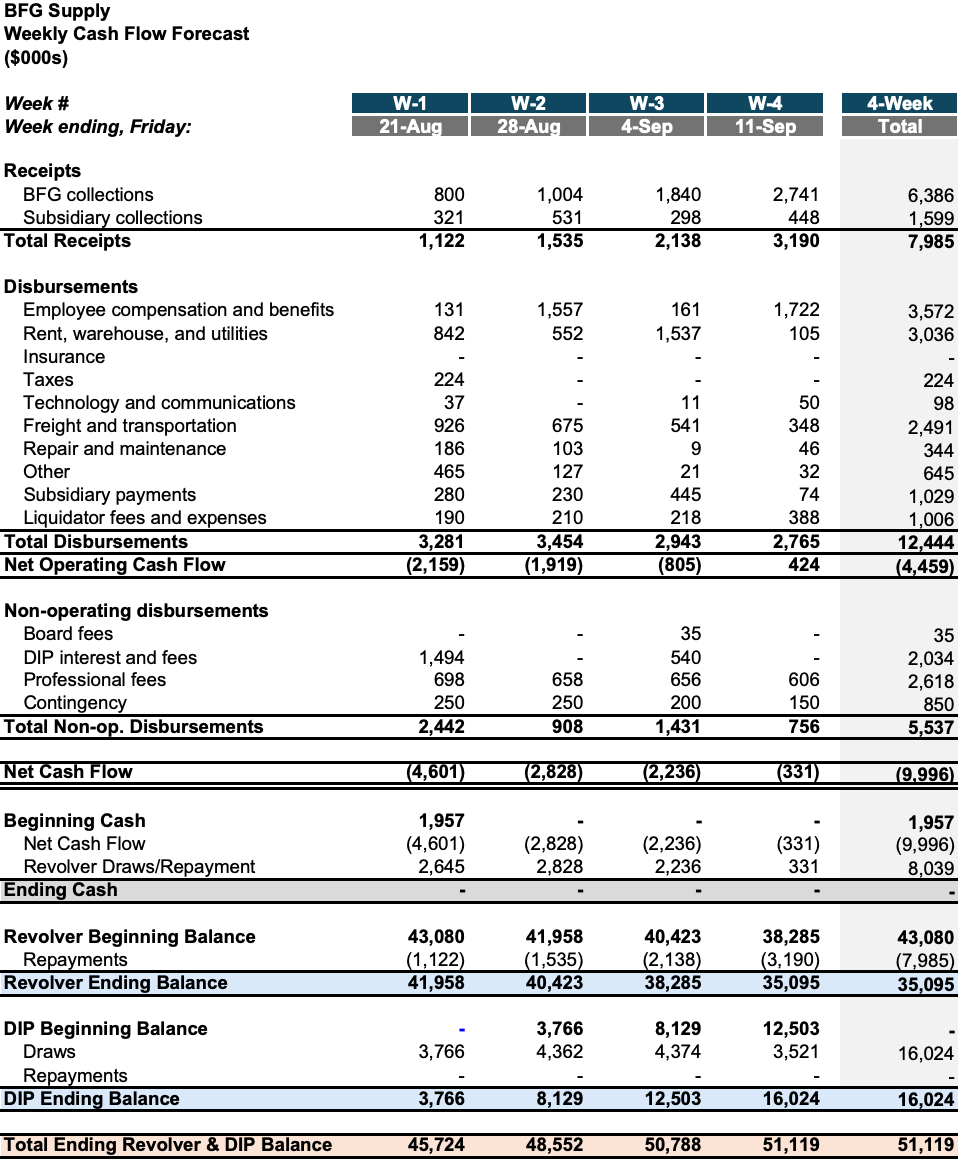
- Roll-Up Mechanics — The interim order approves what it calls a "creeping roll-up": all cash collateral is applied to pay down the prepetition revolving loans, giving rise to a corresponding amount of availability under the DIP facility, which the Debtors then draw to fund operations. Prepetition exposure therefore converts into superpriority DIP debt one collection at a time, at whatever pace receipts arrive, with any balance still outstanding at entry of the final order converting in a single step. The interim budget projects the first four weeks: $7.985 million of receipts pays the revolver from $43.080 million to $35.095 million while the DIP balance climbs to $16.024 million, taking combined exposure to $51.119 million. Of that DIP balance, $7.985 million is the roll-up and the remaining $8.039 million is new money.
- Borrowing Base — 90% of eligible accounts and eligible credit card receivables; 85% of eligible extended terms receivables, capped at $10 million between June 1 and September 30; the lesser of 65% of cost or 90% of net orderly liquidation value of eligible inventory; less reserves.
- Pricing — Alternate Base Rate plus 4.75%, with SOFR and CORRA loans unavailable; default rate adds 2.00%; commitment fee of 0.75% per annum on the average daily unused portion.
- Maturity — The earliest of February 14, 2027 (180 days after the Petition Date), fourteen days after entry of an order confirming a plan, consummation of a §363 sale of substantially all working capital assets, or acceleration following an event of default.
- Carve Out — Professional fees incurred under the Approved Budget before a Carve Out Trigger Notice, plus post-notice fee caps of $250,000 for the Debtors' professionals (Cole Schotz and Reflect Advisors) and $50,000 for any committee's professionals, together with U.S. Trustee and Clerk fees and up to $50,000 for a Chapter 7 trustee.
- Permitted Variances — Receipts at 85.0%/87.5%/90.0% of budget, expenses at 115.0%/112.5%/110.0%, and borrowing at 115.0% of budgeted revolving exposure, tested weekly and reported to the DIP Agent and both prepetition agents. A breach is an event of default.
- Challenge Period — Parties in interest have 75 calendar days from entry of the interim order — through November 3, 2026 — to challenge the Debtors' stipulations as to the validity, priority and enforceability of the prepetition liens and obligations, and to challenge the roll-up and the adequate protection payments. A committee's investigation is capped at $50,000, separate from the fee protection above. The period may be extended by the applicable prepetition secured creditor in its sole discretion or by the Court for good cause, and a conversion to Chapter 7 or appointment of a trustee before expiry adds 60 days to whatever remains.
Interim Approved Budget
Bidding Procedures
The Debtors filed the Bidding Procedures Motion on August 19, the day after the petition, seeking approval of procedures governing a sale of "all, substantially all, or one or more portions of the Debtors' assets." The proposed timeline is compressed — 45 days from the petition to the bid deadline and 57 to the sale hearing — which the Debtors ground in their limited liquidity. No order had been entered as of the last docket entry in this record.
- Qualified Bid — a bid qualifies only if accompanied by a cash deposit of 10% of the purchase price and an executed asset purchase agreement marked against the Debtors' form, carrying no financing contingencies and supported by evidence of financial capacity and adequate assurance information. Bidders must commit to close by October 22, agree to serve as backup bidder, accept the assets as-is and where-is, waive any substantial contribution claim, and certify that they have not colluded with other bidders.
- Minimum Bid Amount — where a stalking horse is designated, competing bids must exceed the stalking horse value plus Bid Protections plus the Minimum Overbid. Neither component is fixed: Bid Protections would be set in a later Stalking Horse Notice, and the Minimum Overbid is to be determined once bids are received. Absent a stalking horse, the Debtors may set a minimum bid and notify prospective bidders by October 5.
- Credit Bidding — the DIP Agent and Prepetition Agents may credit bid across DIP Obligations, Prepetition Secured Obligations and Adequate Protection Claims, and such a bid qualifies automatically, without a deposit, a Minimum Bid Amount, a financing showing, adequate assurance information, or any agreement to serve as backup bidder. Credit bids are excluded from Backup Bid selection and may be increased dollar-for-dollar at auction without cash consideration.
Liquidation Program
Running alongside the marketing process is an orderly liquidation conducted by a joint venture of SB360 Capital Partners, LLC and Tiger Capital Group, LLC under a consulting agreement dated July 28, 2026 — signed roughly three weeks before the filing. Sales began the first week of August; the motion cites an August 3 start date while the agreement contemplates commencement on or about August 4. The Debtors moved on the petition date to assume the agreement and sell the covered assets free and clear.
The agreement covers on-hand and in-transit inventory, machinery, equipment and fixtures at the Debtors' warehouses and distribution centers, and the collection or sale of accounts receivable. It does not cover the Debtors' owned real property or leasehold interests, which are being marketed separately by A&G Realty Partners, LLC.
- Advisory Fee — $50,000 on execution covering the first 30 days, then $50,000 per month, earned in full when paid and non-refundable
- Prepayment — $75,000 deposit held until the final reconciliation, which occurs within 20 days after the sale term ends
- Commission Structure — 4.5% of gross proceeds on inventory, 15.0% on machinery, equipment and fixtures, and 2.5% of amounts actually collected on receivables. The consultant earns no commission on assets sold through a credit bid or a going-concern sale resulting from another professional's engagement without its participation. The three rates fall across both collateral pools: receivables, inventory, cash and deposit accounts are ABL Priority Collateral, while equipment and the balance of the assets are Term Loan Priority Collateral. The interim DIP order polices the split — all proceeds of Term Loan Priority Collateral must be deposited into a segregated Term Loan Reserve, with no use or distribution absent court order or the written consent of both agents, and estate professionals must identify in their fee applications what portion of their work went to preserving or disposing of that collateral.
- Allocation of Remaining Fees — the advisory fee and reimbursable expenses are part of the same payment obligations but are not tied to any particular asset, and neither the agreement nor the orders allocate them between the two collateral pools. Both the consulting agreement order and the DIP order reserve all parties' rights to contest how collateral is characterized and how the consultant's compensation is ultimately allocated against it.
- Termination — 30 days' notice for any reason, or immediate notice if the Debtors pursue a going-concern sale of all or substantially all assets; no break-up or termination fee, with the Debtors liable only for accrued fees and expenses
The liquidation process serves as the floor and the sale process is the option on something better. The Debtors state the liquidation was structured to operate in tandem with the marketing process rather than to foreclose a sale, and the bidding procedures motion makes the dependency explicit: the expedited timeline is driven in part because early indications of interest in a going-concern sale will give the Debtors information critical to deciding whether to continue or halt the liquidation.
Other First Day Motions
- Utilities (Doc 4) — Interim Approval — Debtors seek approval of proposed adequate assurance: a segregated deposit account funded with $53,104, equal to roughly two weeks of utility service, against average monthly spend of approximately $106,208.
- Insurance (Doc 7) — Interim Approval — Debtors seek authority to maintain approximately 17 policies with aggregate annual premiums of approximately $1.6 million, pay related prepetition amounts capped at $200,000 on an interim basis, and continue Lockton brokerage fees, one Ohio license and permit bond, and one RBC customs letter of credit of CAD $140,000.
- Taxes (Doc 8) — Interim Approval — Debtors seek authority to pay prepetition income, franchise, property, sales and use, VAT, and business license obligations capped at $500,000 on an interim basis, with approximately $62,000 of income and franchise, $224,000 of property, and $150,000 of sales and use taxes coming due in the first 21 days.
- Customer Programs (Doc 9) — Interim Approval — Debtors seek authority to honor, modify, or terminate their customer programs in their discretion: approximately $1.6 million in accrued rebates, approximately $450,000 in monthly returns and shortage credits, approximately $1.2 million in customer deposits (largely De Cloet greenhouse orders), and approximately $715,000 in co-op advertising costs. Debtors presently intend to terminate the rebate program and stop accepting returns postpetition.
- Critical Vendors (Doc 10) — Interim Approval — Debtors seek authority to pay Critical Vendor Claims up to $2 million, fully available on entry of the interim order, covering machinery and equipment, IT, billing, customs, shipping, and transportation providers, conditioned on continued supply on Customary Trade Terms.
- Wages (Doc 12) — Interim Approval — Debtors seek authority to pay prepetition Employee Obligations of up to $1.06 million on an interim basis and $1.93 million on a final basis for approximately 461 full-time employees and seven independent contractors, including $0.6 million of accrued wages and $0.2 million of reimbursable expenses, and to continue benefit programs and the workers' compensation program.
- Cash Management (Doc 13) — Interim Approval — Debtors seek authority to continue their existing 16-account cash management system across Signature Bank (now Esquire Bank) and RBC, pay approximately $25,000 of prepetition bank fees, continue a credit card program averaging approximately $450,000 monthly with approximately $250,000 outstanding, and continue intercompany transactions with administrative priority for postpetition claims.
Case Calendar
- August 18, 2026 — Petition Date
- August 19, 2026 — Bidding Procedures Motion filed
- August 20, 2026 — Interim hearing; Interim DIP Order entered
- September 17, 2026 — Sale milestone: Entry of the Bidding Procedures Order
- September 22, 2026 — DIP milestone: Entry of the Final DIP Order
- September 25, 2026 — Cure objection deadline
- September 28, 2026 — Stalking horse designation deadline
- October 1, 2026 — Sale objection deadline
- October 2, 2026 — Bid deadline
- October 5, 2026 — Qualified bidder determinations; deposits due; baseline bid identified
- October 6, 2026 — Auction
- October 12, 2026 — Supplemental sale and adequate assurance objection deadline
- October 14, 2026 — Sale hearing
- October 21, 2026 — Deadline for entry of an Ontario recognition order, if necessary
- October 22, 2026 — Deadline to consummate the sale; same date in the DIP Sale Milestones
- November 3, 2026 — Challenge Deadline
Explore Bondoro Insights for live case dockets and comprehensive coverage of material filings from petition to plan confirmation.
Stay informed on every Chapter 11 bankruptcy case with liabilities exceeding $10 million. Subscribe for free to have our coverage delivered directly to your inbox, and explore our full archive of past summaries.
Subscribers can also opt in to timely filing alerts by updating their email preferences in Account Settings.


