Case Summary: American Hospitality Properties REIT Chapter 11
American Hospitality Properties REIT filed for Chapter 11 without DIP financing amid SEC consent judgments against its former CEO and its sponsor, Marriott franchise defaults, ground lease litigation and shareholder suits. It warns that failing to obtain financing may force conversion to Chapter 7.

A deck version of this summary is also available HERE.
Business Description
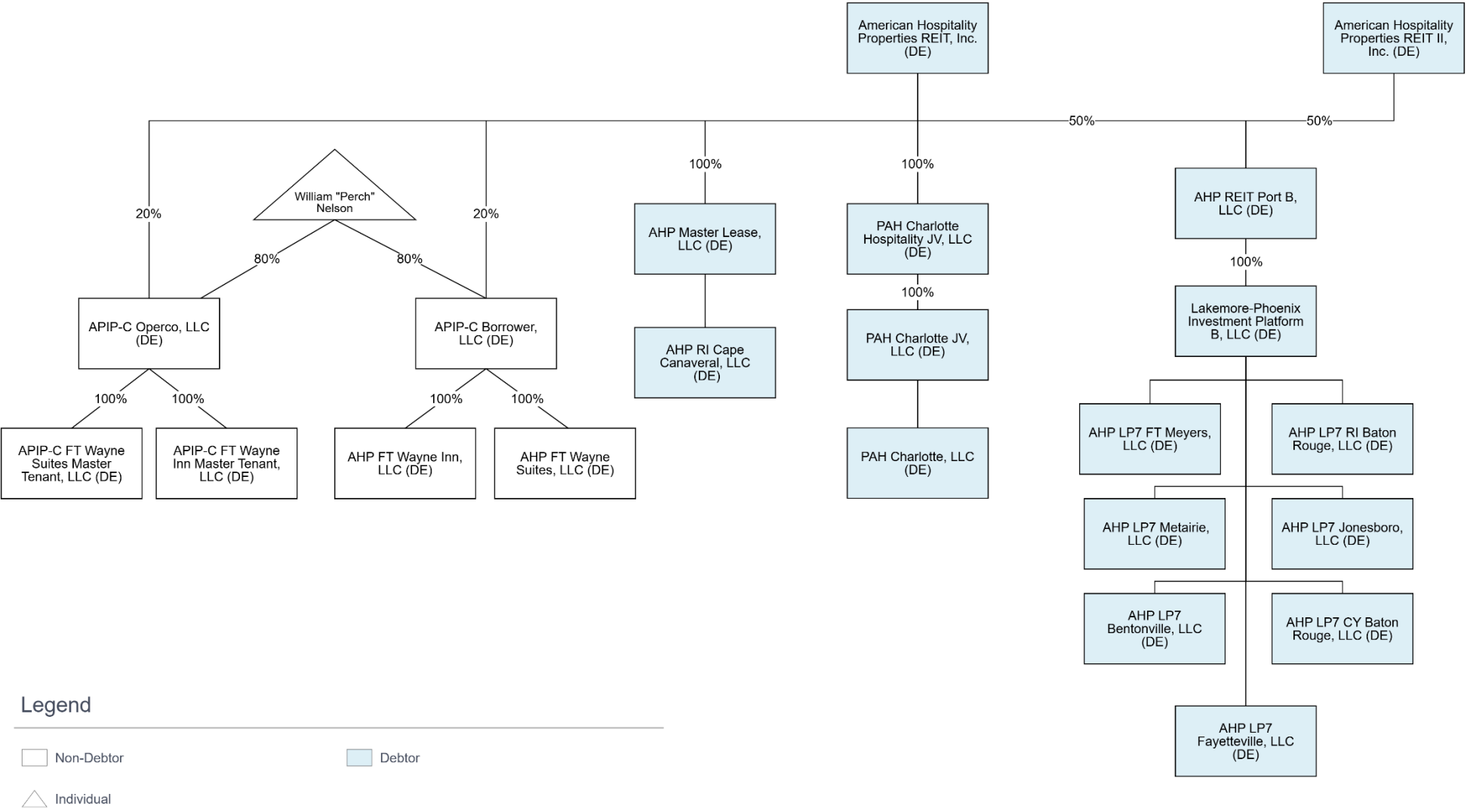
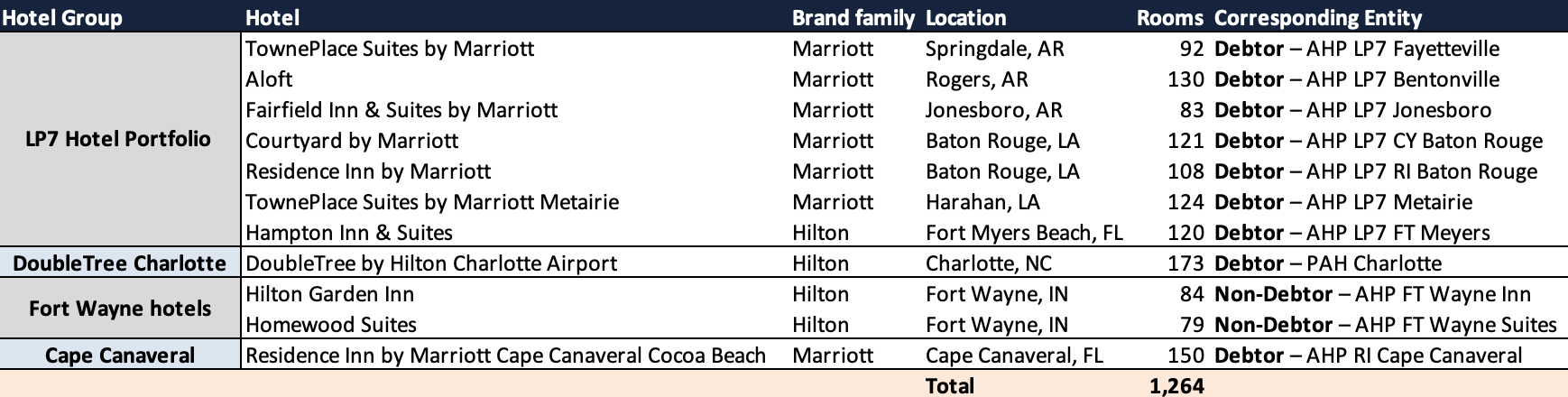
Headquartered in Dallas, TX, American Hospitality Properties REIT, Inc. ("REIT I") and American Hospitality Properties REIT II, Inc. ("REIT II" and, together with REIT I, the "REITs") are non-traded Delaware corporations, formed primarily to acquire and manage premium branded hotels in the United States. The REITs sit at the top of the corporate structure as the ultimate parents of 14 debtor subsidiaries (together with the REITs, the "Debtors" or the "Company"). Through those subsidiaries, the Company holds interests in nine of the eleven hotels in its portfolio. Its interests in the remaining two hotels, both in Fort Wayne, Indiana, run through six affiliated entities that are not Debtors (the "Non-Debtor Entities"). The portfolio spans Arkansas, Louisiana, Florida, North Carolina and Indiana, with seven hotels operating under Marriott-family brands and four under Hilton-family brands.
The REITs trace back to Phoenix American Hospitality, LLC ("PAH"), a Dallas-based manager of hotel investment vehicles that was founded in 2009 by William Lee "Perch" Nelson ("Nelson"), who wholly owns it with a trust he controls. PAH and Nelson formed REIT I in 2018 and REIT II in 2023 to invest in U.S. hotels. Nelson served as chief executive officer and a director of each REIT until May 20, 2026.
American Hospitality Properties REIT, Inc. and certain affiliates⁽¹⁾ filed for Chapter 11 protection on October 4, 2026 (the "Petition Date") in the U.S. Bankruptcy Court for the Northern District of Texas, reporting $0 to $50 thousand in assets and $1 million to $10 million (affiliates report liabilities of up to $50 million to $100 million) in liabilities.
⁽¹⁾ For a complete list of Debtor entities, see organizational structure chart below.
Corporate History and Key Transactions
PAH's Funds
Before forming the REITs, PAH raised hotel capital through private programs that it managed. According to REIT I's 2022 offering circular, two of them were funds. American Hospitality Properties Fund I, LLC ("AHP Fund I") closed in December 2014 with approximately $8.5 million of committed capital. American Hospitality Properties Fund III, LLC ("AHP Fund III") closed in May 2019 with approximately $23.4 million. The funds took minority stakes, alongside other investors, in platforms formed to buy specific hotel portfolios, and they also invested directly in hotel-owning companies.
The 2022 offering circular states that AHP Fund I invested $6.1 million in Debtor PAH Charlotte, LLC ("PAH Charlotte"), owner of the DoubleTree hotel in Charlotte. Besides a stake in a third PAH platform that is not part of these cases, AHP Fund III made four investments: (i) $6.9 million in Debtor Lakemore-Phoenix Investment Platform B, LLC ("LPIP B"), parent of the seven Debtor entities that own seven hotels in Arkansas, Louisiana and Florida (the "LP7 Hotel Portfolio"); (ii) $2 million in non-Debtor APIP-C Borrower, LLC, parent of Fort Wayne hotel owners; (iii) $4.9 million in PAH Charlotte; and (iv) $4.9 million in the Residence Inn Cape Canaveral.
AHP Fund III's interests later passed to REIT I through a merger, discussed below under AHP Fund III Merger.
The REITs' Formation and SEC Fundraising Complaint
PAH and Nelson formed REIT I in August 2018 as American Hospitality Properties Fund IV, Inc. and, with PAH as sponsor, raised capital through a Regulation A offering of up to $50 million at $10 per share, which the SEC qualified in July 2019. REIT II followed in March 2023 with a Regulation A offering of up to $75 million, qualified in September 2023.
The REITs' Regulation A fundraising became the subject of an SEC complaint against PAH and Nelson, filed in June 2026. The SEC alleged that between March 2022 and July 2024, PAH and Nelson raised approximately $86 million from more than 2,000 investors through untrue statements about the REITs' assets and profitability. According to the complaint, PAH and Nelson told investors that REIT I owned as many as eleven hotels and paid distributions of up to 12% a year from profits. The complaint states that REIT I's only hotel investment until January 2024 was an approximately $1.5 million preferred equity investment in a single hotel, which the Debtors' first day declaration (the "Declaration") identifies as REIT I's preferred interest in Debtor PAH Charlotte, the affiliate that owns the DoubleTree Charlotte. According to the SEC's complaint, that investment earned just over $200,000 through 2022 and approximately $5,000 in 2023, while REIT I paid investors more than $1.4 million and $5 million, respectively, over the same periods.
The SEC filed the case on June 4, 2026 as a settled action. On June 5, 2026, the court entered consent judgments against PAH and Nelson, who did not admit the allegations. The judgments permanently bar both from violating the federal anti-fraud provisions and bar Nelson from serving as an officer or director of a public company for five years.
The Fort Wayne 80% Interests Transfer
The Fort Wayne hotels are held through two parent companies. APIP-C Borrower owns the hotels, and APIP-C OperCo owns the master tenants that operate them. Under a Sale-Purchase Agreement dated May 31, 2023, REIT I agreed to acquire 80% of each company (the "80% Interests") for approximately $9.4 million from two sellers with a mailing address care of Lakemore Partners in Dubai. The remaining 20% of each company was held by AHP Fund III.
According to the Declaration, the parties later determined that a transfer of the 80% Interests to REIT I would not be permitted under the Fort Wayne hotels loan documents. Without the lender's consent, which was not obtained, the transfer would trigger an event of default. A transfer to Nelson appeared to be permitted. The Purchase Agreement allowed REIT I to assign the purchase to Nelson without the sellers' consent, and REIT I made that assignment effective June 1, 2023. The sellers then transferred the 80% Interests to Nelson the following day. According to the Declaration, Nelson, acting as CEO and a director of REIT I, had REIT I lend him approximately $9.4 million to fund the acquisition. He continues to hold legal title to the 80% Interests.
On January 29, 2025, Nelson asked the lender to consent to transferring the 80% Interests from himself to REIT I. The Company states it is not aware that consent has been obtained. Subsequently, in March 2025, Nelson assigned REIT I his right to distributions on the 80% Interests and retained the membership interests themselves.
In December 2025, Nelson and REIT I documented the $9.4 million loan in an exchangeable promissory note, effective as of June 1, 2023, bearing 3.53% interest and maturing by September 1, 2028. The note gives REIT I the right to take the 80% Interests in satisfaction of the note once an "exchange trigger" occurs, which the note defines by reference to the termination of the Fort Wayne loan agreement and the lender's consent. The Declaration treats these as alternative triggers. At the first day hearing, Debtors' counsel told the court that either a refinancing of the loan or the lender's consent would trigger the transfer.
AHP Fund III Merger
According to the Declaration, Nelson determined in 2023 to have REIT I acquire the assets of AHP Fund I and AHP Fund III. At the time, he was manager of both funds and CEO and a director of REIT I.
In January 2024, AHP Fund III merged into REIT I, which succeeded to the fund's 20% interest in APIP-C Borrower and APIP-C OperCo. Together with Nelson's March 2025 assignment of his distribution rights, this gives REIT I a 20% interest in the two Fort Wayne parent companies and the distribution rights on the remaining 80%.
Current Organizational Structure
- LP7 Hotel Portfolio (Owned) — Comprises seven hotels in Arkansas, Louisiana, and Florida, acquired by Debtor LPIP B for approximately $101 million in July 2017. The purchase was financed with a $65 million loan from Deutsche Bank, and substantially all of the equity came from an unrelated Dubai-based investment fund. In January 2024, a joint venture of REIT I and REIT II acquired the equity interests in LPIP B.
- DoubleTree Charlotte (Owned) — PAH Charlotte, a Debtor wholly owned by REIT I, owns the 173-room DoubleTree by Hilton Charlotte Airport. According to the Declaration, PAH Charlotte financed the hotel in May 2018 with an $18.2 million loan from Rialto Mortgage Finance.
- Fort Wayne Hotels (Non-Debtors) — The Hilton Garden Inn and Homewood Suites in Fort Wayne, IN, which PAH acquired in August 2018, funded in part with a $15.8 million loan from Société Générale. The hotels are owned by AHP FT Wayne Inn, LLC and AHP FT Wayne Suites, LLC, both held under APIP-C Borrower, and are leased to and run by two tenant companies under APIP-C OperCo.
- Cape Canaveral (Leased) — The Residence Inn Cape Canaveral Cocoa Beach is the only hotel in the portfolio that is leased rather than owned. Debtor AHP RI Cape Canaveral, LLC holds the ground lease from Spirit Realty, L.P. ("Spirit"), which REIT I guarantees.
Operations Overview
Hotel Portfolio
Hotel Management Agreements
Each of the eleven hotels operates under a Marriott or Hilton brand. According to the Declaration, Company entities are parties to eleven hotel management agreements, one for each franchised hotel.
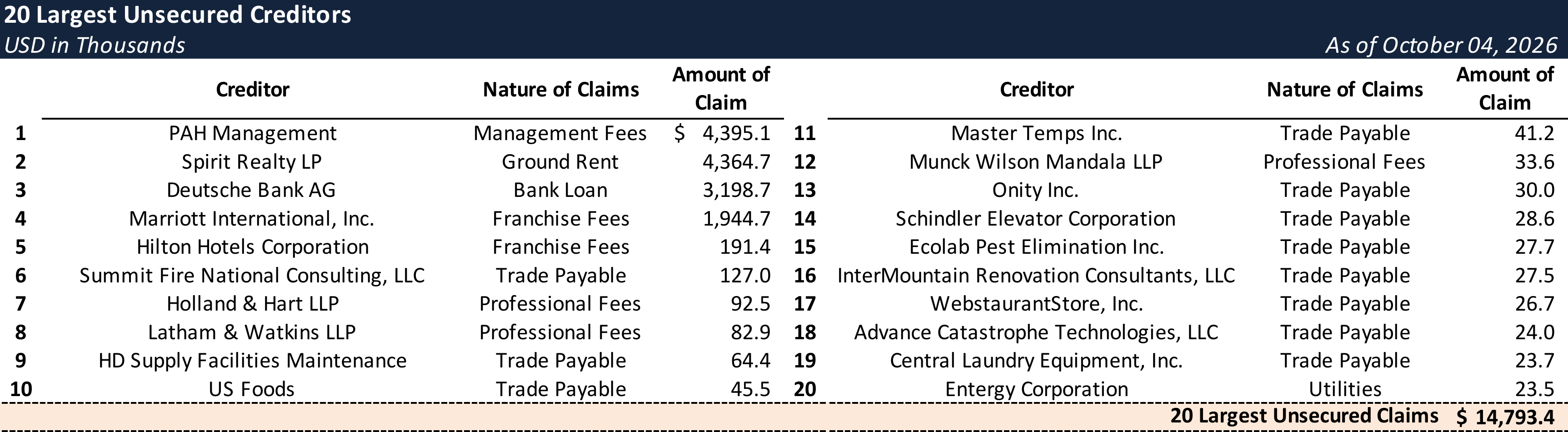
PAH Management, LLC ("PAHM"), which is owned and controlled by PAH, is the manager under these agreements and is responsible for paying the hotels' franchise fees. REIT I's 2021 annual report states that PAHM is entitled to a management fee of 3% of total hotel operating revenues.
The Declaration also questions how the agreements were approved. It states that there is no record of an independent director or independent representative approving any of the subsidiaries' agreements with PAHM, even though Nelson controlled the Debtors, their subsidiaries and PAHM. In the Declaration's account, the agreements are "the result of self-interested transactions negotiated by [Nelson] on behalf of REIT I and REIT II with himself on behalf of PAHM," and they left the REITs with limited options to remove PAHM and Nelson as hotel manager.
Property-Level Performance
Servicer reports for the three financed hotel groups show the LP7 Hotel Portfolio in steep decline, while the DoubleTree Charlotte and the Fort Wayne hotels continue to cover their loan payments.
- LP7 Hotel Portfolio — According to the DB Facility's September 2026 servicer report, the seven hotels generated approximately $2.6 million of net operating income ("NOI") in the trailing twelve months ("TTM") ended March 31, 2026, a 45% decrease from approximately $4.6 million for the TTM ended June 30, 2025. Debt-service coverage has been below 1.0x since the TTM ended September 30, 2025, and fell to 0.63x on NOI (0.42x on net cash flow) for the TTM ended March 31, 2026. Revenue declined approximately 12% from the TTM ended June 30, 2025 on lower occupancy, which fell at all seven hotels to 61% portfolio-wide.
- DoubleTree Charlotte — According to the Rialto Facility's April 2026 servicer report, NOI was approximately $2.3 million for FY2025, against approximately $7.4 million in revenue and occupancy of 79%. Debt-service coverage was 1.85x on NOI (1.61x on net cash flow).
- Fort Wayne Hotels — According to the SocGen Facility's April 2026 servicer report, combined NOI was approximately $1.7 million for FY2025, against approximately $6.5 million in revenue. Debt-service coverage was 1.53x at the Hilton Garden Inn and 2.07x at the Homewood Suites.
Prepetition Obligations
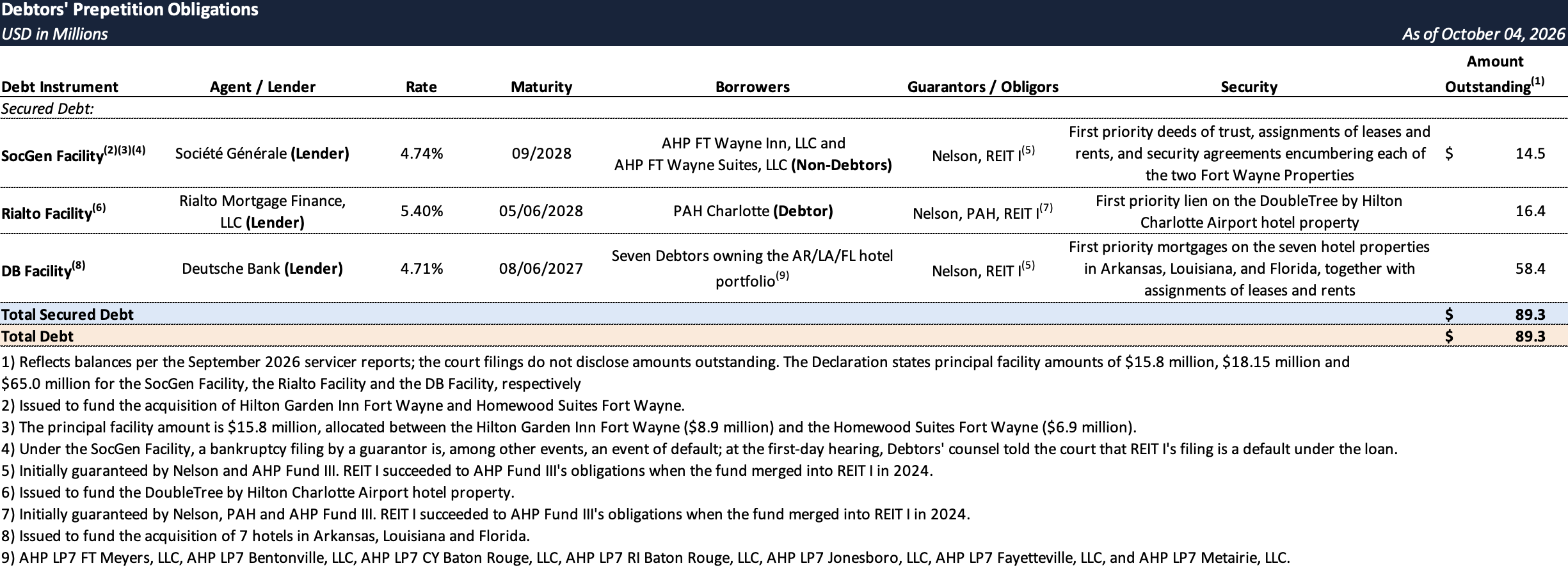
In addition to the funded obligations in the table below, REIT I is a guarantor of several other obligations:
- Cape Canaveral Ground Lease — As AHP Fund III's successor, REIT I guarantees the Residence Inn Cape Canaveral ground lease jointly and severally with PAH. Spirit, the landlord, has sued both and moved for summary judgment of at least approximately $4.3 million.
- Marriott franchise agreements — REIT I and Nelson are jointly and severally liable under guaranties that Marriott has invoked for approximately $1.6 million in unpaid franchise fees at four LP7 hotels.
- Hotel management agreements — REIT I, PAH and Nelson guarantee the eleven hotel management agreements.
Top Unsecured Claims
Events Leading to Bankruptcy
The Alleged August 2025 Stock Issuance
The Declaration says that in August 2026 the Debtors engaged FTI Consulting, Inc. ("FTI") to conduct a forensic audit. The audit found that in August 2025 Nelson directed Axis-Key, REIT I's transfer agent, to issue approximately $4.5 million of REIT I common stock to an entity he controlled. The audit also found that the shares were initially believed to be payment for purported "management fees", that neither REIT's books reflect the issuance, and that Nelson is understood to have collected approximately $40,000 of dividends on them through May 2026.
Hotel Mismanagement and Marriott Default Notices
As noted under Operations Overview, Company entities are parties to hotel management agreements with PAHM, under which PAHM was responsible for paying the hotels' franchise fees.
Those fees went unpaid at four Marriott-branded hotels in the LP7 Hotel Portfolio: the Aloft in Rogers, AR; the TownePlace Suites in Springdale, AR, and in Harahan, LA; and the Residence Inn in Baton Rouge, LA. Marriott issued notices of default in September 2026 covering approximately $1.6 million in unpaid franchise fees, reimbursable charges and accrued interest. Absent payment by October 17 or 19, depending on the property, Marriott reserves the right to suspend reservation-system access or terminate the franchise agreement as early as October 31, 2026, and the notices also invoke guaranties from REIT I and Nelson. Additionally, several Marriott hotels are in the brand's "redzone", meaning they fall well below brand average and are at risk of default.
The Declaration alleges that Nelson cut costs at the hotels to his own benefit, including by having PAH and PAHM stop paying franchise fees, and that Nelson and PAHM did not pay Marriott even though the Boards of REIT I and REIT II directed them to.
Spirit Ground Lease Litigation
The Residence Inn Cape Canaveral sits on land leased from Spirit under a ground lease dated March 28, 2019 (the "Ground Lease"). AHP Fund III and PAH jointly and severally guaranteed the tenant's obligations. A 2020 forbearance agreement, amended in 2021 and 2022, deferred certain rent. In January 2025, with Spirit's consent, the original tenant, AHP Master Lease, LLC, assigned the lease to AHP RI Cape Canaveral, LLC. REIT I, as AHP Fund III's successor, and PAH reaffirmed the guaranty.
According to the Declaration, the tenants stopped paying rent starting September 1, 2025. Spirit sued on December 31, 2025, asserting three claims: (i) breach of the Ground Lease, against AHP Master Lease and AHP RI Cape Canaveral; (ii) breach of the guaranty, against REIT I and PAH, jointly and severally; and (iii) unjust enrichment. The suit sought damages of not less than $2.5 million. On June 23, 2026, Spirit moved for final summary judgment against all defendants, asserting that they owe not less than $4.3 million in unpaid rent, late charges, default interest and other amounts, plus attorneys' fees and costs.
At the first-day hearing, Debtors' counsel said Spirit's summary-judgment motion had been expected to be heard and granted the week before the filing, leaving a risk that judgment could be entered at any time. Counsel added that an entered judgment would give rise to guaranty claims and potential cross-defaults across the Company's capital structure.
Shareholder Litigation
The SEC action related to the REITs' Regulation A offerings has since been followed by two private investor suits, with more expected according to the Declaration. Both suits rely on the SEC's final judgments to claim that shareholders were induced to buy their shares by false and material representations from PAH and Nelson.
The first is a class action filed in September 2026 by Proven Business Skills Inc. against PAH, REIT I, REIT II, and Nelson. It was brought on behalf of investors who bought shares of either REIT between March 1, 2022 and July 31, 2024. According to the plaintiffs' counsel's press release, the complaint alleges violations of the federal securities laws' anti-fraud provisions, and investors seeking to lead the case have until November 16, 2026 to apply. Michael Tarr, as trustee of an investor trust, filed the second suit, dated September 23, 2026, against REIT I, Nelson and Max Aills (a PAH investment analyst).
Governance Change and Removal of PAH as Manager
REIT I and REIT II brought in new leadership after Nelson's departure on May 20, 2026, in connection with the SEC action and its settlement. Joseph Reardon was appointed President and a director of each REIT. Paul Adams joined REIT I's board as an independent director, and Mary Pfeifer joined REIT II's board as an independent director. Following those appointments, Jay Anderson resigned as executive vice president, controller and director of both REITs. He then entered into consulting agreements with each REIT to provide accounting and financial reporting services for one year. The agreements renew automatically for another year on May 20, 2027 unless terminated under their terms.
REIT I's management agreement with PAH was terminated the same day, May 20, 2026. REIT I reported that its hotels would continue to operate under their existing hotel management agreements with PAHM. PAH remained manager of the REITs' operating subsidiaries until September 30, 2026. On that date, the boards of REIT I and REIT II authorized amendments to the subsidiaries' operating agreements removing PAH as manager. For most subsidiaries, the members amended the agreements directly. For AHP REIT Port B LLC ("Port B") and LPIP B, the amendments were made through mergers with newly formed merger subsidiaries, with Port B and LPIP B surviving. Nelson was also removed as an officer of each subsidiary, and new officers were appointed.
Chapter 11 Filing
The new directors explored an out-of-court refinancing, which the Debtors say "could not be achieved in time." Debtors' counsel told the court that a refinancing of the two Fort Wayne hotels and the DoubleTree Charlotte had been very close before the filing and would have freed up some liquidity, but not enough to cover the business's liabilities, litigation and capital expenditure needs.
The 16 Debtors filed for Chapter 11 on October 4, 2026, without a DIP financing or cash collateral motion in place. According to the Declaration, the filing is intended to give the Debtors room to raise liquidity, stabilize governance and operations, restore franchisor confidence, address the Spirit dispute and the shareholder litigation, and preserve value. Given the limited time to prepare and the lack of electronic contact information for most parties, the Debtors' Counsel said additional customary first-day relief, such as cash management and wage motions, would follow once financing is in place.
Governance and Advisors
REIT I's board appointed Alan Tantleff of FTI Consulting as chief restructuring officer ("CRO"), provided that additional approval shall be required for major asset sales, DIP financing or material new borrowing, material settlements, assumption or rejection of major hotel management agreements or franchise agreements, and bankruptcy plan terms. The Debtors' advisors comprises:
- Financial Advisor — FTI Consulting.
- Restructuring Counsel — Vinson & Elkins LLP. The firm has been the Company's outside corporate counsel since July 2025.
- DIP Financing Arranger — LD Realty Capital, LLC. REIT I's board approved its engagement as non-exclusive financing arranger under an engagement letter dated September 28, 2026.
Liquidity and DIP Financing
The Debtors intend to continue a two-week process to obtain DIP financing or identify cash collateral, and failure may force the Debtors to convert these cases to Chapter 7. The Debtors state that they have no liquidity to pay an adverse judgment on Spirit's pending summary-judgment motion, which seeks not less than $4.3 million from REIT I, as guarantor, and other defendants.
At the first-day hearing, Debtors' counsel said the Debtors hope to refinance the two Fort Wayne hotels and the DoubleTree Charlotte in the near term to generate liquidity for the cases, with the Fort Wayne refinancing to be done through the DIP financing. Counsel explained that once the Fort Wayne hotels are refinanced, the 80% Interests would pass to the Debtors under the exchangeable promissory note, giving them full governance control of the Non-Debtor Entities.
If DIP financing is obtained, the Debtors also expect to bring in a new management company to operate the hotels. Counsel added that restructuring counsel had no prepetition dialogue with any of the three secured lenders. Notice of the hearing was sent to Société Générale electronically and was being mailed to Deutsche Bank and Rialto that morning.
Fort Wayne Non-Debtor Stay
On October 5, 2026, the court granted the Debtors' motion to extend the automatic stay to the six Non-Debtor Entities that hold the Fort Wayne hotels, for 30 days. The motion argued primarily that REIT I's interests in those entities are estate property. The motion describes the Fort Wayne hotels as among the most valuable assets associated with the Debtors' estates and REIT I as "the economic owner and beneficiary of 100%" of the Non-Debtor Entities, reflecting its 20% equity interest and its rights to the economic benefits of Nelson's 80%. The Debtors also state their view that the value of the Fort Wayne assets will be a critical and material component of any DIP financing. The motion notes that the SocGen Facility's cross-default, cross-collateralization and springing-recourse provisions mean certain bankruptcy-related events may trigger recourse liability and allow the lender to accelerate the loan.
Related-Party Transactions and Potential Claims Against Nelson
At the first-day hearing, Debtors' counsel said the problems uncovered under Nelson extended beyond the stock issuance. Counsel cited related-party transactions entered into without independent approval (see Hotel Management Agreements) and said that REIT I has not filed required SEC reports since year-end 2021, and REIT II since year-end 2023. Counsel said the Debtors expect to investigate and potentially pursue causes of action against Nelson and his affiliated entities, and may seek emergency relief such as turnover or discovery.
Explore Bondoro Insights for live case dockets and comprehensive coverage of material filings from petition to plan confirmation.
Stay informed on every Chapter 11 bankruptcy case with liabilities exceeding $10 million. Subscribe for free to have our coverage delivered directly to your inbox, and explore our full archive of past summaries.
Subscribers can also opt in to timely filing alerts by updating their email preferences in Account Settings.


