Case Summary: PGR Lessee I Chapter 11
PGR Lessee I and 18 affiliates filed for Chapter 11 after a New York court ordered nine of the debtors to post $30.2 million of collateral under a surety indemnity agreement they say was signed without authority, and will pursue a restructuring that may include a sale of their 17 solar projects.

A deck version of this summary is also available HERE.
Business Description
PGR Lessee I, LLC and eighteen affiliated debtors (collectively, the "Debtors") own and operate seventeen utility-scale solar power facilities (the "Solar Projects") in North Carolina, South Carolina and Rhode Island, with approximately 262 megawatts of direct-current generating capacity.
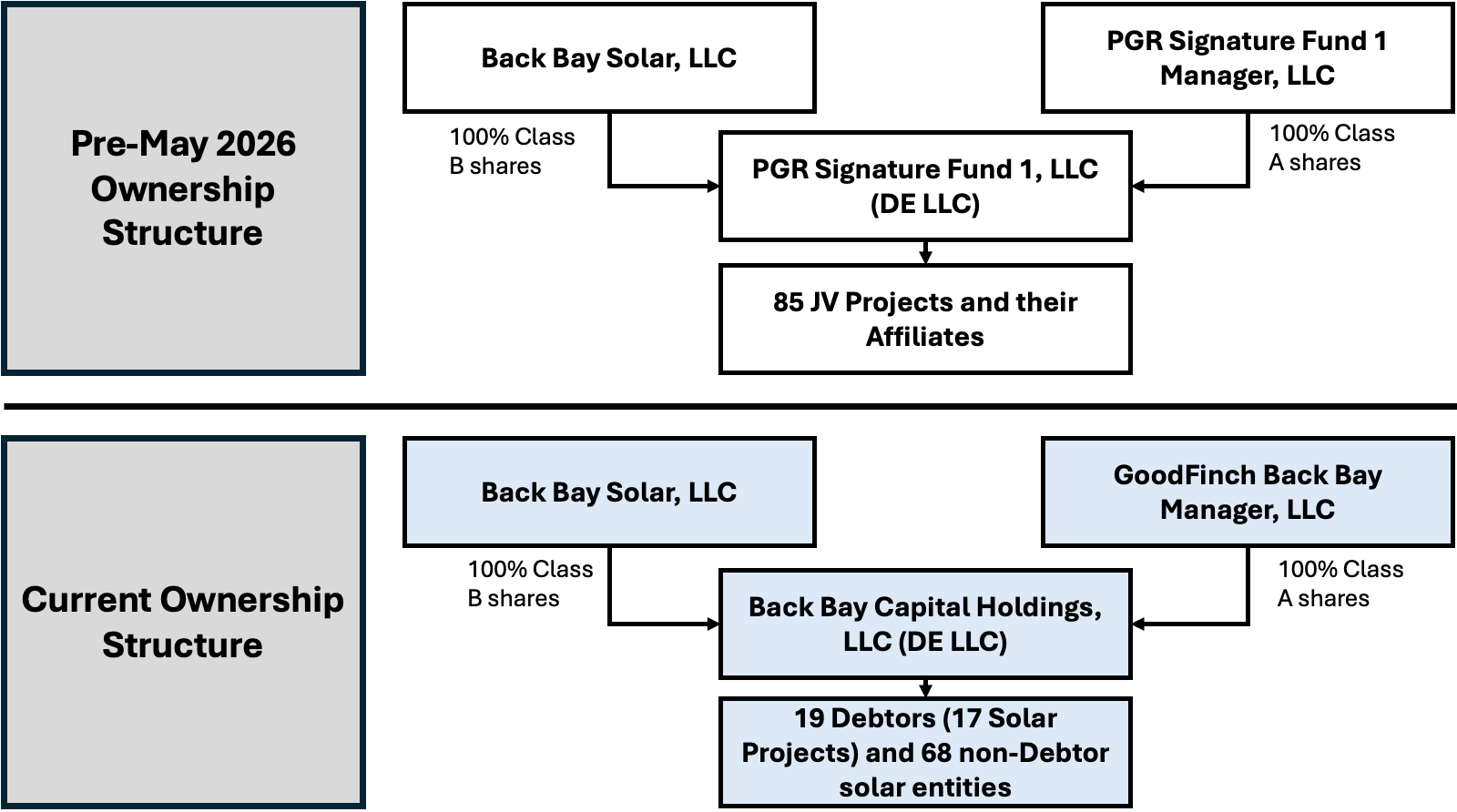
Until May 2026, the Debtors were owned by PGR Signature Fund 1, LLC ("Signature Fund 1"), a joint venture between Back Bay Solar, LLC ("Back Bay Solar") and Pine Gate Renewables, LLC ("Pine Gate"), an Asheville, NC-based solar developer that contributed projects to the venture and managed it through a subsidiary. Pine Gate filed for Chapter 11 in November 2025 without Signature Fund 1 or its subsidiaries, and in December 2025 the Pine Gate bankruptcy court approved a settlement negotiated by Back Bay Solar for Pine Gate's exit from the venture. When the exit closed in May 2026, GoodFinch Back Bay Manager, LLC ("GoodFinch Manager") became managing member and Signature Fund 1 was renamed Back Bay Capital Holdings, LLC ("Back Bay Capital").
The Debtors attribute the filing to an August 5, 2026 New York state-court order (the "Injunction Order") requiring nine of the Debtors to post $30.2 million of collateral with Atlantic Specialty Insurance Company (the "Surety"). The obligation arises under a General Indemnity Agreement dated June 12, 2019, which the Debtors say was entered into on their behalf without authority.
PGR Lessee I, LLC and certain affiliates filed for Chapter 11 protection on September 9, 2026 (the "Petition Date") in the U.S. Bankruptcy Court for the Southern District of Texas, reporting $100 million to $500 million in both assets and liabilities.
Corporate History and Operations
The Joint Venture
In October 2018, Pine Gate and Back Bay Solar agreed on the terms of a joint venture and entered into a Limited Liability Company Agreement and an Equity Capital Contribution Agreement. Back Bay Solar contributed cash and holds Class B interests, which carry predetermined priority distributions and function much like preferred equity. Pine Gate held the Class A interests, which are closer to common equity, through PGR Signature Fund 1 Manager, LLC ("PGR Manager"), which also served as managing member.
Between 2018 and 2022, Pine Gate contributed eighty-five solar projects to the venture, net of two projects it contributed and later re-acquired. Pine Gate also ran the projects day to day. Pine Gate Asset Management, LLC provided treasury, accounting, financial, tax, legal and other general management services, and Pine Gate O&M, LLC procured the projects' operations and maintenance ("O&M") through subcontracts with Pine Gate non-debtor subsidiary ACT Power Services, LLC ("ACT") or with third parties.
Pine Gate's Chapter 11 and Separation Settlement
On November 6, 2025, Pine Gate and certain affiliates filed for Chapter 11. The filers included PGR Manager, Pine Gate Asset Management, LLC and Pine Gate O&M, LLC, but not Signature Fund 1 or its subsidiaries, including the Debtors. Back Bay Solar and Pine Gate had begun negotiating a separation of Signature Fund 1 and its projects from Pine Gate in late October 2025. Pine Gate filed a motion to approve the resulting settlement on November 26, 2025, and the court approved it by order entered December 12, 2025. The key terms were:
- Governance Transfer — At closing, following approval by the Federal Energy Regulatory Commission, PGR Manager's Class A interests were to be transferred free and clear to GoodFinch Management LLC or a designated subsidiary or affiliate, which would become managing member of Signature Fund 1.
- Management Transition — The order appointed SunStrong Management LLC ("SunStrong Management"), an affiliate of GoodFinch Manager, as replacement asset manager for Signature Fund 1 and its projects and directed that cash management, including signature authority over each related bank account, be turned over to SunStrong Management immediately. Pine Gate Asset Management's asset management agreement was to terminate at a time SunStrong Management directed. Pine Gate O&M's subcontracts with ACT were assumed and assigned to the individual project companies, including Debtors Centerfield Cooper Solar, HCE Moore I, Page Solar Farm, Rankin Solar Center, Trent River Solar and Warrenton Solar 1.
- Service Balances — All past-due amounts owed by the projects to Pine Gate through October 31, 2025 were deemed satisfied. Pine Gate had reported that about $9.6 million had accrued and that it had caused the projects to pay down about $4.7 million on that date. It valued the settlement at $7.0 million, counting that prepetition payment and the $2.3 million closing payment.
- Releases — Back Bay Solar, Signature Fund 1 and its direct and indirect subsidiaries, which include the Debtors, released the Pine Gate debtors and their current and former equity holders, officers, directors, managers and employees from claims arising before December 12, 2025. The Pine Gate debtors released the Back Bay parties in turn. Both releases carve out claims based on fraud, gross negligence or willful misconduct; claims to enforce the settlement or the order; and claims related to surety bonds or indemnities.
The exit closed in May 2026. GoodFinch Manager replaced PGR Manager as managing member and Class A member, and Signature Fund 1 was renamed Back Bay Capital.
Operations Overview
Tax Equity and the Inverted Lease Structure
The Debtors' solar projects were financed in part with tax equity, in which an investor provides capital to a solar project in exchange for the right to be allocated the project's clean energy tax credits. Additional legal entities are formed around the projects each tax equity investment finances, and the Debtors' portfolio uses an inverted lease structure. Under that arrangement, a project is leased to a separate entity, the lessee, which is owned in part by the tax equity investor. Federal tax rules allow the project's tax credits to pass through to the lessee and, through its ownership of the lessee, to the tax equity investor. A corresponding lessor entity sits on the other side of the lease. Structures of this kind allocate economic benefits among the tax equity investor, the senior project lender and the sponsor. They also protect the investor against a transfer of its project that would risk tax credit "recapture," meaning mandatory repayment of credits already claimed.
Centerfield Cooper Solar, LLC is the only Debtor that still has a tax equity investor; the others have been bought out. Even so, every Debtor continues to maintain the inverted lease structure within its associated fund. The Debtors report $4.6 million of tax equity in their funded capital, which, unlike their bank debt, carries no interest rate or maturity.
The Debtors' seventeen projects are organized into four funds, within which each Debtor maintains its inverted lease structure: Fund I (nine projects), Fund M (six projects), Fund O (Centerfield Cooper Solar) and Fund P (Trent River Solar). Only Fund I's lessee and lessor, PGR Lessee I, LLC and PGR Lessor I, LLC, are Debtors, and neither owns a Solar Project. The corresponding entities for Funds M, O and P, PGR Lessee M, O and P and PGR Lessor M, O and P, are not Debtors.
Asset Management and O&M
SunStrong Management has served as permanent asset manager for Back Bay Capital and its subsidiaries since Pine Gate's exit closed in May 2026, after serving as interim asset manager from December 2025. Under an asset management and administrative services agreement, SunStrong Management carries out the day-to-day management of each Debtor and Solar Project, providing treasury, accounting, financial, tax, legal and other general management services. It also maintains daily oversight of the Debtors' cash management system and implements the controls for entering, processing and releasing funds. The Debtors outsource O&M to third-party vendors, including ACT, Borrego Solar System, Inc. and Cypress Creek O&M, LLC.
Workforce
The Debtors have no employees and depend on the services of SunStrong Management and their O&M vendors. Before the separation from Pine Gate, asset management services for the joint venture projects were generally performed by Pine Gate employees. The December 2025 settlement allowed SunStrong Management to make employment offers to the Pine Gate employees who provided services to Signature Fund 1 and its projects. Craig R. Jalbert, a principal of Verdolino & Lowey, P.C., was appointed as the Debtors' special manager on September 4, 2026 by GoodFinch Manager, with Back Bay Solar's consent, and oversees the restructuring of the Debtors.
Leases
The Debtors' filings describe two types of leases. Master leases are internal to each fund, between its lessee entity and the lessor or project company. Site leases are with outside landowners for the land on which the projects sit.
- Funds I and M — Project revenue is deposited into lessee-owned control accounts at Live Oak Banking Company ("Live Oak"), the lender to all fifteen Fund I and Fund M projects. These accounts are pledged to the applicable project company to secure the lessee's obligations under the master lease agreements. Lessor operating accounts at Fifth Third Bank pay lease obligations and project taxes. The Debtors' initial four-week cash collateral budget includes about $47,000 of lessor site lease payments and about $35,000 of critical past-due lessor site lease amounts for these Debtors, without identifying the specific projects.
- Fund O — Centerfield Cooper Solar's master lease is with PGR Lessee O, LLC. Quarterly master lease payments are transferred from Lessee O's operating account at Pathward, N.A. ("Pathward"), Centerfield Cooper's lender, to a lessor operating account at Fifth Third Bank. From that account, the amounts needed for debt service and site lease rent are transferred to Centerfield Cooper's operating account at Pathward. Centerfield Cooper also holds a leasehold interest in its project site.
- Fund P — Quarterly master lease payments are transferred from the lessee's operating account at Fifth Third Bank to Trent River Solar's revenue account at First-Citizens Bank & Trust Company ("First-Citizens"), administrative agent under Trent River's financing agreement. Funds in Trent River's distribution account at Fifth Third Bank are applied to site lease rent and lessor-level taxes.
Prepetition Obligations
Secured Project Debt and Lender Silos
As of the Petition Date, the Debtors' prepetition obligations consist of approximately $129.3 million outstanding under project debt facilities. Each Debtor that owns a Solar Project has its own credit facility, with principal and interest due quarterly. The facilities are not cross-collateralized. Each is secured by an all-asset lien in favor of its lender and, in some cases, by a non-Debtor holding company's pledge of its equity in the project company. The Debtors' proposed interim cash collateral order groups the lenders (the "Prepetition Secured Parties") and their borrowers into three silos:
- Live Oak (Funds I and M — $40.7 million) — Live Oak Banking Company finances 15 of the Debtors' 17 projects, each through a separate project-level loan. Fund I's nine loans total $15.1 million, bear interest at 6.24% and mature in 2044 and 2045. Debtor PGR Lessor I, LLC is a co-obligor on each Fund I loan and has pledged its equity interests in each Fund I project company, and non-Debtors PGR Fund I, LLC and PGR Manager I, LLC are also obligors. PGR Lessee I, LLC is not a borrower but falls within the Live Oak silo. Fund M's six loans total $25.6 million at 4.58%, mature in 2045 and 2046, and carry non-Debtors PGR Fund M, LLC, PGR Manager M, LLC and PGR Lessor M, LLC as additional obligors.
- Pathward (Fund O — $38.1 million) — Pathward, successor to Crestmark, a division of MetaBank, holds a loan to Debtor Centerfield Cooper Solar at 4.40%, maturing in June 2045. The collateral extends beyond the project company's own assets. It includes a leasehold mortgage on the project site, a pledge of 100% of the interests in Centerfield Cooper and in non-Debtors PGR Fund O, LLC, PGR Manager O, LLC and PGR Lessor O, LLC, and guaranties from those three non-Debtors. Pathward also holds collateral assignments of the project's ground leases with the underlying landowners and its material contracts, including its power purchase agreement with the South Carolina Public Service Authority (Santee Cooper), which is backed by a Philadelphia Indemnity Insurance Company surety bond, and its master lease.
- First-Citizens (Fund P — $50.6 million) — Debtor Trent River Solar borrowed under a June 30, 2020 financing agreement. First-Citizens Bank & Trust Company and Zions Bancorporation, N.A. are the lenders and swap counterparties. The facility is secured by all assets of Trent River and non-Debtor PGR Lessor P, LLC and by a mortgage on the project site. It is also secured by PGR Fund P, LLC's 51% interest in Lessor P, which owns 100% of Trent River, and by PGR Manager P, LLC's 1% interest in PGR Lessee P.
Top Unsecured Claims

Events Leading to Bankruptcy
The Debtors describe the Injunction Order as the catalyst that made an in-court restructuring necessary now. They also acknowledge that some or all of them would likely have needed a financial restructuring to address their leverage even without that order.
The General Indemnity Agreement
At the center of the cases is the General Indemnity Agreement in favor of the Surety, with addendums dated September 13, 2019, March 23, 2020, May 7, 2020 and July 1, 2020 (collectively, the "GIA"). According to the Debtors, Pine Gate, acting through then-CEO Ben Catt and then-CFO Ray Shem, caused nine of the Debtors (the "Purported Debtor Indemnitors") to purportedly enter into the GIA. The Debtors say the GIA provided credit support for solar projects that neither the Debtors nor Signature Fund 1 owned or controlled, directly or indirectly.
The Purported Debtor Indemnitors are PGR Lessee I, LLC; the six Fund M project companies (Alpha Value Solar, Cubera Solar, ESA Four Oaks 2 NC, ESA Hamlet NC, Rankin Solar Center and Spring Hope Solar 3); Centerfield Cooper Solar, LLC; and Trent River Solar, LLC. The group spans all three lender silos and includes the Debtors' two largest project borrowers, Trent River and Centerfield Cooper.
The Debtors dispute that the GIA binds them. They contend that:
- Lack of Authority — PGR Manager entered into the GIA on the Debtors' behalf without authority, in violation of Back Bay Solar's express consent rights. To the extent any obligations were incurred, they were not disclosed to, and were concealed from, Back Bay Solar when it invested. According to Jalbert, Pine Gate contributed seven of the Solar Projects to the joint venture without disclosing that it had purportedly added them as indemnitors, contrary to its representations and warranties. It later purported to add the remaining Purported Debtor Indemnitors after they had been contributed, without Back Bay Solar's knowledge or approval and contrary to the governing documents between Back Bay Solar and PGR Manager.
- Loan Defaults — Incurring the indemnity obligations violated the Debtors' project-level loan documents. Pine Gate did not obtain the project lenders' approval, and each transaction likely constituted a default or event of default under the relevant credit agreements.
- No Benefit — Pine Gate wrongfully used the Solar Projects to purportedly collateralize nearly $138 million of bonds, none of which relates to the Purported Debtor Indemnitors' projects, and the Purported Debtor Indemnitors receive no benefit from them.
The Collateral Demand and New York Litigation
On or about October 22, 2025, about two weeks before Pine Gate's Chapter 11 filing, the Surety demanded approximately $134.0 million of collateral from the Purported Debtor Indemnitors under the GIA, payable in cash or by irrevocable letter of credit.
On or about December 23, 2025, the Surety sued the Purported Debtor Indemnitors in the Supreme Court of the State of New York. The Surety's complaint asserts, on a joint and several basis, a claim for specific performance of the collateral demand and a claim for breach of contract based on the failure to comply with it. The Surety also moved for a preliminary injunction requiring the Purported Debtor Indemnitors to post collateral. The Purported Debtor Indemnitors opposed the motion, citing, among other things, their lack of unencumbered assets, which had been pledged to secure their senior debt facilities.
On July 10, 2026, the Surety amended its complaint and reduced its claim to $30.2 million, reflecting settlements resolving certain bonds covered by the GIA and the expiration of others. On August 5, 2026, the New York court granted the preliminary injunction and required the Purported Debtor Indemnitors to deposit $30.2 million of collateral with the Surety. The Surety posted a bond in the same amount on or about August 18, 2026, satisfying the condition precedent to the injunction under New York law. On August 20, 2026, the parties stipulated that no collateral would be required before September 9, 2026, and a status conference was set for September 10.
The Debtors say they tried before and after the suit was filed to reach a consensual resolution but that the parties remained far apart. Facing an imminent deadline to post tens of millions of dollars of collateral without the liquidity to do so, the Debtors filed for Chapter 11 to avoid potential contempt of court. The Injunction Order is preliminary relief, and the Debtors continue to describe any obligations under the GIA as disputed and contested.
Back Bay Solar is pursuing the matter separately in Pine Gate's Chapter 11 case. It has filed claims against Pine Gate, PGR Manager and certain of their affiliates for damages relating to the Purported Debtor Indemnitors and the GIA, alleging gross negligence, mismanagement and breach of contract. Back Bay Solar has also reserved the right to assert claims for fraud, intentional misrepresentation and willful misconduct against Pine Gate, PGR Manager, their affiliates and the individuals involved.
Project Leverage and Cash Flow
Through 2025, the Solar Projects operated at a deficit after debt service, which the Debtors attribute largely to their significant debt burden and their inability to operate at maximum capacity. Pine Gate described a similar picture across the full joint venture portfolio. In its November 2025 settlement motion, it reported that much of the projects' cash flow was used "entirely or almost entirely" on project loan debt service, especially in winter months when the projects generate less revenue.
According to Jalbert's First Day Declaration, financial and operational performance has improved since the separation from Pine Gate. All of the Solar Projects generate revenue, but debt service consumes a very substantial portion of their cash flow, and a majority continue to operate at a deficit after debt service; elsewhere, the declaration says "many" do. All of the Solar Projects are projected to need long-term cash funding to cover projected deficits.
The Chapter 11 Filing
The Debtors' stated goal is a strategic restructuring transaction that may include a court-supervised sale of substantially all of their assets and business operations. They have retained Porter Hedges LLP as counsel and Rock Creek Advisors, LLC as financial advisor who will also conduct the sale process. The Debtors say the decision to file and pursue a sale or reorganization was made with the support of their sponsors.
Cash Collateral Motion
The Debtors do not have sufficient cash on hand to run a sale process and are exploring DIP financing from potential lenders, including Back Bay Capital, with which they have held preliminary discussions. Negotiations had not been finalized as of the Petition Date.
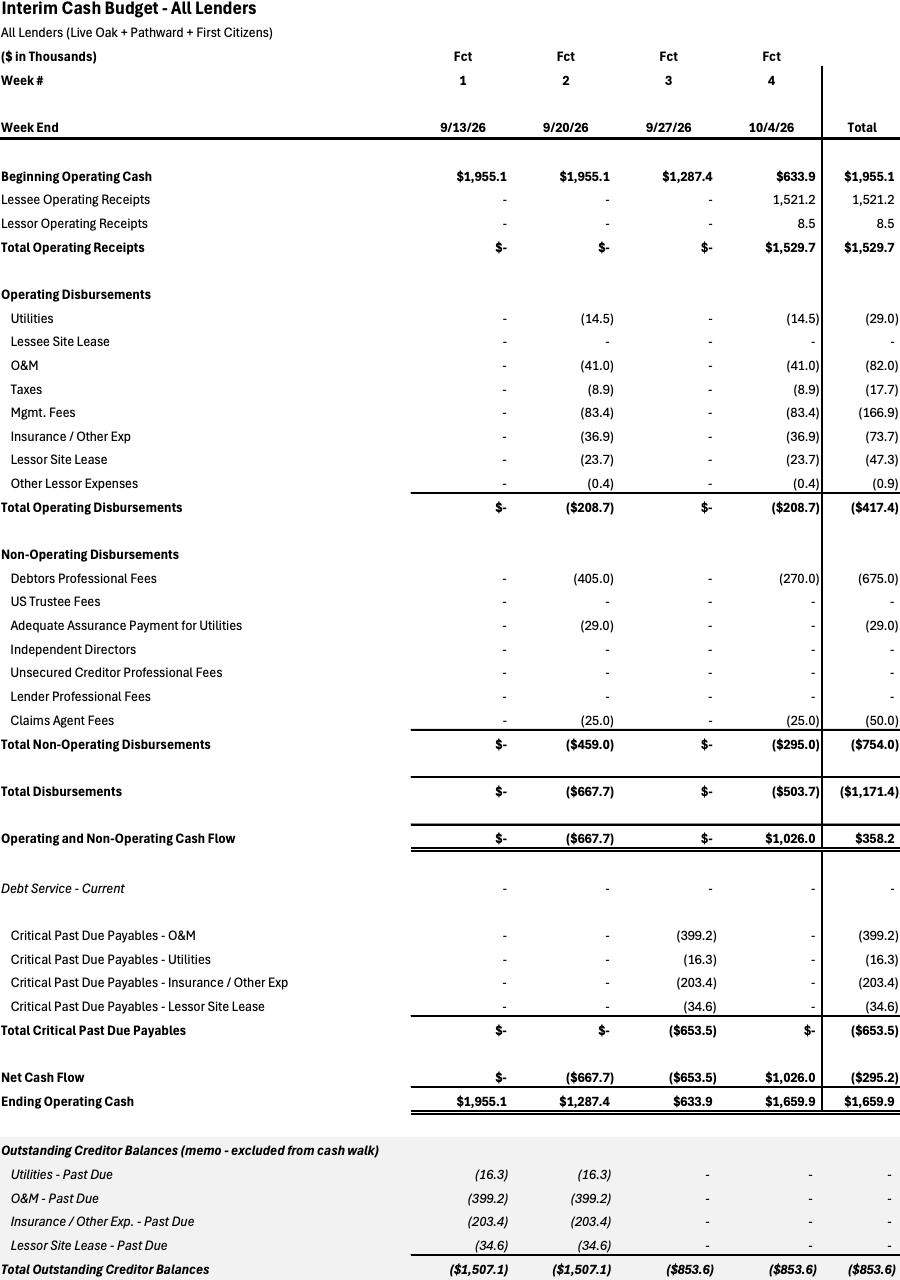
In the meantime, the Debtors have filed a motion to use cash collateral, and the requisite Prepetition Secured Parties have consented to the terms of a proposed interim order. Use is limited to an initial four-week budget. Actual disbursements, excluding restructuring professional fees, may exceed the budget by up to 15% on a rolling four-week basis, and the Debtors must deliver an updated 13-week forecast every four weeks. The initial budget begins with $2.0 million of cash and projects $1.5 million of operating receipts in the fourth week. It provides for $1.2 million of disbursements, including $0.7 million of Debtor professional fees, plus $0.7 million of critical past-due payables, and it includes no current debt service.
As adequate protection, and to the extent of any diminution in value, each lender would receive replacement liens and superpriority administrative expense claims, in each case confined to its own silo and junior to a professional fee carve-out. A lender's cash collateral may not fund another silo's projects, other than shared corporate overhead allocated by nameplate capacity. The Debtors would also provide reporting and would maintain insurance, the projects, their permits and the debt service reserve and other controlled accounts. Funds in the debt service reserve accounts may not be used without the applicable lender's consent. Consensual use would terminate no later than October 5, 2026 unless a final order extends it, and failure to obtain a final order within 45 days of the Petition Date would be a termination event. The Debtors have asked the Court to hold the final hearing on October 2, 2026.
The proposed interim order also contains the Debtors' stipulations to the validity, perfection and priority of the lenders' liens and claims. Parties in interest would have 60 days to bring a challenge, and any official committee could use up to $50,000 of collateral proceeds to investigate. Each lender's right to credit bid its claim in any sale of its collateral is preserved, subject to the challenge period.
The proposed cash management orders add that no intercompany transaction may use a lender's cash collateral to fund any Debtor or non-Debtor affiliate other than the Debtor whose lender's collateral it is without that lender's consent. Transfers to non-Debtor affiliates are limited to the ordinary course, and postpetition intercompany claims rank junior to the lenders' adequate protection claims.
Other First-Day Relief
Citing their cash position and the limits of the cash collateral budget, the Debtors narrowed their first-day requests to matters they consider urgent.
- Cash Management — The Debtors seek to continue their cash management system of 98 accounts at four banks, 70 of which are owned by Debtors and 28 by non-Debtor affiliates, and to keep their existing accounts and business forms. They also seek to continue intercompany transactions, pay or set off prepetition intercompany claims and give postpetition intercompany claims administrative priority. Because Live Oak and Pathward are not U.S. Trustee-authorized depositories, the Debtors ask for a 45-day extension to comply with section 345(b) on an interim basis and a full waiver on a final basis. The proposed orders would also bar any change to Centerfield Cooper's Pathward accounts without Pathward's consent.
- Insurance and Surety Bonds — The Debtors seek to continue their 14 insurance policies, which cover tax indemnity, property, general liability and excess liability. They also seek to pay related obligations, including premium financing amounts reimbursed to Back Bay Capital, deductibles and Marsh brokerage fees. They further ask to maintain and renew the surety bonds securing their decommissioning, permit and power purchase agreement obligations, while expressly excluding any obligation to the Surety under the GIA. The proposed order would require the Debtors to keep their lenders as loss payees, bar coverage reductions without lender consent and preserve Pathward's rights in Centerfield Cooper's $3.75 million power purchase agreement security bond.
- Utilities — The Debtors seek to bar their eight utility providers from discontinuing or altering service because of the filing or about $12,000 of unpaid prepetition invoices. As adequate assurance, they propose to deposit about $16,000, equal to half of their average monthly utility cost of roughly $32,000, into a segregated account. A provider seeking more assurance would serve a written request, and the Debtors would have 14 days to resolve it before asking the court to decide.
- Taxes — The Debtors seek to pay about $47,000 of prepetition taxes and fees, consisting of about $12,000 of property taxes, $22,000 of South Carolina electric power excise taxes and $13,000 of other taxes and fees. They also seek to pay postpetition and straddle-period taxes and any prepetition amounts later determined on audit, and to honor uncashed or returned checks. The proposed order provides that no payment elevates a taxing authority's claim above the claims or liens of the Prepetition Secured Parties.
Explore Bondoro Insights for live case dockets and comprehensive coverage of material filings from petition to plan confirmation.
Stay informed on every Chapter 11 bankruptcy case with liabilities exceeding $10 million. Subscribe for free to have our coverage delivered directly to your inbox, and explore our full archive of past summaries.
Subscribers can also opt in to timely filing alerts by updating their email preferences in Account Settings.


