Case Summary: LIV Golf Chapter 11
LIV Golf filed for Chapter 11 after PIF ended equity funding for the loss-making league, entering with an RSA for a $300 million BC Partners-anchored investment in a restructured "LIV 2.0," with the cases funded by a $49.6 million PIF DIP facility and an orderly wind-down as the alternative.

A deck version of this summary is also available HERE.
Business Description
LIV Golf New Jersey LLC and its affiliated debtors (collectively, "LIV Golf" or the "Company") own and operate a global professional golf league positioned as an alternative to the PGA Tour and the DP World Tour.
Where the established tours eliminate half the field after two rounds and stagger tee times across a playing day of 10 to 12 hours, LIV keeps every golfer in the event to the end, awards a team title alongside the individual one, and starts all groups simultaneously from different points on the course to compress play into a single 4.5-hour window, with the competition staged inside a festival of music and entertainment programming. The 2026 season fielded 57 golfers, 52 of them split across 13 four-member teams with the remaining five competing individually as wild cards.
The Public Investment Fund of the Kingdom of Saudi Arabia ("PIF") holds approximately 98.48% of the common ownership of the group's ultimate parent and has funded the enterprise with approximately $5 billion of equity since inception in 2021. In 2025, the Debtors generated approximately $208.2 million in revenue across sponsorship, tournament hosting fees, ticketing and hospitality, broadcasting, merchandise and other sources.
LIV Golf New Jersey LLC and certain affiliates⁽¹⁾ filed for Chapter 11 protection on September 8, 2026 (the "Petition Date") in the U.S. Bankruptcy Court for the District of New Jersey, reporting $100 million to $500 million in assets and $500 million to $1 billion in liabilities.
⁽¹⁾ For a list of Debtor entities, see organizational structure chart below.
Corporate History and Organizational Structure
Founding and the Contested Origins
LIV's formation followed the Premier Golf League ("PGL"), a proposed rival tour whose framework became public in 2019 under Andy Gardiner, a former corporate finance lawyer who wrote his first plan to reshape professional golf in 2010 and turned it into a full-time venture in 2018. The PGL held talks with Saudi investors about a financial partnership, but Golf Saudi, a division of PIF, instead funded a separate entity in 2020 to pursue its own global league. That entity formally launched as LIV Golf Investments in October 2021. Operations began in March 2022 following equity funding from PIF-controlled entities, and the league played its first tournament in June of the same year, before reaching Asia in October 2022 at Stonehill in Thailand.
Those origins are contested. According to ESPN, in April 2026, World Golf Group, the English company formed in March 2018 to develop the Premier Golf League, along with the PGL, filed a claim in the Commercial Court in London against LIV Golf, PIF, Golf Saudi and other defendants, alleging breach of confidence and unlawful-means conspiracy and seeking between $210 million and $630 million. The claimants allege that PIF and Golf Saudi obtained access to a data room containing PGL business plans, financial models and golfer contracts during investment negotiations that never closed, and that LIV was built from that material. The complaint has not been publicly available since filing, and ESPN verified the copy it obtained through two sources. LIV Golf did not respond to a request for comment.
Corporate Structure
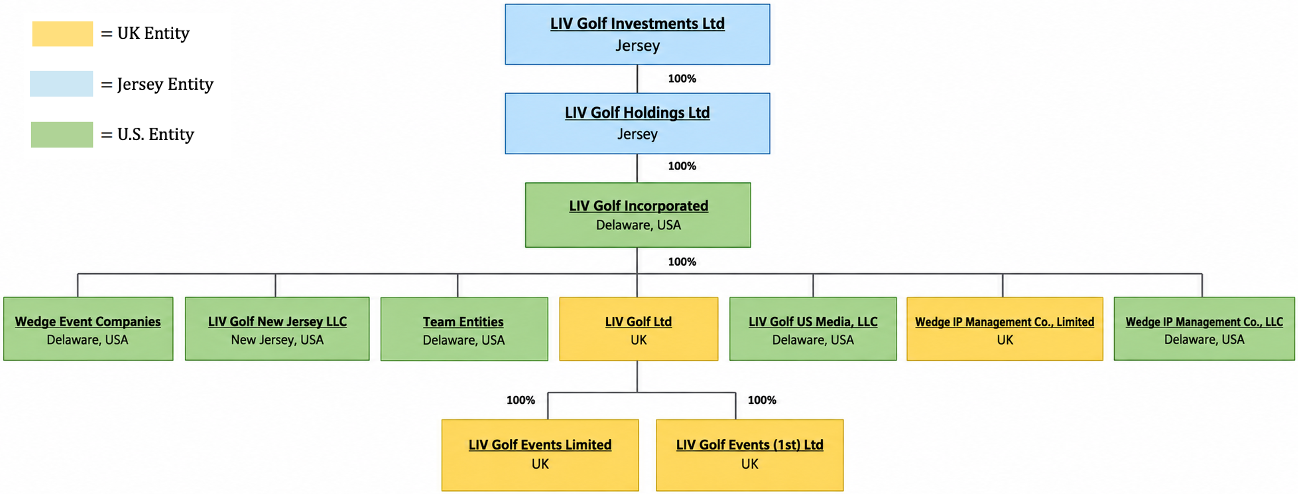
Two companies incorporated in the Island of Jersey, LIV Golf Investments Ltd and LIV Golf Holdings Ltd, sit at the top of the group. Beneath them is LIV Golf Incorporated, a Delaware corporation that directly or indirectly owns every other debtor in these cases.
- LIV Golf New Jersey LLC (New Jersey) — The lead Debtor, incorporated on July 15, 2026 as an operator of the league's New Jersey tournament from August 6 through August 9
- Wedge Event Companies (Delaware) — Six entities incorporated in early 2022, established to operate LIV Golf's U.S. events.
- Team Entities (Delaware) — 41 "Fairway TM" vehicles supporting the thirteen player teams, incorporated beginning January 2023.
- LIV Golf Ltd (UK) — Incorporated June 23, 2021; runs international operations.
- LIV Golf Events Ltd (UK) — International event operator.
- LIV Golf US Media, LLC (Delaware) — Incorporated July 18, 2024.
- Wedge IP Management Co., Limited (UK) and Wedge IP Management Co, LLC (Delaware) — Incorporated December 2021; non-operating entities holding some of the group's intellectual property and counterparties to the player name, image and likeness licenses.
Equity Ownership
As of the Petition Date, PIF held 98.48% of the common ownership of LIV Golf Investments Ltd, through a combination of preference shares and class A ordinary shares. Performance54 Group Limited, an entity majority owned by PIF that also serves as an events vendor to the Debtors, held 1.05% in class B ordinary shares, and LIV Golf's former chief executive officer and a current player held 0.23% each in class C ordinary shares.
Team Ownership Structure
Historically, the teams were partially player-owned. Eleven of the thirteen carried player equity, with one or more team members holding up to 40% of team common equity and more commonly 25%; sponsors held stakes in some, and LIV Golf Holdings Ltd held the majority in every case.
That structure changed two weeks before the filing. On August 24, 2026, mergers collapsed the prior team structures and cancelled the common equity held by players and sponsors, which the First Day Declaration referred to as the Team Consolidation. The declaration states it was effected to preserve the group's net operating losses, which it identifies as among the Debtors' most valuable assets. The last team vehicle, Fairway TM Co 13, LLC, was consolidated on September 8, 2026, before the petitions were filed that day.
Organizational Structure
Below is a simplified organizational structure of the Debtors; a detailed version can be found at page 28 of the First Day Declaration.
Operations Overview
Format and Player Compensation
The league began at 54 holes, three rounds rather than the standard four, and moved to 72 in late 2025 on player feedback and to secure maximum Official World Golf Ranking points and additional sponsor activation opportunities. Shotgun starts remain: with play underway on every hole at once, action is continuous across the course and the marquee names are guaranteed to be playing inside a fixed broadcast window.
Compensation departs further from the established model than the format does. The other tours pay almost entirely through individual prize purses, so golfers who miss the cut leave with no prize money and out-of-pocket costs already incurred. LIV instead pays a mix of guaranteed upfront commitment payments and annual payments, team equity for certain players, and performance-based individual and team purses. In exchange, players granted sponsorship rights to the League or their teams, subject to rights retained under their contracts, and some surrendered their name, image and likeness rights as well.
The season runs about 14 events, with individuals and teams accumulating points and the schedule generally culminating in a team playoff. The league also maintains reserve players who can substitute in for injured or absent competitors.
League and Team Segments
The business divides into two segments.
- The League is the primary revenue driver, split by geography between U.S. operations under LIV Golf Incorporated and international operations under LIV Golf Ltd. League entities operate all tour events and hold the rights that come with them — ticketing, hospitality, host city relationships, broadcasting, and League and event-level sponsorship — along with the vendor contracts and, for certain players, the participation agreements themselves.
- The Teams are thirteen separate operating entities, one per team of four players, wholly owned by LIV Golf Incorporated. They earn revenue chiefly through team-specific sponsorship deals and are typically counterparties to player contracts as well, contributing roughly 20% of 2025 revenue.
Alongside the tour, the Company co-sanctions an International Series with the Asian Tour, generally eight or nine Asia-based competitions featuring future LIV Golf prospects.
2025 Revenue Composition
Revenue in 2025 broke down across the following main categories:
- Sponsorship (49%) — The largest revenue line and, per the First Day Declaration, the Company's most significant growth driver, spanning team sponsorships on patches, equipment, shoes and uniforms; VIP hospitality programs; event-level deals; and season-long, league-wide marketing partnerships. Revenue in the category reached approximately $102 million in 2025, up from roughly $16 million in 2023, and the Company reports approximately $300 million in long-term contracts secured for 2027 through 2029. Several partners on the roster are Saudi entities connected to PIF: PIF carries Ma'aden as a direct subsidiary at 63.78% as of December 2025, and holds roughly 16% of Aramco through wholly owned vehicles. Riyadh Air and Roshn, wholly owned by PIF, are also partners to the Company. The sponsors extend to global brands as well, among them HSBC and Salesforce.
- Tournament Hosting Fees (22%) — Host cities, organizations and venues paid over $34 million in 2025 for hosting rights, drawn by the travel, lodging and entertainment spending an event brings and the profile it lends the venue. The Company puts the average economic impact at $40 million per event and over $1.5 billion since inception.
- Ticketing and Hospitality (16%) — Tickets run from single- and multi-day grounds passes, through "grounds plus" with access to private hospitality structures, to VIP options with premier seating and private clubs; hospitality revenue comes primarily from food and beverage sales across the course. Through June 2026, scanned attendance at comparable events was up approximately 31% year over year and combined ticketing, hospitality and food and beverage revenue up 43%. Adelaide drew 115,000 and South Africa over 100,000.
- Broadcasting (5%) — More than 20 broadcasters carry LIV across over 200 territories, a footprint the Company puts at one billion households, generally paying fees or sharing revenue under long-term contracts for exclusive rights to distribute its content. The most significant of these came in 2025, when Fox Sports became the exclusive U.S. broadcaster — a partnership the declaration credits with shoring up the credibility of LIV's audience base and lifting viewership more than 135% year over year.
- Merchandise (5%) — Hats, clothing and accessories, both league-wide and team-specific, sold through the online store and at booths at each tournament.
- Other (3%) — Comprises food and beverage commissions, interest received and other miscellaneous items.
Workforce
The Debtors entered Chapter 11 with a workforce already cut to a remnant: 41 employees at the Petition Date, roughly 22 in the United States and 19 in the United Kingdom at LIV Golf Ltd's London office, following the prepetition reduction described under Cost Reductions and the Workforce Reduction below.
Prepetition Obligations
The Debtors' prepetition funded debt consists of a single secured term loan from PIF, described below. Besides that, the league was built and run on PIF equity infusions, with its remaining obligations consisting of unsecured amounts under long-term player participation agreements and vendor obligations.
Participation agreements run between certain debtors and players or their affiliated entities, committing each player to League events for a multi-year term generally extending through the 2028 season in exchange for fixed and contingent compensation, and governing licenses to player name, image and likeness rights.
The PIF Facility
The Facility Agreement, signed June 4, 2026 after PIF ended its equity funding (see Events Leading to Bankruptcy below), names LIV Golf Holdings Ltd., a Jersey company, as borrower and PIF as sole lender, and provides for a term loan facility maturing December 31, 2026. Approximately $495 million was outstanding at the Petition Date, secured by first-priority liens on substantially all assets and property of the borrower and guarantors, plus the equity interests in LIV Golf Incorporated — the Delaware opco that holds the group's U.S. NOLs and serves as the DIP borrower.
The facility is guaranteed by nine debtor entities:
- LIV Golf Investments Ltd. (Jersey) — Ultimate parent
- LIV Golf Incorporated (Delaware) — U.S. operations
- LIV Golf Ltd (UK) — International operations
- LIV Golf Events Ltd. (UK) — International event operator
- LIV Golf New Jersey LLC (New Jersey) — Lead Debtor and 2026 New Jersey event operator
- Wedge IP Management Co., Limited (UK) — IP holding entity
- Wedge IP Management Co, LLC (Delaware) — IP holding entity
- Fairway TM Co 3, LLC (Delaware) — Team entity
- Fairway TM Intermediate 3, LLC (Delaware) — Team entity
Top Unsecured Claims

Events Leading to Bankruptcy
Losses and Parent Funding Suspension
Despite growing revenue and attendance across five years, the Debtors ran at a loss in every year of operations. The CRO attributes that to the League's compensation model: because professional golf is individual rather than team-based, recruiting players away from the established tours required upfront guaranteed payments and buying out their personal sponsorship rights so teams could be branded consistently — a structure that by design demanded heavy start-up funding. As of December 31, 2025, the Debtors carried approximately $3.0 billion of net operating losses at LIV Golf Incorporated and approximately $2.0 billion of tax losses at LIV Golf Ltd.
According to the 2024 audited financial statements of LIV Golf Ltd., the UK entity that houses the League's international operations, LIV Golf Ltd. and its subsidiaries FY 2024 revenue sat at $64.9 million, while spending $500.4 million to stage seven events, ending the year with a $461.8 million net loss. Cumulative losses at LIV Golf Ltd. and its subsidiaries stood at $1.105 billion at the end of FY2024.
On April 15, 2026, PIF approved a 2026–2030 strategy aimed at boosting returns and drawing more private capital into its development projects, organized around six focus sectors: tourism, urban development, advanced manufacturing, industrials and logistics, clean energy and water infrastructure, and Neom. On April 30, 2026, it announced that it would not provide the equity capital necessary to carry the League to profitability, that it would fund the remainder of the 2026 season only through a secured facility, and that the required long-term investment was no longer consistent with the current phase of its investment strategy. The term loan facility was subsequently signed on June 4, 2026, as described in the Prepetition Obligations section above.
Cost Reductions and the Workforce Reduction
With funding capped at the end of the season, management and its advisors reviewed the cost structure for savings that wouldn't damage the competitive product. Spending came down on fan experience, live event programming, hospitality and promotional activity, and on travel, lodging and entertainment provided around league events; certain non-critical accommodations for players were scaled back, with those necessary to maintain participation and competitive integrity retained. Two tournaments, Michigan and New Orleans, were cancelled outright.
The workforce followed. The Company issued notices on July 8, 2026 under the federal WARN Act, its New York State equivalent and comparable United Kingdom legislation, and effected the reduction on or about September 1 in the United States and September 3 in the United Kingdom. Roughly 289 employees were terminated and 22 more furloughed, and all prepetition independent contractors were let go. Forty-one employees remained at the Petition Date — 22 in the United States, 19 in the United Kingdom.
Governance Response and Retention of Professionals
In April 2026, the Company appointed Gene Davis and Jon Zinman as independent directors of the two Jersey holding companies and subsequently of every other Debtor except those that are member-managed LLCs. On April 24 they became the sole members of a newly formed Strategic Initiative Committee of LIV Golf Holdings Ltd., with exclusive authority over conflict matters and over any strategic, restructuring, financing or sale transaction. Advised by its own counsel, Kobre & Kim, the committee began assessing potential claims against insiders and affiliated entities before the Petition Date and continues to do so.
The Company retained Gibson Dunn as restructuring counsel and AlixPartners as financial advisor that same month, adding Ducera as investment banker in May. David Orlofsky of AlixPartners was appointed chief restructuring officer on September 7, 2026.
Key Employee Retention Plan
The Company implemented a prepetition retention plan in two tranches, on or about June 23 and August 7, 2026, covering a limited group of employees it identified as critical to finishing the 2026 season and to evaluating and pursuing a restructuring. The stated concern was that uncertainty over the Company's financial condition and the loss of PIF funding had raised the risk of departures among employees holding institutional knowledge and specialized skills. Neither the size of the group nor the amounts paid is disclosed.
The Marketing Process and the BC Partners Bid
Ducera began marketing in May 2026 with a confidential information memorandum and outreach to more than 300 potential investors. Of those, 104 signed non-disclosure agreements and entered the data room, approximately 30 undertook detailed diligence, and five leading prospects were asked to submit final non-binding bids by July 22, 2026. Two term sheets arrived on the deadline. The Company continued engaging with both before determining that the BC Partners proposal was the best and most viable.
Ultimately, the Debtors signed a restructuring support agreement (the "RSA") with BC Partners on the Petition Date, under which BC Partners agreed to anchor a $300 million investment in a restructured league the Company calls LIV 2.0 (details are presented below under The Liv 2.0 Term Sheet), contingent on consummation of a Chapter 11 plan.
BC Partners also holds a position in the sports business. In September 2024 it invested in GSE Worldwide, the athlete management agency, joining Gatemore Capital Management as an investor. GSE's golf roster includes three LIV players — Bryson DeChambeau, Joaquin Niemann and Abraham Ancer — each of whose participation agreements the Debtors moved to reject as of the Petition Date, and whose claims count toward the two-thirds-in-amount, one-half-in-number threshold of eligible player claims whose holders must accede to the RSA within 35 days.
Chapter 11 Filing
The case is structured around a single going-concern transaction with a compressed alternative and will be funded with a $49.6 million new money DIP facility from PIF, which has consented to the priming of its prepetition liens and to the use of cash collateral. The PIF DIP facility gives the Debtors 30 days to finalize the BC Partners transaction and file a plan implementing it, in form and substance satisfactory to PIF; failing that, they intend an orderly wind-down through a liquidating trust. Either outcome is an "Approved Plan" the facility is sized to fund, with a target emergence in January 2027.
The Restructuring Support Agreement
The Debtors and BC Partners Advisors L.P. entered into the RSA on the Petition Date. Its milestones run from that date: the Debtors must file a motion to assume the agreement within 3 days; the Court must enter both the RSA Assumption Order and the Interim DIP Order, and the Debtors must actually assume the agreement, within 10 days; PIF must become a party no later than that same date, on terms acceptable to the Debtors and BC Partners in their sole discretion; and Requisite Players must join within 35 days. The Plan Effective Date must occur within 120 days.
A termination fee of 3% of the total financing amount — $9.0 million on a $300 million investment — is payable in cash solely from the proceeds of an alternative transaction. It is triggered not only by consummation of an alternative restructuring proposal but by the Debtors' delivery of an Alternative Restructuring Engagement Notice, and it survives termination of the agreement as an allowed administrative expense secured by perfected DIP liens.
The LIV 2.0 Term Sheet
New investors would put $300 million into the reorganized Company across three instruments:
- Term Loan — $127.5 million — First lien on all assets of the reorganized company and its subsidiaries, priced at SOFR plus 800 basis points against a 2.0% floor, with a five-year term. Interest runs cash or PIK at the issuer's election, and the loan is interest-only for three years before amortizing at 5% annually. A 2.0% upfront payment is made in kind and a 2.0% exit payment falls due at repayment. Holders receive warrants for 5.00% of the common equity at $0.01 per share.
- Senior Preferred — $147.5 million — Accrues at 15% per annum paid in kind, subject to a minimum return of 1.2 times invested capital in year one, rising 0.2 times annually against the original issue size. That multiple sets the liquidation preference, which sits ahead of the common on any sale, merger or deemed liquidation. Holders receive warrants for a further 10.00% at $0.01 per share.
- Convertible Subordinated Preferred — $25 million — Converts into 30.00% of the common on an as-converted basis, at the same price per share paid by players and management. It carries a liquidation preference senior to the common; once that preference is satisfied, remaining proceeds go to preferred and common together on an as-converted basis.
BC Partners' affiliated funds and co-investors would provide up to $150 million, the balance coming from other investors acceptable to BC Partners. Reorganized common equity would be held 45.00% by new investors, 52.50% by players and 2.50% by management, under a seven-member board seating three BC Partners designees, three player and management designees, and one independent director.
PIF's funded debt and equity would be cancelled in exchange for releases, with no distribution on account of either. BC Partners would retain consent rights over equity issuances, new indebtedness, affiliate transactions, material asset sales, transfers by player equityholders, and any action that would impair the tax attributes. The investors would additionally receive 2% of revenues for seven years, running from the point the board determines LIV 2.0 has reached profitability. BC Partners would separately hold an exclusive right to acquire one expansion team for $1, exercisable once two expansion teams have been introduced post-emergence and expiring ten years after closing.
Closing conditions include delivery of a KPMG opinion that the transaction qualifies under section 382(l)(5), execution of go-forward player contracts covering players the investors specify, affirmations from major sponsors that they will honor their agreements, and the absence of any ownership change during the cases.
Section 382 and the Player Equity Split
LIV Golf Incorporated sits at the top of the consolidated tax group and carried roughly $3.0 billion of net operating losses at the end of 2025. Section 382 normally caps how much of a company's accumulated losses a new owner can use, so that tax attributes cannot simply be bought. Section 382(l)(5) carves out an exception for bankruptcies: the cap disappears entirely if pre-change shareholders and qualified creditors together emerge holding at least half the reorganized company by value and vote.
In this case PIF, the principal pre-change shareholder, takes nothing on its equity, so the test falls effectively to the creditors. On the Petition Date the Debtors moved to reject the player participation agreements effective as of that date, on the stated basis that the existing compensation structure is inconsistent with LIV 2.0 and would accrue administrative cost without benefit. The effect is to convert multi-year contracts into rejection-damages claims — the currency the equity is distributed against, and the same claims that set the denominator for the Requisite Players test. The players' 52.50% follows from the section 382(l)(5) test rather than from a valuation of their claims: with PIF taking nothing, the players must hold at least half the reorganized equity for the transaction to qualify. BC Partners will not fund without a KPMG opinion confirming the transaction qualifies, and can terminate if an ownership change occurs at any point during the case.
Two sets of restrictions protect the section 382(l)(5) qualification.
- The first runs against PIF, whose own conduct could trigger an ownership change. Under the Interim DIP Order, PIF cannot write its equity down as worthless or abandoned for any tax year ending on or before the Plan Effective Date, unless the law requires it to, and cannot transfer or pledge holding-company equity where doing so would risk an ownership change. Both can be relaxed with the Debtors' consent, and the only remedy for breach is a court order to comply — no damages.
- The second runs against the players. Qualifying under section 382(l)(5) generally requires a creditor to have held its claim continuously from the time it arose, so a claim that changes hands may cease to count toward the 50% test. The trading restrictions accordingly cover any claim held by a party to a participation agreement, the player whose services it covered, entities that player owns, or any independent contractor who competes in LIV events — annual payments, prize money, NIL, sponsorship, endorsement, media, expenses and rejection damages alike, at any size. Holders have to identify themselves within 20 days, give two weeks' notice before any transfer, and sit through a 10-day window in which the Debtors can object. A transfer made without following those steps is void from the outset. The Debtors say these claims sit with a small number of holders and are concentrated enough that a single transfer could cost them the relief entirely.
Player Consent and the Requisite Players Test
The RSA gives the Debtors 35 days from the Petition Date to bring the players into the deal, and that deadline carries more weight than most milestones in the case. The players' equity is what makes the tax structure work, their contracts are what the reorganized league would be built on, and BC Partners can terminate if the date passes without them.
Clearing it means satisfying two tests at once. Requisite Players means holders of at least two-thirds of eligible player claims by dollar amount and at least half by number, and a claim stops being eligible once it leaves the hands of the player who originally held it. What the players sign is a lock-up rather than a ballot: on terms BC Partners finds acceptable, each agrees not to trade his claim, grants BC Partners exclusivity over the restructuring, and commits to support the transaction.
The PIF DIP Facility
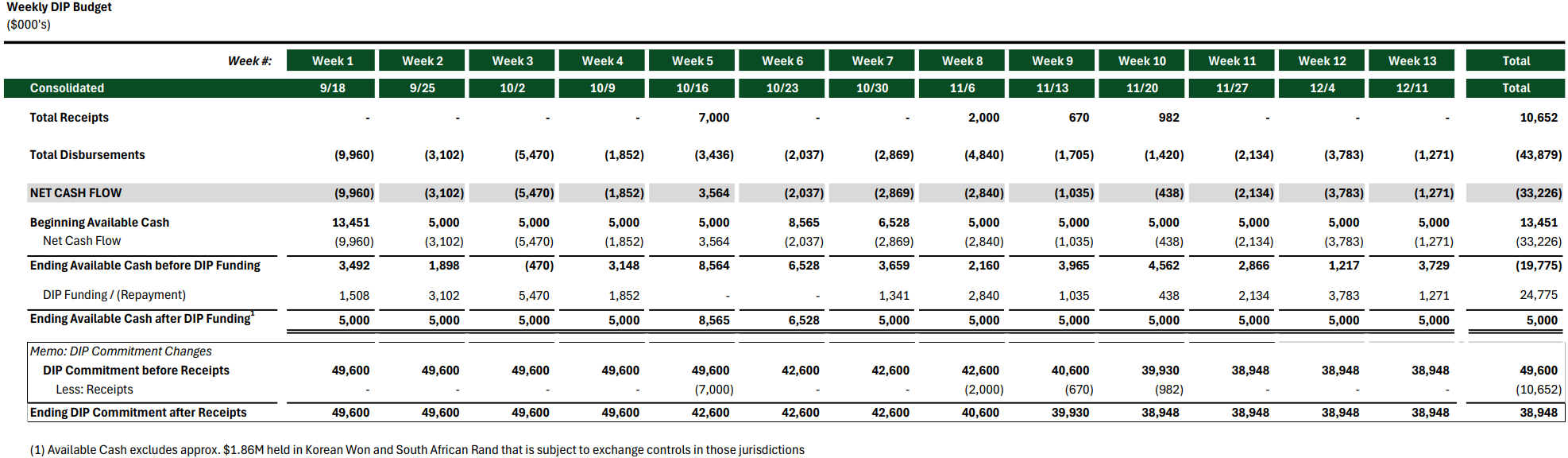
- Size — Up to $49.6 million of new money, $14.0 million available on the interim order and the balance as a delayed-draw term loan
- Interest Rate — At a fixed 12.0% per annum paid in kind and compounded at each interest period, with no upfront, commitment, backstop or exit fees.
- Roll-Up — Prepetition obligations equal on a dollar-for-dollar basis to the interim and delayed-draw loans convert automatically into DIP roll-up loans, which the Debtors characterize as consideration for PIF's agreement to fund rather than as adequate protection.
- Carve-Out — Professional fees capped after a trigger notice at $4.5 million shared among debtor and committee professionals and excluding any success or transaction fees, ranking ahead of the DIP and prepetition liens but with no recourse to the lender reserve account.
- Releases — The Debtors release the DIP lender and its affiliates, advisors and related parties on entry of the interim order from all claims relating to the DIP facility, including lender liability, shadow directorship, equitable subordination and any challenge to lien validity or priority; the parallel release of PIF as prepetition lender is conditioned on completion of the Strategic Initiative Committee's independent investigation. Both are subject to the challenge provisions.
- Avoidance Actions — Excluded from the DIP collateral until the final order, which adds their proceeds; the DIP and adequate-protection superpriority claims are payable from all assets of the loan parties, including avoidance proceeds, from entry of the interim order.
- Challenge Period — Challenges to the stipulations must be brought by the earlier of confirmation of an Approved Plan and 75 days from entry of the interim order; a Chapter 7 or 11 trustee appointed within that period has until the later of that 75-day date and 30 days after its appointment.
- Investigation Budget — The Strategic Initiative Committee may fund its own investigation from cash collateral and DIP proceeds in accordance with the approved budget; any statutory creditors' committee or trustee may spend no more than $50,000 in the aggregate to investigate, but not prosecute, the same stipulations.
- Milestones — From the Petition Date: interim order within 3 days; plan and disclosure statement within 30 days; final order within 35 days; disclosure statement approved within 80 days; confirmation within 110 days; effective date within 120 days, which is also the outside maturity.
The BC Partners DIP Facility
Separate from PIF's DIP facility, BC Partners would provide a second debtor-in-possession facility of up to $30 million to LIV Golf Incorporated, guaranteed by LIV Golf Investments Ltd. and LIV Golf Holdings Ltd. Where PIF's facility funds the cases generally, this one is directed at the start-up costs of the LIV 2.0 transaction, and its availability is tied to the RSA's own milestones rather than to case administration.
- Availability — $1.0 million once the Interim DIP Order and RSA Assumption Order are entered and PIF joins the RSA; a further $1.0 million after PIF joins but before the players do; $2.0 million once both PIF and the Requisite Players have joined; and up to $26.0 million thereafter at the lenders' sole discretion, in biweekly increments. No more than $2.5 million may be funded before entry of the Final DIP Order.
- Draw Mechanics — Draws are capped at 105% of the amounts set out in the most recent weekly disbursement schedule, which the borrower must deliver each Thursday covering the following two weeks in form acceptable to the lenders.
- Pricing — Term SOFR plus 1,400 basis points against a 2.0% floor, compounded monthly and paid in kind, with a default rate of an additional 2.0% payable in cash on demand.
- Premiums — A 10.0% upfront premium ($3.0 million) calculated on the aggregate $30 million commitment rather than on amounts drawn, payable in kind on entry of the Interim DIP Order; and a 10.0% repayment premium on principal repaid, prepaid, satisfied by credit bid, or rolled into the exit facility.
- Maturity — 30 days after closing, extendable by 30 days up to three times on a 0.75% payment-in-kind premium, subject to no default under either DIP facility and the RSA remaining in force.
- Priority — Pari passu with PIF's facility in lien and payment priority, save as to the initial $1.0 million draw, the specified collateral and the termination fee, on which it ranks senior.
- Specified Collateral — A first-priority pledge of all equity in LIV Golf Incorporated, including the equity held by LIV Golf Investments Ltd.
The Foreign Proceedings
Two foreign processes run alongside the Chapter 11 cases, in different forms.
In England and Wales the Debtors seek recognition rather than a separate insolvency. LIV Golf Ltd and LIV Golf Events Ltd hold assets there, and LIV Golf Ltd employs 19 people at its London office. David Orlofsky is to be appointed foreign representative under section 1505 and will apply to the High Court for recognition of their cases under the Cross-Border Insolvency Regulations 2006, as foreign main or alternatively non-main proceedings. Two other English Debtors sit outside the application.
Jersey has not enacted the Model Law, so recognition is unavailable. LIV Golf Investments Ltd and LIV Golf Holdings Ltd have instead applied to the Royal Court of Jersey for administration under Part 20B of the Companies (Jersey) Law 1991 — a plenary proceeding. Andrew McFarlane Wood and Alastair Beveridge are proposed as joint administrators, with Carey Olsen as counsel; the Jersey court controls their appointment and fees. A cross-border protocol signed before the filing establishes the primacy of the Chapter 11 cases.
Both are wired into the PIF DIP facility. Commencing the UK applications and filing the Jersey application are conditions to the interim draw, and thereafter a range of outcomes triggers default — dismissal, denial or withdrawal of the UK applications, late filing in either jurisdiction, the English court declining recognition without a stay within 45 days, or the Jersey order being refused, discharged or reversed.
Explore Bondoro Insights for live case dockets and comprehensive coverage of material filings from petition to plan confirmation.
Stay informed on every Chapter 11 bankruptcy case with liabilities exceeding $10 million. Subscribe for free to have our coverage delivered directly to your inbox, and explore our full archive of past summaries.
Subscribers can also opt in to timely filing alerts by updating their email preferences in Account Settings.


