Case Summary: Braskem Idesa Chapter 11
Braskem Idesa, the Mexican petrochemical joint venture behind the Etileno XXI complex, filed for Chapter 11 after Pemex ethane shortfalls forced costly imported feedstock amid a prolonged downcycle, with an RSA backed by ~79% of secured debt to cut funded debt by over $920 million.

A deck version of this summary is also available HERE.
Business Description
Braskem Idesa, S.A.P.I. ("BAKIDE," and together with its affiliated debtors and debtors in possession, the "Debtors" or the "Company") is a Mexican petrochemical producer formed as a joint venture between Brazilian petrochemical company Braskem S.A. ("Braskem") and Grupo Idesa, S.A. de C.V. ("Grupo Idesa"), a Mexican petrochemical subsidiary of the financial conglomerate Capital Inbursa, S.A. de C.V., to develop and operate the Etileno XXI project — an integrated ethane cracker and polyethylene complex in Nanchital de Lázaro Cárdenas del Río, Veracruz, Mexico.
The Etileno XXI Project was a milestone for Mexico's petrochemical industry, representing the largest private industrial investment in the sector in over 30 years and the largest ever made in Mexico by a Brazilian company. Since completion, the Complex has produced over 7.5 million tons of polyethylene and generated over $9 billion in revenue. As of the Petition Date, BAKIDE holds a sizable portion of the Mexican polyethylene market and exports to customers across Latin America, Europe, Asia and the United States.
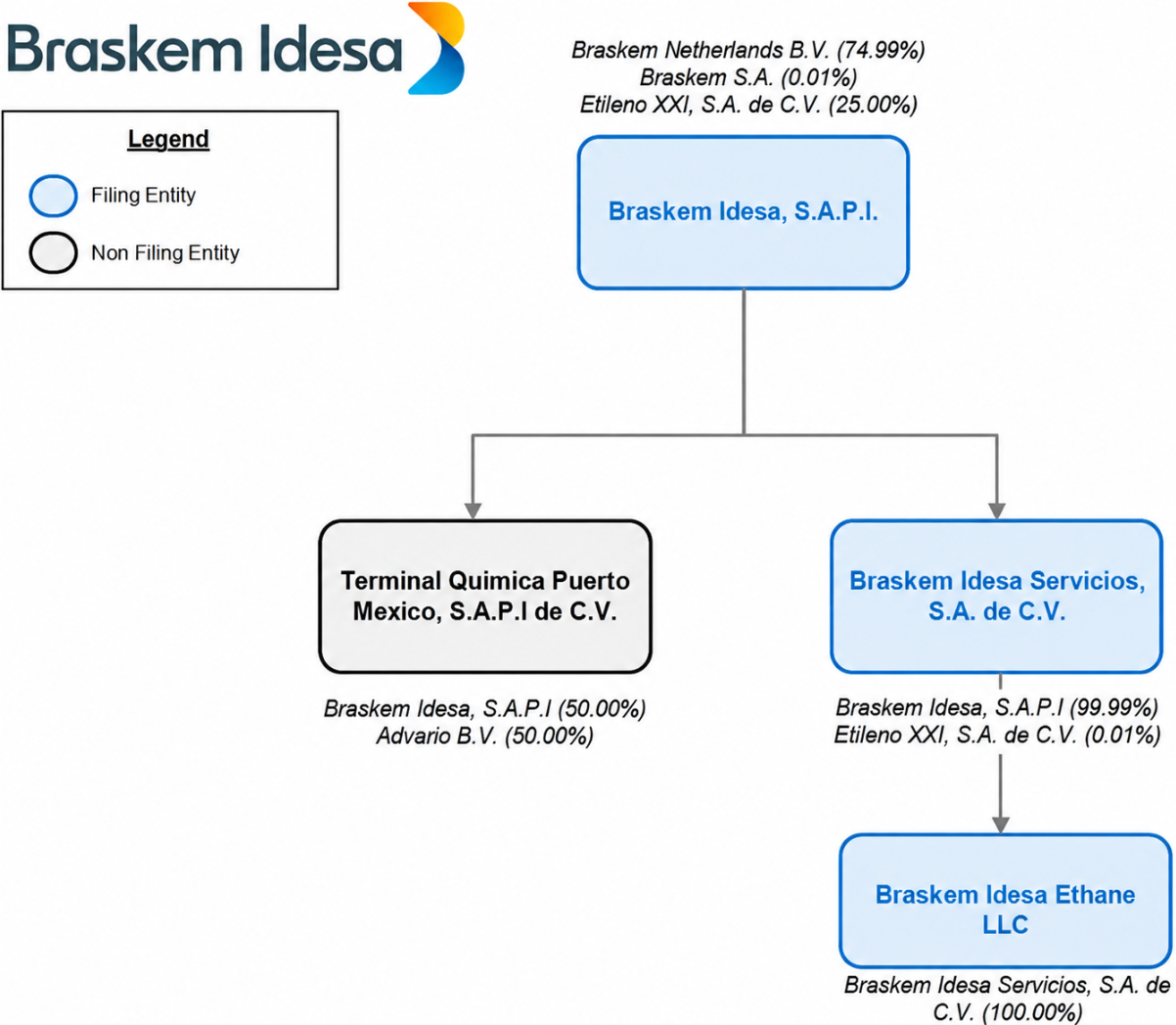
BAKIDE is the operating company; Braskem Idesa Servicios, S.A. de C.V. ("BI Servicios") is 99.99% owned by BAKIDE and performs ancillary operational functions; and Braskem Idesa Ethane LLC ("Braskem Idesa Ethane"), a Texas entity held through BI Servicios, supports the Company's business relationships in the United States. Non-Debtor affiliate Terminal Química Puerto México, S.A.P.I. de C.V. ("TQPM") operates the ethane import terminal on which the Complex depends for feedstock. TQPM is owned equally by BAKIDE and Advario B.V., a Dutch liquid storage logistics company and a subsidiary of German logistics service provider Oiltanking GmbH.
Braskem Idesa, S.A.P.I. and certain affiliates⁽¹⁾ filed for Chapter 11 protection on August 17, 2026 (the "Petition Date") in the U.S. Bankruptcy Court for the Southern District of Texas, reporting $1 billion to $10 billion in both assets and liabilities.
⁽¹⁾ For a list of Debtor entities, see organizational structure chart below.
Corporate History & Ownership Structure
The Etileno XXI project originated in a 2008 Mexican government initiative. Responding to a substantial deficit in Mexico's ethylene production chain, the government and Pemex Transformación Industrial — a subsidiary of Petróleos Mexicanos ("Pemex") — invited 31 Mexican and international petrochemical companies to bid for a long-term raw material contract (the "Pemex ESA") and for the construction of an integrated petrochemical complex (the "Complex"). Braskem and Grupo Idesa bid as a consortium and won in 2009, taking both the Pemex ESA and the mandate to construct on approximately 200,000 acres in the Coatzacoalcos region.
BAKIDE was incorporated in Mexico in April 2010, and BI Servicios in December 2010. Construction of the Complex began thereafter, and the first phase of the Etileno XXI Project was implemented over the following 6 years. On April 7, 2016, BAKIDE began producing polyethylene, and by August 2017 had produced one million tons.
Organizational Structure
Operations Overview
Petrochemical Complex and Production Process
The Complex produces both high-density polyethylene ("HDPE") and low-density polyethylene ("LDPE"). The facility comprises an ethane cracker of 6 furnaces with annual capacity of 1,050,000 tons of ethylene; two HDPE plants with combined annual capacity of 750,000 tons; an LDPE plant with annual capacity of 300,000 tons; a 150 megawatt power generation plant; and an effluents treatment plant and a water treatment plant, which return water to the community in compliance with applicable regulations.
Natural gas-based ethane is the primary feedstock, which BAKIDE historically obtained from Pemex and other suppliers. The ethane cracker first converts that feedstock into ethylene, which is then converted into polyethylene at the three downstream plants. The two grades differ in molecular structure and density, which determines how tightly their molecules pack together. HDPE's more linear structure yields a denser, more rigid, higher-strength material used in products such as milk jugs, heavy-duty pipes and trash bins. LDPE's more irregularly branched structure yields a lower-density, softer and more flexible material used in products such as squeeze bottles, shrink wrap and resealable sandwich bags. Demand and pricing for each can differ based on market conditions.
Customers
BAKIDE's customers are generally producers of third-generation petrochemicals — finished products rather than intermediates — manufacturing plastic-based consumer and industrial goods. End uses include plastic films for food and industrial packaging, bottles, shopping bags and other consumer goods containers, and household appliances. The Debtors state that the diversity of these end uses reduces the Company's dependency on any single industry or type of end-user.
BAKIDE carries approximately 15 different grades of polyethylene and sells into both the Mexican market and international export markets. The Debtors state that the Company's structure and location give it flexibility to shift between those markets depending on pricing dynamics.
Distribution & Logistics
Alongside its domestic sales in Mexico, the Company has historically used Braskem's global presence and distribution channels to reach foreign markets. In geographies where BAKIDE lacks a market presence, it sells directly to related parties, which then use their own networks to reach the end customer. The United States is one of BAKIDE's largest export markets, served generally by bulk rail shipments that the Debtors state allow the Company to be cost competitive.
Supporting that reach, the Complex holds on-site logistics infrastructure: a railyard with capacity for more than 400 hopper cars and 30 tank cars for chemicals, tied into the major railroad concession in Mexico; 21 silos of 500 tons each; a 215,000 square foot warehouse; and a 300,000 square foot external yard capable of holding more than 36,000 tons of polyethylene. The site also sits near ports and roads, and BAKIDE moves product through relationships with third-party logistics operators, reaching anywhere in Mexico within an average of 72 hours according to the declaration.
Ethane Supply
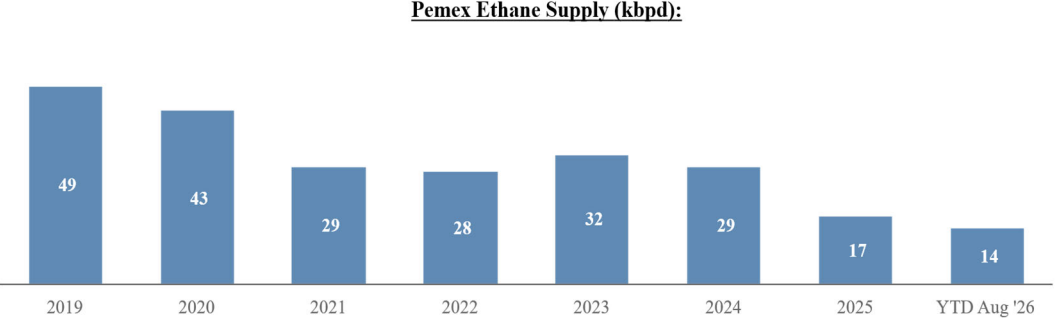
- The Pemex Agreement — Pemex agreed in 2010 to supply 66,000 barrels of ethane per day for 20 years on a deliver-or-pay basis, but deliveries fell well short. Pemex supplied 49,000 barrels per day in 2019, 29,000 in 2021 and 17,000 in 2025, and approximately 14,000 barrels per day year-to-date through August 2026. Its own ethane production declined over the same period, from 101,000 barrels per day in 2017 to 39,000 in 2025.
- The 2021 Pemex Amendment — The parties amended the contract in 2021. Pemex's supply obligation was cut by more than half, to 30,000 barrels per day until completion of a dedicated ethane import terminal; liquidated damages for prior shortfalls were released; and Pemex agreed to support the terminal's permitting. That minimum-volume commitment, originally set to run to February 2025 and extendable for permitting delays outside the Company's control, expired as of February 9, 2026. Pemex now owes no minimum delivery obligation, and BAKIDE holds a right of first refusal through 2045 over volumes Pemex does not consume in its own production.
- Replacement Supply Chain — The Company built its replacement supply chain in stages. From 2019 it ran an interim overland import route, contracting with the port operator Smart Pass and the cryogenic transport specialist Enestas to receive seaborne ethane at Coatzacoalcos and truck it to the Complex. Braskem Netherlands became both a supplier of imported ethane and lessor of the vessels moving it from Texas, under agreements running to March 31, 2033, with title passing to BAKIDE in Texas before export and approximately $120 million of ethane and vessel invoices outstanding at the Petition Date. The overland route concluded on the opening of the ethane import terminal described below.
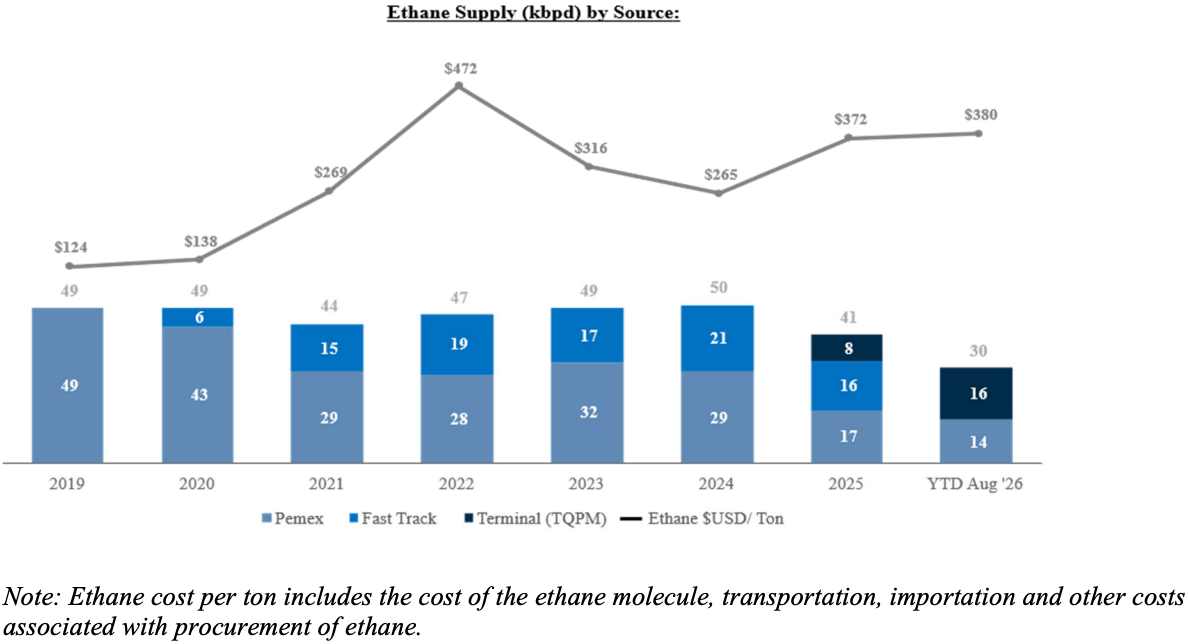
- Cost of Imported Feedstock — Supply from all sources held between 44,000 and 50,000 barrels per day from 2019 through 2024 as imports offset the Pemex decline, before falling to 41,000 in 2025 and 30,000 year-to-date through August 2026. Over the same stretch, the all-in cost of ethane delivered to the site — inclusive of the molecule, transportation, importation and related procurement costs — rose from $124 per ton in 2019 to a peak of $472 in 2022, settling at $372 in 2025 and $380 year-to-date through August 2026. Logistics costs, which did not apply at all under the original pipeline-fed arrangement, reached $180 per ton by 2025. Customs duties on goods the Debtors purchase internationally ran to $36.6 million in the year before filing, with nonpayment carrying a risk of seizure of goods.
Ethane Import Terminal
The ethane import terminal at Laguna de Pajaritos is a project of non-Debtor TQPM. The terminal connects to the Complex by a twelve-kilometer pipeline, can move approximately 80,000 barrels per day and holds roughly 54,000 tons of storage. It was inaugurated in May 2025 and began supplying the Complex during commissioning that September. Total construction value reached approximately $586 million, against the $408 million project facility TQPM borrowed to finance it, which sits alongside a $32 million debt service reserve letter of credit facility under an October 2023 credit agreement. BAKIDE separately agreed to provide equity contributions and credit support to TQPM, with Braskem S.A. as equity support provider.
BAKIDE contracted for use of the terminal under two agreements with TQPM, both dated October 31, 2023 — one for ethane storage, one for transportation — each running 20 years from the Commercial Operation Date. TQPM invoices monthly on 60-day terms, averaging approximately $7.4 million for storage and approximately $630,000 for transportation, inclusive of value-added tax, or roughly $96 million a year payable to a non-Debtor.
Prepetition Obligations
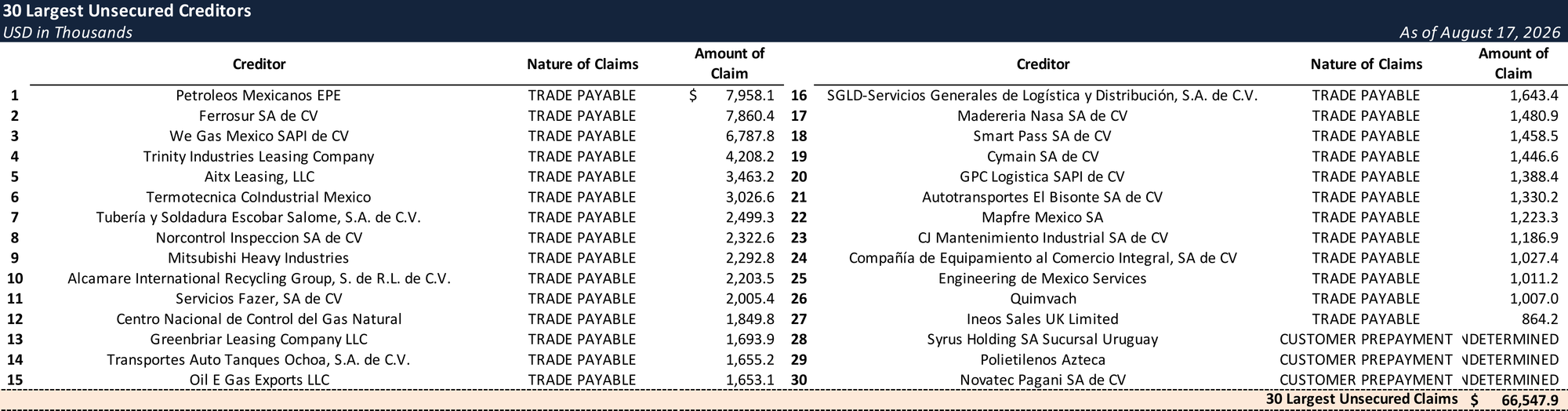
Top Unsecured Claims
Events Leading to Bankruptcy
Operational Headwinds
Since the second half of 2022 the Company has faced a prolonged petrochemical downcycle, compressed industry spreads, and constrained ethane supply in Mexico, which raised feedstock costs and limited plant utilization. Over the same period the Company replaced its feedstock procurement process entirely, shifting from an inexpensive, integrated source to one carrying significant fixed costs and much higher variable costs. The declaration attributes to these factors a material weakening of operating cash flow, a highly constrained liquidity position and an unsustainable leverage profile.
Those liquidity constraints worked their way into the trade base, which comprises over 400 vendors. Average days past due reached 150, with some vendors unpaid for more than a year — a strain that the declaration links back to the Company's inability to return to optimal operating levels or to fund the logistics providers moving finished product to customers.
Against that backdrop, geopolitical factors including conflict in the Middle East disrupted petrochemical supply and demand, and polyethylene prices doubled in the first half of 2026. However, the Company could not capitalize on the rising polyethylene pricing as the Complex was running at less than 50% of capacity on average, which the Debtors attribute to constrained working capital; and prices fell back toward historically normalized levels before the opportunity could be captured.
Funded Debt Defaults and the Terminal's Financing Forbearance
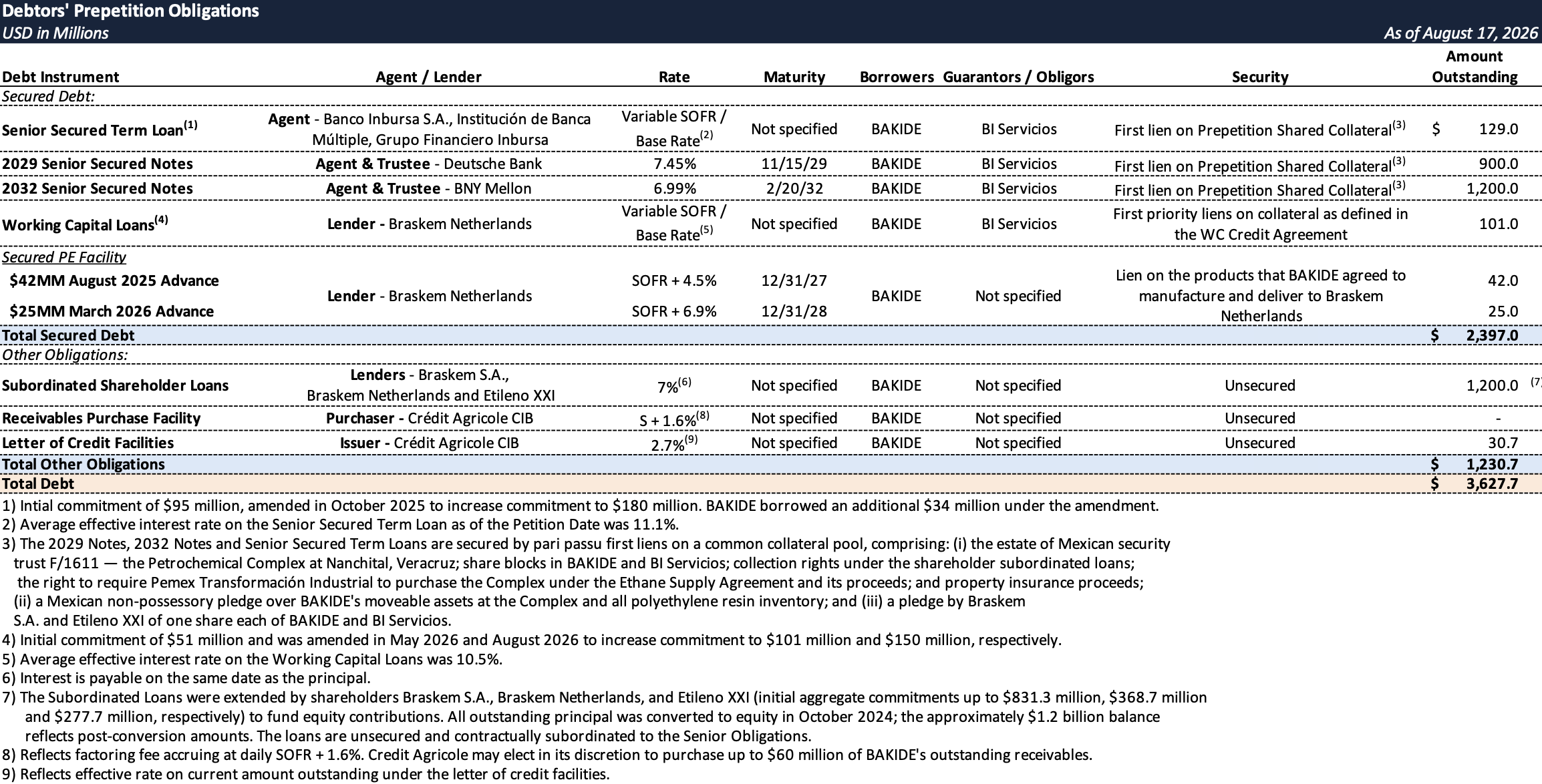
BAKIDE stopped paying interest across the funded stack while negotiations proceeded, a step the declaration describes as taken to conserve liquidity. The Working Capital Facility fell into default earliest, on June 25, 2025, with further missed payments in July 2026. The notes and term loan followed: a $33.5 million coupon on the 2029 notes went unpaid on November 15, 2025 and again in May 2026; a $41.9 million coupon on the 2032 notes in February 2026; and three payments on the Inbursa term loan in January, April and July 2026. By the Petition Date the Company carried more than $180 million in accrued and unpaid interest against approximately $3.6 billion of total principal outstanding.
Creditors responded differently depending on where they sat. Braskem Netherlands, the affiliate lender under the WC Facility, agreed to forbear through August 17, 2026, after which the accrued and unpaid interest was capitalized into outstanding principal. None of the senior secured noteholders or the term lender called a default, accelerated or pursued remedies before the filing.
The defaults extended past the Debtors' capital structure. On the Ethane Import Terminal side, delays in obtaining customs permits caused non-Debtor TQPM to miss project completion milestones, triggering a default under the terminal's credit agreement. TQPM and its financing parties entered a first forbearance agreement in December 2025, which expired in April 2026, and a second in July 2026 that covered the existing defaults and extended to defaults arising from a BAKIDE Chapter 11 filing. Absent the second forbearance, the equity support agreements would have accelerated, obliging BAKIDE and Braskem S.A. to fund half of TQPM's project debt at the moment of the Chapter 11 filing.
Going Concern and Deteriorating Financials
Braskem S.A.'s FY2025 financial statements carry a going-concern assessment for Braskem Idesa separate from the parent's own. Braskem attributes the deterioration to the downturn and feedstock dynamics described above, adding weaker-than-expected global demand, oversupply largely from China and the United States, and a rising ethane reference price under the original Pemex contract. On that basis the statements conclude a material uncertainty exists as to BAKIDE's ability to continue as a going concern, and record two consequences: a R$1,468 million (US$267 million) impairment of BAKIDE's assets, and a R$1,175 million (US$214 million) valuation allowance against its deferred tax assets, substantially the entire balance.
The standalone figures, consolidating BAKIDE with BI Servicios and TQPM, show the same pattern. Net revenue for 2025 fell 21% to R$4,135 million ($752 million) from R$5,247 million in 2024, while the loss for the year widened 34% to R$4,414 million ($803 million) from R$3,288 million. Total assets declined 6% to R$21.8 billion ($3.98 billion) against liabilities of R$24.7 billion ($4.5 billion), up 8% year over year, turning equity of R$497 million ($90 million) at the end of 2024 into negative R$2.8 billion ($511 million) at the end of 2025.
Emergency Prepetition Financing
In the months before the Petition Date, facing a liquidity shortfall against approaching debt service obligations, the Company negotiated with its shareholders, affiliate stakeholders and existing lenders, including Braskem and Inbursa. Three facilities followed:
- Emergency Inbursa Term Loan — $34 million, October 22, 2025. Extended by Inbursa under the Senior Secured Term Loan Amendment.
- Secured PE Facility amendment — $25 million, March 3, 2026. Extended by Braskem Netherlands after liquidity tightened again in early 2026.
- WC Credit Agreement — $101 million outstanding. Entered March 25, 2026 with Braskem Netherlands, bringing the two Braskem facilities — together the Emergency Braskem Bridge Facilities — to $126 million funded by the Petition Date.
Failed Out-of-Court Exchange
An out-of-court exchange was attempted and failed. Under confidentiality agreements signed December 18, 2025, the Company proposed up to $700 million of new shareholder liquidity — a $300 million backstopped facility plus a $400 million equity injection to repurchase notes from holders electing to cash out at 55 cents — with remaining notes exchanged at par into 7-year take-back notes carrying a 5-year interest holiday. An ad hoc group of holders of the 2029 and 2032 senior secured notes countered on January 6, 2026, seeking $900 million, comprising $200 million of first lien notes backstopped by the group at 11% and a $700 million shareholder equity injection, with existing notes taking second lien paper or the same 55-cent cash-out. Braskem Idesa declined the counterproposal.
Braskem S.A.'s Own Restructuring
The controlling shareholder entered its own restructuring in parallel. On June 24, 2026, Braskem S.A. and certain affiliates commenced a jointly administered protective injunction proceeding in support of a court-supervised interim mediation under Brazilian Federal Law No. 11.101/2005, before the 2nd Bankruptcy and Reorganization Division of the São Paulo State Court of Justice. Its foreign representative filed for Chapter 15 recognition in the Southern District of New York on June 26, and that court granted provisional relief on June 30. The São Paulo court stayed enforcement actions and attachments by creditors invited into the mediation for 60 days.
The Chapter 11 Filing
The Debtors entered Chapter 11 with a restructuring support agreement already executed by Braskem, Inbursa, and an ad hoc group of senior secured noteholders, together holding approximately 79% of the prepetition secured debt. The plan would cut prepetition funded debt by more than $920 million, taking senior debt from approximately $2.5 billion to approximately $1.6 billion, and fund a return to economic operating rates.
The Braskem DIP Facility
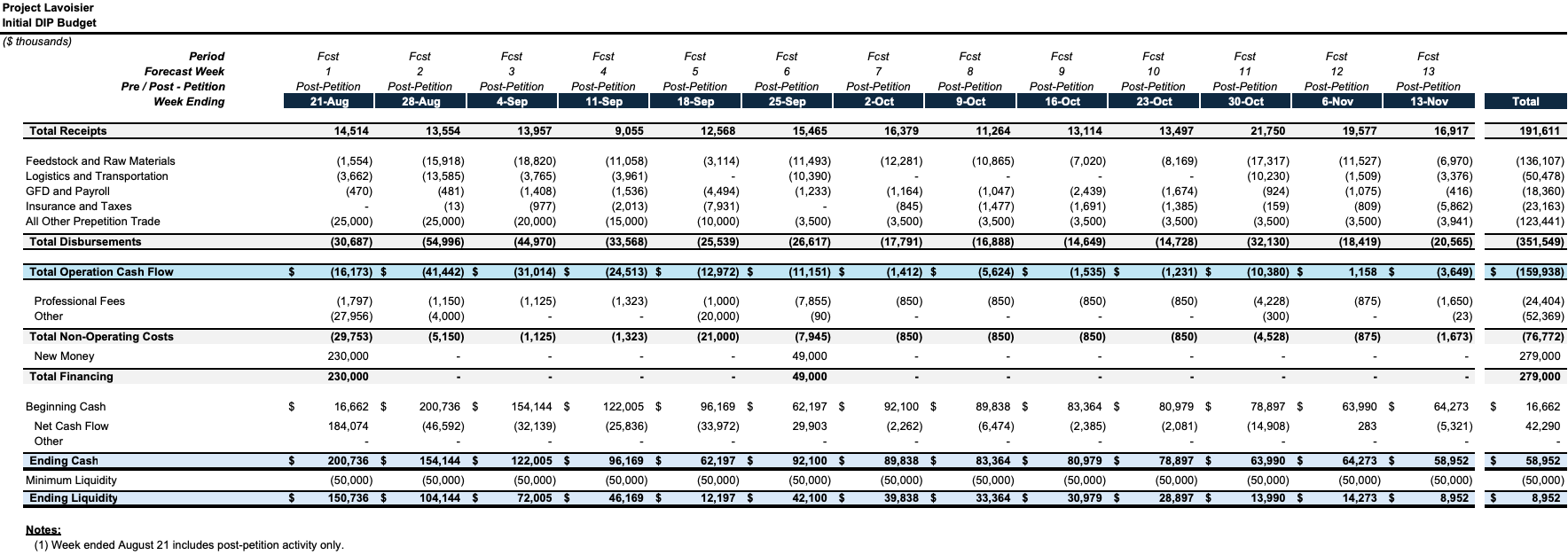
The Debtors filed seeking a superpriority, priming, delayed-draw DIP facility of $408.9 million from parent Braskem Netherlands B.V. and Braskem America, Inc., or their affiliate designees. The facility comprises $279 million of new money — drawn $230 million on the interim order and $49 million on the final — and a $129.9 million roll-up of prepetition debt. Only claims held by DIP lenders or their affiliates are eligible for roll-up treatment, so the roll-up reaches only Braskem's own prepetition bridge lending: the $101 million Working Capital Facility and $25 million March 2026 Secured PE Facility advances — for a total of $126 million in principal plus accrued amounts.
- Pricing — 10% per annum paid in kind and capitalized to maturity, with a 0.50% commitment fee, also paid in kind, totaling approximately $1.4 million on the new money.
- Maturity — 6 months from the effective date, extendable by one month.
- Security — Priming liens under section 364(d)(1), with the Debtors seeking waivers of the section 506(c) surcharge, the section 552(b) equities-of-the-case exception, and marshaling.
- Carve-outs — Professional fees capped at $8 million following a trigger notice, plus a $50,000 investigation budget for any statutory committee.
- Challenge period — The earliest of confirmation, 60 days after appointment of a committee, or 30 days after entry of the interim order.
- Remedies — On default and delivery of a termination notice, enforcement is barred for a standstill of up to 15 months while the parties negotiate an alternative transaction. From six months, the 2029 and 2032 noteholders and the term lender may prosecute a credit bid for their collateral, provided the Requisite Prepetition Secured Creditors consent and the bid discharges the DIP in full.
Initial DIP Budget
Reorganized Equity and Exit Notes
- Reorganized Equity — Ownership of the reorganized company divides into equal thirds on a fully diluted basis: (i) to holders of the $2.1 billion of senior secured notes, for equitizing $825 million of their claims; (ii) to existing shareholders, for their cancelled interests; and to (iii) Braskem, for converting approximately $414 million of DIP financing (projected at the Effective Date, inclusive of accrued interest and the commitment fee) and injecting a further $71 million of cash at emergence. The disclosure statement puts the implied plan equity value at approximately $1.46 billion, derived from these negotiated terms rather than from an appraisal — it states expressly that no valuation analysis was prepared.
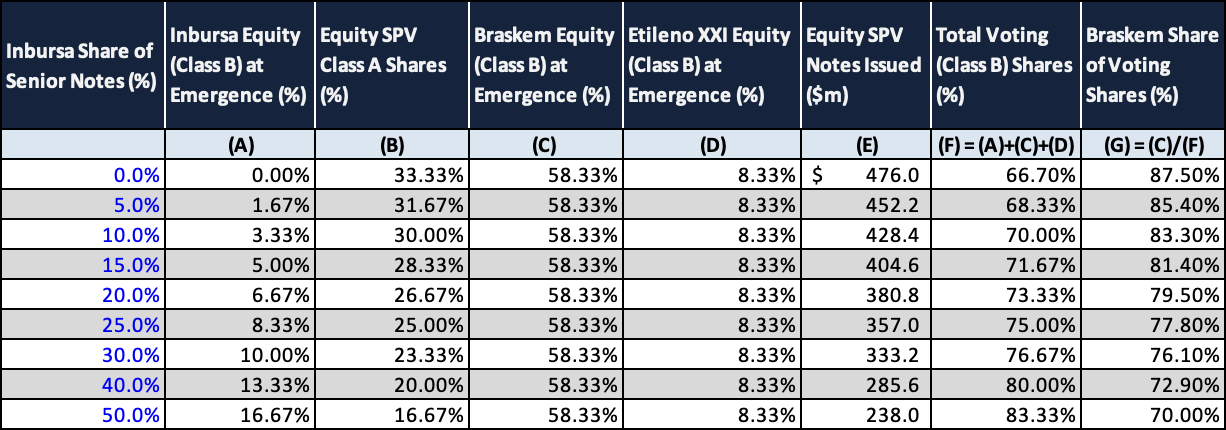
- The Equity SPV — The noteholders' third is delivered two ways depending on who holds it. Inbursa, which holds notes alongside its term loan, takes voting Class B shares directly, alongside Braskem and the existing shareholders. Non-Inbursa noteholders take non-voting Class A shares issued not to them but to a newly formed, bankruptcy-remote Equity SPV, which becomes the registered shareholder and issues its own secured notes to those holders in turn.
- SPV Notes — Principal on the SPV notes is formulaic: the percentage of the 2029 and 2032 notes held by parties other than Inbursa, Grupo Carso and their affiliates, multiplied by $476 million, issued at par. The notes pay 5.00% in kind, capitalizing annually through the seventh anniversary, run 15 years without amortization, and are secured by the SPV's assets: the Class A shares, dividends and distributions on them, sale proceeds, controlled accounts and rights under shareholder agreements. Braskem S.A. can call the entire Class A block at any point in the first 5 years; if it does not, holders can put it back to Braskem S.A. across a one-year window opening at the fifth anniversary. The price is the same on both sides and set by formula — initial principal compounding at 5.00% to the seventh anniversary, in step with the notes' own PIK accrual.
- Post-Emergence Ownership Structure — At emergence, Braskem would hold approximately 58% of the reorganized company: a third for its DIP conversion and $71 million cash infusion at Effective Date, plus the 75% it holds of the shareholder third. Etileno XXI takes the other 25% of that shareholder third, or approximately 8% of the company. The remaining third goes to the senior noteholders, with Inbursa taking its pro rata slice as Class B shares and the Equity SPV holding the balance as Class A. The illustrative table below sets out how the reorganized ownership resolves at varying levels of Inbursa's holdings of the 2029 and 2032 notes, a figure the filings do not disclose; all other columns derive from the Plan's equal thirds, the $476 million cap on the Equity SPV notes, and the 74.99%/25% prepetition split between Braskem Netherlands and Etileno XXI.
- Exit Notes — Approximately $1.6 billion of first lien notes, shared between the noteholders' residual claims after the equitized portion and Inbursa's approximately $129 million senior secured term loan
Treatment of Claims Summary
- DIP Claims (unclassified) — Allowed DIP Claims are equitized at emergence instead of being paid in cash. The DIP facility therefore leaves no debt on the reorganized balance sheet.
- Non-Voting Classes — Other Secured Claims (Class 1), Other Priority Claims (Class 2), General Unsecured Claims (Class 8), Intercompany Claims (Class 9) and Intercompany Interests (Class 10) — None is entitled to vote: Classes 1, 2 and 8 are Unimpaired and conclusively presumed to accept, while Classes 9 and 10 are presumed to accept or deemed to reject depending on their treatment. Other Secured Claims are satisfied at the Debtors' option by cash payment in full, return of collateral, or reinstatement; Other Priority Claims are paid in full; General Unsecured Claims are reinstated and paid in full in cash; and Intercompany Claims and Interests are cancelled or reinstated at the Reorganized Debtors' discretion, subject to the consent of Braskem S.A. and the Required Consenting Creditors.
- Class 3 — Senior Secured Notes Claims ($2.1 billion) — Comprises the 2029 and 2032 notes, allowed at the full amount owing under the indentures including interest accrued to the Effective Date. $825 million is equitized as described above; the residual is satisfied in Exit Notes.
- Class 4 — Senior Secured Term Loan Claims ($129 million) — Inbursa's approximately $129 million term loan, deemed allowed at the full amount owing with accrued interest and exchanged for Exit Notes at par. No writedown and no equity component.
- Class 5 — Secured PE Facility Claims — Braskem Netherlands' product-financing exposure under the manufacturing and distribution agreement, to the extent not rolled into the DIP — the $25 million advanced in March 2026 forms part of the roll-up, while the $42 million advanced in August 2025 remains outstanding. Satisfied per a schedule to be filed with the plan supplement.
- Class 6 — Subordinated Loans Claims — Approximately $1.2 billion of unsecured shareholder loans at 7%, neither repaid nor converted. Each is amended and restated to extend beyond the maturity of the Exit Notes, subordinated to them, with all interest payable in kind. Shareholder capital stays in the business behind the new money, with no cash service.
- Class 7 — Braskem Commercial Claims — Braskem's claims under the Braskem Agreements, which comprise intercompany arrangements between Braskem and the Debtors, agreements relating to TQPM, and agreements between Braskem and current or former BAKIDE shareholders, excluding the WC Credit Agreement, Secured PE Facility and subordinated loans. The largest component is ethane — the approximately $120 million of Second BNL Ethane Supply Agreement invoices described under Ethane Supply. Treatment follows the same plan supplement schedule as Class 5.
- Class 11 — Existing Equity Interests — Cancelled on the Effective Date, with holders receiving a pro rata share of one third of the reorganized equity as Class B shares.
Explore Bondoro Insights for live case dockets and comprehensive coverage of material filings from petition to plan confirmation.
Stay informed on every Chapter 11 bankruptcy case with liabilities exceeding $10 million. Subscribe for free to have our coverage delivered directly to your inbox, and explore our full archive of past summaries.
Subscribers can also opt in to timely filing alerts by updating their email preferences in Account Settings.


