Case Summary: True Food Kitchen Chapter 11
True Food Kitchen filed for Chapter 11, closing 12 of its 46 restaurants, citing strategic missteps, frequent management turnover and declining sales. A $20 million DIP from an affiliate of equity holder HumanCo funds a sale or recapitalization process.

A deck version of this summary is also available HERE.
Business Description
Headquartered in Scottsdale, AZ, FRC Balance, LLC ("True Food Kitchen" or the "Company") and its eight debtor affiliates (collectively, the "Debtors") operate a health-focused restaurant chain whose menu follows the anti-inflammatory diet, which emphasizes biodiverse whole foods and limits processed ones.
The Company was founded in 2008 by wellness author Dr. Andrew Weil and Sam Fox, a Phoenix-based restaurateur and founder of Fox Restaurant Concepts. By fall 2026, the chain had grown to 46 restaurants, in addition to a test kitchen.
Technomic estimates the Company's 2025 U.S. sales at $312 million across 45 restaurants. The Debtors now operate 34 restaurants across 14 states, having closed 12 the day they filed.
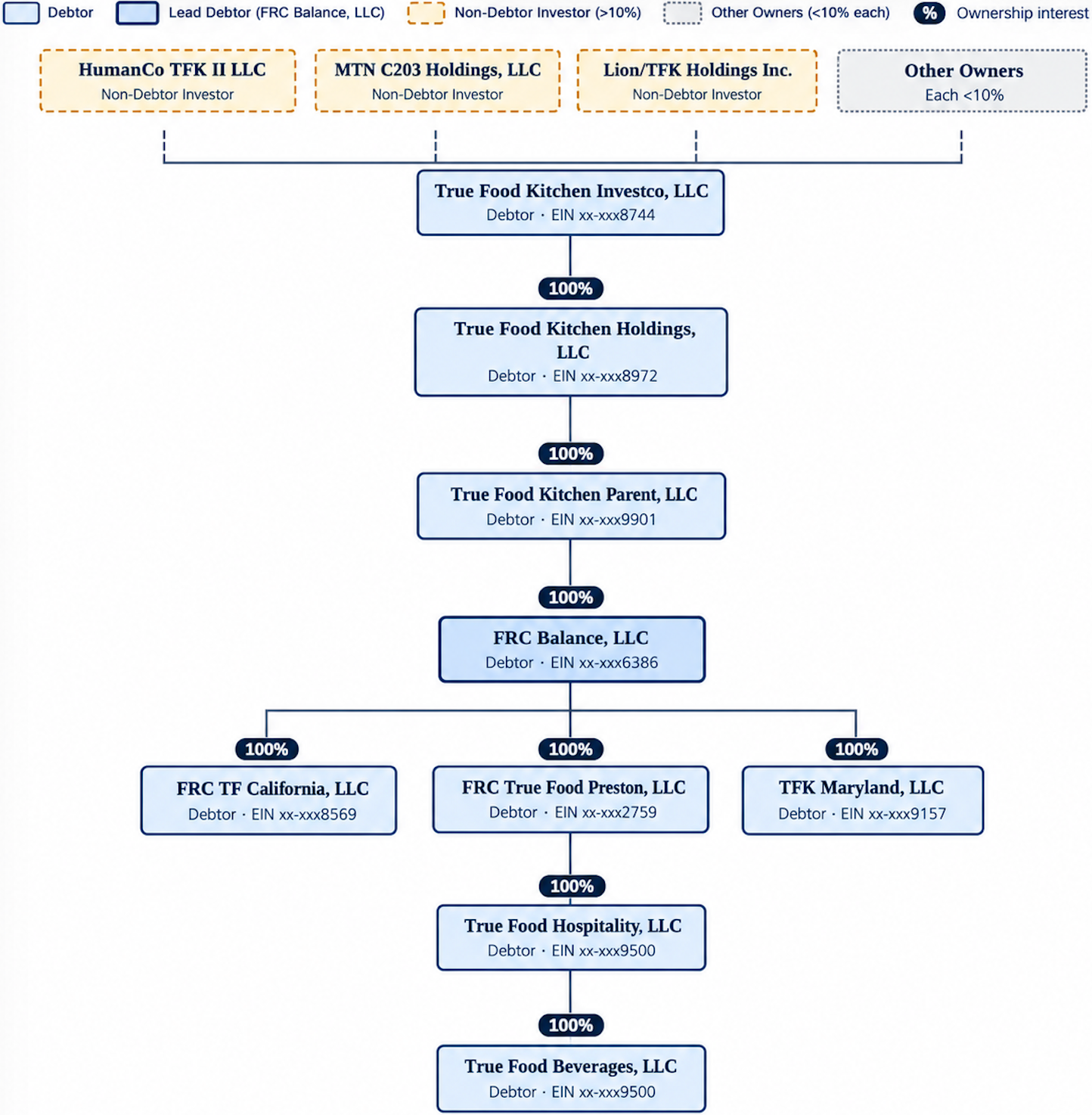
FRC Balance, LLC and certain affiliates⁽¹⁾ filed for Chapter 11 protection on October 4, 2026 (the "Petition Date") in the U.S. Bankruptcy Court for the Southern District of Texas, reporting $10 million to $50 million in both assets and liabilities.
⁽¹⁾ For a complete list of Debtor entities, see organizational structure chart below.
Corporate History
Founding and the P.F. Chang's Option
From its founding in Phoenix, True Food Kitchen was run as one of Fox Restaurant Concepts' brands. In 2009, P.F. Chang's agreed to lend the chain money to build new restaurants, and the loan carried an option. P.F. Chang's could convert what it was owed into a majority equity position, making it the controlling owner.
In February 2012, P.F. Chang's elected to convert early and take a 51% stake, with operations and development remaining with Fox Restaurant Concepts. Before the conversion took effect, P.F. Chang's agreed to be acquired by Centerbridge Partners. The two sides then agreed that if that acquisition closed first, the conversion would be rescinded and the loan would continue on its original terms. The acquisition closed in July 2012, and the conversion fell away. A Centerbridge spokesman said P.F. Chang's was back on the 2009 terms: still a lender, with the option to convert into majority ownership once the chain opened its sixth restaurant.
Centerbridge Majority and the Spin-Off from Fox
By 2016, Centerbridge held majority ownership of True Food Kitchen. Restaurant Business reported that year that Fox had sold a major stake to P.F. Chang's and that the chain had since been developed with Centerbridge funding. Fox Restaurant Concepts kept a stake and continued to run the chain as one of its brands.
In September 2016, Fox Restaurant Concepts named Christine Barone, a former Starbucks executive, as True Food Kitchen's first chief executive. Her mandate was to turn the 13-unit chain into a stand-alone company under Centerbridge's majority ownership. The separation was completed in December 2017, when the chain left Fox Restaurant Concepts as FRC Balance with 20 locations and absorbed more than 20 single-restaurant LLCs in a merger. In July 2018, Oprah Winfrey made an equity investment and joined the board; Centerbridge remained the controlling shareholder.
The HumanCo and Manna Tree Investment
On September 8, 2022, the Company announced a funding round of more than $100 million. It was led by two new investors, HumanCo and Manna Tree, and supported by existing investor Centerbridge. Oprah Winfrey, Lion Capital, Dr. Weil and Howard Schultz were also listed as investors. Barone said the capital would fund more than 10 new restaurants over two years and the launch of a fast-casual concept. By April 2023, the Company was owned by a consortium that included Centerbridge, HumanCo and Manna Tree.
Equity Ownership
As of the Petition Date, the Debtors' ownership statement lists three holders of 10% or more of True Food Kitchen Investco, LLC ("Investco"), a Debtor and the top entity in the corporate structure:
- HumanCo TFK II LLC — 37.78%
- MTN C203 Holdings, LLC, a Manna Tree vehicle — 24.05%
- Lion/TFK Holdings Inc. — 22.74%
Organizational Structure
Operations Overview
Restaurant Footprint
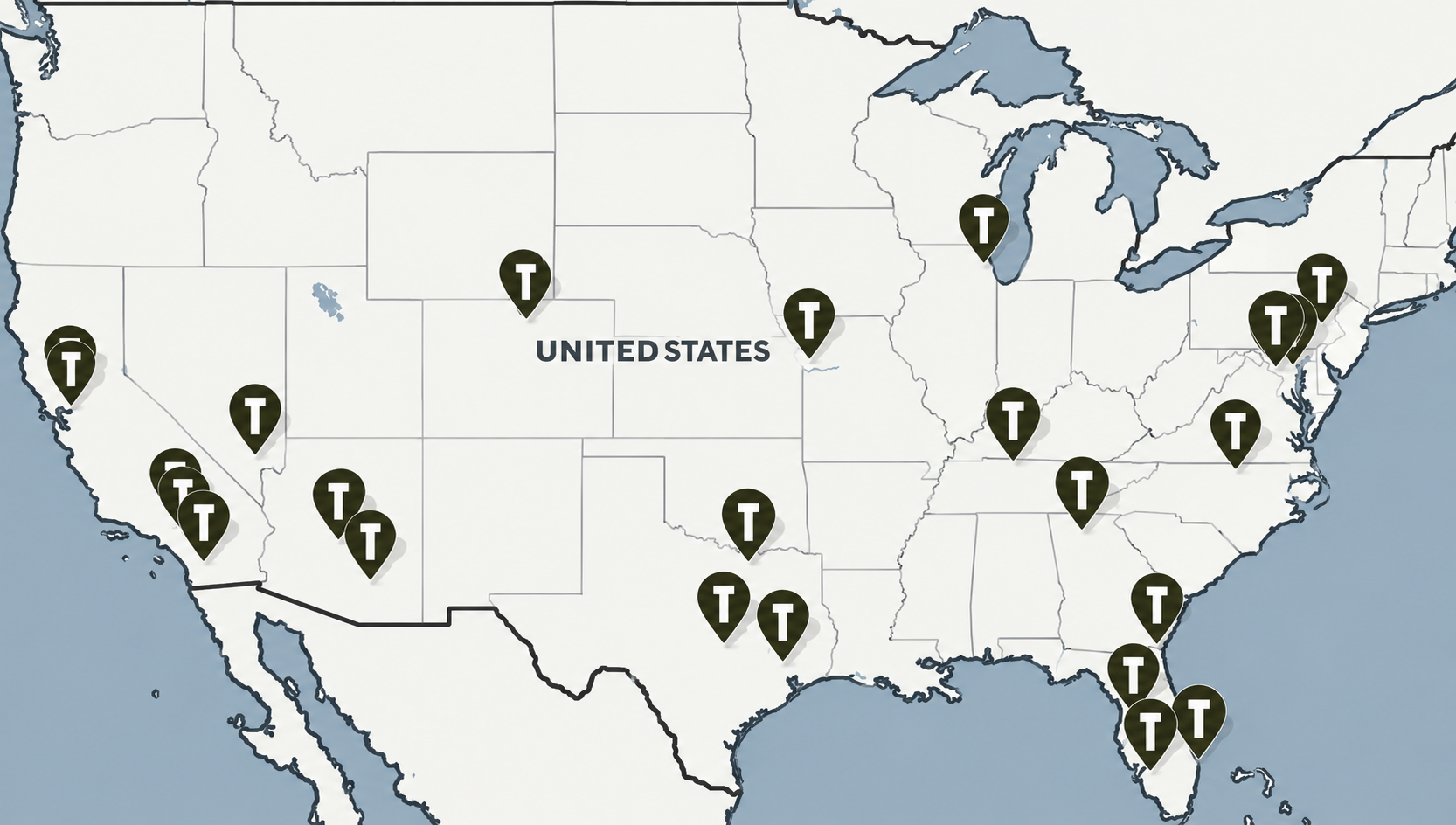
Prior to filing, True Food Kitchen operated 46 restaurants in 18 states. The October 4 closures took the Debtors out of Louisiana, New Jersey, New York and Ohio entirely and reduced their count in California, Florida, Maryland, Virginia and Illinois. The map below reflects the Debtors' current store footprint.
Menu Offerings
True Food Kitchen restaurants serve grass-fed beef, antibiotic-free chicken, sustainably raised salmon and pasture-raised eggs. Since February 2025 they have been 100% seed oil-free, cooking only with avocado and olive oil. The Company had committed to those two oils in 2022 and removed seed oils from 98% of its menu soon after.
The seasonal menu spans starters, salads and bowls, burgers, entrées and desserts. A July 2025 DoorDash case study named the Ancient Grain Bowl and Edamame Dumplings as the chain's core classics, alongside newer dishes such as air-fried chicken and house-fermented sourdough pizzas. Drinks include matcha, coffee, signature and zero-proof cocktails, and beer and wine. The restaurants also serve a kids' menu, weekend brunch and happy hour, with prices varying by location.
The menu changes four times a year, includes vegan, vegetarian and gluten-free options, and is prepared in kitchens with no freezers or fryers, then-CEO Christine Barone told Bloomberg in 2018. Seasonal menus and new cocktails anchor the Company's promotions, and the restaurants open on Thanksgiving to serve a turkey dinner.
Services and Sales Channels
Besides dine-in service, the restaurants offer reservations, private dining, online ordering, catering and gift cards. In October 2024, the Company opened True Food Market, a restaurant-retail hybrid of approximately 2,800 square feet, near its Scottsdale headquarters. It pairs a fast-casual menu built around air-fried chicken tenders with a grab-and-go market selling packaged goods, prepared meals and merchandise.
In 2022, sales were split roughly evenly between lunch and dinner. Off-premise sales made up approximately 30% of revenue, much of it through the Company's own channels. In the same DoorDash case study, chief financial officer Peter Koumas put DoorDash orders at approximately 10% of overall revenue.
Suppliers and Vendors
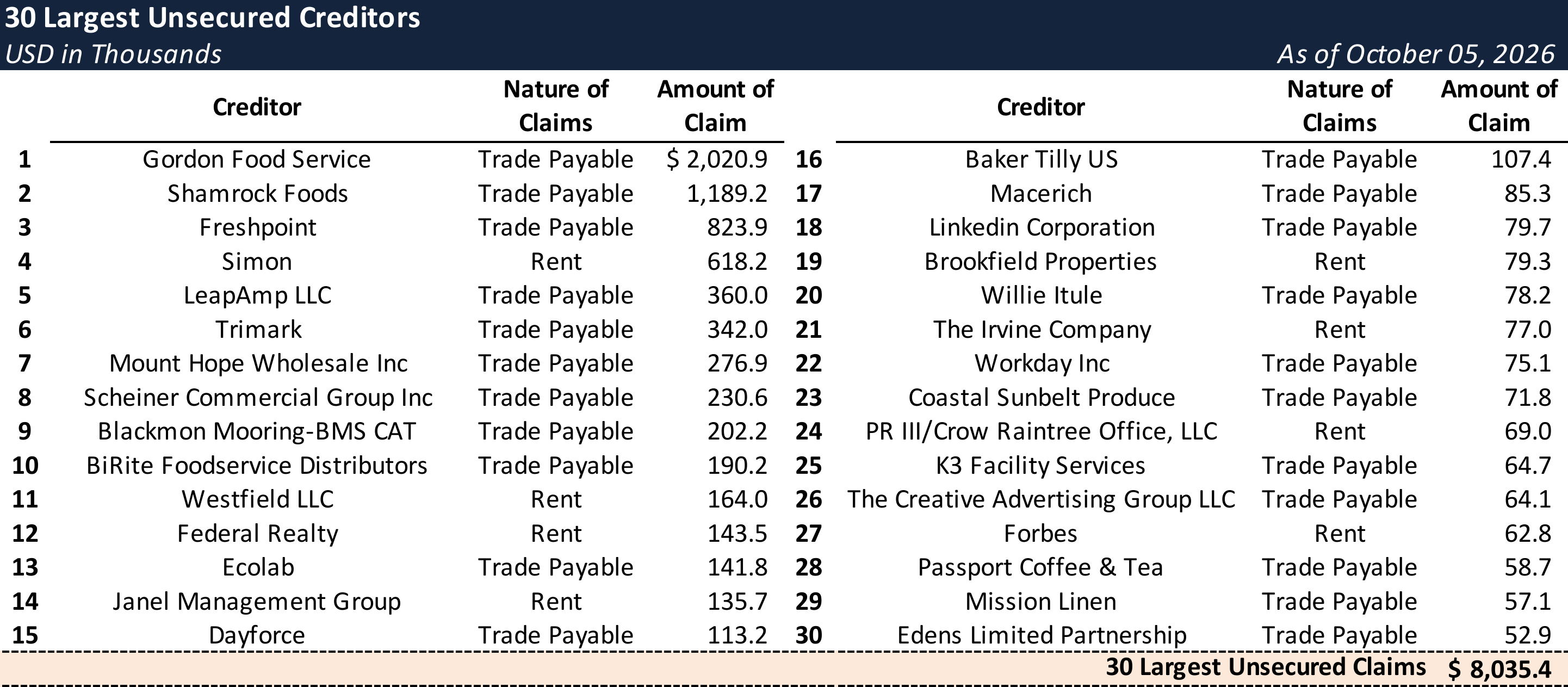
The Debtors rely on farmers, growers, producers and distributors for fresh produce, meat, poultry and other perishable goods. Some of these suppliers may hold trust claims under the Perishable Agricultural Commodities Act ("PACA") or the Packers and Stockyards Act ("PASA"), federal statutes that protect qualifying sellers of produce, livestock and poultry. The Debtors estimate they owed approximately $4.4 million to these vendors as of the Petition Date, led by Gordon Food Service ($2.0 million), Shamrock Foods ($1.2 million) and FreshPoint Atlanta ($0.8 million).
Beyond those suppliers, the Debtors treat three vendor groups as critical:
- suppliers of other food, beverages, alcohol, packaging and cleaning supplies;
- technology vendors for inventory, accounts payable, recruiting, cybersecurity and point of sale; and
- restaurant service providers, including janitorial contractors and vendors of rented kitchen and dishwashing equipment.
Most of the Debtors' supplier relationships are not governed by long-term contracts, and the Debtors buy food, beverage and packaging supplies on an order-by-order or as-needed basis.
Workforce
The Debtors employ approximately 2,788 people. Approximately 264 are full-time and 2,524 part-time, and approximately 2,533 are hourly and 255 salaried. Headquarters staff handle food safety and quality assurance, culinary oversight, facilities, marketing, accounting, finance, IT and human resources. Restaurant staff serve guests, run and supervise restaurant operations, and train employees.
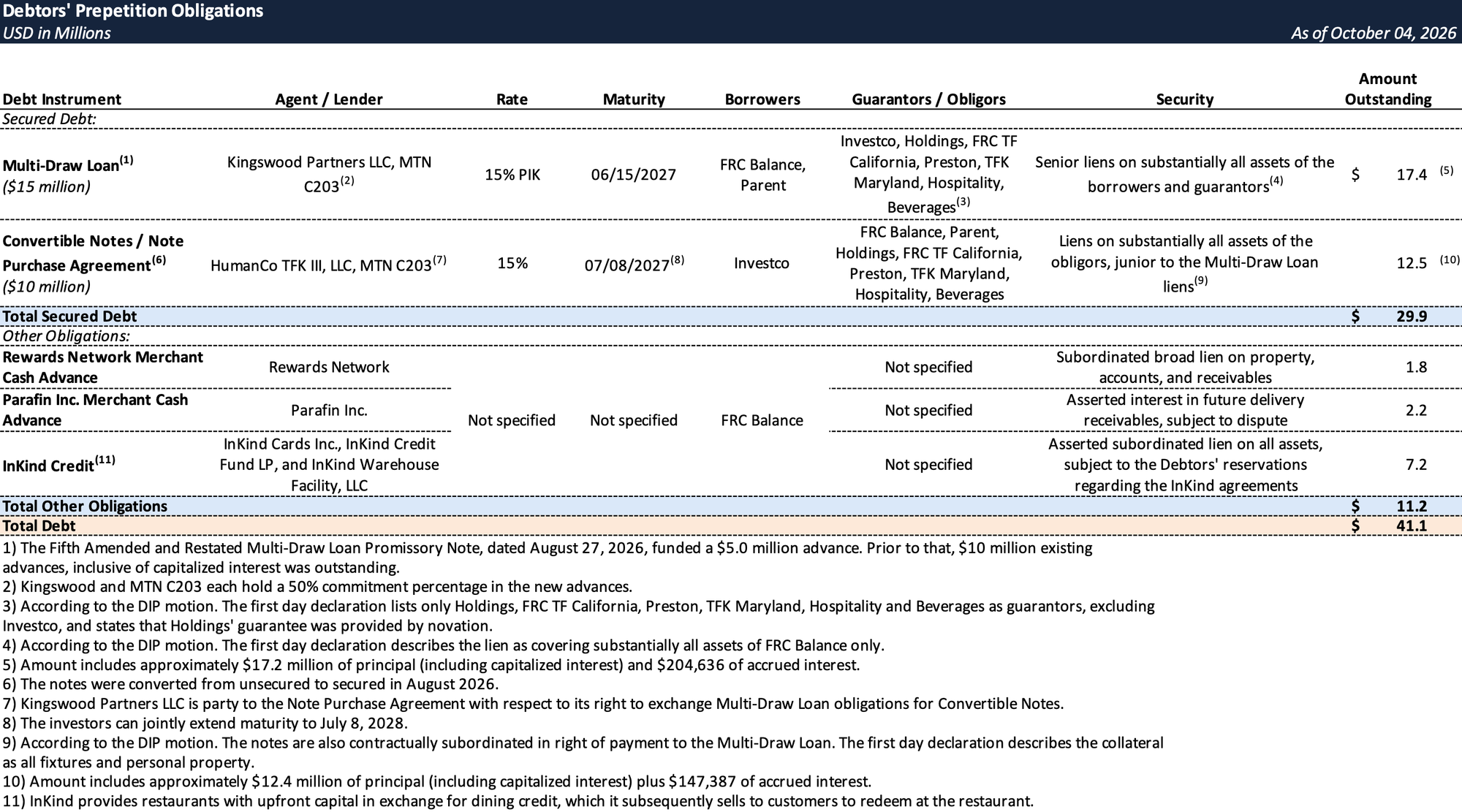
Prepetition Obligations
Top Unsecured Claims
Events Leading to Bankruptcy
Operational Challenges
The pandemic cut into the Company's profitability during a period of growth. To offset the drop in in-person dining, the Company ran some restaurants as ghost kitchens and opened one off-site kitchen for delivery only. The First Day Declaration says these tests "impaired staffing and the restaurant and service experience," and both have since ended.
The First Day Declaration also points to strategic missteps. Successive leadership teams invested capital outside the Company's core markets and in new product lines and restaurant concepts that ultimately failed, including equipment for product lines that didn't fit the health-focused brand. FSR Magazine's bankruptcy coverage cites True Food To Go, a takeout-only format announced in April 2023 for Tempe, Arizona, as "a quick-service prototype that never gained traction."
Some restaurants struggled with lower-than-expected foot and car traffic, and others lost profitability as local markets and demographics changed. In 2025, systemwide sales fell 0.7%, the chain's first decline outside 2020, and the Debtors closed a location, according to Technomic data.
Cyclospora Outbreak
Although absent from the Debtors' filings, the 2026 cyclospora outbreak was cited by Debtors' counsel at the first day hearing as one of the factors leading to the filing. Federal investigators traced the outbreak to contaminated iceberg lettuce grown in central Mexico and supplied by Taylor Farms, which issued a recall on July 17. The CDC reported 12,883 illnesses, 570 hospitalizations and two deaths across 21 states before the outbreak was declared over on September 11.
The outbreak weighed on other health-focused chains. Sweetgreen said the news hurt consumer demand for fresh prepared foods, cut July comparable sales by an estimated 600 basis points, and prompted it to lower its full-year guidance. Salad and Go, a health-focused drive-through chain that filed for Chapter 11 in August, cited the outbreak, along with rising gas prices and weaker consumer spending, as having accelerated its cash losses.
Management Turnover
The First Day Declaration cites frequent management turnover, which brought repeated changes in expansion strategy, brand direction and menu, as another source of distress. The chain had four chief executives in under four years.
In November 2022, Christine Barone, True Food Kitchen's chief executive since 2016, was named president of Dutch Bros, effective in early 2023. John Williams, formerly Lazy Dog Restaurants' marketing chief, replaced her in March 2023 and stayed until he resigned in December 2024. Jim Dunn then led the Company as interim chief executive until January 2026. In July 2026, less than three months before the filing, the Company hired Jeff Chandler, Hopdoddy Burger Bar's chief executive for 10 years, whose announced priorities included "restoring operational consistency" across the restaurants.
Prepetition Restructuring Efforts
Before the filing, the Debtors took several steps to address their liquidity constraints. They engaged Teneo to evaluate the business plan and liquidity and assess strategic alternatives, and appointed Nathan Cook of Teneo as CRO. In addition to retaining Gordon Brothers to review the real estate portfolio and renegotiate leases, the Debtors cut corporate headcount and renegotiated vendor contracts to limit expenses.
On or about September 10, 2026, the Debtors retained SOLIC Capital Advisors ("SOLIC") as investment banker to evaluate strategic alternatives, raise DIP financing and assist with a sale. SOLIC contacted 38 potential lenders, 11 of which signed confidentiality agreements. The process produced two term sheets, and the Debtors selected the one from HumanCo TFK IV, LLC, a HumanCo affiliate.
Chapter 11 Filing
The DIP Facility
The Chapter 11 Cases will be funded through a $20 million senior secured, superpriority, multiple-draw term loan DIP Facility from HumanCo TFK IV, LLC ("HumanCo IV"). HumanCo IV is an affiliate of HumanCo TFK III, LLC, an NPA noteholder that, with its affiliates, holds approximately 42.1% of Investco's fully diluted units. The Court granted interim approval on October 6, 2026. The facility is all new money, with no roll-up of prepetition debt, and every Debtor is a borrower, jointly and severally liable.
- Structure — Tranche A provides $5 million on entry of the interim order, which also makes the full $20 million commitment binding. Tranche B provides $15 million in six sequential advances, each requiring the prior one to have funded: $2 million on the final order; $2 million on approval of bidding procedures that incorporate the term sheet's competing-bid requirements; $2 million on a binding stalking horse agreement; $2.5 million on selection of a successful bidder; $3 million on a sale or plan order providing for full repayment of the DIP; and the remaining commitment thereafter.
- Interest — 10%, paid in kind and capitalized monthly. The default rate increase of 5% a year, payable in kind or cash at the lender's election.
- Fees — The Debtors pay a 3% commitment fee ($0.6 million), earned on entry of the interim order, and a 3% funding fee on each advance. Both are paid in kind and added to the DIP balance. The facility also guarantees HumanCo IV a minimum return, or "target return," of $1.9 million on funded balances up to $5 million, rising pro rata to $4 million if the full $20 million is drawn. At repayment, whether at maturity, on refinancing, at a sale closing or on a plan's effective date, the lender's accrued interest, commitment fee and funding fees are measured against that target. Any shortfall is paid as an exit fee. The target therefore sets a floor on the lender's return regardless of how long the loan remains outstanding.
- Maturity — The earliest of (i) March 31, 2027; (ii) three business days after a sale of all or substantially all assets closes; (iii) a plan's effective date; (iv) conversion or dismissal; and (v) acceleration after an event of default.
- Milestones — The DIP term sheet requires a final DIP order by October 31, 2026, a bidding procedures order by November 7, and any stalking horse agreement by November 30. Sale milestones include a bid deadline of December 10, completion of the auction by December 17, a sale order by December 22 and closing by January 22, 2027. A plan must go effective, or the DIP must be repaid, by March 31, 2027. Deadlines that depend on the Court extend automatically for delays caused by its calendar. The interim DIP order states that the Court has not adopted the milestones, which will be considered at the final hearing.
- Credit Bid and Competing Bids — HumanCo IV may credit bid its DIP claim, fees included, with no cash deposit required on the credit-bid portion. A competing bid must repay the DIP in cash at closing and commit to replace any undrawn Tranche B financing.
- Carve-Out — The carve-out covers U.S. Trustee and clerk fees, up to $75,000 for a Chapter 7 trustee, budgeted professional fees through two business days after a trigger notice, and up to $650,000 of professional fees after that.
- Challenge Period — Challenges to prepetition liens, claims, transfers and causes of action are due 60 days after a creditors' committee is formed and 75 days after the interim order for other parties with standing. A trustee appointed before the period ends gets the later of the original deadline and 60 days after appointment. The cash collateral order sets 45, 60 and 30 days instead, while describing its period as the same as the DIP order's. Either period can be extended by agreement or court order, and any sale order entered before the period ends must preserve a timely challenger's rights, including by excluding disputed amounts from a credit bid.
- Investigation Budget — Up to $50,000, within the DIP commitment and in addition to the carve-out, for committee professionals to investigate and bring a challenge before the period ends. No other DIP proceeds, collateral or cash collateral may be used to challenge the DIP lender or the prepetition lenders' claims and liens.
Interim Approved Budget
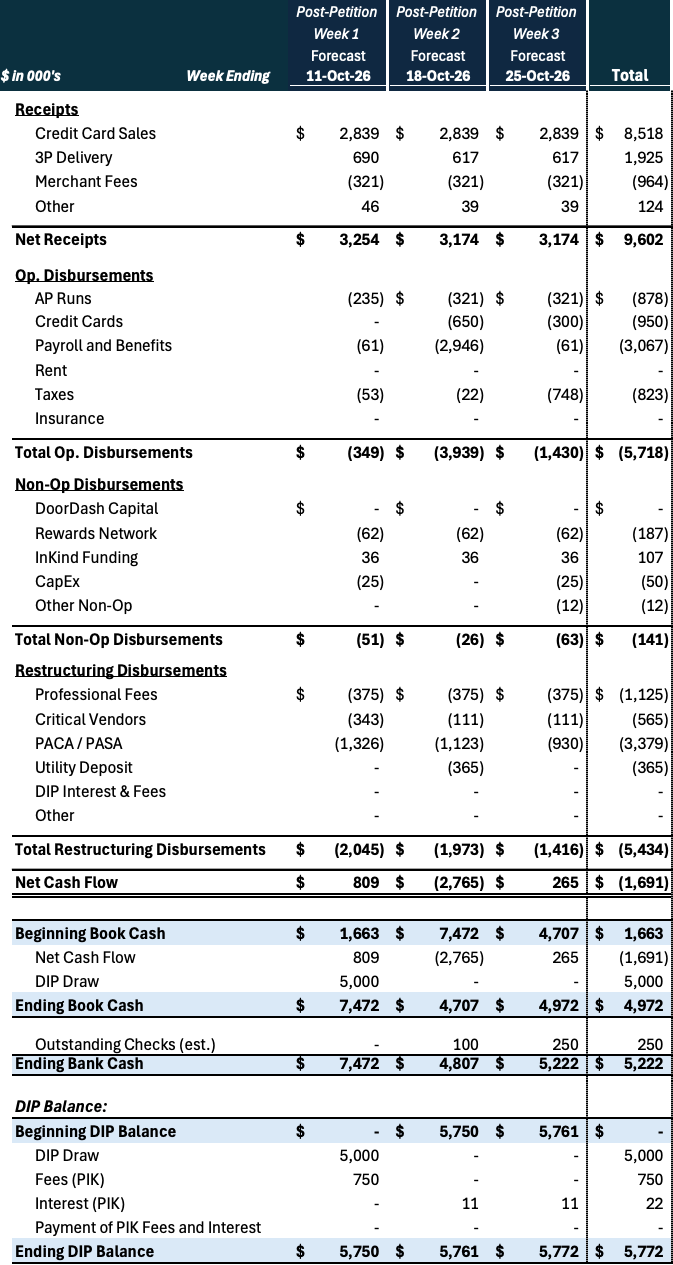
Bidding Procedures
On October 6, 2026, the Debtors filed a motion seeking approval of bidding procedures. That process allows three kinds of bids: a Section 363 sale of all or substantially all assets, a sale under a Chapter 11 plan, or a recapitalization in which the winning bidder sponsors the plan and takes the reorganized Debtors' equity. The Debtors say a plan route may better preserve leases, permits and licenses, including the alcohol permits held by True Food Beverages, LLC.
- Stalking Horse — The Debtors may select one or more stalking horse bidders, including HumanCo IV, by November 30, 2026. Bid protections are capped at a 3% break-up fee plus up to $250,000 of expenses. If HumanCo IV is selected, its bid protections are added on top of its DIP claim. If it bids, HumanCo IV stops being a consultation party on stalking horse selection, bid evaluation and the auction.
- Bid Requirements — Beyond the DIP's competing-bid terms, a bid must include cash to fund a court-approved wind-down amount. If there is a stalking horse, the bid must exceed it by the bid protections plus $350,000. Each bid also needs a 10% good faith deposit.
- Timeline:
- Bid Qualification — December 12.
- Auction — December 15.
- Sale Objection Deadline — December 18.
- Sale Hearing — December 21.
Merchant Cash Advances
The Debtors are seeking to reject their merchant cash advance agreement with Parafin. They are continuing reduced remittances to Rewards Network and have reserved their position on InKind, with no motion filed yet.
- Parafin — On October 5, the Debtors moved to reject their September 10, 2024 agreement with Parafin, effective as of the Petition Date. The proposed order would bar Parafin from debiting the Debtors' accounts after the Petition Date and would require it to return any amounts already debited on or after that date. Parafin would have 30 days after entry of the order to file a rejection damages claim.
- Rewards Network — The Debtors will keep making remittances at a temporarily reduced rate, 25% below the contract rate, and have budgeted $0.8 million for them over the budget period. Remittances are debited automatically from the Debtors' sweep accounts.
- InKind — The Debtors reserve all rights on how the InKind obligations are characterized and treated. They point to Bravo Brio, where, in an October 30, 2025 oral ruling, the Bankruptcy Court for the Middle District of Florida approved rejection of a credit purchase agreement with InKind. That court held the agreement was an executory contract rather than a security agreement, and that rejecting it was a proper exercise of business judgment. Until InKind's treatment is resolved, the Debtors operate under a temporary agreement: they keep 70% of weekly InKind-funded sales above a $0.1 million threshold.
Restaurant Closures and Lease Rejection
The Debtors filed an omnibus motion to reject the leases for the 12 closed restaurants and the Scottsdale headquarters, effective October 8. For any location not yet returned to its landlord by that date, rejection would take effect only when the Debtors surrender the premises. Landlords would have 30 days to file claims for damages arising from the rejections, measured from the latest of entry of the order, the rejection date or any other bar date the Court sets. Claims not filed by then would be barred.
The Debtors also seek authority to abandon any furniture, fixtures or other personal property left at the closed sites. Third-party owners of leased equipment, such as dishwashers, would have 14 days after rejection to coordinate removal with the landlords. The Debtors state that they continue to review their remaining leases and may seek further rejections.
Separately, the Debtors are pursuing lease assignments, which transfer leases to new tenants rather than terminating them. According to the First Day Declaration, the Debtors' prepetition efforts included "exploring assignment transactions for all or substantially all of the Company's unexpired leases." The Debtors have since agreed to assign "certain leases" and plan to file a motion seeking approval of that transaction.
The interim DIP and cash collateral orders address how lender liens apply to the leases:
- DIP Lender — Under the interim DIP order, the DIP lender takes no lien on a leasehold where the lease or applicable law prohibits or restricts one. Any consideration the Debtors receive from assigning, selling or otherwise disposing of that lease is still DIP collateral.
- Prepetition Lenders — The interim cash collateral order applies the same carve-out to their adequate protection liens. Those liens reach lease-sale proceeds only to the extent the proceeds were already the lenders' collateral before the bankruptcy. The order also provides that adequate protection is not cumulative, so a lender cannot recover twice for the same diminution in value under the cash collateral and DIP orders.
First Day Relief
- Wages and Benefits (Final Approval) — The Court granted final approval for the Debtors to pay approximately $4.5 million in prepetition compensation and benefits, including $2.2 million in wages, and to continue their employee benefit programs.
- Taxes and Fees (Final Approval) — The Court granted final approval for the Debtors to pay approximately $2.2 million in prepetition taxes and fees, including $2.0 million in sales and use taxes, and to keep paying these obligations after the Petition Date. The motion also sought authority to settle prepetition tax claims for less than face value.
- Insurance (Interim Approval) — The Court granted interim approval for the Debtors to continue their insurance and workers' compensation programs and to renew or replace policies and premium financing arrangements. The order also authorizes payment of approximately $0.7 million in prepetition premiums and related obligations.
- Utilities (Final Approval) — The Court granted final approval for the Debtors' utility protections. Utility providers are barred from altering or cutting off service, and the order sets procedures for resolving their requests for additional assurance. Within 20 days, the Debtors must deposit $0.3 million in a segregated account, approximately half of one month's average utility cost.
- Cash Management (Interim Approval) — The Court granted interim approval for the Debtors to keep their existing cash management system, bank accounts and business forms. The motion also sought authority to pay bank fees, merchant fees, refunds and chargebacks, and automatic-debit payments.
- Customer Programs (Interim Approval) — The Court granted interim approval for the Debtors to honor gift cards and continue their promotions, rewards programs and corporate partnerships. Approximately $3.9 million in gift cards was outstanding as of the Petition Date. The programs include Rewards Network, which costs approximately $0.1 million a month.
- Critical Vendors (Interim Approval) — The Court granted interim approval for the Debtors to pay up to $0.6 million in prepetition claims held by critical vendors. The Debtors are seeking authority to pay up to $1.5 million on a final basis.
- PACA/PASA Claims (Interim Approval) — The Court granted interim approval for the Debtors to pay up to $2.5 million in prepetition claims held by produce and meat suppliers with statutory trust rights. The Debtors are seeking authority to pay up to $4.6 million on a final basis.
Explore Bondoro Insights for live case dockets and comprehensive coverage of material filings from petition to plan confirmation.
Stay informed on every Chapter 11 bankruptcy case with liabilities exceeding $10 million. Subscribe for free to have our coverage delivered directly to your inbox, and explore our full archive of past summaries.
Subscribers can also opt in to timely filing alerts by updating their email preferences in Account Settings.


