Case Summary: Alea Holdings Chapter 11
Alea Holdings US Company and affiliates, non-operating holdcos in Catalina Holdings' runoff platform, filed Chapter 11 after non-Debtor SPARTA was left holding legacy AEIC liabilities and a TruPS tender fell short, pursuing an RSA-backed plan and 363 sales of equity in two non-Debtor insurers.

A deck version of this summary is also available HERE.
Business Description
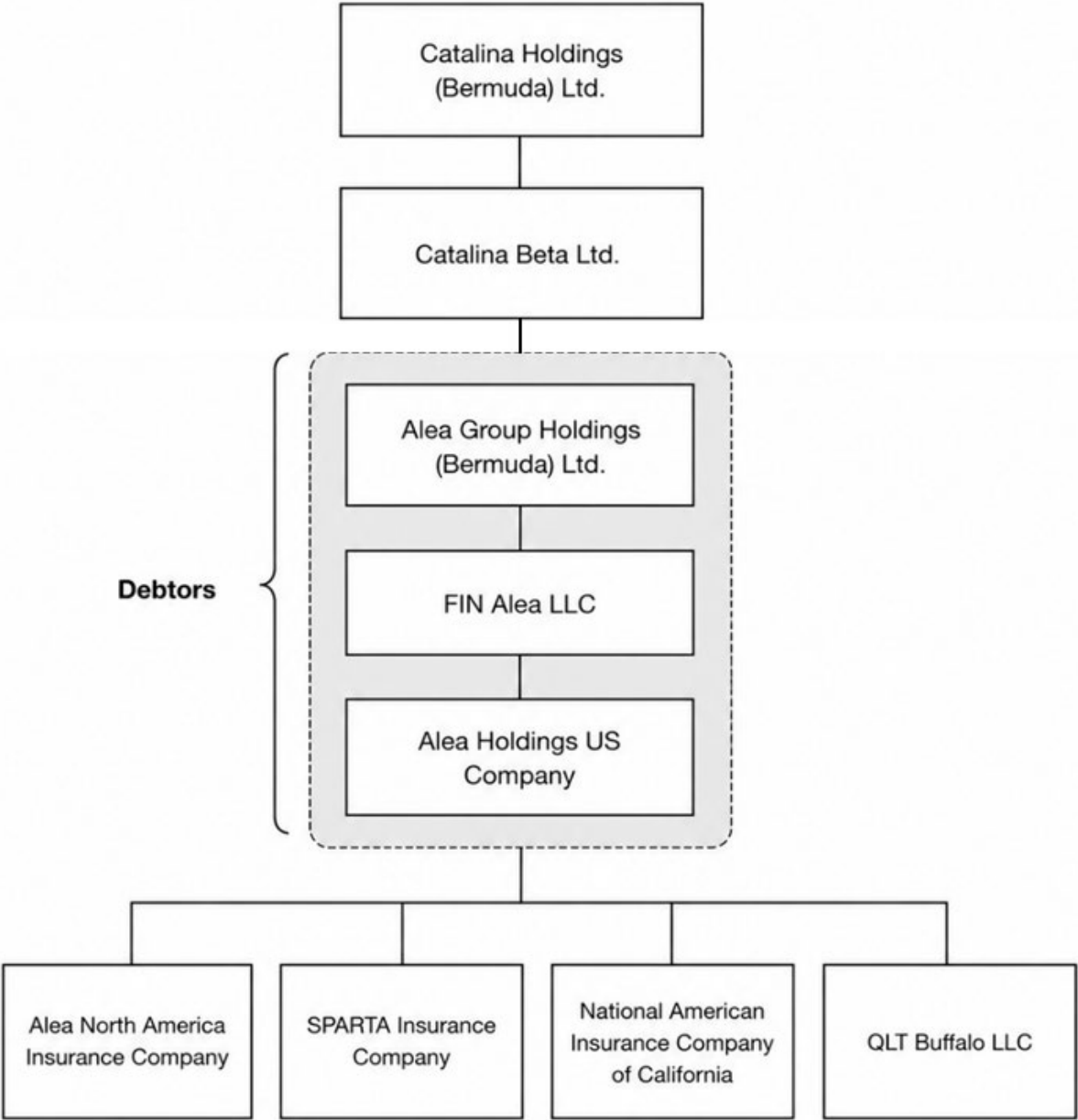
Headquartered in Hartford, CT, Alea Holdings US Company ("AHUSCO") — together with Debtor affiliates FIN Alea LLC ("FIN") and Alea Group Holdings (Bermuda) Ltd. ("AGHBL," and collectively, the "Debtors")⁽¹⁾ — forms a chain of non-operating, intermediate holding companies within the insurance runoff platform of Catalina Holdings (Bermuda) Ltd. ("Catalina"). The Debtors neither write policies nor employ staff of their own; their sole purpose is to hold and oversee the group's non-Debtor insurance subsidiaries, a portfolio of runoff (non-life) business being wound down over time.
AHUSCO's non-Debtor subsidiaries are three runoff insurers and one dormant entity:
- SPARTA Insurance Company ("SPARTA"): Connecticut-regulated insurer running off asbestos, hazardous-waste, talc, PFAS, workers' compensation, and sexual-abuse claims.
- Alea North America Insurance Company ("ANAIC"): New York-regulated insurer, a legacy property-and-casualty and reinsurance business in runoff, wholly owned by AHUSCO and subject to a pending sale to a U.S.-based specialty insurance and reinsurance holding company.
- National American Insurance Company of California ("NAICC"): California-regulated property-and-casualty insurer in runoff since 2012, wholly owned by AHUSCO and subject to a pending sale to a U.K.-based international insurance and reinsurance group.
- QLT Buffalo LLC: Dormant entity acquired in AHUSCO's 2015 merger with Quanta U.S. Holdings Inc.
Alea Holdings US Company and certain affiliates⁽²⁾ filed for Chapter 11 protection on July 19, 2026 (the "Petition Date") in the U.S. Bankruptcy Court for the Southern District of Texas, reporting $10 million to $50 million in assets and $100 million to $500 million in liabilities.
⁽¹⁾ In September 2025, AHUSCO and FIN redomiciled to Texas. AGHBL remains a Bermuda company as of the Petition Date.
⁽²⁾ For a complete list of Debtor entities, see organizational structure chart below.
Corporate History
Origins and Growth
Alea was formed by the private equity firm KKR, which acquired the Basel-based reinsurer Rhine Re in December 1997 as its initial platform. After acquiring several other niche international firms, KKR officially consolidated and rebranded the combined entities under the Alea name in September 2000, creating a global multiline insurer-reinsurer focused on alternative risk. The group grew quickly throughout the early 2000s. It raised $247.2 million of equity in December 2001, listed on the London Stock Exchange in November 2003, and reached $1.3 billion in gross premiums the same year.
Collapse Into Runoff
The 2005 hurricane season brought an end to the growth phase. Mounting underwriting losses, capped by the back-to-back storms Katrina, Rita, and Wilma, prompted a damaging downgrade from A.M. Best — which adversely affected Alea's ability to write business. Unable to compete for new premium, Alea opted to wind down solvently, entering run-off in late 2005. The franchise was then dismantled through three unconnected renewal-rights sales covering in aggregate over 40% of 2004 gross premiums written — portions of the U.S. primary program business to AmTrust, Alea London's facilities book to Canopius, and Alea Europe's property and casualty treaty portfolio to SCOR, with the residual book in each case left in runoff — and the 2006 sale of the group's U.S. specialty carrier to Insurance Corporation of Hannover.
Runoff Consolidator Hands: Fortress, then Catalina (2007–2017)
In 2007, Fortress Investment Group acquired Alea Group Holdings by cash tender offer through FIN Acquisition Limited. By then Alea was a legacy portfolio manager rather than a live underwriting business: 2006 net insurance premium revenue was $215.9 million, against $1.08 billion in 2005. Catalina, a Bermuda runoff consolidator, agreed in September 2013 to acquire Alea from Fortress and closed in March 2014. Catalina assembled the U.S. runoff cluster through four transactions both before and after the Alea 2014 transaction: acquisition of Quanta Capital Holdings in 2008, acquisition of SPARTA and NAICC in 2014, and assumption of the US branch runoff portfolio of Samsung Fire & Marine via ANAIC in 2017.
Apollo $700MM Equity Infusion
Apollo Global Management funds first invested in Catalina in December 2013 and signed in October 2017 to acquire a majority shareholding. The transaction closed in October 2018, with the Apollo funds committing an additional $700 million of new equity capital and taking approximately 94% of Catalina's ordinary voting shares; RenaissanceRe Ventures Ltd. concurrently acquired a minority stake of roughly 6% (Catalina 2025 Financial Condition Report).
Organizational Structure
Operations Overview
The Debtors conduct no insurance operations of their own. They are holding and financing vehicles that employ no staff, carry no insurance, own no real property, and run principally through shared-services and intercompany arrangements. FIN's activity is limited to recording book entries for liabilities, with no cash transactions of its own, and AHUSCO has not issued a physical check in years. The substantive runoff work sits entirely at the non-Debtor insurers — SPARTA, ANAIC, and NAICC — under the oversight of their Connecticut, New York, and California regulators.
Runoff Portfolios of the Non-Debtor Insurers
- SPARTA — AHUSCO's non-Debtor subsidiaries collectively run off legacy exposures spanning asbestos, hazardous waste, talc, PFAS, workers' compensation, and sexual-abuse claims. Those at the center of these cases sit at SPARTA, under pre-2007 policies of American Employers' Insurance Company ("AEIC"), which SPARTA administers through third-party administrator A.G. Risk Management, Inc. The resulting AEIC claims crisis is covered in Events Leading to Bankruptcy below.
- ANAIC — In runoff since December 31, 2005, ANAIC cedes 70% of its net underwriting results to its Bermuda affiliate Catalina General Insurance Ltd. ("CatGen," formerly Alea Bermuda Ltd.) under a flexible quota-share agreement. Because CatGen is an unauthorized affiliate reinsurer, its obligations to ANAIC must be secured: at December 31, 2020, ANAIC's $19.0 million recoverable from CatGen was fully collateralized. ANAIC itself carried surplus of $51.5 million against a minimum requirement of just $2.2 million.
- NAICC — NAICC runs off private passenger automobile, surety, and legacy workers' compensation and other-liability lines carrying asbestos and environmental exposures. AHUSCO repeatedly backstopped NAICC's liquidity in the years before the filing: capital contributions of $0.5 million in 2020 and $1.2 million and $1.0 million in 2024, alongside a CDI-approved $2.5 million promissory-note facility that ran from 2021 until NAICC repaid it in full in August 2025. (CA DOI 2024 examination)
Intercompany Relationships
The Debtors routinely transact with one another and with their non-Debtor affiliates in the ordinary course, generating intercompany receivables and payables ("Intercompany Claims"). These relationships arise from historical practice and from intercompany agreements, and exist to support the group's operations and shared-service functions. All such transactions are tracked through the Debtors' general ledger and ERP platform, the SUN System.
- Shared Services — The central relationship runs through AHUSCO's Administrative Service Agreement, under which it obtains services from non-Debtor affiliates. The primary provider is Catalina U.S. Insurance Services LLC ("CUSIS"), which supplies personnel, tax, and audit services, among others, all billed at cost. Mechanically, AHUSCO accrues an estimated CUSIS charge monthly, is invoiced quarterly for actual amounts, and settles in cash; it also periodically "trues up" with other non-Debtor affiliates for CUSIS services that another entity paid but that should properly be borne by AHUSCO.
- Workforce — On the personnel side, CUSIS employs the staff that serve the Debtors, their subsidiaries, and other non-Debtor affiliates. AHUSCO is allocated a share of each individual's cost ranging from 10% to 100%, depending on how much of that person's work is for AHUSCO and its subsidiaries versus other affiliates. Because the Debtors have limited operational capacity of their own, these intercompany arrangements are how they function day to day, and they were expected to continue at their historical levels.
- Intercompany Funding and Surplus Notes — To fund SPARTA's claim payments and litigation, AHUSCO on-lent approximately $134.9 million to SPARTA in exchange for a series of surplus notes totaling roughly $179 million including contractual interest, with maturities falling on various dates in 2033 and 2034. Those notes are deeply subordinated — ranking behind SPARTA's policyholder, claimant, and beneficiary obligations — and cannot be repaid to AHUSCO without regulatory approval. Beyond these intercompany arrangements, the Debtors report no third-party general unsecured claims: all outside services have been provided either by advisors, since paid in full, or by affiliates under intercompany relationships.
Prepetition Obligations
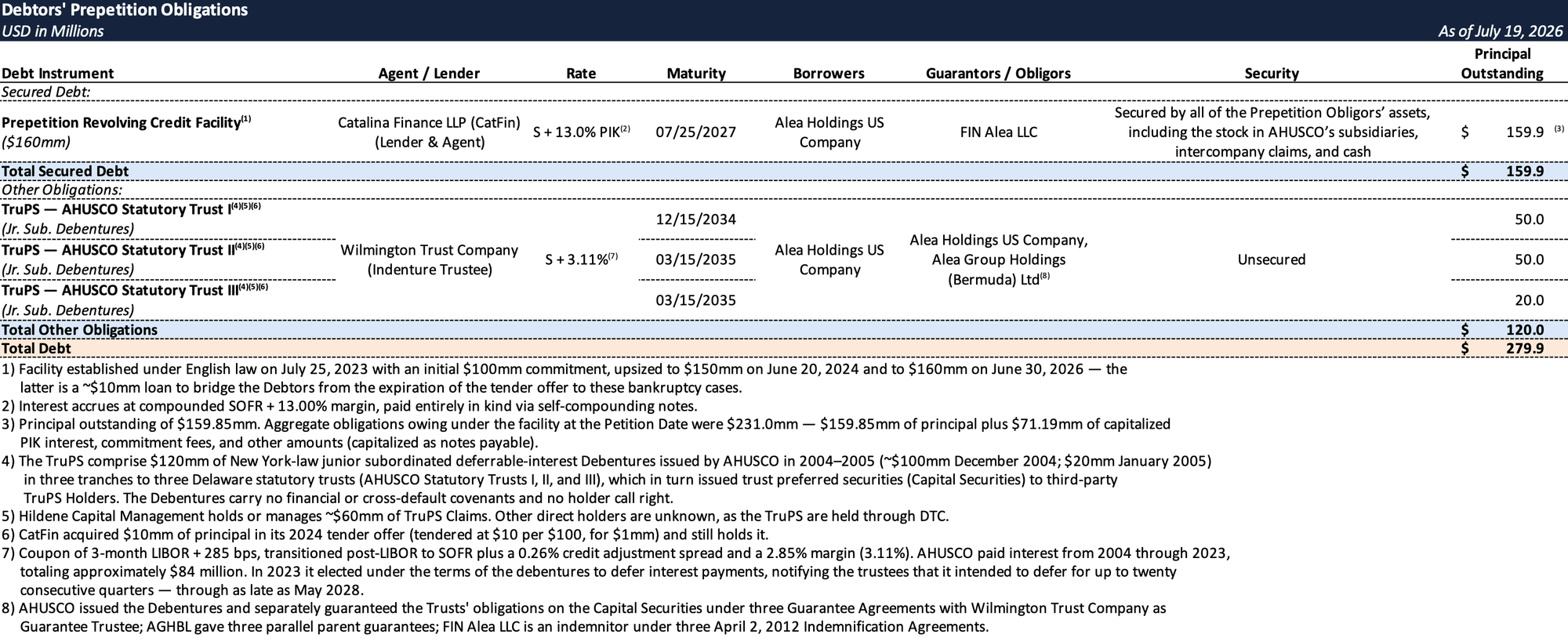
The Debtors have no other third-party general unsecured claims against them, as all other services are provided either by advisors (e.g., specialty legal, tax, and audit), who have been paid in full, or by the Debtors' affiliates pursuant to intercompany relationships. The Debtors' prepetition obligations consist of funded debt only, and are presented in the table below.
Events Leading to Bankruptcy
The AEIC Legacy-Liability Chain
For roughly a decade, the Debtors operated as intermediate holding companies for their subsidiaries' run-off insurance businesses, which had been largely stable and profitable. In 2021, their subsidiary SPARTA faced an existential liability arising from a complex chain of prior transactions.
Before AHUSCO acquired it, SPARTA was a subsidiary of SPARTA Insurance Holdings, Inc. ("SIH"). In 2007, SIH acquired American Employers' Insurance Company ("AEIC," renamed SPARTA Insurance Company later that year) through a "clean shell" purchase — an insurer with multi-jurisdictional licenses but no active policies and no remaining insurance liabilities, AEIC's liabilities having previously been transferred to its parent, Pennsylvania General Insurance Company (later renamed Pennsylvania Insurance Company ("PIC"), now indirectly owned by Applied Underwriters, Inc.). AHUSCO acquired SIH and its subsidiaries, including SPARTA, in 2014; SIH was merged into SPARTA effective October 9, 2015 following Connecticut regulatory approval.
On March 11, 2021, Bedivere Insurance Company — which had assumed the handling and payment of claims on the legacy AEIC policies from PIC — was placed into liquidation in Pennsylvania, and the liquidator disclaimed continued responsibility for those claims. Since late 2021, SPARTA has been paying claims tendered against pre-2007 AEIC policies, under a full reservation of rights and through a third-party administrator, pending litigation against PIC. It has made approximately $114.3 million in claim handling and loss payments to date. Among these, SPARTA settled claims asserted in the Archdiocese of New Orleans Chapter 11 — where the demand at one point exceeded $360 million — for $21 million, in exchange for a full buyback and release of the policy.
PIC Litigation
SPARTA filed suit against PIC in the U.S. District Court for the District of Massachusetts on July 26, 2021, seeking to enforce PIC's obligation to manage and pay the AEIC claims and for indemnification. On September 30, 2025, the court granted SPARTA partial summary judgment on two of its four claims, holding that PIC's obligations had not been novated, waived, modified or barred by laches and remain enforceable, and denying PIC's cross-motion in full. Summary judgment was denied on both damages counts, leaving causation, the contractual notice conditions and SPARTA's fee claim for a jury trial set for April 2026. In April 2026, SPARTA and PIC reached a confidential settlement in principle under which SPARTA retains certain ongoing obligations to pay claims, and any amounts paid to SPARTA under the settlement are expected to remain available exclusively to SPARTA as part of the Connecticut Insurance Commissioner's ongoing regulatory capital requirements, subject to specified release conditions.
To fund the litigation and SPARTA's operating expenses and claim payments, AHUSCO made draws on its prepetition facility and on-lent $134.9 million to SPARTA. In exchange, SPARTA issued surplus notes to AHUSCO totaling approximately $179.0 million including contractual interest, maturing on various dates in 2033 and 2034 and subordinated to the claims of SPARTA's policyholders, claimants, and beneficiaries.
Negotiations with Hildene
In February 2025, Hildene Capital Management and its affiliates — through counsel at Quinn Emanuel — sent the Debtors a letter claiming to represent certain Capital Securities holders, asserting various claims and threatening litigation, which the Debtors disputed. The parties exchanged letters through 2025 and began a series of negotiation sessions in December 2025. Those talks produced the RSA, which Hildene supports as the direct holder or manager of $60 million in TruPS Claims. The Debtors don't know the identity of any other direct TruPS holder, since all holder communications run through the AHUSCO Trusts' indenture trustee and the Depository Trust Company, where the securities are held.
Special Committee Formation
On July 24, 2025, the Debtors appointed Pamela Corrie as an independent director on each board and formed a Special Committee consisting solely of her, with a mandate to review strategic options and to investigate and, if warranted, settle or prosecute any potential causes of action held by the Debtors. Represented by separate counsel from Greenberg Traurig, Corrie conducted an investigation and recommended and approved the Debtors' entry into the RSA, the launch of the tender offer, and the commencement of these cases and the Plan.
The RSA and the Failed Tender Offer
The Debtors negotiated with Hildene over a resolution of the TruPS and, separately, with the prepetition lender, CatFin, to obtain additional liquidity — both to enable a TruPS transaction and to bridge the Debtors through the ANAIC and NAICC sale closings. Those negotiations produced the RSA, entered into among the Debtors, CatFin, and Hildene.
The RSA set out two scenarios. Under the first, TruPS holders would receive $25 million if 100% of the TruPS were tendered in an out-of-court tender offer. If 100% was not reached, Hildene would instead vote for a Chapter 11 plan providing a $20 million cash pool for TruPS holders — with CatFin waiving any distribution from that pool on account of the TruPS it holds. Under either scenario, TruPS holders would release the Debtors, CatFin, and their related parties — by tendering into the out-of-court offer, or under the Plan through an opt-out mechanism that deems a holder to grant the release unless it checks the release opt-out box on its ballot by September 2, 2026. A holder that opts out grants no release and is excluded from the Released Parties, but its recovery is unchanged.
AHUSCO launched the tender offer on June 11, 2026, and ran through July 16. Ultimately, Hildene and CatFin tendered ~60% while the remaining holders did not respond, and the Debtors commenced these Chapter 11 cases on July 19, 2026.
The Chapter 11 Filing
DIP Financing and Cash Collateral
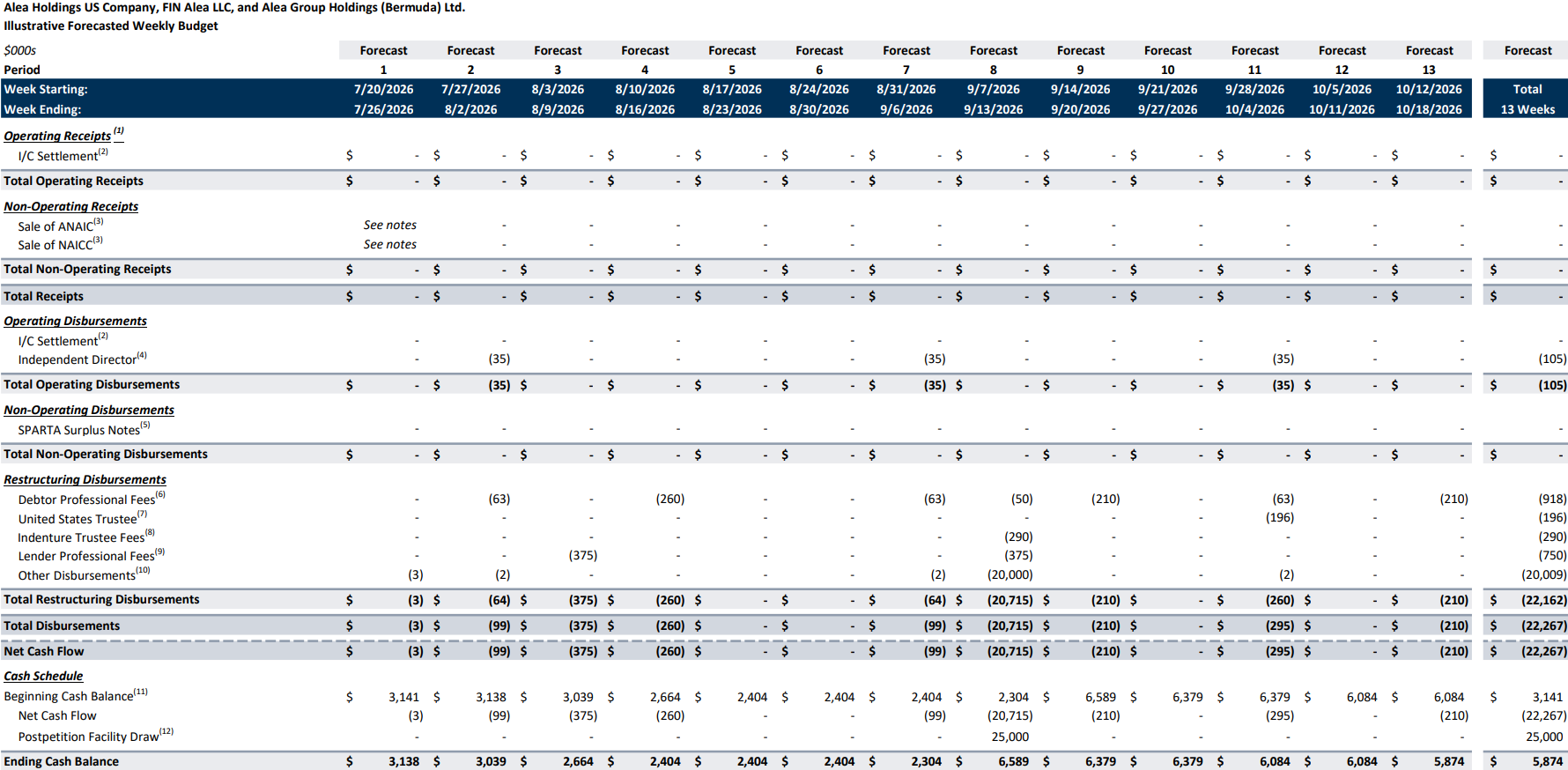
The DIP Facility is a $35 million incremental commitment under the prepetition credit facility, bringing total commitments to $195 million; the new money sits under the same agreement and, similar to the prepetition credit facility, pays interest in kind of SOFR + 13%. Commitment fee is 4.55% per annum on the undrawn commitment, also settled in PIK Notes rather than cash. No amount is drawable until the Final Order — interim relief authorizes the use of cash collateral only. CatFin has agreed that the DIP "will receive the same treatment as the Prepetition Facility under the Plan and need not be repaid in full in cash on the Effective Date." Under the Plan, the Postpetition Facility Claim is satisfied either by payment in full in cash or — by agreement — on the same terms available to the Prepetition Facility, including conversion into equity of Reorganized AHUSCO. In other words, the DIP need not be paid out in cash and can itself be equitized.
In exchange for consenting to the use of cash collateral, the Debtors stipulate to CatFin's claim "in the aggregate amount as of the Petition Date of not less than $231 million" and to the validity and perfection of its liens, and release CatFin and its representatives, carved out only for bad faith, fraud, gross negligence or willful misconduct established by a final, non-appealable order. The stipulations and release bind the Debtors on entry of the Interim Order, but bind other parties in interest only if no Challenge is timely filed — within 45 days of entry, by September 3, 2026, or 60 days from the formation of a creditors' committee — and sustained by a final, non-appealable order. CatFin is an affiliated lender, and the Debtors' entry into the facility was overseen and approved by the independent director through the Special Committee.
Missing an RSA milestone is itself a Termination Event. The Final Order must be entered within 30 days of the petition date — by August 18, 2026 — and interim cash-collateral authority otherwise expires 35 days out, on August 23, 2026.
Adequate protection runs to CatFin as replacement liens, section 507(b) superpriority claims, budget and variance covenants, payment of its professional fees without court approval (subject to a party review period), and payment-in-kind interest accruing on the full stipulated claim ahead of any junior recovery.
Sale of ANAIC and NAICC
AHUSCO is selling its two other operating insurance subsidiaries, ANAIC and NAICC, through private sales; SPARTA is not part of the sales and remains in runoff. Both entities were marketed for several years before the filing, and the proceeds are earmarked to fund distributions under the Plan. The Debtors filed a motion on July 20 asking the court to approve both sales and to authorize them free and clear of liens, claims, and encumbrances under section 363(f) of the Bankruptcy Code. Both are structured as private sales — no postpetition auction. Because the purchase agreements and the buyers' identities have been filed under seal, neither the prices nor the purchasers are public. Proceeds will be treated as collateral of the Debtors' secured lender, Catalina Finance LLP, deposited in a segregated account and applied under the Financing Orders. The sale hearing is set for August 17, 2026.
- ANAIC — AHUSCO signed a stock purchase agreement on June 6, 2025 to sell ANAIC to a U.S.-based specialty insurance and reinsurance holding company. The deal is subject to insurance-regulatory approval and to bankruptcy court approval, which are being pursued in parallel.
- NAICC — AHUSCO signed a stock purchase agreement on October 1, 2025 (later amended) to sell NAICC to a U.K.-based international insurance and reinsurance group, on the same two-track approval path.
Treatment of Claims Summary
- Unclassified Claims — Certain claims are not classified and not entitled to vote: Administrative Claims (paid in full in cash on or after the Effective Date), Priority Tax Claims (paid over up to five years from the petition date), U.S. Trustee statutory fees, and Indenture Trustee Fees (paid in cash without a fee application). Two DIP-related items also sit here: Postpetition Facility Claims are allowed as superpriority claims and satisfied either by payment in full in cash or, by agreement, the same treatment as the Prepetition Facility (including equity conversion); and Adequate Protection Claims granted under the Financing Orders are preserved.
- Class 1 — Other Secured Claims. Unimpaired; presumed to accept; not entitled to vote. On the Effective Date, each holder receives, at the Debtors' option, one of the following: payment in full in cash; return of the collateral securing the claim; reinstatement of the claim; or any other treatment that leaves the claim unimpaired under section 1124. In other words, these claimants are made whole in one form or another.
- Class 2 — Other Priority Claims. Unimpaired; presumed to accept; not entitled to vote. Each holder is paid in full in cash, either on the Effective Date or in the ordinary course as the claim comes due, or otherwise receives treatment consistent with section 1129(a). These are non-tax priority claims and are likewise unaffected.
- Class 3 — Prepetition Facility Claims. Impaired; entitled to vote. The Prepetition Facility Claims (CatFin's revolving-facility debt) are allowed at $160 million in aggregate principal, plus accrued but unpaid interest through the petition date, plus all non-contingent fees, costs, premiums, reimbursement, indemnification, hedging, and other amounts owing under the facility and the Financing Orders — an allowance that is not subject to any objection, challenge, offset, recharacterization, or subordination. On the Effective Date, each holder receives, as agreed between the Debtors and the holder, one or a combination of: its pro rata share of the Prepetition Facility Cash Pool (the Debtors' remaining cash after other distributions, less a reserve); a replacement note on terms satisfactory to the Debtors and the lender; conversion of the claim into equity of Reorganized AHUSCO (or a capital contribution of some or all of it); and/or reinstatement. This is the class whose treatment can leave CatFin owning the reorganized equity.
- Class 4 — TruPS Claims. Impaired; entitled to vote. The TruPS Claims are allowed at $120 million in aggregate outstanding principal of the Debentures, plus accrued but unpaid interest through the petition date, plus non-contingent fees and related amounts under the Indentures and Trust Documents, and the allowance is likewise insulated from challenge. In full and final satisfaction, the Indenture Trustee (for the ratable benefit of the holders and itself) receives the TruPS Cash Pool of $20 million for distribution to holders. Each holder's share is calculated using only the aggregate principal it is owed, and the Prepetition Facility Lender (CatFin) voluntarily waives its right to any distribution on the TruPS it or its affiliates hold, with that share reallocated pro rata to the other holders. All distributions run through the Indenture Trustee and are subject to the Indenture Trustee Charging Lien.
- Class 5 — General Unsecured Claims. Unimpaired; presumed to accept; not entitled to vote. Each Allowed General Unsecured Claim is simply Reinstated — left unaltered — on the Effective Date. Because the Debtors report essentially no third-party general unsecured claims (services being provided by paid-in-full advisors and affiliates), this class is effectively a placeholder that rides through unimpaired.
- Class 6 — Section 510(b) Claims. Impaired; deemed to reject; not entitled to vote. Any claims subordinated under section 510(b) (e.g., claims arising from the purchase or sale of a security) are subordinated to all Allowed Claims, and the holders receive and retain nothing under the Plan. Because they are wiped out, they are deemed to reject and do not vote.
- Class 7 — Intercompany Claims. Unimpaired or Impaired; not entitled to vote (deemed to accept or reject). Allowed Intercompany Claims (claims held by a Debtor or affiliate against a Debtor or affiliate) are, at the Debtors' option with the Plan Sponsor's consent, reinstated, set off, distributed, contributed, cancelled, or released — without any distribution. Depending on how each is handled, the class is treated as unimpaired (deemed to accept) or impaired (deemed to reject); either way it does not vote.
- Class 8 — Intercompany Interests. Unimpaired or Impaired; not entitled to vote (deemed to accept or reject). The existing equity interests among the Debtors are Reinstated — subject to possible dilution or replacement by the equity granted to holders of Prepetition Facility Claims — or otherwise addressed at the Debtors' option with the Plan Sponsor's consent, without any distribution. As with Class 7, the voting treatment follows whether the interest ends up unimpaired or impaired.
Explore Bondoro Insights for live case dockets and comprehensive coverage of material filings from petition to plan confirmation.
Stay informed on every Chapter 11 bankruptcy case with liabilities exceeding $10 million. Subscribe for free to have our coverage delivered directly to your inbox, and explore our full archive of past summaries.
Subscribers can also opt in to timely filing alerts by updating their email preferences in Account Settings.


