Case Summary: Alkegen Chapter 11
Alkegen, the Clearlake-backed specialty materials maker formed in Unifrax's debt-funded 2021 acquisition of Lydall, filed a prepackaged Chapter 11 to shed roughly $3.1B of its $3.5B of funded debt, with first lien creditors taking substantially all of the reorganized equity.

A deck version of this summary is also available HERE.
Business Description
Headquartered in Irving, Texas, Ulysses Investment Holdco, Inc. and its subsidiaries, including lead debtor ASP Unifrax Holdings, Inc. (collectively, "Alkegen" or the "Company") manufacture engineered fibrous materials with proprietary chemistries for high-temperature insulation, filtration, emissions control, and battery fire protection. The products serve steel and aluminum manufacturing, petrochemical refining, glass production, mineral processing, automotive emission control, EV battery safety and stationary energy storage, commercial building fire protection, aerospace insulation, and advanced filtration.
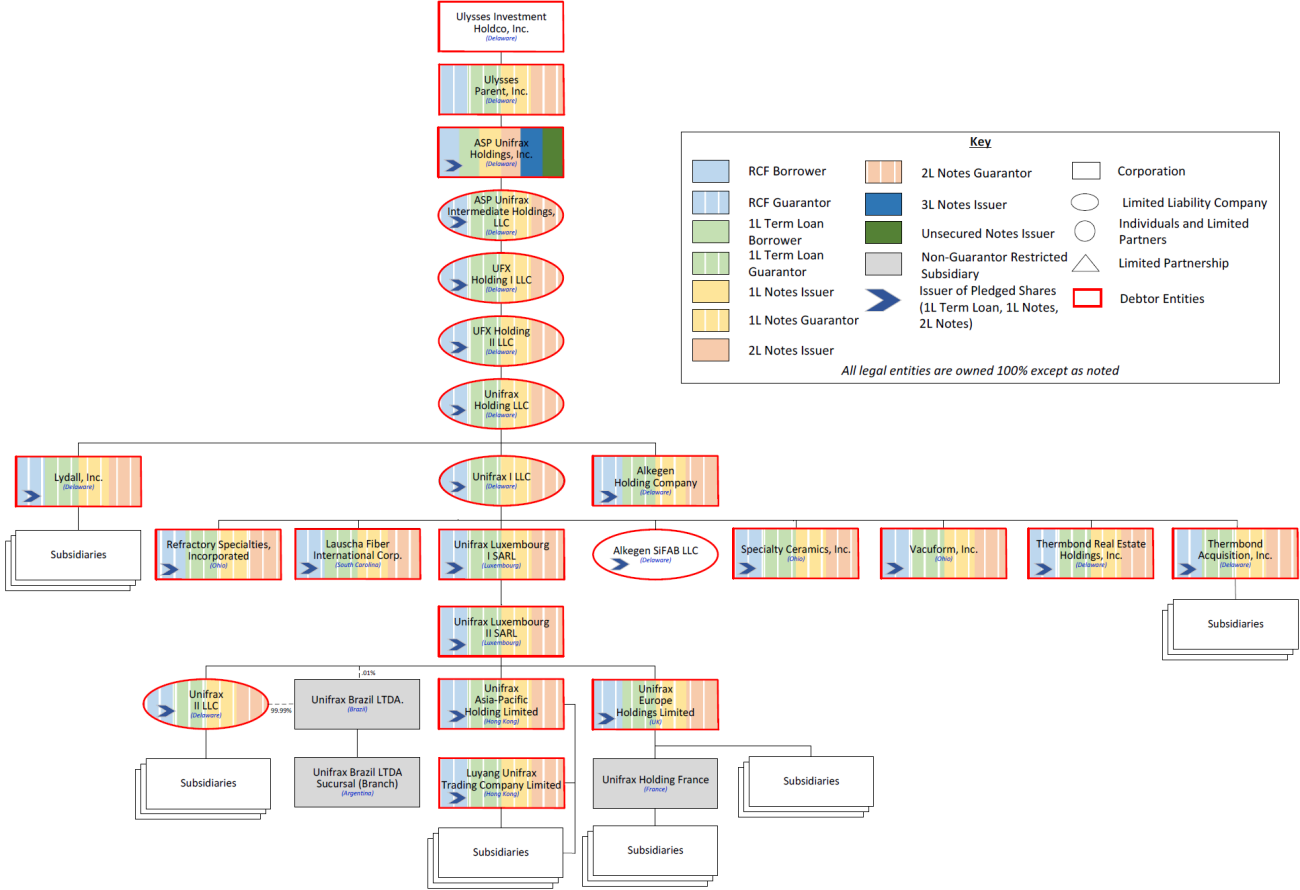
- The Company comprises 115 legal entities, 63 of which are Debtors⁽¹⁾, and is owned by vehicles affiliated with Clearlake Capital Group, L.P. (the "Sponsor"). The Debtors also hold a 52.7% controlling stake in Shenzhen-listed Luyang Energy-Saving Materials Co. Ltd. ("Luyang"), a non-Debtor in the case. References to Alkegen include Luyang, but consistent with the filings, operating and financial statistics are stated excluding it unless noted. Throughout this summary, "Alkegen" and "the Company" refer to Ulysses Investment Holdco, Inc. and its subsidiaries, including non-Debtor Luyang.
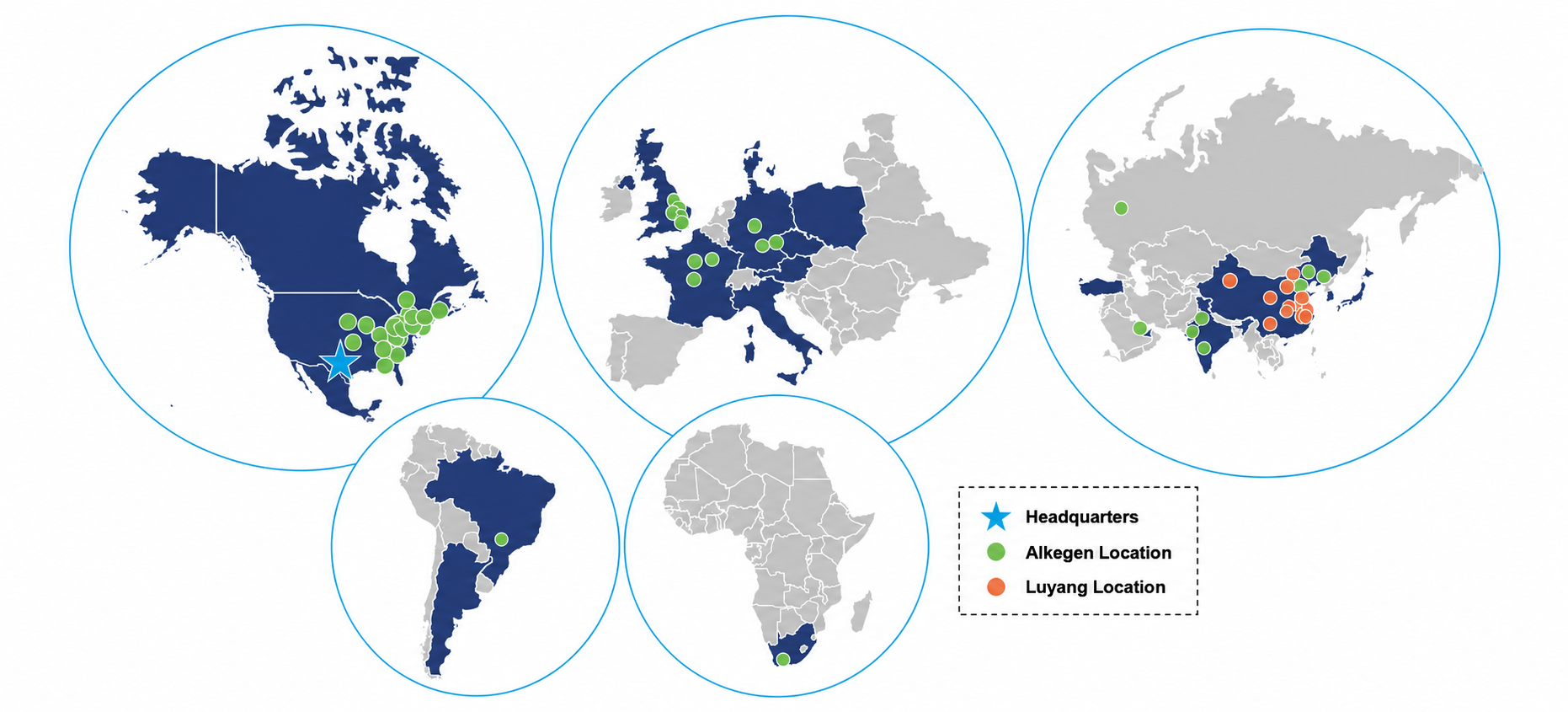
Alkegen employs approximately 3,900 people across 23 countries and operates roughly 50 fully integrated plants, excluding its Chinese affiliate Luyang, with North America, Europe, and Asia 2025 revenue mix of approximately 55%, 30% and 15%, respectively. Net sales for 2025 were approximately $992 million excluding Luyang, and gross profit was approximately $215 million, a roughly 21.7% margin.
ASP Unifrax Holdings, Inc. and certain affiliates filed for Chapter 11 protection on July 26, 2026 (the "Petition Date") in the U.S. Bankruptcy Court for the Northern District of Texas, reporting $1 billion to $10 billion in both assets and liabilities.
⁽¹⁾ For a list of Debtor entities, see organizational structure chart below.
Corporate History
Alkegen is the combination of two long-established industrial materials businesses — Unifrax LLC and Lydall, Inc. — brought together under Clearlake ownership in September 2021 and rebranded as Alkegen in January 2022.
Carborundum, Unifrax, and the 1996 Carve-Out
The Unifrax half of Alkegen began as The Carborundum Company, which was formed in September 1891 by Edward Goodrich Acheson and a group of Monongahela investors. In 1987, British Petroleum acquired Standard Oil and its Carborundum subsidiary and organized the business under BP Chemicals. In February 1996, BP sold substantially all Carborundum businesses except the North American ceramic fibers division to Saint-Gobain affiliates, and the surviving entity, retaining the fibers business, was renamed Unifrax Corporation. Unifrax passed through four successive private-equity ownerships over the following two decades — Kirtland Capital Partners from October 1996, then American Securities in 2003, AEA Investors in 2006, and American Securities again in 2011 — before Clearlake Capital Group, L.P. acquired lead debtor ASP Unifrax Holdings, Inc. in 2018.
Lydall Acquisition and Rebrand to Alkegen
Lydall, Inc. traces to an 1869 Manchester, Connecticut family business and reached 2021 as an NYSE-listed specialty filtration and advanced materials group. Unifrax, then owned by Clearlake, agreed on June 21, 2021, to acquire Lydall at $62.10 per share in cash, an enterprise value of approximately $1.3 billion and a premium of approximately 87% to Lydall's last close before announcement. The purchase was funded with $1.2 billion of new debt issued in September 2021 — $800 million in secured notes due 2028 and $400 million in senior notes due 2029, along with $400 million of additional new cash and equity from investors including Clearlake. The merger closed in September 2021, and in January 2022 the combined company rebranded as Alkegen and announced a new regional office in Dallas.
Arguably, the Lydall acquisition and the liabilities incurred in connection with it are the ultimate trigger for the Company's overlevered capital structure. The $1.2 billion in notes issued in connection with the transaction was refinanced in 2024 and now accounts for roughly one-third of the Debtors' outstanding debt. Additionally, the enterprise valuation supporting this plan — $1.55 billion at the midpoint, covering the entire reorganized business including the 52.7% Luyang stake — comes to only 1.19x what was paid for Lydall alone.
The Luyang Stake
The Luyang position dates to 2014, when Debtor Unifrax Asia-Pacific Holding Limited acquired 28.14% of the Shenzhen-listed company by negotiated transfer, held as a foreign strategic investment under China's Administrative Measures for Strategic Investment by Foreign Investors in Listed Companies. In June 2022, the same Debtor subsidiary completed an unsolicited partial tender offer for a further 24.86% of share capital, at more than RMB 2.7 billion (approximately $400 million), taking it to a controlling interest of approximately 52.43%, later 52.66% after a share cancellation.
Organizational Structure
Operations Overview
The Four Business Groups
Alkegen specializes in high-performance engineered fibrous materials—such as ceramic fibers, polycrystalline wool, low biopersistent fibers, and aerogel composites—supplied in forms including blankets, felts, papers, boards, and mats. The Company operates through two primary divisions, Industrial Solutions and Mobility Solutions, alongside an industrial filtration business and SiFAB, a start-up business.
- Industrial Solutions — Covers insulation, energy preservation, fire protection, and high-performance filtration, and supplies the glass fiber used in absorbent glass mat batteries. Its established positions are in insulation materials, high-efficiency filtration, and micro fine glass fibers. This is the Company's largest business, generating roughly $636 million, or 64% of 2025 revenue.
- Mobility Solutions — Supplies emission control mats, battery fire protection for electric vehicles and stationary energy storage systems, and sealing products — gaskets, paper, and related materials — for heavy duty, automotive, and industrial engines. Its refractory ceramic fiber and aerogel-based products serve both vehicle and grid-scale storage applications. Alkegen states that its products are used by virtually every automaker for catalytic converter support. Mobility Solutions generated $267 million of revenue in 2025.
- Industrial Filtration — Makes felt-based filtration media for industrial waste gases, serving the energy, minerals, chemicals, and metal production markets. This group contributed approximately $88 million of 2025 revenue.
- SiFAB® — SiFAB, a structured silicon anode material for lithium-ion batteries, came out of a long-range R&D program begun in 2017. According to the First Day Declaration, Alkegen is working toward commercializing it for applications including automotive, drones, defense, and consumer electronics.
Operational Footprint
Prepetition Obligations
Top Unsecured Claims
Events Leading to Bankruptcy
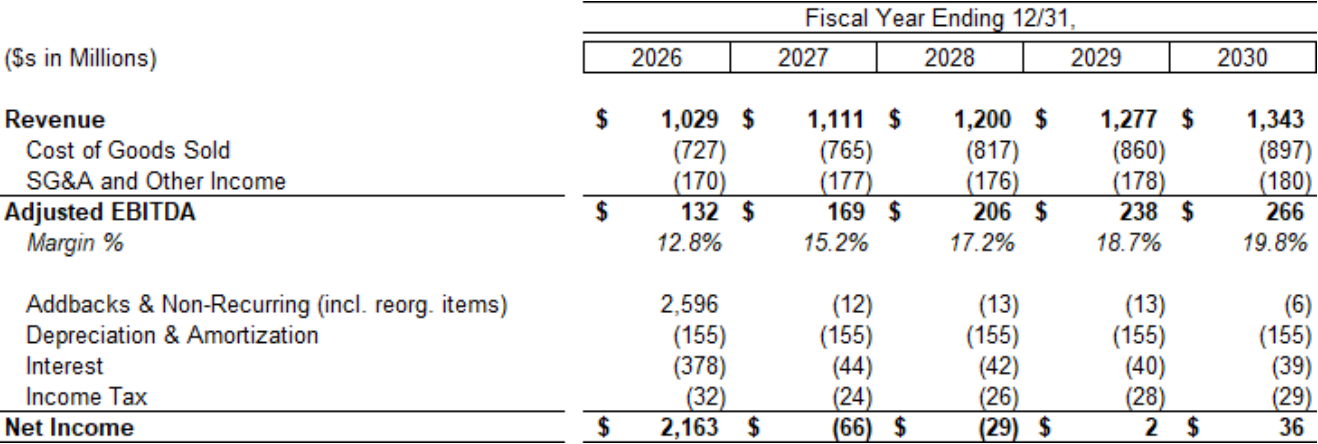
Alkegen forecast 2026 debt service of approximately $320 million against full-year 2026 Adjusted EBITDA of $132 million — implying debt service at 2.4x EBITDA — with prepetition gross leverage of roughly 25x. The distress is a balance-sheet story rather than an operational one.
Operational Challenges
Alkegen attributes its deterioration to several years of weakening demand for industrial products, compounded by company-specific operational factors.
- Macroeconomic Headwinds — Elevated interest rates have depressed global industrial demand since the COVID-19 pandemic, leaving industrial capacity utilization below its long-run average — per Federal Reserve G.17 data as of June 15, 2026 — and weighing on customers particularly in the Industrial Solutions and Industrial Filtration groups. Those pressures bear directly on Alkegen, which is highly exposed to automotive manufacturing, steel manufacturing, and construction. EV sales have fallen over the past year to between 5.3% and 6% of new-vehicle sales from a 2025 peak of 10.6% — a decline the Company attributes in part to high rates — and the North American EV transition has fallen short of expectations since 2024. Inflation has compounded the pressure on the cost side, weighing on Alkegen's supply chain, while demand across its end markets has stayed below post-pandemic expectations, leaving them oversupplied.
- Supply Overcapacity — The second pressure came from China. Persistent overcapacity in Chinese manufacturing has driven aggressive price competition among domestic producers, and the effects have carried well beyond China — for Alkegen, lost market share and, against a backdrop of global inflation, thinner margins. The Luyang stake deepened that exposure rather than hedging it, tying Alkegen directly to Chinese industrial overcapacity, sustained pricing pressure, contracting domestic markets, and sales that arrived later than expected. The numbers since bear it out: Luyang's market capitalization is down roughly 60% since the 2022 controlling-stake acquisition, 2025 sales fell $141 million, and Adjusted EBITDA more than halved — leaving little room to keep paying dividends up to Alkegen, which had been the investment's principal return.
- Product Development — Several growth initiatives that underpinned the 2024 Refinancing have missed their marks — some never reached commercialization, others ramped more slowly than planned, as market conditions shifted and development and commercialization timelines stretched.
- Capital Allocation — Historical allocation choices weighed on the business. Deferred plant maintenance created operating difficulties across many facilities, hitting both revenue and cost, while a complex organizational structure cut into efficiency and profitability. Leverage also shaped priorities: the Company favored higher-impact initiatives that were harder to execute while under-investing in the core business.
The September 2024 Refinancing
In 2023, against deteriorating market conditions, Alkegen engaged Kirkland & Ellis and Centerview Partners to evaluate options for the 2025 maturity of the Company's then first lien debt facility. A marketing process opened in February 2024, canvassing both existing creditors and third-party financing sources. By September the Company had reached agreement with a majority of its existing lenders and a group of new third-party investors — the investors who now constitute the Ad Hoc Group driving these Chapter 11 cases. The refinancing comprised three components.
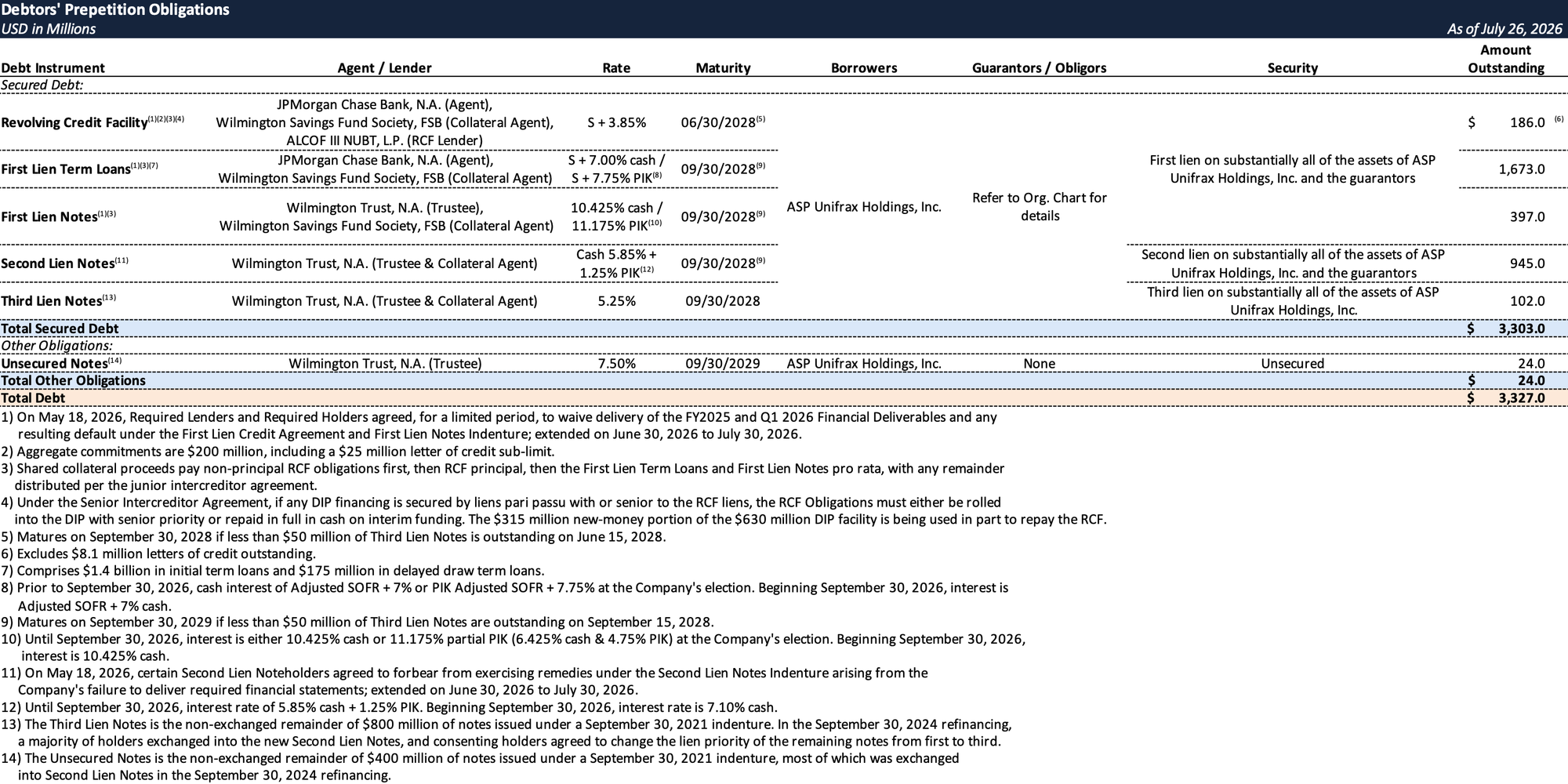
- RCF Refinancing — The revolving facility was uptiered to superpriority, ahead of the other first lien debt in the payment waterfall, in exchange for a sixteen-month maturity extension.
- Term Loan Refinancing — The then existing first lien term loan was refinanced in cash through the Company's entry into the Senior Facilities, the new senior package comprising the revolving facility, approximately $1.4 billion of first lien term loans with $175 million of delayed-draw capacity, and approximately $365 million of first lien notes.
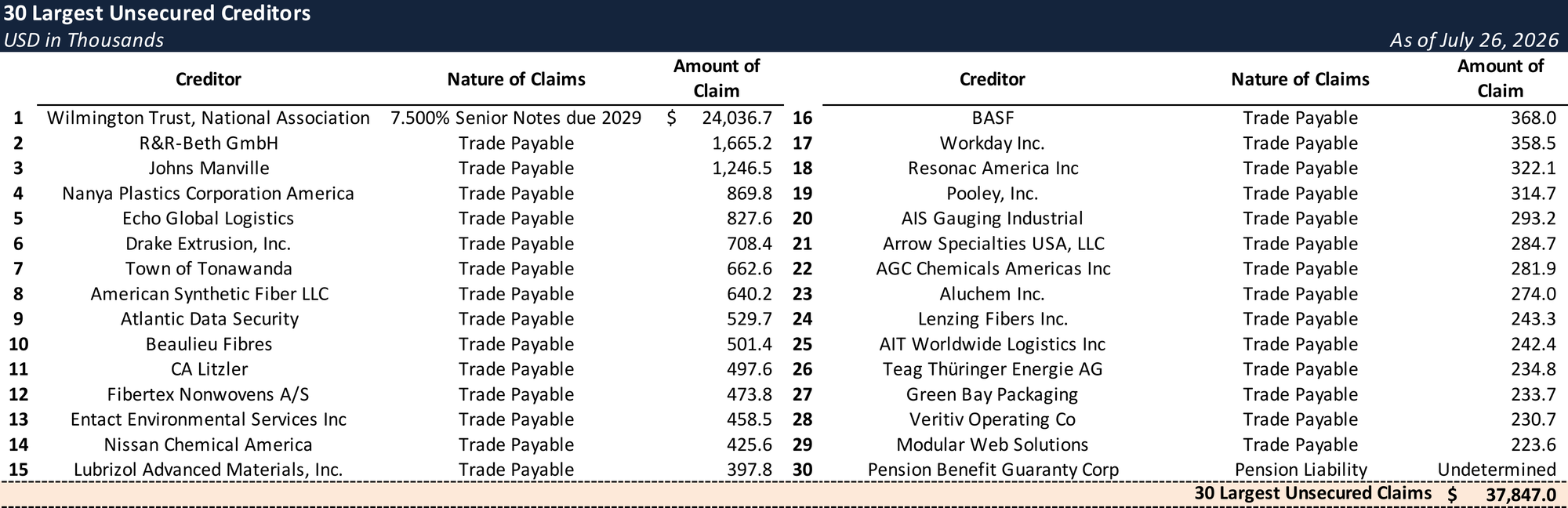
- Old Notes Exchange — Holders of the 2021 notes issued in connection with the Lydall transaction — $800 million secured 5.25% notes due 2028 and $400 million unsecured 7.5% notes due 2029, together the "Old Notes" — were offered new Second Lien Notes in exchange, at a discount to face. A majority across both series accepted, and approximately $924 million of Second Lien Notes was issued. Two stubs remain. Approximately $102 million of the $800 million secured series survives as the Third Lien Notes — same 5.25% coupon and 2028 maturity, but two liens lower and secured only by ASP Unifrax's own assets rather than reaching the guarantors. Approximately $24 million of the $400 million unsecured series survives at the same 7.50% and 2029 maturity, without covenants or guarantees.
The transaction pushed maturities to 2028 and 2029, captured approximately $150 million of discount and approximately $350 million of incremental liquidity, and embedded a two-year PIK option. The debt burden was not meaningfully reduced, and the Declaration concedes that several key growth initiatives that underpinned the 2024 Refinancing failed to commercialize or ramped late. Consummation was approved by a special committee of a single disinterested director, Gary Begeman, who was appointed twenty days before closing, and resigned from the Boards after the closing. S&P cut the rating to selective default on October 2, 2024; Fitch downgraded to restricted default the following day.
The Waivers
Alkegen's first lien documents require delivery of an unqualified audit opinion together with audited annual financial statements, quarterly statements, and related compliance certificates — collectively, the Financial Deliverables. The Company did not deliver the FY2025 and Q1 2026 Financial Deliverables.
On May 18, 2026, Required Lenders under the First Lien Credit Agreement and Required Holders under the First Lien Notes Indenture executed a Limited Waiver, temporarily waiving both the delivery requirement and any default or event of default arising from the failure to deliver. The same day, certain Second Lien Noteholders executed a Forbearance Agreement, agreeing to refrain from exercising remedies under the Second Lien Notes Indenture arising from the Company's failure to deliver its annual and quarterly financial statement deliverables and related compliance certificate. On June 30, 2026, both the Limited Waiver and the Forbearance Agreement were extended to July 30, 2026.
Leadership Change, Project Horizon, and the 2026 Special Committee
In October 2025, the Boards replaced management: Brian Whittman was appointed Chief Executive Officer and Bob Caruso Chief Transformation Officer, both from Alvarez & Marsal, with additional A&M professionals brought in to review the business, build a 2026 budget and long-range plan, and implement performance improvements. Kirkland & Ellis and Centerview Partners were engaged in February 2026 to evaluate refinancing and restructuring options.
On March 10, 2026, two disinterested directors — David Ford and Todd Arden — were appointed to the Boards, and a special committee comprising them was established the same day. The committee was granted exclusive authority over matters where a conflict of interest exists or is reasonably likely to exist between the Company and its Related Parties, together with authority to review and evaluate strategic transactions.
On April 16, 2026, at the sole direction of the disinterested directors, the Company retained Katten Muchin Rosenman as independent counsel to assist with an investigation into the merits and potential value of any claims or causes of action the Company may hold in relation to those conflicts matters. That investigation has been running since April 2026 and remains ongoing.
Operational Improvement Efforts
In late 2025, Alkegen and A&M launched a cost and efficiency initiative code-named Project Horizon. Under it, the Company consolidated nine business units into two — Industrial Solutions and Mobility Solutions — in March 2026, flattening the reporting structure, centralizing operations management, and reducing headcount for approximately $9 million of annual savings.
A further set of performance improvements, aimed at capital allocation and reinvestment in the core businesses, is being implemented across 2026 to 2028. Together with Project Horizon, these are forecast to deliver approximately $40 million of Adjusted EBITDA improvement by 2030. The Company states that the savings are insufficient to support its current debt without a comprehensive restructuring of the capital structure.
Negotiations and the Restructuring Support Agreement
The Company and its advisors concluded that a comprehensive balance-sheet solution was required, and initiated discussions with key stakeholders in late Q1 2026, including the Ad Hoc Group and its advisors Davis Polk & Wardwell and PJT Partners. Term sheets were exchanged over May and June, converging on a transaction framework. According to the Declaration, the Ad Hoc Group members were the only stakeholders that agreed to provide capital in the amount needed and on the timeline required.
The Restructuring Support Agreement was executed on July 19, 2026, following those negotiations, with support from holders of more than 99% of First Lien Claims, 80% of Second Lien Notes Claims, 95% of Preferred A Stock, and 99% of Senior Common Stock.
The Chapter 11 Filing
The RSA, executed July 19, 2026, and amended July 24, contemplates a deleveraging of approximately $3.1 billion of the Company's approximately $3.5 billion of funded debt: first lien creditors take substantially all of the reorganized equity, everything junior is canceled or reduced to warrants, and trade creditors are left unimpaired. A $630 million DIP facility funds the cases, with exit financing and an equity rights offering funding emergence.
The $630 Million DIP Facility
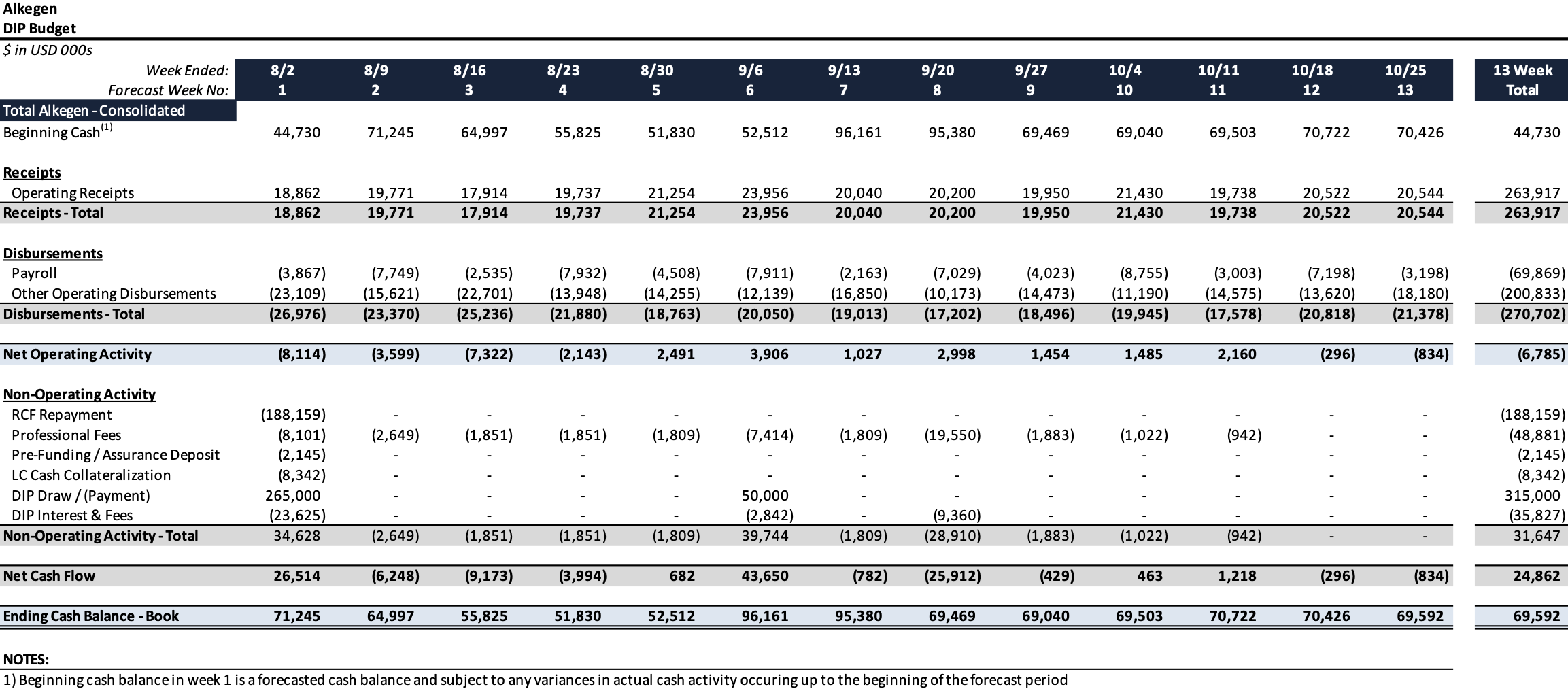
The Debtors obtained a $630 million superpriority senior secured DIP facility, comprising $315 million of new money and $315 million rolled up from prepetition first lien debt. The DIP lenders are the members of the Ad Hoc Group — the same holders of First Lien Term Loans, First Lien Notes, and Second Lien Notes who negotiated the RSA — with Barclays Bank PLC acting as fronting lender and Wilmington Savings Fund Society, FSB as administrative and collateral agent. Key terms are as follows:
- New money — $265 million funded on the closing date, plus a $50 million delayed-draw tranche available after entry of the final order.
- Roll-up — $315 million of prepetition first lien obligations exchanged 1:1 against new money — $265 million on the interim order, $50 million on the final order.
- Pricing — SOFR plus 8.375% (ABR plus 7.375%), 1.00% floor, with a PIK toggle at 50% of accrued interest that applies by default unless the borrower opts out.
- Fees — 5.00% backstop premium on the $315 million of backstop commitments, 2.50% upfront fee, 2.25% exit fee on new money funded, and 1.0% for each of two available one-month maturity extensions.
- Maturity — Four months from the Petition Date, extendable twice by one month each with Required DIP Creditor consent.
- Use of Proceeds — Repay the revolver in full — approximately $188 million plus $8.4 million to cash collateralize letters of credit at 103% — fund the cases and operations, and make adequate protection payments.
- Covenants — Minimum liquidity of $32.5 million tested monthly; disbursements capped at 112.5% of the approved budget on a cumulative basis, excluding professional fees, U.S. Trustee fees, and adequate protection payments. Both exclude Luyang.
- Carve Out — U.S. Trustee and clerk fees, up to $100,000 of Chapter 7 trustee fees, accrued professional fees through the trigger notice, and a $4 million post-trigger cap.
- Challenge Period — 75 days from entry of the interim order for parties in interest, or 60 days from appointment for a creditors' committee, with a $25,000 cap on investigation costs. No committee had been appointed as of entry.
Treatment of Claims Summary
The Revolving Credit Facility is repaid in full in cash from DIP proceeds on entry of the interim order — approximately $188 million, plus $8.4 million to cash collateralize outstanding letters of credit at 103% — and receives no plan treatment. A further $315 million of first lien obligations was rolled up 1:1 against the DIP new money and now sits in the DIP facility rather than the prepetition stack.
- Class 1 — Other Secured Claims. Unimpaired. At the Debtors' option with Required Consenting First Lien Creditor consent: payment in full in cash, return of the collateral, reinstatement, or other unimpairing treatment. Presumed to accept.
- Class 2 — Other Priority Claims. Unimpaired. Treatment consistent with section 1129(a)(9). Presumed to accept.
- Class 3 — First Lien Secured Claims. Impaired, entitled to vote. Deemed allowed at $997.5 million, representing the section 506(a) collateral value of the First Lien Term Loans and First Lien Notes. Holders receive a pro rata share of $85 million of Takeback Term Loans and 100% of the New Equity Interests — subject to dilution from the Management Incentive Plan, the Equity Rights Offering, the Equity Backstop Premium, the Unsecured Funded Debt Equity Interests, and the New Equity Warrants — plus pro rata subscription rights in the rights offering.
- Class 4 — Unsecured Funded Debt Claims. Impaired, entitled to vote. Deemed allowed at $1.9 billion in aggregate; the Plan does not allocate that amount among its components. The liquidation analysis estimates the Second Lien, Third Lien, and Unsecured Notes Claims at $977 million, $105 million, and $25 million, respectively, implying a First Lien Deficiency Claim of approximately $796.5 million, or 42% of the class. All holders receive a pro rata share of the New Equity Warrants and the Unsecured Funded Debt Equity Interests — 1.0% of the New Equity, subject to dilution from the Management Incentive Plan and the New Equity Warrants.
- Class 5 — General Unsecured Claims. Unimpaired. Reinstated, paid in full in cash on or shortly after the Effective Date, or otherwise rendered unimpaired. Presumed to accept.
- Class 6 — Intercompany Claims. Reinstated or cancelled at the option of the Debtors and the Required Consenting First Lien Creditors. Presumed to accept or deemed to reject accordingly.
- Class 7 — Intercompany Interests. Reinstated or set off, settled, cancelled, or otherwise addressed at the same option. Presumed to accept or deemed to reject accordingly.
- Class 8 — Existing Alkegen Holdco Interests. Impaired, deemed to reject. Cancelled with no recovery or distribution, regardless of surrender.
- Class 9 — Section 510(b) Claims. Impaired, deemed to reject. Cancelled, released, and extinguished, with no distribution.
The Exit Facility
The Plan contemplates a $400 million senior secured term facility on the Effective Date, distributed entirely to first lien creditors — $315 million to the DIP lenders, converting their new-money instruments dollar-for-dollar, and $85 million to holders of Allowed First Lien Claims as takeback paper. Key terms include:
- Sizing — $315 million of new money DIP-to-Exit Term Loans, converting on a cashless, dollar-for-dollar basis and including principal, premium, and fees capitalized into the DIP, plus $85 million of Takeback Term Loans. The two tranches are intended to be fungible and constitute a single class.
- Pricing — Term SOFR plus 6.25% with a 1.00% floor, or ABR plus 5.25% with a 2.00% floor, payable in cash at least quarterly.
- Maturity and Amortization — Five years from the Exit Facility Closing Date, amortizing at 1.00% per annum in equal quarterly installments from the first full fiscal quarter after closing, balance at maturity.
- Security — First priority liens on substantially all assets, subject to excluded assets and, for foreign guarantors other than those in Canada, the Agreed Security Principles carried over from the First Lien Credit Agreement.
- Luyang Carved Out — On the Exit Facility Closing Date, Luyang and each of its subsidiaries become the "Luyang Group Unrestricted Subsidiaries," with no other unrestricted subsidiary designations except as mutually agreed.
- Revolving Facility — The Reorganized Debtors may seek a super senior revolving facility of up to $150 million on or after the Effective Date, documented within the Exit Facility Credit Agreement itself and secured by the same collateral, ranking ahead of the exit term loans.
The Equity Rights Offering
Under the Plan, 59% of the reorganized equity is offered for purchase to holders of Allowed First Lien Secured Claims at an aggregate subscription price of up to $335 million, with a defined group of holders backstopping any shortfall. The offering is sized against the $315 million DIP roll-up and is the mechanism by which the DIP is taken out at emergence. It is distinct from — and additional to — the equity Class 3 receives on account of its claims.
- Sizing — 59% of the New Equity Interests on a fully diluted basis, subject to dilution only by the Management Incentive Plan and the New Equity Warrants.
- Subscription Price — Up to $335 million. The Plan defines the Equity Rights Offering Amount as the amount of Allowed Roll-Up DIP Claims at the Effective Date, capped at $335 million — $315 million of roll-up principal plus accrued interest and fees — so that the offering absorbs the roll-up whenever emergence occurs.
- Eligibility — Holders of Allowed First Lien Secured Claims, being Class 3, with rights distributed pro rata to each holder's claim. Roll-up DIP claims are not an eligibility criterion: a Class 3 holder with no DIP position is eligible; a DIP claim holder with no Class 3 claim is not.
- Allocation — Fixed rather than competed for. A holder with 10% of Class 3 has a right to 10% of the 59% and an obligation to fund 10% of the offering amount.
- Commitment — For Consenting First Lien Creditors that elected to subscribe for the DIP, participation is contractual rather than elective. RSA Section 6.03 obliges each DIP Commitment Party, severally and not jointly, to subscribe for its pro rata share, and provides that transfer of a Consenting Creditor's DIP commitments or DIP claims does not relieve it of that obligation absent express assumption. Class 3 holders outside that group retain a right rather than an obligation.
- Payment — Either in cash, leaving the subscriber's Class 3 claim unaffected and still entitled to full Plan treatment; or, for a subscriber that also holds an Allowed Roll-Up DIP Claim, by contributing that claim in an amount equal to the cash otherwise payable, in which case the claim is cancelled and extinguished. Roll-up claims in excess of the subscription obligation are repaid in cash under the DIP claim treatment. Offering proceeds are applied first to satisfy Allowed DIP Claims, so a DIP lender subscribing in cash would be funding its own repayment. Contribution collapses the round trip.
- Backstop — A defined group of holders has committed, severally and not jointly, to purchase any unsubscribed equity, for an Equity Backstop Premium of 3.0% of the New Equity Interests, earned on commitment rather than on funding. The Disclosure Statement identifies termination of the Equity Backstop Commitment Agreement as a risk to consummation.
Financial Projections
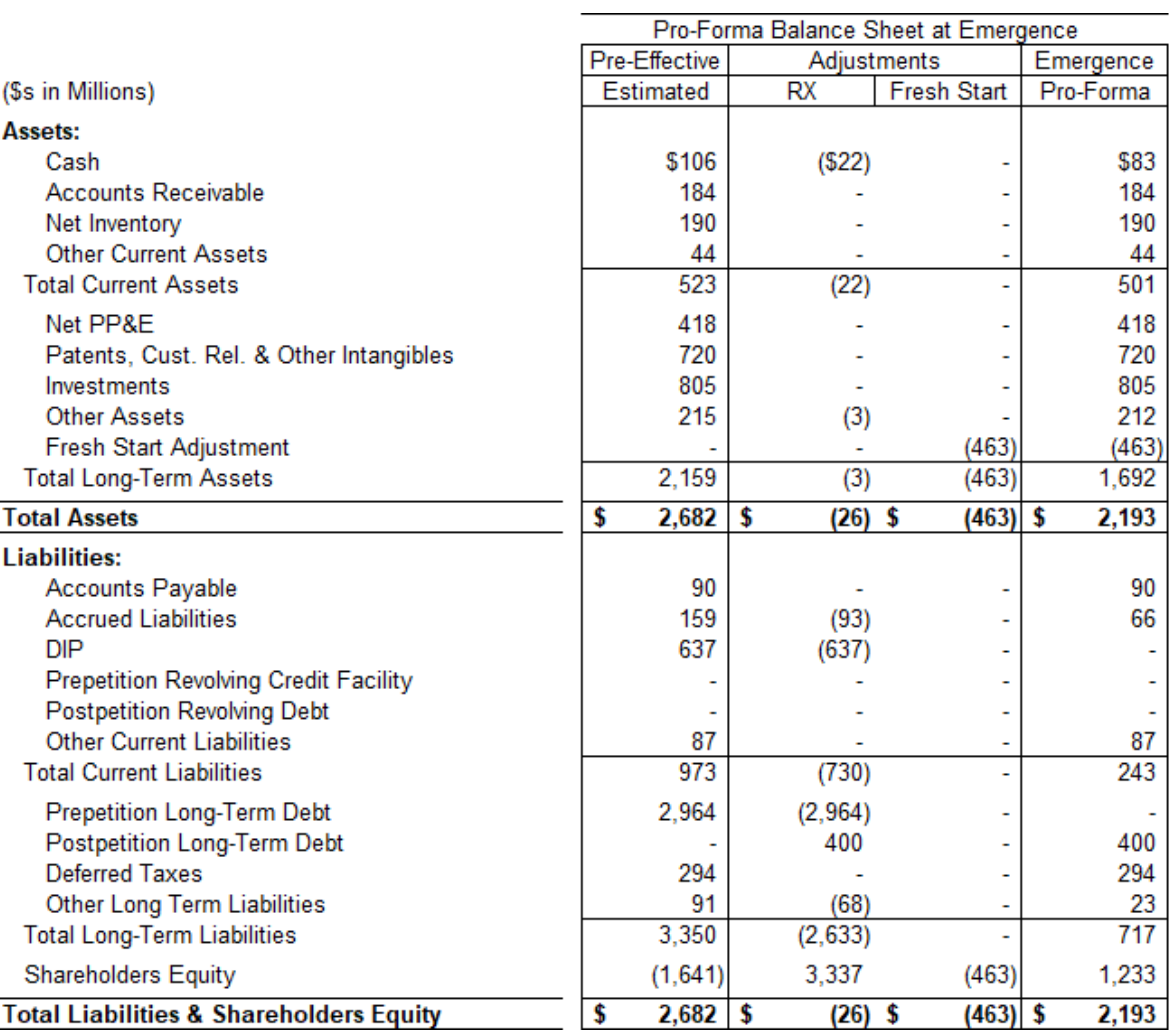
Centerview Partners estimated the reorganized enterprise value at $1.25 to $1.85 billion as of July 8, 2026, midpoint of $1.55 billion, and equity value at $933 million to $1.53 billion, midpoint of $1.2 billion. The enterprise value expressly includes the Luyang stake, which Centerview valued using a dividend discount analysis applied to it alone. Centerview offers no opinion on the attainability of the projections, and the Reorganized Debtors will be privately held and are not obligated to file any public reports.
Illustrative Post-Emergence Balance Sheet
Income Statement Projections
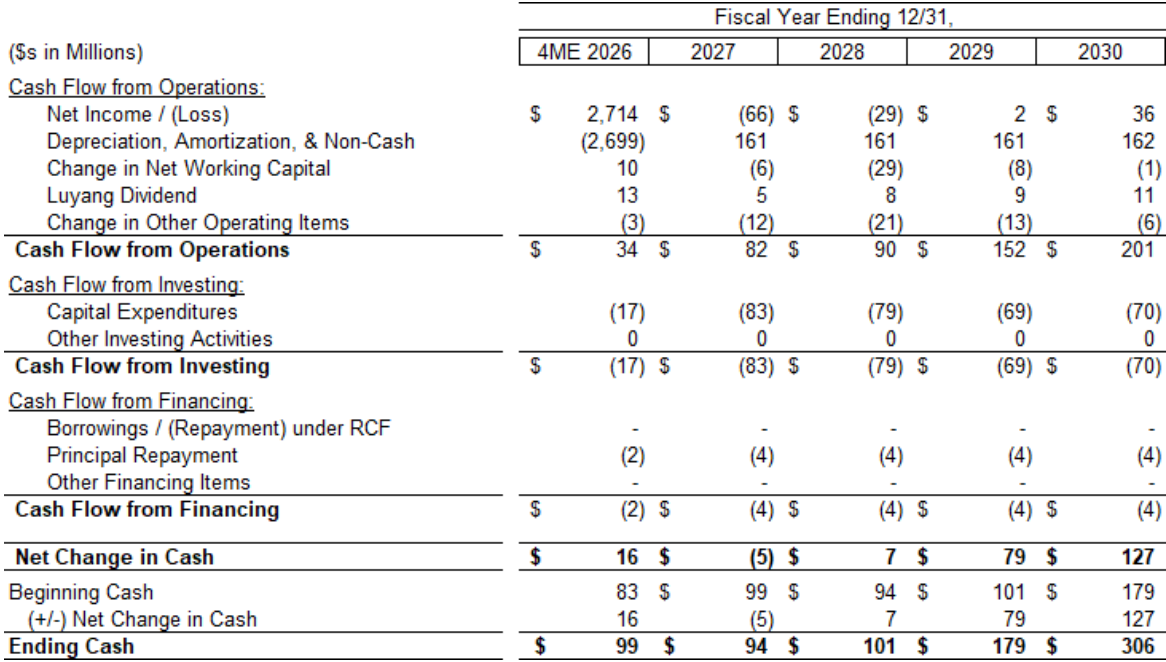
Cash Flow Statement Projections
Explore Bondoro Insights for live case dockets and comprehensive coverage of material filings from petition to plan confirmation.
Stay informed on every Chapter 11 bankruptcy case with liabilities exceeding $10 million. Subscribe for free to have our coverage delivered directly to your inbox, and explore our full archive of past summaries.
Subscribers can also opt in to timely filing alerts by updating their email preferences in Account Settings.


