Case Summary: America's Car-Mart Chapter 11
America's Car-Mart filed for Chapter 11 after failing to secure warehouse financing, with a prepackaged plan and a $370 million stalking horse sale to a Superior Auto affiliate, about $328 million of it rollover debt to Silver Point-led prepetition lenders, who also fund a $60 million new-money DIP.

A deck version of this summary is also available HERE.
Business Description
Headquartered in Rogers, AR, America's Car-Mart, Inc. ("ACM"), a Texas corporation listed on NASDAQ as CRMT, together with its subsidiaries (the "Company"), is a "buy here pay here" used-vehicle retailer, one that finances the vehicles it sells. ACM and five of its subsidiaries (together, the "Debtors") operate principally through two entities: America's Car Mart, Inc. ("Car Mart"), which runs the dealerships, and Colonial Auto Finance, Inc. ("Colonial"), which buys Car Mart's receivables and holds them or, once they are securitized, the residual interest in them.
The Debtors sell used vehicles to consumers with limited or impaired credit, finance substantially all of those purchases, sell service contracts and accident protection plans, and service the resulting receivables. As of the Petition Date they operated 93 dealerships in twelve states, about 65% in communities under 50,000 people, and employed approximately 1,120 people.
In fiscal 2026 (ended April 30, 2026) the Company sold 48,891 retail units and reported $1.3 billion of revenue. As of July 31, 2026, the Company had 85,753 active customers and $1.2 billion of finance-receivable principal.
America's Car-Mart, Inc. and certain affiliates⁽¹⁾ filed for Chapter 11 protection on November 24, 2026 (the "Petition Date") in the U.S. Bankruptcy Court for the Southern District of Texas, reporting $1.2 billion in assets and $829.3 million in liabilities (as of July 31, 2026).
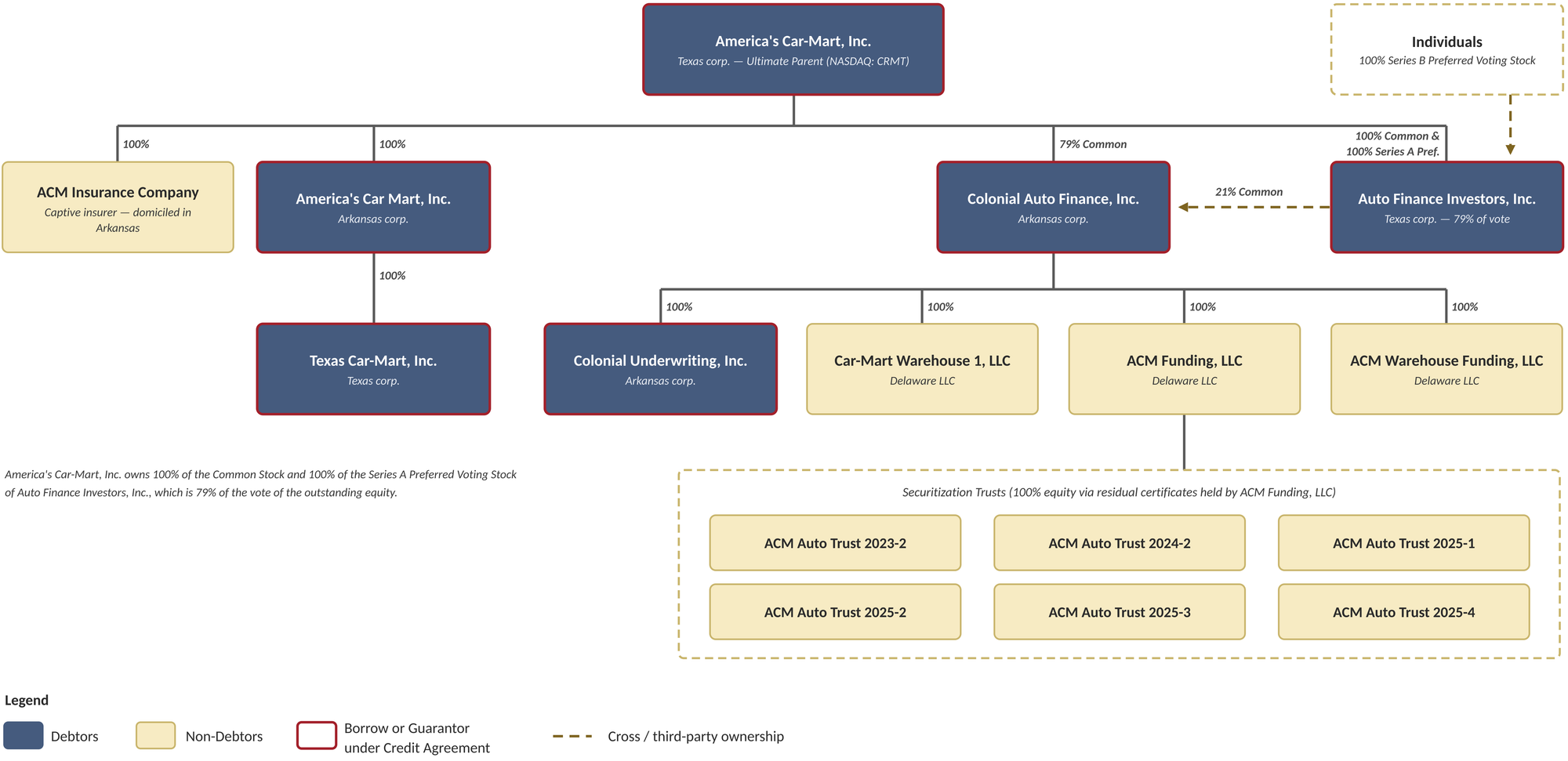
⁽¹⁾ For a complete list of Debtor entities, see organizational structure chart below.
Corporate History
Bill Fleeman opened the first Car-Mart dealership in Rogers, Arkansas, in August 1981. In January 1999, Crown Group, Inc. acquired Fleeman Holding Company, the parent of America's Car-Mart, Inc., for $41 million. In March 2002, Crown Group announced its renaming as America's Car-Mart, Inc., and the stock began trading on Nasdaq under the ticker CRMT on April 1, 2002.
Organizational Structure
ACM, the only Debtor with publicly traded equity, is the group's ultimate parent.
- Dealership chain — ACM wholly owns Car Mart, which wholly owns Debtor Texas Car-Mart, Inc. ("Texas Car-Mart").
- Finance chain — ACM owns 79% of Colonial's common equity, and Debtor Auto Finance Investors, Inc. ("AFI") owns the other 21%; ACM owns AFI's common stock, and individuals hold its Series B preferred stock. Colonial owns Debtor Colonial Underwriting, Inc.
- Non-Debtor affiliates — Colonial's subsidiary ACM Funding, LLC ("ACM Funding") holds the equity of the four active ACM Auto Trust ("ACMAT") securitization trusts through residual certificates. ACM also owns a captive insurer, ACM Insurance Company ("ACM Insurance").
The petition's list of equity security holders identifies four record holders of 5% or more as of the filing: Nantahala Capital Management (7.69%), MIT-affiliated holders (7.21%), Ameriprise Financial (6.86%) and Magnolia (6.79%).
Operations Overview
Revenue Model
The Company's fiscal 2026 revenue of $1.3 billion came from two sources: $1.03 billion from selling vehicles and related products, and $253.7 million of interest and other income from financing those sales.
- Retail vehicle sales ($861.3 million). The Company buys vehicles primarily from wholesalers, new-car dealers, rental and fleet companies, auctions and the public. These vehicles are generally five to twelve years old, at an average cost of about $9,500. Substantially all retail sales are financed by the Company itself through retail installment sale contracts.
- Interest and other income ($253.7 million). Financing is the second leg of the model. Contracts carry fixed rates of 6.0% to 20.3%, with a 17.7% weighted average across the portfolio, and the average down payment is 5.1%. Interest income is recognized on active accounts, and late fees are recognized when collected. Each dealership services the contracts it originates, and the manager who approves a credit is "ultimately responsible for contract collections," with compensation tied to the dealership's collection performance.
- Service contracts ($85.2 million). A substantial majority of customers buy a service contract at the time of sale, covering mechanical repairs and maintenance performed by unaffiliated third parties.
- Accident protection plans ($34.4 million). The Company earns a one-time fee of 6.25% of the amount financed (5.5% in Texas) on each accident protection plan it sells, and the fee is financed into the principal of the customer's contract. In exchange, the Company agrees to cancel the remaining loan balance if the vehicle is stolen or declared a total loss. The product is offered in ten states, where approximately 92% of customers buy it. In fiscal 2026, claim losses of $36.3 million exceeded APP revenue.
- Wholesale sales ($46.9 million). These are sales of vehicles to third parties outside the retail channel.
Receivables Funding and Securitization
Car Mart and Texas Car-Mart sell the installment contracts they originate to Debtor Colonial under a monthly purchase agreement, without recourse. Colonial securitizes pools of contracts through non-Debtor affiliates ACM Funding and the ACM Auto Trusts ("ACMAT"), which issue asset-backed notes backed by those pools, and Car Mart services the pools for a fee of 4% a year of the pool balance. Four trusts had notes outstanding at the Petition Date. Three of them have a "turbo" feature, under which all receipts pay down the notes and no excess cash returns to the Debtors until the notes are repaid; the fourth, ACMAT 2025-4, releases residual cash flow to Colonial through ACM Funding. The Debtors say their business model depends on revolving or warehouse financing to fund inventory and new receivables until they are securitized. The fiscal 2026 10-K reported that the Company had been unable to secure a revolving warehouse facility and had relied on the reduced collections it retained after trust paydowns, together with cash on hand.
Workforce
As of the Petition Date, the Debtors employed approximately 1,120 people across 93 dealerships and the corporate office: about 1,070 full-time and 50 part-time employees, roughly 380 of them salaried and the remainder hourly. None is represented by a union.
Prepetition Obligations
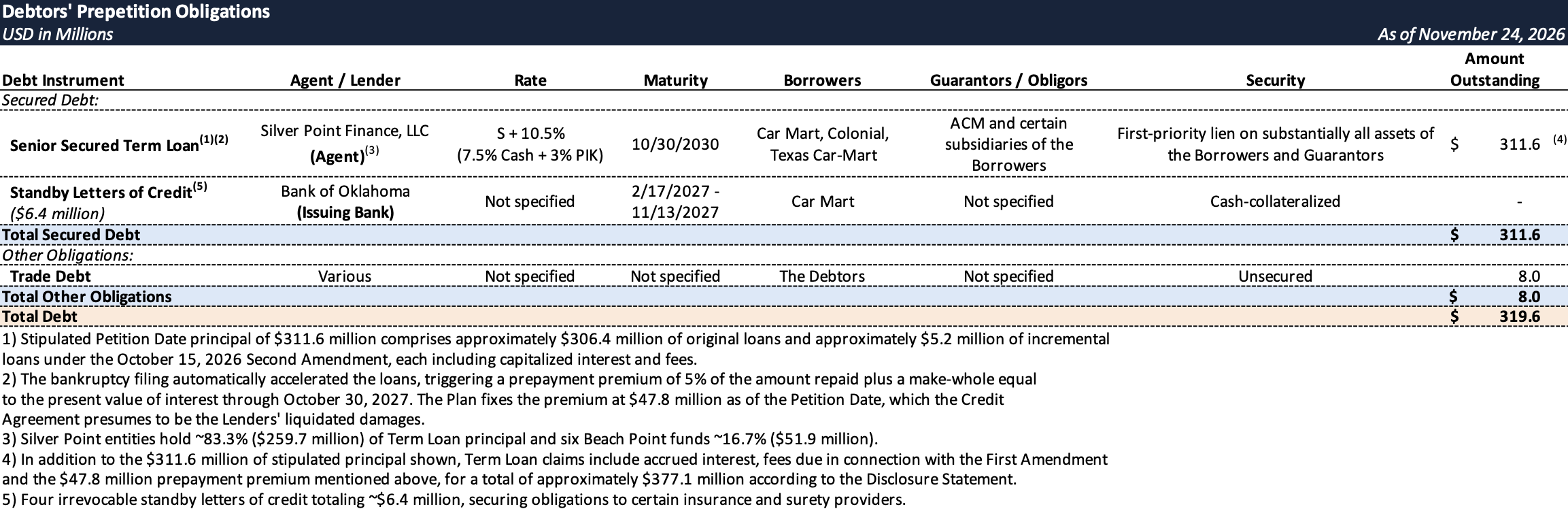
In addition to the Debtors' obligations illustrated in the table below, the Company also disclosed approximately $249.3 million of asset-backed notes outstanding at the non-Debtor level as of the Petition Date, issued by ACMAT 2025-1 through 2025-4. The trusts are bankruptcy-remote, and noteholders have no recourse to the Company beyond the securitized receivables, which totaled approximately $455.7 million as of October 31, 2026 and which the Debtors say are not property of their estates.
Top Unsecured Claims
Events Leading to Bankruptcy
According to the Debtors, they repaid their revolving credit facility in connection with the October 2025 Credit Agreement but could not obtain the warehouse facility they expected to replace it. From early 2026, they say, inventory purchases and new originations were constrained, and store closures, headcount cuts and a curtailment of retail sales followed.
Failed Warehouse Facility
In October 2025, ACM refinanced its prior asset-based revolving credit facility with the $300 million Term Loan, with a separate warehouse facility intended to fund vehicle purchases and new originations going forward. Before entering into the Term Loan, the Company evaluated warehouse financing options and selected a prospective provider, and the Credit Agreement permitted the warehouse to operate alongside the Term Loan. In its results for the quarter ended October 31, 2025, the Company attributed a 1.1% decline in unit sales primarily to capital constraints and said it anticipated putting a warehouse line in place in the second half of fiscal 2026.
The Debtors say they targeted a January 2026 closing but were unable to finalize documentation with the provider in February, after which they sought replacement warehouse and other financing from new lenders. On the March 12, 2026 earnings call, CEO Douglas Campbell described the warehouse talks as "very active and substantive," but on April 7 the Company disclosed that it had become increasingly apparent that the path to a warehouse facility was less certain. With subprime auto lending having tightened after several lender failures in late 2025, and new lenders needing more time than the Debtors' liquidity allowed, no alternative warehouse financing was obtained.
Deteriorating Financial Performance
ACM's sales peaked in fiscal 2023 at $1.2 billion on 63,584 retail units and have declined every year since, falling to $1.03 billion on 48,891 units in fiscal 2026. Pre-tax results moved in the same direction: income before income taxes of $122.6 million in fiscal 2022 turned into a $40.1 million loss by fiscal 2024 and, after a brief return to $22.8 million of pre-tax income in fiscal 2025, a $108 million loss in fiscal 2026.
Credit performance weakened over the same stretch. Net charge-offs rose from 18.3% of average finance receivables in fiscal 2022 to 27.2% in fiscal 2024 and, after easing to 25.9% in fiscal 2025, climbed back to 27.6% in fiscal 2026. The trend continued into the current fiscal year, with quarterly net charge-offs rising to 9.5% in 1Q 2027 from 6.6% a year earlier.
Borrowing costs grew as well. Interest expense increased from $10.9 million in fiscal 2022 to $74.5 million in fiscal 2026, which the Company attributed to higher rates and higher average borrowings through fiscal 2025 and principally to higher average debt in fiscal 2026. The October 2025 Term Loan, priced at SOFR plus 7.5% and issued with warrants, replaced a revolver that had carried SOFR plus 3.5%, and the term loan rate later stepped up to SOFR plus 10.5%, including 3% paid in kind.
By 2026, liquidity was running down. Unrestricted cash fell from approximately $117.9 million at January 31 to approximately $47 million at April 30, $28 million at July 31 and about $12 million by the Petition Date, and the Company's fiscal 2026 10-K included a going-concern disclosure.
Subprime Lending Conditions
ACM's search for warehouse financing coincided with a period of stress in subprime auto lending. In September 2025, Tricolor, a subprime auto retailer and lender, filed for Chapter 7, and its founder and its former chief operating officer were later charged with fraud for allegedly pledging the same collateral to multiple lenders. A May 2026 Federal Reserve note, whose bank-lending sample includes ACM, found that the probability of default banks reported on their buy-here-pay-here exposures rose nearly 150% from the second to the third quarter of 2025. The Debtors say subprime auto finance tightened significantly after several lender failures in late 2025, while tariffs, inflation and geopolitical conflict raised costs for their customers and heightened lender concern about credit performance.
Store Closures, Sales Curtailment and Portfolio Runoff
As liquidity tightened, ACM shrank its footprint, closing 60 of its 154 dealerships between November 2025 and April 2026, including 42 approved by the board on April 7. In May 2026 the Debtors curtailed retail vehicle sales, and, having lost the reconditioning and retail capacity to resell repossessed vehicles through their dealerships, they began selling substantially all repossessions at wholesale venues from late May.
The effect showed in 1Q 2027, when retail units fell 81.9% from a year earlier to 2,450 and new loan originations dropped to $41 million from $262.7 million, leaving the portfolio to run off largely without replacement. Cash generated by the shrinking book went in part to the securitization trusts, with $101.9 million of net repayments on the asset-backed notes during the quarter against $80.1 million of operating cash flow.
Advisor Retention and Special Committee
With a default under the Credit Agreement looming, the Debtors retained Mayer Brown LLP as restructuring counsel, FTI Consulting as financial advisor and Houlihan Lokey Capital, Inc. ("Houlihan") as investment banker between February and April 2026.
On May 22, the board formed a special committee to oversee a review of strategic alternatives. The committee now comprises Adam Paul, Jonathan Buba, Gilbert Nathan and Michael Wartell, and any bankruptcy filing requires the approval of three of its four members.
Term Loan Amendments
Expecting covenant defaults, the Company obtained a forbearance from the Prepetition Agent on June 1, extended twice through June 19, 2026, when the parties entered into the First Amendment. The lenders granted a limited waiver of certain defaults and reset the financial covenants, and the Company agreed to a $15 million exit payment and a timeline for a Houlihan-run sale and refinancing process.
On October 15, 2026, the Company entered into a Second Amendment, under which the lenders provided $5 million of incremental term loans and waived further defaults. The funding allowed the Company to retire the remaining ACMAT 2024-2 notes through a clean-up call, an option to pay off a securitization's notes once they have amortized below 10% of their original balance, returning about $92 million of receivables held by the trust to the Debtors.
Chapter 11 Filing
The Debtors filed with a prepackaged Chapter 11 Plan centered on a sale of substantially all of their assets to a five-entity stalking horse buyer group that includes Cardinal Finance LLC and Claypool Holdings, LLC (collectively, the "Buyer"), subject to higher or otherwise better bids. The Prepetition Lenders, the sole voting class, have accepted the Plan. Under the stalking horse asset purchase agreement (the "APA"), the Buyer would acquire substantially all of the Debtors' assets for consideration the Debtors value at $370 million, the majority of which consists of new debt issued to the Prepetition Lenders (the "Rollover Debt"). After closing, the Debtors would wind down and dissolve.
The Debtors' first day hearing presentation describes the Buyer as an affiliate of Superior Auto, a regional buy-here-pay-here dealer and auto finance company with 70 locations in the Midwest.
The Proposed Sale
The $370 million consists of approximately $42 million of cash and $328 million of Rollover Debt. The Buyer takes the operating business and loan portfolio but none of the Debtors' equity, acquiring only non-Debtor ACM Funding, LLC, the depositor for the ACM Auto Trust securitizations.
At closing, the receivables, securitization residuals and vehicles would move into a bankruptcy-remote subsidiary of the Buyer, which would issue the Rollover Debt to the Prepetition Lenders. The Debtors' Liquidation Analysis carries the unsecuritized receivables at a book value of $530.9 million. Through ACM Funding, the Buyer would also take the residual interest in the approximately $455.7 million of securitized receivables, which are subject to approximately $249.3 million of asset-backed notes. At the first day hearing, Debtors' counsel said the parties believe there could be "material excess value" from both pools after the Rollover Debt is repaid, a portion of which would reach the estate through the Estate Earn Out.
- Cash Price: A $10 million base payment and $13.7 million for owned real estate, plus retail vehicle inventory at closing (about $9 million) and reimbursement for vehicles bought with DIP proceeds (up to $10 million). The Rollover Debt adjusts dollar for dollar against the non-DIP cash.
- Rollover Debt: A five-year loan at one-month SOFR plus 7.5% in cash, with interest deferrable without default when collateral cash flow falls short. The term sheet "is non-binding," and the loan requires at least $25 million of cash equity in the Buyer from its parent, Cardinal Asset Holdings – TX LLC. Either the Buyer or ACM may terminate the APA if the Rollover Debt documents are not in agreed form by December 3, 2026.
- Rollover Debt Repayment and Estate Earn Out: The Rollover Debt is repaid from collections on the acquired loan portfolio through a fixed waterfall. Collections first cover servicing costs, including fees to a Cardinal affiliate acting as servicer (a 4% annual base fee on unsecuritized receivables plus an incentive fee tied to debt service paid to the lenders), then pre-closing consumer and regulatory losses and a reserve for them, then securitization clean-up calls, and finally interest and principal on the Rollover Debt. Once the Rollover Debt is repaid in full, any remaining cash flow is split: 15%, less the regulatory losses paid since closing, goes to the Wind Down Trust as the "Estate Earn Out," and the rest goes to the Buyer's parent.
- Excluded Assets: Cash, insurance policies, claims against directors and officers, and Chapter 5 avoidance actions.
- Assumed Liabilities: All liabilities other than excluded liabilities, including the securitization liabilities, vehicle service contract and accident protection plan obligations, and claims relating to the customer loans.
- Retained Liabilities: SEC and other regulatory claims relating to ACM, and pre-closing liabilities from CFPB investigations and other governmental claims over loan origination or collection.
- Deposit and Bid Protections: A $25 million escrow deposit, a $9 million break-up fee payable only from the proceeds of an alternative transaction, and up to $1.5 million of expense reimbursement. Approval of the break-up fee and expense reimbursement was deferred to a December 7, 2026 hearing.
- Licensing and Transition: Debtors holding non-transferable licenses would keep operating under them, and remain responsible for the regulated business, under a transition services agreement with an initial six-month term, renewable by the Buyer for up to twelve months after closing.
- Bonuses and Retention: Transaction bonuses of up to $5.6 million, $2 million of it for CEO Douglas Campbell, and a $1.3 million supplemental pool would be paid at closing out of purchase price otherwise payable to the Debtors. The APA also preserves retention awards that ACM's board approved on June 3, 2026, including $1.2 million for the CEO.
Competing Bids and the Lender Backup Bid
Under the bidding procedures, competing bids are due December 17, 2026 and must exceed the stalking horse bid by at least the bid protections plus $1 million and include enough cash to pay the bid protections at closing. If the bid protections are approved as proposed, then based on the Debtors' $370 million valuation and up to $10.5 million of bid protections, the minimum opening overbid would be about $381.5 million, and a cash bidder would need to post a deposit of 10% of its purchase price, or roughly $38 million. An auction, if needed, would be held on December 22.
New ACM HoldCo, LLC ("HoldCo"), formed by or on behalf of Silver Point Finance, LLC as DIP Agent and Prepetition Agent, would serve as designated backup bidder under a draft agreement that is expressly non-binding. HoldCo would credit bid all DIP claims and an unspecified amount of Term Loan claims and assume liabilities, offering no cash. Unlike the Buyer, it would also acquire ACM Insurance and all cash other than the wind-down and professional fee reserves, and its excluded liabilities do not include the governmental and SEC liabilities the APA leaves with the estates. The bidding procedures motion states that HoldCo is not entitled to any bid protections, while the draft agreement provides it a superpriority expense reimbursement. Milbank LLP represents both HoldCo and the DIP Agent.
If the Debtors select an alternative transaction that does not include a lender credit bid, each Prepetition Lender's acceptance of the Plan is deemed withdrawn, unless:
- the DIP Agent or Prepetition Agent, or an affiliate, is the buyer;
- the lender consents; or
- the bid pays in cash at closing the DIP claims in full, restructuring expenses, and at least the "Prepetition Lender Priority Amount," which is the Term Loan principal not rolled into the DIP Facility, plus default interest and the $15 million exit payment, but excluding the $47.8 million prepayment premium.
DIP Facility
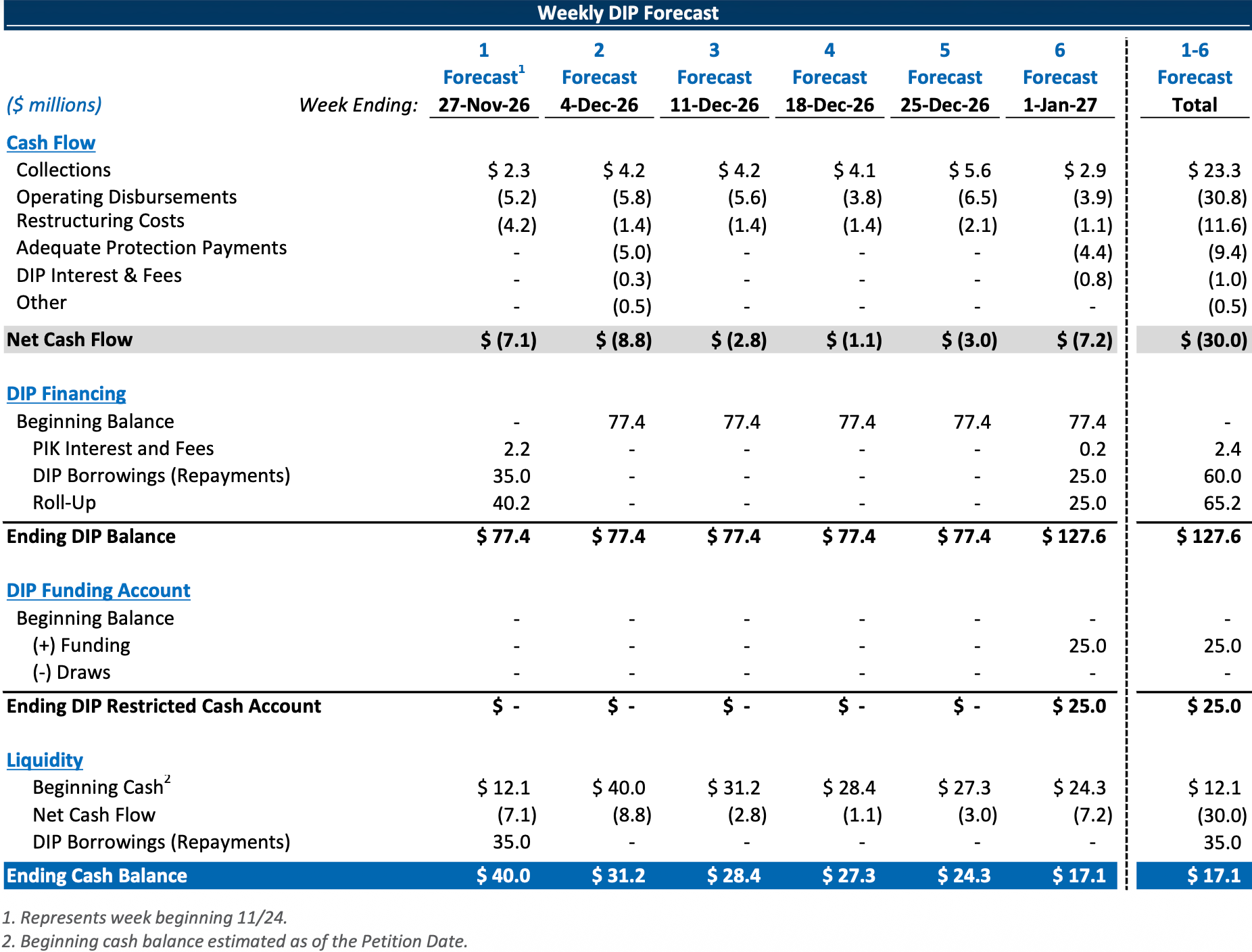
On November 25, 2026, the court approved on an interim basis an approximately $125 million senior secured superpriority term DIP facility from the Debtors' prepetition lenders, with Silver Point Finance as DIP agent, comprising $60 million of new money and a roll-up of up to $65.2 million of prepetition term loans. America's Car Mart, Inc., Colonial Auto Finance, Inc. and Texas Car-Mart, Inc. are borrowers, and the other Debtors are guarantors. A final hearing is set for December 21, 2026, with objections due December 14.
- New Money and Funding Timing: $35 million of initial term loans became available on entry of the interim order, and $25 million of delayed-draw term loans becomes available in a single draw on entry of the final order.
- Roll-Up: On the initial draw under the interim order, approximately $40.2 million of prepetition principal rolls up, including the $5.2 million of Second Amendment term loans and $35 million of prepetition loans matched dollar for dollar with the new money. A further $25 million rolls up with the final-order draw, for up to $65.2 million in total, together with accrued interest on the converted loans. The court approved the interim roll-up over a shareholder's request to defer it to the final order; counsel to Silver Point said it remains subject to the challenge period.
- Pricing: Term SOFR (1% floor) plus 10.5%, or the Base Rate (2% floor) plus 9.5%, and a default rate increase of 2.5%.
- Fees: A 3% commitment premium on the new-money commitments, paid through $1.8 million of Premium DIP Loans, and a 2% exit premium on new-money loans. Agency fees are payable under a separate fee letter.
- Maturity: The facility matures at the earliest of May 23, 2027, acceleration, dismissal or conversion, consummation of a sale of substantially all assets, or substantial consummation of a confirmed plan. The May 23 date can be extended to up to 225 days after the Petition Date if needed to obtain regulatory and third-party consents for the sale.
- Milestones: Interim DIP, bidding procedures and hearing-scheduling orders within 3 business days of the Petition Date; a bid deadline within 28 days; an auction and final DIP order within 35 days; disclosure statement approval, the sale order and confirmation within 40 days; and the plan effective date and sale closing within 45 days, extendable to 225 days for regulatory and third-party consents.
- Collateral and Priority: Liens on substantially all of the Debtors' property and superpriority claims, junior only to the carve-out and to permitted senior liens. Avoidance actions are excluded, as counsel to the DIP agent confirmed at the first day hearing, and their proceeds would be included only upon the final order. The securitization vehicles' assets and accounts are excluded. The Debtors state there is no cross-collateralization or non-consensual priming.
- Carve Out: Statutory and clerk fees, up to $100,000 for a Chapter 7 trustee, professional fees incurred through the first business day after a carve-out trigger notice, and up to $5 million after that.
- Challenge Period and Investigation Budget: Challenges are due by the earlier of the day before the confirmation hearing and 60 days after a committee's appointment, or after the interim order for other parties. A committee may spend up to $50,000 investigating the prepetition lenders' claims and liens.
- Budget and Covenants: Minimum liquidity of $7 million. Net operating cash flow may not trail budget by more than $1.5 million in any four-week testing period, excluding professional fees and DIP interest.
Initial Budget
Distributions at Closing and Treatment of Claims
At closing, the Debtors would first fund two cash reserves from the sale proceeds and cash on hand. The first, agreed with the DIP Lenders, would pay claims the purchaser does not assume and fund the wind-down (the "Wind Down Amount"). The second would cover estate professionals. The remaining value would then be distributed in order of priority, starting with the DIP claims.
- DIP Claims (unclassified): Paid in full at closing with all cash remaining after the reserves, with any unpaid balance satisfied in Rollover Debt of an equal principal amount. DIP claims receive no interests in the Wind Down Trust.
- Class 3 (Prepetition Lenders): Impaired and the only voting class. Claims are allowed at approximately $309.2 million, calculated as $311.6 million of Term Loan principal, less approximately $65.2 million rolled into the DIP Facility, plus the $47.8 million prepayment premium and the $15 million First Amendment exit payment, with default-rate interest and fees added on top. In exchange, holders receive the Rollover Debt not issued for DIP claims, any cash remaining after the reserves and DIP claims, and senior interests in the Wind Down Trust (the "Senior Interests"). Although the premium is part of the allowed claim, the trust's distribution waterfall excludes it from the amount the lenders must recover before equity can share in further distributions.
- Classes 1, 2, 4 and 7: Unimpaired. Other priority, other secured, general unsecured and AFI preferred claims would be assumed by the purchaser, reinstated or paid in full in cash from the Wind Down Amount; AFI preferred interests receive their pro rata share of a $500,000 aggregate liquidation preference plus any accrued, unpaid dividends. Any deficiency claim of the Prepetition Lenders is excluded from general unsecured claims.
- Class 8 (ACM common stock and warrants): Canceled and deemed to reject. Each common share receives one junior interest in the Wind Down Trust (a "Junior Interest").
The Wind Down Trust
After closing, the Debtors' remaining assets would move to a trust (the "Wind Down Trust") run by a wind-down trustee. These include: (i) the Wind Down Amount, (ii) assets excluded from the sale, such as excluded real property, residual letter-of-credit cash collateral and retained causes of action, (iii) the right to the Estate Earn Out, and (iv) cash generated by ACM Insurance Company, ACM's non-Debtor captive insurer. ACM would continue to own ACM Insurance, which the Buyer is not acquiring. Its surplus reaches the trust only after its own policy claims and regulatory capital requirements are met. The Liquidation Analysis puts its net value at about $5.8 million.
The trust would first use the Wind Down Amount to pay allowed claims the purchaser did not assume, which must generally be filed within 30 days after the Effective Date, along with its own expenses. ACM and the other Debtors would remain in existence only to complete the wind-down, perform the transition services agreement and hold non-transferable licenses, and would then be dissolved.
What remains in the trust would be distributed at least every six months, in three tiers:
- First: Up to $2.5 million to the Junior Interests, paid only from ACM Insurance proceeds, residual letter-of-credit collateral and excluded real property.
- Second: All other trust distributions, including the Estate Earn Out, go to the Senior Interests to cover the shortfall between the "Prepetition Lender Priority Amount" and the face value of the Rollover Debt and any cash the lenders received at closing on their Term Loan claims. The Priority Amount is approximately $261.4 million plus default interest, comprising the roughly $246.4 million of Term Loan principal not rolled into the DIP Facility and the $15 million exit payment, but excludes the $47.8 million prepayment premium.
- Third: Any remainder to the Junior Interests.
First Day Hearing
At the first day hearing on November 25, 2026, Judge Christopher M. Lopez approved the DIP facility on an interim basis, conditionally approved the disclosure statement and granted the Debtors' other first day motions, except a motion to reject leases that he continued to December 7 to give landlords more notice. He approved the sale timeline, with bids due December 17 and an auction, if needed, on December 22, but deferred approval of the Buyer's break-up fee and expense reimbursement to the December 7 hearing. A combined hearing on the sale, final approval of the disclosure statement and confirmation of the Plan is set for December 29, 2026.
Two parties raised objections. The U.S. Trustee said it continues to object to opt-out releases and reserved its rights on confirmation. Samuel Epstein, a shareholder, asked that any lender credit bid exclude the $47.8 million prepayment premium and $15 million exit payment unless they survive challenge, that the Debtors be able to extend the bid deadline without lender consent, that the roll-up of prepetition loans into DIP loans be deferred to the final DIP order, and that adequate protection interest be paid at the non-default rate until the final hearing. The court overruled his objections to the interim DIP order and reserved all parties' rights on the bid protections. Counsel to Silver Point Finance, LLC, the lenders' agent, said the roll-up remains subject to the challenge period and that consent to extending the bid deadline would not be unreasonably withheld.
Related Coverage
The following summaries provide further detail on the Debtors' key filings:
Explore Bondoro Insights for live case dockets and comprehensive coverage of material filings from petition to plan confirmation.
Stay informed on every Chapter 11 bankruptcy case with liabilities exceeding $10 million. Subscribe for free to have our coverage delivered directly to your inbox, and explore our full archive of past summaries.
Subscribers can also opt in to timely filing alerts by updating their email preferences in Account Settings.


