Case Summary: Mercer International Chapter 11
Mercer International filed for Chapter 11 with a prepackaged plan to equitize about $1.1 billion of senior notes and cut funded debt by roughly $900 million, following weak pulp prices, rising wood fiber costs and a debt-funded solid wood expansion that failed to generate earnings.

A deck version of this summary is also available HERE.
Business Description
Headquartered in Vancouver, British Columbia, Mercer International Inc. (NASDAQ: MERC) ("Mercer") and its wholly owned subsidiary Mercer International (Texas) LLC ("Mercer Texas" and, together with Mercer, the "Debtors"), together with their non-Debtor affiliates (the "Non-Debtor Affiliates" and, with the Debtors, the "Company"), make pulp, lumber, pallets and engineered wood products used mainly in paper, packaging and construction, with operations in Germany, Canada and the United States.
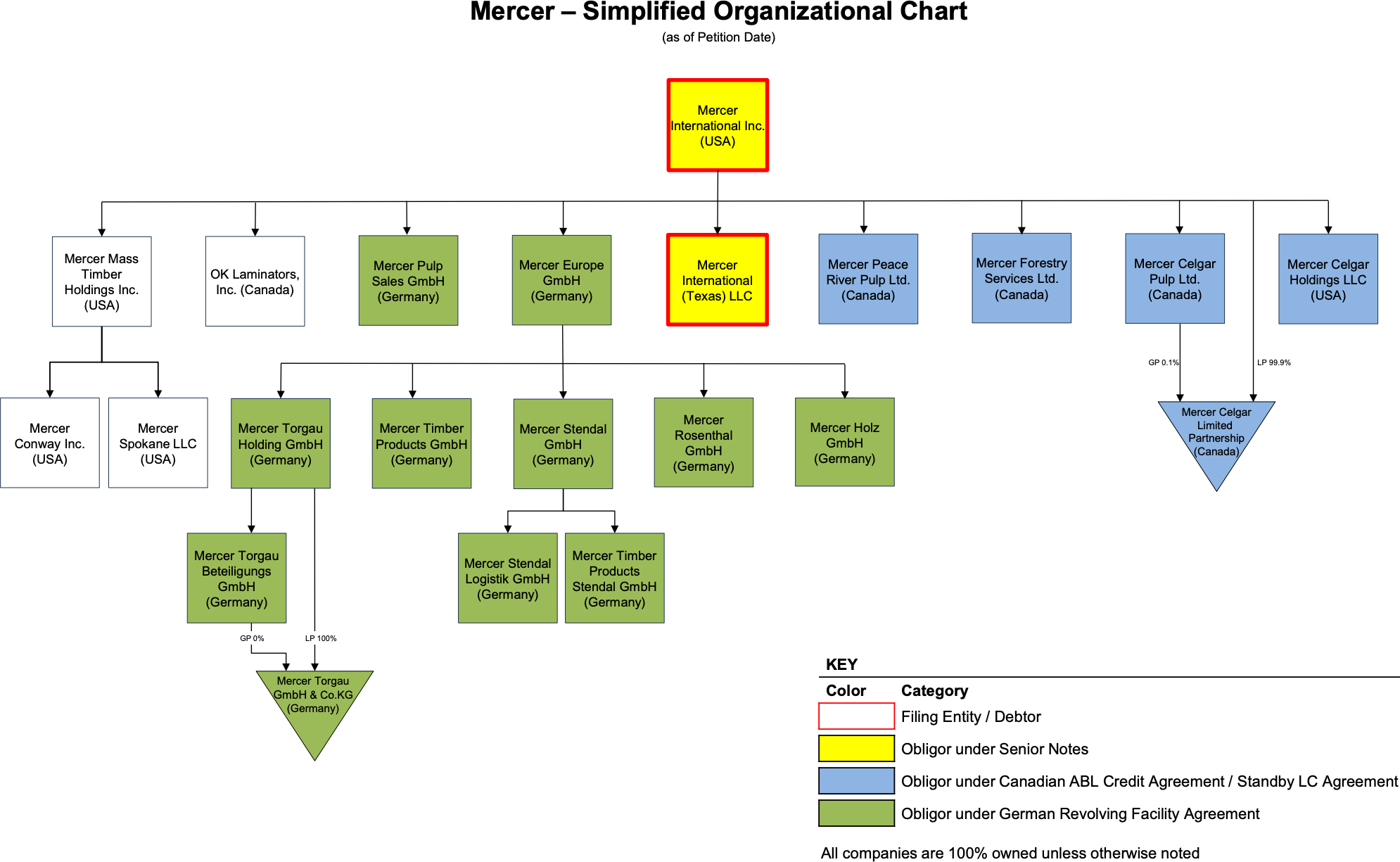
Only Mercer, the group’s publicly traded parent, and Mercer Texas are Debtors. Neither has operations or employees, and the business is run through the Non-Debtor Affiliates and organized into two segments across nine facilities:
- The Pulp Segment has two mills in Germany and two in western Canada. Three produce northern bleached softwood kraft (“NBSK”) pulp, a long-fiber grade that makes tissue and paper products stronger. The fourth, in Alberta, can also produce northern bleached hardwood kraft (“NBHK”) pulp, a short-fiber grade that makes paper smoother and more opaque.
- The Solid Wood Segment has two German sawmills and three North American mass timber plants making cross-laminated timber ("CLT").
For the twelve months ended September 30, 2026, revenue declined approximately 3.5% to $1.84 billion from $1.91 billion in the prior-year period, while operating EBITDA swung to negative $36.3 million from positive $97.3 million.
Mercer International Inc. and its debtor affiliate⁽¹⁾ filed for Chapter 11 protection on November 9, 2026 (the "Petition Date") in the U.S. Bankruptcy Court for the Southern District of Texas, reporting $1.9 billion in assets and $2.0 billion in liabilities (as of June 30, 2026).
⁽¹⁾ For a complete list of Debtor and Non-Debtor entities, see organizational structure chart below.
Corporate History
Mercer began in 1968 as a Washington business trust investing in real estate before entering the pulp business in 1994 with its acquisition of the Rosenthal mill in Germany. It expanded over the following decade, opening the Stendal mill in Germany in 2004 after an investment of approximately $1.1 billion and acquiring the Celgar mill in British Columbia in 2005 for approximately $210 million, before converting to a Washington corporation in 2006.
Acquisitions, 2017–2023
From 2017 through 2023, Mercer made five notable acquisitions totaling approximately $803 million, adding a fourth pulp mill and moving into lumber, pallets and mass timber.
- Friesau, Germany (April 2017) — Mercer entered wood products by buying a sawmill and biomass power plant near Friesau, Germany, for approximately $61.6 million.
- Peace River, Canada (December 2018) — Mercer paid $344 million for Daishowa-Marubeni International Ltd., whose assets were the Peace River mill in Alberta, and a 50% stake in the Cariboo pulp mill joint venture in British Columbia.
- Spokane, WA (August 2021) — Mercer entered mass timber by paying $51.3 million for a plant in Spokane, WA that makes cross-laminated timber (“CLT”), engineered wood panels used in building construction. According to trade press, the plant was sold through the Chapter 11 case of Katerra, its prior owner.
- Torgau, Germany (September 2022) — Mercer bought Holzindustrie Torgau, the world’s largest producer of EPAL wood pallets used for shipping, which also makes lumber and biofuels, for €270 million ($263.2 million).
- Conway, AR and Okanagan, Canada (June 2023) — Mercer bought the mass timber assets of Structurlam, a CLT and glue-laminated timber (“glulam”) maker, out of its bankruptcy for $82.1 million. The assets included a plant in Conway, AR and three British Columbia facilities that Mercer later consolidated into its Okanagan facility.
Organizational Structure
Mercer directly or indirectly owns nine material operating subsidiaries. Mercer Texas was formed shortly before the Petition Date and became a guarantor of Mercer's senior notes on November 5, 2026.
Operations Overview
Revenue Breakdown
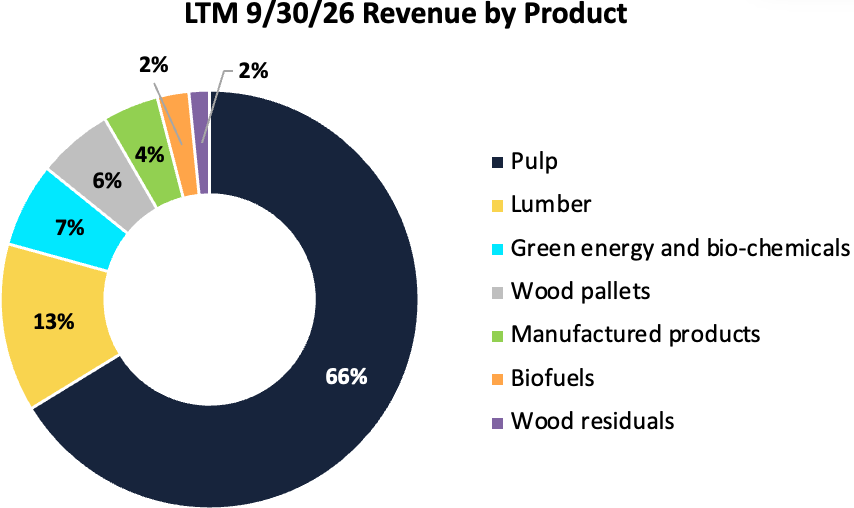
For the twelve months ended September 30, 2026, the Company generated approximately $1.84 billion of revenue, consisting of approximately: $1.2 billion from pulp sales, $240 million from lumber sales, $120 million from green energy and bio-chemical sales, $107 million from wood pallet sales, $80 million from manufactured products, $45 million from biofuel sales, and $29 million from wood residual sales. Revenue declined approximately 3.5% from approximately $1.91 billion for the twelve months ended September 30, 2025.
By destination, LTM revenue consisted of approximately: (i) $519 million, or 28%, from China; (ii) $491 million, or 27%, from Germany; (iii) $315 million, or 17%, from the United States; and (iv) $516 million, or 28%, from other countries.
Pulp Segment
The Pulp Segment produces and sells pulp, green electricity and bio-chemicals at four mills: Rosenthal (360,000 air-dried metric tonnes (“ADMTs”) of annual capacity) and Stendal (740,000) in Germany, and Celgar (520,000) in British Columbia and Peace River (475,000) in Alberta. Three of the mills produce NBSK pulp, a premium grade valued for its strength and sold mainly to tissue and paper producers. Peace River can produce both NBSK and NBHK pulp. The mills also operate as bio-refineries, generating green electricity from biofuels produced during pulping, such as black liquor and wood waste, to run mill operations and selling the surplus to third-party utilities or into regional electricity markets.
For the twelve months ended September 30, 2026, the segment generated approximately $1.31 billion of revenue, consisting of $1.2 billion from pulp and $95.4 million from energy and chemicals. China was the largest market, at $516.1 million, or approximately 39.3% of segment revenue, followed by Germany at $278.8 million, or approximately 21.2%, and the United States at $143 million, or approximately 10.9%, with the remaining $376.6 million from other countries.
Solid Wood Segment
The Solid Wood Segment produces and sells lumber, wood pallets, engineered wood products, biofuels, electricity and wood residuals through two German sawmills and three mass timber plants in the United States and Canada.
The sawmills’ lumber is sold to distributors, construction firms, secondary manufacturers, retail yards and home centers in the United States, Europe and Asia, and their pallets go mainly to European customers. The mass timber plants make cross-laminated timber (“CLT”) and glue-laminated timber (“glulam”) used in residential and commercial construction. Wood residuals are used internally, sold to third parties or converted into pellets and briquettes, and certain facilities generate renewable electricity from biomass.
For the twelve months ended September 30, 2026, the segment generated approximately $504.8 million of revenue, consisting of $239.6 million from lumber, $107.4 million from pallets, $79.6 million from manufactured products, $45 million from biofuels, $22 million from energy and $11.2 million from wood residuals. Germany was the largest market, at $211.3 million, or approximately 41.9% of segment revenue, followed by the United States at $171.8 million, or approximately 34%, with the remaining $121.7 million mostly from other countries.
Mercer’s mass timber order book and commitments stood at approximately $151 million at September 30, 2026, anchored by large-scale data center infrastructure projects that are expected to begin contributing to results in late 2026 and into 2027. On its November 2026 earnings call, management said approximately 62% of the backlog consisted of data center projects sponsored by hyperscalers, the largest cloud computing companies.
Facilities
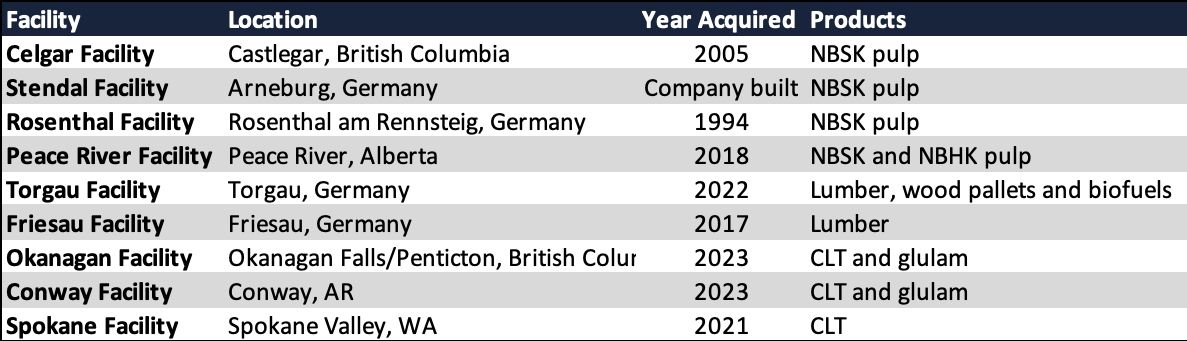
As of the Petition Date, the Company operates nine facilities, comprising four pulp mills and five solid wood facilities: two sawmills in Germany and three mass timber plants in the United States and Canada.
Workforce
As of the Petition Date, the Non-Debtor Affiliates employed all of the Company’s approximately 3,500 workers, a majority under collective agreements, including approximately 2,310 in Germany, 1,070 in Canada and 145 in the United States.
Prepetition Obligations
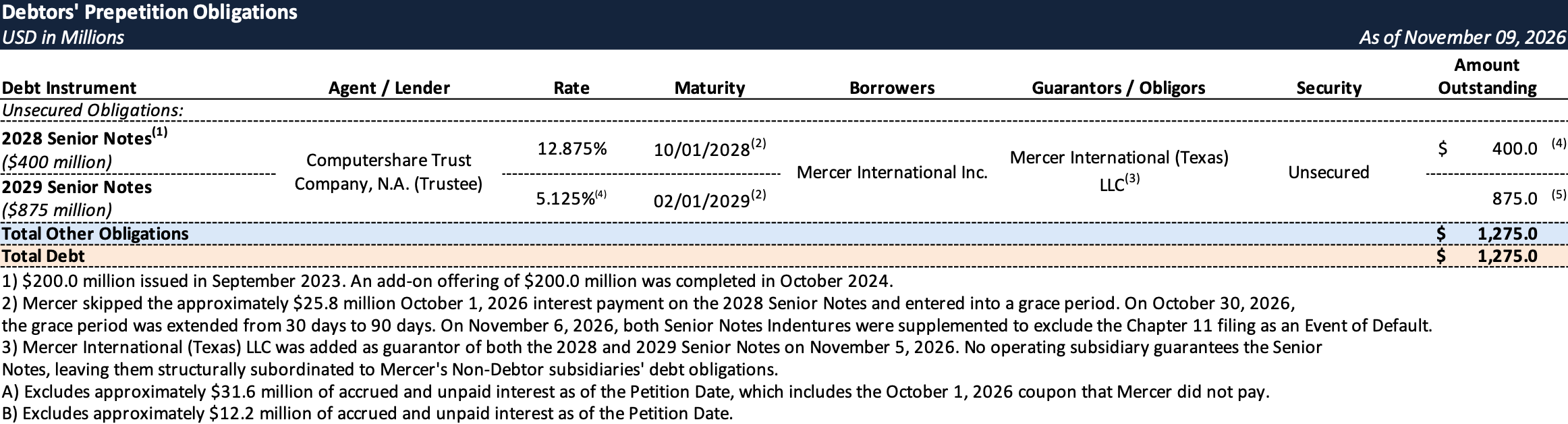
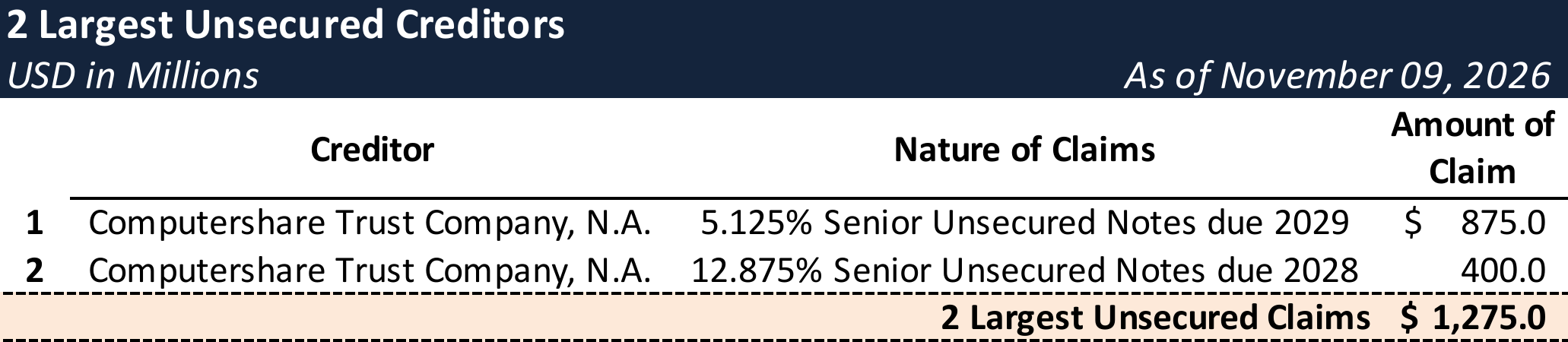
The Debtors’ funded debt consists of two series of unsecured notes totaling approximately $1.3 billion, summarized in the table below.
At the Non-Debtor level, the Company had approximately $367.8 million outstanding under two secured credit facilities, along with a standby letter of credit facility and an unsecured demand loan:
- Canadian ABL Facility ($80.8 million) — An asset-based revolver of up to C$160 million from three banks, with Royal Bank of Canada as agent, maturing January 21, 2027. It is secured by substantially all assets of its borrowers and guarantors, which are certain Canadian subsidiaries (see Organizational Structure). As of the Petition Date, approximately $80.8 million was outstanding.
- German RCF ($287 million) — A revolving facility of up to €370.1 million to certain German subsidiaries maturing September 15, 2027. As of the Petition Date, approximately $287 million was drawn and approximately $24 million of letters of credit were outstanding.
- Other facilities — Comprises (i) A standby letter of credit facility for the Canadian mills, with approximately C$4.1 million ($2.9 million) of letters of credit outstanding at the Petition Date, and (ii) a €2.6 million unsecured demand loan at Mercer Rosenthal GmbH.
Top Unsecured Claims
Events Leading to Bankruptcy
Debt-Funded Growth
Between 2017 and 2023, Mercer spent approximately $803 million on acquisitions, more than half of it to build out its solid wood business. According to the Disclosure Statement, approximately $396.6 million of that went to solid wood acquisitions from 2021 through 2023, alongside approximately $96.3 million of capital expenditures in the segment. The expansion was funded largely with debt and available cash: from the end of 2020 through 2023, the Company’s senior note and credit facility borrowings rose approximately $430 million, to approximately $1.58 billion.
The solid wood business added scale but not earnings. After generating approximately $122 million of EBITDA in 2021, the segment recorded negative Segment Operating EBITDA in each year from 2023 through 2025.
Pulp Prices and Weak Demand
Market conditions for pulp have remained challenging, particularly for NBSK in China and North America. According to the Debtors, Chinese demand has been constrained by an oversupplied paper market and economic and trade uncertainty. According to Mercer’s cleansing materials published on November 2, 2026, Chinese softwood imports have decreased, and more than 2.7 million tons of softwood pulp capacity have been removed from the market since 2023. These trends bear directly on Mercer, as NBSK accounted for approximately 82% of its pulp production in the first nine months of 2026. According to the Debtors, weaker demand has reduced the prices the Company receives for its NBSK pulp.
The China net price for NBSK averaged approximately $672 per ADMT in the first half of 2026, compared with approximately $764 in the same period of 2025, and Mercer’s average NBSK sales realizations decreased approximately 11% over the same period. Globally, NBSK and NBHK net prices are 20% to 30% below their 2022 peak, according to the cleansing materials.
In solid wood, the Debtors report that demand in Europe has remained subdued due to economic conditions. Although average lumber selling prices increased approximately 5% in the first half of 2026, lumber revenues declined on lower sales volumes.
Costs Increase
Alongside weaker pricing, the Company has faced rising production costs, most significantly for wood fiber. According to the Debtors, the increase has been particularly acute in Germany, where reduced fiber availability and increased demand for wood as an energy source have pushed prices higher. The cleansing materials link both trends to the Russia-Ukraine conflict. German production of wood pellets, a fuel made from compressed wood residues, has grown at an approximately 28.2% annual rate since 2019, increasing competition for the wood chips used in pulp production, while Russian wood fiber flows to Northern Europe have ceased.
According to the cleansing materials, Mercer’s pulp fiber cost per ADMT rose at an approximately 13.3% annual rate from 2021 through the first quarter of 2026, while its average pulp price fell at an approximately 2.3% annual rate. In the first half of 2026, per unit pulp fiber costs increased approximately 18%, prompting production cuts at the German pulp mills, and per unit lumber fiber costs rose approximately 32%, with fiber representing approximately 85% of lumber cash production costs.
Other Macroeconomic Headwinds
Beyond pricing and fiber, the Company has been affected by broader geopolitical, currency and trade developments:
- Geopolitical conflicts and energy costs. According to the Debtors, the conflicts in Ukraine and the Middle East have disrupted global energy markets and weighed on demand, with higher oil and energy prices adding to freight, fiber and other production costs.
- Foreign exchange. Mercer incurs most of its costs in euros and Canadian dollars but prices most of its products in U.S. dollars, so a weaker dollar raises its costs. In the first half of 2026, the Company recorded a negative foreign exchange impact of approximately $15.7 million on operating loss compared with the same period of 2025.
- Trade policy. U.S. imports of softwood lumber have been subject to a 10% duty since October 14, 2025, under a presidential proclamation, affecting the lumber Mercer exports from Germany to the United States. U.S. tariffs have also redirected Chinese exports, reducing demand for softwood pulp.
Impact on Results
According to the Debtors, these conditions have contributed to weaker demand across the Company’s key markets and significant margin compression, despite ongoing cost-reduction and efficiency efforts. Operating EBITDA declined from approximately $243.7 million in 2024 to negative $22 million in 2025, and was negative $13.1 million in the first half of 2026, compared with positive $26.5 million in the same period of 2025. Over the same six months, the Company recorded approximately $51 million of inventory impairment charges, primarily against pulp and fiber inventory as a result of low pulp prices and high fiber costs, and used approximately $100.8 million of cash in operating activities, compared with approximately $7.5 million a year earlier.
Combined with the Company’s approximately $1.6 billion of funded debt and approximately $122 million of annual cash interest expense, these pressures rendered its existing capital structure unsustainable.
German RCF Covenant Breach and Waiver
At March 31, 2026, the German borrowers breached the German RCF’s maximum leverage ratio. On May 4, 2026, the lenders waived the covenant for the first three quarters of 2026 in exchange for tighter terms, including a €300 million cap on utilization, temporary security over certain assets, higher interest margins and restrictions on distributions to Mercer. In August 2026, management determined that a breach at the December 31, 2026 test was probable, and the Plan provides for the German RCF to be repaid in full and terminated on the Effective Date.
Prepetition Restructuring Efforts
The Company faced near-term maturities under both of its principal credit facilities: the Canadian ABL Facility, due January 21, 2027, and the German RCF, due September 15, 2027. According to Mercer’s cleansing materials, repaying both facilities on December 31, 2026 would create a peak liquidity need of approximately $428 million in July 2027, before any further interest payments on the Senior Notes. According to the Debtors, the Company lacked the liquidity to repay the facilities at maturity. Its efforts to address its position included:
- Cost and liquidity measures. The Company continued its “One Goal One Hundred” cost-savings program, which had realized approximately $75.7 million of savings by October 2026.
- Governance. In February 2026, the Board formed a Special Committee of independent directors to oversee liquidity and capital structure alternatives.
- Advisors. Mercer engaged Houlihan Lokey as investment banker in December 2025, retained Latham & Watkins and Hunton Andrews Kurth as legal counsel and Alvarez & Marsal as financial advisor.
- Lender discussions. The Company engaged with lenders under the Canadian ABL Facility and the German RCF on potential extensions and refinancings, but those discussions did not produce a transaction on commercially viable terms.
- Noteholder negotiations. By July 2026, the Company had begun discussions with holders of Senior Notes, later focusing on an ad hoc group that includes Millstreet, Redwood Capital Management and Mackay, advised by Paul, Weiss, Rifkind, Wharton & Garrison LLP and Ducera Partners LLC (the “Majority Ad Hoc Group”), along with certain large equity holders. The parties reached agreement in principle on a commercial term sheet in September 2026 and finalized the Restructuring Support Agreements, the Plan, the Rights Offering and the backstop commitment during late September and October.
- Missed interest payment and indenture amendments. On October 1, 2026, Mercer did not make the approximately $25.8 million interest payment due on the 2028 Senior Notes and entered a 30-day grace period, which was later extended to December 30, 2026. In early November, both Senior Notes Indentures were supplemented to add Mercer International (Texas) LLC as a guarantor and to provide that the Chapter 11 filing would not constitute an Event of Default.
Chapter 11 Filing
The Debtors' prepackaged Chapter 11 plan contemplates exchanging the $1.275 billion of Senior Notes for new equity and secured notes, reducing funded debt by approximately $900 million, from approximately $1.6 billion to approximately $700 million, principally by equitizing approximately $1.1 billion of the notes, and cutting annual cash interest by approximately $100 million. The cases will be funded entirely with unencumbered cash, without DIP financing or the use of cash collateral. Although the Debtors have no operations or customer receipts, they are funded by cash from the Non-Debtor Affiliates, including distributions, cost reimbursements, management fees and intercompany loan repayments.
Restructuring Support Agreements
On November 2, the Debtors entered into Restructuring Support Agreements with holders of approximately 88.58% of Senior Notes principal and approximately 43.1% of Mercer’s existing equity, along with a Backstop Commitment Letter with certain members of the Majority Ad Hoc Group, who agreed to fully backstop the Rights Offering. The Plan is a “straddle” prepackaged plan: solicitation of Senior Notes holders began before the Petition Date, while equity holders will vote after the filing, with a voting deadline of December 10, 2026.
- Commitments and covenants. Consenting holders must vote to accept the Plan and not opt out of its releases. Until December 31, 2026, the Company’s cash plus revolver availability may not fall below $30 million. Without the consent of holders of a majority of the consenting noteholders’ notes (the “Required Consenting Senior Noteholders”), the Company may not amend or refinance its bank facilities, sell material assets or seek government financing.
- Milestones. The Disclosure Statement must be conditionally approved within three days of filing, the backstop order entered within 22 days of the Petition Date and the Confirmation Order entered within 45 days. The Effective Date must occur by the earlier of December 31, 2026 and 14 days after confirmation, subject to a 30-day extension for regulatory approvals.
- Termination. The noteholder RSA terminates automatically two business days after a missed milestone unless extended. The Required Consenting Senior Noteholders may also terminate it if any other funded debt is accelerated or any non-Debtor subsidiary commences an insolvency proceeding.
- Transfer restrictions. Consenting noteholders may not acquire Senior Notes or equity if doing so would bring their combined ownership above 9.9% of Mercer’s existing equity.
Exit Capital Structure
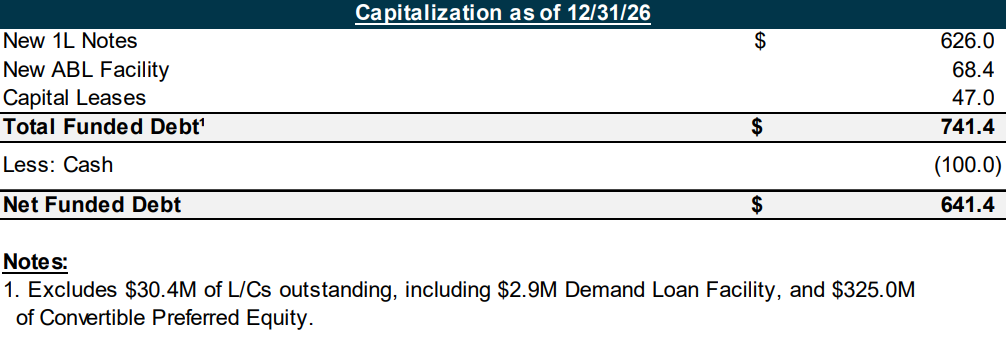
The reorganized Company would emerge with approximately $626 million of new first-lien senior secured notes ($420 million of new money, $150 million of takeback and $56 million of put option premium notes, all on identical terms) and approximately $68.4 million drawn under a new ABL facility. The notes bear interest at 12.25% cash, or 13.75% with up to 12.75% payable in kind, for the first 24 months, then 12.50% cash. They are expected to be secured by a first lien on Mercer Mass Timber Inc.’s assets and a second lien on the bank facilities’ collateral.
Proceeds from the Rights Offering and the New ABL Facility will be used to repay and terminate the German RCF, with its outstanding letters of credit transferred to the New ABL Facility or cash collateralized, and to reduce the Canadian ABL Facility by at least $41 million.
- Rights Offering. Holders of Senior Notes may purchase up to $420 million of New Money Senior Secured Notes, inclusive of $20 million of original issue discount, for up to $400 million of cash. Participants also receive stapled equity consisting of 40% of the new common stock and 40% of the new convertible preferred stock ("Stapled Equity"). The offering is subject to a dollar-for-dollar reduction for amounts drawn under the New ABL Facility at closing, but only to the extent liquidity at closing exceeds $300 million, and the reduction cannot take liquidity below that level.
- Backstop. Certain members of the Majority Ad Hoc Group have committed to fully backstop the Rights Offering in exchange for a $56 million put option premium, equal to 14% of the $400 million commitment, payable in additional notes (or in cash if the backstop commitment terminates before the Effective Date for reasons other than a backstop party breach).
- Takeback Notes. Holders of Senior Notes Claims will receive $150 million of new takeback senior secured notes, maturing four years and 364 days after issuance. The takeback notes will be issued under a single indenture with the New Money Senior Secured Notes and the $56 million of put option notes, and all three share the same terms.
- New ABL Facility. A new asset-based revolving credit facility of up to $300 million, which may be structured as a global facility or regional facilities. Its size will be reduced by any amount the Canadian ABL lenders agree to reinstate, extend or provide. Entry into the facility is a condition to the Effective Date, and Houlihan Lokey has launched a financing process with lenders, with initial market feedback expected by mid-November.
Reorganized Equity
On the Effective Date, existing Mercer common stock will be cancelled, and the reorganized Company will issue new common stock and $325 million of new convertible preferred stock to noteholders, rights offering participants and existing shareholders. Both securities will be diluted by a management incentive plan. Mercer expects Nasdaq to delist its existing common stock and intends to apply to list the new common stock on a national exchange.
- New Common Stock. The new common stock will be held 51.5% by noteholders, 40.0% by rights offering participants as Stapled Equity and 8.5% by existing shareholders, before dilution from a management incentive plan reserving up to 8.5%.
- New Convertible Preferred Stock. $325 million of convertible preferred stock will be held 56.5% by noteholders, 40% by rights offering participants as Stapled Equity and 3.5% by existing shareholders. The preferred stock would rank senior to the new common stock and carry an 8% dividend, payable in kind at reorganized Mercer’s election, stepping up to 10%, 12% and 14% from the third, fourth and fifth anniversaries of closing.
Plan Classes and Treatment
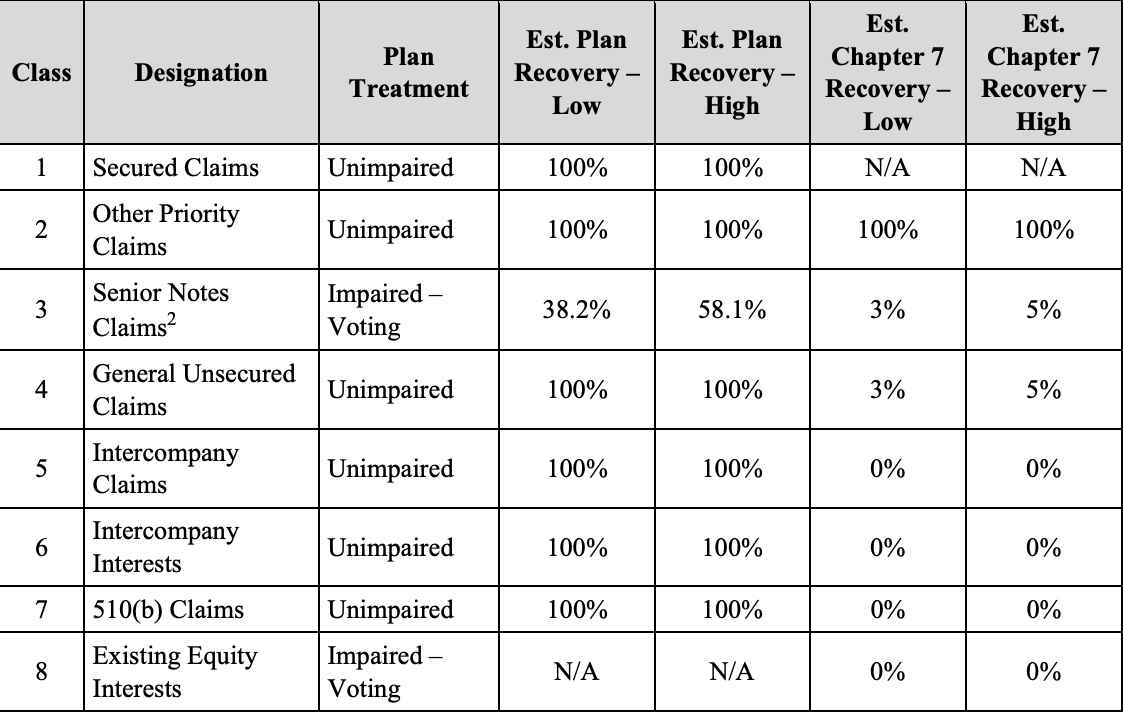
Of the Plan's eight classes, only Class 3 (Senior Notes claims, covering both series) and Class 8 (existing equity interests) are impaired and would vote.
- Class 3 (Senior Notes Claims). Claims are allowed at approximately $1.32 billion, equal to principal plus accrued and unpaid interest as of the Petition Date. Holders will receive their pro rata share of 51.5% of the New Common Stock, 56.5% of the $325.0 million of New Convertible Preferred Stock, $150.0 million of takeback senior secured notes and subscription rights in the Rights Offering. Noteholders that participate in the Rights Offering receive an additional 40.0% of the New Common Stock and 40.0% of the New Convertible Preferred Stock as Stapled Equity. According to the Disclosure Statement, projected recovery for the class is 38.2% to 58.1%, based on a $1.3 billion midpoint enterprise value, with the range depending on whether holders participate in the Rights Offering.
- Class 8 (Existing Equity Interests). Holders will receive their pro rata share of 8.5% of the New Common Stock and 3.5% of the New Convertible Preferred Stock, diluted only by the management incentive plan and conversion of the preferred stock.
- Unimpaired classes. All other classes, including general unsecured and trade claims and section 510(b) claims, are unimpaired.
Recoveries Against Hypothetical Chapter 7 Liquidation
Financial Projections
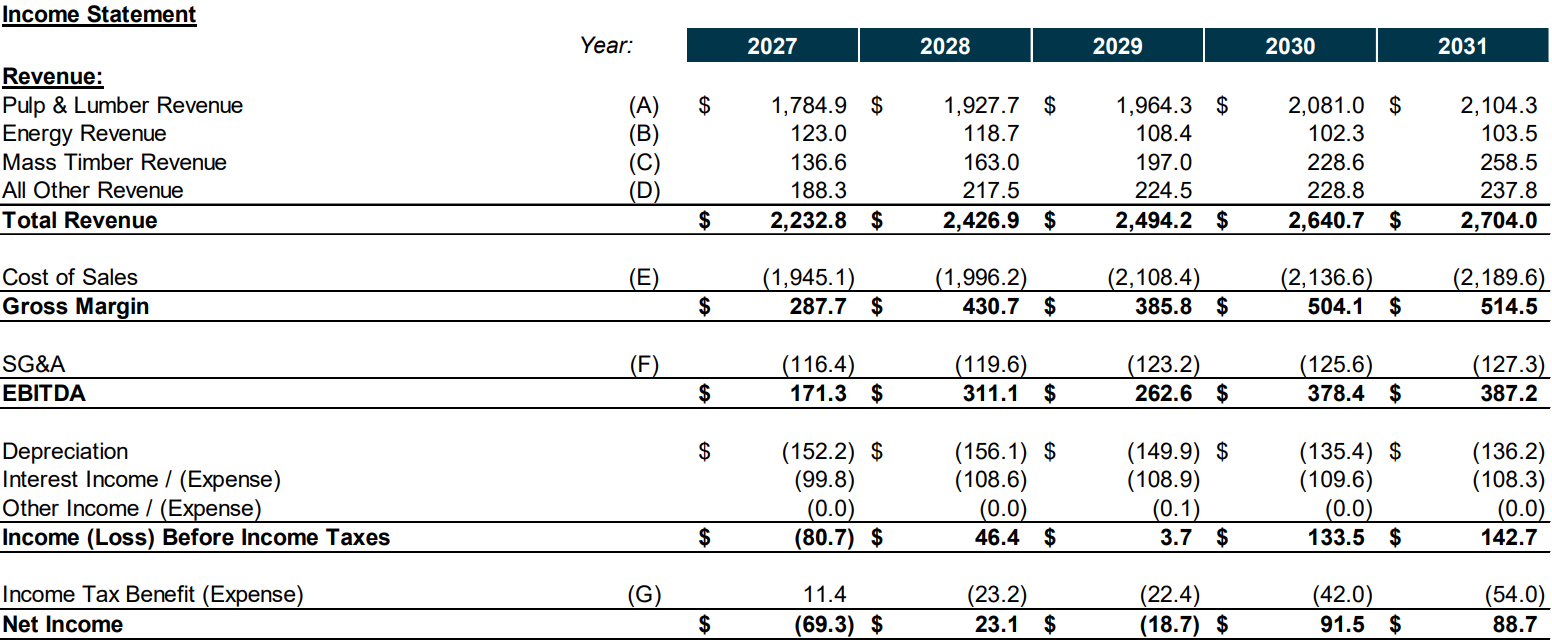
The Company projections assume a recovery beginning in 2027. Revenue is projected to grow from approximately $1.89 billion in 2026 to approximately $2.23 billion in 2027 and approximately $2.7 billion by 2031. EBITDA is projected to rise from negative $4 million in 2026 to $171.3 million in 2027 and $311.1 million in 2028, and to approximately $387 million by 2031, a margin of approximately 14%.
The forecast assumes the Iran conflict is resolved by late 2027 or early 2028, lowering gas prices in Germany, but assumes no resolution of the Russia-Ukraine conflict and no change to U.S. tariffs.
First-Day Relief
- Cash Management (Docs. 8, 39): The Debtors received interim approval to continue their cash management system of six accounts holding approximately $4.35 million and continue intercompany transactions, with net cash to non-Debtor affiliates capped at the RSA-approved budget.
- Critical Vendors (Docs. 9, 40): The Debtors received final approval to pay approximately $1.14 million in prepetition trade claims in the ordinary course, consistent with the approved budget. Vendors accepting payment must continue providing services on customary trade terms.
- Insurance (Docs. 10, 43): The Debtors received final approval to maintain 27 insurance policies carrying approximately $17 million in annual premiums, including approximately $1 million owed as of the Petition Date, and pay related deductibles and broker fees. The order also modifies the stay to permit D&O insurers to pay defense costs.
- Taxes (Docs. 11, 42): The Debtors received final approval to pay prepetition, postpetition and straddle-period taxes and fees, which, according to the Debtors, are de minimis.
- NOL Trading (Docs. 12, 44): The Debtors received final approval of notice and objection procedures for holders of 4.5% or more of common stock to protect approximately $70 million of federal NOLs and approximately $402 million of disallowed business interest carryforwards. Proposed trades require 20 business days' advance notice, subject to a 15-business-day objection period.
Explore Bondoro Insights for live case dockets and comprehensive coverage of material filings from petition to plan confirmation.
Stay informed on every Chapter 11 bankruptcy case with liabilities exceeding $10 million. Subscribe for free to have our coverage delivered directly to your inbox, and explore our full archive of past summaries.
Subscribers can also opt in to timely filing alerts by updating their email preferences in Account Settings.


