Case Summary: Redeemer Health Chapter 11
Redeemer Health filed for Chapter 11 after years of hospital and physician network losses, increased competition, and missed bond payments, seeking a going-concern sale of Holy Redeemer Hospital and its physician network while preserving its post-acute and life care operations.

A deck version of this summary is also available HERE.
Business Description
Headquartered in Meadowbrook, PA, Redeemer Health ("RH"), together with its Debtor and non-Debtor affiliates (collectively, the "Company"), is a nonprofit Catholic health and social services system serving southeastern Pennsylvania and New Jersey. RH, the parent of eleven Debtor affiliates (together with RH, the "Debtors"), is a holding company with no employees or direct operations. Its wholly owned subsidiary, Holy Redeemer Health System (“HRHS”), operates Holy Redeemer Hospital, a licensed 239-bed acute care facility in Abington Township, PA. The hospital provides emergency, inpatient and outpatient care and ancillary services, including rehabilitation and respiratory therapy, with a focus on cancer care, women’s health, cardiovascular health and orthopedics.
The Debtors divide the business into three lines:
- Acute Care — Operated by HRHS and its wholly owned subsidiary HR Physician Services d/b/a Holy Redeemer Physician and Ambulatory Services (“HRPAS”), the acute care business consists of Holy Redeemer Hospital and HRPAS’s physician practices, which employ and contract physicians in primary care, obstetrics and gynecology, imaging, orthopedics and oncology.
- Home Care and Hospice — In-home skilled nursing, therapy, palliative and hospice services in Pennsylvania and New Jersey, plus State-funded "Healthy Families" programs for new and expectant parents in Union and Cape May Counties, NJ.
- Life Care — Senior living and skilled nursing at two Pennsylvania campuses, St. Joseph Manor (296 nursing and 62 personal care beds) and The Lafayette (304 residential units and 70 nursing beds), along with low-income and transitional housing, including for people with disabilities, provided through non-Debtor affiliates and joint ventures.
The Company as a whole has 54 locations and employs more than 155 physicians and 3,200 other employees. For FY2025 ended June 30, 2025, the Company generated $479.9 million in total revenue.
Redeemer Health and certain affiliates⁽¹⁾ filed for Chapter 11 protection on November 1, 2026 (the "Petition Date") in the U.S. Bankruptcy Court for the Eastern District of Pennsylvania. Redeemer Health reported $0 to $50 thousand in both assets and liabilities; certain affiliates reported liabilities of up to the $100 million to $500 million range.
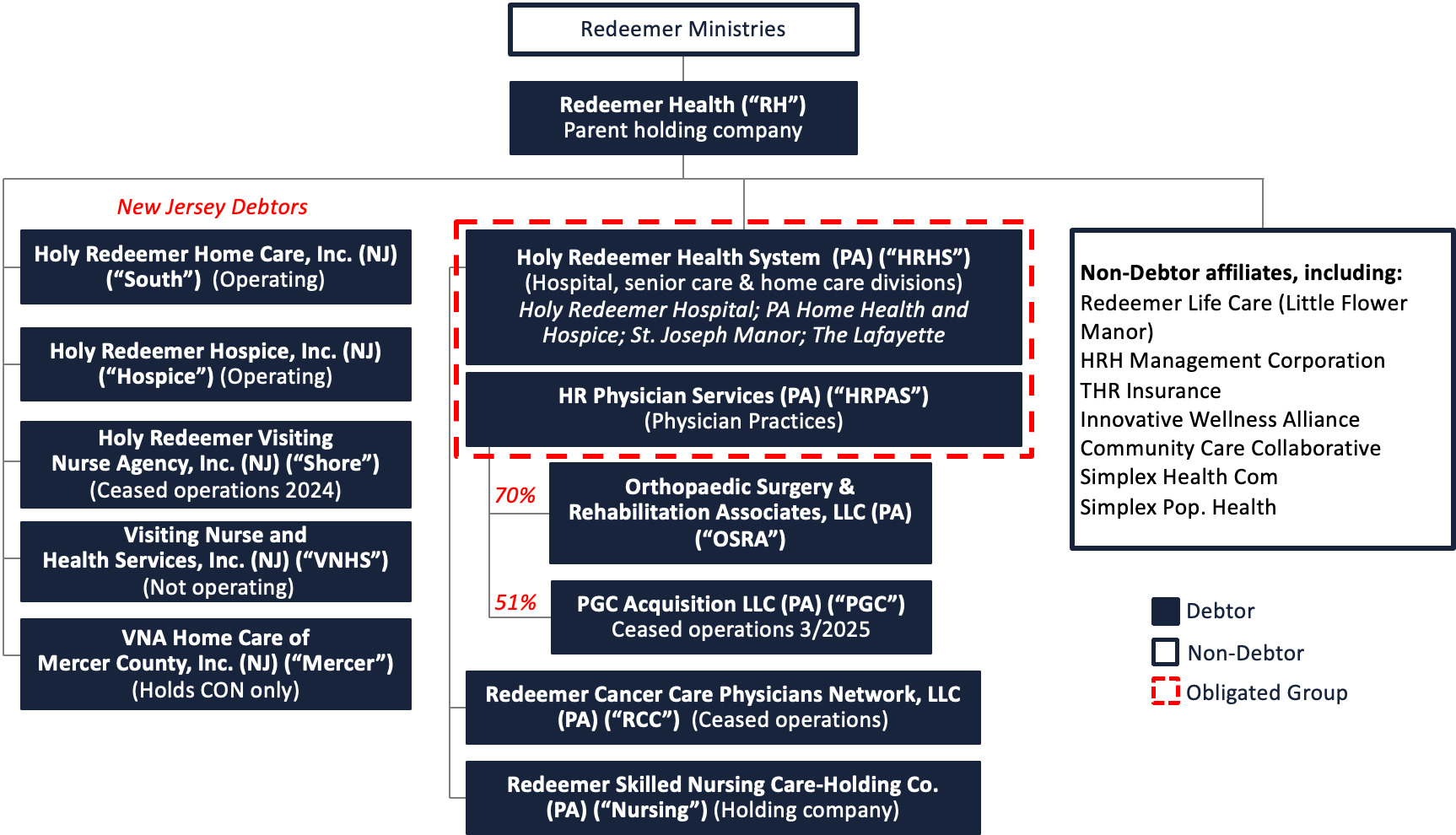
⁽¹⁾ For a complete list of Debtor entities, see organizational structure chart below.
Corporate History
Founding and Origins
The Company traces its roots to 1924, when 12 Sisters of the Redeemer arrived from Germany to provide home care for the sick and poor. The Sisters expanded into senior care with St. Joseph Manor in 1934, into acute care with Holy Redeemer Hospital in 1959, and into senior living with the 1992 acquisition of The Lafayette, building the continuum of acute, home and post-acute care the Company operates today.
Abington Health Merger Attempt
In June 2012, the system, then operating as Holy Redeemer Health System, signed a letter of intent to combine with the larger Abington Health. Because the combination would have ended abortion services at Abington in deference to the Company’s Catholic identity, it drew opposition from Abington physicians and community activists, and the parties ultimately called off the deal. Abington later joined Jefferson Health in 2015, and its flagship hospital, now Jefferson Abington Hospital, operates a few miles away as the Company’s much larger competitor.
Recent Developments
As the congregation’s U.S. membership declined from a peak of 141 Sisters in 1938 to 16 by 2020, the Sisters transferred sponsorship of the system in 2020 to Redeemer Ministries, whose board pairs Sisters with lay leaders to oversee the system’s Catholic mission. The following year, the system adopted the Redeemer Health name.
By then, the Company had posted operating losses every year since 2017. Around the start of 2023, it paid $7 million for a minority stake in Chestnut Hill Hospital, joining Temple Health, which took a majority stake and manages the hospital, and the Philadelphia College of Osteopathic Medicine in acquiring it from Tower Health. Losses continued to mount. In August 2023, S&P downgraded the Company to BB, noting that management was still seeking a strategic partner for the hospital, a search the Company had launched in 2022 that ultimately produced no buyer.
Since 2024, the Company began divesting certain assets. In October 2024, BAYADA Home Health Care acquired its New Jersey home health and hospice operations in Elizabeth and Egg Harbor for $23 million. In August 2025, the Company sold its Chestnut Hill stake to Temple in exchange for a $6.2 million note due September 2027.
Organizational Structure
The Company follows the U.S. Conference of Catholic Bishops’ Ethical and Religious Directives for Catholic Health Care Services. At the top of the structure sits Redeemer Ministries, a non-Debtor entity recognized under Catholic Church law that owns RH. Redeemer Ministries oversees the system’s Catholic mission rather than its finances or operations.
RH conducts its operations through eleven Debtor affiliates, with HRHS, which operates divisions in all three business lines at the center:
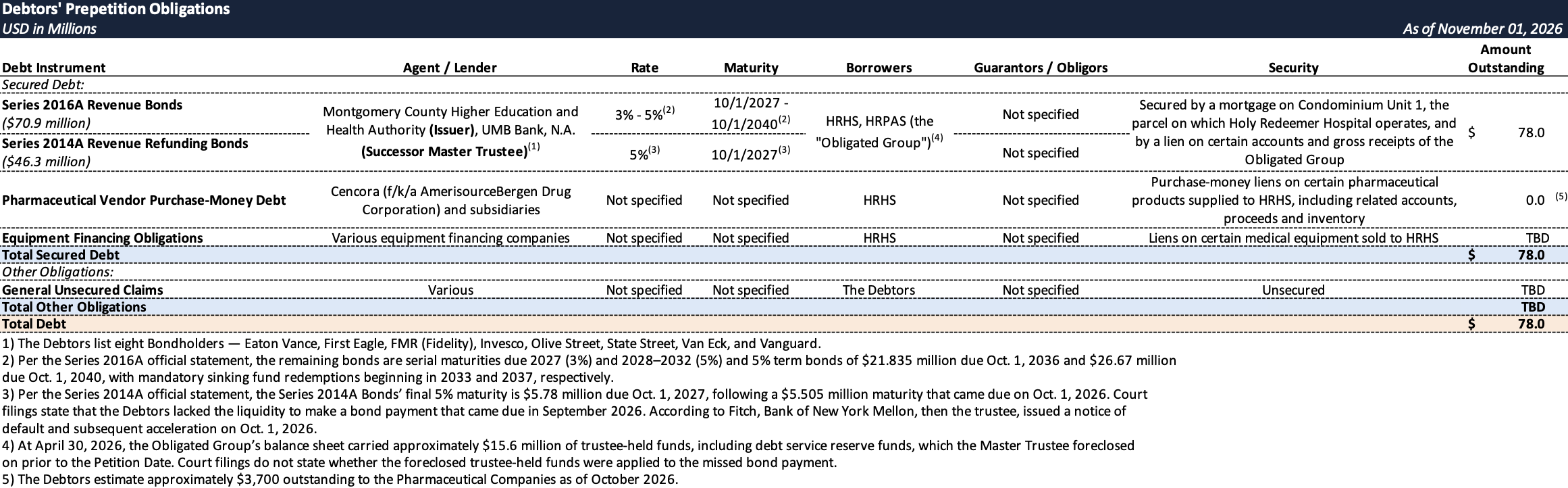
- Holy Redeemer Health System (“HRHS”) — The Debtors’ principal operating entity, HRHS operates four divisions: Holy Redeemer Hospital; PA Home Health and Hospice, which provides in-home skilled nursing, therapy, palliative and hospice care to patients in Pennsylvania and New Jersey; and two Pennsylvania senior care facilities, St. Joseph Manor, a skilled nursing and personal care facility, and The Lafayette, which offers independent living, personal care and skilled nursing. Together with HRPAS, HRHS forms the Obligated Group on the Company’s bonds (see Prepetition Obligations).
- HR Physician Services (“HRPAS”) — Employs and contracts physicians and other providers. HRPAS also holds 70% of the orthopedic practice Orthopaedic Surgery & Rehabilitation Associates, LLC (“OSRA”) and 51% of the behavioral health practice PGC Acquisition, LLC (“PGC”), which ceased operations in March 2025.
- Other HRHS Subsidiaries — Redeemer Cancer Care Physicians Network, LLC, a former oncology practice, no longer operates. Redeemer Skilled Nursing Care – Holding Company (“Nursing”) was formed to own St. Joseph Manor and The Lafayette, but due to organizational issues, according to the Debtors, ownership was never transferred.
- New Jersey Entities — Five New Jersey Debtors make up the Company’s New Jersey home care business, which provides home health, hospice, skilled nursing and rehabilitation services. As of the Petition Date, only two are operating: Holy Redeemer Home Care, Inc. (“South”), which serves southern New Jersey, and Holy Redeemer Hospice, Inc. (“Hospice”), which provides end-of-life care statewide. Holy Redeemer Visiting Nurse Agency, Inc. sold its assets, including its certificate of need (“CON”), to BAYADA in 2024, and Visiting Nurse and Health Services, Inc. has also ceased operations. VNA Home Care of Mercer County, Inc. (“Mercer”) remains in existence only to hold its CON, which it has agreed to sell once a moratorium on such transfers is lifted.
Operations Overview
Patient Revenue
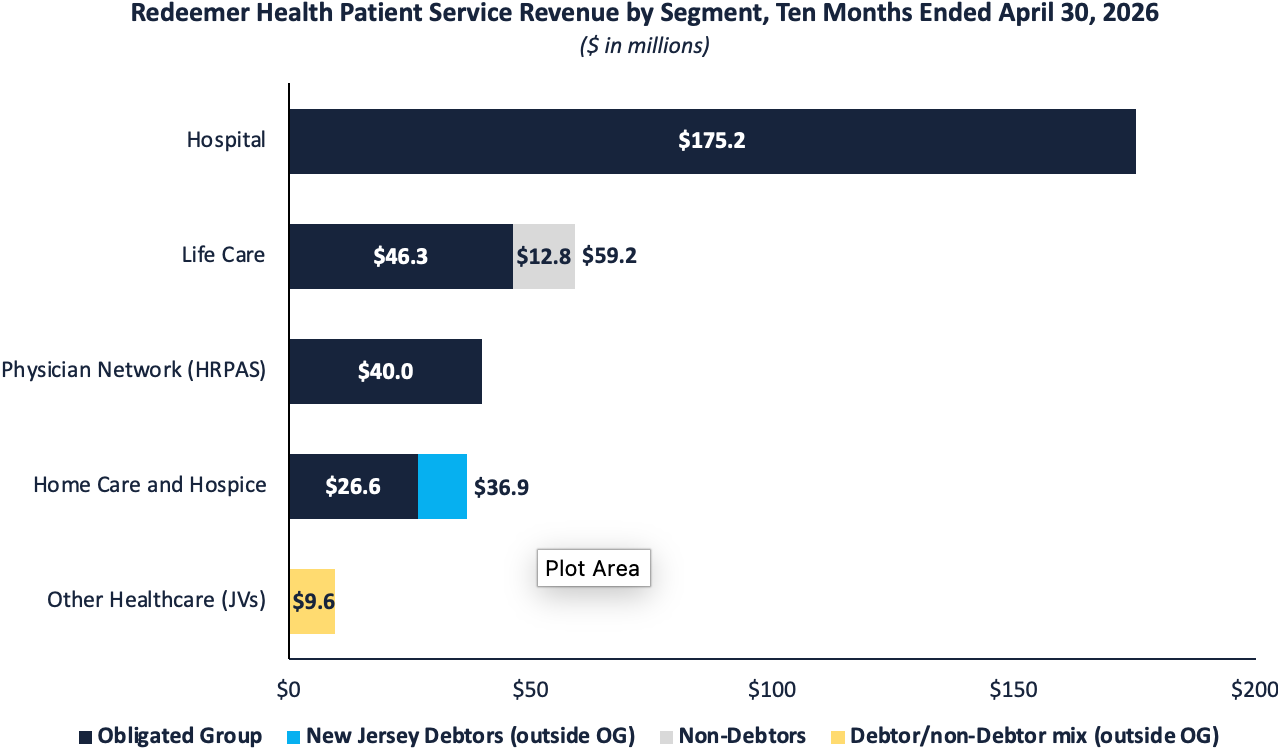
In the ten months ended April 30, 2026, Redeemer Health generated $320.8 million of consolidated patient service revenue, $288.1 million (89.8%) of it at the Obligated Group Debtors, HRHS and HRPAS.
The Hospital
Holy Redeemer Hospital, an HRHS division within the Obligated Group, runs an obstetrics and gynecology program that has handled more than 11,000 deliveries since 2021 and a neonatal intensive care program in partnership with Children’s Hospital of Philadelphia, and holds academic nursing affiliations with local colleges and universities. In FY2025, the hospital staffed 167 beds and recorded 9,035 discharges and 35,794 emergency room visits, according to its operating reports to bondholders. The hospital generated $175.2 million of patient revenue in the ten months ended April 30, 2026.
HRHS also holds an investment in Rothman Ortho Specialty Hospital, LLC, an orthopedic and sports medicine hospital in Bensalem, Pennsylvania.
Life Care
The Debtors’ life care operations are conducted through two senior care campuses, which the Debtors describe as divisions of HRHS within the Obligated Group:
- St. Joseph Manor in Meadowbrook, which provides skilled nursing and personal care
- The Lafayette in Northeast Philadelphia, which offers independent living, personal care and skilled nursing
In the ten months ended April 30, 2026, the two campuses generated $46.3 million of patient revenue - $28.2 million at St. Joseph Manor and $18.2 million at The Lafayette.
Physician Network
The Debtors’ physician services are conducted through HRPAS, the other member of the Obligated Group, which employs and contracts the physicians and other providers who staff the hospital and the Company’s other facilities. In the ten months ended April 30, 2026, HRPAS generated $40.0 million of patient revenue.
Home Care and Hospice
The Debtors’ home care and hospice operations are conducted through HRHS’s PA Home Health and Hospice division, within the Obligated Group, and two New Jersey Debtors outside it, South and Hospice. PA Home Health and Hospice generated $26.6 million of patient revenue in the ten months ended April 30, 2026.
In New Jersey, after the 2024 sale of most of its home care operations to BAYADA, the Company continues to operate South and Hospice, along with state-funded “Healthy Families” programs in Union and Cape May Counties that support new and expectant parents through in-home education. The New Jersey Debtors generated approximately $10.3 million of patient revenue over the same period. In total, the home care and hospice segment generated $36.9 million of patient revenue.
Housing (Non-Debtor)
Through the Redeemer Village entities, direct and indirect non-Debtor subsidiaries of HRH Management, the Company also provides low-income rental housing for the elderly and disabled, with residents’ rents subsidized under HUD’s Section 8 program. The housing is financed under a project loan from the Pennsylvania Housing Finance Agency (“PHFA”) to Redeemer Village Housing, LLC, under which HRH Management has provided liquidity and asset guarantees.
Real Estate
The Company’s real estate around Holy Redeemer Hospital is divided into condominium parcels held by HRHS and by non-Debtor HRH Management, a real estate holding subsidiary of RH:
- HRHS:
- Condominium Unit 1: The parcel on which Holy Redeemer Hospital operates. It is mortgaged to secure the Bond Debt (see Prepetition Obligations).
- Condominium Lot 4: The site of a rehabilitation center and a child care center adjacent to the hospital. Under the proposed cash collateral order, it would be pledged to the Bondholders as additional collateral for adequate protection.
- HRH Management (non-Debtor):
- Condominium Unit 2: The site of two medical office buildings adjacent to the hospital, referred to as Lot 2 in the proposed cash collateral order.
- Other properties: Beyond the hospital campus, HRH Management owns professional offices and other facilities in Bucks and Montgomery Counties, PA. These are held directly and through non-Debtor entities.
- Redeemer Village entities: The low-income housing properties described above, which are financed by the PHFA project loan and subject to HRH Management’s guarantees under it.
Workforce
As of the Petition Date, the Debtors employ approximately 2,770 people: approximately 2,310 at HRHS, 370 at HRPAS and 90 at South and Hospice. Approximately 1,575 are full-time and 1,195 part-time, and none is represented by a union. The Debtors also engage approximately 150 independent contractors, including physicians, consultants and third-party service providers, and supplement their staff with nurses and other temporary workers supplied by staffing agencies.
Prepetition Obligations
Top Unsecured Claims
Events Leading to Bankruptcy
The Company attributes its distress to rising labor and supply costs, reimbursement challenges, changing utilization and increased competition. Despite operating leanly, cutting administrative positions and transferring viable programs to other operators, it has struggled for several years to meet expenses and service its debt. Before the filing, the Company held discussions with other Philadelphia-area health systems but reached no agreement, the Philadelphia Business Journal reported.
Hospital and HRPAS Financial Deterioration
According to the Debtors, Holy Redeemer Hospital and its physician network have lost between $31.6 million and $48.9 million a year over the past five years, with unaudited FY2026 producing the largest losses at both HRHS and HRPAS, and RH’s other services, which historically supported them, can no longer offset the losses.
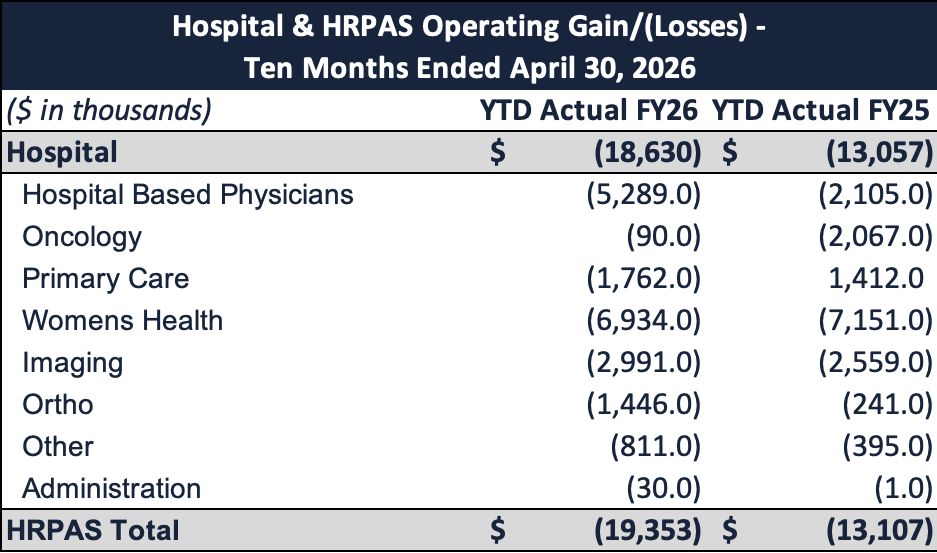
In the ten months ended April 30, 2026, Holy Redeemer Hospital’s operating loss widened to $18.6 million, $5.6 million more than in the same period a year earlier. The hospital also drove a wide budget miss. On a consolidated basis, the Company had budgeted a $17.1 million operating loss for the period but lost $34.6 million, a $17.5 million shortfall. The hospital alone came in $19.9 million below its budget, more than the entire consolidated shortfall, driven primarily by a $21.1 million revenue miss.
Over the same period, HRPAS lost $19.4 million. Women’s health accounted for approximately 36% of that loss ($6.9 million), followed by hospital-based physicians at approximately 27% ($5.3 million). Year over year, HRPAS’s loss widened by $6.2 million, driven mainly by hospital-based physicians, whose loss grew by $3.2 million, and primary care, which swung from a $1.4 million gain to a $1.8 million loss.
Competitive Landscape
According to the Debtors, the market in which Holy Redeemer Hospital operates has declined over the past several years, and because of its scale, the hospital is unable to compete effectively with larger hospital systems in the area. The Inquirer has pointed to stiff competition from Jefferson Health’s nearby Abington hospital, which generated $774 million of net patient revenue in FY2025, approximately 3.4 times Holy Redeemer’s, according to the Pennsylvania Health Care Cost Containment Council (“PHC4”), the state agency that publishes annual hospital-level financial data.
- Holy Redeemer Hospital’s discharges fell from 8,656 in FY2020 to 8,272 in FY2025, a decline of approximately 4%, according to Medicare cost reports. Over the same period, discharges at Abington rose approximately 23%, from 28,794 to 35,357, and discharges at Pennsylvania general acute care hospitals grew approximately 3.9% in each of FY2024 and FY2025, according to PHC4.
- The hospital’s FY2025 operating margin of −6.78% was well below the −2.05% average for PHC4’s Region 8, which covers 20 hospitals in the suburban counties around Philadelphia, and ranked fifth-lowest in the region. The weakness was not limited to a single year: Holy Redeemer’s three-year average total margin for FY2023–FY2025 was −6.37%, against a regional average of −2.53% and 1.58% at Jefferson Abington.
Ratings Downgrades and the Turnaround Plan
Holy Redeemer’s credit ratings fell as its losses mounted. S&P lowered the bonds to BB from BB+ in August 2023, then cut to B+ in July 2024, citing a multiyear trend of operating losses well above budget and its expectation that the Obligated Group would miss its 1.1x debt service coverage covenant for FY2024. Fitch followed a similar path, downgrading the Company to BB− from BB+ in June 2024 and to B+ in June 2025 with a negative rating watch, which it removed in November 2025 after the Company avoided a second consecutive covenant breach. Moody’s cut its rating to B1 from Ba2 in October 2024, pointing to ongoing operating cash flow losses, declining cash and a likely breach of the FY2024 coverage covenant.
In January 2025, the Company adopted a $46 million multiyear plan targeting recurring savings of approximately $13.2 million in FY2025 and $31.0 million in FY2026, through emergency department throughput, revenue cycle improvements, vendor renegotiations and the sale of non-core assets.
The improvement that followed leaned on one-time gains. The FY2025 operating loss narrowed to $16.7 million from $53.2 million, partly due to the $23 million sale of two New Jersey home care businesses and the $3.55 million sale of three office buildings. Moody’s moved its outlook to stable in December 2025 and affirmed its B1 rating, but its projected operating cash flow margin of approximately 2% for FY2026 rested partly on approximately $15 million of one-time asset sales.
Liquidity Erosion and Delayed Vendor Payments
The Obligated Group’s liquidity has eroded steadily over the past six years. Unrestricted cash and investments fell from $195.4 million at June 30, 2020 to $63.2 million at June 30, 2024, according to the Obligated Group’s operating reports to bondholders. The balance held at $71.1 million at June 30, 2025 and $71.5 million at April 30, 2026, partially due to deferred payments and collections from affiliates. Over the ten months ended April 30, 2026, the Obligated Group generated $8.8 million of cash flow from operating and nonoperating activities, supported by a $9.1 million reduction in amounts due from affiliates outside the group and growth of $8.8 million in accounts payable and $7.2 million in accrued expenses.

On a consolidated basis, Redeemer Health’s unrestricted cash and investments rose from $117.0 million at the start of FY2026 to $124.4 million in December before easing to $119.1 million at April 30. That balance also masked weaker underlying cash generation. Consolidated cash flow from operating and nonoperating activities totaled $14.5 million for the ten months, however, $24.1 million of it came from a rise in self-insurance and patient care liabilities; without that increase, cash flow would have been approximately negative $9.6 million.
Liquidity constraints also forced the Debtors to delay vendor payments. Between June 30, 2025 and April 30, 2026, consolidated accounts payable rose approximately 50%, from $12.2 million to $18.3 million, and the Obligated Group’s roughly doubled, from $8.6 million to $17.4 million.
Default and Acceleration
Due to insufficient liquidity, the Debtors failed to make the bond payment due September 1, and another October 1 payment also went unpaid. In early October, the Debtors disclosed the default to bondholders. The Philadelphia Business Journal reported that Bank of New York Mellon, as trustee, was accelerating all outstanding obligations, and on October 9 Moody’s cut the rating to Caa3 from B1, citing the missed payments and the acceleration.
Later that month, the Bondholders replaced Bank of New York Mellon with UMB Bank, N.A. as Master Trustee, and trustee-held funds, including debt service reserve funds, were foreclosed on before the Petition Date.
Chapter 11 Filing
The Debtors intend to seek a going-concern sale of the hospital and physician network, with a wind-down plan if none is possible, and to preserve the post-acute and life care operations, many of which are conducted through non-Debtor entities.
Cash Collateral
The Chapter 11 cases will be funded with cash collateral, together with the Debtors’ board-designated endowment and operating revenues. According to the Debtors, without access to cash collateral, the Obligated Group Debtors would face imminent shutdown and liquidation.
Two groups of secured creditors hold interests in that cash collateral. The Bondholders, through the Master Trustee, hold a lien on the Obligated Group’s accounts and gross receipts and a mortgage on Condominium Unit 1, securing approximately $77 million. Cencora and its subsidiaries ASD Specialty Healthcare, LLC and Integrated Commercialization Solutions, LLC (the “Pharmaceutical Companies”) hold purchase money liens on the pharmaceutical products they supplied to HRHS and the related accounts, proceeds and inventory (see Prepetition Obligations). The proposed orders rank the Pharmaceutical Companies ahead of the Bondholders only on that pharmaceutical collateral; the Bondholders’ lien covers the rest of the Obligated Group’s cash and receivables.
The Master Trustee, acting for the Bondholders, has not consented to the use of its cash collateral except on the terms of the proposed interim bond order, which would provide:
- Rollover Lien and Superpriority Claim — As adequate protection for any diminution in the value of its collateral, the Master Trustee would receive a replacement lien (the “Rollover Lien”) on the Obligated Group Debtors’ existing and future bond collateral, junior only to valid senior liens, including the Pharmaceutical Companies’ liens on their collateral. It would also receive a section 507(b) superpriority claim ranking ahead of all other claims against the Obligated Group Debtors except those of the Pharmaceutical Companies and other first-priority lienholders, and pari passu with administrative expenses.
- Supplemental Lien — As further adequate protection, the Master Trustee would receive a new lien (the “Supplemental Lien”) on HRHS’s Condominium Lot 4, the site of a rehabilitation center and a child care center. If HRH Management’s Lot 2 is sold together with Obligated Group assets, the lien would also cover the net sale proceeds, to the extent permitted by HRH Management’s liquidity guarantee to The Royal Bank of Canada and the related loan documents. The lien would rank behind prior liens and would exclude avoidance actions other than section 542 claims.
- Sale Milestones — Within 14 days of the Petition Date, the Debtors would file an application to retain an investment banker and a bid procedures motion reasonably acceptable to the Master Trustee, with later dates set by the bid procedures order. The Master Trustee could extend or waive the milestones in its sole discretion, and missing one would be a Termination Event on five business days’ notice.
- Sale Proceeds and Credit Bid — Net proceeds from any sale of bond collateral would be paid to the Master Trustee at closing. The Master Trustee has the right to credit bid.
- Budget Variance — Disbursements would be tested weekly on a rolling four-week basis. The proposed interim bond order allows a 15% aggregate unfavorable variance on operating disbursements, while the motion, the Pharmaceutical Companies’ order and the proposed final order provide for 10%.
- Charitable Assets — Any disposition of bond collateral that constitutes charitable assets would require notice to, and consent of, the Attorneys General of Pennsylvania, the City of Philadelphia and/or New Jersey, as applicable.
A separate interim order would grant the Pharmaceutical Companies replacement liens on their HRHS collateral, junior only to U.S. Trustee and clerk fees. Separately, Redeemer Health, which is not in the Obligated Group, received a bequest of approximately $10 million before the Petition Date. According to the Debtors, the bequest is not bond collateral and they plan to use it for operations and professional fees under the Budget; the Master Trustee disputes that position.
In a November 3 limited objection, the Master Trustee said the proposed adequate protection is insufficient, though it does not oppose interim use of its cash collateral at this stage if adequate protection is provided.
Initial Budget
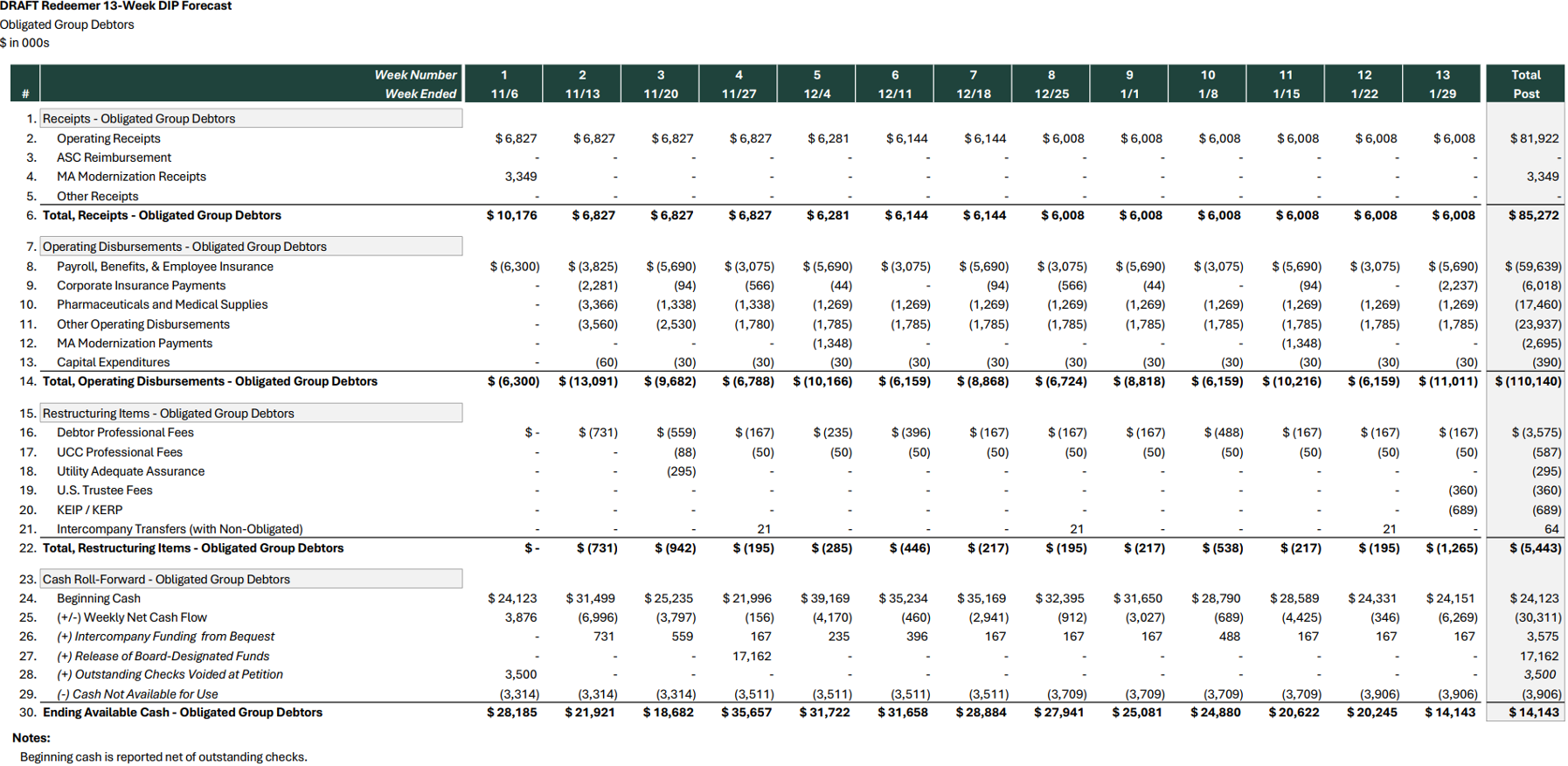
The Obligated Group Debtors’ 13-week budget projects available cash of approximately $14.1 million at the end of January, a balance that depends on a $17.2 million release of board-designated funds in the fourth week and approximately $3.6 million of intercompany funding from the bequest. Without the release, ending cash would be approximately negative $3 million, and without both sources, approximately negative $6.6 million.
Investment Banker Retention
The Debtors retained SSG Capital Advisors as investment banker several months before the Petition Date to facilitate the sale process. SSG previously advised Philadelphia’s St. Christopher’s Hospital for Children on its 2019 Chapter 11 sale, where the hospital’s doctors had repeatedly called for a nonprofit operator. St. Christopher’s Hospital ultimately cancelled its auction to negotiate with a Tower Health and Drexel University venture, which bought the hospital for $50 million over a competing bid from for-profit KPC Global, returning it to nonprofit ownership.
Marketing Process and Potential Buyers
According to the Debtors, four major healthcare systems, three local and one national, have signed NDAs and are conducting diligence. The Debtors have also marketed certain non-Obligated Group assets for more than a year, including Mercer’s CON.
The Inquirer sought comment from Jefferson Health, the University of Pennsylvania Health System (Penn Medicine), Temple University Health System and Trinity Health; Penn Medicine and Jefferson Health declined to comment, and Temple and Trinity did not immediately respond. Three of the four are Philadelphia-based and one, Trinity Health, is national, matching the Debtors’ description, although none has confirmed its involvement. Each already has a presence near Holy Redeemer or a relationship with the Company:
- Jefferson Health is Holy Redeemer’s closest competitor. It owns Jefferson Abington Hospital, a few miles from Holy Redeemer, and Jefferson Einstein Montgomery, both in Montgomery County, and its parent owns Rothman Ortho Specialty Hospital in Bensalem, in which HRHS holds an investment.
- The University of Pennsylvania Health System (Penn Medicine) has been expanding into the suburban region where Holy Redeemer operates. It acquired Chester County Hospital in 2013 and acquired Doylestown Health in Bucks County in April 2025. Both hospitals fall within PHC4’s Region 8, the same region as Holy Redeemer.
- Temple University Health System has an existing financial relationship with the Company. It took a majority stake in, and manages, Chestnut Hill Hospital, in which Redeemer held a minority stake until 2025, and it is the obligor on the $6.2 million note Redeemer received when it sold that stake.
- Trinity Health, a national Catholic health system based in Livonia, Michigan, operates three hospitals in the Philadelphia region, Mercy Fitzgerald, Nazareth and St. Mary Medical Center in Langhorne, through Trinity Health Mid-Atlantic, which describes itself as the largest Catholic health system serving Greater Philadelphia. It is the only national system among the four and, as a Catholic system, shares Holy Redeemer’s religious affiliation.
Regulatory Approvals
A sale or closure of the hospital will require approvals beyond the bankruptcy court.
- Department of Health — The Pennsylvania Department of Health oversees both outcomes. A hospital must give the Department 90 days’ written notice before closing and before a change of ownership, and its license transfers to a buyer only if the Department finds the new owners to be responsible persons. The Department enforces these rules: when Hahnemann University Hospital announced its closure in 2019, the Department ordered it to halt until it filed proper notice and a closure plan.
- Canon Law — As a Catholic ministry, the Company may also need the Holy See’s permission. Canon law requires it for sales of church property above set thresholds, which in the United States begin at $3.5 million for entities subject to a diocesan bishop. That approval can take months: Mercy Health System of Maine received Vatican approval approximately six months after signing a letter of intent. It can also shape the outcome: in 2012, the Vatican declined to approve a Mercy hospital sale in Arkansas to a for-profit buyer and asked Mercy to explore Catholic alternatives. After the deal also failed to win Federal Trade Commission support, Mercy sold the hospital to St. Vincent Health System, an affiliate of Catholic Health Initiatives, in 2014.
First-Day Relief
- Wages Motion (Doc. 8) — The Debtors seek to pay approximately $16.6 million of prepetition employee obligations for approximately 2,770 employees and approximately 150 independent contractors. This includes approximately $8.4 million of wages and selected incentives, $1.5 million owed to independent contractors, $4.6 million of medical, dental and vision benefits, $1 million of workers' compensation and $650,000 of payroll taxes.
- Cash Management Motion (Doc. 10) — The Debtors seek to continue their cash management system, including 42 bank accounts and a central HRHS concentration account at Wells Fargo through which substantially all Debtor and non-Debtor payroll and expenses are paid, along with ordinary-course intercompany transfers within any approved budget. They also seek to pay approximately $15,000 of prepetition bank fees and approximately $70,000 outstanding on a corporate credit card program.
- Utilities Motion (Doc. 11) — The Debtors seek to provide adequate assurance to their utility providers through a deposit of approximately $305,500, equal to roughly half of their average monthly utility expense, into a segregated account within 20 days of the Petition Date.
- Insurance Motion (Doc. 12) — The Debtors seek to continue their insurance program, which carries approximately $14.6 million of annual premiums, including approximately $12.8 million for healthcare comprehensive and excess liability coverage, and to pay any related prepetition obligations. They also seek to honor a premium financing agreement with First Insurance Funding covering approximately $532,000 of annual premiums on nine policies, and to maintain 12 surety bonds totaling approximately $10 million.
- KERP Motion (Doc. 22) — The Debtors seek approval of a key employee retention plan of approximately $708,000 for 29 non-insider employees in three tiers: (i) seven employees leading emergency and surgical services, pharmacy, patient safety, health information management, human resources and IT, who would receive 20% of base salary (approximately $245,000); (ii) 20 employees overseeing clinical service lines and corporate support functions, who would receive 15% (approximately $452,000); and (iii) two administrative employees in provider credentialing and hospital administrative support, who would receive 10% (approximately $12,000). Payments would be made within 30 days after the earlier of a plan's effective date or 12 months after the Petition Date, and participants who leave before then forfeit the award unless terminated without cause, or they die or become disabled. The Debtors also seek administrative expense priority for all KERP payments.
Explore Bondoro Insights for live case dockets and comprehensive coverage of material filings from petition to plan confirmation.
Stay informed on every Chapter 11 bankruptcy case with liabilities exceeding $10 million. Subscribe for free to have our coverage delivered directly to your inbox, and explore our full archive of past summaries.
Subscribers can also opt in to timely filing alerts by updating their email preferences in Account Settings.


