Case Summary: RiverStreet Chapter 11
RiverStreet filed for Chapter 11 after a roughly $153 million funding gap halted its subsidy-backed rural fiber buildout and triggered grant defaults, pursuing a 363 sale to an Oaktree stalking horse for $92.5 million, with a proposed $80 million CoBank-led DIP including $20 million of new money.

A deck version of this summary is also available HERE.
Business Description
Headquartered in Wilkesboro, NC, Wilkes Telephone Membership Corporation ("WTMC") is a member-owned, not-for-profit telephone membership corporation organized under North Carolina law. WTMC and its 20 Debtor affiliates (collectively, the "Debtors"), together with their non-Debtor affiliates ("RiverStreet" or the "Company"), operate under the unified RiverStreet brand, providing fiber-to-the-premises broadband, voice, wireless, and security and managed services to residential and business customers. The Company has served many of its rural markets for decades as the original local telephone company and has been upgrading those networks to broadband; beyond those territories, it has built competitive fiber networks in rural expansion markets. Its network buildout has been funded principally by government grant and subsidy programs.
As of the second quarter of 2026, the Company served approximately 31,600 subscribers across predominantly rural Virginia and North Carolina, plus a small number of customers in South Carolina. For FY 2025, the Company generated revenue of approximately $66 million and EBITDA of approximately $20.6 million. For FY 2026, the Company projects revenue of approximately $67.8 million, and EBITDA of approximately $26.5 million.
RiverStreet Communications of Virginia, Inc. and certain affiliates⁽¹⁾ filed for Chapter 11 protection on October 21, 2026 (the "Petition Date") in the U.S. Bankruptcy Court for the Eastern District of Virginia, reporting $100 million to $500 million in both assets and liabilities.
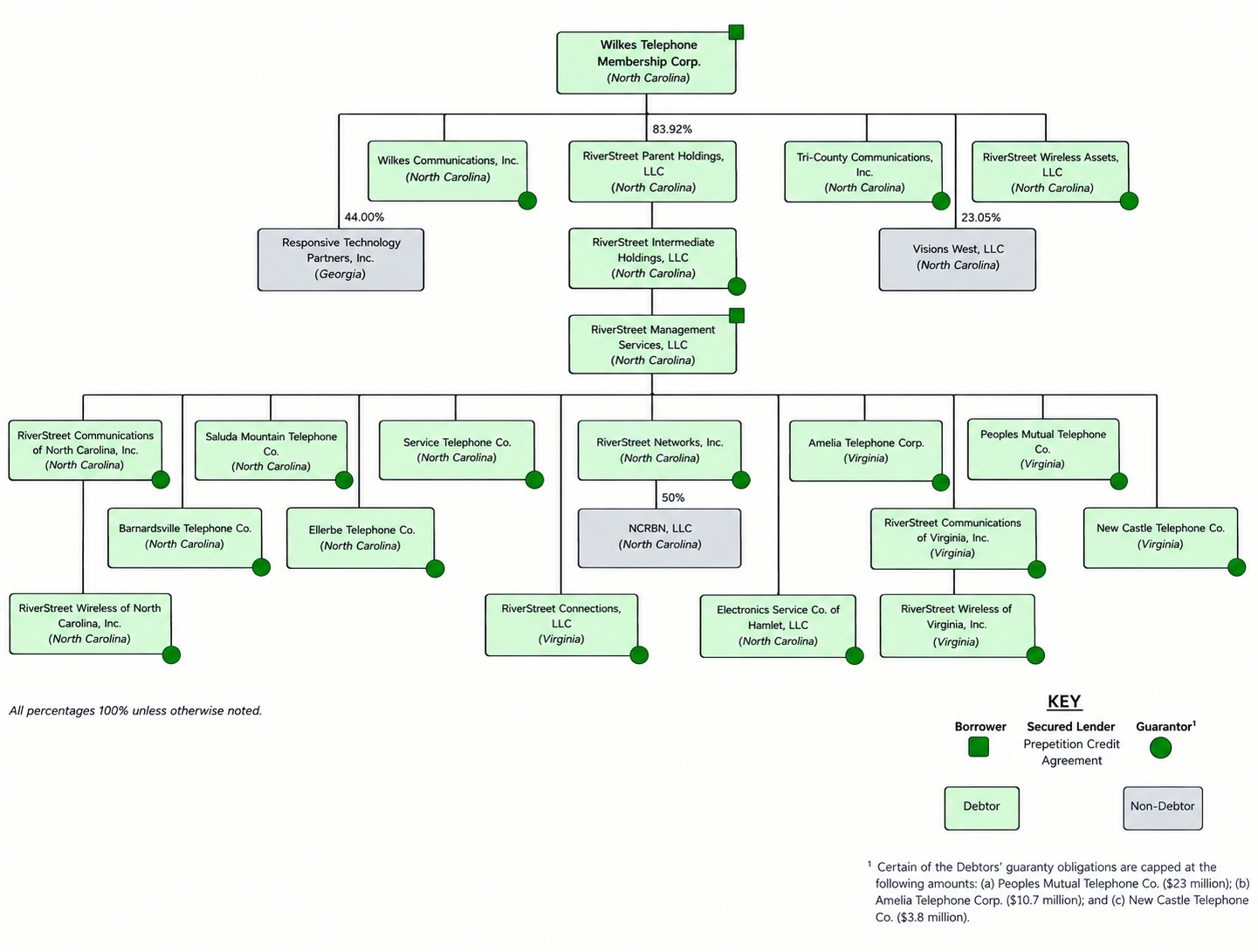
⁽¹⁾ For a complete list of Debtor entities, see organizational structure chart below.
Corporate History
Founding and Origins
In 1949, a group of residents in Wilkes County, NC, petitioned Central Telephone Company to bring telephone service to their community, an area the Debtors describe as one that investor-owned carriers were unwilling or unable to serve. That effort led to WTMC’s incorporation in 1951 as a telephone membership corporation serving four telephone exchanges: Champion, Clingman, Boomer, and Lomax. The cooperative made its first phone call in 1958 and began building fiber in Wilkes County in 1992, later launching internet service in 1995, high-speed internet in 2001, TV in 2006, and security services in 2009.
In 2013, it introduced gigabit internet speeds and earned national Gig certification from NTCA–The Rural Broadband Association. In 2014, having extended fiber-to-the-home to all of its members, the cooperative’s customer-owners, WTMC began doing business as Wilkes Communications and created a second brand, RiverStreet Networks, to bring its services to areas outside its traditional cooperative market. In 2024, Wilkes Communications and RiverStreet Networks united under a single name, RiverStreet.
Acquisitions
The Company has been growing through acquisitions since 2015. It has bought the original local telephone companies in several rural communities, known as incumbent local exchange carriers (“ILECs”), first in North Carolina and later in Virginia, adding them to the cooperative’s original Wilkes County base.
- The first deal came in 2015, when RiverStreet Networks, LLC, a subsidiary of WTMC, agreed to acquire three small telephone companies in rural North Carolina from TDS Telecom: Barnardsville Telephone Company, Saluda Mountain Telephone Company, and Service Telephone Company. Together, these ILECs served approximately 2,800 lines in and around Barnardsville, Saluda Mountain, and Fair Bluff. The three companies remain as Debtors in the Chapter 11 cases.
- The Company grew further in 2018 through two separate transactions. First, WTMC merged with Tri-County Telephone Membership Corporation, another North Carolina telephone cooperative. Tri-County no longer exists as a separate entity, and its former territory now operates as a division of WTMC, with separate accounting kept for regulatory purposes. Second, RiverStreet Management Services, LLC (“RSMS”) acquired Ellerbe Telephone Company, the local phone company serving Ellerbe, NC area. Unlike Tri-County, Ellerbe remains a separate company and is a Debtor.
- 2018 also marked the Company's entry to Virginia through its acquisition of Peoples Mutual Telephone Company (“Peoples Mutual”) from Consolidated Communications. Peoples Mutual is the local phone company for the Virginia communities of Gretna, Hurt, Renan, and Sandy Level. Peoples Mutual is now a Debtor subsidiary of WTMC.
- Additional Virginia expansion came in 2024, when the Company acquired Amelia Telephone Corporation ("Amelia Telephone") and New Castle Telephone Company ("New Castle Telephone") from TDS Telecom, both of which are Debtors.
- In March 2025, the Company announced that it had acquired the New Castle, VA market area of Citizens Cablevision, the cable subsidiary of Citizens Telephone Cooperative, a provider headquartered in Floyd, VA. The transaction added customers in Craig County, the same area served by New Castle Telephone.
Organizational Structure
Operations Overview
Principal Segments
As of the second quarter of 2026, the Company’s network passed approximately 83,000 locations, approximately 67,000 of them with fiber. Approximately 28,300 subscribers took internet service, including approximately 22,700 on fiber. The rest subscribed to voice and/or security service only. Roughly one in three locations passed with fiber took fiber service.
The Company’s operations fall into four principal segments, split between ILEC territories and markets it entered as a competitor:
- Legacy Cooperative Exchanges: the North Carolina territories where WTMC itself is the ILEC, including its founding Wilkes County exchanges and the exchanges added through the 2018 Tri-County merger.
- Legacy North Carolina ILECs: the territories of Saluda Mountain, Ellerbe, Barnardsville, and Service Telephone, which the Company acquired and where each is the original local phone company.
- North Carolina Competitive and Expansion Markets: areas where the Company is not the incumbent provider. It entered these markets as a competitor, building new fiber networks and competing with existing providers for customers.
- RiverStreet Virginia: all Virginia operations. This segment mixes both types: the acquired Peoples Mutual, Amelia Telephone, and New Castle Telephone territories, where the Company is the incumbent, and competitive fiber markets elsewhere in the state.
Workforce
The Company employs approximately 136 people, all full-time (approximately 110 hourly and 26 salaried). Certain employees are represented under two collective bargaining agreements, each running from March 1, 2022 through February 28, 2027:
- Teamsters Local 61: covers WTMC and certain of its subsidiaries, excluding the wireless, security, and Virginia-based subsidiaries.
- IBEW Local 1181: an agreement with Peoples Mutual and RiverStreet Communications of Virginia, Inc. covering technicians based at the Company’s Gretna, VA facility.
Grant and Subsidy Programs
Overview
The Company’s fiber expansion has been funded principally by FCC, Virginia, and North Carolina programs, which have awarded it approximately $480 million and paid approximately $188 million to date. These programs fall into two categories:
- Reimbursement-Based Construction Grants: This category consists principally of the Virginia and North Carolina state grant programs (described below). Under these grants, the Company spends its own capital first, including required matching funds, and is reimbursed by the granting agency only after the completed work is documented and verified. This category accounts for approximately $249 million of awards and $115 million of receipts.
- Recurring Federal High-Cost Support: This category consists of three FCC programs (described below), which subsidize the extension of broadband to designated rural areas. Rather than reimbursing completed work, these programs pay the Company monthly over a multi-year term, conditioned on meeting buildout milestones, which are deadlines by which a required share of the committed locations must be built. This category accounts for approximately $230 million of awards and $73 million of receipts.
According to the Debtors, three structural features of this funding model are central to the Chapter 11 cases:
- Upfront Capital: Construction grants reimburse only part of the completed work, and federal support is paid over time subject to milestones. As a result, the Company must borrow to fund construction and matching capital before government payment arrives.
- Continuous Construction: Both categories condition funding on buildout milestones measured at regular intervals, so an interruption in construction can cause defaults on existing awards.
- Asymmetric Downside: A defaulted award exposes the Company not only to the loss of future funding but also to repayment demands for amounts previously received, penalties for missed milestones, and draws on the letters of credit posted as security.
Virginia Programs
The Company’s largest grant program is the Virginia Telecommunication Initiative (“VATI”), a state program run by the Virginia Department of Housing and Community Development (“DHCD”) that funds the construction of broadband networks. The Company holds awards from VATI’s 2022 and 2023 funding rounds. The official recipient of the grant money (the “grantee of record”) is the West Piedmont Planning District Commission, a regional government body, while the Company participates as co-applicant and as the provider that builds and operates the network. Across both rounds, VATI awards total approximately $185 million, of which approximately $110 million has been received. Like the other state construction grants, VATI pays on a reimbursement basis, with funding contingent on construction keeping pace with the contracted schedule.
The Company was also awarded two smaller Virginia grants:
- Broadband Equity, Access, and Deployment (“BEAD”): A federal broadband construction program funded through the National Telecommunications and Information Administration, a federal agency, and administered in Virginia by DHCD. The Company was awarded approximately $44 million, which DHCD terminated in August 2026 (see Loss of Construction Grants below).
- Appalachian Regional Commission (“ARC”): A federal-state partnership that awarded the Company approximately $700,000 for a project in Patrick County, VA, with the county serving as grantee of record.
North Carolina Programs
In North Carolina, the Company participates in four broadband construction grant programs run by the North Carolina Department of Information Technology’s Broadband Infrastructure Office:
- Growing Rural Economies with Access to Technology (“GREAT”): The Company holds two GREAT awards, approximately $5.3 million for Stokes County and approximately $933,000 for Wilkes County. Of these, approximately $2.9 million and $675,000, respectively, have been received, and both awards remain active and in good standing.
- Completing Access to Broadband (“CAB 2.0”): CAB is a state program run jointly by each participating county and the Broadband Infrastructure Office, under which only providers prequalified by the state may bid to build broadband to unserved and underserved locations in that county. The state funds 70% of each project’s cost on a reimbursement basis, and the provider funds the remaining 30%. The Company was awarded approximately $9.4 million across four counties: Camden, Currituck, Stokes, and Wilkes. The Camden and Currituck awards were forfeited on July 15, 2026. The Stokes and Wilkes awards remain active, with construction due by December 31, 2026.
- Stop Gap: The Company holds approximately $960,000 in Stop Gap awards across Camden, Currituck, Stokes, and Wilkes Counties, the same counties covered by its CAB 2.0 awards. The Camden and Currituck awards were forfeited on July 15, 2026, and the Stokes and Wilkes awards remain active.
- BEAD: The Company was provisionally awarded approximately $2.3 million, and the contracts have not been executed.
Federal High-Cost Support
The Company participates in three FCC programs that pay recurring support in exchange for building broadband in rural areas. In each program, the Universal Service Administrative Company (“USAC”) disburses the support on the FCC’s behalf.
- Enhanced Alternative Connect America Cost Model (“E-ACAM”): E-ACAM is available only to incumbent local exchange carriers that chose to participate. It pays them monthly through 2038 in exchange for enforceable commitments to bring broadband at specified speeds to specified locations in their service areas. Under the FCC’s program terms, participating carriers must complete that buildout by the end of 2028, with interim milestones along the way. The Company’s North Carolina E-ACAM support totals approximately $129.6 million over the program term.
- Connect America Fund Phase II (“CAF II”): CAF II awarded support through a 2018 FCC auction in which providers bid to serve unserved rural areas, with support paid over a ten-year term. RiverStreet Communications of Virginia, Inc. (“RCVA”) holds a CAF II award of approximately $32.1 million, and RiverStreet Communications of North Carolina, Inc. (“RCNC”) holds a smaller award of approximately $0.7 million.
- Rural Digital Opportunity Fund (“RDOF”): RDOF is a later FCC auction modeled on CAF II, providing up to $20.4 billion over ten years to fund broadband in rural areas. RCVA holds an RDOF award of approximately $39.8 million, payable through 2031. Peoples Mutual and two North Carolina affiliates hold smaller RDOF awards totaling approximately $2.5 million, of which Peoples Mutual’s share is approximately $1.5 million.
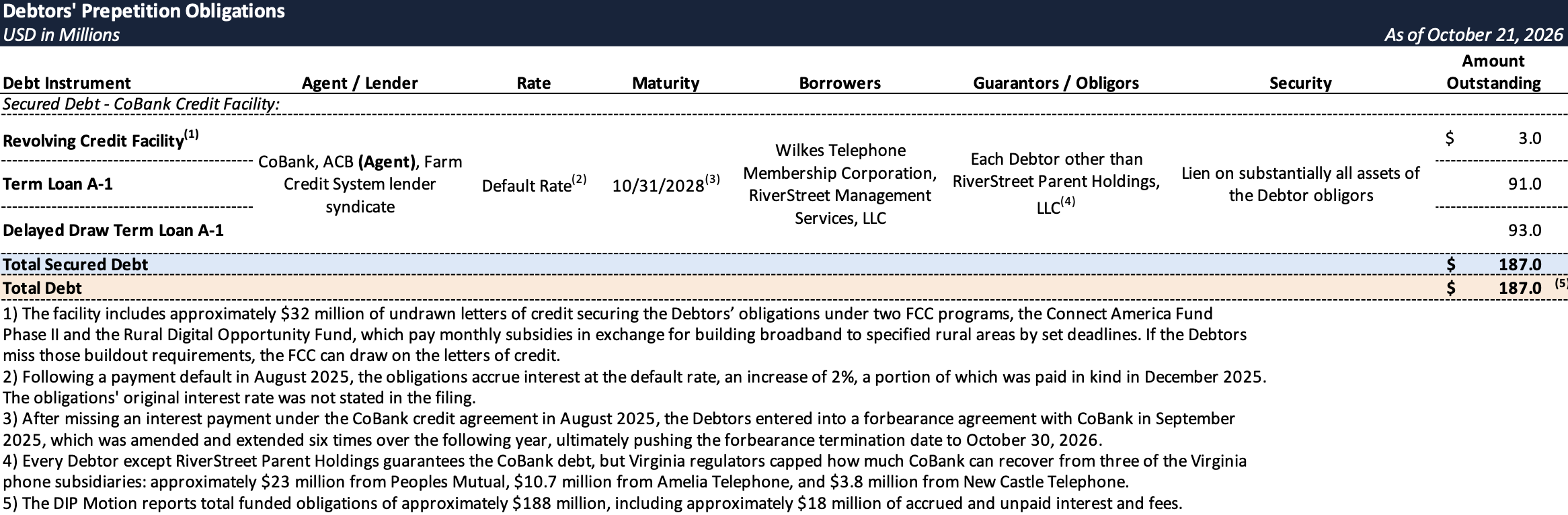
The CAF II and RDOF obligations are secured by letters of credit issued under the CoBank credit facility.
Prepetition Obligations
Top Unsecured Claims
Events Leading to Bankruptcy
Expansion Plan and Liquidity Shortfalls
In 2023, backed by federal and state broadband grants and subsidies, the Company committed to an approximately $480 million fiber buildout reaching approximately 182,000 locations across Virginia and North Carolina. The Debtors entered into a credit agreement with CoBank to fund the buildout’s construction costs, on the expectation that state grant reimbursements and recurring federal support would repay the borrowed money as construction was completed.
Through 2024, inflation in materials and labor costs and higher interest rates widened the gap between the cost of the buildout and the capital available to fund it. The Company’s mitigation efforts narrowed that gap but could not close it, leaving an unfunded capital need that the Company and its advisors estimated at approximately $153 million. According to the Debtors, the capital markets available to rural telecommunications providers offered no realistic way to raise that amount on terms the Company’s cash flows could support.
Missed Interest Payment and Construction Halt
In August 2025, the Company missed a scheduled interest payment under the CoBank credit agreement and paused new construction across its expansion footprint to conserve cash. Because its grant awards conditioned funding on continued construction and the addition of paying customers, the pause caused existing awards to fall into default. Reimbursements and support payments were suspended or withheld, the granting agencies’ remedies began to accrue, and the customer revenue the Company had expected could not be realized.
Loss of Construction Grants
- Virginia BEAD Award: The Company’s BEAD award was conditioned on its securing a performance bond or letter of credit. Federal BEAD rules allow that security to be as little as 10% of the award where the state pays on a reimbursement basis for periods of six months or less, which here would have been approximately $4.4 million. On July 16, 2026, DHCD issued a cure letter requiring the Company to demonstrate committed funding for the buildout by August 15, and on August 18 it terminated the agreement for failure to satisfy its conditions precedent. No BEAD funds were disbursed.
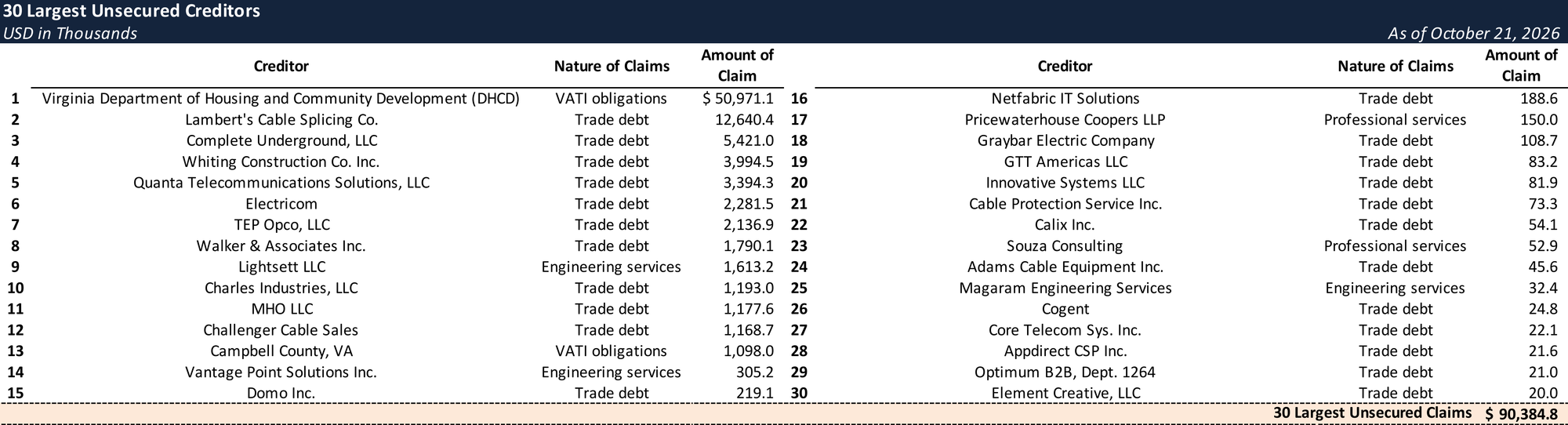
- VATI Corrective Action and Removal: After the construction pause, DHCD held risk assessment meetings with the Company in September 2025 and January 2026. In April 2026, it placed the Company's VATI projects under corrective action plans. The plans required the Company to identify its sources of lending and equity, and DHCD later asked for proof that all outstanding capital was secured. In July 2026, DHCD determined that the Company could not secure the financing needed to complete its builds and removed it from its eastern projects funded by VATI and the American Rescue Plan Act. The consequences have extended beyond the loss of the work itself. DHCD has demanded repayment of funds tied to the eastern projects, a demand the Debtors dispute. The First Day Declaration describes the amount sought as "tens of millions of dollars" of the $110.2 million the Company received; according to Amelia County, $10.9 million of the demand is attributable to the Amelia project alone; and DHCD has referred its claims to the Virginia Attorney General for collection. The eastern projects are now being rebid county by county, and the western project is being transferred to another provider.
Loss of Federal Support
In addition to losing its state construction grants, the Company has lost much of its recurring federal support. Missed milestones have led to withheld payments, defaults, and a withdrawal.
- CAF II (Virginia): The problems began well before the construction pause. According to a May 2024 FCC order, RCVA told the FCC in January 2023 that it had missed its first buildout milestone, 40% of required locations by the end of 2022. USAC’s disbursement records show that RCVA’s monthly payment of approximately $267,800 was cut in half in April and May 2023 and suspended from June 2023 through April 2024, before resuming at approximately $200,900 a month. RCVA faces penalties if it does not complete the buildout by a December 31, 2026 cure deadline, and in October 2026 it told the FCC that it is defaulting on 15 of its Virginia block groups, the geographic units in which CAF II and RDOF awards are made.
- CAF II (North Carolina): RCNC’s CAF II award is in a cure period, with a penalty anticipated around April 2027, and USAC has not disbursed its support since May 2026.
- RDOF (Virginia): USAC has withheld approximately 25% of RCVA’s monthly RDOF support since April 2026, reducing it from approximately $315,300 to approximately $236,500. In October 2026, RCVA and Peoples Mutual told the FCC that they are defaulting on 42 Virginia block groups.
- E-ACAM (Virginia): Amelia Telephone and New Castle Telephone withdrew from the program after building 475 locations combined. The Company concluded that completing the buildout would require substantial new capital.
Program Portfolio
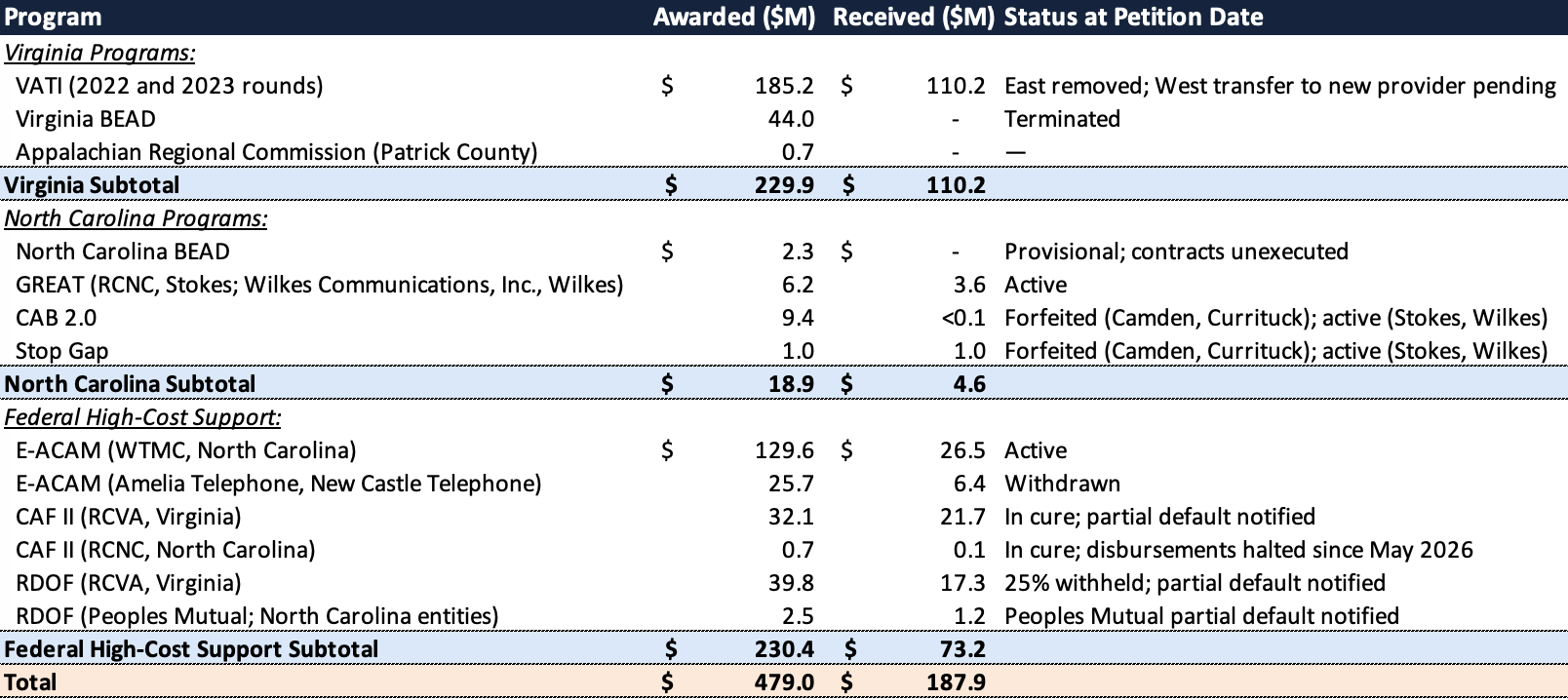
The Company’s losses are concentrated in Virginia. The Virginia awards that have been terminated, removed, withdrawn, or placed in partial default represent approximately $328.3 million, or 69%, of total awards and approximately 83% of total receipts. Those awards are VATI, BEAD, the E-ACAM award held by Amelia Telephone and New Castle Telephone, the CAF II and RDOF awards held by RCVA, and the RDOF award held by Peoples Mutual.
Modified Build Plan
With its restructuring advisor, Areté Partners, LLC, the Company adopted a modified build plan to right-size debt, preserve certain grant programs, eliminate commitments requiring substantial new capital, and keep deployed locations operating.
Restructuring Efforts
In June 2025, the Company engaged Guggenheim Securities, LLC (“Guggenheim Securities”) as its investment banker to explore certain financing and sale alternatives:
- Junior Capital: Beginning July 23, 2025, Guggenheim Securities sought junior capital, mainly for Virginia capital expenditures. According to the Debtors, the search ended after approximately three months due to a lack of investor interest.
- Select-Asset Sale: A sale of select assets, mainly in Virginia, ran from November 2025 to April 2026. According to the Debtors, it ended because buyers would not underwrite the construction plan or assume certain regulatory subsidy obligations.
- Dual-Track Process: Re-engaged in April 2026, Guggenheim Securities launched a sale process seeking a stalking horse bid for substantially all assets. On May 22, 2026, it launched a parallel process seeking senior secured financing either to complete the buildout or to refinance the existing lenders while walking away from much of the grant obligations, with an option for counterparties to provide DIP financing. The financing track produced one preliminary DIP proposal, which was deemed not actionable, and was suspended after approximately seven weeks.
- July 2026 Relaunch: On July 10, while continuing the sale process, Guggenheim Securities approached 79 counterparties about exit and DIP financing. The process ultimately proved unsuccessful, as no party would provide standalone DIP financing without the existing lenders’ consent to being primed, which those lenders declined to give. The Company instead negotiated its DIP facility with CoBank, the agent for those same lenders.
Chapter 11 Filing
The Debtors filed for Chapter 11 to sell substantially all assets under section 363 with a stalking horse in place, to rationalize the grant and subsidy portfolio, including through arrangements recognizing support for locations actually built, and to keep service uninterrupted. The proposed sale would end WTMC’s status as a member-owned cooperative.
Stalking Horse APA
On October 20, 2026, the Debtors entered into an asset purchase agreement (the “Stalking Horse APA”) with OCM Riverstreet Holdings, LLC, an entity formed by Oaktree Capital Management for the transaction. Under the agreement, the buyer would acquire substantially all of the Debtors’ assets for $92.5 million plus the assumption of certain liabilities, subject to court approval and to higher or better offers. Measured against the Company’s figures, the stalking horse bid represents approximately 4.5x FY2025 EBITDA and 3.5x projected FY2026 EBITDA. The Debtors may also sell assets and liabilities not covered by the APA to third parties. As of October 23, 2026, neither the Stalking Horse APA nor a bidding procedures motion had been filed on the docket.
The DIP documents set several terms for the sale process:
- Credit Bid Rights: The lenders may credit bid their DIP and prepetition claims for the Debtors’ assets, but agree not to do so against a stalking horse bid that the DIP Agent has approved in writing, for as long as that bid remains viable. Assets outside that bid remain open to a credit bid. If the stalking horse bid stops being viable, or the DIP Agent never approves it, the lenders may credit bid on any of the assets.
- Lender Consent: The Debtors may not propose or support a sale that does not pay the DIP and prepetition obligations in full without the lenders’ written consent. Seeking sale procedures without the required lenders’ consent is an event of default.
- Milestones: The DIP facility requires the Debtors to file a sale procedures motion within four business days of the petition date, or by October 27, 2026. They must then obtain a bidding procedures order within 35 days, hold the bid deadline and auction within 55 and 60 days, respectively, and obtain a sale order within 65 days.
DIP Facility
The Debtors propose to fund the cases with a senior secured superpriority DIP facility of up to $80 million from the Debtors’ prepetition lenders, with CoBank serving as agent. The facility comprises $20 million of new-money delayed-draw term loans and a $60 million roll-up of prepetition Term Loan A-1. WTMC and RSMS are the borrowers, and every other Debtor guarantees the facility jointly and severally. The terms below reflect the latest revised proposed interim order (Doc. 55).
- Structure — $10 million of the new money is available on an interim basis and the remaining $10 million upon entry of the final order. For each $1 of new-money commitment made available, $3 of prepetition principal is deemed refinanced into the DIP facility. That results in a $30 million roll-up on interim approval and an additional $30 million upon entry of the final order, for $60 million in total.
- Pricing — Interest accrues at the weekly one-month SOFR index plus 6.5%. The index itself includes a 0.1% adjustment over term SOFR. The facility carries a 2% default rate increase.
- Fees — A 1% unused fee, a $50,000 administration fee, and 1.5% origination and exit fees. The origination and exit fees are fully earned on entry of the interim order.
- Maturity — The earliest of six months after the petition date, a plan’s effective date, consummation of a sale of substantially all assets, or dismissal, conversion, or appointment of a trustee.
- Collateral and Priority — Priming liens, with the lenders’ consent, on substantially all assets, expressly including “grants, grant proceeds,” plus superpriority claims. Upon entry of the final order, the collateral also includes section 506(c) and 550 claims. Avoidance actions are excluded except for section 549 proceeds. The liens are junior only to permitted prior liens and the Carve Out.
- Carve Out — Budgeted professional fees through termination, plus any allowed Guggenheim Securities success fee, whether it accrues before or after termination. After termination, the Carve Out covers up to $250,000 of additional professional fees, plus $50,000 for a Chapter 7 trustee.
- Adequate Protection — The prepetition lenders receive replacement liens and superpriority claims to the extent the value of their collateral declines.
- Investigation Budget — $50,000 for a committee, if one is appointed. Only a party granted standing by the court may challenge the Debtors’ stipulations to the prepetition liens and claims, or the DIP liens securing the roll-up. A challenge must be brought within 60 days after a committee forms or, if none forms, 75 days after interim entry. The window closes earlier on a plan or sale order.
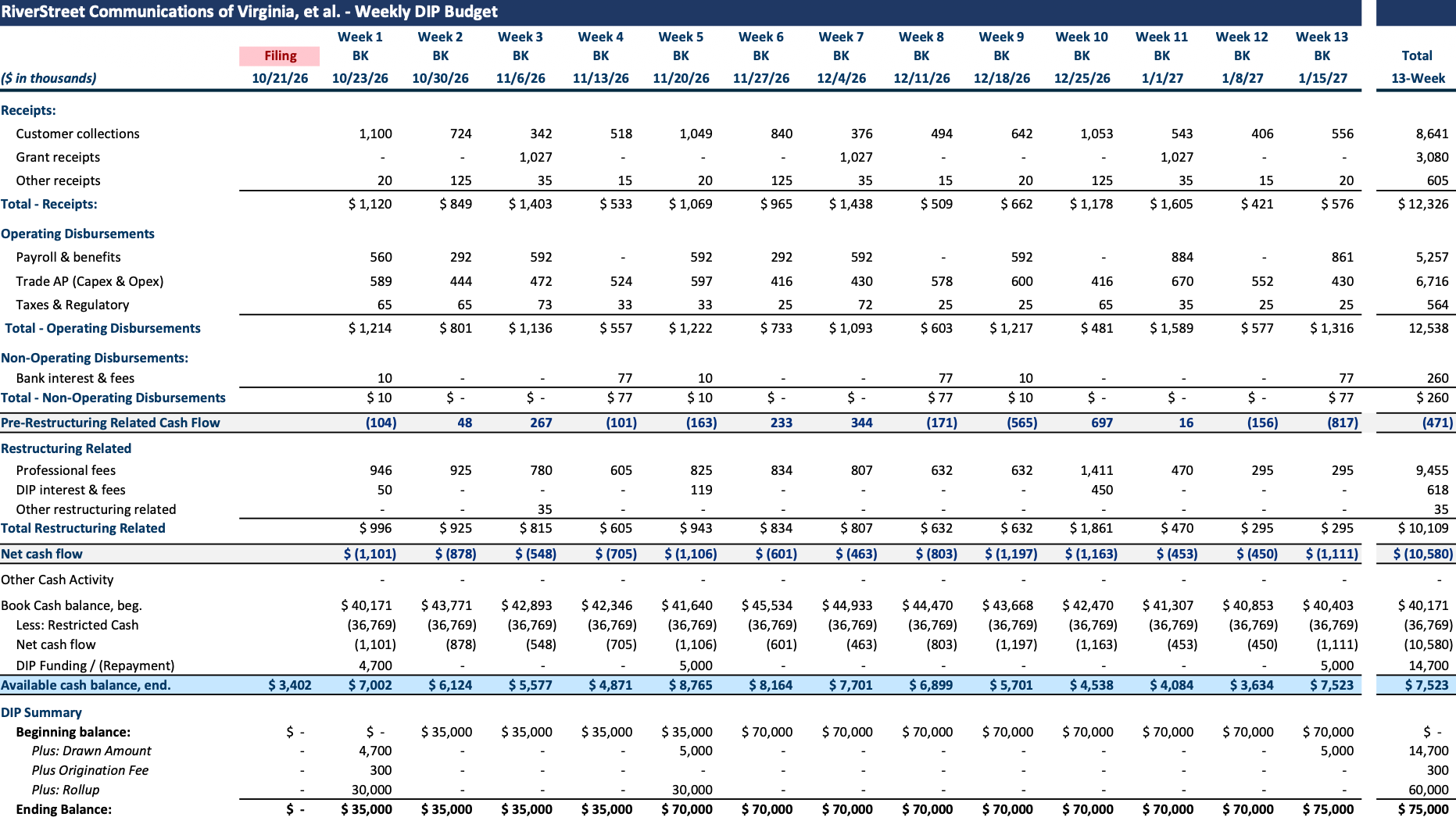
- Budget Variance — Disbursement variances are tested weekly against a 10% limit, in aggregate and by line item. Testing is cumulative through week 3 and then on a rolling four-week basis.
- Covenants — Without the DIP Agent’s consent, the Debtors may not join new funding programs or forfeit grant awards unless consistent with the budget. Any funding-agency recoupment, setoff, or withholding that impairs budgeted revenue is deemed a material adverse change, which becomes a default if not cured within two business days.
Initial DIP Budget
Other First Day Relief
- Wages (Doc. 4): The Debtors seek authority to pay approximately $310,000 of prepetition compensation and benefit obligations on an interim basis and approximately $315,000 on a final basis, covering wages, independent contractors, payroll taxes, expense reimbursements, and 401(k) and other benefits. The motion also discloses that before the Petition Date, the Debtors paid retention bonuses to certain insider and non-insider employees, which recipients must repay if they leave before the retention period ends. The motion does not disclose the amounts and does not seek court approval of those payments.
- Customer Programs (Doc. 5): The Debtors seek to continue their customer programs to honor approximately $1.51 million of prepetition customer obligations. They request authority to pay up to $1.73 million on both an interim and final basis.
- Cash Management (Doc. 6): The Debtors seek to continue operating their cash management system of 38 Wells Fargo bank accounts and 13 investment accounts, to pay bank fees (including up to $100,000 of any prepetition fees), and to maintain their corporate and fuel card programs. The revised proposed interim order would cap corporate card payments to Wells Fargo at $30,000, bar distributions from members’ capital accounts without DIP lender consent or a court order, and require a court order before the Debtors surrender, return, or repurpose grant funds.
- Taxes and Fees (Doc. 7): The Debtors seek authority to pay approximately $2.51 million of accrued prepetition taxes and fees, with interim payments capped at $400,000. The interim amount covers sales and use taxes, excise and communications taxes, customer surcharges, and business fees, while income, property, and franchise taxes of approximately $2.1 million are deferred to the final order.
- Utilities (Doc. 8): The Debtors propose a $34,050 adequate assurance deposit, equal to approximately two weeks of their approximately $68,000 in average monthly utility spend, along with procedures for resolving utilities’ requests for additional assurance.
- Insurance (Doc. 9): The Debtors seek to maintain 24 insurance policies (approximately $1.30 million in annual premiums), 13 surety bonds (approximately $66,000 in annual premiums), and seven letters of credit totaling approximately $32 million. Related payments would be capped at $25,000 on an interim basis, with no dollar cap in the proposed final order, and any renewal or new coverage requires DIP Agent consultation.
DHCD Limited Objection
On October 22, 2026, DHCD filed a limited objection to the DIP motion and the cash management motion (Doc. 51). DHCD argued that approximately $27.6 million of VATI grant funds held by the Debtors are not property of the estate. It says it advanced those funds to RCVA, through VATI and grant administration agreements implemented by the West Piedmont Planning District Commission, and that the Debtors have neither earned them nor committed them to expenses. On that basis, DHCD contends the Debtors hold the funds in constructive trust for DHCD and VATI, retaining only legal title.
DHCD took issue with two features of the Debtors’ proposed orders: the DIP liens on all assets, including “grants, grant proceeds,” and the proposed cash management orders’ requirement of the DIP Agent’s consent before the Debtors could surrender, return, or repurpose grant funds. It proposed three changes:
- Broader Cash Exclusion — Extend the DIP order’s existing exclusion for cash held in trust for third parties to cover constructive trusts, cash in which a Debtor holds only bare legal title, and cash that is otherwise not estate property.
- VATI Carve-out — Exclude from DIP collateral all funds advanced by, or subject to recoupment by, DHCD or its agents, contractors, partner localities, commissions, or authorities in connection with VATI, estimated at approximately $27.6 million.
- Court Approval for Returning Grant Funds — Require a court order, rather than the DIP Agent’s consent before the Debtors surrender, return, or repurpose grant funds.
The latest revised proposed interim DIP order filed did not carve the VATI funds out of the lenders’ collateral as DHCD requested. Instead, it added a provision stating that nothing in the order determines whether those funds are property of the Debtors.
DHCD also reserved its rights to be heard on the disposition of VATI funds at future hearings, including on the final DIP order, any sale motion, and plan confirmation, and to seek return or turnover of the funds.
Regulatory Approvals for a Sale
Because the Debtors are regulated telecommunications providers, a sale requires regulatory approval. The FCC oversees their interstate services, and while the Debtors’ FCC licenses passed to them as debtors in possession automatically on filing, assigning those licenses to an unrelated buyer in a section 363 sale requires FCC approval.
The DIP financing documents address the regulatory approvals directly. Neither the DIP Agent nor the lenders may take any action that would transfer a license or change control of a licensee without first obtaining any required approval from the FCC, a state utility commission, or another regulator. The Debtors must cooperate in filing the applications needed to transfer the licenses, including to a lender-designated buyer following a credit bid.
Explore Bondoro Insights for live case dockets and comprehensive coverage of material filings from petition to plan confirmation.
Stay informed on every Chapter 11 bankruptcy case with liabilities exceeding $10 million. Subscribe for free to have our coverage delivered directly to your inbox, and explore our full archive of past summaries.
Subscribers can also opt in to timely filing alerts by updating their email preferences in Account Settings.


