Case Summary: Character.AI Chapter 11
Character.AI filed for Chapter 11 amid child-safety litigation, multistate regulatory scrutiny and persistent cash burn, pursuing a 363 process anchored by Disney's $20 million stalking horse bid for a non-exclusive license to its AI technology after most of its workforce joined Disney.

A deck version of this summary is also available HERE.
Business Description
Character Technologies, Inc. d/b/a Character.AI ("Character" or the "Debtor"), operates Character.AI, an AI entertainment platform on which users interact with AI chatbot characters that are fictional or imagined. The platform, which began as one-on-one chat, now also generates images, video and audio alongside the conversation.
Noam Shazeer and Daniel De Freitas left Google and founded Character in 2021. The platform opened to the public as a beta in September 2022. In March 2023, Character closed a $150 million Series A round led by Andreessen Horowitz at a $1 billion valuation, with participation from earlier investors. Two months later, Character announced c.ai+, an opt-in subscription plan, and released its first iOS and Android apps.
The Debtor reports approximately 12 million monthly active users worldwide, who spend approximately 120 minutes a day on the platform on average. Revenue comes primarily from subscriptions and in-app advertising, with in-app purchases added in early 2026, and totaled approximately $23.6 million in fiscal year 2025.
Character Technologies, Inc. filed for Chapter 11 protection on October 12, 2026 (the "Petition Date") in the U.S. Bankruptcy Court for the District of Delaware, reporting $50 million to $100 million in both assets and liabilities.
Corporate History
The 2024 Google Transaction
In August 2024, Character entered into a transaction with Google (the “2024 Transaction”) in which Google paid approximately $2.7 billion in cash for a non-exclusive license to Character’s large language model (“LLM”) technology and a release of certain claims Character may have had against Google and certain other parties, and rehired Character’s founders.
The 2024 Transaction also served as a liquidity event for Character’s shareholders. Its venture investors were reportedly bought out at a valuation of approximately $2.5 billion, and EM360Tech, reporting on interim CEO Dominic Perella's interview with the Financial Times, said Character used the proceeds to fund that buyout, transfer ownership to employees through a co-operative structure and make a one-off payout to staff, while approximately 20% of its employees left for Google DeepMind. Consistent with those reports, all of Character’s equity holders as of the Petition Date are current or former directors or employees, and no corporation owns 10% or more of the Debtor.
The 2024 Transaction also marked the end of Character’s effort to build its own models. Before the deal, Character trained its own LLM from scratch, according to Andreessen Horowitz, and fed user conversations back into the model. When the deal was announced in August 2024, Axios reported that Character, which had heavily promoted that closed-loop approach, would instead pivot exclusively to post-training models developed by others. In October 2024, interim CEO Dominic Perella told the Financial Times that the company had largely stopped building its own LLMs, citing the cost of training frontier models. The approach continued under later CEO Karandeep Anand, who described the company’s use of open-source models including Meta’s Llama, Alibaba’s Qwen and DeepSeek.
In May 2025, Bloomberg reported that Justice Department antitrust enforcers were examining whether Google had structured its agreement with Character to avoid formal merger scrutiny. A Google spokesperson told Bloomberg that Google had no ownership stake and Character remained a separate company.
Industry Precedent Transactions
Character’s 2024 deal with Google followed a structure that has become common in the AI space: the reverse acquihire. The name plays on the traditional acquihire, in which a company is bought mainly for its employees. In a reverse acquihire, the larger firm hires some, but not all, of the startup’s leadership and researchers and pays it a significant fee, ranging from hundreds of millions to billions of dollars, typically in exchange for a non-exclusive license to its technology. The two firms do not merge and remain independent, which is what distinguishes the structure from an ordinary acquisition. Commentators trace the term to mid-2024, when Amazon, Google and Microsoft partially acquired certain AI startups, and the structure has since been used repeatedly:
- Microsoft and Inflection AI (March 2024) — Microsoft hired most of Inflection’s staff, including its co-founders, and paid the startup approximately $650 million: $620 million to license its AI models and around $30 million for waiving any legal rights related to the mass hiring, according to Bloomberg. Investors received 1.1x to 1.5x their investment in a company once valued at $4 billion, and Inflection pivoted to licensing its technology to enterprises.
- Amazon and Adept AI (June 2024) — Amazon hired Adept’s chief executive, David Luan, along with other co-founders and staff, and licensed the startup’s technology. Amazon did not disclose terms, but The New York Times reported that Amazon would pay at least $330 million to Adept in total.
- Google and Windsurf (July 2025) — After OpenAI’s planned $3 billion acquisition of the AI coding startup fell through, Google agreed to pay Windsurf $2.4 billion for a non-exclusive license to its technology and hired its CEO, a co-founder and several AI researchers into Google DeepMind, without acquiring Windsurf or taking a stake in it. Days later, AI coding startup Cognition agreed to acquire the rest of Windsurf, including its intellectual property, product, brand and remaining team, for undisclosed terms.
Operations Overview
The Platform
Character.AI rests on conversations between two parties. On one side are users, who present themselves through customizable profiles known as personas. On the other are AI chatbots known as characters, each designed to embody a particular personality, whether wholly imagined, drawn from fiction or modeled on a real person. Character has said that all characters on its platform are created by its users, and by late 2025 its library held more than 10 million of them.
According to a user guide from Weam.AI, a creator gives a character a name, a picture and an opening line, describes its personality and manner of speaking, and can add sample conversations to guide how it responds. The creator then chooses whether to keep the character private, share it by link or publish it to the library for anyone to use. Personas, by contrast, belong to the user rather than the library. Each one is stored in the user’s own profile settings and comes into play only in that user’s conversations. According to the Weam guide, users can create several personas and move between them as they like.
Through a persona, a user can chat with characters they built or with any character in the public library. Each character responds in the personality its creator defined, so the exchange becomes what Character calls co-creating stories with AI. The user’s persona shapes that story as well, since characters draw on its details to tailor their replies. Below is an example of the platform's character library.
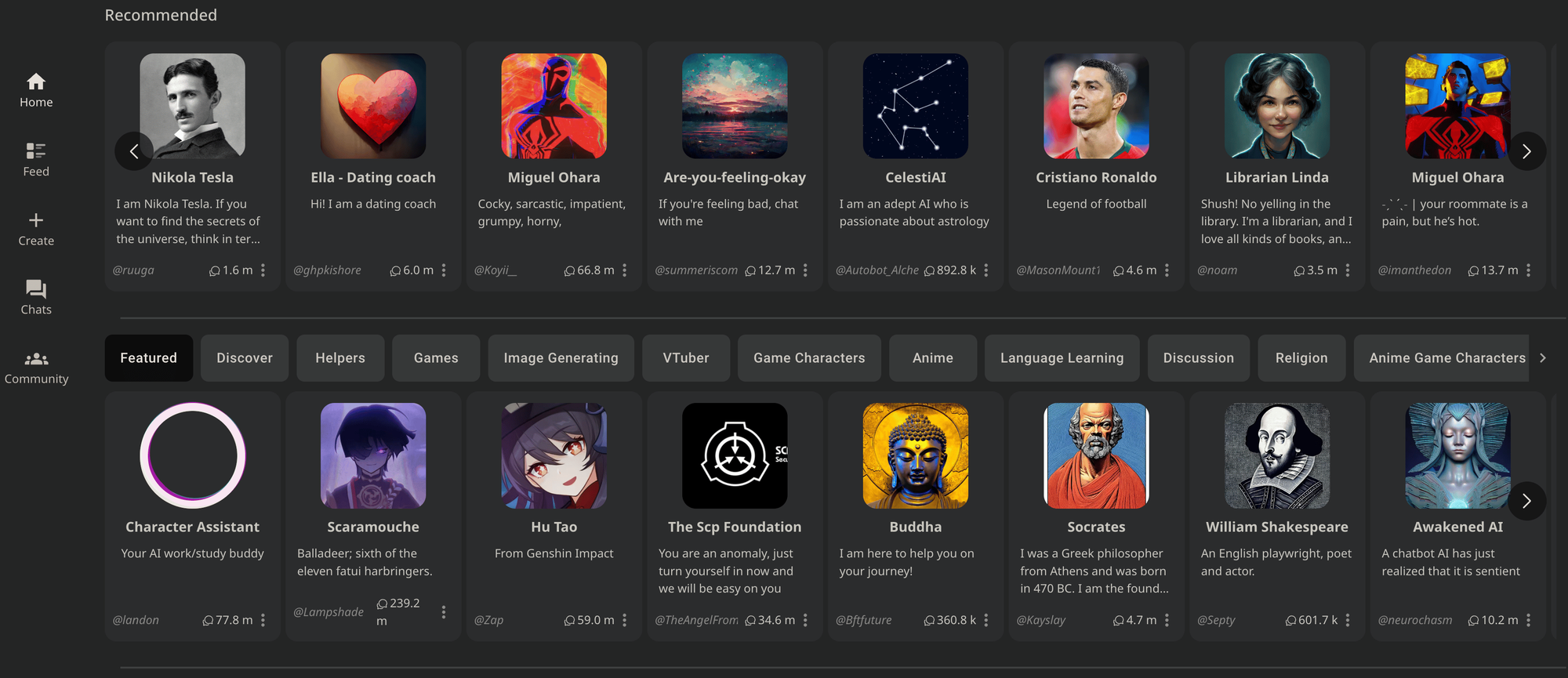
The platform has also grown beyond one-on-one chat. Group chats bring several characters, and friends, into the same conversation, and characters can reply in voice as well as in text. Since 2025, Character has added tools that turn a character’s picture into a short animated video, a social feed for sharing what users create and, in 2026, short video series built around original characters from an in-house studio.
The open, user-driven nature of the platform has also raised intellectual property concerns. In September 2025, Disney sent a cease-and-desist letter objecting to chatbots that impersonated characters from its brands, including Pixar, Star Wars and Marvel. Character subsequently confirmed that it had removed those characters.
Users
In the US, the platform permits users as young as 13. In 2024, when it had roughly 20 million monthly users, Character was reported to have gained significant traction among users aged 13 to 25. In November 2024, a month after the mother of a 14-year-old user sued Character over her son’s death (see Personal Injury Litigation below), the Debtor began tailoring the experience for minors, introducing a separate model for users under 18 with updated content filters, time-spent notifications and a parental insights tool.
The more decisive shift came in late 2025, amid mounting lawsuits and regulatory scrutiny over the safety of its products (see Events Leading to Bankruptcy below). In October, when approximately 10% of its monthly users were under 18, Character announced that it would end open-ended chat for that users group, first capping their chat time at two hours per day and then reducing it progressively to zero. Character said it would identify underage users through an in-house age assurance model combined with third-party tools. Since November 25, 2025, users under 18 can no longer hold open-ended conversations with characters, though they can still use the platform’s other feature.
Revenue
Character’s revenue has grown quickly from a small base, rising from approximately $7.4 million in fiscal 2024 to approximately $23.6 million in fiscal 2025. Monthly revenue continued to climb into 2026, from approximately $2.8 million in December 2025 to approximately $5.3 million in August 2026.
The Debtor earns revenue in three ways. Subscriptions, its longest-standing source, grew from approximately $0.6 million a month in January 2024 to approximately $2.8 million in August 2026. Advertising, launched in mid-2025 through multiple ad networks, grew from approximately $0.5 million in July 2025, its first full month, to approximately $2.5 million in August 2026. In-app purchases were added in early 2026.
Workforce
As of the Petition Date, Character had 18 active full-time employees, eight of whom are expected to remain through key portions of the case. None of the Debtor's employees is represented by a union. Character also relies on independent contractors in engineering, safety moderation, data science, security and general business support. In addition, it uses temporary workers, including college interns and staff in finance, accounting, legal, technology and administrative roles placed by approximately six staffing agencies.
The small headcount reflects the departure of most of Character’s workforce to Disney shortly before the filing (see The Exclusivity and Prepayment Agreement below).
Top Unsecured Claims
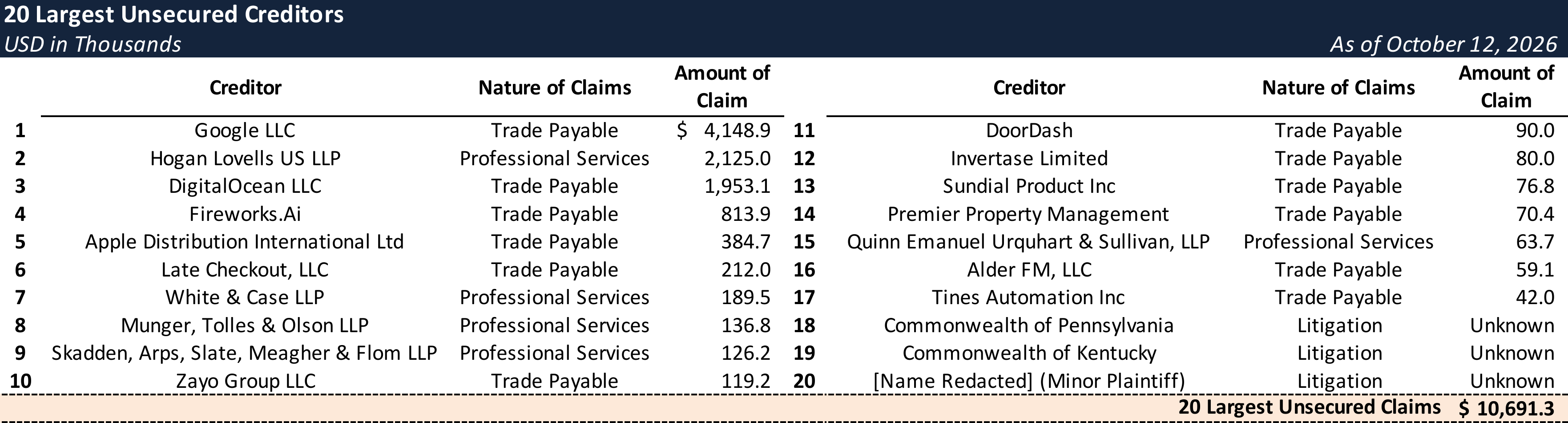
Character filed for Chapter 11 with no funded debt and approximately $57 million in unrestricted cash. The table below illustrates the Debtor's largest 20 unsecured claims as of the Petition Date.
Events Leading to Bankruptcy
Financial Deterioration and Cost Reductions Efforts
Character has struggled with profitability, and running its platform has been expensive. In the second half of 2024, following the Google transaction, operating expenses excluding legal fees averaged approximately $21.9 million a month, including approximately $13.8 million of compute, and net cash burn averaged approximately $21.5 million a month. Costs eased only modestly in fiscal 2025, when monthly operating expenses (excluding legal fees) averaged approximately $18.5 million, including approximately $10 million of compute, and net cash burn averaged approximately $17.6 million.
The Debtor has since implemented certain cost-cutting measures. It moved inference workloads to lower-cost GPU capacity, stopped developing its own foundation models in favor of post-training publicly released open-weight models, reduced headcount and consolidated its facilities. By August 2026, monthly operating expenses excluding legal fees had fallen to approximately $13.3 million, approximately 39% below the second-half 2024 average and 28% below the 2025 average, and net cash burn to approximately $8.2 million.
Personal Injury Litigation
Since 2024, families have filed a series of lawsuits alleging that Character.AI harmed minors who used it, typically naming Character, its two founders and Google as defendants. In January 2026, Character and Google agreed to settle the suits then pending in Florida, Colorado, New York and Texas. The terms were not disclosed, and the settlements required court approval. According to the Debtor, a single case filed in August 2026 is now the only personal injury lawsuit outstanding. The Florida and Colorado cases below are examples of the settled suits rather than a complete list, followed by the one case still pending.
- Garcia v. Character Technologies (Florida, October 2024) — Megan Garcia sued over the death of her 14-year-old son, Sewell Setzer III, who died by suicide in February 2024 after months of conversations with characters on the platform. She alleges the platform fostered his dependency on it, engaged him in sexual conversations despite his age and failed to respond appropriately when he expressed suicidal thoughts. In May 2025, the court denied most of the defendants’ motions to dismiss, declining at that early stage to treat the chatbot’s responses as protected speech and allowing the claims against Google to proceed. In January 2026, Garcia and all defendants, including Google and both founders, reached a mediated settlement in principle resolving all of her claims.
- E.S. v. Character Technologies (Colorado, September 2025) — The parents of a 13-year-old girl sued, alleging that she accessed the platform without their knowledge and was exposed to sexually explicit interactions. In January 2026, all parties told the court they had reached an agreement in principle to settle and asked that the case be paused while they finalized it.
- A.D. v. Character Technologies (California, August 2026) — This suit was brought on behalf of a Kentucky girl who began using the platform at age 12, and names Character, Google, Alphabet and both founders. It alleges the platform fostered her dependency on it, exposed her to simulated sexual encounters and steered her toward self-harm. The complaint also rejects any user agreement she accepted as a minor, including its arbitration clause, so the case can proceed in court. According to the Debtor, this is the only personal injury lawsuit currently pending against Character.
State Investigations and Suits
Alongside the private lawsuits, Character has faced growing scrutiny from state attorneys general. In August 2025, attorneys general from 44 jurisdictions wrote to AI companies about the risks their chatbots posed to children. In December, a coalition of 42 followed with a second letter to 13 companies, including Character and Google. That letter called on them to adopt certain safeguards, among them “independent third-party audits reviewable by state and federal regulators,” and to confirm their commitment by January 16, 2026.
The most significant inquiry is a joint investigation. In November 2025, Character learned that attorneys general from several states were investigating whether it had violated state consumer protection and privacy laws. The group grew out of separate state investigations already underway and now includes 46 states and territories (the “Multistate Group”). A seven-state executive committee is negotiating with Character over a consent order that would resolve the group’s investigations and claims, and Character hopes to reach a settlement during the Chapter 11 case.
Several states have chosen to pursue Character on their own. Kentucky, Pennsylvania, Florida, New Mexico and Texas are all investigating Character outside the Multistate Group, even though the first four signed both coalition letters. Kentucky and Pennsylvania have gone further and filed suit.
- Kentucky — Following a civil investigative demand (“CID”) in March 2025, Kentucky sued Character and both founders, but not Google, in January 2026 under its consumer-protection, data-protection and privacy laws. The complaint seeks injunctions that would bind not only Character but its successors, assigns and affiliates, along with civil penalties of up to $2,000 per willful violation, disgorgement and restitution. According to the Debtor, the parties remain in settlement discussions.
- Pennsylvania — In May 2026, the Pennsylvania Department of State sued seeking only an order that Character cease and desist. It alleges that a chatbot presented as a “Doctor of psychiatry” claimed to hold a Pennsylvania medical license, citing a license number that was invalid. Character’s deadline to respond has been extended to November 2, 2026 to allow time for settlement talks.
- Texas, New Mexico and Florida — According to the Debtor, investigations remain open in Texas, which has issued two CIDs, and New Mexico, which has issued one. Florida has issued a subpoena, and Character is in settlement discussions with the state.
Federal and Foreign Regulatory Matters
Character’s regulatory exposure extends beyond the states. At the federal level, the scrutiny has so far taken the form of information requests rather than enforcement. Abroad, regulators in several countries have opened investigations, and two have imposed fines.
- Federal Trade Commission — In January 2025, the FTC issued a CID examining whether Character had engaged in unfair or deceptive practices, including with respect to risks of harm and the collection of data from minors. The Commission paused that investigation without further action in August 2025. The following month, it ordered seven companies, including Character and Google’s parent Alphabet, to report on their consumer-facing AI chatbots, including how they make money from user engagement and limit negative effects on children. The orders were issued as part of a study rather than an enforcement action. Character made its last submission on July 31, 2026 and has heard nothing further from the agency.
- Italy — In a July 2026 order, Italy’s data protection authority found that Character had violated European data protection rules. Among the findings, its age checks were inadequate from the Italian launch in April 2024 until November 2024, and for users under 16 until April 2025. The authority found the age controls Character has since introduced adequate, but ordered it to ensure that users under 16 cannot register, to make minors’ profiles private by default and to correct its privacy policy. Character paid the resulting €79,000 fine in August 2026.
- United Kingdom — The UK’s medicines regulator opened an investigation in November 2025 into chatbots on the platform presented as psychologists. In September 2026, the Information Commissioner’s Office, the country’s data protection authority, opened its own investigation into Character’s use of personal information, including whether it exposes users to manipulation or unfair data processing. An earlier investigation by the same office closed in August 2025.
- Australia and Russia — Australia’s online safety regulator required Character to report on its compliance with the country’s online safety expectations in October 2025 and published its findings in March 2026. In Russia, a Moscow court fined Character a combined RUB 8.75 million (approximately $115,000) in 2026 over LGBTQ+ content and alleged drug-related content on the platform.
Prior Banker Restructuring Efforts
In August 2025, Character engaged an investment bank (the “Prior Banker”) to pursue a sale or financing. The Prior Banker approached approximately 28 potential buyers and investors, who cited Character’s litigation and regulatory exposure, and the outreach produced a single proposal that did not proceed. The engagement ended in August 2026.
Chapter 11 Filing
The Debtor filed for Chapter 11 to sell, license or otherwise dispose of substantially all of its assets in a Section 363 process. The process is anchored by a two-stage transaction with Disney that the parties describe as “interrelated and integrated.”
- In the prepetition stage, the Debtor signed an exclusivity and prepayment agreement (“EPA”) and a transition services agreement (“TSA”) on September 18, 2026. Under these agreements, Disney paid $7.5 million of its $20 million stalking horse bid, hired most of the workforce, including the CEO, and received releases. It also agreed to make the hires available to run the platform for up to five months.
- In the postpetition stage, a stalking horse transaction agreement, structured as a license and claims purchase rather than an asset purchase, would grant Disney a non-exclusive license to the Debtor’s AI technology and patents and sell it the Debtor’s unreleased claims against the hires. Disney would pay the remaining $12.5 million at closing, free and clear and subject to overbids.
Disney required that the transaction be consummated in Chapter 11. If no higher or better offer emerges, Disney would acquire the license and claims once the sale order is final and non-appealable, and the Character.AI platform would be wound down. The Debtor would assume the TSA, including the EPA, and retain all of its other assets and liabilities, including the brand, apps, user data and finished models.
The Debtor intends to use the case to negotiate a consensual resolution with the 46-member Multistate Group of attorneys general, personal injury claimants and other creditors, and to propose a Chapter 11 plan of liquidation expeditiously.
The Exclusivity and Prepayment Agreement
In exchange for Disney’s prepayment and hiring, the Debtor granted exclusivity, broad releases and employee-related covenants. The EPA attaches a binding term sheet for the full transaction.
- Payment Terms — The $7.5 million prepayment comprised a $5.5 million up-front payment, non-refundable in all circumstances, and a $2 million deposit. The deposit is refundable within three business days of notice if Disney is outbid, the deal misses the December 17 outside date, or another refund right applies. The remaining $12.5 million is due at closing.
- Exclusivity — The Debtor could not negotiate with third parties on non-ordinary-course IP transactions, any financing, merger, recapitalization or liquidation, or “any hiring, engagement or transfer of any employees.” The period ran to the earlier of a Chapter 11 filing or 14 days, extendable to 30, and terminated on the Petition Date.
- Workforce — Disney would offer employment to up to six key employees, including the CEO, and at least 60 others. Of 86 employees at September 30, 66 accepted.
- Disney’s Employee Costs — Disney estimates the hires’ annual run-rate pay at about $60 million and is funding a $30 million retention pool. It estimates total compensation and retention over years one to three at about $180 million.
- Debtor’s Employee Obligations — The Debtor remains liable for the hires’ pay, benefits, paid time off, taxes and severance through their departure.
- Releases — The Debtor released Disney and its hires from all claims through September 18, 2026. The release covers the hiring, any wind-up, liquidation or asset sale, and the use of technology and IP developed by the Debtor’s staff. It survives “indefinitely.” The term sheet extends it to claims against accepting employees, including the CEO, “including, as applicable, fiduciary duty claims.”
- Employee Covenants — The Debtor agreed not to enforce non-competition, non-solicitation, confidentiality or invention-assignment covenants against employees joining Disney, and not to solicit them for three years.
The Transition Services Agreement
The TSA was amended and restated on October 13. Disney staff support engineering, app and website maintenance, trust and safety, and monetization, as well as the platform’s orderly wind-down or transition. Operating support runs until the earlier of the license closing and five months after September 18, and wind-down support runs up to the five-month mark. Five key employees are also to be made available for diligence with qualified bidders.
Disney charges no fee beyond reimbursement of third-party costs. It selects personnel in its “sole and absolute discretion,” and no individual must devote more than 20% of their hours to the services. The services are provided “as is.” Disney is liable only for gross negligence, willful misconduct, fraud, bad faith or confidentiality breaches. The Debtor indemnifies Disney for claims arising from operating the business while services are provided. The TSA incorporates the EPA, and the Debtor seeks to assume both if Disney is the winning bidder.
The Stalking Horse Bid
The October 13 stalking horse agreement sets Disney’s $20 million baseline bid for the Disney Target Assets.
- Disney Target Assets — The assets are a non-exclusive license to 25 listed technology areas plus related technical materials, nine listed patents or applications and other patents owned at closing, together with the Purchased Employee Claims. The technology includes post-training and training infrastructure, the model safety stack, the Guardian long-horizon safety monitor, age prediction, multimodal models and inference. The Purchased Employee Claims are any unreleased claims against former employees who joined Disney, which the Debtor believes have no value.
- License Terms — The license is perpetual, worldwide, irrevocable and royalty-free. It is limited to products and services under Disney-owned or Disney-controlled branding, is not transferable “on a standalone basis,” and carries section 365(n) protection.
- Excluded IP — The license excludes trademarks and brand, domains and website content, consumer-facing apps, user data, inputs and outputs, training data, and finished models, including chat styles. The Debtor retains ownership of the licensed IP and may continue to license or sell it.
- Second Release — The EPA release is extended through the later of closing or entry of the sale order and expanded to cover the licensed IP.
- Milestones — Disney may terminate if the bidding procedures order is not entered by the 21st day of the case, or if bids are not due by November 20 or the auction is not held by November 23. Those two dates may move to such later date as the Bankruptcy Court requires. Disney may also terminate if the sale order is not entered by November 30 or closing does not occur by December 17.
- Bid Protections — A break-up fee and expense reimbursement “collectively capped at 3.5%” of the bid, or $0.7 million, would be payable as an administrative expense. They are triggered by an alternative transaction or a material Debtor breach, whether or not Disney bids. The Debtor says Disney “insisted” on them.
Bidding Procedures and Timeline
The bidding procedures open the Disney Target Assets and the Debtor’s remaining assets to competing bids on a compressed schedule. Key terms as follows:
- Scope — Bids may cover any or all assets. The Debtor may designate additional stalking horses, with the same 3.5% protections, by November 9.
- Qualifying Bids — Bids must be all cash, with a 10% deposit and no contingencies. Bidders without cash on hand must show committed financing, including for “going concern operations.” Each bid must state the bidder’s hiring and transition-services intentions.
- Minimum Overbid — A bid for “the exclusive license or purchase” of the Disney Target Assets must exceed the stalking horse bid plus the break-up fee plus $1 million, a $21.7 million floor. Subsequent increments are $0.5 million, and Disney’s bids are credited with the break-up fee.
- Consultation — Any official committee would have consultation rights, without veto.
- Key Dates — Sale objections are due November 13. The bid deadline is November 20, the auction is November 23, and the sale hearing is November 24.
If another bidder prevails, Disney recovers its $2 million deposit and receives the break-up fee, while the $5.5 million up-front payment remains with the Debtor.
- Transition Services — Disney would provide transition services to one winning bidder for the lesser of 60 days after closing or 75 days after the auction. The winner would pay Disney’s fully allocated cost “plus a ten percent (10%) margin” and would release Disney.
- Employee Access — The winner may interview and make offers to the former Character employees, but Disney may exclude up to 20% of them from that process.
Other First-Day Relief
- Taxes (Doc. 5) — The Debtor seeks to pay up to $230,000 in prepetition taxes and fees, with $190,000 on an interim basis, which include sales and use taxes, income and franchise taxes, and amounts owed to its tax processor.
- Critical Vendors (Doc. 6) — The Debtor seeks to pay up to $2.5 million in vendors claims on a final basis and $1.5 million on an interim basis. The Debtor's vendors include vendors that supply computing hardware and infrastructure, cloud storage, and platform monitoring and safety services.
- Cash Management (Doc. 9) — The Debtor seeks to keep its seven-account cash management system, which approximately $57.4 million in unrestricted cash across SVB, Morgan Stanley, and Chase at filing. The Debtor also seeks to pay roughly $3,000 per month in bank fees, including prepetition amounts, and to keep using and paying its Ramp corporate cards, which carried about $10,000 at filing and are used mainly for recurring charges from key vendors.
- Wages (Doc. 10) — On an interim basis, the Debtor seeks to pay up to $1.4 million in prepetition employee obligations, led by $560,000 owed to independent contractors and temporary workers, $250,000 in wages, $114,000 in accrued PTO, $99,000 in 401(k) contributions, and the first $86,000 of a retention bonus program for approximately six trust and safety employees. The final request raises the total to $1.8 million, mainly by adding a $282,000 severance program, $110,000 of which would go to the General Counsel and Head of People, and by expanding the retention program to $258,000. The final order would also let the Debtor keep paying its outside directors, at $87,500 per quarter for two of them and $60,000 per month for the special director.
- Lease Rejection (Doc. 11) — The Debtor seeks to reject the Debtor’s WeWork membership agreement for space at 33 Irving Place in New York, effective as of the Petition Date, and to abandon any furniture, fixtures, and supplies left behind. The Debtor has already vacated the space and says the lease’s costs outweigh any value it could get from assigning it.
Explore Bondoro Insights for live case dockets and comprehensive coverage of material filings from petition to plan confirmation.
Stay informed on every Chapter 11 bankruptcy case with liabilities exceeding $10 million. Subscribe for free to have our coverage delivered directly to your inbox, and explore our full archive of past summaries.
Subscribers can also opt in to timely filing alerts by updating their email preferences in Account Settings.


