Case Summary: Getty Images Chapter 11
Getty Images filed for Chapter 11 citing warrant-litigation judgments, costs of a terminated Shutterstock merger and heavy debt service, entering with an RSA and prepackaged plan under which its largest shareholders, the Getty family and Koch, invest up to $533 million and take the company private.

A deck version of this summary is also available HERE.
Business Description
Headquartered in Seattle, WA, Getty Images Holdings, Inc. (“GIH”) and its debtor affiliates (collectively, the “Debtors” and, together with GIH’s non-Debtor subsidiaries, the “Company”) are best known for the Getty Images brand and together form one of the largest providers of stock imagery and multimedia content. The Company covers more than 160,000 news, sports and entertainment events a year and supplies the stock imagery businesses use in websites, ads and marketing.
The Company's content comes from staff photographers and videographers, as well as independent contributors. Through the Getty Images, iStock and Unsplash brands, the Company licenses photos, illustrations, video and music to corporations, media organizations, advertising agencies and individual creators, who can buy content à la carte or by subscription. Its library holds more than 662 million images and videos and grows by approximately 11 million assets each quarter, alongside an archive of more than 150 million historical photographs.
In 2025, the Company generated $981.3 million in revenue with Adjusted EBITDA of $320.9 million, a 32.7% margin. For the twelve months ended June 30, 2026, revenue stood at approximately $978 million and Adjusted EBITDA approximately $307 million.
Getty Images Holdings, Inc. and certain affiliates⁽¹⁾ filed for Chapter 11 protection on October 21, 2026 (the "Petition Date") in the U.S. Bankruptcy Court for the District of Delaware, reporting $3.1 billion in assets and $2.6 billion in liabilities (as of June 30, 2026).
⁽¹⁾ For a complete list of Debtor entities, see organizational structure chart below.
Corporate History
Founding and the PhotoDisc Merger (1995–1998)
Co-founded by Mark Getty and Jonathan Klein in London, Getty Communications began operations on March 14, 1995 with the acquisition of Tony Stone Images, a leading contemporary stock photography provider, and expanded through further acquisitions, including the Hulton Getty archive. It went public on Nasdaq under the symbol “GETTY” on July 2, 1996. In September 1997, it agreed to combine with Seattle-based PhotoDisc, a publisher of royalty-free digital stock photography founded in 1991. The transaction closed on February 9, 1998, forming Getty Images, Inc., which began trading on Nasdaq as “GETY” the following day.
Private Ownership (2008–2019)
In July 2008, Getty Images went private after private equity firm Hellman & Friedman LLC (“H&F”) acquired the company for approximately $2.4 billion, including assumed debt. The Getty family’s investment vehicle, Getty Investments, and related parties, including co-founder Mark Getty, held approximately 15% of the shares and rolled them into the acquiring entity. In 2012, H&F sold the company to The Carlyle Group for $3.3 billion. Carlyle took a controlling stake, Mark Getty and the Getty family rolled substantially all of their interests, and co-founder and CEO Jonathan Klein invested alongside management.
After six years under Carlyle, control returned to the Getty family in 2018, when it bought out all of Carlyle’s equity and Mark Getty resumed the role of Chair. Later that year, Koch Equity Development LLC (“KED”), the investment arm of Koch Industries, agreed to make a $500 million non-controlling preferred equity investment, leaving the Getty family in control.
Return to the Public Markets (2021–2022)
Getty Images returned to the public markets through a special purpose acquisition company, or SPAC: a shell company that raises cash in an IPO and then uses it to merge with a private business. Its partner was CC Neuberger Principal Holdings II (“CCNB”), a SPAC formed by Neuberger Berman and CC Capital. CCNB raised $828 million in its July 2020 IPO by selling units at $10 each. Each unit paired one CCNB share with one-fourth of a public warrant, and each whole warrant gave the holder the right to buy one CCNB share at $11.50. Once a merger closed, each CCNB share would convert into one share of the combined company, and each whole warrant into the right to buy one of those shares at the same $11.50 price.
On December 9, 2021, CCNB and Getty Images agreed to merge in a deal that valued Getty Images at an enterprise value of $4.8 billion. The transaction was funded from three sources: the $828 million of CCNB’s IPO proceeds; a $150 million PIPE, a private sale of new shares at $10 each, from the CCNB sponsor and Getty Investments; and a $200 million forward purchase commitment from Neuberger Berman Opportunistic Capital Solutions Master Fund LP (“NBOKS”).
Because CCNB’s investors could redeem, or take their money back instead of becoming shareholders, NBOKS also agreed to backstop up to $300 million of redemptions by buying replacement shares.
Ultimately, approximately 99.4% of CCNB’s public shareholders chose to redeem at approximately $10.03 per share, withdrawing approximately $825.2 million, but kept their public warrants. To fill the funding gap, the PIPE was upsized to $360 million through a subscription from Multiply Group and an additional subscription from Getty Investments. NBOKS also exercised its $300 million backstop commitment, funding $500 million in total.
The combination closed on July 22, 2022, with CCNB merging into a subsidiary of a newly formed Delaware parent, Getty Images Holdings, Inc., which began trading on the NYSE under the ticker “GETY” on July 25, 2022. As part of the closing, Getty Images Holdings, Inc. assumed CCNB’s warrant agreement, converting all 20.7 million outstanding public warrants into rights to buy Getty shares at $11.50. These public warrants are at the center of the warrant litigation described in Events Leading to Bankruptcy.
Simplified Organizational Structure
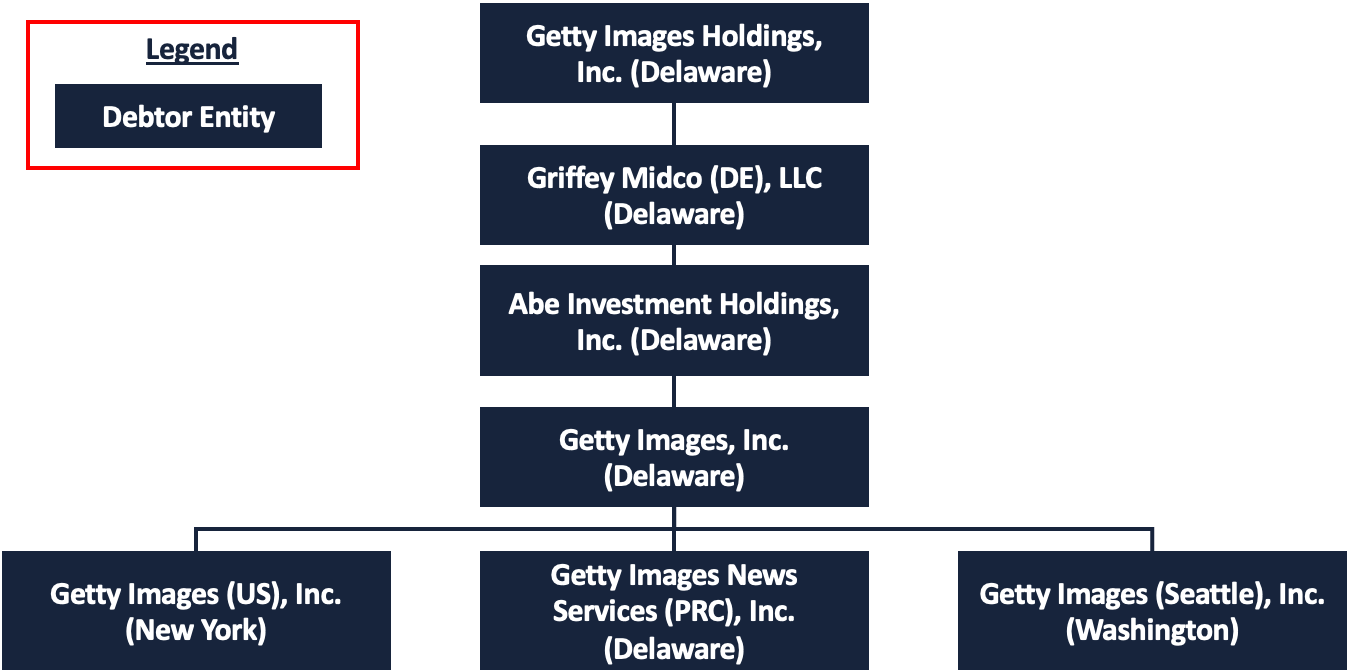
According to the Debtors’ Corporate Ownership Statement filed on the Petition Date, the Getty family, through Getty Investments L.L.C., two family trusts and Mark Getty directly, together beneficially owns approximately 45.5% of GIH’s Class A common stock. KED Icon Holdings, LLC, an indirect subsidiary of Koch, Inc., owns approximately 27.4%. No other holder owns 10% or more.
GIH owns the other Debtors indirectly through three wholly owned non-Debtor holding companies, GGH Holdco, LLC, GGH Operating, LLC and Griffey Holdings, Inc. Refer to the First Day Declaration for the detailed version of the organizational structure.
Operations Overview
Brands and Customers
The Company sells through three primary brands, each aimed at a distinct customer segment.
- Getty Images is the Company’s flagship brand. It serves enterprise agency, media and corporate customers with creative content and editorial coverage, including video, with customizable rights and protections, supported by the Company’s global sales and service teams. Customers can buy à la carte or through subscriptions. These include Premium Access, which gives customers access to the full Getty Images and iStock libraries in a single subscription.
- iStock is the Company’s e-commerce offering for small and medium-sized businesses, including freelancers. It provides creative stills, video, music and generative AI services, with capped indemnification and the option of additional protection. Customers buy primarily through online self-service, either à la carte or through monthly and annual subscriptions.
- Unsplash offers free stock photo downloads and paid subscriptions to small and medium-sized businesses, prosumers, and professional and semi-professional creators, with more than 101 million image downloads a month. It runs on a free, ad-supported model alongside subscription and paid API offerings, the last of which let partners integrate Unsplash content into their own platforms. Getty Images acquired Unsplash in 2021, and co-founder Mikael Cho continues to lead the business.
Within these brands, the Company also maintains specialty collections focused on particular subjects. WireImage covers celebrity, red carpet, concert and live-event imagery, and Allsport, a sports photography agency the Company acquired in 1998, covers historic sports photography. Beyond its websites, the Company makes its content, metadata and search available to customers and partners through APIs, mobile apps and plugins, allowing them to use its library directly within their own tools and platforms.
Content Sourcing
The Company’s content comes from four sources:
- Staff and Freelance Photographers. The Company employs more than 115 staff photographers and videographers who supply editorial content. Most staff-produced content carries minimal or no royalty obligations. The Company also engages a global network of freelance photographers to cover events at a set rate, and in many cases it owns the resulting copyright and pays no royalties.
- Independent Contributors. The Company distributes content from more than 600,000 contributors, over 84,000 of whom are exclusive to Getty Images. Independent contributors typically fund their own production costs and retain copyright ownership, but grant the Company global distribution and pricing rights, often on an exclusive basis. In return, contributors under contract typically receive royalties of 20% to 50% of the license fee, depending on the license model and how the content is used, and are also compensated when their content is used in AI training data sets.
- Content Partners. The Company distributes content from more than 360 premium content partners. Its image partners are third-party companies that license their collections through the Company, which generally serves as their primary or exclusive distribution channel. They include more than 75 exclusive editorial content partners, among them AFP, Disney, Bloomberg, BBC Studios and NBC News Archives. Sports organizations including Formula One, the NBA, FIFA and the International Olympic Committee distribute event content through the Company and grant it commercial rights and event access.
- Archive. The Company maintains an archive of more than 150 million images dating to the beginning of photography and exclusively represents collections including the Bettmann Archive, the Sygma and Gamma collections, and the Hulton Archive.
Product Categories
The Company organizes its content and services into three primary product categories: Creative, Editorial and Other.
- Creative offers royalty-free photos, illustrations, vectors and video covering subjects including lifestyle, business, science, health, wellness, beauty, sports, transportation and travel. Customers use the content in websites, digital and social media, marketing campaigns, corporate collateral, textbooks, film and television. The Company primarily sources Creative content from independent contributors. The category also includes Generative AI by Getty Images and iStock, tools trained exclusively on permissioned content that provide customers with indemnification and perpetual, worldwide usage rights. This category generated 56.7% of 2025 revenue.
- Editorial provides photo and video coverage of news, sports and entertainment. The Company covers more than 160,000 events each year, including almost 70,000 entertainment events and more than 50,000 sporting events, ranging from the Olympics and FIFA World Cup to the Super Bowl and the Oscars. The Company sources Editorial content from its staff and freelance photographers, content partners and archive. This category generated 37.7% of 2025 revenue.
- Other includes data access and licensing, music licensing, digital asset management, distribution services and print sales. This category generated 5.6% of 2025 revenue.
Across Creative and Editorial, the Company has licensed images, video and metadata to AI technology companies for training foundation models, powers AI-driven search and discovery tools including those offered by Perplexity and ChatGPT, and maintains search licensing agreements with traditional web search engines.
Foreign Operations
Approximately 44% of the Company's revenue in each of 2025 and 2024 came from operations outside the United States. Those operations are conducted through non-Debtor subsidiaries in jurisdictions including the United Kingdom, Ireland, Canada, Australia, Japan, India, Singapore, Hong Kong, Sweden, Germany, France and Brazil, none of which are Chapter 11 Debtors.
Prepetition Obligations
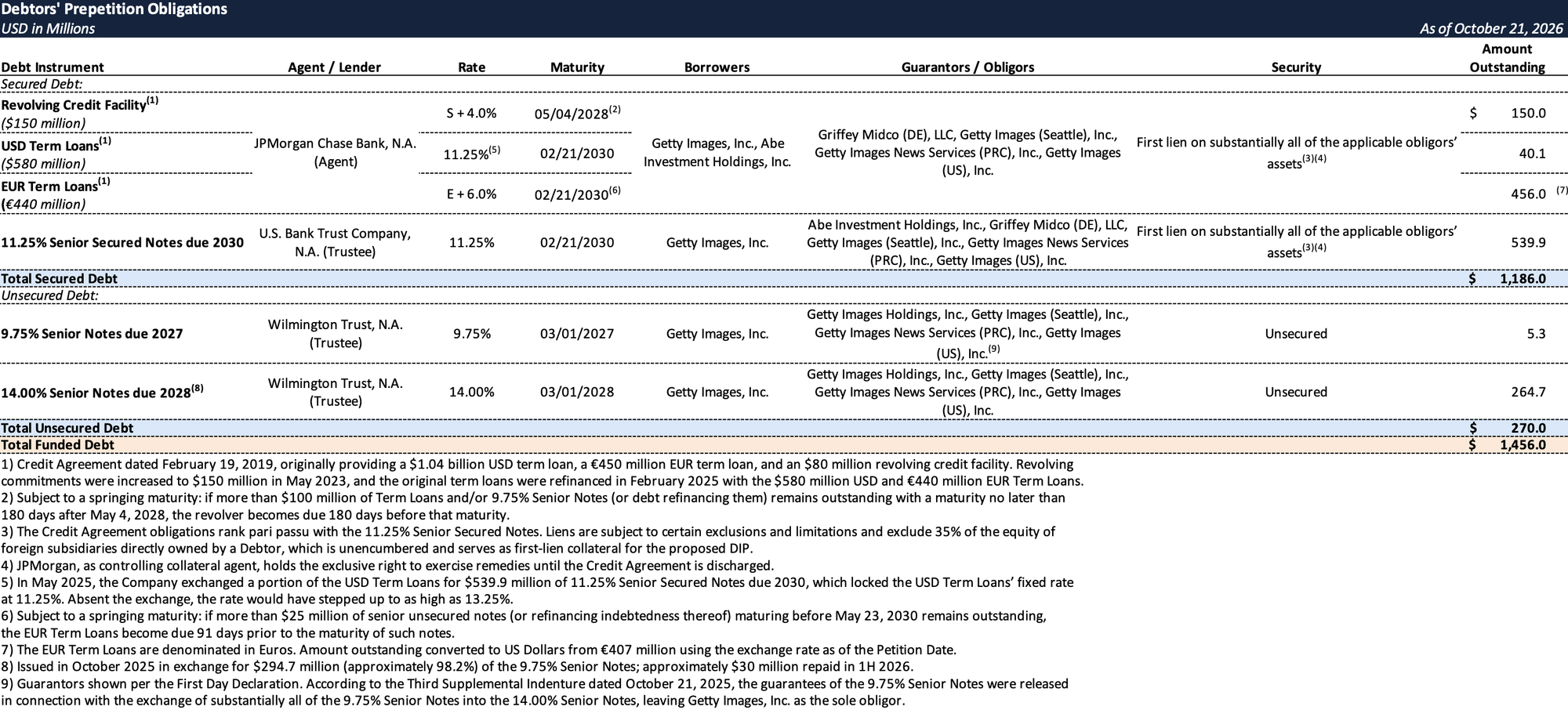
Besides approximately $1.46 billion in funded debt, the Debtors also have several categories of unsecured obligations, including:
- Warrant Litigation. GIH carries a litigation reserve of approximately $99.5 million for the pending warrant litigation. The Company also estimates potential exposure of more than $275 million in additional warrant claims that have not yet been asserted.
- Accounts Payable. Approximately $105.3 million is owed to vendors, content contributors, and other counterparties in the ordinary course of business.
- Accrued Expenses. Approximately $67 million, made up of accrued compensation, interest payable, professional fees, current lease liabilities, and other items.
- Deferred Revenue. Approximately $179 million, representing amounts customers have prepaid for content subscriptions and other services not yet delivered.
- Lease Obligations. Approximately $20.9 million of long-term operating lease liabilities.
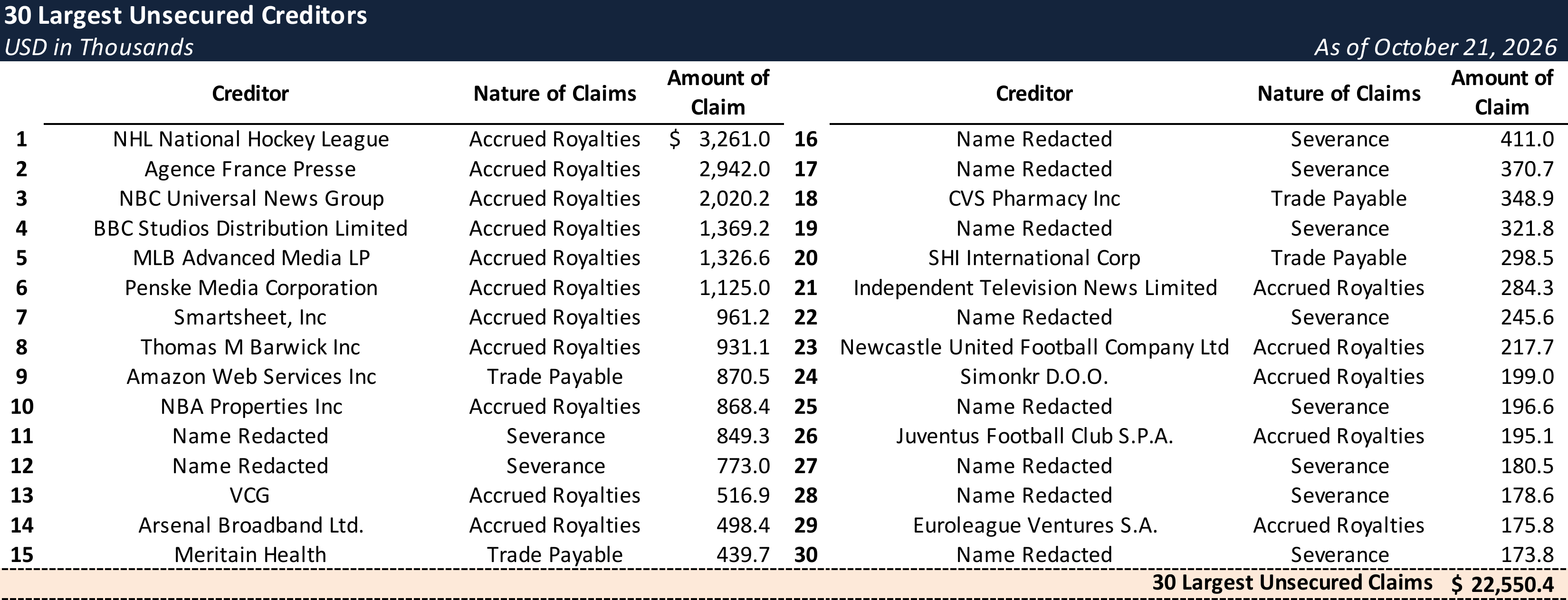
Top Unsecured Claims
Events Leading to Bankruptcy
Warrant Litigation
When GIH and CCNB combined in July 2022, GIH assumed CCNB’s 20.7 million public warrants and the warrant agreement governing them. The warrants became exercisable 30 days after closing, provided that a registration statement covering the underlying shares was effective and the related prospectus was current. With less than 0.2% of GIH’s shares available to trade after the listing, the stock rose from under $10 to over $32 within a week, well above the warrants’ $11.50 exercise price.
According to the Second Circuit, CRCM Institutional Master Fund (BVI) Ltd. and CRCM SPAC Opportunity Fund LP (together, "CRCM") and Alta Partners, LLC (“Alta”) tried to exercise on August 22–24, 2022, when the stock was trading at approximately $28 to $31, and GIH refused. GIH took the position that the conditions had not been met because a separate registration statement was not yet effective. That registration statement took effect on September 15, 2022. GIH allowed exercises from the next day, when the stock closed at $8.49, below the exercise price. Beginning in late 2022, former warrant holders sued GIH for breach of the warrant agreement in three groups of cases:
- Initial Warrant Litigation. Alta and CRCM sued in the U.S. District Court for the Southern District of New York in October 2022 and February 2023, respectively. In October 2023, the court granted them summary judgment, awarding $36.9 million to Alta and $51 million to CRCM, plus 9% pre-judgment interest. On January 15, 2026, the Second Circuit affirmed over one judge’s dissent, holding that the Form S-4 had already registered the warrant shares and that its prospectus was current. After the court denied rehearing on April 16, 2026, GIH drew $120 million under the Revolving Credit Facility on April 22, partly to fund the judgment, and paid $110.9 million in judgments and interest the following day. The matter had been fully reserved in prior periods.
- Berner/Lapp Actions. Two follow-on suits filed in the same court in mid-2024 resulted in summary judgment for the plaintiffs in August 2025. The court cited, among other things, collateral estoppel, a doctrine that prevents a party from relitigating an issue already decided against it, relying on the breach finding in the Initial Warrant Litigation. Damages, including pre-judgment interest, total approximately $7.8 million. GIH appealed and posted two supersedeas bonds, which stay enforcement of a judgment pending appeal, of approximately $5.9 million and $1.9 million.
- NY State Actions. Twelve suits filed in New York State Supreme Court between July 2024 and January 2025 were consolidated under Funicular Funds LP v. Getty Images Holdings, Inc. The court granted the plaintiffs summary judgment on June 9, 2026. On July 27, 2026, it directed entry of a $67.8 million judgment plus 9% interest from August 22, 2022, which the plaintiffs calculated at approximately $92.3 million as of August 25, 2026. GIH appealed, but could not obtain a bond to stay enforcement due to lack of liquidity. On August 25, 2026, GIH and the plaintiffs agreed to a standstill: the plaintiffs would not enforce the judgment for sixty days, in exchange for a partial payment of approximately $4.2 million credited against it.
The Debtors state that the warrant litigation has produced more than $200 million in adverse judgments and interest and $35 million in legal fees and expenses over approximately four years, and estimate additional unasserted warrant claims to be more than $275 million.
The Failed Shutterstock Merger
On January 6, 2025, GIH agreed to combine with Shutterstock, Inc. (“Shutterstock”), a New York-based stock and editorial content company and one of its closest competitors, in a merger of equals valued at approximately $3.7 billion. U.S. regulators cleared the transaction, but the U.K. Competition and Markets Authority (the “CMA”) did not approve it unconditionally.
In its Final Report of May 15, 2026, the CMA found no competition concern in stock content globally, citing Adobe, Canva and growing generative-AI competition. In U.K. editorial content, however, it found that GIH was already the market leader “by a significant margin” and that buying Shutterstock would remove one of its few meaningful rivals. The CMA therefore allowed the merger to proceed on the condition that Shutterstock sold its entire editorial business. GIH was not required to accept that condition under the merger agreement, and on June 30, 2026, its Board decided to walk away. The Board judged that the cost and burden of the divestiture would outweigh the benefits, at a time when warrant judgments and transaction costs had already depleted GIH’s liquidity.
The failed deal was costly. According to the Disclosure Statement, GIH spent more than $100 million in fees, approximately $10 million on accelerated Sarbanes-Oxley compliance, and approximately $43.6 million in net interest and fees on $628.4 million of notes issued to finance the merger, which were redeemed after the merger termination.
Liquidity and Interest Burden
GIH’s interest costs were rising before the warrant judgments came due. Interest expense grew from $126.9 million in 2023 to $156.2 million in 2025. In the first half of 2026 alone, it reached $111.5 million, up 61.1% from $69.2 million a year earlier. The Company attributes the increase mainly to the merger financing described above and to higher rates from its 2025 refinancings, including the exchange of approximately $294.7 million of its 9.75% Notes into 14% Notes. Even after the merger notes were redeemed, annualized debt service at the Petition Date was approximately $239 million: approximately $154 million of interest, €22 million of EUR Term Loan amortization and $60 million of required 14% Notes repayments. According to the First Day Declaration, that is more than the business generates in cash.
The warrant judgments then drained GIH’s remaining cushion. After the April draw to pay the Initial Warrant Litigation judgment, GIH drew the last $30 million under the Revolving Credit Facility in July, exhausting within approximately three months a facility that had been undrawn at March 31, 2026. Cash fell from $90.2 million at year-end 2025 to approximately $50 million at the Petition Date. To conserve cash, GIH used the thirty-day grace period on approximately $18.8 million of Unsecured Notes interest due September 1.
By July 2026, the Company’s own forecasts showed liquidity falling below its $50 million minimum operating requirement by the fourth quarter and turning negative by June 2027, before any payments to warrant holders or restructuring fees. Management concluded there was substantial doubt about GIH’s ability to continue as a going concern.
Industry Headwinds
According to the First Day Declaration, GIH, like others in the visual content industry, has faced structural shifts, including the rise of generative AI and changes in media consumption and marketing strategies. The First Day Declaration says these shifts have been felt mainly in iStock, the e-commerce brand serving small and medium-sized businesses, and among agency customers, the two groups that drive most of GIH’s customer and subscriber counts. Total purchasing customers fell from approximately 835,000 in 2022 to approximately 636,000 in the twelve months ended June 30, 2026, a decline of approximately 24%. Active annual subscribers fell from 321,000 to 240,000 over the year to June 30, 2026.
Restructuring Negotiations
In July 2026, GIH engaged Guggenheim Securities as investment banker and began negotiating with three groups: an ad hoc group of secured lenders holding its Term Loans and 11.25% Secured Notes (the "Secured Ad Hoc Group"), an ad hoc group of unsecured noteholders (the "Unsecured Noteholders Ad Hoc Committee"), and affiliates of the Getty family and KED, its two largest shareholders (the "Plan Sponsors"). By early September, GIH had reached a deal in principle with the Secured Ad Hoc Group, whose members held approximately $830 million of the Company's secured funded debt. It required the Plan Sponsors to invest at least $280 million of new cash equity and to convert approximately $100 million of their term loans into equity.
GIH had offered the unsecured noteholders a mix of cash and a stake in the restructured company in exchange for cancelling the $270 million of Unsecured Notes, however, this proposal was rejected by the Unsecured Noteholders Ad Hoc Comittee, and the group said it was considering a bid for the Company. GIH then began discussing with the Secured Ad Hoc Group a transaction that would include a marketing process. However, the Debtors viewed a lengthy public sale as a material risk to customer and contributor relationships. Guggenheim Securities’ talks with six other parties produced no proposal the Company considered favorable.
While evaluating the sale option, GIH pressed the Plan Sponsors for more capital. By late September, they had raised their cash equity commitment to up to $433 million. The increase funds an all-cash recovery of $170.2 million for Unsecured Notes holders, approximately 37% below the $270 million principal. On September 28, GIH reached an agreement in principle with both ad hoc groups, and the Restructuring Support Agreement (the "RSA") was signed on October 12.
Chapter 11 Filing
The Debtors filed with a prepackaged plan of reorganization (the “Plan”) under the RSA, having begun soliciting votes on October 20. The RSA parties are the Plan Sponsors and creditors holding approximately 90% of the secured funded debt, 100% of the revolving loans and approximately 83% of the Unsecured Notes.
DIP Facility
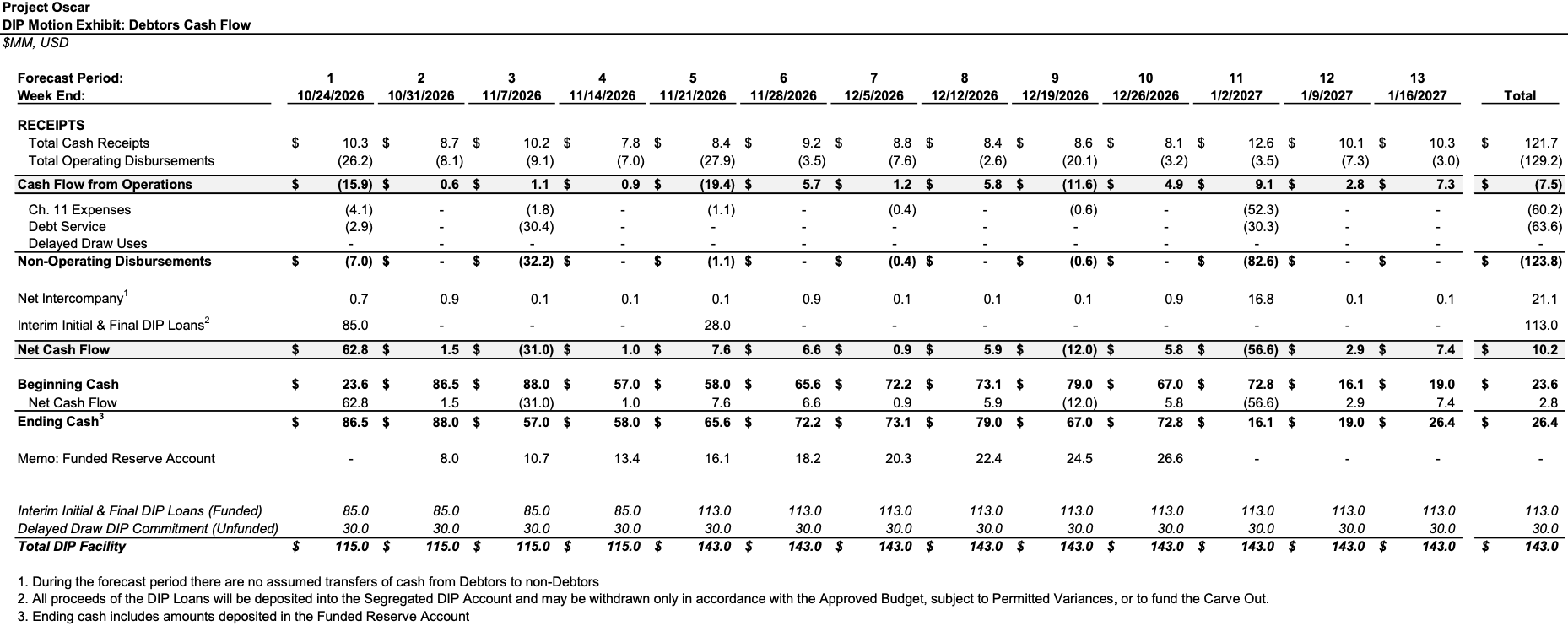
The Chapter 11 Cases will be funded through a DIP facility of up to $143 million from KED and its affiliates, as DIP lenders, with Cantor Fitzgerald Securities as administrative and collateral agent. GIH is the borrower, and every other Debtor guarantees the obligations jointly and severally. The facility is all new money, with no roll-up of prepetition debt, and it does not prime the liens of the prepetition secured parties, who have consented to the Debtors’ use of cash collateral.
- Structure: Up to $143 million comprising (i) $113 million of term loans, of which $85 million is available on entry of the interim order and $28 million on entry of the final order, and (ii) $30 million of delayed-draw loans are available on interim entry, but only for specified budgeted payments.
- Interest: Term SOFR plus 5.00%, paid in kind, with a default rate increase of 2%.
- Fees: The only fee is a 2.0% exit fee on outstanding DIP loans, payable in cash only if the RSA is terminated under its fiduciary-out provisions.
- Conversion: If the Plan is consummated, the DIP loans will be converted to common and preferred equity. The term loans and accrued interest convert into new common equity, and any outstanding delayed-draw loans convert into new preferred equity.
- Collateral and Priority: First lien on the segregated DIP account, on the 35% of foreign-subsidiary equity not pledged to the prepetition lenders, and on other previously unencumbered property, plus junior liens on prepetition collateral.
- Adequate Protection: Holders of the revolving loans, Term Loans and 11.25% Secured Notes receive replacement liens and superpriority claims to the extent the value of their collateral declines. They also receive current cash payment of interest at the non-default rate, scheduled amortization (including on KED’s EUR Term Loans) and their advisors’ fees.
- Investigation Budget: None. No DIP proceeds, collateral or cash collateral may be used to investigate or challenge the claims or liens of the DIP lenders or the prepetition secured parties, other than to contest whether a default has occurred.
- Covenants: The Debtors must keep at least $15.0 million of liquidity at all times. Spending is subject to the approved budget, with disbursement variances tested every two weeks against a 20% limit.
Initial DIP Budget
Plan Sponsor Investment
According to the First Day Declaration, the RSA provides for a total investment by the Plan Sponsors of up to $533 million, made up of two components:
- New Equity Investment. Under an equity commitment letter (the “ECL”), the Plan Sponsors will invest $433.2 million, less any DIP term loans outstanding at emergence, which convert into equity rather than being repaid. The new cash is capped at $320.2 million: $158.2 million from KED and $162.0 million from the Getty family. If GIH’s cash at emergence would exceed a $50 million minimum after closing payments, the cash investment is reduced dollar for dollar.
- Conversion of Existing Debt. KED will convert approximately $100 million (€87.6 million of principal) of EUR Term Loans into reorganized equity.
Additionally, if any of the $30 million of delayed-draw DIP loans are outstanding at emergence, they convert into new preferred equity without reducing the cash investment, raising the total to up to $563 million.
According to the Plan documents, the new equity proceeds fund the $170.2 million cash recovery for Unsecured Notes holders and the repayment in full of the $150 million revolver as it rolls into the new revolving facility. In return, the Plan Sponsors receive 100% of the new common equity, subject only to dilution of up to 10% from a management incentive plan (the “MIP”). The equity is split between them in proportion to their contributions in a final allocation set shortly before emergence.
Treatment of Claims
- DIP Claims: At emergence, delayed-draw principal converts into reorganized preferred equity, which is not diluted by the MIP. All other DIP amounts, including accrued interest on all DIP loans, convert into reorganized common equity subject to MIP dilution of up to 10%.
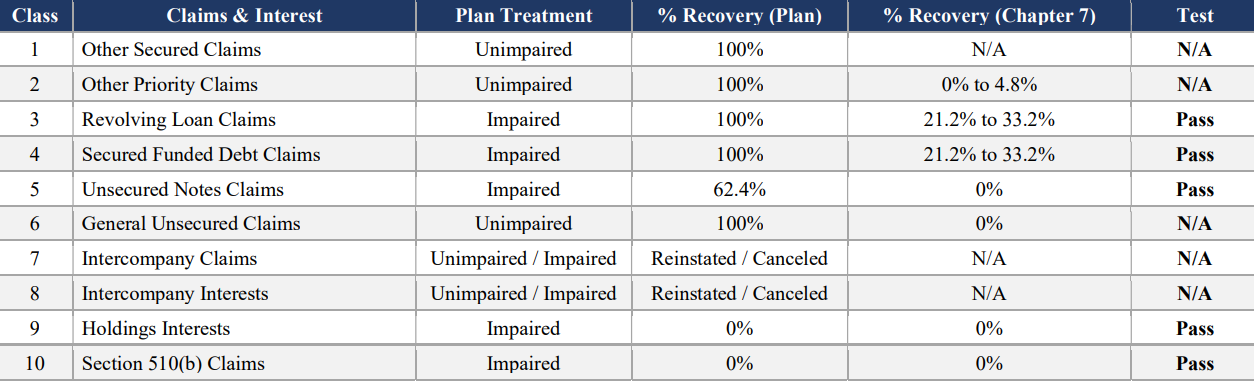
- Classes 1, 2 and 6: Other secured, other priority and general unsecured claims ride through unimpaired.
- Class 3 (Revolving Loans): The $150.0 million of revolver principal converts dollar-for-dollar into an amended and restated $150.0 million revolving credit facility (the “New RCF”). The New RCF is then repaid in full from new equity investment proceeds.
- Class 4 (Secured Funded Debt): Each instrument converts dollar-for-dollar into a new first-lien exit facility, with accrued interest paid in cash. The holders forgo an approximately $50 million make-whole across the three instruments.
- 11.25% Secured Notes ($539.9 million) and USD Term Loans ($40.1 million): These exchange into $580.0 million of new senior secured notes (the “New Notes”). USD lenders that decline New Notes receive new USD term loans instead.
- EUR Term Loans (€407.0 million): Holders other than KED receive new EUR term loans (the “New EUR Term Loans”) in an equal principal amount. KED’s €87.6 million of EUR Term Loans are equitized into reorganized common equity.
- Class 5 (Unsecured Notes): Impaired. Noteholders share a fixed $170.2 million cash recovery, approximately 63% of the $270 million principal.
- Class 9 (Equity Interests): Cancelled, including the Plan Sponsors’ GIH shares.
- Class 10 (Warrant Claims): Cancelled. This class consists mainly of claims by former holders of GIH’s public warrants, including the pending Berner/Lapp and New York State judgments and any warrant claims not yet asserted. Section 510(b) of the Bankruptcy Code provides that damages claims arising from the purchase or sale of a company’s securities rank no higher than the securities themselves. Because the warrants were rights to buy GIH common stock, the Debtors treat these claims as equal in priority to common equity, which receives nothing under the Plan. Confirmation would make that treatment final and binding on every warrant claimant, whether or not it filed a claim or voted, and would bar any further warrant litigation inconsistent with the Plan. Claimants who dispute the treatment must object to confirmation. The Plan also prohibits the Debtors from seeking to subordinate or recharacterize claims held by the RSA parties, the DIP lenders or the new equity investors, including the Plan Sponsors.
- Settlement Lane: The RSA’s consenting creditors agree not to oppose a warrant settlement as long as it neither adversely affects the Unsecured Notes treatment nor impairs the Classes 3 and 4 recoveries.
- Stakes: The Disclosure Statement cites approximately $99.5 million of pending judgments and interest in the Berner/Lapp and New York State actions. It also estimates more than $275 million of unasserted warrant claims. Together these exceed $374 million, approximately 2.2 times the Unsecured Notes Recovery.
Post Emergence Capital Structure
The Plan Sponsors would own 100% of the reorganized equity, subject to an MIP of up to 10% set by a board they designate. Based on the ECL’s contribution formula, approximately 70% would go to KED for its equity investment, DIP claims and EUR Term Loans, and approximately 30% to the Getty family entities for their share of the equity investment. KED would also receive reorganized preferred equity for any delayed-draw DIP principal outstanding at emergence. The exit term sheet sets out three exit facilities as follows:
- New Notes: $580 million, due April 2032. The coupon is 10.500% above 3.00x first-lien leverage, falling to 9.000% at 2.00x or below. USD lenders that decline New Notes would instead receive new USD term loans.
- New EUR Term Loans: €313.9 million, per the exit term sheet, issued to prepetition EUR term lenders other than KED. The loans mature in April 2032 at EURIBOR plus 5.25% to 3.75% on the same leverage steps. They amortize 5% a year in quarterly installments beginning with the quarter ending June 30, 2027.
- New RCF: $150 million, due January 2031, undrawn at emergence. It carries a 4.75x leverage covenant, tested quarterly beginning June 30, 2027 and on a pro forma basis at each draw.
All three would rank pari passu on shared collateral, with JPMorgan as controlling secured party. The collateral would include a 100% pledge of direct foreign-subsidiary equity, up from 65% prepetition.
Trademark Option Agreement
Under a 1998 agreement, Getty Investments, the Getty family’s holding vehicle, holds an option over the “Getty Marks,” the name under which the company operates. The RSA requires Getty Investments’ consent to any restructuring document affecting the agreement, including the DIP financing documents, and Getty Investments may enforce that requirement as a third-party beneficiary. Any interference with the agreement permits termination of the RSA, which would also end the Plan Sponsors’ equity commitment.
The Plan assumes the agreement “as is” and exempts it from the provisions that would otherwise cancel or override it. The trademarks vest in the reorganized company subject to Getty Investments’ rights and cannot be sold or pledged without its consent and that of the Plan Sponsors. If the Plan does not go effective, Getty Investments retains all of its rights. The restructuring therefore changes the company’s ownership without altering the arrangement governing the Getty name.
Projected Recovery Against a Hypothetical Chapter 7 Liquidation
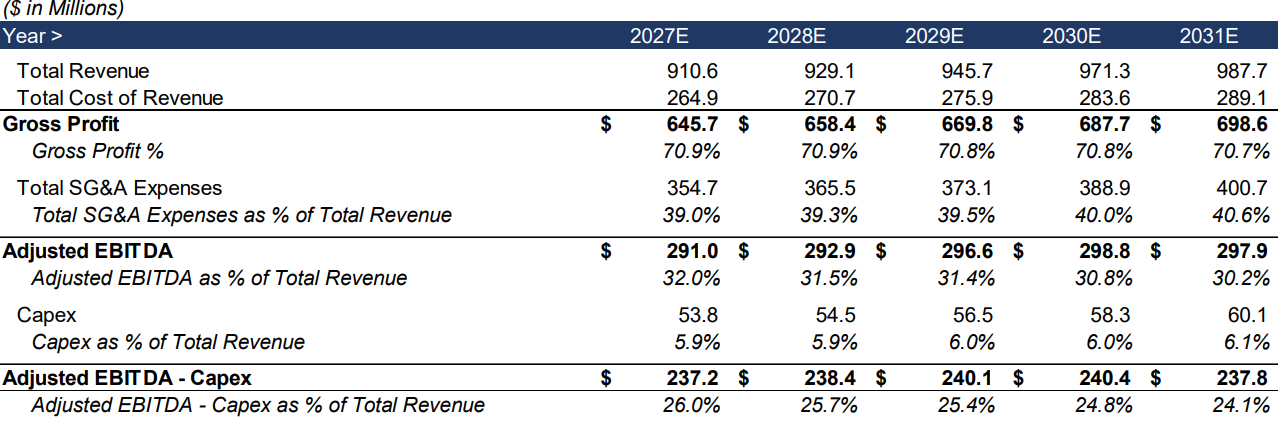
Projected Consolidated Statement of Operations
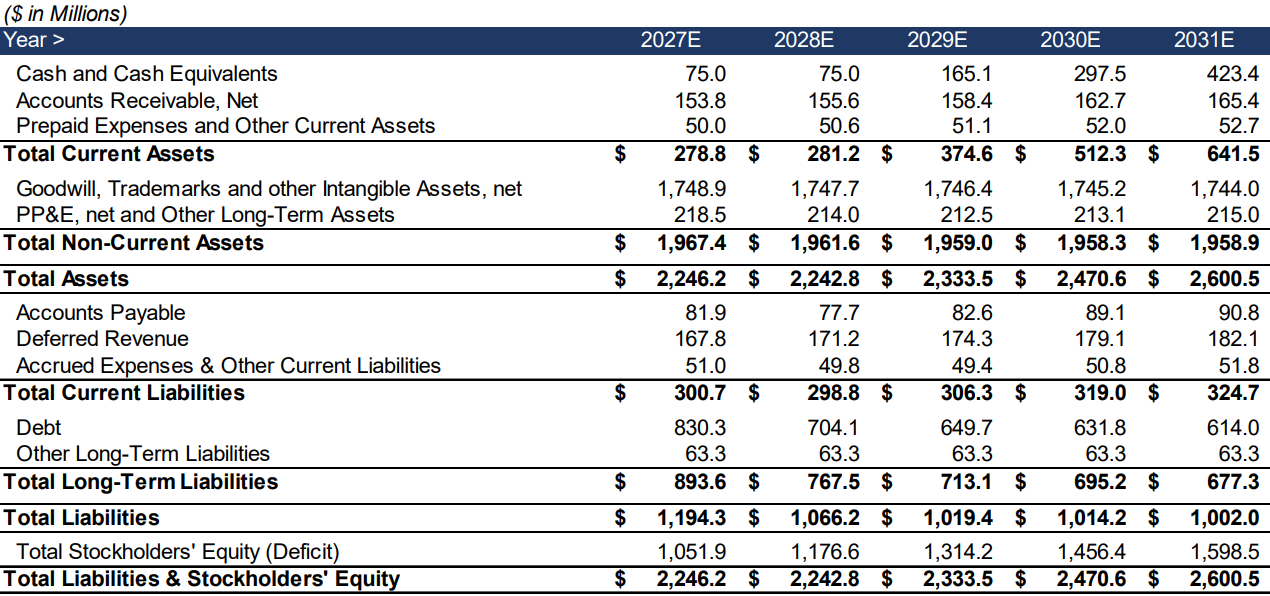
Projected Consolidated Balance Sheet
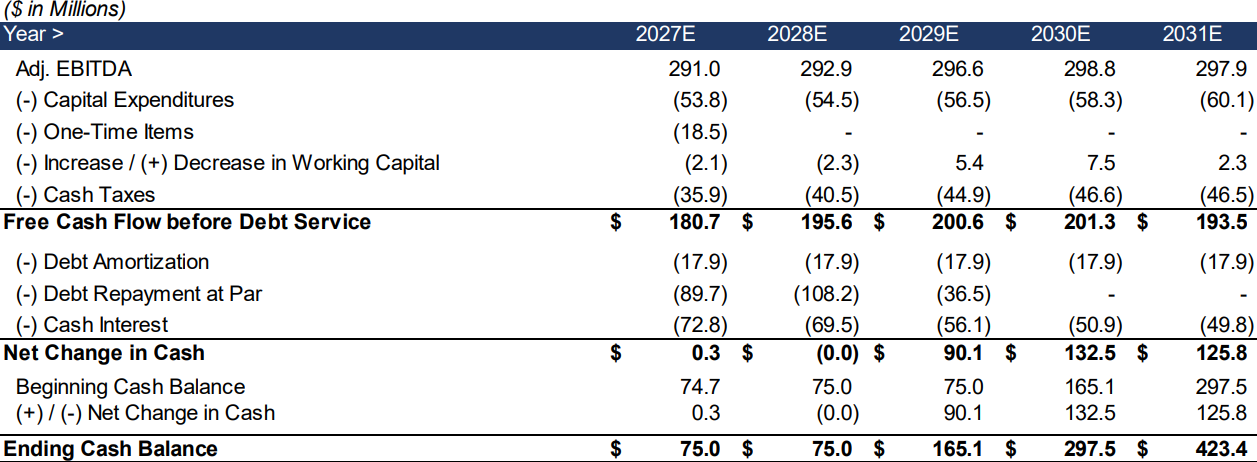
Projected Consolidated Free Cash Flow
Explore Bondoro Insights for live case dockets and comprehensive coverage of material filings from petition to plan confirmation.
Stay informed on every Chapter 11 bankruptcy case with liabilities exceeding $10 million. Subscribe for free to have our coverage delivered directly to your inbox, and explore our full archive of past summaries.
Subscribers can also opt in to timely filing alerts by updating their email preferences in Account Settings.


