Case Summary: ZOM Living Chapter 11
ZOM Holding, Inc. and affiliates filed Chapter 11 after a $308.6 million Arizona judgment for breaching a 2019 non-circumvention agreement. They plan to sell substantially all assets, with related non-debtor ZOM Holding, LP as proposed DIP lender and stalking horse, and seek to continue the appeal.

A deck version of this summary is also available HERE.
Business Description
Headquartered in Winter Springs, FL, ZOM Holding, Inc. (“ZHI”) and its two debtor affiliates, ZOM Associates, Inc. (“ZAS”) and ZH Development I, LLC (“ZH Dev” and, together with ZHI and ZAS, the “Debtors”), are part of an organization that specializes in the construction and management of multifamily and senior living communities and operate under the “ZOM” and “ZOM Living” names. The business was built on a co-investment model. For each project, the Debtors partnered with a lender and an equity investor, retained a small interest and served as developer, generally selling the completed property to a third party.
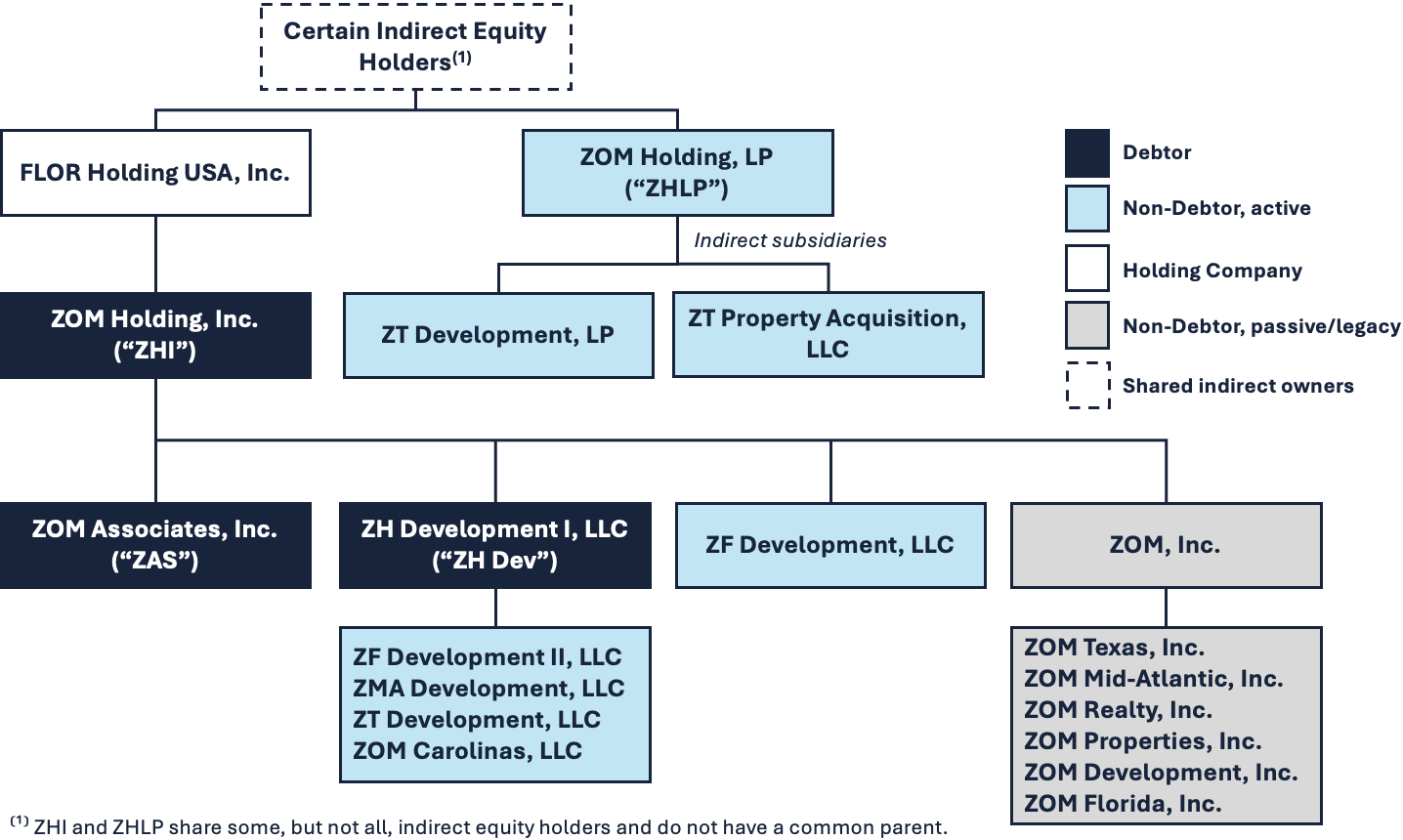
ZHI has traditionally served as the holding company for the development business and holds the federal trademarks covering the “ZOM,” “ZOM Living” and “ZOM Senior Living” names. It is wholly owned by non-Debtor FLOR Holding USA, Inc. and, in turn, owns the other two Debtors. ZAS is the employment company that houses the workforce supporting the business, and ZH Dev is one of the organization’s developer entities.
Over the past decade, new development has moved outside the Debtors. In 2017, as part of a tax-driven restructuring, certain of ZHI’s equity holders formed non-Debtor ZOM Holding, LP (“ZHLP”) to serve as the holding company for new projects, and ZHLP continues to develop real estate today. Apart from two legacy projects on which ZHI may still earn development fees, the Debtors now largely support that platform.
ZOM Holding, Inc. and certain affiliates⁽¹⁾ filed for Chapter 11 protection on October 30, 2026 (the "Petition Date") in the U.S. Bankruptcy Court for the Middle District of Florida, reporting $1 million to $10 million in assets and $500 million to $1 billion in liabilities.
⁽¹⁾ For a complete list of Debtor entities, see organizational structure chart below.
Corporate History
Formation of the Debtors
ZOM traces its roots to the Netherlands. According to the company, founder Joost Zyderveld built an energy business in Rotterdam in the 1960s, and the ZOM name derives from that venture, Zyderveld Olie Maatschappij. Zyderveld later turned to real estate and moved to Central Florida in 1977, keeping the ZOM name and investing in local projects alongside his Dutch partners. In 1997, he sold the company to Hans van Veggel, and ZOM’s investor base shifted over time from private Dutch capital to U.S. institutions.
The three Debtors were formed between 1996 and 2011 as the business grew. ZHI was incorporated in Florida in 1996 to serve as the holding company for the development business. ZAS followed in Florida in 2009 as the employment company supporting that business, and ZH Dev was formed in Delaware in 2011 as one of its developer entities. ZHI sits at the top of the Debtor group as the sole shareholder of ZAS and the member and manager of ZH Dev. Non-Debtor ZOM Partners, LP holds a variable profits interest in ZH Dev that changes based on certain employment contracts, though, according to the First Day Declaration, it has no control or authority over the entity.
The 2016–2017 Restructuring and ZHLP
The Debtors’ most important counterparty in these cases is ZHLP. ZHLP is ZHI’s prepetition secured lender, its proposed DIP lender and its expected stalking horse bidder, and it houses the development business the Debtors once ran.
ZHLP was formed as part of a tax-driven restructuring. According to the First Day Declaration, certain of ZHI’s direct and indirect equity holders began exploring a more efficient tax structure for new development projects in 2016, and ZHLP was formed in Florida the following year to serve as the holding company for those projects.
ZHLP acquired ZHI’s investments in four development partnerships, along with ZHI’s preacquisition costs. In exchange, ZHLP took on a $16 million unsecured loan in favor of ZHI, which ZHLP paid in full by the end of 2021. ZHLP also assumed future obligations under the partnership investments and all risk of loss associated with the preacquisition costs. ZHI also made a $5 million upfront cash payment to ZHLP.
The 2019 Arizona Transaction
In 2019, Gray Development Group, a Phoenix-based multifamily developer led by Bruce Gray, approached ZHI about developing four Arizona parcels. The parcels were owned by single-purpose entities affiliated with Gray. In connection with those discussions, ZHI signed a non-circumvention agreement with Gray Services LLC.
ZT Development, LP, an indirect ZHLP subsidiary, agreed to buy the parcels but terminated the purchase agreement in April 2020. The parcels were ultimately acquired by ZT Property Acquisition, LLC, another indirect subsidiary of ZHLP, out of the Gray entities’ bankruptcy cases, which had been converted to Chapter 7 in 2020. The Gray entities subsequently sued ZHI in Arizona state court for breach of the non-circumvention agreement, and that litigation remains at the center of the Debtors’ Chapter 11 cases, discussed further below.
Organizational Structure
Governance and Management
In January 2026, ZHI’s former directors resigned and two independent directors, Colin Adams and Anna Phillips, were appointed as ZHI’s sole directors. Neil Luria of restructuring firm SOLIC has served as Chief Restructuring Officer (“CRO”) of ZHI since January 27, 2026, and of ZAS and ZH Dev since October 16, 2026. The leadership team also includes Greg West (Chief Executive Officer), Jonathan Young (Chief Financial Officer) and Matthew Adler (Chief Investment Officer).
Operations Overview
Revenue and Management Services Agreement
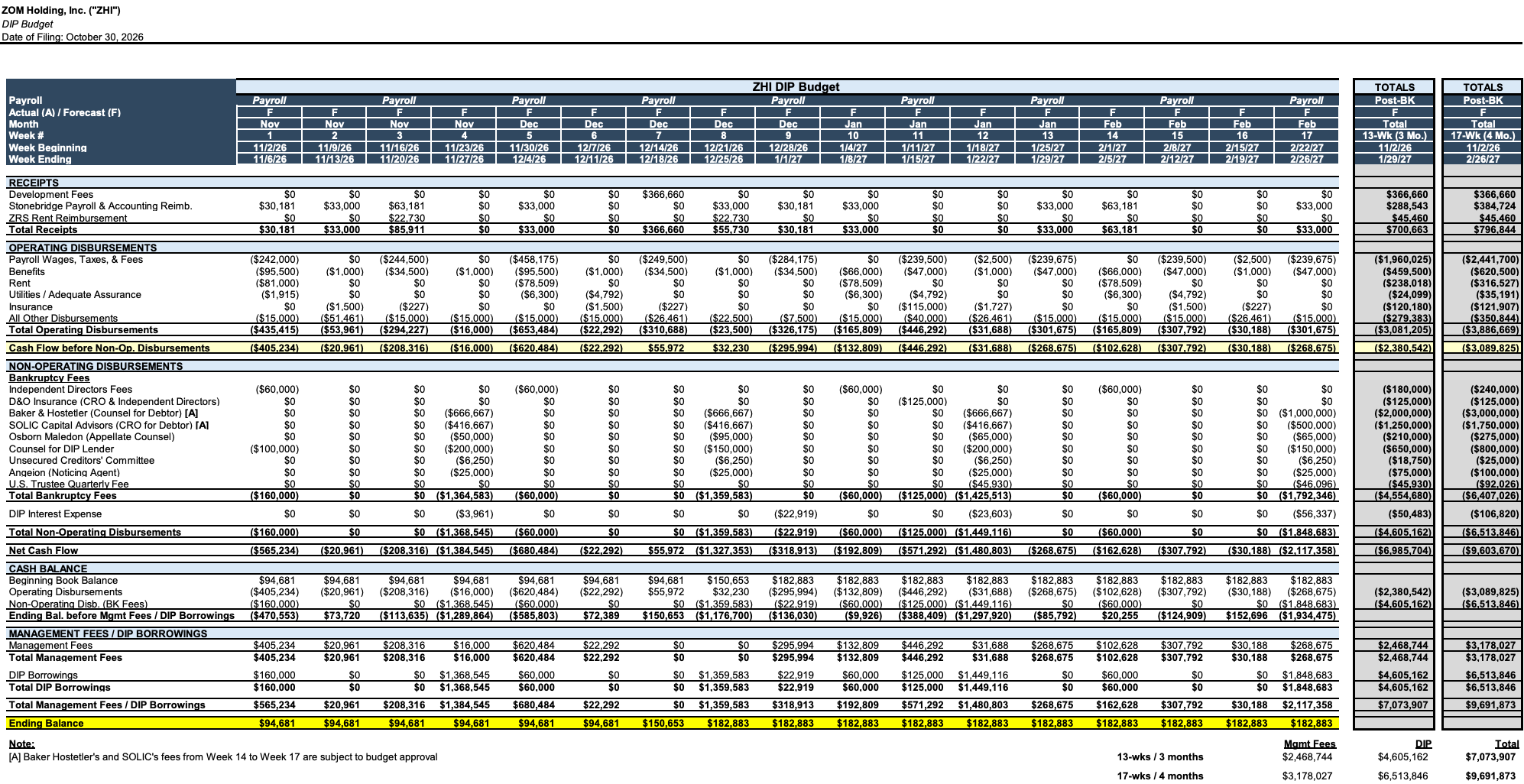
Since new development moved to ZHLP in the 2017 restructuring, the Debtors describe their primary business as providing employees to ZHLP and to non-Debtor Stonebridge REIM Inc. (“Stonebridge”). The relationship with ZHLP is governed by a Management Services Agreement among ZHI, ZAS and ZHLP (the “MSA”). Under the MSA, ZHI and ZAS provide ZHLP with employees and day-to-day services, including accounting, information technology and other administrative functions, as well as the right to use the “ZOM,” “ZOM Living” and “ZOM Senior Living” names in exchange for a management fee. The Debtors' 17-week DIP budget projects approximately $3.2 million of ZHLP management fees, or 80% of projected operating inflows.
The Debtors’ remaining revenue comes from a few smaller sources.
- Stonebridge reimburses payroll and pays an accounting management fee for the Debtor employees who work on its behalf.
- Non-Debtor ZRS Management, LLC pays rent reimbursements, which will end on January 1, 2027.
- The Debtors have also continued to receive development and construction-management fees since the restructuring, and ZHI may still earn development fees on two legacy projects if certain incentives are met. The first is MetWest in Tampa, FL, a 375-unit community developed with MetLife Investment Management that opened as Emerald at MetWest in July 2026. The second is Hazel & Azure in Arlington, VA, whose project-level loan ZHI guarantees.
Altogether, the Debtors reported gross revenues of approximately $17.0 million in fiscal 2025 and approximately $14.5 million year to date, before any adjustments.
Debtors' Assets
The Debtors’ assets consist primarily of their workforce, trademarks, insurance policies, office furniture and equipment, development interests and causes of action. In addition to the Winter Springs headquarters, the Debtors have offices or share office space in Arizona, Texas, North Carolina and Massachusetts, all of which are leased.
Workforce
As of the Petition Date, the Debtors employed 31 full-time employees, 27 salaried and four hourly, along with one independent contractor. The workforce provides real estate development and management, accounting, information technology and other administrative services. Much of that work is performed for non-Debtor affiliates rather than for the Debtors themselves. Some employees serve ZHLP under the MSA, while others serve Stonebridge, which reimburses the Debtors for their cost. A handful of employees are formally tied to those entities: two have employment contracts with, or are otherwise employed by, ZHLP subsidiaries, and five by Stonebridge. The Debtors pay these employees directly and are reimbursed by ZHLP or Stonebridge.
Prepetition Obligations
As of the Petition Date, the Debtors’ prepetition obligations primarily consist of approximately $3.8 million of secured debt, an approximately $308.6 million judgment obtained by Gray entities, plus interest (the “Gray Judgment”), and approximately $232.6 million of contingent guaranty claims. The Debtors estimate total unsecured claims of approximately $541 million, which also include bond indemnity obligations related to ongoing projects and certain vendor payables.
Secured Debt
The Debtors' only material secured debt is a $3.8 million line of credit that ZHLP extended to ZHI as sole borrower (the "ZHLP Loan Facility"), secured by all of ZHI's assets. The facility originated on February 4, 2026, and ZHI drew seven further advances, the last on October 21, 2026.
The Gray Judgment
Gray Services LLC and Gray Development LLC, entities affiliated with Arizona developer Bruce Gray, obtained a final judgment against ZHI on May 12, 2026, for breach of a 2019 non-circumvention agreement (see Events Leading to Bankruptcy). The judgment totals approximately $308.6 million, consisting of approximately $296.4 million of compensatory damages and approximately $12.1 million of attorneys’ fees and costs. It also awards 8.25% interest, accruing on the compensatory damages from the October 3, 2025 jury verdict to the judgment date and on the full judgment amount from the judgment date until paid. ZHI lists the claim at approximately $308.6 million, marked contingent and disputed.
Guaranty Obligations
ZHI also guarantees loans on five ZOM real estate projects, each listed as a contingent claim on ZHI’s top-20 unsecured creditor list:
- $152.8 million PNC Bank loan: Hazel & Azure, a 491-unit community in Arlington, VA, completed in January 2025.
- $57.7 million Truist Bank loan: Azola Avery Centre, a 359-unit community in Round Rock, TX, delivered in June 2025.
- $9.9 million CB&S Bank land loan: a site on Carpenter Fire Station Road in Cary, NC, planned for Azalea at the Park, a 330-unit community.
- $6.2 million Santander Bank loan: Ludlam Trail Phase II in Miami, part of ZOM’s MiLine Miami development.
- $6.0 million Santander Bank loan: Ludlam Trail Phase III in Miami, also part of MiLine Miami.
Top Unsecured Claims

Events Leading to Bankruptcy
The Arizona Properties and the Non-Circumvention Agreement
In May 2019, Bruce Gray approached ZHI about developing four parcels in Phoenix and Scottsdale (the “Arizona Properties”). The parcels were owned by four single-purpose entities affiliated with Gray (the “Gray SPEs”) and were encumbered by substantial debt. According to the First Day Declaration, the lender had already begun foreclosure proceedings before Gray contacted ZHI.
In connection with those discussions, ZHI entered into a Mutual Confidentiality and Non-Circumvention Agreement with Gray Services LLC dated May 29, 2019 (the "Non-Circumvention Agreement"). Under the agreement, Gray provided ZHI with information it considered confidential, and each party agreed not to initiate "any transactional relationship that bypasses one of the Parties" in connection with "the subject Transactions or any related future Transactions."
The Arizona Bankruptcy Sale
Later in 2019, the Gray SPEs agreed to sell the Arizona Properties to ZT Development, LP ("ZT Development"), an indirect ZHLP subsidiary, however, ZT Development terminated the agreement in April 2020. Subsequently on April 21, 2020, the Gray SPEs and a related Gray entity filed for Chapter 11 in Arizona (the "Arizona Bankruptcy Cases"), and the court converted the cases to Chapter 7 that August.
The properties were sold out of those cases later that year. On November 25, 2020, the Arizona bankruptcy court approved an $82 million sale of the Arizona Properties to ZT Property Acquisition, LLC ("ZT Property Acquisition"), another indirect ZHLP subsidiary (the "Arizona Bankruptcy Sale Order"). Based on testimony from the trustee and from Greg West "on behalf of ZT," the court found ZT Property Acquisition to be a good-faith purchaser under section 363(m), which protects a completed sale from being undone on appeal.
The Gray Litigation
Almost two years after the sale, in 2022, Gray Services LLC and Gray Development LLC (the “Gray Plaintiffs”) sued ZHI in Maricopa County Superior Court, an Arizona state court (the “Gray Litigation”). The complaint asserted claims for breach of contract, unjust enrichment and breach of the implied duty of good faith and fair dealing. According to the First Day Declaration, all of the claims were based on the Non-Circumvention Agreement and the sale of the Arizona Properties to ZT Property Acquisition.
Gray alleged that ZHI breached its covenant not to circumvent Gray. According to Gray’s trial counsel’s post-verdict release, the parties were to pursue development of the sites together, but ZOM instead acquired the parcels through an affiliate and began developing them. The claims alleged that ZOM “could not circumvent the Gray companies’ interests.” Gray sued only ZHI, the party that signed the Non-Circumvention Agreement, and not ZT Property Acquisition, the entity that bought the parcels.
The Reopened Arizona Cases and the Clarification Order
The lawsuit prompted a parallel fight in the court that had approved the sale. In November 2024, ZT Property Acquisition, joined by ZT Development and ZHI (collectively, the “ZOM entities”), asked the Arizona Bankruptcy Court to reopen the Arizona Bankruptcy Cases. The two sides framed the dispute differently:
- The ZOM entities treated it as a property question. Gray’s damages were the value of developing the parcels, and the free-and-clear sale had already transferred that right to the buyer. In their view, the suit sought to recover value the Arizona Bankruptcy Sale Order had already disposed of, and they asked the court to enjoin it.
- Gray treated it as a contract question. Its claims ran only against ZHI for breaching the agreement and concerned the project plans and confidential information Gray had shared with ZHI, not ownership of the land.
On September 12, 2025, four days before trial, the Arizona Bankruptcy Court ruled for the ZOM entities on the property question but declined to stop the lawsuit (the “Arizona Bankruptcy Clarification Order”). It held that the Gray entities had transferred all rights in the parcels, including development rights, into the Gray SPEs without reservation, and that those rights passed to ZT Property Acquisition in the sale, a point the Gray entities conceded. On the contract question, because the Non-Circumvention Agreement was between parties that were not debtors in the Arizona Bankruptcy Cases, the court left liability to the Maricopa County Superior Court and made no binding determination on liability or damages. It nonetheless commented that it was difficult to see how Gray could claim damages “based on the value of a development that was impossible to complete.” The Maricopa County Superior Court later excluded the order from evidence at trial, a ruling ZHI now challenges on appeal.
Trial, Verdict and Judgment
The Gray Litigation went to a 12-day jury trial in the Maricopa County Superior Court beginning September 16, 2025. On October 3, the jury found ZHI liable for breach of contract and breach of the implied duty of good faith and fair dealing and awarded approximately $148.2 million to each Gray Plaintiff, for a combined total of approximately $296.4 million. The damages represent the profits Gray claimed it would have earned from developing the Arizona Properties. The Maricopa County Superior Court entered final judgment on May 12, 2026, for approximately $308.6 million plus interest.
The Appeal
ZHI appealed the Gray Judgment to the Arizona Court of Appeals on May 26, 2026, and filed its opening brief on September 30, 2026. The Gray Plaintiffs’ answering brief is due December 9, 2026. ZHI seeks reversal on two grounds: that Gray failed to prove lost-profit damages with reasonable certainty, and that Gray recovered profits from rights it never owned. In the alternative, ZHI seeks a new trial based on four asserted errors by the Maricopa County Superior Court:
- measuring damages from May 2019, without evidence of a breach at that time
- admitting Gray’s expert testimony on lost profits
- excluding the Arizona Bankruptcy Clarification Order from evidence
- refusing a jury instruction that Gray never owned the parcels or the right to develop them
Settlement Negotiations and Potential Estate Claims
While the appeal was pending, the parties pursued a settlement. Beginning in May 2026, ZHI and ZHLP produced thousands of pages of documents to Gray, held several informal settlement conferences and attended a full-day mediation on July 28 with mediator Antonio Piazza. Negotiations continued for several months afterward before reaching an impasse. Throughout this period, ZHI was also in discussions with its lenders to avoid defaults under its guaranties.
In connection with those negotiations, ZHI, through SOLIC, investigated potential claims against ZHLP and potential Debtor insiders on theories related to repayment of certain transfers and successor liability. ZHI has made a demand on ZHLP, which contests the claims. ZHI has also entered into tolling agreements covering certain potential claims against professionals involved in the Arizona Bankruptcy Cases and the Gray Litigation.
Florida Enforcement
On October 1, 2026, the Gray Plaintiffs recorded the Gray Judgment in Seminole County, Florida, where ZHI is headquartered, to domesticate it under the Florida Enforcement of Foreign Judgments Act. Under the Act, a recorded out-of-state judgment cannot be executed on, and does not become a lien on the debtor's property, until 30 days after notice of the recording is mailed to the debtor. That period had not ended by the Petition Date, so the Gray Judgment had not yet become enforceable or a lien in Florida.
Chapter 11 Filing
Through these Chapter 11 cases, the Debtors intend to sell substantially all of their assets, including all claims and causes of action, while continuing to operate in the ordinary course and pursuing ZHI’s appeal of the Gray Judgment. According to the First Day Declaration, enforcement of the Gray Judgment outside bankruptcy would cause "immense harm" to the Debtors' other creditors and employees and destroy any remaining value for creditors. A ZHI default on its guaranties of certain ZHLP loans would cross-default those loans, significantly reducing ZHLP's value and the value of the Debtors' claims against ZHLP. The filing itself will cause the Debtors to default under those guaranties, but the Declaration says the obligations may be assumed through the court-supervised sale process. As of the Petition Date, the Debtors were finalizing a stalking horse asset purchase agreement with ZHLP, the proposed DIP lender, or its designee.
DIP Facility
The Chapter 11 cases will be funded by a senior secured, priming, superpriority DIP facility of up to $10.3 million from ZHLP (or its designee), ZHI's prepetition secured lender and the proposed stalking horse bidder. The facility consists of up to $6.5 million of new-money term loans and a $3.8 million roll-up of the prepetition ZHLP Loan Facility. ZHI is the borrower, and ZAS and ZH Dev are guarantors.
- Structure — $1.5 million of new money is available on an interim basis and $5.0 million upon entry of the final order, including up to $1.5 million reserved for Debtor professional fees after day 90. The $3.8 million roll-up takes effect on entry of the final order.
- Pricing — Term SOFR plus 2.50%, paid in kind quarterly, with a 2.00% default rate payable in cash.
- Fees — None, other than the DIP lender's counsel fees and expenses.
- Maturity — The earliest of March 29, 2027; a plan's effective date; approval of a sale to a third party or consummation of a sale to ZHLP; the filing of a claim against ZHLP or its affiliates by or with the support of the Debtors; or 35 days after the Petition Date absent a final order.
- Collateral and Priority — Priming liens on all prepetition collateral, with ZHLP's consent, and first-priority liens on unencumbered assets, including causes of action and avoidance actions, plus superpriority claims, subject to the Carve Out.
- Carve Out — Budgeted professional fees through termination, plus up to $200,000 afterward and $50,000 for a Chapter 7 trustee.
- Adequate Protection — Replacement liens and superpriority claims to the extent of any decline in collateral value, plus reimbursement of ZHLP's fees and expenses.
- Investigation Budget and Challenge Period — $25,000 for a committee, if one is appointed, to investigate the prepetition liens and claims. A challenge must be brought by the earlier of 60 days after the Petition Date or the bid deadline, and bringing one is an event of default.
- Release — Upon entry of the final order, the Debtors would release ZHLP from claims arising from its conduct as DIP lender and as prepetition lender, including lender liability and equitable subordination claims.
- Budget Variance — Tested weekly on a cumulative basis, with a 10% limit on disbursements (0% for professional fees) and a requirement that receipts be at least 90% of budget.
- Milestones — A bidding procedures motion within seven days, the final DIP order and bidding procedures order within 35 days, a sale order within 120 days and closing within 150 days. The Debtors must also address maturities of the guaranteed project loans between November 2026 and March 2027.
- Credit Bid — ZHLP may credit bid the full DIP obligations, with the roll-up subject to challenge.
Initial DIP Budget
First-Day Relief
- Wages (Doc. 11): The Debtors seek authority to pay approximately $252,000 of prepetition employee obligations, consisting of approximately $166,000 of wages and approximately $86,000 of benefits and withholdings, with no employee owed more than the $17,150 priority cap. They also seek to continue their bonus programs, including executive bonuses under individual employment agreements, in consultation with the DIP lender.
- Cash Management (Doc. 15): The Debtors seek to continue using their two PNC Bank accounts, ZHI's operating account and ZAS's payroll account, which held approximately $94,700 combined as of the Petition Date. They also request a waiver of section 345(b) because PNC is not an authorized depository in this region.
- Insurance (Doc. 13): The Debtors seek authority to maintain and renew their insurance program, brokered by Marsh McLennan and CRC Insurance Services, in consultation with the DIP lender. The Debtors do not believe any prepetition premiums are owed.
- Utilities (Doc. 14): The Debtors pay approximately $2,900 per month for utilities and propose an adequate assurance deposit of approximately $1,400, equal to half of one month's average cost, to be held in a segregated account. Utility providers that want additional assurance may request it under proposed procedures.
Explore Bondoro Insights for live case dockets and comprehensive coverage of material filings from petition to plan confirmation.
Stay informed on every Chapter 11 bankruptcy case with liabilities exceeding $10 million. Subscribe for free to have our coverage delivered directly to your inbox, and explore our full archive of past summaries.
Subscribers can also opt in to timely filing alerts by updating their email preferences in Account Settings.


