Case Summary: Karyopharm Therapeutics Chapter 11
Karyopharm Therapeutics filed for Chapter 11 with a prepackaged plan to equitize about $276 million of secured funded debt into up to 55% of a combined company with Ayrmid, subject to competing bids, after payment defaults and what it calls mixed Phase 3 results.

A deck version of this summary is also available HERE.
Business Description
Headquartered in Newton, MA, Karyopharm Therapeutics Inc. ("Karyopharm"), together with its sole Debtor affiliate, KPT Texas LLC ("KPT Texas" and, with Karyopharm, the "Debtors" or the "Company"), is a commercial-stage pharmaceutical company that develops and sells drugs for life-threatening blood cancers and solid tumors.
The Company’s primary compound, selinexor, works by blocking XPO1, a protein that cancer cells use to push tumor-fighting proteins out of the cell nucleus. Selinexor is marketed as XPOVIO, the Company’s only commercialized product, and is sold directly in the United States for multiple myeloma, a blood cancer, and through licensing partners in more than 50 countries and territories.
Karyopharm reported total revenue of $146.1 million for 2025 from XPOVIO product sales and licensing. The Company is also developing selinexor for other cancers, led by an FDA application in myelofibrosis, a rare blood cancer, along with several earlier-stage compounds in its pipeline.
Karyopharm Therapeutics Inc. and its debtor affiliate filed for Chapter 11 protection on November 2, 2026 (the "Petition Date") in the U.S. Bankruptcy Court for the Southern District of Texas, reporting $111.3 million in assets and $441.5 million in liabilities (as of June 30, 2026).
Corporate History
Founding and Initial Public Offering
Karyopharm was founded by Dr. Sharon Shacham and Dr. Michael Kauffman, and was incorporated in Delaware on December 22, 2008. In November 2013, the Company went public, raising approximately $113 million from the IPO, and began trading on the NASDAQ under the ticker KPTI.
2024 and 2025 Refinancings
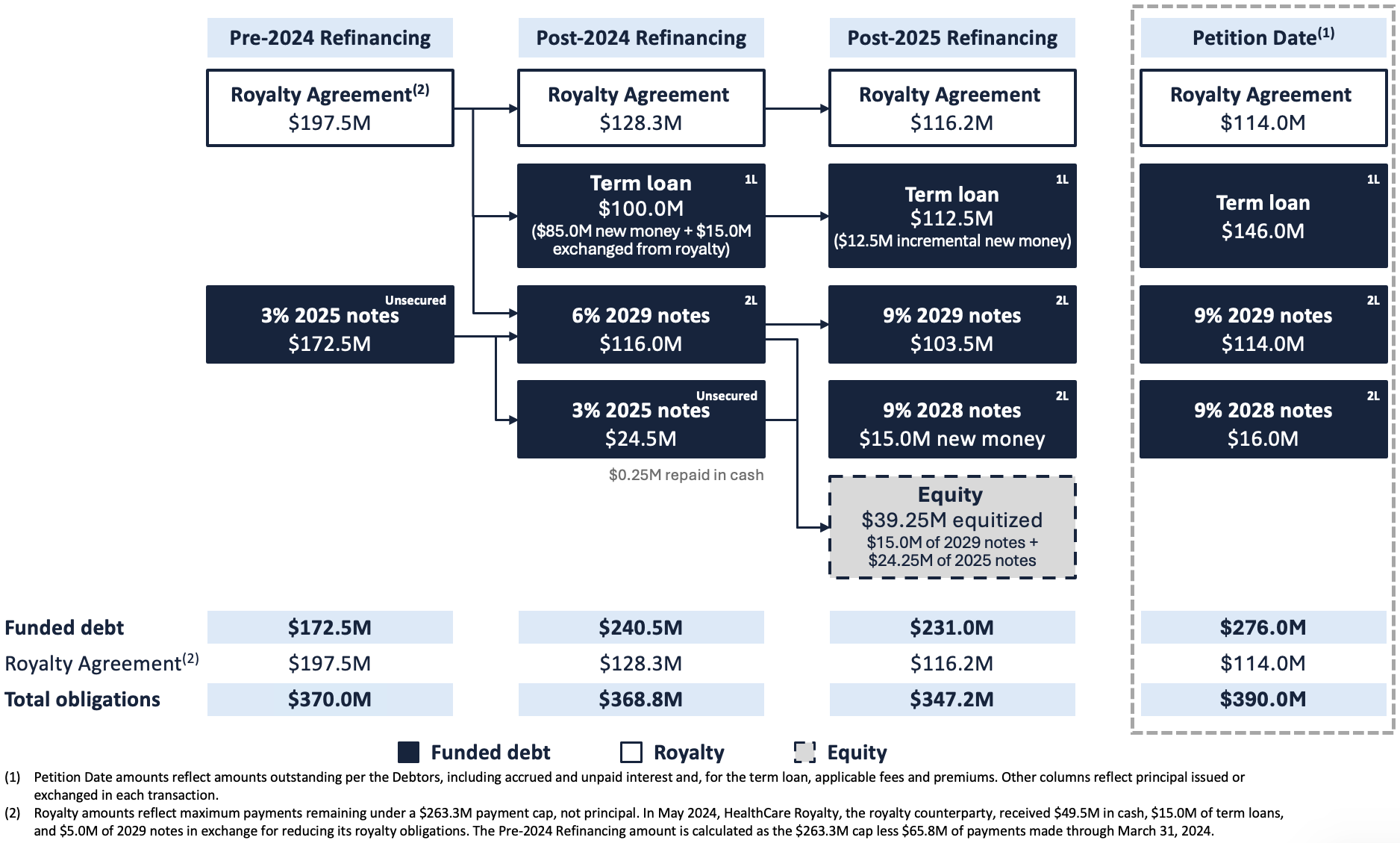
In 2024 and 2025, the Company completed two refinancings that increased its funded debt from $172.5 million to $231 million.
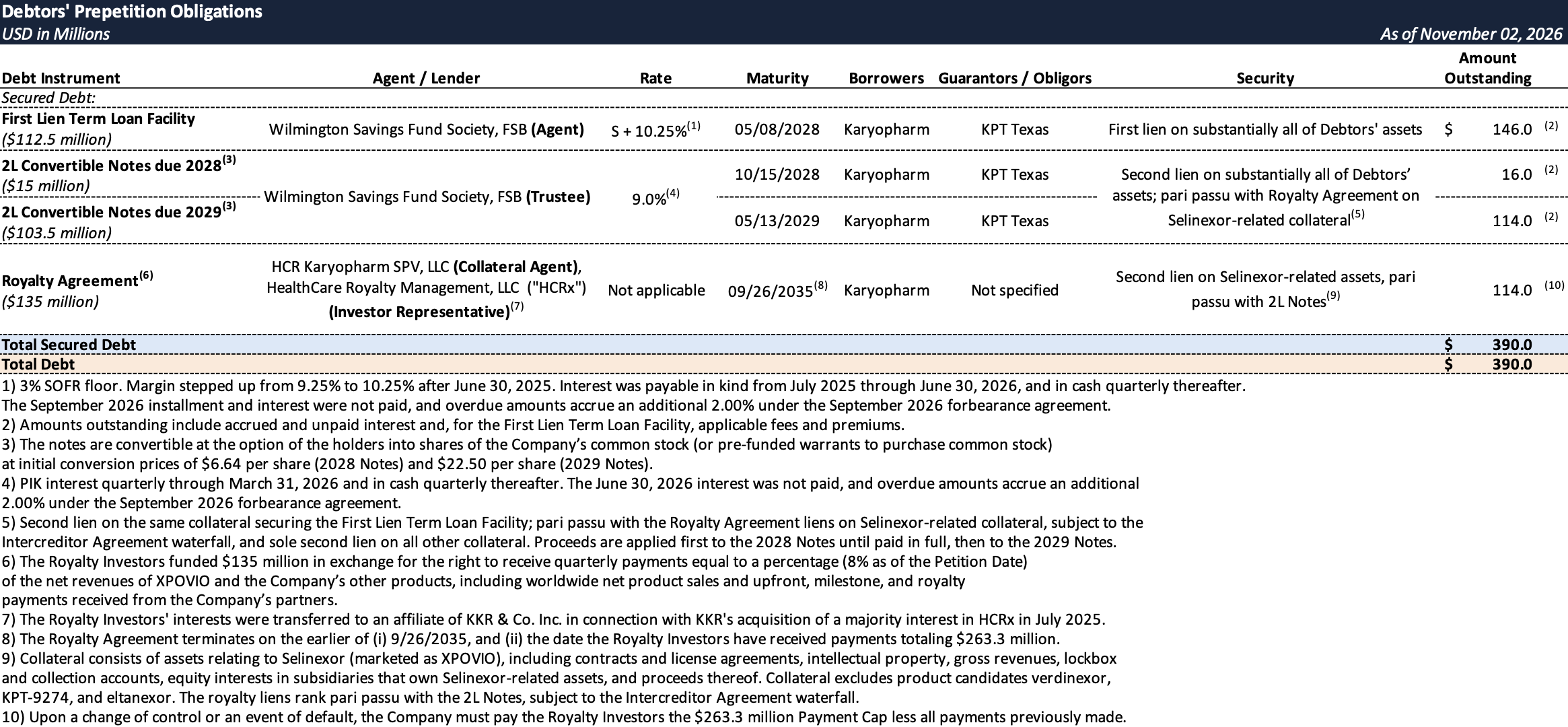
Before the 2024 refinancing, the Company’s debt consisted of $172.5 million of unsecured notes due October 2025 (the “2025 Notes”) and a royalty financing agreement with HealthCare Royalty (“HCR”) (the “Royalty Financing Agreement”), under which the Company owed a percentage of selinexor revenue up to a $263.3 million payment cap. In May 2024, funds managed by Braidwell, Highbridge Capital Management, LLC (“Highbridge”), Davidson Kempner, and Context Capital Management, the four largest holders of the 2025 Notes, exchanged approximately $148 million of those notes at 75% of face value for new second lien convertible notes due 2029 (the “Original 2029 Notes”). The Company also entered into a new $100 million first lien term loan, funded with $85 million of cash from existing 2025 Notes holders and $15 million from HCR in exchange for royalty obligations. HCR also reduced its royalty claim in exchange for a portion of the Original 2029 Notes and a cash payment.
In October 2025, facing the maturity of the remaining $24.5 million of 2025 Notes and missed interest and royalty payments, the Company completed a second round of transactions with its existing creditors (the “October 2025 Transactions”) to fund operations until topline data from a Phase 3 trial in its lead development program. The October 2025 Transactions provided for:
- New money — A $12.5 million incremental term loan, and $15 million of new second lien convertible notes due 2028 (the “2028 Notes”), purchased by holders of the Original 2029 Notes.
- Note exchanges — The exchange of $101 million of Original 2029 Notes for $103.5 million of new second lien convertible notes due 2029 (the “2029 Notes”), and the conversion of the remaining $15 million of Original 2029 Notes into equity. Of the remaining $24.5 million of 2025 Notes, $24.25 million was converted into equity and $0.25 million was repaid at maturity.
- Payment relief — A waiver of royalties on revenue from April 1, 2025 through March 31, 2026, in exchange for an increase in the royalty rate from 7% to 8%, and a temporary $15 million reduction in the minimum liquidity covenant.
The Company also raised approximately $8.8 million through a concurrent private placement of equity.
Organizational Structure
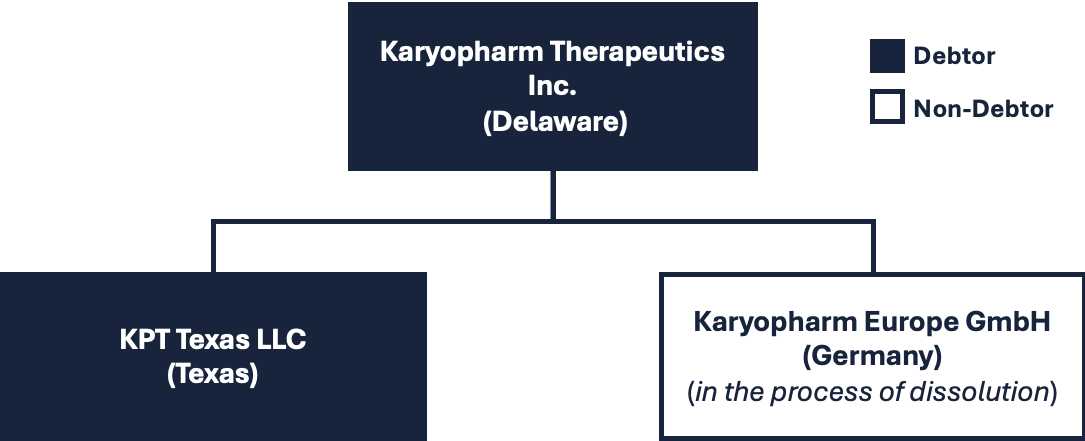
Karyopharm is the sole member of KPT Texas, a Texas limited liability company, and owns non-Debtor Karyopharm Europe GmbH (Germany), which is in voluntary dissolution.
Operations Overview
XPOVIO Approvals
Between July 2019 and December 2020, the FDA approved XPOVIO for three uses:
- Multiple myeloma after four or more prior treatments (July 2019) — Approved for use with the steroid dexamethasone in patients who had been through at least four prior treatments and no longer responded to the main existing myeloma drugs.
- Multiple myeloma after at least one prior treatment (December 2020) — Extended XPOVIO, in combination with bortezomib and dexamethasone, to a broader group of patients who had received at least one prior treatment.
- Diffuse large B-cell lymphoma (“DLBCL”) (June 2020; withdrawn 2026) — Accelerated approval for relapsed or refractory DLBCL, a common and aggressive cancer of the white blood cells in the lymph nodes, in patients whose disease had returned or stopped responding to treatment. In March 2026, at the FDA’s request, the Company agreed to withdraw the approval after it was unable to complete the required confirmatory trial, and the withdrawal took effect April 30, 2026.
Outside the United States, the drug is sold as NEXPOVIO. It received conditional approval in Europe in March 2021 and in the United Kingdom in May 2021, and both were converted to full approvals, in July 2022 and February 2023, respectively.
Other Selinexor Development
Beyond XPOVIO’s approved uses, the Company has tested selinexor in other cancers and in new myeloma combinations:
- Myelofibrosis (lead program) — The Company is pursuing the indication through two trials. The more advanced trial, SENTRY, is a Phase 3 trial testing selinexor plus ruxolitinib against ruxolitinib alone in patients who had not yet started ruxolitinib or similar drugs. In March 2026, SENTRY met its goal of shrinking patients’ enlarged spleens but not its goal of improving symptoms. In July 2026, the FDA indicated in writing that the spleen results could support accelerated approval, subject to further discussion of the supporting data and the path to full approval. On August 31, 2026, the Company submitted a supplemental new drug application (the “sNDA”) for the combination as an expanded use of XPOVIO. The Company expects to learn by approximately November 10, 2026 whether the application has been formally accepted. The second trial, SENTRY-2, is a mid-stage trial that has been testing selinexor alone since mid-2024, with initial results expected in the second half of 2026.
- Endometrial cancer (winding down) — A Phase 3 trial launched in late 2022 tested selinexor as a maintenance treatment after chemotherapy in patients with a genetic subtype of advanced or recurrent endometrial cancer, and was redesigned in early 2025 in response to FDA feedback. On July 30, 2026, the Company announced that the trial did not meet its primary goal. The Company is winding down the program to focus its resources on myelofibrosis and multiple myeloma.
- Multiple myeloma combinations — The Company has also sought to broaden selinexor’s role in myeloma through the Phase 3 EMN29 trial, run with the European Myeloma Network, which is testing an all-oral combination of selinexor with two other myeloma drugs and is expected to produce initial results in the second half of 2026.
Other Compounds Development
The Company has also developed several compounds beyond selinexor, none of which has been approved for human use:
- Eltanexor (KPT-8602) — A second-generation compound that works the same way as selinexor, eltanexor was studied in an early- to mid-stage trial, but its development has been on hold since January 2024 as the Company focused resources on its late-stage selinexor programs.
- KPT-9274 — Unlike selinexor, KPT-9274 works by blocking two proteins that cancer cells rely on for energy and growth. The Company has been evaluating development options for the compound.
- KPT-350 — Another related compound, KPT-350 is being evaluated for neurological diseases. The Company reacquired it in February 2024 and intends to develop it either internally or through a partner.
- Verdinexor (KPT-335) — A related compound approved only for veterinary use, verdinexor is licensed exclusively worldwide for cancer in companion animals. The Company does not sell it, but earns milestone payments and royalties from the license, including a $3.5 million milestone in the first half of 2026.
Product Revenue
U.S. sales of XPOVIO have been the Company’s only source of product revenue to date. The Company earns revenue through two channels: direct sales of XPOVIO in the United States, reported as product revenue, and payments from partners licensed to develop and sell its compounds in other markets, reported as license and other revenue.
Product revenue totaled $114.9 million in 2025, or 78.6% of total revenue. The Debtors ship XPOVIO to specialty pharmacies, which dispense it to patients, and to specialty distributors, which resell it to healthcare entities. These sales are concentrated among a few customers: three accounted for 26%, 23%, and 22% of 2025 total revenue, and one held 37% of year-end accounts receivable.
Licensing Revenue and Agreements
License and other revenue, which accounted for the remaining $31.2 million of 2025 revenue, comes from partners that develop and commercialize the Company’s products outside the United States and Japan, where the Company retains full development and commercial rights.
The Company’s two largest licensing partners are Berlin-Chemie AG, an affiliate of the Menarini Group (“Menarini”), and Antengene Therapeutics Limited (“Antengene”), which together accounted for $30.6 million, or 98.2%, of 2025 license and other revenue. Licensing revenue from these partners consists of royalties, milestone payments, and, in Menarini’s case, reimbursement of a share of the Company’s development costs.
- Menarini — Under a December 2021 license agreement, Menarini holds a non-exclusive license to develop, and an exclusive license to commercialize, selinexor for all human cancer indications. The territory covers the European Economic Area, the United Kingdom, Switzerland, Turkey, Mexico, Central and South America, and several former Soviet states, and was extended to all of Africa and parts of the Middle East by a March 2023 amendment. The Company received $75 million upfront at signing and $3.5 million on the amendment, and is eligible for milestone payments tied to development and sales targets, as well as tiered royalties ranging from the mid-teens to the mid-twenties percent of net sales. Menarini also covered 25% of the Company’s selinexor development costs, up to $15 million a year, from 2022 until the arrangement expired at the end of 2025.
- Antengene — Under a May 2018 license agreement, amended in May 2020, Antengene holds exclusive rights to develop and commercialize, at its own cost, selinexor, eltanexor, and KPT-9274 for cancer indications, and verdinexor for certain non-cancer indications. The territory covers mainland China, Taiwan, Hong Kong, Macau, South Korea, much of Southeast Asia, Australia, and New Zealand. Antengene paid $11.7 million upfront in 2018 and an additional $11.7 million on the 2020 amendment. The Company is eligible for milestone payments and tiered royalties, double-digit on selinexor and eltanexor and single- to double-digit on verdinexor and KPT-9274.
Distribution Agreements
In addition, the Company has exclusive distribution agreements for XPOVIO with FORUS Therapeutics in Canada and Promedico in Israel and the Palestinian territories, entered into in December 2020 and February 2020, respectively. Under both agreements, the partner is responsible for local regulatory filings and holds exclusive selling rights, while the Company retains exclusive production rights and supplies the finished product. Each provides for milestone payments and double-digit royalties on net sales.
Supply Chain
The Company does not own any manufacturing facilities and relies on third-party contract manufacturers for all commercial and clinical supply. The Company currently relies on a single source supplier for its active pharmaceutical ingredient and its drug product manufacturing requirements. The active ingredient for XPOVIO is manufactured in France, and the XPOVIO drug product and finished goods are manufactured in the United States. The Company generally maintains inventory sufficient to exceed its two-year forecasts for XPOVIO.
Trade Vendors
Beyond manufacturing, the Company depends on a broad network of vendors. These include contract research organizations, laboratories, and the hospitals, academic institutions, and oncology networks that serve as clinical trial sites; suppliers of comparator and supportive-care drugs, active ingredient, and other materials; providers of packaging, labeling, storage, and distribution; and marketing, market-access, patient-support, technology, and corporate service providers. In the twelve months ended October 30, 2026, the Debtors paid approximately $107 million to these vendors.
Workforce
As of the Petition Date, the Debtors had approximately 192 employees, none of whom are represented by a union, working remotely throughout the United States and overseas or at the Company’s leased headquarters in Newton, MA. The Debtors’ operations are also supported by 34 independent contractors.
Prepetition Obligations
Top Unsecured Claims
Events Leading to Bankruptcy
Operating Losses and Liquidity
The Company has incurred significant operating losses since its inception. According to the Debtors, revenue from XPOVIO has not been sufficient to fund the Company's R&D, its commercial infrastructure, and its funded debt obligations.
In the first half of 2026, the Company reported an operating loss of approximately $49.3 million and interest expense of approximately $25.7 million, and as of June 30, 2026, its accumulated deficit stood at approximately $1.8 billion. The Company disclosed that its approximately $64 million of cash and investments as of December 31, 2025 would fund operations only into the second quarter of 2026, and its FY2025 financial statements carried a going-concern warning.
Competition and Pricing Pressure
XPOVIO’s core market has grown more crowded. Since 2022, a series of newer immune therapies has been approved for patients with relapsed multiple myeloma, and the Company stated in its 2025 10-K that these approvals have significantly affected its product revenues. In October 2025, the FDA approved GSK’s Blenrep for use with the same two drugs paired with XPOVIO, and in March 2026 it approved a Johnson & Johnson combination for patients after as few as one prior treatment. XPOVIO’s U.S. net product revenue grew only 2% in 2025, to $114.9 million, driven primarily by higher net pricing. Those price increases carried a cost: Medicare inflation rebates on XPOVIO rose from approximately $1.3 million for the year ended September 2023 to approximately $8.0 million two years later, according to CMS.
February 2026 Forbearance and March 2026 Equity Raises
On February 27, 2026, the Company entered into a forbearance agreement with its term lenders, noteholders, and the investor representative under the Royalty Financing Agreement. These creditors agreed not to exercise certain remedies, without waiving any defaults, with respect to:
- Payment defaults through September 30, 2026 arising from non-payment of the cash interest due June 30, 2026 on both series of the second lien notes
- Defaults under the notes’ minimum liquidity covenant through October 10, 2026, provided the Company maintained the lower minimum required under the term loan
Concurrently, a second amendment to the term loan deferred the principal installment due June 10, 2026 to September 10, 2026 and converted the June 30, 2026 interest payment to PIK. Both agreements took effect only once the Company raised at least $25 million in cash from common stock sales before June 10, 2026.
On March 24, 2026, the Company sold common stock, pre-funded warrants, and accompanying warrants to RA Capital Healthcare Fund, L.P. in a private placement for net proceeds of $26.9 million, satisfying the capital raise condition. The Company also sold shares through its at-the-market program with Jefferies during the first half of 2026 for net proceeds of $19.8 million. According to the Debtors, these arrangements were intended to fund the Company through the SENTRY readout and the sNDA submission while it evaluated strategic alternatives.
Mixed Trial Results and Market Reaction
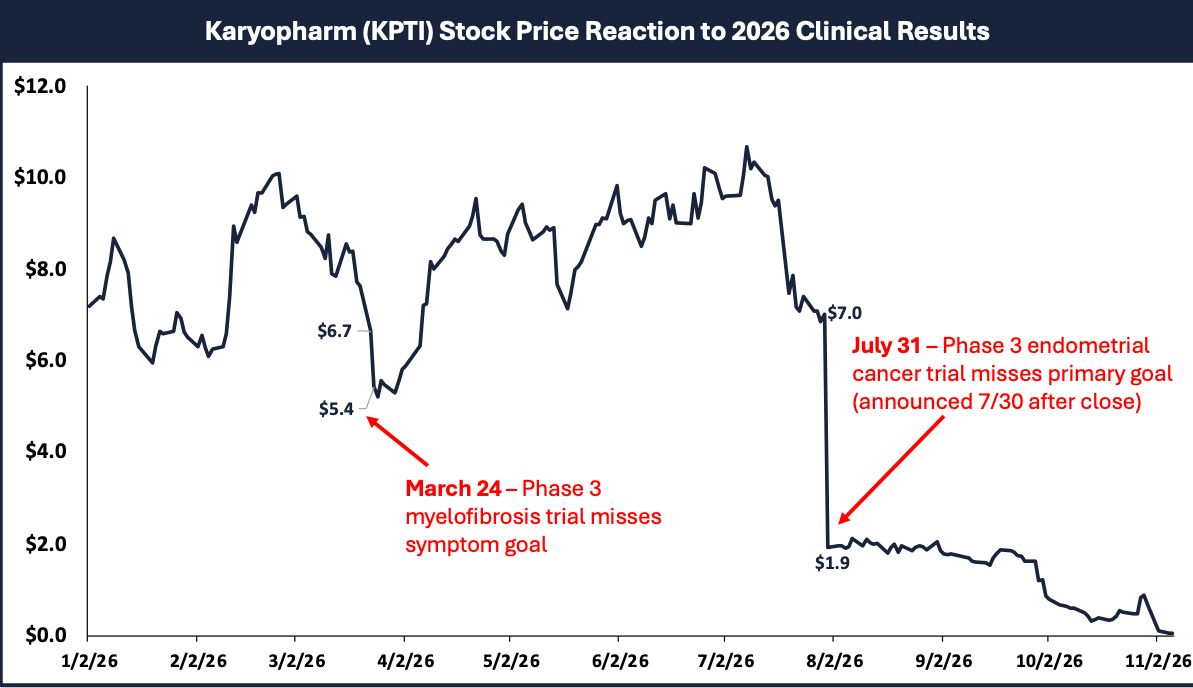
As described above, the Company’s two Phase 3 selinexor trials produced mixed results in 2026. The Company’s financing through 2025 and early 2026 had been structured around SENTRY, with the October 2025 Transactions and the February 2026 forbearance each designed to carry the Company to the readout. On March 24, 2026, the Company announced that SENTRY had met its spleen goal but missed its symptom goal, and its stock fell approximately 18%.
On July 30, 2026, the Company announced that its Phase 3 endometrial cancer trial had missed its primary goal, and its stock fell approximately 73%, from $7.01 to $1.92, by the close of the next trading day.
Payment Defaults and the September 2026 Forbearance
By September 2026, the obligations deferred in February had come due, and the Company was unable to make the payments. These included:
- The cash interest due June 30 on its second lien notes, which, together with interest accrued on the overdue amount, became payable when the February forbearance expired on September 30, and
- The $15.8 million term loan installment due September 10, which also covered the installment deferred from June.
The Company also did not expect to make the interest payments due September 30 on the term loan and the notes, or to meet the $25 million minimum liquidity covenant that would apply under both after October 10.
On September 10, the Company entered into a new forbearance agreement with its term lenders, noteholders, and the investor representative under the Royalty Financing Agreement, expiring October 15 and ultimately extended to November 1. In exchange, the Company paid a $20 million fee in kind through the issuance of convertible preferred stock.
The new agreement subjected all term loan obligations to the 2% default rate from the missed September 10 installment and added 2% to the interest on overdue note amounts, and the creditors could end the forbearance early if, among other things, the FDA refused to accept the sNDA for filing or the Company’s liquidity fell below $10 million. Absent consent from each creditor group, the agreement also restricted the Company from agreeing to sell or exclusively license all or a material portion of its assets, or to enter into a change-of-control transaction, unless the deal repaid the term loan and notes in full in cash and repurchased the preferred stock.
Marketing and Sale Process
In July 2026, the Company, with the assistance of Centerview Partners, launched a formal marketing process for all, substantially all, or a material portion of its equity and assets. Centerview contacted 35 potential acquirors and 83 potential equity investors, 17 of which signed confidentiality agreements and received access to a data room of more than 5,500 documents. The Company received five non-binding proposals for all or part of its business, structured as whole-company acquisitions, asset purchases, and recapitalizations.
Ultimately, the Debtors determined that a business combination with Ayrmid Ltd. (“Ayrmid”), the parent of commercial-stage cell therapy company Gamida Cell Inc., was the highest or otherwise best actionable proposal received, and that transaction now serves as the baseline against which any competing bid will be measured.
Chapter 11 Filing
The Debtors filed for Chapter 11 with a Restructuring Support Agreement (the “RSA”) in place with all of their secured creditors, holders of 100% of their term loans, 2028 Notes, 2029 Notes, and royalty claims, as well as Ayrmid as plan sponsor. The RSA supports a prepackaged plan that provides for two alternative paths:
- The baseline is a merger that would combine reorganized Karyopharm with Ayrmid under a holding company (“NewCo”) and equitize all of the Company’s approximately $276 million of funded debt into 55% of NewCo equity, leaving NewCo with no more than $135 million of debt under a new exit facility (the “Reorganization Transaction”).
- The Debtors will continue marketing the business, and if a higher or otherwise better bid emerges, they may pursue a sale of their assets instead (a “Sale Transaction”), with the consent of the required funded-debt holders and royalty investors.
Plan Sponsor Background and Highbridge Role
Ayrmid is a U.K. holding company majority-owned by funds managed by Highbridge, one of the Company’s prepetition lenders. Its commercial products are Omisirge, an FDA-approved stem cell therapy for patients with blood cancers undergoing umbilical cord blood transplants, marketed through its Gamida Cell subsidiary, and APHEXDA, a stem cell mobilization drug licensed from BioLineRx. The two products generated $16.5 million of revenue in fiscal 2025, against a $48.5 million operating loss, according to the consolidated financial statements of Ayrmid’s parent, Ayrmid Holdings Ltd.
Gamida Cell, previously listed on NASDAQ, became an Ayrmid subsidiary following a 2024 restructuring in which Highbridge funds exchanged their convertible notes for all of its equity, cancelling the existing shareholders’ stock, and provided a $50 million secured facility.
Because Highbridge funds sit on both sides of the transaction, Highbridge stepped back from the ad hoc group’s discussions of the sale process and Ayrmid’s proposal, leaving the group’s other members to negotiate the deal terms, and the Debtors say Highbridge’s votes will not be counted in determining whether a class has accepted the plan.
Merger Consideration and NewCo
The Reorganization Transaction would equitize the Debtors’ funded debt and combine the reorganized company with Ayrmid under NewCo. The transaction provides for the following:
- Equitization of Funded Debt — On the Effective Date, holders of the term loans and the 2028 and 2029 Notes, whose claims total approximately $276 million including accrued interest and fees, along with holders of the DIP roll-up loans and any new-money DIP claims not repaid in cash, would receive 100% of the equity of reorganized Karyopharm (“Reorganized Karyopharm”), or 55% of NewCo equity.
- Exit Financing — NewCo would enter into a senior secured exit term loan of up to $135 million (the “NewCo Facility”), funding of which is a condition to closing. The Debtors have received only nonbinding indications of interest for the facility, which has not yet been committed. Although the Debtors describe the NewCo Facility lenders as third parties, the Plan permits them to include existing funded-debt holders, DIP Lenders, or their affiliates.
- DIP Repayment and Equitization — NewCo exit facility proceeds would repay up to $50 million of new-money DIP claims, with any excess cash at closing also applied to those claims and any remaining balance converted into up to approximately 1.4% of NewCo equity. DIP roll-up claims would be equitized into approximately 11.9% to 12.2% of NewCo equity.
- NewCo Ownership — Reorganized Karyopharm’s equity would then be exchanged in the merger for 55% of NewCo, with Ayrmid’s equityholders retaining the remaining 45%. NewCo would be privately held unless Ayrmid and the required funded-debt holders agree otherwise, and the final structure will be set out in the merger agreement, to be filed with the plan supplement (the “Plan Supplement”).
- Myelofibrosis CVRs — Alongside the NewCo equity, the creditors would receive contingent value rights entitling them to a synthetic royalty on XPOVIO’s myelofibrosis net sales (the “MF CVRs”), equal to 20% of those sales if approval comes by December 31, 2027, or 15% if later. The MF CVRs would be unsecured, effectively subordinated to the NewCo Facility, non-transferable, unlisted, and without voting rights.
- Omisirge Earn-Out — Ayrmid’s equityholders could earn up to an additional 8.5% of NewCo if fiscal 2028 global net revenues of Omisirge exceed $70 million, roughly 6.8 times its fiscal 2025 revenue of $10.3 million, with the full 8.5% earned at $120 million. According to the Disclosure Statement, the contingent equity would dilute only the creditors’ shares and not those issued to Ayrmid’s equityholders, with the issuance mechanics to be set out in the merger agreement.
- Ayrmid Term Loan — Ayrmid’s existing indebtedness, under a December 12, 2022 loan agreement with Gamida Cell Inc. as borrower, would have to be either equitized into Ayrmid or structurally subordinated in full to the claims against, and equity in, NewCo, and no NewCo Facility proceeds could be used to prepay it.
- Royalty Investors — The Royalty Financing Agreement, which currently pays 8% of net revenues from all of the Company's products, would be cancelled, including its change-of-control payment. It would be replaced with a new unsecured royalty equal to 3% of NewCo's net revenues from selinexor products for five years, subject to an $18.75 million liquidated damages provision. The royalty investors may also acquire the Debtors' interests in certain other royalty agreements for up to $35 million, subject to consent.
Under the RSA, the Reorganization Transaction must become effective within 110 days of the Petition Date, or approximately February 20, 2027. If the FDA grants the requested Priority Review, its six-month goal date for the myelofibrosis application would fall around February 28, 2027, so on the current timeline creditors would receive their NewCo equity and MF CVRs before that goal date.
Alternative Sale Transaction
The Debtors received final approval on its bidding procedures, with Ayrmid’s merger proposal serves as the stalking horse bid, subject to higher or otherwise better offers, with bids due December 16, 2026. With the consent of both the required funded-debt holders and royalty investors holding at least 50.01% of the royalty claims, the Debtors may elect to pursue a Sale Transaction in place of the Ayrmid merger by the deadline to file the Plan Supplement.
- Successful Bid Mandatory Conditions — A competing bid may be selected only if it provides at least $335.4 million of net cash proceeds at closing, from readily available funds and not subject to any financing contingency, of which the $18.75 million allocable to royalty claims may be satisfied in non-cash consideration acceptable to the royalty investors. According to the Debtors, this floor is sized to repay the DIP, term loans, and 2028 Notes in full in cash and to provide the agreed minimum recoveries on the 2029 Notes and royalty claims. The bid must also pay general unsecured claims in full or leave them unimpaired, pay Ayrmid’s bid protections in full in cash, and fund the wind-down budget. Including the maximum bid protections, a competing bid would need to deliver approximately $347.8 million before wind-down funding and general unsecured claims.
- Bid Protections — Subject to a further order after a November 30 hearing, Ayrmid would be entitled to a break-up fee of 3% of a $311.4 million bid protection base (approximately $9.3 million) and expense reimbursement capped at 1% of that base (approximately $3.1 million). Both would be earned upon selection of a competing bid, payable from the sale proceeds within three business days of closing, and allowed as administrative claims ranking behind only the DIP claims and the carve-out.
- Credit Bids — Secured creditors may credit bid the face value of their claims against assets securing them, and any credit bid is treated as a cash bid.
- Back-Up Bid — If a competing bid is selected, Ayrmid must remain available as back-up bidder.
Treatment of Claims
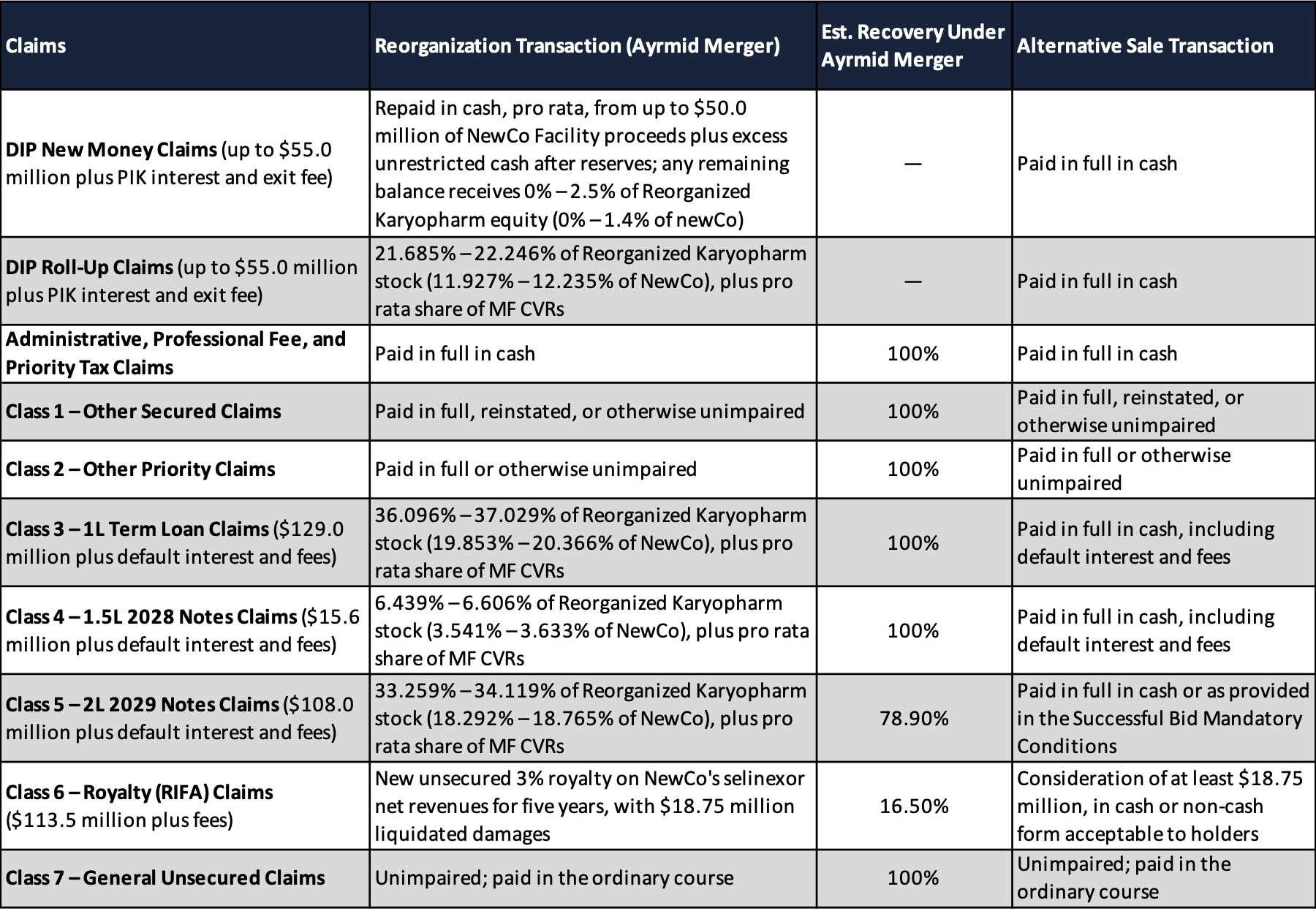
The table below summarizes the treatment of claims under the Ayrmid merger and an alternative Sale Transaction. Treatment under a Sale Transaction reflects the minimum recoveries required under the Successful Bid Mandatory Conditions. Under either transaction, intercompany claims and interests (Classes 8 and 12) would be reinstated, cancelled, or otherwise addressed without any distribution, and all existing equity, including preferred stock, common stock, and other equity interests (Classes 9 through 11), would be cancelled with no recovery.
Recovery Against a Hypothetical Chapter 7 Liquidation
The Disclosure Statement does not include a valuation of NewCo or Reorganized Karyopharm. According to the Debtors, the estimated recoveries reflect the results of the marketing and sale process rather than a separate valuation analysis, which was omitted to avoid prejudicing the ongoing competitive sale process. The Debtors’ hypothetical Chapter 7 liquidation analysis assumes a trustee would wind down the clinical trials, continue supplying existing patients, and sell XPOVIO and its related intellectual property at approximately 0.5x to 1.0x estimated 2026 revenue, with no value assigned to the remaining pipeline. On that basis, net proceeds of approximately $71.9 million to $138.2 million would be available against approximately $389.7 million of secured claims, yielding a 49.3% to 94.7% recovery for the term loan and no recovery for the 2028 Notes, 2029 Notes, or royalty claims.
DIP Financing
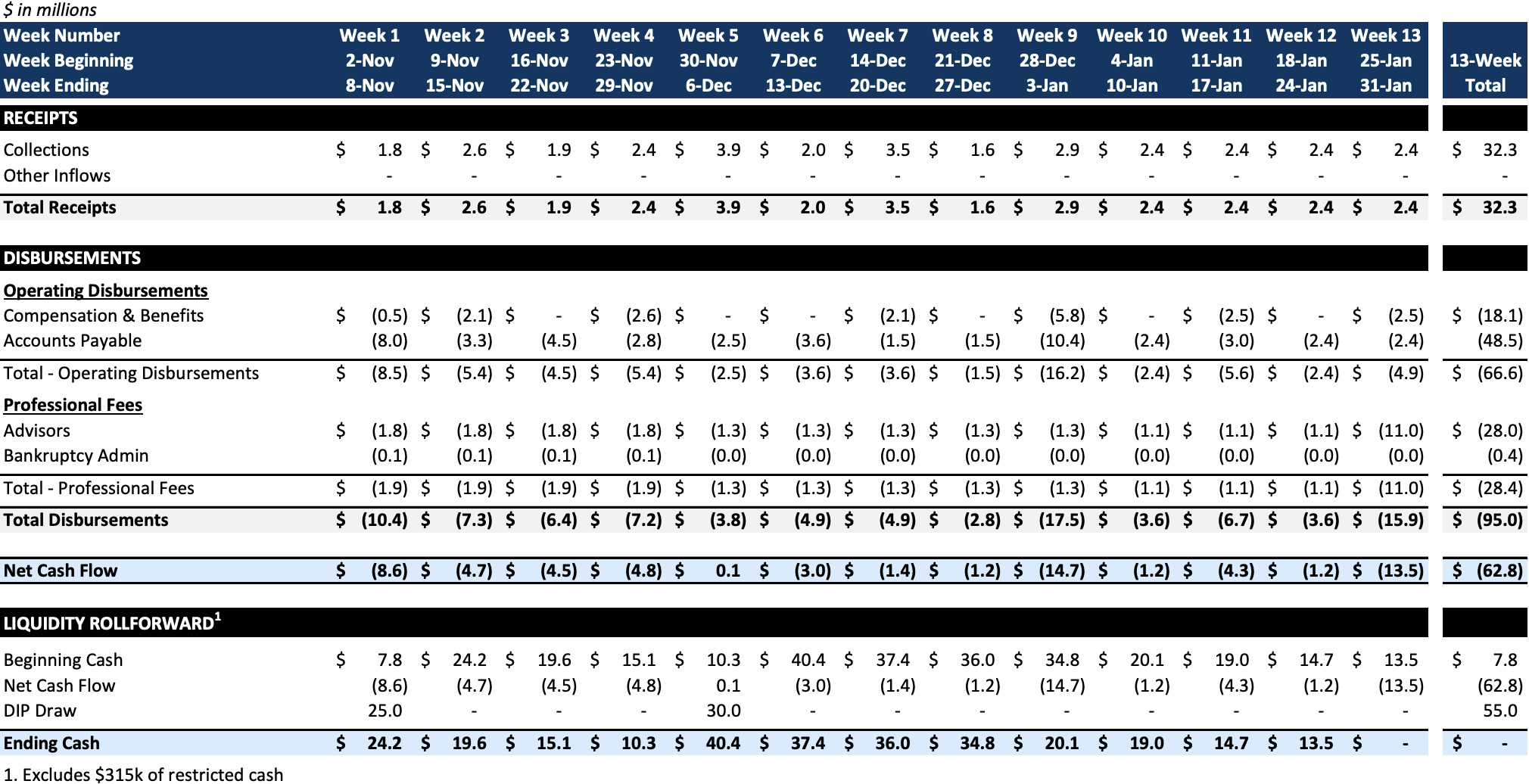
The Chapter 11 cases will be funded by a DIP facility of up to $110 million from certain of the Debtors’ prepetition first lien term lenders (the “DIP Lenders”). The facility consists of $55 million of new-money term loans and up to $55 million of roll-up of prepetition first lien term loans. Karyopharm Therapeutics Inc. is the borrower, and KPT Texas LLC is the guarantor.
- Structure — $25 million of new money is available on an interim basis and $30 million upon entry of the final order. Each draw is accompanied by a dollar for dollar roll-up of the funding DIP Lender’s prepetition first lien term loans, totaling up to $25 million on an interim basis and $30 million on a final basis. No 2028 Notes, 2029 Notes, or royalty obligations are rolled up. The new-money loans are first-out and the roll-up loans second-out.
- Pricing — SOFR plus 9% on the new-money loans and SOFR plus 12.25% on the roll-up loans, both paid in kind quarterly with a 3% SOFR floor, and an additional 2% upon an event of default.
- Fees — Exit fees of 4% on the new-money loans and 8% on the roll-up loans.
- Maturity — The earliest of May 1, 2027; a plan’s effective date; the closing of a sale of all or substantially all assets; acceleration; or dismissal or conversion of the cases.
- Collateral and Priority — Priming liens on substantially all assets, including intellectual property and regulatory approvals, plus superpriority claims, subject to the Carve Out.
- Carve Out — Statutory fees, up to $100,000 for a Chapter 7 trustee, and allowed professional fees incurred before delivery of a termination notice, plus up to $2.75 million for Debtor professionals and $50,000 for committee professionals afterward.
- Adequate Protection — Replacement liens and superpriority claims to the extent of any decline in collateral value, plus monthly payment of advisor fees for the term lenders, noteholders, and royalty investors. The term lenders also receive default-rate interest, and the 2028 noteholders receive PIK interest.
- Investigation Budget and Challenge Period — $50,000 for a committee, if one is appointed, to investigate the prepetition liens and claims. A challenge must be brought by the earliest of plan confirmation, the sale objection deadline, or 60 days after a committee forms (75 days after the interim order for other parties).
- Budget Variance — Tested every other week on a cumulative basis, requiring receipts of at least 80% of budget and disbursements of no more than 120%, with a $10 million minimum liquidity covenant.
- Milestones — Incorporated from the RSA: interim DIP, conditional disclosure statement, and bidding procedures orders within three days; the final DIP order within 35 days; an auction, if necessary, within 60 days; disclosure statement approval, any sale order, and plan confirmation within 80 days; and the plan’s effective date within 110 days.
- Credit Bid — The DIP Agent may credit bid all DIP obligations, and the prepetition first lien agent may credit bid the prepetition first lien obligations.
Interim Approved DIP Budget
2026 Retention Programs
Between July and September 2026, the Company adopted six cash retention programs for critical employees. The Company paid approximately $10.6 million under these programs before the Petition Date, and approximately $2.5 million of fixed installments, plus up to approximately $1.2 million of performance-based payments, remain outstanding.
The largest retention program, an $8.9 million lump sum approved on July 13, 2026 for 15 employees, replaced previously guaranteed amounts under the Company’s 2026 bonus plan and was paid in full before the Petition Date. As a condition, the executive leadership team and certain other participants gave up their remaining 2026 bonus installments. Approximately $3.7 million went to four executives: CEO Richard Paulson received $1.73 million, the Chief Medical Officer $0.73 million, the Chief Development Officer $0.64 million, and the Chief Financial Officer $0.63 million. For the CEO, Chief Medical Officer, and Chief Development Officer, the awards equal approximately 88% to 91% of the cash severance each would receive if terminated following a change in control, based on 2025 pay, so the awards effectively pay out most of that severance in advance. The leadership awards are subject to clawback if a recipient leaves under certain circumstances, but the clawback period ends at the earliest of 12 months after payment, 30 days after a change in control, or 30 days after emergence from Chapter 11. Separately, in October 2025, the Chief Medical Officer and Chief Development Officer received retention bonuses of $1 million and $250,000, respectively.
The remaining five programs covering non-executive personnel, with a combined cost of approximately $4.2 million plus up to approximately $1.7 million in performance-based sales payments, are described in the Wages Motion.
First-Day Relief
- Critical Vendors Motion (Doc. 7) (Final Approval): The Debtors seek to pay approximately $25 million of invoiced prepetition trade claims owed to CROs, clinical trial sites, drug suppliers and other vendors in the ordinary course. They also seek to pay accrued but uninvoiced clinical trial site costs.
- Utilities Motion (Doc. 8) (Final Approval): The Debtors seek to provide adequate assurance to approximately 18 utility providers through a deposit of approximately $11,500, equal to two weeks of utility costs, into a segregated account within 14 business days of the Petition Date.
- Taxes Motion (Doc. 9) (Final Approval): The Debtors seek to pay approximately $566,000 of prepetition taxes and fees. Most of this is approximately $456,000 of regulatory fees, including FDA user fees and the IRS branded prescription drug fee. They also seek to pay the remaining taxes of non-Debtor Karyopharm Europe GmbH from a segregated account holding approximately $40,000.
- Insurance Motion (Doc. 10) (Final Approval): The Debtors seek to continue 58 insurance policies, with approximately $2.3 million of annual premiums plus approximately $540,000 of one-time clinical trial policy premiums, pay approximately $190,000 of prepetition premiums and brokerage fees, and maintain three surety bonds totaling approximately $225,000 that secure drug distributor licenses and customs obligations.
- NOL Motion (Doc. 11) (Final Approval): The Debtors seek trading and worthless stock deduction procedures to protect tax attributes, including approximately $861 million of federal NOLs and $114 million of federal tax credits.
- Customer Programs Motion (Doc. 12) (Final Approval): The Debtors seek to continue their XPOVIO customer programs and honor approximately $15.6 million of prepetition obligations. The largest items are approximately $7.4 million of Medicare drug inflation rebates, $2.8 million of product returns, $1.1 million under the 340B program and $965,000 of Medicaid rebates.
- Wages Motion (Doc. 13) (Final Approval): The Debtors seek to pay approximately $5.2 million of prepetition obligations for approximately 192 employees and 34 independent contractors. This includes approximately $2.6 million under the short-term incentive plan, $911,000 owed to contractors and $431,000 under 2026 retention programs. They also seek to continue honoring outstanding equity awards through share settlement.
- Cash Management Motion (Doc. 14) (Interim Approval): The Debtors seek to continue their cash management system of 10 bank accounts at five banks and to keep their credit card program, which carries approximately $425,000 of prepetition charges.
Explore Bondoro Insights for live case dockets and comprehensive coverage of material filings from petition to plan confirmation.
Stay informed on every Chapter 11 bankruptcy case with liabilities exceeding $10 million. Subscribe for free to have our coverage delivered directly to your inbox, and explore our full archive of past summaries.
Subscribers can also opt in to timely filing alerts by updating their email preferences in Account Settings.


