Case Summary: FuturHealth Chapter 11
FuturHealth filed for Chapter 11 citing an underperforming iHeartMedia ad deal, its exit from compounded GLP-1s and litigation with Goglia Nutrition that it says impaired its financing, seeking a sale of some or all of its assets with a DIP of up to $5 million from Twelve Bridge.

A deck version of this summary is also available HERE.
Business Description
Headquartered in San Diego, CA, FuturHealth, Inc. (“FuturHealth” or the “Debtor”), a direct-to-consumer weight-management platform, offers programs that pair access to prescription medications, including GLP-1 medications, with medical support, nutrition planning and fitness content. Customers enroll through FuturHealth’s website and mobile app in programs that vary by duration and included services, as well as by medication when one is prescribed by an independent medical professional. While FuturHealth manages the customer relationship, it relies on third parties for clinical care and dispensing.
FuturHealth’s proprietary platform, Whole Health OS, routes patient information to the appropriate medical-service organization and delivers personalized nutrition, fitness and educational content over the course of each program. Since its inception in 2023, FuturHealth has facilitated more than 1 million prescriptions, and as of the Petition Date the Debtor had approximately 26,000 current customers and 195,000 historical customers.
FuturHealth earns revenue from initial program purchases and recurring subscriptions or renewals, and acquires customers primarily through digital and social-media marketing. In 2024, its first full year of operations, it generated $86.6 million of revenue and $1.2 million of cash while recording a $10.7 million operating loss. In 2025, revenue rose to approximately $120 million.
FuturHealth, Inc. filed for Chapter 11 protection on November 1, 2026 (the "Petition Date") in the U.S. Bankruptcy Court for the District of Delaware, reporting $10 million to $50 million in both assets and liabilities.
Corporate History
Origins and Formation
FuturHealth’s history begins with Goglia Nutrition, LLC, which does business as G-Plans (“Goglia Nutrition”), a personalized-nutrition service formed in December 2015 by four equal cofounders: Philip Goglia, Lisa Saridakis, John Levan and Luke Mahoney. In 2023, while still serving as Goglia Nutrition’s operational managers, Levan and Mahoney established FuturHealth together with Jon Hambidge, the Debtor’s current CEO, with Mahoney as CEO, Levan as President and Hambidge as CFO. The business began operating in 2023 through FuturHealth, LLC, which converted in November 2023 into a Delaware corporation named FuturCo Health Technologies, Inc. and took the name FuturHealth, Inc. in January 2024.
The December 2023 Agreements
In December 2023, Goglia Nutrition entered into three agreements with FuturHealth: a Technology License Agreement (the “TLA”), an Inbound Data License Agreement and a Services Agreement (together, the “December 2023 Agreements”). Under the TLA, Goglia Nutrition granted FuturHealth a “perpetual, irrevocable, worldwide, exclusive” license to the G-Plans technology within a defined field. In return, FuturHealth agreed to pay monthly per-member royalties on a sliding scale, with the option to replace future royalties with a $4 million buyout, reduced by half of the royalties already paid.
FuturHealth exercised the buyout option and agreed to pay the balance in four installments of $934,288 between April 2024 and February 2025, or approximately $3.7 million in total. A federal court later found that FuturHealth paid Goglia Nutrition approximately $1.4 million by the end of 2023 and just over $8.2 million in total from June 2023 through December 8, 2025. Additionally, the relationship between the two companies extended beyond the license: as of August 2024, Mahoney served as CEO of both, and FuturHealth hosted G-Plans’ subscriber data, as a breach notice to G-Plans subscribers later described.
Around September 2024, Goglia Nutrition sought to repudiate or rescind the December 2023 Agreements, and in September 2025 it sued FuturHealth, Levan, Mahoney and Hambidge, alleging that its managing members had built a competing business using its assets and challenging the validity of the agreements (the “Goglia Litigation”; see Events Leading to Bankruptcy).
The Novo Nordisk Litigation
FuturHealth’s early growth came during a surge in demand for GLP-1 weight-loss drugs, when patients increasingly turned to compounded semaglutide, often sold through telehealth platforms. These versions are prepared by compounding pharmacies and are not reviewed by the FDA.
In August 2024, Novo Nordisk A/S and Novo Nordisk Inc. (“Novo Nordisk”), the developer and manufacturer of Ozempic and Wegovy, sued FuturHealth and Goglia Nutrition for trademark infringement, false advertising and unfair competition. At the time, Ozempic and Wegovy were the only FDA-approved injectable semaglutide products in the U.S.
Novo Nordisk alleged that both companies used the Ozempic and Wegovy names and images in their online advertising, drawing in customers seeking Novo Nordisk’s medicines. According to the complaint, after customers paid a subscription fee, they were offered a cheaper compounded product labeled “Generic Semaglutide.” That product was presented as equivalent to Ozempic, including in FDA-approved status, though no generic semaglutide has been approved.
The companies moved to dismiss, arguing that naming the drugs was permissible because they facilitated prescriptions for Ozempic and Wegovy. In September 2025, the court denied the motion. It accepted that the companies needed to use the drug names to describe their services, but held that displaying the branded Ozempic pen went beyond what was necessary and that their promotional claims could plausibly suggest Novo Nordisk’s endorsement.
The parties later resolved the case through a settlement.
September 2026 Leadership Change
Effective September 9, 2026, Mahoney resigned as CEO and from the board of directors (the “Board”), and Levan resigned as President, from all other officer positions and from the Board. The Board appointed Hambidge, who had served as CFO since 2023, as CEO. Hambidge and Sabrina Burgi, who had been identified as FuturHealth’s chief operating officer in August 2024, joined the Board, along with Mary Schroeder as an independent director (the “Independent Director”). On September 18, 2026, the Board formed a special restructuring committee (the “Committee”), with the Independent Director as its sole member.
Before the filing, the Debtor engaged Levan and Mahoney as independent contractors under advisory agreements to provide transition and advisory services, then terminated those agreements on October 31, 2026.
Equity Ownership
In December 2023, Corazon Capital led FuturHealth’s $5 million seed financing round. The Form D for the offering, filed under the name FuturCo Health Technologies, Inc., reports approximately $5 million sold to three investors, with the first sale on December 15, 2023.
As of September 12, 2026, the Debtor had approximately 58 equity security holders, including option and warrant holders. Its equity consists of common stock held by six holders and two series of seed preferred stock held by four holders, with warrants and options outstanding for an additional 484,913 and 597,440 common shares, respectively.
- Common Stock — Concentrated in two entities. Levan Enterprises, Inc. and Mahoney Marketing Group, LLC each hold 4,500,000 shares, or approximately 44.6% each and approximately 89.2% combined. The Hambidge Family Trust holds approximately 9.9%, and the remaining shares are split among Corazon Capital III LP and two individuals.
- Series Seed-1 Preferred — Corazon Capital III LP holds approximately 53.2%, two InterAlpen Partners funds hold approximately 42.6% combined, and Oversubscribed Ventures Fund I holds the remaining approximately 4.3%.
- Series Seed-2 Preferred — Held entirely by Corazon Capital III LP.
Operations Overview
Whole Health OS Platform
Whole Health OS is the connective layer between FuturHealth’s customers and the third parties that deliver their care. Customers interact with it through FuturHealth’s mobile and web applications, text messaging and email, while the platform uses data and AI-enabled tools to direct each customer to the right provider and guide them through their program. The third-party vendors FuturHealth relies on for pharmacy, telehealth, customer service, payment processing, operational software and compliance services are largely integrated into or run alongside the platform. FuturHealth also owns a federally registered FUTURHEALTH trademark covering downloadable software and meal-planning services, with applications pending for its stylized “F” logo.
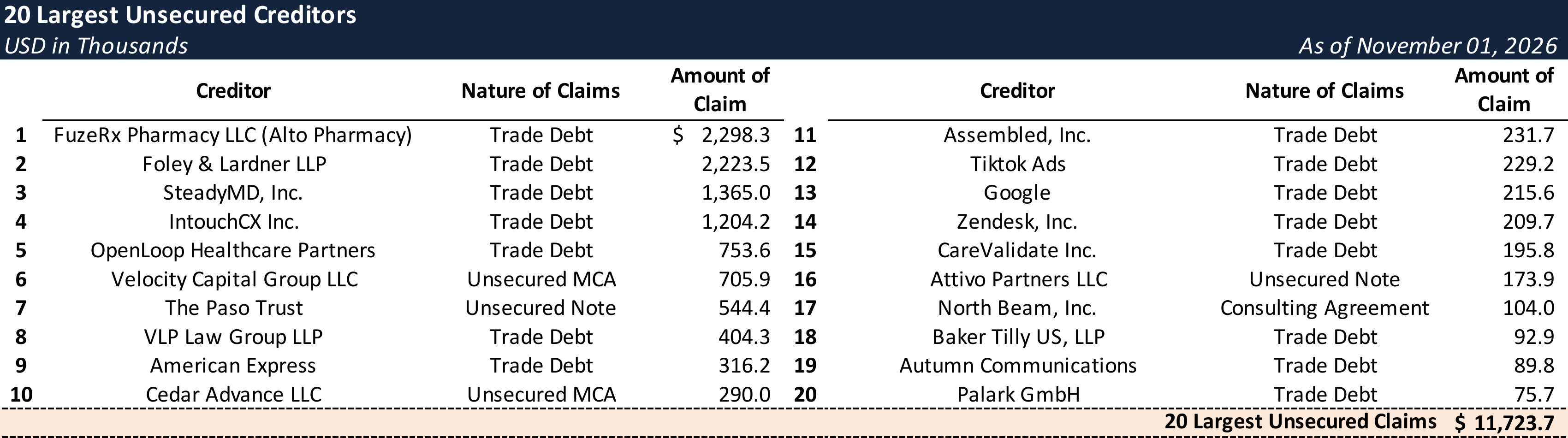
The Debtor’s list of its 20 largest unsecured creditors includes several of the partners that deliver FuturHealth’s programs:
- Clinical Care — According to FuturHealth’s privacy notice, clinical services may be provided by SteadyMD Physician Group, OpenLoop Healthcare Partners and provider groups supported by CareValidate. SteadyMD is owed approximately $1.4 million, OpenLoop approximately $0.8 million and CareValidate approximately $0.2 million.
- Pharmacy — Alto Pharmacy delivers GLP-1 medications prescribed through FuturHealth’s provider network, and its pharmacy entity, FuzeRx Pharmacy LLC, holds the Debtor’s largest unsecured claim at approximately $2.3 million.
- Customer Experience — IntouchCX, a customer-experience firm, is owed approximately $1.2 million.
Revenue Model
FuturHealth earns revenue from initial program purchases and recurring subscriptions. A monthly subscription buys access to the platform and to telehealth consultations with clinicians at independent medical groups. It does not include prescription medication, pharmacy costs or lab fees, and it does not guarantee a prescription, since prescribing decisions rest entirely with the clinician. A customer’s total cost is therefore the subscription plus any medication, lab and other charges, which are disclosed before they are incurred.
The care itself is delivered by two kinds of outside parties, which shapes how money moves through the platform. Clinical services come from independent medical groups, and when a customer buys one, FuturHealth acts as the group’s payment agent: it collects the provider’s charge, remits it to the group and keeps only its own platform service fee, with each purchase itemized to show the two separately. Medication is dispensed by independent licensed pharmacies that FuturHealth does not own or control, and its cost is not included in the subscription.
Customers pay out of pocket on a recurring basis, with a few features that shape how they pay:
- Self-Pay — FuturHealth does not bill insurers, including Medicare and Medicaid, for platform fees, so members pay for the subscription themselves. For medication, which is not included in the subscription, FuturHealth offers a third-party benefits check that can estimate whether a member’s own insurance would cover a prescribed drug.
- Pay-Over-Time — Since March 2025, approved customers can pay through Affirm, financing medications, meal plans, consultations and lab services in installments.
- Auto-Renewal and Refunds — Subscriptions renew monthly unless cancelled at least 24 hours before the renewal date. Under FuturHealth’s satisfaction guarantee, a cancelling member may recover the refundable portion of membership fees paid in the prior six months, but not amounts already spent on provider visits, clinical services, medication, pharmacy charges or lab work.
Program and Medication Developments
Until August 2025, FuturHealth marketed compounded GLP-1 medications, which are pharmacy-made versions rather than manufacturers’ branded products (see Events Leading to Bankruptcy). Since then, its offering has centered on FDA-approved medications. Under every program, a clinician in FuturHealth’s network decides whether to prescribe, an independent licensed pharmacy dispenses the medication, and customers may send their prescription to any pharmacy they choose. The main additions include:
- Branded Wegovy (Injection) — On July 30, 2025, FuturHealth began offering Wegovy through Novo Nordisk’s cash-pay program at $499 a month, following a limited-time $299 first month, with free next-day delivery from Alto Pharmacy.
- Wegovy Pill — In January 2026, it added a $198-a-month program pairing a prescription for the Wegovy pill with ongoing medical support, with an optional customized meal program.
- Foundayo — In April 2026, it began offering Foundayo (orforglipron), Eli Lilly’s once-daily GLP-1 pill, through a program starting at $198 a month, with eligible members prescribed the medication by clinicians in FuturHealth’s network and receiving it by home delivery.
Workforce and Facilities
As of the Petition Date, FuturHealth employed approximately 28 full-time employees and relied on approximately 20 independent contractors, plus staffing-agency personnel. Together, they cover engineering, quality assurance, customer experience, medical operations, marketing, finance and administration. The workforce operates remotely across multiple states rather than from a central office. FuturHealth leases office space in San Diego, but the location is not used for ongoing operations, and the Debtor anticipates rejecting the lease during the case.
Prepetition Obligations
Top Unsecured Claims
Events Leading to Bankruptcy
Unsuccessful Advertising Agreement
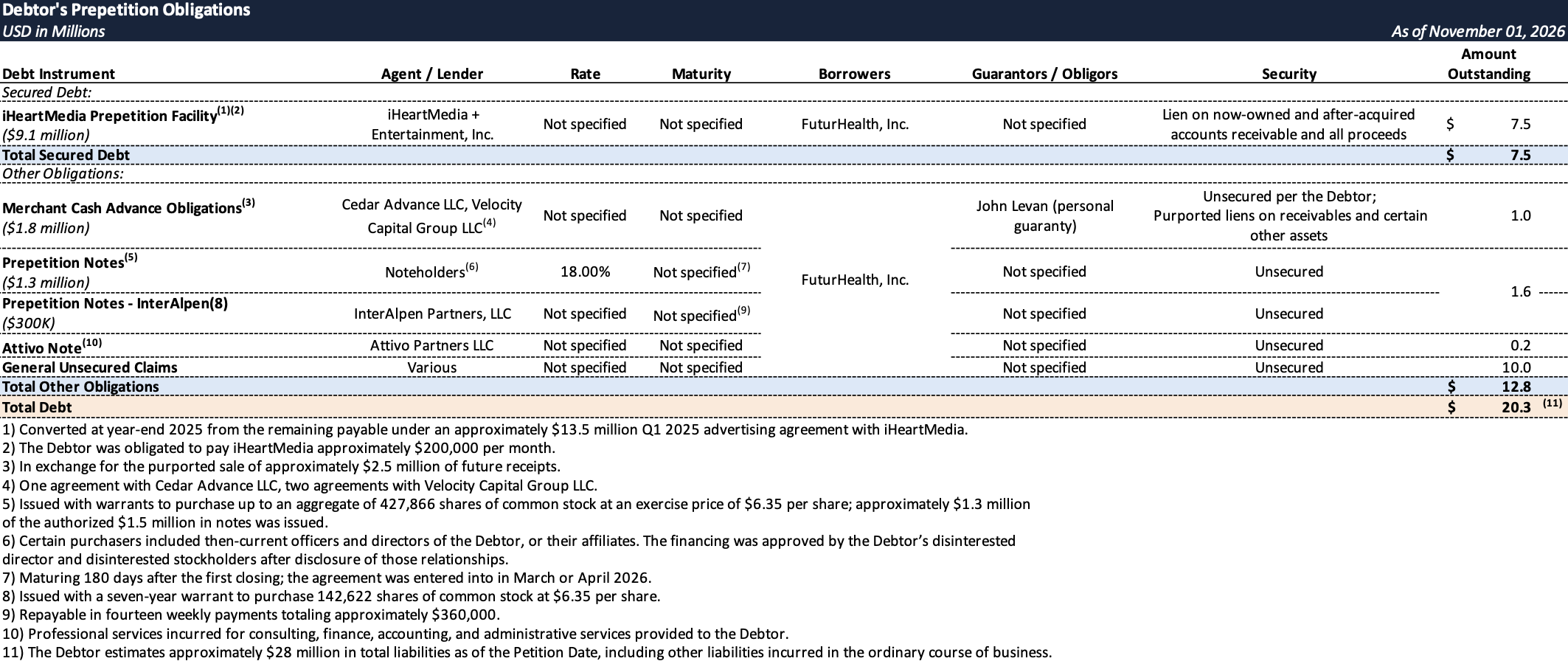
In the first quarter of 2025, the Debtor entered into an advertising agreement with iHeartMedia worth approximately $13.5 million. According to the Debtor, the campaign failed to produce the anticipated return, and the agreement required more than $4 million in cash payments during the first half of 2025. That cash went to iHeartMedia rather than to the marketing spend the Debtor relies on to acquire new customers. The Debtor generated approximately $120 million of revenue in 2025 but ended the year with approximately $3 million less cash than it started with.
The Shift from Compounded GLP-1s
Federal law generally prohibits compounding pharmacies from producing copies of FDA-approved drugs, but suspends that restriction while a drug appears on the FDA’s shortage list, its record of medications for which U.S. demand exceeds supply. That exception underpinned the compounded GLP-1 market during 2022 through early 2025, when tirzepatide and semaglutide were in shortage and telehealth platforms sold compounded versions widely.
The exception began to close in October 2024, when the FDA determined that Eli Lilly’s supply of tirzepatide, the active ingredient in Mounjaro and Zepbound, could meet demand and removed it from the list. It reaffirmed that decision in December 2024 following a voluntary remand. On February 21, 2025, the FDA reached the same conclusion for semaglutide, the active ingredient in Novo Nordisk’s Ozempic and Wegovy, while allowing a transition period before enforcement. That period ran until April 24, 2025 for pharmacies and physicians, when a federal court declined to enjoin the decision, and until May 22, 2025 for outsourcing facilities. Compounders challenged both delistings, but on August 27, 2026, the Fifth Circuit upheld the FDA’s decisions on tirzepatide and semaglutide.
FuturHealth’s exit followed several months after those transition periods ended, and after Novo Nordisk’s 2024 lawsuit over its marketing of compounded semaglutide (see The Novo Nordisk Litigation). In August 2025, the company stopped marketing compounded GLP-1 medications to focus on FDA-approved alternatives. According to the Debtor, the transition required reduced marketing spend, which slowed new-customer acquisition.
The Goglia Litigation
Goglia Nutrition alleges that Levan and Mahoney, while managing Goglia Nutrition, secretly formed FuturHealth and moved its most valuable assets to it for a fraction of their fair value.
Central to the case is Goglia Nutrition’s challenge to the December 2023 Agreements. Goglia and Saridakis say they believed they were approving a licensing deal with an independent vendor. They say they had not seen the agreements, which were not attached to the consent they signed, and did not know that FuturHealth was owned by their fellow managers or that the TLA let it acquire the G-Plans technology outright for $4 million. Goglia Nutrition argues the agreements are therefore void for fraud in the execution. FuturHealth counters that the two knew they were approving a licensing deal and chose not to read the agreements, and it has asserted counterclaims.
FuturHealth moved to compel arbitration under the TLA, but in December 2025 the court deferred the motion until it could decide whether the agreements were valid. In the meantime, a stipulated order entered on January 30, 2026 imposes two requirements on FuturHealth:
- Escrow Revenue — FuturHealth must hold GLP-1 revenue received since January 12, 2026 from customers shared with G-Plans in escrow, in constructive trust for Goglia Nutrition. According to the Debtor, approximately $920,000 has been escrowed.
- Platform — FuturHealth must remove references to G-Plans and its “metabolic typing” approach, and stop using metabolic classification in its platform.
On August 20, 2026, the court sided with Goglia Nutrition, holding the December 2023 Agreements, including their arbitration clause, void for fraud in the execution. The court found that Levan and Mahoney deceived Goglia and Saridakis about the basic nature of the agreements, pressing them to sign the consent within minutes without the agreements attached. Shortly after counsel advised that full disclosure was required, Mahoney also had his and Levan’s names replaced with Hambidge’s on the FuturHealth side. The court also cited internal messages, including Mahoney’s October 2023 note that he would have Goglia sign and “fill him in later.”
The ruling did not decide Goglia Nutrition’s claims, which still await trial, but it left FuturHealth without a valid license to the G-Plans technology unless reversed. FuturHealth appealed to the Ninth Circuit on September 8, 2026, and on October 8, 2026, the district court stayed the entire action, including FuturHealth’s counterclaims, pending the appeal.
According to the Debtor, the litigation also materially impaired its ability to raise new equity or conventional debt during 2026, as it had expected the dispute to proceed in arbitration on a timeline that would have allowed it to raise capital.
Financing Efforts and Liquidity Issues
Faced with declining revenue and limited access to capital, the Debtor took steps in 2026 to reduce costs and preserve liquidity. From January through July 2026, it cut non-marketing operating expenses by approximately 42%, including through two workforce reductions. However, those savings could not offset the decline in revenue.
Unable to obtain conventional equity or debt financing in 2026, the Debtor turned to costlier sources of liquidity: approximately $1.6 million of insider and affiliate notes issued in March and April 2026, and three merchant cash advance agreements entered into between May and July 2026 that provided an aggregate purchase price of approximately $1.8 million.
Those obligations further strained the Debtor’s cash resources. With weekly merchant cash advance remittances of approximately $77,000 on top of the approximately $200,000 monthly payment to iHeartMedia, the Debtor puts its debt service at approximately $500,000 a month. According to the Debtor, the combination of declining revenue and scheduled debt payments left it behind on amounts owed to vendors and other service providers.
Strategic Alternatives
The Debtor engaged Centerview Partners LLC in March 2025 to evaluate strategic alternatives. After briefly retaining another advisor in September 2026, it hired Hilco Corporate Finance, LLC (“Hilco”) on September 21, 2026 to run parallel processes for DIP financing and a sale. According to Hilco, 33 prospective lenders received teasers, eight signed nondisclosure agreements, and the process produced three non-binding term sheets. They came from Twelve Bridge Capital, LLC (“Twelve Bridge”), from an unrelated third party whose less favorable offer was later withdrawn, and from a party affiliated with Hambidge, the Debtor’s CEO. No lender would provide financing on an unsecured basis, and every proposal depended on priming iHeartMedia’s liens.
The Debtor signed a term sheet with Twelve Bridge on October 14, 2026. After the term sheet was signed, a lender connected to Hambidge made a new offer on similar terms, but with less funding and a much shorter sale timeline. The Committee determined the offer was not sufficiently superior to warrant exercising its fiduciary out, and it was withdrawn on October 30, 2026.
The Chapter 11 Filing
The Debtor filed primarily to pursue a court-supervised sale of some or all of its business and assets, while evaluating in parallel whether a standalone reorganization or another transaction would deliver more value.
The DIP Facility
The Chapter 11 case will be funded by a senior secured superpriority priming DIP facility of up to $5 million from Twelve Bridge, which received interim approval on November 3. The facility is entirely new money, with no roll-up of prepetition debt. The final hearing is scheduled for December 1, 2026.
- Structure — $1.5 million was available on interim approval. The remaining $3.5 million becomes available only after entry of the final order and execution of a Qualified Stalking Horse APA. That is a binding asset purchase agreement acceptable to Twelve Bridge that provides enough closing cash to repay the DIP in full, with no financing or material diligence contingency.
- Pricing — Interest accrues at 14% a year, paid in kind monthly, with a 3% default rate increase.
- Fees —
- Commitment Fee — $250,000 on entry of each of the interim and final orders. If the Debtor refinances between the two orders, the full $500,000 is earned.
- Funding Fee — 5% of each draw.
- Exit Fee — 7% of outstanding principal plus capitalized interest.
- Work Fee — $50,000, of which $25,000 is credited against the exit fee.
- Stalking Horse Reduction — If the Debtor signs a Qualified Stalking Horse APA within 21 days of filing, the final commitment fee drops to $150,000 and later funding fees drop to 4%.
- Maturity — The earliest of 120 days after the Petition Date, a sale of substantially all assets or a plan's effective date.
- Collateral and Priority — Priming liens on substantially all of the Debtor's property, including the Whole Health OS platform and commercial tort and litigation claims, plus superpriority claims. Avoidance actions are excluded. The DIP liens also prime the merchant cash advance funders' asserted liens without acknowledging their validity, and the funders receive no adequate protection.
- Carve Out — Budgeted estate professional fees through a default notice, plus up to $100,000 afterward and $25,000 for a Chapter 7 trustee.
- Adequate Protection — In exchange for consenting to the priming of its liens, iHeartMedia receives: (i) junior replacement liens and a section 507(b) claim, (ii) current cash interest and payment of its professional fees, and (iii) an equal share with Twelve Bridge of the first $50,000 of sale proceeds.
- Challenge Rights — The Debtor and Twelve Bridge stipulate to the extent, validity and priority of iHeartMedia’s loan and liens, subject to a challenge by a committee or another party with standing within 75 days after entry of the interim DIP order, a deadline that falls on January 19, 2027.
- Sale Proceeds and Credit Bidding — Apart from the first $50,000 shared with iHeartMedia, sale proceeds go first to repay the DIP in full. iHeartMedia may credit bid only in a transaction that pays the DIP in full in cash.
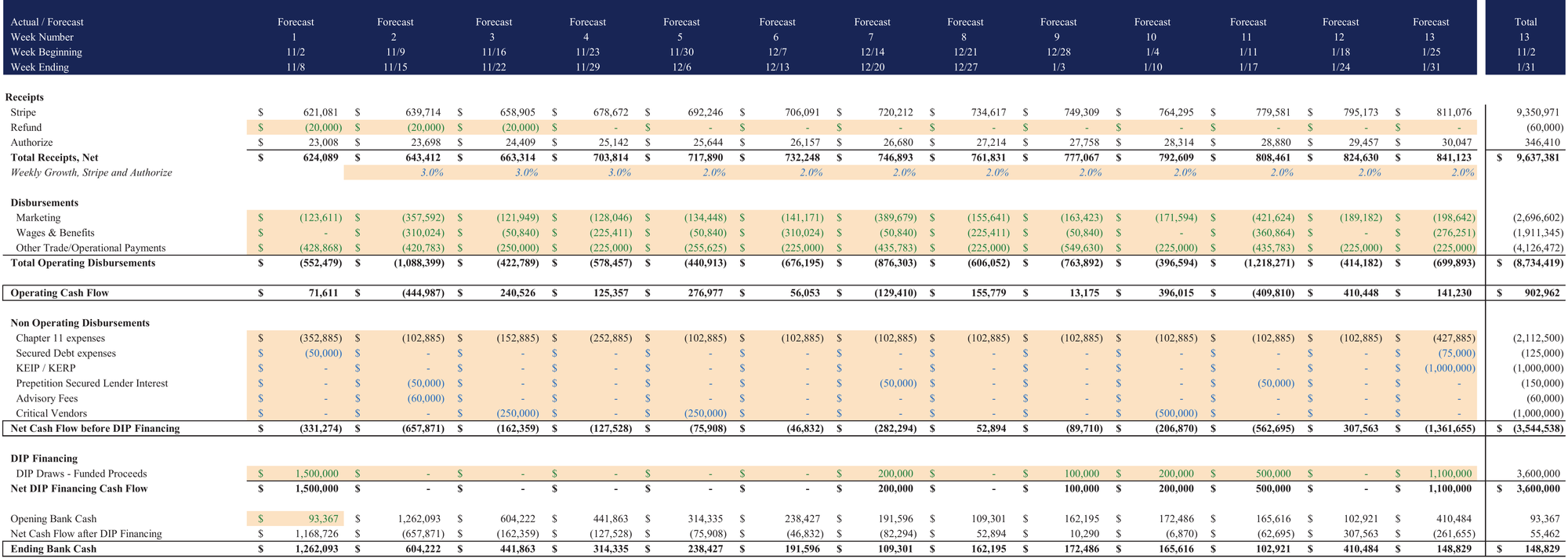
- Budget Variance — Aggregate disbursements may not exceed the budget by more than 15% on a rolling four-week basis. The Debtor must maintain at least $100,000 of unrestricted cash.
- Milestones — The parties target a sale closing within approximately 120 days of filing.
- Covenants — The Debtor must maintain the Whole Health OS platform and its material medical, pharmacy, technology and service relationships. An order allowing a merchant cash advance funder to divert postpetition receipts without Twelve Bridge's agreement is an event of default.
Initial Budget
Bidding Procedures and Timeline
The Debtor's bidding procedures motion proposes to sell substantially all of its assets through a competitive bidding process, with a sale hearing requested for December 29, 2026. Hilco contacted approximately 135 strategic and financial parties before and after the filing, and 17 signed nondisclosure agreements, but no third party had made an actionable proposal as of November 3, 2026. Key terms are as follows:
- Scope — Bids may cover all, substantially all or a portion of the assets, including intellectual property and the Debtor’s claims and causes of action. Partial bids may be combined with one another, or evaluated together with the liquidation value of the remaining assets.
- Stalking Horse — The Debtor does not yet have a stalking horse in place and may designate one by December 1, 2026, with bid protections in the form of a break-up fee and/or expense reimbursement.
- Qualifying Bids — Bids must be in cash, or include a valuation of any non-cash consideration, with a 10% deposit and no financing or diligence contingencies. Bidders must also commit to close by January 12, 2027 and state whether they intend to hire any of the Debtor’s employees.
- Credit Bidding — Secured creditors may credit bid, and Twelve Bridge is automatically a Qualified Bidder if it submits a credit bid by the bid deadline.
- Minimum Overbid — If a stalking horse is designated, competing bids must exceed the stalking horse bid plus its bid protections plus $250,000, and auction increments start at $250,000. Without a stalking horse, the Debtor may set its own minimum bid.
- Key Dates — The stalking horse designation deadline is December 1, 2026, and sale and cure objections are due December 14. The bid deadline is December 15, the auction, if needed, is December 18, and the proposed sale hearing is December 29, subject to the court’s availability. The sale must close by January 12, 2027.
First-Day Relief
The court granted interim approval of each motion below on November 3, 2026, with a final hearing scheduled for December 1, 2026.
- Cash Management Motion (Doc. 5) (Interim Approval) — The Debtor seeks to continue its cash management system of four bank accounts. It also seeks to keep paying bank fees, which average approximately $100 a month, and payment processing fees, which average approximately $98,000 a month.
- Critical Vendor Motion (Doc. 6) (Interim Approval) — The Debtor seeks to pay up to $1 million of prepetition trade claims, with $500,000 authorized on an interim basis. The claims belong to vendors providing pharmacy, telehealth, customer service, payment processing, software and compliance services, most of which are built into or work with Whole Health OS.
- Taxes Motion (Doc. 7) (Interim Approval) — The Debtor seeks to pay approximately $33,700 of prepetition taxes and fees, consisting of approximately $27,000 of sales taxes and approximately $6,700 owed to two tax service providers, Gable Tax Consulting Group and Ceretax. The interim order authorizes the full amount but excludes any past-due taxes.
- Wages Motion (Doc. 8) (Interim Approval) — The Debtor seeks to pay approximately $317,500 of prepetition workforce obligations for a workforce of approximately 48, consisting of 28 employees and approximately 20 independent contractors, plus personnel supplied by three staffing agencies. Approximately $291,800 is authorized on an interim basis. Nearly all of the request relates to contractors: approximately $240,000 owed to the staffing agencies and approximately $60,000 owed under the advisory agreements with Levan and Mahoney, which the Debtor will not pay above the priority cap without further approval. The remainder covers approximately $10,000 of wages and small amounts for payroll processing, benefits and expense reimbursements.
Additional Issues to Watch
- Title to the Platform — The August 2026 ruling voided the agreements under which FuturHealth licensed the G-Plans technology, and FuturHealth’s appeal remains pending before the Ninth Circuit. A buyer of Whole Health OS may therefore acquire the platform subject to that dispute rather than with a clean license. The interim DIP order also makes no finding that disputed property, such as the approximately $920,000 of escrowed revenue held in constructive trust for Goglia Nutrition, belongs to the estate.
- Estate Claims — A creditors' committee may examine the Debtor’s dealings with insiders, including the 2026 notes purchased in part by then-current officers and directors and the founders’ prepetition advisory agreements. How much any recovery benefits unsecured creditors depends partly on the final DIP order.
- Customer Data — The Debtor counts its database of existing and prospective customers among the assets supporting a sale, though not all of the related data may belong to the Debtor. Medical records appear to be kept by the independent medical groups that treat FuturHealth’s customers, data received from G-Plans came under an agreement the court has since voided, and any transfer of customer information is subject to FuturHealth’s privacy policy. Which data a buyer can actually acquire therefore remains an open question.
Explore Bondoro Insights for live case dockets and comprehensive coverage of material filings from petition to plan confirmation.
Stay informed on every Chapter 11 bankruptcy case with liabilities exceeding $10 million. Subscribe for free to have our coverage delivered directly to your inbox, and explore our full archive of past summaries.
Subscribers can also opt in to timely filing alerts by updating their email preferences in Account Settings.


