Case Summary: The Children's Place Chapter 11
The Children's Place filed Chapter 11 to continue store closing sales at its 512 stores while marketing its assets, including the Gymboree IP and its Amazon operations, funded by $282 million of DIP facilities from prepetition lenders Wells Fargo and SLR, including $16 million of new term loans.

A deck version of this summary is also available HERE.
Business Description
Founded in 1969 and headquartered in Secaucus, NJ, The Children’s Place, Inc. (“TCP”) (Nasdaq: PLCE) is a children’s specialty retailer. TCP and its Debtor affiliates (the “Debtors”), together with certain non-Debtor affiliates (collectively, the “Company”), design, contract to manufacture and sell apparel, accessories and footwear for girls, boys, toddlers and babies, predominantly at value prices. The Company sells under its flagship The Children’s Place brand and the Gymboree brand, which, according to the Debtors, provides a more premium offering.
As of the Petition Date, the Company’s network comprised 512 stores in North America, two e-commerce sites, wholesale marketplaces including Amazon, and 323 international points of distribution in thirteen countries operated through ten franchise and wholesale partners.
For the twelve months ended August 1, 2026, the Company generated net sales of approximately $1.1 billion and a net loss of approximately $133 million, compared with net sales of approximately $1.3 billion and a net loss of approximately $27.3 million for the twelve months ended August 2, 2025.
The Children's Place, Inc. and certain affiliates⁽¹⁾ filed for Chapter 11 protection on November 8, 2026 (the "Petition Date") in the U.S. Bankruptcy Court for the District of New Jersey, reporting $742.3 million in assets and $881.3 million in liabilities (as of August 1, 2026).
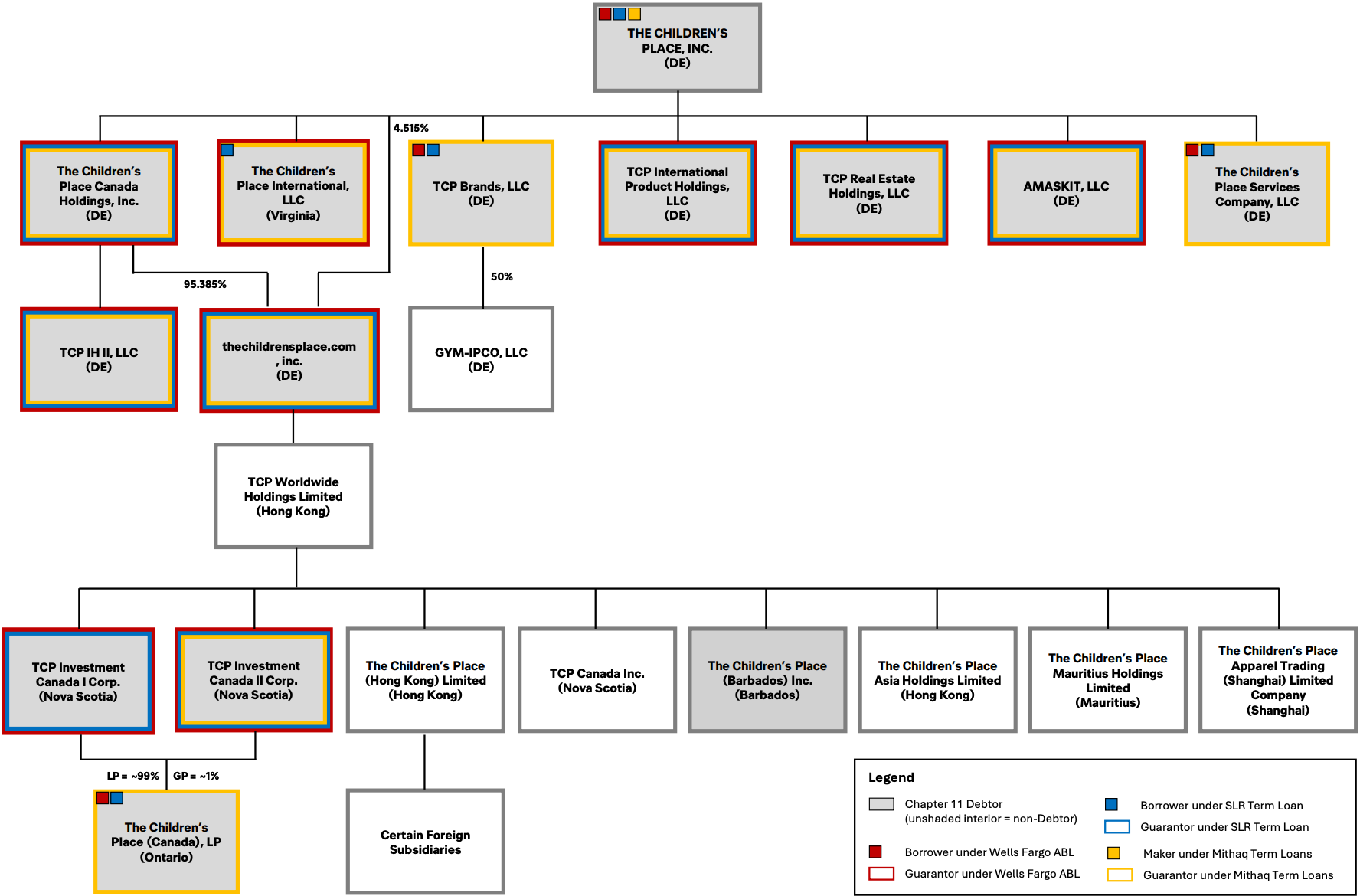
⁽¹⁾ For a complete list of Debtor entities, see organizational structure chart below.
Corporate History
Gymboree Acquisition
The Gymboree brand came to TCP through another retailer’s restructuring. Gymboree first filed for Chapter 11 in June 2017 and emerged that September only to return to bankruptcy court in January 2019. Out of Gymboree's second bankruptcy, TCP Brands, LLC, now one of the Debtors, acquired the worldwide rights to the Gymboree and Crazy 8 names and related intellectual property in April 2019 for $76 million. The Company then relaunched Gymboree across its digital and other channels as a more premium complement to its core The Children’s Place brand.
Mithaq Ownership
Mithaq Capital SPC, a Riyadh-based investment vehicle led by Turki Saleh A. AlRajhi, became TCP’s majority stockholder in February 2024, acquiring approximately 56% of its common stock for approximately $97.8 million. Mithaq increased its stake a year later through TCP’s $90 million equity rights offering, completed in February 2025. According to the Debtors’ petition, Mithaq held approximately 61.1% of TCP’s common stock.
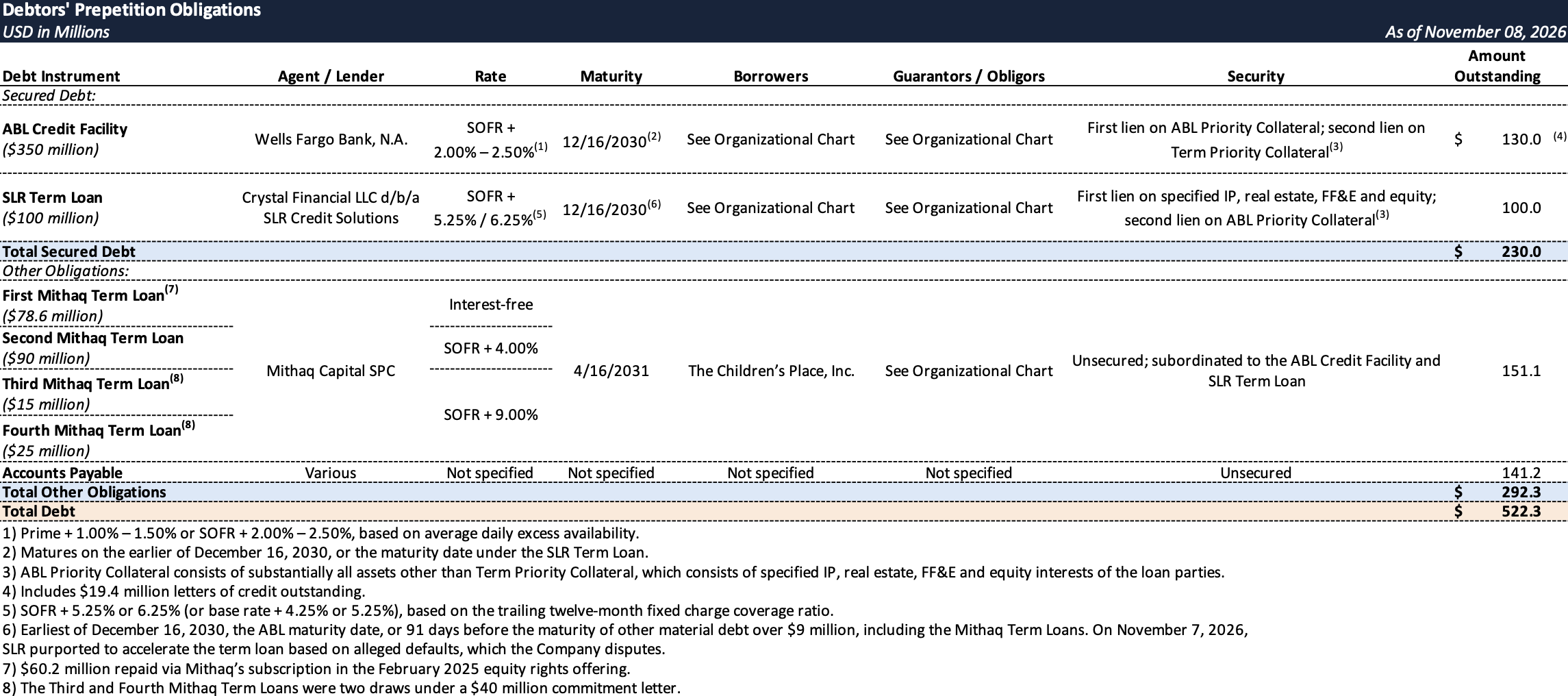
Mithaq is also a lender in TCP’s capital structure, having extended four unsecured promissory notes to the Company between February 2024 and September 2026. Approximately $151.1 million remained outstanding as of the Petition Date, net of $60.2 million exchanged for equity in the February 2025 rights offering.
Organizational Structure
The Debtors consist of TCP and thirteen of its subsidiaries, which largely make up the Company’s U.S. (including Puerto Rico) and Canadian operations. TCP's non-Debtor subsidiaries are foreign entities that provide sourcing, import and export, customer service and IT support, and that also engage in limited wholesale and online retail sales.
- Canadian Debtors. Consists of The Children’s Place (Canada), LP, an Ontario limited partnership that operated 56 leased stores across nine provinces as of the Petition Date, and its general and limited partners, TCP Investment Canada II Corp. and TCP Investment Canada I Corp. Both partners are owned by TCP Worldwide Holdings Limited, a non-Debtor Hong Kong subsidiary.
Operations Overview
Revenue Segments
TCP reports its results across two geographic segments, and the U.S. accounts for nearly all of the business:
- The Children’s Place U.S. This segment covers the U.S. and Puerto Rico stores, the U.S. wholesale business and the two e-commerce sites. In fiscal 2025, it generated approximately $1.10 billion in net sales, or 91.3% of the Company’s approximately $1.21 billion total, along with a $41.5 million operating loss.
- The Children’s Place International. This segment combines 56 leased stores across nine Canadian provinces with revenue from franchisees operating more than 300 points of distribution in 13 countries. In fiscal 2025, it generated approximately $105.4 million in net sales, or 8.7% of the total, along with a $15.7 million operating loss.
The second half of the year produced 55.3% of fiscal 2025 net sales. Working capital needs typically peak in the third quarter, when the Company purchases inventory ahead of the back-to-school and holiday selling periods. According to the Debtors, this seasonal funding requirement heightened the liquidity pressure created by recent operating losses.
E-commerce, Wholesale and Franchise Channels
- E-commerce. TCP’s two digital storefronts, childrensplace.com and gymboree.com, carry the same merchandise as its stores, along with online-only items, and support buy-online-pickup-in-store and ship-from-store. According to the 2025 Annual Report, e-commerce accounted for approximately 51% of fiscal 2025 retail sales, down from approximately 55% a year earlier.
- Wholesale and Amazon. Amazon is TCP’s largest wholesale account and, according to the Debtors, an important customer acquisition channel. The fiscal 2025 10-K reports a single U.S. wholesale customer above 10% of net sales, with sales to it of $127.7 million, down from $170.7 million in fiscal 2024, and attributes the decline in wholesale revenue to a planned reduction in shipments to Amazon.
- International franchise. As of the Petition Date, ten international franchise and wholesale partners operated 323 points of distribution across 13 countries. TCP earns revenue from these partners through both product sales and sales-based royalties.
Sourcing and Distribution
The Company designs the substantial majority of its branded products and contracts their manufacture directly with vendors, primarily in Bangladesh, Vietnam, Ethiopia, Indonesia, India, Kenya, Cambodia and China. The Company's sourcing offices in Hong Kong, Pakistan, Kenya, China, India, Ethiopia and Indonesia manage those vendor relationships. Bangladesh and Vietnam each supplied more than 15% of sourced merchandise in fiscal 2025.
Most merchandise moves through the Company’s owned, approximately 700,000-square-foot distribution center in Fort Payne, AL, which serves stores, wholesale and e-commerce in both the U.S. and Canada. A third-party facility in Mississauga, Ontario handles Canadian e-commerce fulfillment. International franchise partners are supplied mainly from a third-party warehouse in Asia.
Retail Stores and Lease Portfolio
As of the Petition Date, TCP leases all of its 512 stores, including 56 stores in Canada. As of August 1, 2026, operating lease liabilities had a present value of $224 million, against $286.4 million of undiscounted payments, $173.3 million of which falls due in fiscal 2028 or later. The weighted-average remaining lease term was 5 years as of the same date. Fixed operating lease cost totaled $86.7 million in fiscal 2025.
For leases the Debtors reject, the Bankruptcy Code limits what landlords can recover. Under § 502(b)(6), a landlord’s damages claim is capped at rent for the greater of one year or 15% of the remaining lease term, up to a maximum of three years. Unpaid rent due as of the Petition Date, or the date the premises are surrendered if earlier, is added on top. With a 5-year weighted-average remaining term, the cap for a typical TCP lease is one year’s rent.
Using a simple average rent of approximately $169,000 per store, based on fiscal 2025 fixed lease cost and 512 stores, a hypothetical rejection of 50 leases would cap landlord damages claims at approximately $8.5 million, plus any unpaid prepetition rent. Even if each of those leases had eleven years remaining, the longest remaining term across TCP’s leases, the cap would rise to approximately $14 million. Actual claims will depend on each rejected lease’s rent and remaining term, and on which leases a buyer assumes.
Workforce
As of the Petition Date, the Company employed approximately 7,210 people, approximately 6,911 of them at the Debtors. Approximately 6,162 worked in the United States and approximately 1,048 abroad, including approximately 749 in Canada. The Company also used approximately 13 temporary workers and independent contractors in corporate functions.
According to press reports, the Company expects to lay off all 593 workers at its Fort Payne, Alabama distribution center when the facility closes on January 5, 2027. A WARN notice posted with New Jersey’s labor department in November covers 732 workers across 14 counties, effective February 4, 2027. Together, these two announcements cover 1,325 employees, approximately 19% of the Debtors' workforce.
Prepetition Obligations
Top Unsecured Claims
Events Leading to Bankruptcy
Sustained Sales and Margin Decline
TCP’s sales reached approximately $1.92 billion in fiscal 2021 and have declined every year since, with gross margin falling from 41.5% to 29.9% over that period. The decline continued in fiscal 2025, when net sales fell 12.8% to $1.21 billion, approximately 37% below the fiscal 2021 level. Comparable retail sales declined approximately 8.4% that year, and operating loss widened to approximately $57.2 million from $13.7 million in fiscal 2024.
The Company’s most recent quarterly report showed no improvement: net sales for the first half of fiscal 2026 fell approximately 15.4% year over year to $457 million, and operating loss grew to approximately $55.2 million from $20 million in the prior-year period. In its Q2 2026 earnings release, the Company also cited a clearance-heavy sales mix and said a delayed transition of its e-commerce operations to Salesforce had contributed in part to the sales decline.
The Debtors attribute the overall decline to weaker demand for value-priced children’s apparel, persistent cost inflation, elevated tariffs, and growing competition from traditional retailers and e-commerce players. Falling sales left less gross profit to cover a largely fixed cost base, which the Company could not reduce at the same pace.
Customer Losses and Assortment Missteps
In his letter to shareholders in the Company’s 2025 Annual Report, then-Executive Chairman Turki S. AlRajhi attributed more than half of fiscal 2025’s sales decline to e-commerce, where the Company lost more customers than it gained, and about a quarter to wholesale. He also acknowledged that the assortment had missed: in some seasons it leaned too heavily on basics, while newer, higher-priced lines failed to resonate with value-conscious shoppers.
Liquidity and Operational Efforts
Beginning in fiscal 2025, TCP pursued a series of financing transactions to extend its runway. In December 2025, it refinanced its senior capital structure through amendments to the ABL Credit Facility and the new $100 million SLR Term Loan. Mithaq advanced a further $15 million in July 2026 and the final $25 million in September, and the Company used the proceeds to reduce ABL borrowings, pay vendors and fund working capital.
On the operating side, the Company identified more than $100 million of run-rate cost-saving opportunities, spanning organizational redesign, store footprint reductions, supply chain efficiencies and corporate overhead. It also cut inventory by more than $100 million between August 2025 and August 2026. However, these measures did not offset the decline in revenue and the operating losses.
Strategic Alternatives and Sale Process
Starting in September 2026, TCP retained BRG as financial advisor, Cascadia Capital as investment banker and White & Case as restructuring counsel, and it later engaged A&G Realty Partners to negotiate with landlords. The Company evaluated a standalone sale of the Gymboree brand and related intellectual property, as well as an “IPCo” structure in which certain intellectual property would be retained and licensed while other assets were sold or liquidated. Cascadia launched a marketing process that month, contacting approximately 33 strategic and 17 financial parties about a going-concern sale, a liquidation or the sale of discrete assets such as the Gymboree brand and the Amazon business. By the Petition Date, the Debtors had received nine proposals: six for going-concern or intellectual property transactions and three liquidation proposals for substantially all of the assets.
Lender Reserves and Governance Changes
Beginning in early October, Wells Fargo and SLR imposed restructuring reserves under their respective facilities, ultimately reaching $30 million per facility by early November. On October 28, Wells Fargo sent a shifting control notice to JPMorgan Chase, taking control of a TCP deposit account held there.
On October 30, the board appointed Rudolph Morando and Chris McAvinn of BRG as Co-CROs. Subsequently on November 3, a Special Committee was formed with Elizabeth A. LaPuma as its sole member.
Prepetition Executive Payments
In the months leading up to the Petition Date, TCP agreed to three cash payments to current and former executives, totaling approximately $1.4 million:
- Roy separation payment. On July 23, 2026, TCP agreed to pay $525,000 to Kim Roy under a separation agreement ending her temporary role as executive director. She remained on the board until October 30, 2026.
- Umair cash award. A September 11, 2026 letter, effective July 1, granted a one-time $350,000 award to Muhammad Umair, TCP’s former chief executive, in connection with his move to chief strategy officer.
- Szczepanski retention award. On October 19, 2026, TCP granted chief financial officer John Szczepanski a $550,000 cash retention award. The award is payable upfront but must be repaid if he resigns or is terminated for cause within six months. Szczepanski became acting president on November 1, 2026, after Umair and interim chief executive Muhammad Asif Seemab resigned their officer roles.
Chapter 11 Filing
The Debtors filed Chapter 11 to continue the inventory liquidations already underway while marketing their operational assets and intellectual property to a buyer. Store closing sales began at all locations on November 6, two days before the Petition Date, and both the liquidation and the sale process are funded by DIP financing from the Debtors' prepetition secured lenders.
The DIP Facilities
The Chapter 11 cases will be funded by two senior secured superpriority DIP facilities provided by the Debtors' prepetition secured lenders, which received interim approval on November 10, 2026. Wells Fargo is agent for an asset-based revolver of up to $166 million (the "DIP ABL Facility"), and SLR is agent for a term facility of up to $116 million (the "DIP Term Facility"). Only $16 million of the financing is new term money. The remaining rolls up the approximately $230 million of prepetition secured debt into DIP obligations. The final hearing is scheduled for December 15, 2026, with objections due December 8. TCP is lead borrower under both facilities, with four subsidiaries as co-borrowers and eight as guarantors.
- Structure — The DIP ABL Facility consists of $146 million of revolving loans plus a $20 million letter-of-credit sublimit, with borrowings capped at $131 million until a final order is entered. The DIP Term Facility consists of $16 million in new money and $100 million roll-up of prepetition term loan.
- New Money and Funding Timing — SLR funded $16 million of new term loans at closing under the interim order, $15 million of which was required to pay down the prepetition revolver.
- Term Roll-Up — On interim approval, $16 million of the prepetition SLR term loan rolls up into DIP term loans. The remaining $84 million converts upon entry of the final order.
- ABL Roll-Up — The prepetition revolver converts into DIP debt through a “creeping” roll-up. Collections from ABL collateral pay down the prepetition revolver, while the Debtors fund operations with DIP ABL borrowings, steadily replacing old debt with new. Existing letters of credit, cash management obligations and bank products became DIP ABL obligations on interim approval, and accrued prepetition interest and fees were paid in cash at closing. Any remaining prepetition balance converts into DIP revolving loans upon entry of the final order.
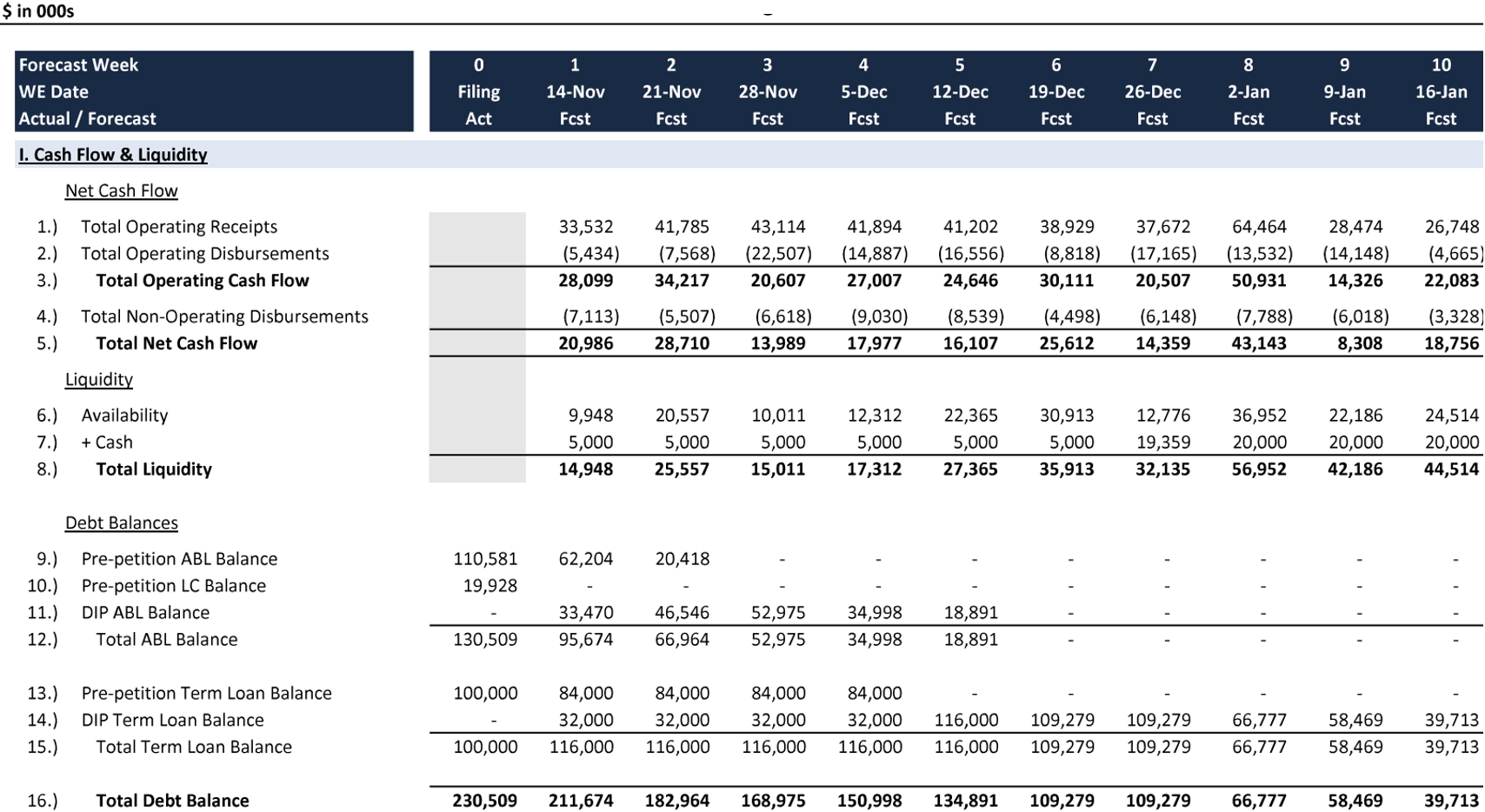
- Reserve Releases — The restructuring reserves had reached $60 million across both facilities before the filing. They were cut to $37.5 million on day one: the ABL portion went to zero while the term portion increased to $37.5 million. They are scheduled to fall to $30 million after the week ending November 28 and to be removed entirely after the week ending December 5. Freight, rent and tax reserves of approximately $8.2 million were also released on day one.
- Pricing — The DIP ABL Facility bears interest at base rate plus 3.50%, and the DIP Term Facility at three-month Term SOFR plus 8.25%, with a 2% floor. Both facilities have a 2% default rate increase.
- Fees — The ABL carries an unused line fee of 0.375% (0.250% when more than half the commitment is unused), with letter-of-credit fees of 1.75% for commercial and 3.50% for standby letters of credit. Term facility fees are not publicly filed.
- Maturity — The DIP ABL Facility matures at the earliest of January 29, 2027, a plan's effective date, a sale of substantially all assets, dismissal or conversion, or 30 days after the Petition Date (December 8, 2026) if a final order has not been entered. The DIP Term Facility follows the same terms, with an outside date of March 1, 2027.
- Collateral and Priority — Liens on substantially all assets plus superpriority claims, allocated between the ABL and term lenders by collateral type under a lien priority schedule and the Intercreditor Agreement. Liens on avoidance action proceeds are reserved for the final order.
- Carve Out — Statutory and clerk fees, professional fees incurred before a default notice, up to $1.5 million afterward, and up to $50,000 for a Chapter 7 trustee.
- Adequate Protection — The prepetition lenders receive replacement liens, § 507(b) superpriority claims, payment of principal and default-rate interest on the remaining prepetition debt, and payment of their professional fees.
- Challenge and Investigation Budget — A challenge must be filed within 60 days after a creditors' committee is formed or, if none is appointed, 75 days after entry of the interim order (January 25, 2027). A committee may spend up to $50,000 investigating the prepetition liens.
- Budget Variance — A 13-week budget, updated every fifth week, with weekly variance reporting. Receipts must be at least 85% of budget, operating disbursements no more than 110%, and professional fees no more than 115%. The term facility also requires that net cash flow not fall more than $10 million below budget.
Initial DIP Budget
Sale Process
The Debtors filed a motion seeking approval of bidding procedures to sell some or all of their assets, including the intellectual property and brands, among them “The Children’s Place” and “Gymboree,” and the Amazon operations. Under the proposed Bidding Procedures, bids are due December 9, 2026, 31 days after the Petition Date. An auction, if needed, would follow on December 11, and the sale hearing on December 15. Each date falls one to three days ahead of the corresponding DIP milestone. Separately, the DIP milestones require motions by November 20 to retain a broker to sell the Fort Payne distribution center and, if the Debtors and the DIP Agents agree on funding, a sales consultant for the intellectual property.
- Stalking Horse — The Debtors have not yet selected a stalking horse and may not elect to select one. Under the proposed order, they may designate one or more stalking horse bidders by November 17, 2026.
- Bid Protections — A stalking horse may receive a break-up fee of up to 3% of the purchase price and/or reimbursement of reasonable and documented expenses.
- Credit Bidding — The DIP and prepetition lenders may credit bid their applicable obligations, subject to the challenge provisions. Neither lender group may credit bid for the other’s priority collateral unless that group’s obligations are paid in full in cash.
- Bid Requirements — Each bid must include a 10% cash good-faith deposit, carry no financing or diligence contingencies and remain irrevocable until closing. Overbids at the auction must exceed the prior bid by at least $250,000 plus any stalking horse protections.
- No Lease-Only Bids — Under the revised proposed order, leases may not be purchased on a standalone basis, individually or as a portfolio. A lease may be acquired only as part of the same buyer’s purchase of other assets.
Debtwire reported on October 26, 2026 that Catalyst Brands was considering a bid for roughly 200 stores and the intellectual property.
Inventory Liquidation
Under the Consulting Agreement, Tiger Capital Group, SB360 Capital Partners and GA Retail Solutions (the “Consultant”) are running store closing sales across all stores and warehouses and through the e-commerce platform. The sales cover TCP and its subsidiaries other than TCP Brands and GYM-IPCO, and run through February 28, 2027 unless ended earlier. According to the Debtors, the Consultant has syndicated the agreement to Hilco Merchant Resources and Gordon Brothers Retail Partners. The Debtors keep title to unsold merchandise, intellectual property, receivables and real estate.
- Fees and Expenses — The Consultant earns a base fee of 2.5% of gross proceeds from merchandise sales and a 15% commission on furniture, fixtures and equipment. Consultant expenses are capped by a $34.1 million budget, supported by a $3.1 million deposit paid at signing. Sale advertising, including signage, banners and digital marketing, accounts for $24.7 million of the budget, and the Consultant’s store supervisors for $9.3 million.
- Halting Store Closures — According to the Debtors, the agreement preserves the ability to halt store closures if a going-concern bid becomes actionable. Withdrawing a store from the sales requires either consent from the lenders or a good-faith board determination, after consulting outside counsel, that its fiduciary duties require it. Separately, both DIP facilities bar removing stores from the closing process without the applicable DIP agent’s reasonable consent or a court order permitting it.
- Consultant as Bidder — The proposed store closing order allows the Consultant and its affiliates to bid on Debtor assets outside the Consulting Agreement, subject to separate court approval.
First-Day Relief
- NOL Trading (Docs. 8, 81 – interim approval): The Debtors received interim approval of notice and objection procedures for holders of 4.5% or more of common stock to protect federal NOLs the Debtors estimate at approximately $79.1 million, and $51 million of disallowed business interest carryforwards
- Foreign Representative (Docs. 10, 80 – final approval): The Debtors received final approval for TCP to act as foreign representative in seeking recognition of the Chapter 11 cases as a foreign main proceeding in the Ontario Superior Court of Justice (Commercial List).
- Customer Programs (Docs. 11, 76 – interim approval): The Debtors received interim approval to continue their customer programs, carrying approximately $39.5 million in prepetition obligations, including approximately $17.4 million in outstanding gift cards and merchandise credits.
- Insurance (Docs. 13, 77 – interim approval): The Debtors received interim approval to maintain approximately 51 insurance policies and pay approximately $565,000 in premiums due during the interim period, out of approximately $1.28 million outstanding, plus related deductibles and broker fees. They may also maintain eight surety bonds totaling approximately $18.7 million, backed by cash-collateralized letters of credit from Wells Fargo.
- Cash Management (Docs. 14, 73 – interim approval): The Debtors received interim approval to continue their cash management system of 31 bank accounts holding approximately $2 million. The approval also covers approximately $958,000 in payment processing fees, $160,000 in armored car transport fees and $64,767 under their American Express corporate card program, and allows intercompany transactions to continue as long as none benefit Mithaq Capital or other insiders.
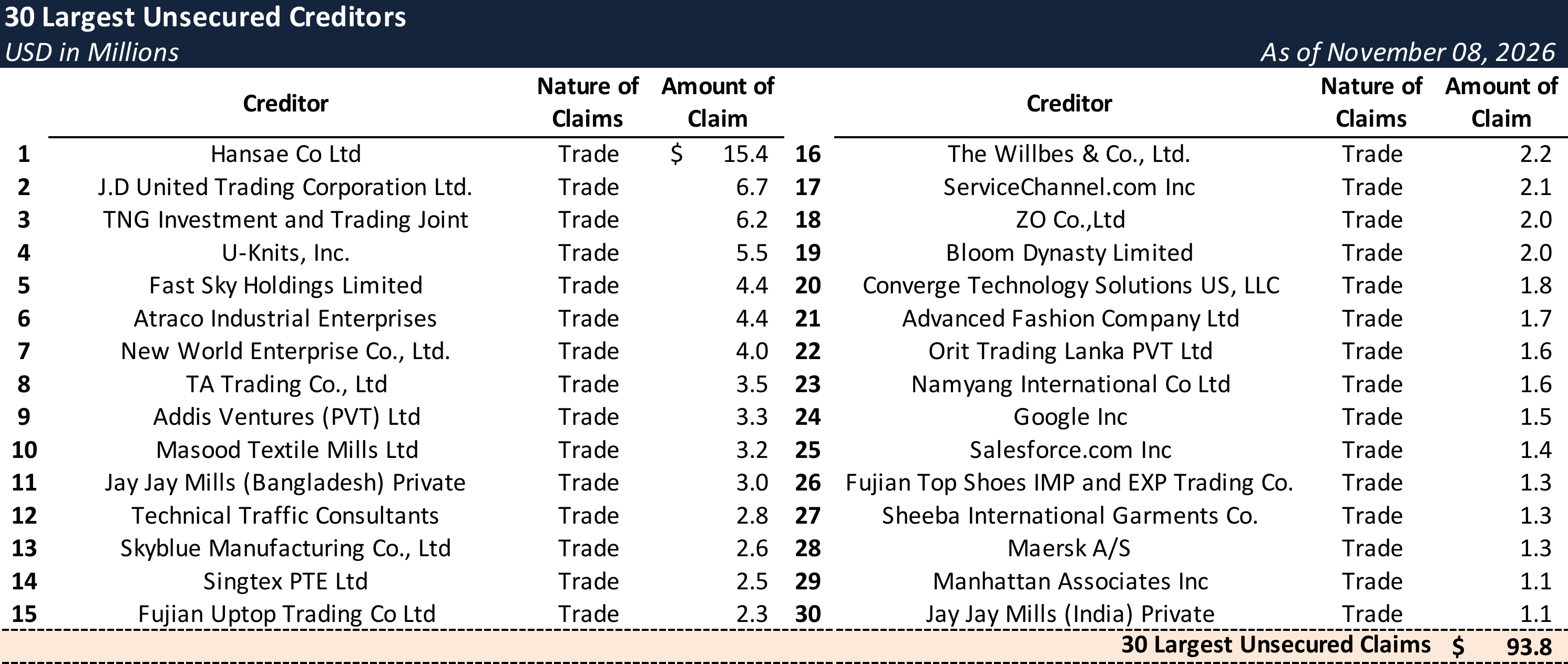
- Critical Vendors (Docs. 15, 79 – interim approval): The Debtors received interim approval to pay prepetition trade claims, which they estimate at approximately $10 million, the same estimate given on a final basis. This consists of approximately $3.5 million to performance marketing vendors and $6.5 million to carriers, freight forwarders, customs brokers and warehousemen holding potential liens, with funds interchangeable between the two categories.
- Utilities (Docs. 16, 83 – interim approval): The Debtors received interim approval to deposit approximately $302,129 into a segregated adequate assurance account within 20 days of the Petition Date.
- Taxes (Doc. 17 – pending): The Debtors seek approval to pay approximately $13.6 million in prepetition taxes and fees on both an interim and final basis, which consists of approximately $9.4 million in customs and import duties, $4 million in sales and use taxes and approximately $174,000 in property, income, franchise and withholding taxes and tax service provider fees.
- Wages (Docs. 18, 85 – interim approval): The Debtors received interim approval to pay approximately $2.9 million in prepetition compensation and benefits, the same amount requested on a final basis, subject to a $17,150 per-individual cap. Non-insider bonus programs may continue, but insider incentive payments require further court approval.
Explore Bondoro Insights for live case dockets and comprehensive coverage of material filings from petition to plan confirmation.
Stay informed on every Chapter 11 bankruptcy case with liabilities exceeding $10 million. Subscribe for free to have our coverage delivered directly to your inbox, and explore our full archive of past summaries.
Subscribers can also opt in to timely filing alerts by updating their email preferences in Account Settings.


