Case Summary: Ascend Elements Chapter 11
Ascend Elements has filed for Chapter 11 bankruptcy amid a construction dispute at its flagship Kentucky plant, federal grant cancellations, and a lithium price collapse, pursuing an expedited 363 sale of substantially all assets.

Business Description
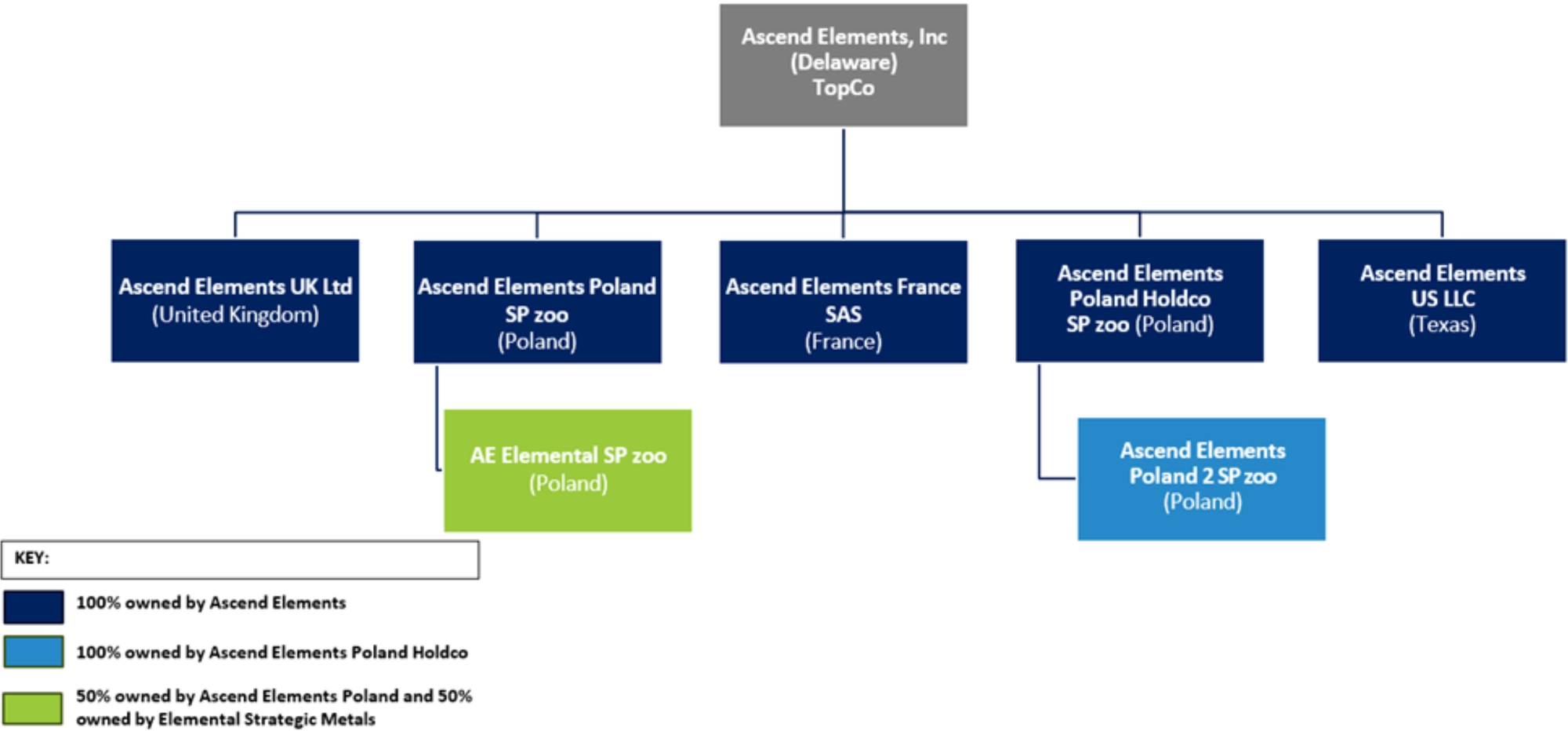
Headquartered in Westborough, MA, Ascend Elements, Inc. ("Ascend Elements"), along with its Debtor affiliate Ascend Elements US, LLC (collectively, the "Debtors" and, together with their non-Debtor affiliates, the "Company")⁽¹⁾, is a lithium-ion battery recycler that recovers critical minerals from end-of-life EV batteries and gigafactory scrap and converts them into battery-grade materials—black mass, precursor cathode active material ("pCAM"), and lithium carbonate.
- The Company's proprietary Hydro-to-Cathode® process, developed at Worcester Polytechnic Institute ("WPI"), combines hydrometallurgy with direct precursor synthesis and is licensed from WPI.
- The technology underpins a worldwide intellectual property portfolio of 154 granted and pending patents.
Ascend operates an active commercial facility in Covington, GA (Apex 0); a 60% complete, construction-paused pCAM plant in Hopkinsville, KY (Apex 1); a 50/50 Polish joint venture with Elemental Strategic Metals in Zawiercie (AE Elemental); an early-stage wholly-owned Polish lithium carbonate and pCAM extraction project in the Wałbrzych Special Economic Zone (Apex 2); an R&D facility in Westborough, MA; and a cathode-finishing lab in Novi, MI (per Ascend's careers page; not separately named in the First Day Declaration).
- Headcount was approximately 102 at the Petition Date. Estimated 2024 revenue was approximately $35 million (per CB Insights).
The commercial pipeline rests on four principal contracts: (i) a November 2025 multi-year offtake with Trafigura Group for 15,000 metric tons of lithium carbonate between 2027 and 2031 (Ascend PR, Nov. 12, 2025) (described by Ascend in its December 2025 year-end release as a "take-or-pay" agreement); (ii) a December 2025 multi-year supply contract valued at approximately $1 billion with an unnamed "leading global automaker" (Ascend PR, Dec. 18, 2025); (iii) a separate June 2023 pCAM supply contract, also valued at approximately $1 billion (with an option to expand up to $5 billion), for an unnamed "major U.S. company" to be sourced from Apex 1 (Ascend PR, Jun. 7, 2023); and (iv) a March 14, 2023 agreement with Koura—the fluorinated solutions business of Orbia, whose venture arm (Orbia Ventures) led the Company's 2021 Series B—for up to 5,000 metric tons per year of recycled lithium carbonate (Ascend PR, Mar. 14, 2023). A non-binding February 2023 "basic agreement" with Honda (Honda Global, Feb. 27, 2023) and one-time commercial deliveries to Navitas Systems (for an undisclosed DoD project) (Ascend PR, Jan. 31, 2022) and Freudenberg e-Power Systems (described by Ascend as "relatively small in relation to the intended full-scale commercial program") round out the named customer relationships.
- Ascend claims more than $2 billion in aggregate future commitments (Doc. 11, ¶10); each of the three largest contracts is structurally dependent on completion of Apex 1.
Ascend Elements, Inc. filed for Chapter 11 protection on April 9, 2026 (the "Petition Date") in the U.S. Bankruptcy Court for the Southern District of Texas, reporting $1 billion to $10 billion in assets and $500 million to $1 billion in liabilities.
⁽¹⁾ See the organizational structure chart below for all entities.
Corporate History
Battery Resourcers, LLC was founded in 2015 as a WPI spinout by Dr. Yan Wang (Chief Scientist), Dr. Eric Gratz (CEO), and Dr. Diran Apelian (Board Chair), commercializing research Wang and Apelian had initiated at WPI in 2011. Mike O'Kronley, an A123 Systems veteran who had joined the board in 2017, was appointed CEO in March 2020.
Scale-Up and Rebrand (2021–2024)
Under O'Kronley, the Company rebranded as Ascend Elements in January 2022 and raised approximately $1 billion of equity over three years, including a $300 million October 2022 Series C financing (including $200 million in equity) led by Fifth Wall Climate, with SK ecoplant joining as a new strategic investor; a $542 million September 2023 Series D led by Decarbonization Partners (a BlackRock/Temasek JV), Temasek, and Qatar Investment Authority, with Fifth Wall, BHP Ventures, Tenaska, and Alliance Resource Partners; and a $162 million February 2024 round from Just Climate, Clearvision Ventures, and IRONGREY.
SK ecoplant, the environmental arm of SK Group, was Ascend's largest individual equity holder, having committed $60.84 million across the Series C and a follow-on and taken a board seat. On September 9, 2024—contemporaneous with Linh Austin joining the Ascend board, and less than two months before Ascend issued its November 1, 2024 Work Suspension Directive at Apex 1 (Doc. 79, ¶23)—SK ecoplant sold its entire stake (approximately 9.2 million shares, or ~7.7% of shares outstanding) to Seoul-based SKS Private Equity Co., Ltd. for approximately $98.23 million, a ~60% gain on cost (KED Global, Sep. 9, 2024; Korea Herald).
- SKS Private Equity, a Seoul-based firm spun off from SK Securities' private equity division in 2019, has filed a Notice of Appearance in the Chapter 11 case (Doc. 33) through Baker & McKenzie LLP (Courtney E. Giles, Blaire A. Cahn, Mark D. Bloom).
- SK ecoplant separately sold its waste- and water-treatment business to KKR for approximately $1.1–$1.2 billion in August 2025 (KED Global, Aug. 2025).
Leadership Transition
O'Kronley departed on or about March 20, 2025 (Doc. 11, ¶3). Approximately 38 days later, on April 27, 2025, NOVONIX Limited (ASX/NASDAQ: NVX), an Australian-headquartered synthetic graphite and anode materials company, announced his appointment as CEO effective May 19, 2025. NOVONIX's announcement described O'Kronley as having "increased the enterprise value of [Ascend] by US$1.6 Billion in 5 years"—language that stands in tension with Austin's subsequent characterization of Ascend's pre-2025 period as one of "fiscal and operational mismanagement."
- September 2024 was also when Ascend's pre-2025 operations leadership unwound. Per TKJV (Doc. 79, ¶18), Ascend disclosed at a September 3, 2024 project meeting that Chief Operating Officer Dan Russel and Vice President of Construction Wenqing Su—both original authorized representatives for Apex 1—had "abruptly left the company," with O'Kronley and then-CFO Andrew Aberdale assuming "more active roles" in the project.
- Those departures were approximately contemporaneous with SK ecoplant's September 9, 2024 equity exit and Austin's September 2024 board appointment—three concurrent September 2024 developments that together mark the beginning of the leadership unwind that Austin would formalize in March 2025.
Linh Austin, a 30-year energy-industry operator (formerly Regional CEO of McDermott International's Middle East & North Africa division, with prior senior roles at ARCO/BP, and most recently chairman of Fluitron) who had joined the Ascend board in September 2024, was appointed President and CEO on March 20, 2025. Eight of eleven senior leaders have joined since 2025 (Doc. 11, ¶11). Alvarez & Marsal's Adam Titus served as interim CFO beginning January 2026; Ahmed Allouache was appointed permanent CFO on March 21, 2026; Titus then transitioned to Chief Restructuring Officer on April 3, 2026—six days before the petition (Doc. 19, ¶5).
Organizational Structure
Operations Overview
Apex 0 — Covington, GA (Operational)
Ascend's first commercial facility is a 154,000-square-foot plant approximately 35 miles east of Atlanta, originally announced in January 2022 as a $43 million investment.
- In public remarks during the August 2025 facility restart, Austin disclosed that the Company had "invested over $120 million" in the facility (Covington News, Aug. 2025)—a near-threefold overrun relative to the original budget.
Apex 0 is designed to process approximately 30,000 metric tons of battery feedstock per year into 20,000–30,000 metric tons of black mass (Doc. 11, ¶22), and in August 2025 produced what the Company described as the first commercial-scale recycled lithium carbonate (>99% pure) in U.S. history.
The facility has a troubled safety history: fourteen fire-related incidents between March 2023 and February 2025 (WSB-TV) culminated in a February 2025 operational suspension under pressure from the Covington Fire Department, with operations restarting on August 25, 2025 after safety upgrades and a near-total site management replacement. Utility-connection upgrades remain necessary for commercially viable lithium carbonate output.
Apex 1 — Hopkinsville, KY (60% Complete, Paused)
Announced in August 2022 as a Phase 1 $310 million investment with eventual buildout of up to $1 billion, Apex 1 was designed as North America's first commercial-scale pCAM and lithium carbonate manufacturing facility, targeting pCAM for roughly 750,000 EVs per year.
Ascend contracted the Turner-Kokosing Joint Venture ("TKJV")—Turner Construction Company (ultimately owned by Germany's Hochtief AG and Spain's ACS Group) and Kokosing Industrial, Inc.—as design-builder in November 2022 under the AIA Document A141-2014 Standard Form of Agreement Between Owner and Design-Builder (Doc. 79, Background ¶1; Doc. 79, Exhibit A), with SSOE Group as the design/architect partner and Ascend's own Blue Star Engineering retained directly by Ascend to design and specify the process equipment.
- The contract is a cost-plus compensation structure with no guaranteed maximum price, which allocates cost-overrun risk to Ascend as Owner rather than to TKJV.
- The original contract scope was approximately 950,000 gross square feet of buildings on a 70-acre greenfield site (Doc. 79, Exhibit A), which TKJV alleges expanded to approximately 1.45 million gross square feet with an $878 million cost estimate by May 2024 under Ascend-directed scope changes (Doc. 79, ¶12)—including a May 15, 2023 strategic pivot in which Ascend abandoned the originally designed cathode active material ("CAM") process as "no longer commercially viable" and directed TKJV to shift exclusively to pCAM production. Work last occurred on December 20, 2024, and the facility has been paused since.
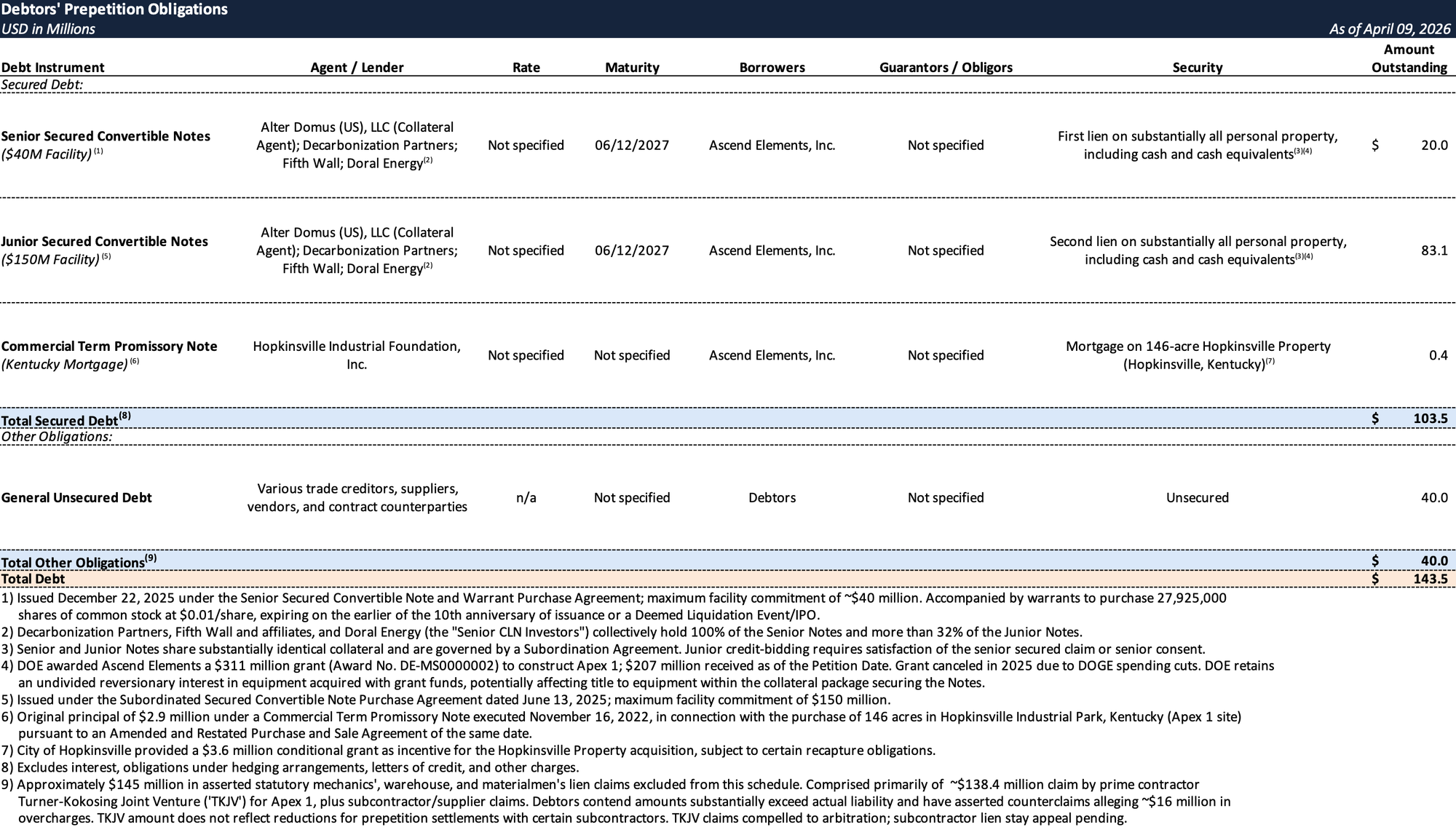
Aggregate investment into Apex 1 has been substantial. The DOE disbursed approximately $207 million in grant funds toward Apex 1 construction (Doc. 11, ¶45), and TKJV claims an additional $138.4 million in unpaid work performed (Doc. 11, ¶51), both against the $310 million original Phase 1 budget. Apex 1 incentives included up to $9.5 million in performance-based Kentucky tax incentives and a $3.6 million Hopkinsville conditional grant subject to recapture (Doc. 11, ¶46). The Debtors have expressly disavowed any intent to restart construction in Chapter 11.
Poland Operations
AE Elemental (Zawiercie). On April 9, 2024, Ascend and Elemental Strategic Metals formed a 50/50 joint venture operating a 12,000 MT/year battery metals recovery facility in Zawiercie that commercially opened September 19, 2024. Elemental Strategic Metals is a subsidiary of Elemental Holding S.A., a financially robust global urban-mining group (delisted from the Warsaw Stock Exchange in 2021 and reorganized through Luxembourg) that closed a €252 million banking refinancing in early 2025 (announced March 2025).
- Critically, Elemental Holding is separately developing the POLVOLT refining expansion adjacent to Zawiercie—designated one of only two Polish "Strategic Projects" under the EU Critical Raw Materials Act in March 2025 and awarded €240 million (PLN 1 billion) in TCTF state aid in October 2025 (Notes from Poland, Oct. 6, 2025)—meaning Ascend's JV partner is building a competing refining outlet for the same black mass feedstock intended to supply Apex 2.
- The First Day Declaration acknowledges that only "small amounts of Black Mass are currently produced" at Zawiercie (Doc. 11, ¶28), in tension with AE Elemental's public marketing. The shareholders' agreement is not public, but change-of-control and right-of-first-refusal provisions customary in Polish 50/50 JVs are likely implicated by the filing.
Apex 2. A separately planned, wholly-owned pCAM and lithium carbonate extraction facility in the Wałbrzych Special Economic Zone in Lower Silesia, approximately 200 kilometers west of Zawiercie, held through non-Debtor Ascend Elements Poland 2 (Doc. 11, ¶¶29–30). On May 7, 2025, Poland's Ministry of Economic Development and Technology announced a grant offer of up to $320 million (1.22 billion PLN) under the EU Temporary Crisis and Transition Framework (TCTF) (Ascend PR, May 7, 2025; Notes from Poland, May 14, 2025); Ascend's December 2025 year-end release subsequently characterized the figure as $340 million, likely reflecting PLN appreciation. No portion of the grant has been disbursed, and no binding grant agreement has been publicly reported as executed.
- TCTF was replaced by the Clean Industrial Deal State Aid Framework on June 25, 2025.
- The First Day Declaration also references "significant financial backing from the European Bank for Reconstruction and Development" (Doc. 11, ¶29).
- On March 27, 2026, the Polish Investment and Trade Agency named Apex 2 its "Manufacturing Investment of the Year."
- Ascend filed only U.S. Chapter 11, leaving six non-Debtor European entities—including Ascend Elements Poland 2 (the Apex 2 vehicle) and the AE Elemental joint venture—outside U.S. bankruptcy court jurisdiction and the automatic stay. The Cash Management Motion caps intercompany funding of foreign non-Debtors at $100,000 aggregate without further court approval (Doc. 11, ¶76), against a historical run-rate of approximately $55,000 per month (Doc. 11, ¶75)—less than two months of runway.
Prepetition Obligations
Top Unsecured Claims
Events Leading to Bankruptcy
Apex 1 Construction Dispute
The immediate precipitant of Ascend's distress was the collapse of its relationship with TKJV. The First Day Declaration frames the dispute as Ascend pausing capital expenditure in early 2025 after an internal review that left management "suspecting fraudulent billing" by TKJV (Doc. 11, ¶50); TKJV, in its April 14, 2026 Objection (Doc. 79), frames it diametrically differently—as a pattern of Ascend-directed scope changes and payment defaults on an owner-risk cost-plus contract, culminating in Ascend itself issuing a Work Suspension Directive on November 1, 2024 (Doc. 79, ¶23) and then failing to pay amounts already due.
- The documented payment-default chronology, per TKJV: by September 26, 2024, approximately $41.5 million in Ascend-approved invoices had become delinquent; on October 24, 2024, TKJV issued a formal 7-Day Stop-Work Notice under Section 9.7 of the Agreement and the Kentucky Fairness in Construction Act; on November 1, 2024, Ascend issued its own Work Suspension Directive citing budget overruns and unresolved change orders; TKJV then demobilized in an orderly fashion, with work concluding December 20, 2024. TKJV alleges that pending change orders exceeding $29 million remain unexecuted (Doc. 79, ¶12), reflecting what it characterizes as "Ascend's material failure to follow the contractually agreed-upon change processes."
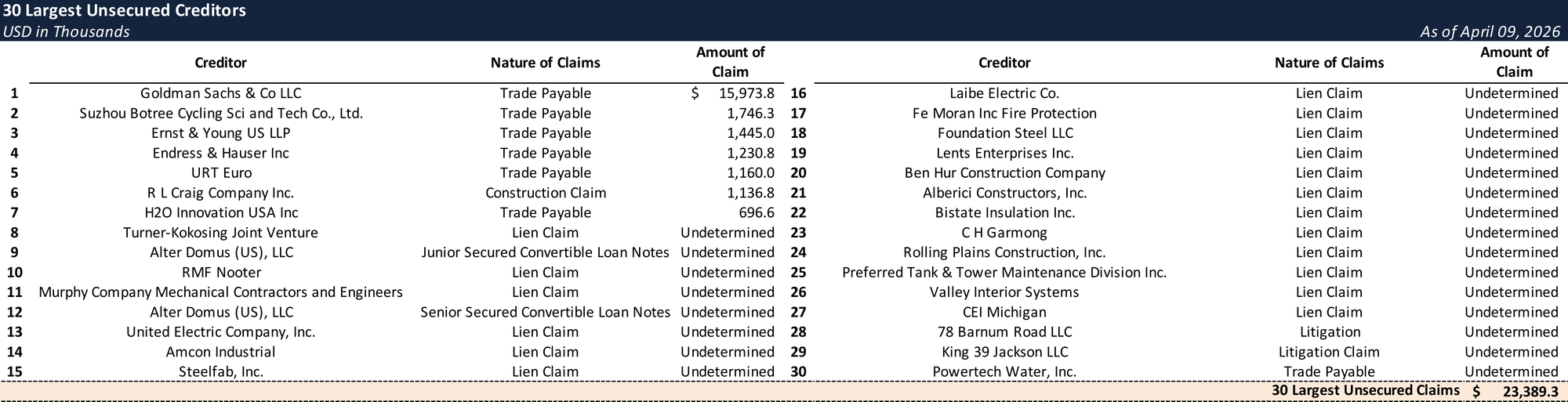
- TKJV recorded an initial mechanic's lien of $121,867,606.21 in the Christian County Clerk's Office on January 17, 2025, and filed an amended lien increasing the claim to $138,418,735.00 on February 14, 2025, the same day TKJV filed a verified lien-foreclosure action in Christian County Circuit Court, Kentucky seeking the full amended amount plus 12% contractual interest under breach-of-contract, quantum meruit, and Kentucky Fairness in Construction Act theories. The complaint named approximately 19 co-defendants, including the Hopkinsville Industrial Foundation, Planters Bank, the City of Hopkinsville, Christian County Government, and numerous Apex 1 subcontractors that had recorded or threatened mechanics liens.
- Ascend asserted counterclaims against TKJV and one of its (unnamed) subcontractors, alleging they "negligently and/or fraudulently overcharged the project by at least $16 million" (Doc. 11, ¶51); the Company has also disclosed that prepetition settlements were reached with "certain subcontractors of TKJV" (Doc. 11, ¶51, fn. 4) (identities and amounts undisclosed).
On May 7, 2025, Christian County Circuit Judge John Atkins granted Ascend's motion to compel arbitration of the TKJV prime-contract dispute but declined to stay the separate mechanics lien claims asserted by subcontractors, holding that the subs "should file their claims at the state level" (WHOP NewsRadio, May 7, 2025).
- Ascend appealed that portion of the ruling; the appeal remained pending as of the Petition Date, and the arbitration is ongoing with no reported award (Doc. 11, ¶51).
Postpetition TKJV and Subcontractor Objections. On April 14, 2026, TKJV—represented by Winston & Strawn LLP (J. Laurens Wilkes, Madison K. Haueisen, Jonathan Levine, James T. Bentley)—filed an Objection (Doc. 79) to both the Cash Collateral Motion and the Bid Procedures Motion. TKJV asserts that it is the Debtors' largest secured creditor, that its lien was "properly perfected prior to the funding and perfection of any of the Debtors' funded debt", and that it is therefore senior in priority to the noteholders on the Apex 1 real property and improvements (Doc. 79, ¶41). TKJV demands parity adequate protection and argues that "an examiner may be warranted in this case to uncover what happened to the money and whether any amounts can be recovered for the benefit of creditors".
- TKJV's objection also challenges specific bid procedures mechanics, arguing that the 17-day post-petition marketing window is "wholly insufficient"; that secured parties should be permitted to credit bid the full amount of their secured claims regardless of asset value; and that the Senior Secured Holder consultation / firewall structure is "closing the gate after the horses have left the stable".
- TKJV "flatly denies" Austin's "fraudulent billing" characterization, calling it "a red herring raised to excuse Ascend's refusal to pay", and notes that even accepting Ascend's allegation at face value, the alleged $16 million overbilling would represent less than 12% of the $138.4 million due.
On April 15, 2026, RMF Nooter, LLC—a TKJV subcontractor represented by Andrews Myers PC (T. Josh Judd) and Stites & Harbison PLLC (Cassidy R. Rosenthal)—filed its own Notice of Perfection of Mechanic's Lien under 11 U.S.C. § 546(b)(2) (Doc. 82) disclosing an individual lien claim of $39,850,480.17—approximately 29% of the aggregate $138.4 million TKJV figure. Nooter's work was last performed around October 25, 2024 (Doc. 82, Exhibit A); its lien was recorded in the Christian County Clerk's Office on December 26, 2024.
- On the same day, Nooter filed a Joinder to TKJV's Objection (Doc. 85), adopting TKJV's arguments and adding three specific clarifications it seeks in the Final Cash Collateral Order and any Sale Order (Doc. 85, ¶9): (i) adequate-protection liens and 507(b) claims granted to the prepetition noteholders are junior to properly perfected Kentucky mechanics' liens on Hopkinsville real property; (ii) no party may assert 363(k) credit-bid rights in a manner that would prime the mechanics' liens absent full satisfaction of 363(f); and (iii) any sale order must provide that Kentucky statutory mechanics' liens attach to net sale proceeds with the same priority as of the Petition Date, with a segregated reserve sufficient to protect disputed M&M claims. Nooter also reserves rights on the 506(c) and 552(b) waivers, teeing up a possible Final Hearing objection.
- The Revised Bid Procedures Order (Doc. 110, ¶31) subsequently established a lienholder resolution framework: TKJV, RMF Nooter, United Electric Company, and AMCON Industrial (collectively, the "Lienholders") must work cooperatively with the Debtors through April 27, 2026 to resolve all issues relating to the validity, extent, priority, and amount of the asserted liens; failing resolution by that date, the parties must seek an expedited court determination on a schedule designed to avoid disruption to the Auction or sale process.
Commodity Prices and Policy Whiplash
Lithium carbonate prices peaked at approximately $80,000 per metric ton in November 2022 before collapsing to roughly $8,259 per ton by June 2025—an 89% decline driven by Chinese capacity additions.
- As of 2023, China controlled nearly 85% of global battery cell production capacity by monetary value and, as of 2022, over two-thirds of the world's cobalt and lithium processing capacity (U.S. EIA).
Prices have since recovered sharply. Spot battery-grade lithium carbonate roughly doubled in Q1 2026 (InvestingNews, Q1 2026 Lithium Market Update)—from approximately $13,433 per metric ton in early December 2025 to approximately $26,278 per metric ton by late January 2026.
- Ascend's November 2025 Trafigura take-or-pay was signed near the cycle trough; while the pricing mechanism is not publicly disclosed, the subsequent price recovery and guaranteed volume commitment enhance the contract's value in any sale process.
U.S. policy shifts compounded the downturn. USTR Section 301 tariffs on Chinese lithium-ion EV batteries rose from 7.5% to 25% effective September 27, 2024 (89 FR 76581, published September 18, 2024), and Chinese EVs themselves were tariffed at 100% on the same date. The One Big Beautiful Bill Act, signed July 4, 2025, terminated Section 30D's $7,500 consumer EV tax credit for vehicles acquired after September 30, 2025 (IRS FAQs, P.L. 119-21) (originally scheduled through 2032) and narrowed Section 45X advanced manufacturing credits with new Foreign Entity of Concern restrictions. The Section 30D termination triggered a 28% year-over-year collapse in Q1 2026 U.S. new EV sales (Electrek, Mar. 27, 2026).
Loss of Federal Grant Funding
In October 2022, the U.S. Department of Energy awarded Ascend two Battery Materials Processing grants totaling approximately $480 million under the Bipartisan Infrastructure Law: a $316.2 million grant for pCAM infrastructure (Assistance Agreement No. DE-MS0000002; the First Day Declaration cites "$311 million" (Doc. 11, ¶45)) and a $164 million grant for CAM manufacturing infrastructure. The $164 million CAM grant was mutually canceled on February 27, 2025. The $316.2 million pCAM grant was unilaterally canceled by DOE on or about October 7, 2025 as part of a five-grant $718 million termination wave from DOE's Office of Manufacturing and Energy Supply Chains (E&E News). Approximately $207 million had been disbursed at termination (Doc. 11, ¶45), leaving approximately $110 million unfunded. DOE stated the canceled projects "had missed milestones... were not economically viable, and would not provide a positive return on investment of taxpayer dollars."
- Pursuant to 2 CFR § 910.360, DOE retains an "undivided reversionary interest" in equipment acquired with grant funds (Doc. 11, ¶45)—a conditional-title arrangement typically perfected via UCC-1 filings.
Management Overhaul and Failed Bridge
The Debtors' current management team implemented weekly cash management and spend controls in Q1 2025 and retained Alvarez & Marsal on September 17, 2025. Jefferies was engaged as investment banker in the fall of 2025. Beginning that fall, Ascend negotiated bridge financing with a group of prepetition noteholders holding a majority of outstanding debt; those efforts resulted in the December 2025 Senior Notes.
In the weeks before filing, Ascend and a third-party lender commenced negotiations on a term sheet combining DIP financing and an asset purchase agreement for substantially all assets, but those negotiations did not result in definitive documentation.
Chapter 11 Filing and Path Forward
The Debtors commenced Chapter 11 to stabilize operations, preserve liquidity, and execute a value-maximizing sale—not to restart Apex 1 construction (Doc. 11, ¶13). The case is running on a 42-day sale calendar from Petition Date to the May 21, 2026 Sale Hearing, with bids due May 9 and an auction, if necessary, on May 12 (Doc. 120, ¶22).
Consensual Cash Collateral Use
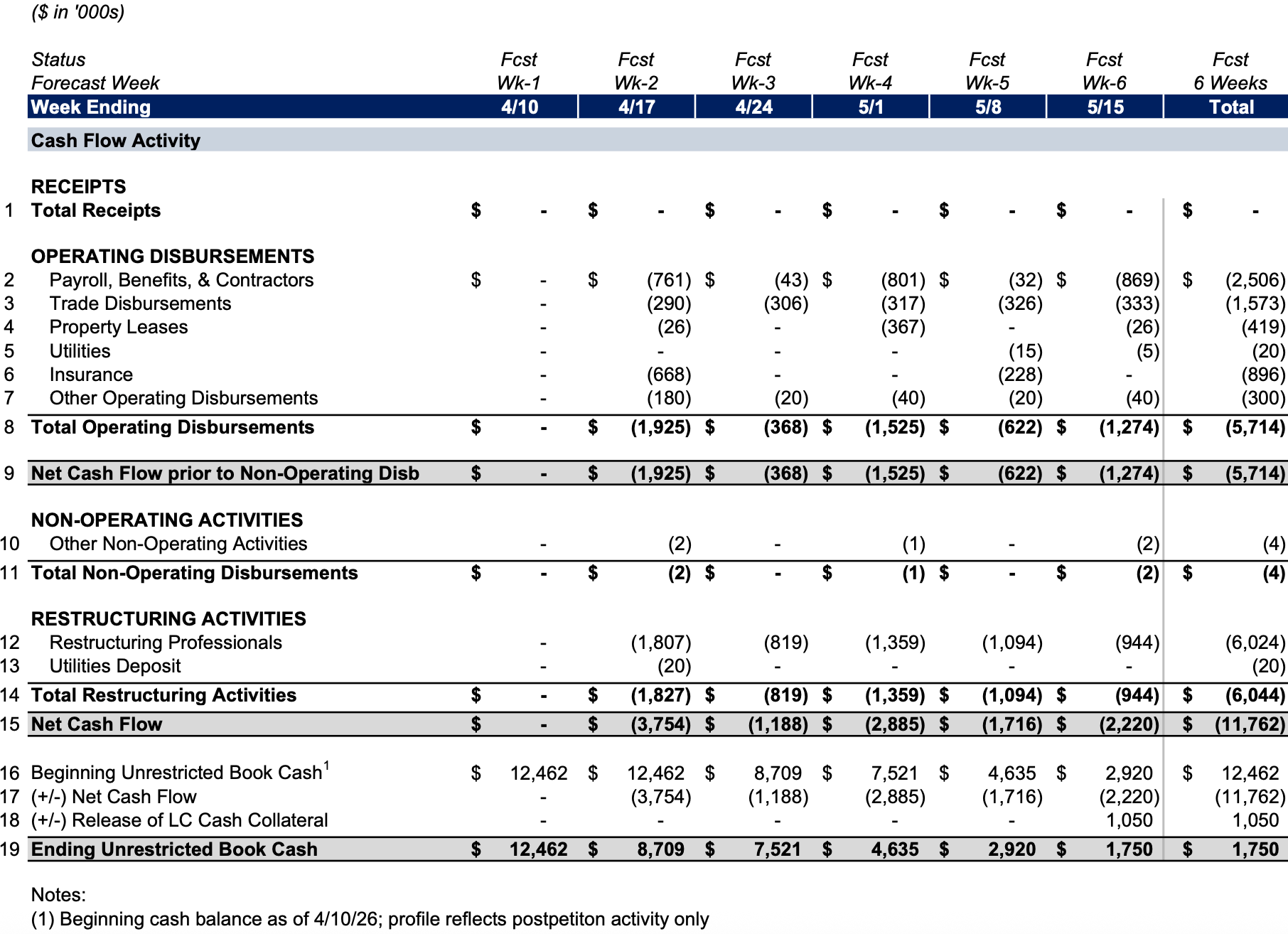
The Interim Cash Collateral Order authorizes consensual use of cash collateral through a Final Hearing on May 7 (objections due May 1) (Doc. 74, ¶30), with a six-week initial operating budget (weeks ending April 10 through May 15).
- Adequate protection includes first- and second-priority additional and replacement liens on substantially all prepetition and postpetition property; section 507(b) superpriority claims; uncapped cash payment of Senior Secured Holder Advisor professional fees within five business days of invoice; 24-hour notice of any competing sale or financing proposals; and continued compliance with all prepetition note covenants.
- Any subsequently appointed Committee is capped at $50,000 of Cash Collateral usage for investigating Challenges during the 60-day Challenge Period. The Senior Secured Holders retain broader case control through Termination Events (Doc. 74, ¶7), which include failure to meet any sale milestone, designation of any stalking horse, approval of bidding procedures, or selection of any winning bidder without written senior consent, termination of CRO Adam Titus, any uninsured postpetition judgment over $750,000, and any stay relief over $250,000. Separately, the Debtors may not reject any material contract without prior written senior consent (¶4(e)).
Initial Approved Budget
Expedited Sale Process
The Debtors filed without a designated Stalking Horse Bidder, without a committed DIP facility, and without requesting any break-up fees. A subsequent declaration by Jefferies Managing Director Michael O'Hara (Doc. 88) disclosed that Jefferies contacted approximately 120 potentially interested parties and executed approximately 18 confidentiality agreements during the prepetition process, which began in fall 2025 and was re-engaged in March 2026 when liquidity issues reemerged.
- The proposed sale timeline is: Bidding Procedures Order — entered April 17 (Doc. 120); IOI Deadline — May 1; Stalking Horse Designation Deadline — May 6; Bid Deadline — May 9; Baseline Bid Deadline — May 11; Auction (if more than one Qualified Bid) — May 12 at 10:00 a.m. CT at Norton Rose Fulbright's Dallas office; Sale Hearing — May 21 at 9:00 a.m. CT.
- The bid procedures permit Partial Bids and authorize sub-auctions for asset sub-groups with competing bids. The Order includes an express carve-out from secured-lender collateral for Jefferies' M&A Transaction Fee. For Qualified Bids solely for the Debtors' Hopkinsville, KY real property, the Order downgrades the Senior Secured Holders' consent right to consultation (Doc. 120, ¶9).
- The Order directs M&M Lienholders, Mortgagees, and the Debtors to resolve lien priority issues by April 27, failing which they must seek expedited court determination (Doc. 120, ¶31).
Explore Bondoro Insights for live case dockets and comprehensive coverage of material filings from petition to plan confirmation.
Stay informed on every Chapter 11 bankruptcy case with liabilities exceeding $10 million. Subscribe for free to have our coverage delivered directly to your inbox, and explore our full archive of past summaries.
Subscribers can also opt in to timely filing alerts by updating their email preferences in Account Settings.


