Case Summary: CashCall Chapter 11
CashCall, a subprime consumer lender, filed Chapter 11 after two consumer-finance judgments totaling roughly $402.6M, seeking $4M of financing from an owner-controlled affiliate while evaluating a potential estate claim concerning a 2021 distribution to that same owner.

Business Description
CashCall, Inc. ("CashCall" or the "Debtor") is a consumer lender that provides unsecured installment loans to consumers with weak credit profiles. The company is a California S corporation licensed under the California Financing Law and wholly owned by J. Paul Reddam, its chief executive officer and president.
Starting with $10,000 loans at 24%–39% interest (requiring a credit score of at least 600), the Debtor broadened its product line to reach more borrowers — adding $5,000 loans at 47%–59% and, in late 2004, $2,600 loans at 79% interest with a 42-month maximum term.
Economic conditions and litigation developments eventually rendered CashCall’s lending models unviable. It ceased originating loans by 2021 but resumed a small number of California originations beginning in March 2024, subject to a state interest rate cap of 36% plus the Federal Funds Rate on loans of at least $2,500 but less than $10,000. CashCall originated 21 loans totaling $94,619 in March 2026 but was no longer making loans as of the Petition Date.
CashCall, Inc. filed for Chapter 11 protection on July 20, 2026 (the "Petition Date") in the U.S. Bankruptcy Court for the Southern District of California, reporting $1 million to $10 million in assets and $100 million to $500 million in liabilities.
Corporate History & Operations Overview
CashCall's corporate history reflects a sequence of product and origination changes: a California subprime platform built around high-cost unsecured loans; national expansion through bank and tribal originators; a mortgage business sold in 2015; and an eventual withdrawal from lending that the Debtor attributes to economic conditions and litigation developments that made its lending models no longer viable.
Early Growth and the $2,600 Product
Reddam founded CashCall in 2003. The Debtor initially offered $10,000 loans at interest rates of 24% to 39%, then broadened its products to include $5,000 loans at 47% to 59% and, beginning in late 2004, a 42-month, $2,600 loan at 79%. The $2,600 principal sat just above California's then-existing $2,500 threshold for an express interest rate ceiling.
CashCall later raised the interest rate on its $2,600 loans first to 87% and then to 96% in 2005, and eventually to as high as 135% by July 2009. The Debtor attributes the later increases to a spike in defaults following the 2008 recession, stating that defaults exceeded 50% during that period — though the San Mateo trial court found that CashCall's default rate stayed roughly constant at 35% to 40% regardless of the interest rate charged. That product became the basis of the De La Torre class litigation discussed below.
Bank Lending Model
Until 2006, California was CashCall’s primary market. The Ninth Circuit explained in CFPB v. CashCall that CashCall sought to expand beyond California but was concerned that compliance with other states’ usury laws would make its operations unprofitable. It therefore paid two federally insured, state-chartered banks—First Bank & Trust of Milbank and First Bank of Delaware—to originate loans that CashCall subsequently purchased and serviced. Federal law permitted the banks to charge out-of-state borrowers the rates allowed under their home-state laws, notwithstanding interest-rate caps in the borrowers’ states.
CashCall eventually wound down its relationship with First Bank & Trust of Milbank and relied exclusively on First Bank of Delaware. In June 2008, First Bank of Delaware informed CashCall that it was terminating its partnerships with all non-bank assignees due to FDIC pressure. CashCall purchased its final loan under the Bank Lending Model from First Bank of Delaware in November 2008.
The arrangement drew state regulatory scrutiny. On June 23, 2009, Maryland’s Commissioner of Financial Regulation issued a summary cease-and-desist order against CashCall and Reddam after finding that their activities had resulted in Maryland consumers obtaining usurious loans. Following administrative proceedings, the Commissioner issued a final order on November 8, 2012, requiring CashCall and Reddam to pay a civil penalty of $5,651,000. The Court of Appeals of Maryland later stated that CashCall’s activities appeared to constitute a “rent-a-bank” scheme, in which a payday lender partners with a federally insured bank to take advantage of the bank’s exemption from state usury caps. West Virginia separately imposed two $730,000 civil penalties against CashCall — one for unlicensed lending and another for unfair or deceptive conduct and making or collecting usurious loans.
Switch to Tribal Lending Model
After ceasing to purchase loans under the “Bank Lending Model” in November 2008, CashCall then pursued a similar arrangement through a tribal lender. In 2009, a member of the Cheyenne River Sioux Tribe formed Western Sky Financial, LLC, a South Dakota entity with offices on the tribe's reservation. Under separate assignment and service agreements, CashCall funded Western Sky's loans through its subsidiary WS Funding, LLC, and purchased every loan just days after origination — before borrowers made any payments — taking on all economic benefits and risks and indemnifying Western Sky against legal and regulatory expenses. CashCall serviced the loans alongside Delbert Services Corporation, an entity it created to collect on defaults.
Western Sky offered loans of up to $10,000 at interest rates of 89% to 169%. No borrowers lived on the reservation or applied on tribal land — they applied online or by phone (handled first by CashCall agents in California, later by Western Sky agents on tribal land), signed electronically on a Western Sky website hosted on CashCall's California servers, and paid from their home states. The loan agreement named Western Sky as lender and included a choice-of-law provision designating the law of the Cheyenne River Sioux Tribe and disclaiming any U.S. state law.
The Tribal Lending Model ultimately proved unprofitable: 10% of borrowers never made a payment, and the Debtor lost nearly $30 million program-wide, according to the First Day Declaration. It also drew state enforcement actions over the Debtor’s servicing of the loans — prompting CashCall, beginning in 2012, to stop purchasing Western Sky loans issued to borrowers residing in states that brought enforcement actions and, in September 2013, to stop purchasing Western Sky loans altogether, which ended Western Sky’s operations. The program nevertheless generated the CFPB litigation and resulting judgment, which now constitutes one of the estate’s two dominant liabilities and is described further below.
Mortgage Sale and Retreat from Lending
CashCall entered mortgage origination in 2008, and mortgages represented most of its business by 2010. In 2015, Impac Mortgage Holdings, Inc. acquired certain assets of CashCall's residential mortgage operations under a sale that included $10 million of installment cash payments, Impac shares, and a three-year earnout.
Prepetition Obligations
As of the Petition Date, the Debtor reported no prepetition secured or public debt. According to the CEO's First Day Declaration, CashCall's prepetition obligations comprise (i) roughly $5 million in trade debt and professional fees, (ii) litigation claims arising from two judgments against the Debtor totaling roughly $402 million, and (iii) additional pending litigation claims of approximately $45 million.
Top Unsecured Claims

Events Leading to Bankruptcy
CashCall reported that it struggled to maintain profitability despite efforts over the years to address default rates, prepayments, and overhead costs. The Debtor attributed the filing to two consumer-finance cases that resulted in judgments totaling approximately $402.6 million and separately reported a pending challenge to an October 2021 shareholder distribution.
By the Petition Date, CashCall was no longer making loans, had no employees, and generated only minimal recurring cash from collections on its residual loan portfolio. Apart from the estate’s causes of action, it reported that its only material asset was a book of loans receivable valued at approximately $1.5 million.
Economic Headwinds
Structural features of subprime lending eroded the Debtor's profitability. Roughly 70% of applicants failed to meet underwriting criteria, forcing the Debtor to raise advertising spend to reach eligible borrowers — advertising ran about 25% of loan amounts, with servicing costs adding another 8%–9%. Defaults claimed a very large share of loans, with many borrowers paying nothing toward principal and a large number making no payments at all; defaults spiked during the 2008 recession, prompting the Debtor to raise interest rates. Most of the Debtor's funding sources collapsed at the beginning of the recession, and the surviving lenders sharply curtailed its access to capital, pushing financing costs to about 30% of amounts loaned.
Borrowers who did not default often repaid their loans well before maturity. High interest rates and no prepayment penalty incentivized early repayment. Although prepayment avoided losses of principal, it reduced the interest income on which the Debtor’s profitability depended.
Despite repeated efforts to adapt—including rate increases, national expansion through the Bank and Tribal Lending programs, and a move into mortgages—the Debtor struggled to remain profitable.
San Mateo Case (De La Torre v. CashCall)
This class action began in July 2008 in the U.S. District Court for the Northern District of California. It alleged, among other state and federal claims, that the interest rates on CashCall’s $2,600 loans were unconscionably high and therefore violated California’s Unfair Competition Law. After certifying classes on the UCL claim and one federal cause of action, the district court denied CashCall’s motion for summary judgment on the unconscionability-based UCL claim in July 2014 but granted that motion on reconsideration in October 2014.
On appeal, the Ninth Circuit certified to the California Supreme Court the question whether the interest rate on a consumer loan of $2,500 or more could render the loan unconscionable under section 22302 of the California Financial Code. The court answered yes, while cautioning courts to proceed carefully and acknowledging that unsecured loans to high-risk borrowers often justify high rates. The Ninth Circuit then vacated the district court’s judgment and remanded the case. On February 5, 2019, the district court declined to exercise supplemental jurisdiction over the remaining UCL claim and dismissed the action without prejudice.
De La Torre then refiled the UCL claim in San Mateo County Superior Court. In January 2020, the court certified a class of individuals who, while residing in California, borrowed between $2,500 and $2,600 from CashCall for personal, family, or household use from August 1, 2005, through July 10, 2011. Under that definition, CashCall had made 133,848 loans to 119,844 class members. A 14-day bench trial was held over several months in 2021. On August 31, 2023, the court entered judgment awarding the class $245,515,389 in restitution. The California Court of Appeal affirmed the judgment in an unpublished opinion filed on February 27, 2026.
CFPB Case (CFPB v. CashCall)
The CFPB case arose from CashCall’s Tribal Lending Model. CashCall obtained opinions from outside counsel that the structure was viable, while also receiving warnings that the model faced significant legal risk. On December 16, 2013, the CFPB sued CashCall, Inc., WS Funding, LLC, Delbert Services Corporation, and J. Paul Reddam, alleging that servicing and collecting on loans, or portions of loans, that state law rendered void or not subject to repayment constituted unfair, deceptive, or abusive acts or practices under the CFPA.
The district court found all four defendants liable. In its initial remedies decision, however, it found insufficient evidence that the violations were knowing or reckless, imposed a tier-one penalty of $10.3 million, and denied the CFPB’s requests for a tier-two penalty of $51.6 million and $235.6 million in restitution. CashCall paid the $10.3 million penalty on March 23, 2018. Both sides appealed. On May 23, 2022, the Ninth Circuit affirmed liability but held that CashCall had acted recklessly beginning in September 2013, vacated the civil penalty and the denial of restitution, and remanded the case.
In its February 10, 2023 order on remand, the district court imposed a $33.3 million civil penalty—including tier-two treatment beginning September 1, 2013—and awarded $134.1 million in restitution. After crediting the $10.3 million previously paid, the February 21, 2023 Amended Judgment imposed joint-and-several liability for a remaining civil penalty of $23.0 million and restitution of $134.1 million totaling $157.1 million. CashCall appealed again, principally arguing that the restitution award triggered a Seventh Amendment right to a jury trial. The Ninth Circuit rejected that argument in an opinion filed January 3, 2025, then amended its opinion and denied rehearing on April 24, 2025. The Supreme Court denied certiorari on March 2, 2026.
Direct appellate review is exhausted, although a post-judgment motion challenging the Amended Judgment remained pending as of the Petition Date and enforcement of the pledged collateral remains contested. As security for the Amended Judgment during the appellate proceedings, Absolutely Zero Corporation—an entity wholly owned by Reddam and the proposed DIP lender in this Chapter 11 case—pledged an account maintained in its name at Merchants Bank of Indiana. As of July 2, 2026, the account held funds and investments worth approximately $144 million.
On June 11, 2026, the CFPB directed Merchants to transfer all collateral in the account to the CFPB. CashCall and Reddam instructed Merchants to maintain the status quo and not transfer or alter the collateral. On June 25, they filed a Rule 60(b) motion seeking to vacate the Amended Judgment and contended that no “Final Resolution” had occurred under the governing pledge and control agreements. Faced with the competing demands, Merchants filed an interpleader action on July 2, 2026, asking the court to determine the parties’ respective rights to the account.
Shareholder Distribution & Avoidance Litigation
- Malpractice settlement and the October 2021 distribution — In 2017, the Debtor and Reddam sued their former outside counsel Katten Muchin Rosenman LLP and partner Claudia Callaway over the advice underlying the Tribal Lending Model, settling the action in 2021. On the recommendation of tax advisors, the settlement proceeds (net of fees) were paid to the Debtor; because, under the Debtor's S corporation status, Reddam, as sole shareholder, was responsible for shareholder-level taxes on taxable income earned by the Debtor, a distribution was made to Reddam in October 2021 to account for tax obligations arising from the malpractice settlement, among other things.
- Fraudulent Transfer Case — On August 21, 2024, De La Torre sued Reddam and the Debtor in Orange County Superior Court, alleging that the October 2021 distribution was intended to hinder the San Mateo judgment. Reddam's defense rests on where that distribution falls in the San Mateo timeline: it came more than two years after the federal action was dismissed and the case was refiled in state court, and it preceded both the trial court's January 2022 tentative decision and the August 2023 statement of decision and judgment — that is, before any indication of how the case would resolve. The Debtor and Reddam moved for summary judgment on November 3, 2025; the court heard argument and took the matter under submission on May 11, 2026, and denied the motion in July 2026, leaving the claim to be litigated on the merits.
Chapter 11 Filing
The Proposed Insider DIP
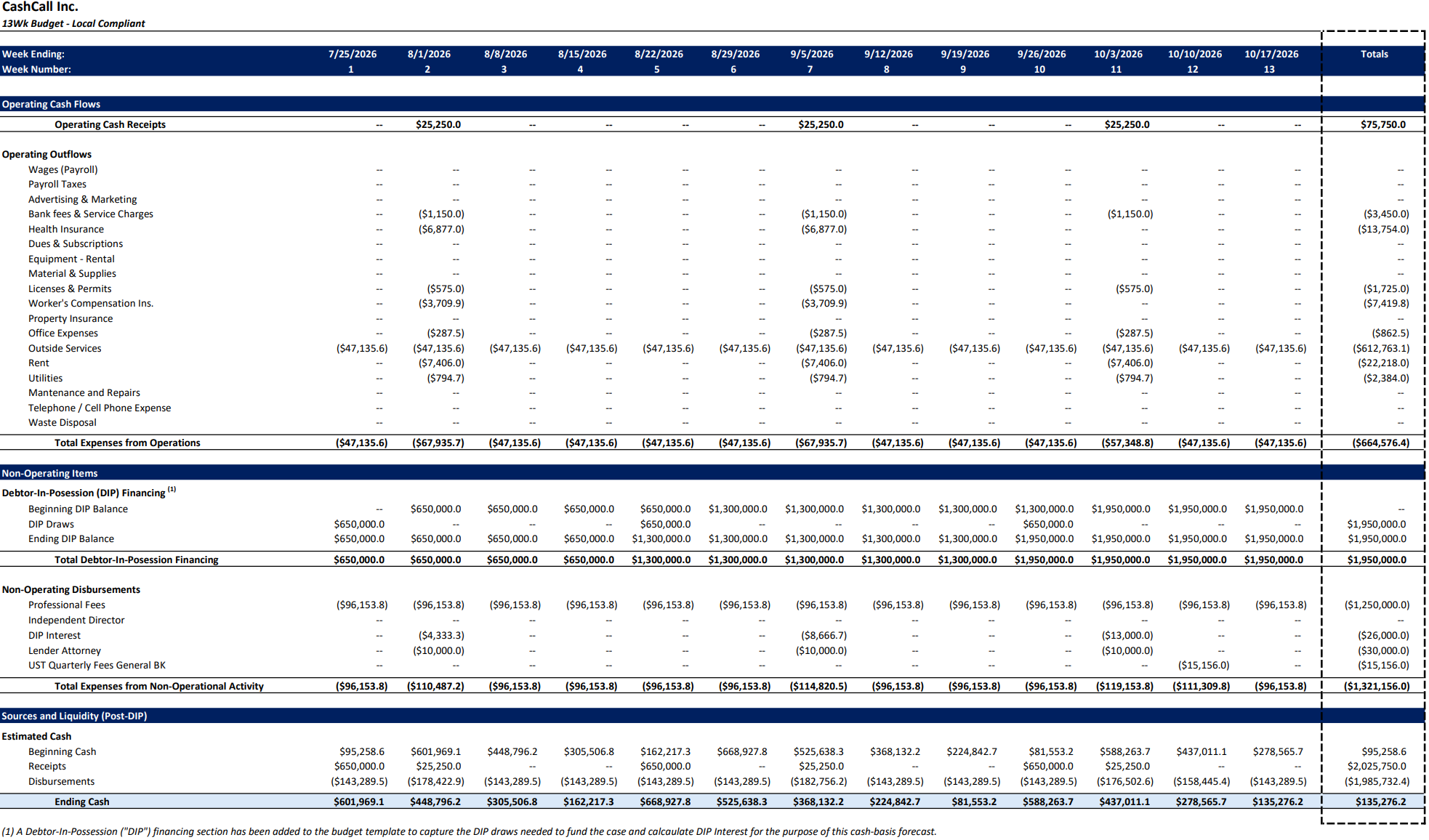
Absolutely Zero Corporation — identified in the term sheet as a related party and insider of the Debtor, wholly owned by CEO Reddam — would provide a $3.995 million secured, superpriority revolving DIP, with $1.3 million available on entry of the interim order and the balance on the final order.
- Pricing and terms. Interest accrues at SOFR, is paid in kind until maturity or termination, and steps up 2% on termination; the facility matures December 31, 2026, subject to earlier termination on events including a plan effective date or the closing of a 363 sale. It carries no origination, prepayment, or exit fees, no prepetition roll-up, no lender release, and no cross-collateralization, with no milestones beyond the deadlines for entry of the interim and final orders.
- Collateral and control terms. Under the proposed term sheet, the DIP liens would encumber substantially all estate property — subsidiary stock, intercompany debt, insurance proceeds, commercial tort claims, and, upon entry of the final order, Chapter 5 avoidance actions and their state-law equivalents, together with their proceeds. Those liens would be treated as effective and perfected from the petition date, subject only to the carve-out and to any valid, perfected liens already in place when the case was filed. The lender's superpriority claim would likewise be payable from avoidance actions and their proceeds, up to the principal balance outstanding. The collateral also extends to recoveries the estate may obtain under sections 506(c) (charging preservation costs against a secured creditor's collateral) and 550 (collecting on avoided transfers, including from downstream recipients), as well as proceeds from the sale, assignment, or other disposition of leased real property and the Debtor's right to select, identify, and designate which commercial leases may be assumed and assigned under section 365. The budget may be amended only with the lender's prior written consent, and several events trigger a default: deviating from the budget by more than 20%, the Debtor's attempt to obtain—or another party's obtaining—an order or judgment that subjects the lender's collateral to a section 506(c) surcharge, or the Debtor's filing or support of a proposed plan of reorganization that does not provide for indefeasible payment in full of the DIP obligations, unless the lender otherwise agrees in writing in its sole discretion. The proposed term sheet states that, subject to section 363(k), the lender would have an unqualified right to credit bid up to the full amount of the DIP obligations in any sale of the Debtor's assets, and the Debtor's taking, or support for another person in taking, action to restrict or prohibit the lender's submission of a credit bid is itself an event of default.
- Rationale and approval. According to the Debtor, no conventional asset-based lender could underwrite the facility given the limited value of the Debtor's non-litigation assets, and one of the principal sources of collateral supporting the financing is the estate's fraudulent-transfer claim against Reddam, any recovery on which is contingent on the outcome of the litigation. The Chief Restructuring Officer and Independent Director reviewed and approved the facility, with separate counsel negotiating for the lender. Matthew Dundon of Dundon Advisers states that third-party litigation funding would require at least one to several months of diligence and a contractually guaranteed 3.0x–4.0x multiple on invested capital, assuming success.
- Insider dynamics. The proposed structure presents an apparent circularity: a Reddam-owned lender would finance — and hold a superpriority claim on the proceeds of — litigation whose principal collateral, per Dundon, is the estate's fraudulent-transfer claim against Reddam. Two features cut against that concern: no release is proposed in connection with the financing, and the facility was reviewed and approved by the Debtor's Chief Restructuring Officer and Independent Director. Others sharpen it. Neither DIP proceeds nor cash collateral, including Carve Out proceeds, could be used by any party — expressly including an official committee of unsecured creditors — to challenge the validity, perfection, or priority of the lender's liens, to bring or defend any claim or proceeding against the lender, its affiliates, or their agents, attorneys, and advisors, or to challenge the Debtor's obligations under the DIP loan documents. The one exception runs to Debtor-retained professionals working on the existing fraudulent-transfer action. Committee-professional fees are separately capped at $25,000 before termination and $10,000 after, against a $250,000 post-termination cap for Debtor professionals.
U.S. Trustee DIP Opposition
On July 22, 2026, the U.S. Trustee filed an omnibus opposition to portions of the requested first-day relief. With respect to the proposed DIP, the U.S. Trustee argued that CashCall had not adequately demonstrated an emergency financing need for a debtor that was no longer originating loans and had no employees, or shown concrete efforts to solicit alternative financing. The U.S. Trustee emphasized that the $3.995 million commitment exceeded the approximately $1.5 million disclosed value of the residual loan portfolio while the estate’s shareholder-transfer claim remained unvalued, and argued that liens and superpriority claims held by a Reddam-controlled lender could impair the independent pursuit of that claim.
The U.S. Trustee also objected to reimbursement of the lender’s legal fees, liens on avoidance and transfer actions, and a post-termination professional carve-out of $250,000 for the Debtor and its professionals or officers compared with $10,000 for an official creditors’ committee. It additionally questioned the use of an unsigned term agreement and the request to use cash collateral despite the Debtor’s disclosure that it had no secured debt. The U.S. Trustee stated that it was diligently working to appoint an official committee of unsecured creditors and requested time for any committee to review the first-day motions.
The Shareholder-Transfer Claim
With its only tangible asset a residual loan portfolio of under $1.5 million in face value against roughly $452 million in claims, the estate's principal recovery prospect is a potential claim to unwind the October 2021 distribution to Reddam. Because that transfer occurred roughly four years and nine months before the bankruptcy filing, it falls outside the two-year federal clawback window, leaving the estate to rely on California fraudulent-transfer law — which allows up to four years to challenge such a transfer — through the Bankruptcy Code's mechanism for borrowing state law, a route available only if a qualifying unsecured creditor could still have sued. The Orange County action was filed in August 2024, within four years of the October 2021 transfer; that filing satisfied the four-year timing requirement for the plaintiff's own action but does not by itself establish the debtor in possession's § 544(b)(1) standing or control the timeliness of a bankruptcy avoidance action. But timing alone establishes neither liability nor collectability: the first-day filings do not disclose the amount transferred or where the proceeds now sit, provide only a limited outline of Reddam's position, and do not disclose any potentially applicable insurance or settlement range for the fraudulent-transfer claim — leaving the amount and expected value of this potential recovery unquantified.
Explore Bondoro Insights for live case dockets and comprehensive coverage of material filings from petition to plan confirmation.
Stay informed on every Chapter 11 bankruptcy case with liabilities exceeding $10 million. Subscribe for free to have our coverage delivered directly to your inbox, and explore our full archive of past summaries.
Subscribers can also opt in to timely filing alerts by updating their email preferences in Account Settings.


