Case Summary: Magellan Aerospace Middletown Chapter 11
Magellan Aerospace, Middletown filed for Chapter 11 after legacy aircraft programs wound down with no replacements and decades-old environmental liabilities at former California sites triggered mounting cleanup orders and an adverse jury verdict, exploring a standalone restructuring or sale.

A deck version of this summary is also available HERE.
Business Description
Magellan Aerospace, Middletown, Inc. (the “Debtor”) operates an aerospace manufacturing facility at 2320 Wedekind Drive in Middletown, OH. It manufactures components for commercial aircraft, defense and space applications and is the modern successor to the historic Aeronca business. Its direct parent, Magellan Aerospace USA, Inc. (“Magellan USA”), intermediate parent Magellan Aerospace Limited and ultimate parent Magellan Aerospace Corporation (“Magellan Corp.”) are non-Debtor affiliates in this case.
The Debtor produces jet engine nacelles, exhaust components, and heat-resistant space products. In 2025, it generated approximately $26.3 million in gross revenue against a net loss of $8.5 million, and for the six months ended June 30, 2026, it recorded roughly $16.8 million in revenue against a net loss of $2.8 million. Revenue is heavily concentrated: the Debtor's three largest customers account for approximately 80% of revenue, consistent with an industry the First Day Declaration describes as having a limited number of institutional buyers.
Magellan Aerospace, Middletown, Inc. filed for Chapter 11 protection on July 22, 2026 (the "Petition Date") in the U.S. Bankruptcy Court for the Southern District of Ohio, reporting $10 million to $50 million in assets and $50 million to $100 million in liabilities.
Corporate History
Founding Era
In November 1928, Robert A. Taft, future Ohio Senator and son of former President William Howard Taft, along with a group of prominent Ohio businessmen, founded the Aeronautical Corporation of America, which ultimately became the Debtor. It had no aeronautical product until 1929, when the founders were introduced to Jean-Alfred Roché, then chief civilian engineer at McCook Field (site of the first U.S. military aviation research center), who later became Head Aeronautical Engineer of the U.S. Army. Roché had designed and tried to market a single-seat personal airplane but could not raise investor capital before the aviation boom. The Debtor bought the design in exchange for stock and a board seat, adapted it for mass production, and released it as the C-2 Scout in 1929.

Light Aircraft Era
Despite being released during the Depression, the C-2 succeeded — described as arguably America's first successful "personal" airplane, nicknamed the "flying bathtub," lightweight, simple to fly, and affordable; it helped popularize general aviation and spurred flying schools and clubs. In 1931 the Debtor introduced the C-3 "Collegian," a two-seat C-2 variant that allowed owners to carry passengers and gave financially strapped flight schools a cheap trainer. By the mid-1930s the Debtor led U.S. light aircraft production, and its Scout line evolved into the Chief and Super Chief series by the end of the decade. A major flood in 1937 destroyed the original Lunken Airport factory and early blueprints, prompting relocation to Hook Field Municipal Airport in Middletown, OH. The Debtor became Aeronca Aircraft Corporation in 1941.
In the lead-up to and during WWII, over 1,000 Aeronca aircraft entered U.S. military training programs. The L-3 Grasshopper saw extensive Pacific and European use as an aerial commanders' observation platform, close-in reconnaissance aircraft, artillery spotting and fire-control aircraft, emergency medical evacuation ambulance, small cargo and personnel transport, among other roles. Post-war, the Debtor returned to civilian production — Champion, Chief, Super Chief, Defender, Arrow — but despite high production rates and demand, a postwar recession and market pressures led it to exit the light aircraft business in 1951. The Champion design was sold to Champion Aircraft Company and, through subsequent transfers, came to Bellanca and then American Champion, which still manufactures consumer airplanes.
Shift to Structures and Name Changes
The Debtor changed its name to Aeronca Manufacturing Corporation in 1950. After exiting light aircraft, it shifted to high-strength engine and airframe structures for commercial, military, and space applications, building on a specialty it had already been developing: brazing and bonding heat-resistant aircraft components. Its high-temperature brazed honeycomb structures shielded the Apollo lunar program command modules and, decades later, the Space Shuttle. In the late 1950s it acquired Longren Aircraft Company, Inc., a Torrance, California manufacturer whose site liabilities are discussed below. In 1969, the Debtor was reorganized and renamed Aeronca, Inc. (paragraph 22 of the First Day Declaration states that the Debtor's name change to Aeronca, Inc. was in 1966).
Magellan Ownership
Through a series of corporate transactions beginning in the late 1980s and ending in the mid-1990s, the Debtor became a subsidiary of Magellan Aerospace Corporation, though the First Day Declaration elsewhere dates the series to the mid-1980s through mid-1990s, beginning with a 1986 transaction with Fleet Acquisition Corp.
In 2012, the Debtor changed its name to Magellan Aerospace, Middletown, Inc., and in 2016 enhanced its brazing and honeycomb capability through the acquisition of Benecor Inc.'s assets. In 2018, the Debtor acquired Fleet Aerospace, Inc., with the Debtor as the surviving entity.
Organizational Structure
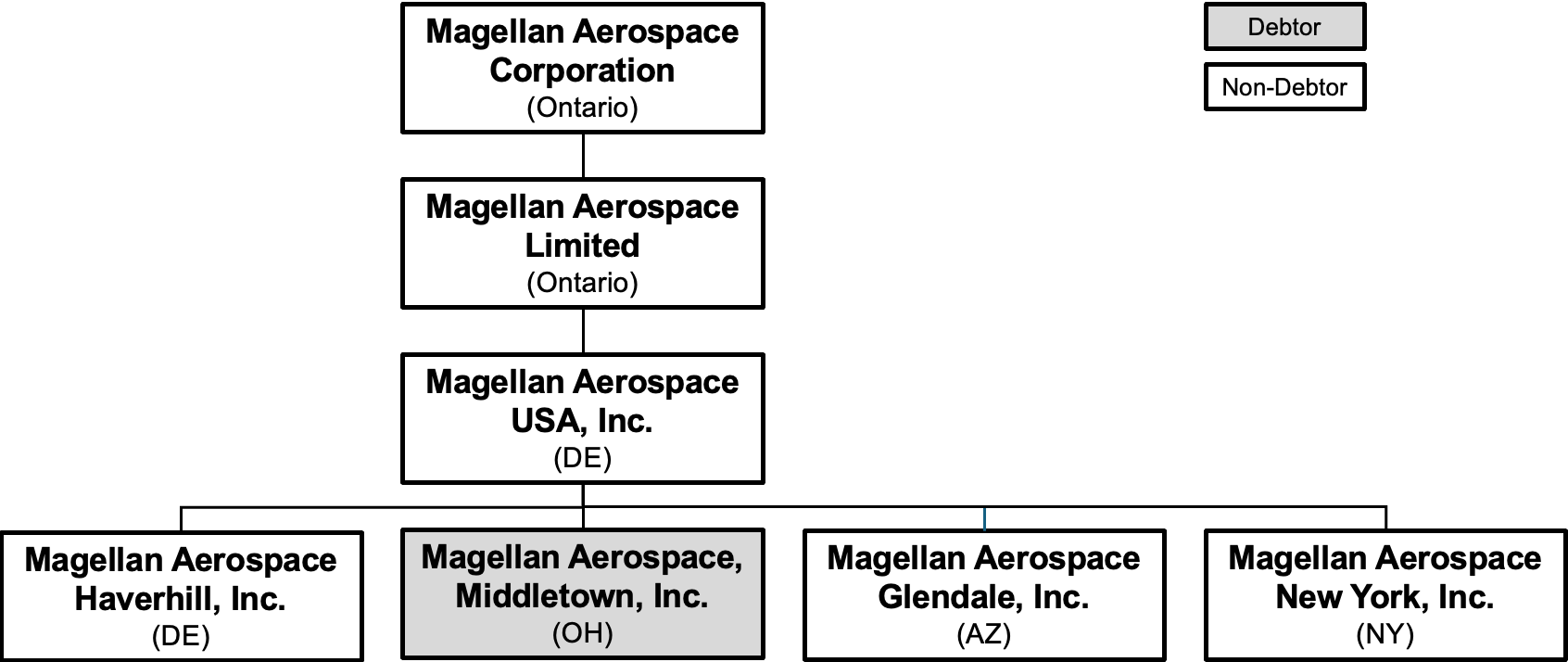
Operations Overview
Owned Plant and Manufacturing Infrastructure
Public property records indicate that the Debtor's Middletown plant is owned rather than leased. The Butler County Auditor parcel profile lists the approximately 17.8-acre property in the name “Aeronca Inc.,” the Debtor’s former name, and uses Magellan Aerospace Middletown as the tax-bill mailing name. The commercial property card identifies approximately 236,670 gross square feet of manufacturing space.
A 2022 NIST case study describes a modernization project at the Middletown facility, carried out with TechSolve and Siemens, that connected more than 40 pieces of production equipment — machine tools, furnaces, and related systems — to a digital monitoring platform. The study indicates that a digital-manufacturing foundation was in place as of 2022, but it speaks to neither current utilization nor equipment ownership, condition, or maintenance requirements.
Publicly Disclosed Customer Programs
The filings do not identify the Debtor's three largest customers or disclose their individual shares, margins, committed backlog or termination rights. Three Middletown programs appear in the public record; each establishes program history or activity at a point in time, and none establishes committed volume, pricing, duration or renewal terms.
- Boeing 767 — Magellan Corp. announced a contract extension in May 2023 under which Middletown continues to supply acoustic plug and nozzle exhaust assemblies for the 767 program, produced using internally manufactured metallic honeycomb. The announcement discloses no contract value, duration, minimum volume or pricing. Boeing has said commercial 767 Freighter production will end in 2027, with KC-46A production continuing, though the public record does not establish Middletown's scope on the military variant.
- U.S. Navy — USAspending records a $749,232 firm-fixed-price NAVSUP contract for energy-absorption work, signed in September 2025 and running through September 9, 2026. The award confirms an active federal prime contract as of the Petition Date but does not indicate remaining revenue, margin or likelihood of renewal.
- Raytheon missile fins — A January 2021 announcement described an award of approximately $61.4 million, currency unspecified, with deliveries scheduled through 2024. No extension has been identified, leaving the program as history rather than substantiated current work.
The parent’s 2025 Annual Information Form supplies context, but not Middletown-specific terms: group aerospace contracts are primarily firm-fixed-price, generally last three to ten years and often permit customers to change quantities or delivery dates with limited supplier recourse; some sites operate without long-term purchase orders. Program participation therefore should not be equated with committed backlog. Contract-level orders, termination rights, price protection, tooling ownership, setoff rights, cure exposure and contribution margins remain necessary to value the business.
Workforce and Shared Services
Average monthly payroll is $690,668, with fully burdened monthly employee cost of $930,777 including taxes, benefits, withholding and administration fees. The Debtor employs approximately 105 full-time, two seasonal and two corporate charge-back employees, of whom roughly 58 are union members covered by several collective bargaining agreements — though neither the unions nor the number of agreements is identified.
The Debtor relies on the non-Debtor parent group for shared services, centralized expertise, greater purchasing power and insurance coverage, carrying no separate policies of its own and instead relying on broad policies maintained by the corporate parent. That dependence extends to payroll: the two corporate charge-back employees are employed and paid by the parent, with payroll processed and medical benefits provided by the Debtor, per the First Day Declaration.
Prepetition Obligations
As of the Petition Date, the Debtor reported no secured debt and no public debt. Its disclosed obligations consisted principally of:
- Unsecured intercompany loans from parent Magellan USA in excess of $80 million. The filings do not disclose the underlying instruments, advance dates, maturity, interest, repayment terms, internal approvals or tax treatment, and do not state whether the balance includes cash-sweep entries, shared-service allocations, insurance charges or other non-cash items. The Debtor's sole bank account swept surplus cash daily to a Magellan USA master account for over 20 years; the Debtor requested deactivation of that mechanism shortly before the Petition Date.
- Legacy environmental obligations, on which the Debtor has already expended more than $13 million in compliance and litigation defense costs and expects to incur an estimated $10 million over the following six months.
- Unsecured trade debt owed to suppliers, employees, unions and others, including approximately $1.8 million to suppliers, approximately $450,000 of accrued prepetition employee compensation and related payroll taxes, and approximately $500,000 associated with a retiree medical plan.
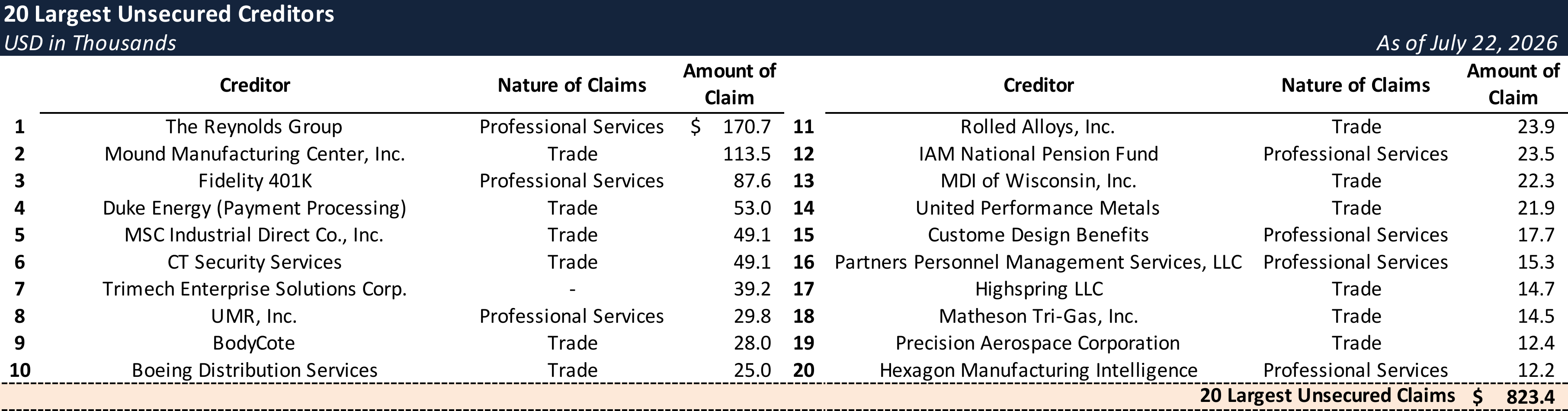
Top Unsecured Claims
Events Leading to Bankruptcy
Contract Wind-Down and Revenue Decline
In 2000, the Debtor invested $11 million in a 10,000-square-foot expansion and renovation of its Middletown facilities and committed several million more, alongside another company, to engineer exhaust systems for the Airbus A340 and the then-new A318; it subsequently secured the exhaust system contract for the A380. The Debtor produced exhaust systems for the Boeing 747 and 767 under a comparable arrangement. Beginning in the 2010s these programs wound down in sequence: A340 production ended in 2011, the A318 in 2013, and — after the customer cancelled a 2017 A320neo PW1100G-JM nacelle award in 2020, before it entered service — both the A380 and the final Boeing 747 concluded production in 2021. With no replacement programs, the Debtor's revenue declined year over year.
Torrance Liability
The Debtor's Torrance exposure originates with Longren Aircraft Company, which began operating in 1954 at an industrial site in Torrance ("Torrance Property 1") leased from the City of Torrance, and was incorporated as Longren Aircraft Company, Inc. in 1956. In the late 1950s the Debtor, then named Aeronca Manufacturing Corporation, acquired Longren as the surviving entity and, in doing so, assumed liability related to the operation of Torrance Property 1; its operations there ended in 1987, though the First Day Declaration's account of the facility's operating history extends its use under the Debtor until a sale in the early 1990s. The Debtor also subleased and operated a nearby City-leased site in the late 1960s and early 1970s ("Torrance Property 2"). These sites, together with neighboring properties affected by migrating hazardous substances, are the "Torrance Properties."
The contamination has drawn both regulatory and civil action. On the regulatory side, the Los Angeles Regional Water Quality Control Board issued a Cleanup and Abatement Order (the "Cleanup Order") in June 2021 naming the Debtor among several responsible parties. The Cleanup Order requires those parties to investigate the contamination, carry out the Board-directed remediation, and fund the Board's oversight until it issues a closure determination. The Debtor has challenged the Cleanup Order by administrative petition, which remains pending, and the Board has referred enforcement to the California Attorney General's Office. The Cleanup Order thus remains open and unresolved as to the Debtor.
Separately, the City of Torrance sued in the U.S. District Court for the Central District of California, asserting CERCLA (the Superfund law under which former operators can be liable for cleanup costs decades after leaving a site) and related claims and, by amendment, adding the Debtor as a defendant. Several parties have since settled. The Debtor itself resolved claims with the United States under a March 2025 CERCLA consent decree, under which the United States agreed to pay the Debtor $250,000 for alleged response costs. Co-defendants Esterline (a former operator at the Torrance properties) and Hi-Shear (the current operator) separately settled with the City — with Hi-Shear assuming a defined portion of the cleanup obligations — leaving the Debtor as a principal remaining defendant that the City has stated it intends to continue pursuing.
The claims against the Debtor proceeded to trial in March 2026. According to the First Day Declaration, the four-week trial ended in a jury verdict finding the Debtor and a co-defendant that operates at the Torrance Airport jointly and severally liable to the City for more than $5.2 million in past investigation and cleanup costs. The jury also returned advisory verdicts on statutory and equitable claims, including a recommended contribution of approximately $1.9 million from the Debtor to a co-defendant and third-party plaintiff, and a finding that the Debtor is responsible for 25% of the Torrance Properties' remediation costs, which the Debtor estimates at $25 million to $64 million. Both the contribution and the allocation remain subject to the court's final determination, and the Debtor awaits entry of final judgment — which could impose further obligations for past costs, future cleanup and regulatory oversight.
San Diego Liability
The Debtor's San Diego exposure traces to the Langley Corporation, which — with its successors — operated an industrial facility in San Diego (the "Langley Property") allegedly from 1953 to the early 1990s. Before selling the site to the Jacob Center for Nonprofit Innovation on May 15, 1998, the operator conducted a voluntary environmental assessment and cleanup and received a No Further Action letter from the California Department of Toxic Substances Control ("DTSC"). Elevated levels of trichloroethylene ("TCE") vapors were later discovered in buildings on the Langley Property and in an adjacent 149-unit residential apartment complex, giving rise to an order later issued by the DTSC.
The liability reached the Debtor through a chain of corporate transactions. The Langley Corporation, incorporated in California in 1939, was acquired by the Langly Corporation in 1983, with Langly surviving. In 1989, Langly and Fleet Acquisition Corp. entered into a transaction in which Langly survived but renamed itself Fleet Aerospace, Inc., which assumed liability related to the Langley Property. Fleet Aerospace directly owned the Debtor until 2018, when the Debtor acquired Fleet Aerospace as the surviving entity and, in doing so, assumed Fleet's liabilities regarding the Langley Property.
On February 12, 2026, the DTSC issued an Imminent and Substantial Endangerment Determination and Order (the "DTSC Order") naming the Debtor as a Respondent and directing it to implement immediate interim measures to mitigate indoor TCE concentrations and to undertake a remediation investigation and feasibility study for the entire San Diego Property. The Debtor did not contest the DTSC Order and has been complying with it. Its environmental consultants have advised that the cost to satisfy the investigation and remedial-feasibility portion of the DTSC Order alone will exceed $12 million. Beyond that estimate, the Debtor must continue funding ongoing compliance — payments to the environmental vendors currently performing the required work, running to millions of dollars this year alone. If the Debtor stops paying those vendors, it falls out of compliance, and the DTSC Order imposes a penalty of $25,000 for each day it remains noncompliant.
Insurance Coverage
Because the environmental liabilities date back many decades, the Debtor has undertaken substantial diligence to identify potential insurance coverage. It has located certain policies providing some coverage for the Torrance Properties and is still working to identify policies covering the San Diego Property. Some insurers have accepted coverage subject to a reservation of rights, while others have been less cooperative. Although the identified policies carry collective limits exceeding $100 million and should provide very significant coverage, delays and denials by many carriers have made it difficult for the Debtor to meet the numerous environmental demands.
Chapter 11 Filing
The Debtor states that it is exploring all alternatives, including a standalone restructuring, a sale, or another value-maximizing transaction. As of the Debtor's early docket, no bid-procedures motion, stalking-horse agreement, or retention application for its financial advisor, Rock Creek Advisors, had been filed. The First Day Declaration states the Debtor expected to begin contacting potential buyers within a week of filing and to decide between a sale and a standalone reorganization within two to four weeks.
Magellan USA DIP Facility
The Debtor received interim approval on July 24, 2026 to fund the case with a DIP facility from Magellan USA — the Debtor's parent and sole prepetition lender, now also its DIP lender. Terms below are from the interim order except where the DIP term sheet or the motion's Rule 4001 concise statement differs, as noted.
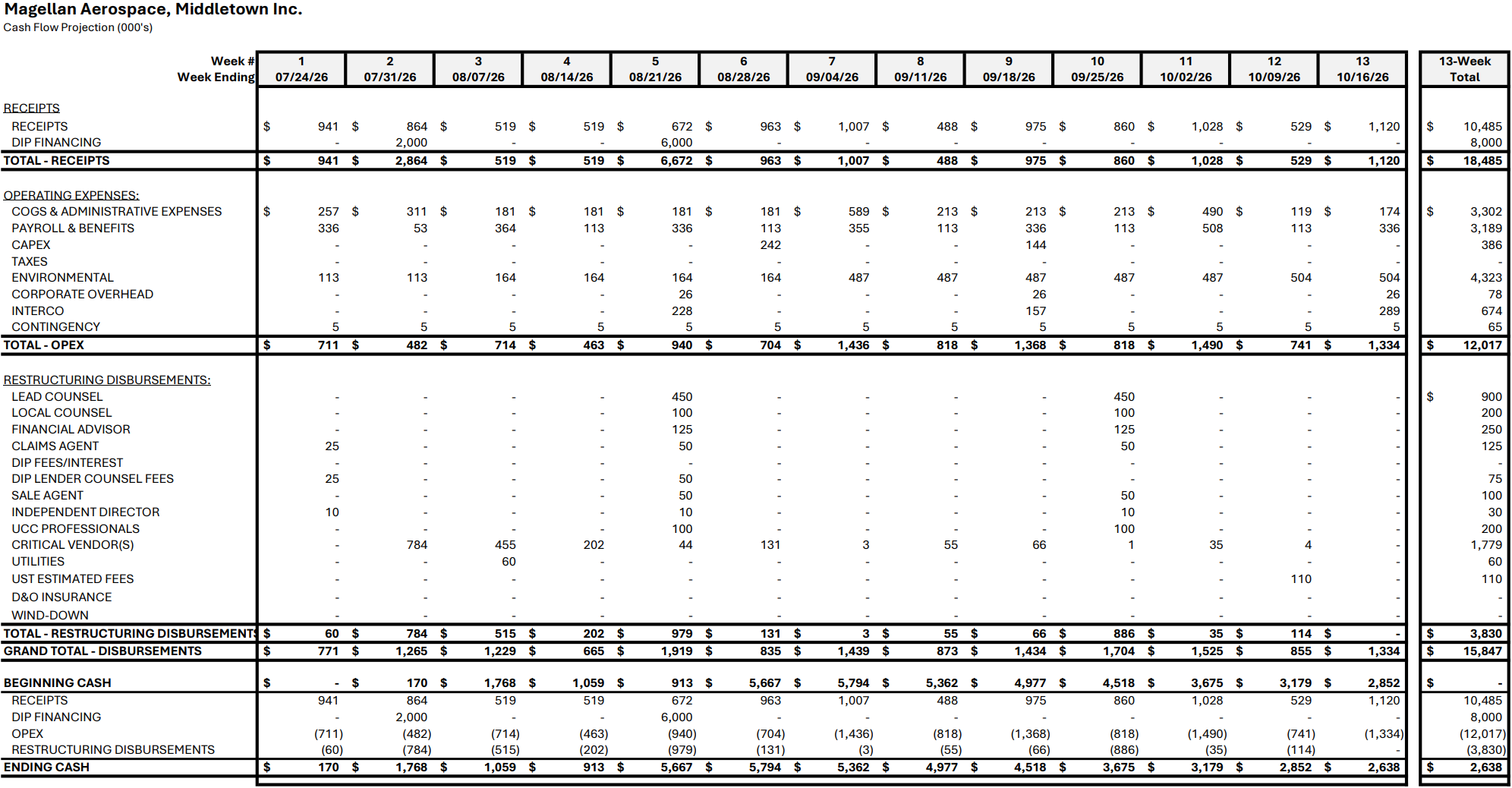
- Sizing — A $20 million revolving facility with $2 million on interim approval, the balance on final. The budget contemplates $8 million drawn over the initial 13 weeks.
- Roll-up — Subject to entry of the final order, the facility rolls up prepetition parent debt at 3:1: every $1 drawn converts $3 of Magellan USA's unsecured loans to secured superpriority, capped at $60 million. The budgeted $8 million draw would roll up $24 million; a full draw reaches the $60 million cap, giving the parent $80 million of superpriority principal — $60 million of converted prepetition debt plus $20 million of new money. Nothing rolls up at the interim stage. The interim order records the roll-up as a request by the Debtor, subject to objection and the Court's approval, and the term sheet makes it subject to any limitations or modifications the Court orders.
- Interest — The DIP term sheet sets non-default interest at SOFR plus 1.5%, stepping up by 2.0% (to SOFR plus 3.5%) upon the Termination Date, which includes but is not limited to an event of default. The interim order states the rate differently — the term sheet's Default Rate plus a further 2.0% following an event of default — and provides that the order controls over conflicting DIP documents.
- Fees — The interim order states flatly that there are no fees associated with the DIP Loan, and the term sheet confirms no origination, prepayment or exit fees. The term sheet nonetheless obligates the Debtor to reimburse the lender's reasonable and documented legal, financial-advisor and similar expenses — prepetition and postpetition — on demand within ten business days, outside the budget and without court approval, with non-payment an event of default. The 13-week budget carries $75,000 for DIP lender counsel fees against that uncapped obligation. Given the order's control over conflicting DIP documents, whether that reimbursement obligation survives the no-fees statement is unresolved on the face of the papers.
- Carve Out — Professional fees ring-fenced ahead of the parent's liens, so counsel and advisors are paid even if the lender forecloses. Before the lender delivers notice that a Termination Date has occurred: court and U.S. Trustee fees, plus the Debtor's professionals uncapped and any committee's capped at $50,000. After that notice: $250,000 for the Debtor's professionals, $100,000 for a committee's, and up to $50,000 for a chapter 7 trustee. The Debtor funds the reserve weekly into a separate account. The motion's Local Rule 4001-2 checklist flags the disparity between the Debtor's and a committee's allowance, and the interim order leaves the caps unapproved and open to change before the final order.
- Maturity — The facility terminates on the earliest of the specified Termination Date events. Two are near-term: 40 days after the Petition Date (August 31, 2026) if no final order has been entered, and the closing date of any section 363 sale. The outside dates are 180 days after the Petition Date (January 18, 2027) under the term sheet and December 31, 2026 under the interim order, subject to extension by the DIP Lender in its sole and absolute discretion. Given the August 18 final hearing, the 40-day date is the operative constraint rather than either outside date.
- Collateral — Substantially all assets, including intercompany rights, indemnification claims and insurance proceeds. Avoidance actions — the estate's claims to unwind prepetition transfers — are added on final approval, though the term sheet bars the parent from applying those claims or their proceeds to its superpriority claim. That claim primes administrative expenses under sections 503(b) and 507(b) only, narrowed at entry from the proposed order, which primed administrative expenses of every kind. The parent also takes credit-bid rights, limited as described below, and must be named loss payee or additional insured on all policies covering collateral. Two protections are deferred to the final order: the section 506(c) waiver, which would stop the estate from charging the cost of preserving collateral back to the parent, and a no-marshaling provision barring anyone from forcing the parent to look to other assets first — the latter granted immediately in the proposed order. The insurance pledge matters most here: the environmental policies, potentially the estate's largest recovery source, become the parent's collateral rather than value available to unsecured creditors.
- Control — Lender-approved budget with a 20% permitted variance. Consent is required for unbudgeted prepetition payments and for additional priority financing; DIP proceeds are barred from funding any challenge to the parent's claims or liens. Two provisions warrant attention: an interim or final order not acceptable to the lender in its sole discretion is itself an event of default, and the parent's indemnification survives into any liquidating trust, non-dischargeable without its consent — though the interim order narrowed that indemnity to exclude losses from defending a challenge to the prepetition claims and liens, third-party challenges to those claims, and chapter 7 causes of action.
- Releases — The interim order fixes the parent's $80 million-plus prepetition claim as valid and allowed and forecloses the estate's ability to attack it: no recharacterization as equity, no subordination behind other creditors, no avoidance — all before the Debtor has filed schedules or any creditors' committee exists. It also releases the parent, its affiliates, officers and professionals from claims relating to the prepetition loans "or otherwise" — language broad enough to reach conduct outside the lending relationship. Both the term sheet and the motion's Rule 4001 chart describe the release as limited to claims arising from the DIP financing, so the order concedes more than the disclosure indicates. Unlike the proposed order, the stipulations now carry a challenge period: 60 days after a committee forms, or 75 days from the Petition Date if none does — measured from filing rather than from entry of the interim order, which is what the local rule contemplates. The interim order also cuts the parent's credit-bid right back to the DIP loan alone, subject to contrary order for cause, though the unamended term sheet still purports to allow bidding the full amount including prepetition debt.
Explore Bondoro Insights for live case dockets and comprehensive coverage of material filings from petition to plan confirmation.
Stay informed on every Chapter 11 bankruptcy case with liabilities exceeding $10 million. Subscribe for free to have our coverage delivered directly to your inbox, and explore our full archive of past summaries.
Subscribers can also opt in to timely filing alerts by updating their email preferences in Account Settings.


