Case Summary: Poolin Chapter 11
Poolin, once the world's largest Bitcoin mining pool, and affiliates filed for Chapter 11 after a 2022 liquidity crisis froze customer withdrawals and left ~$163.7M in wallet-holder IOUs; its West Texas mining sites, which never reached scale, are now being marketed for sale under a §363 process.

Business Description
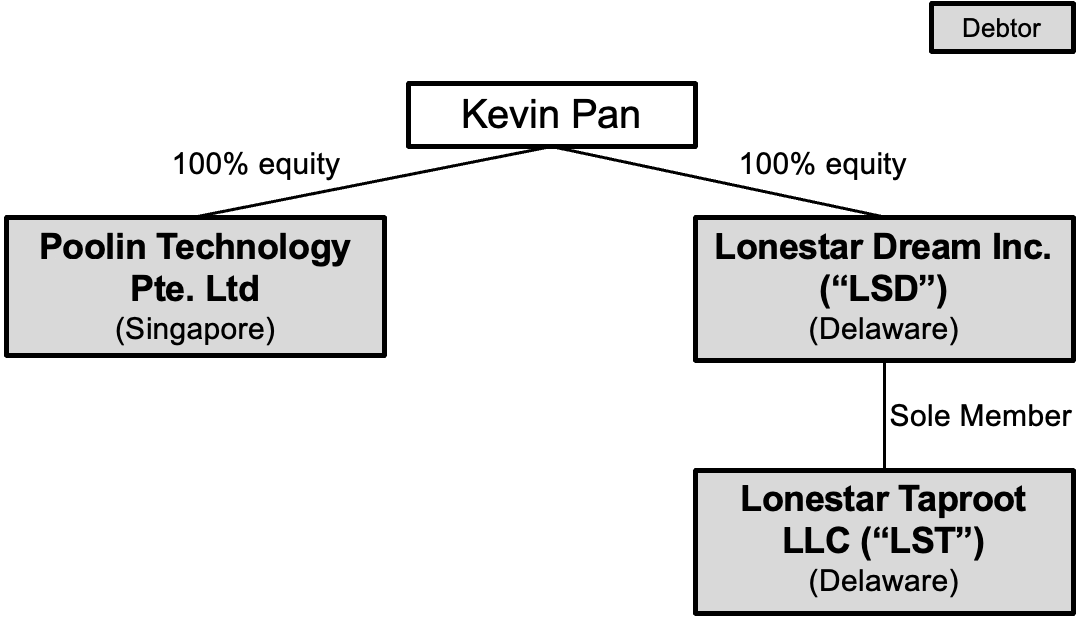
Poolin Technology Pte. Ltd. (“Poolin”), Lonestar Dream Inc. (“LSD”) and Lonestar Taproot LLC (“LST,” and collectively, the “Debtors”) are three affiliated cryptocurrency and digital-infrastructure companies directly and indirectly owned by Zhibiao “Kevin” Pan. Poolin is a Singapore private limited company historically associated with the Poolin cryptocurrency mining pool, once the world's largest bitcoin mining pool in 2019. LSD and LST are Delaware entities that developed and operated two Bitcoin-mining and equipment-hosting sites in West Texas, however, LSD and LST terminated core mining and hosting operations on July 10, 2026.
The enterprise historically operated across three principal businesses:
- Mining-pool services — the Poolin-branded pool, which by 2019 ranked among the largest globally. The pool launched in November 2017 and added Bitcoin service in July 2018, predating debtor Poolin Technology's September 2019 incorporation.
- Poolin Wallet — Bitcoin-collateralized USDT⁽¹⁾ lending and deposit products, funded by repledging customer cryptocurrency to institutional lenders.
- Texas mining and hosting — proprietary Bitcoin mining and third-party equipment hosting at the Tarbush and Pyote sites in West Texas.
Poolin Technology Pte. Ltd. and certain affiliates⁽²⁾ filed for Chapter 11 protection on July 22, 2026 (the "Petition Date") in the U.S. Bankruptcy Court for the District of New Jersey, reporting $1 million to $10 million in assets and $100 million to $500 million in liabilities.
⁽¹⁾ Tether (USDT) is a stablecoin designed to be pegged 1:1 to the US dollar, meaning its price is meant to consistently hover around $1.
⁽²⁾ For a complete list of Debtor entities, see organizational structure chart below.
Corporate History
Poolin Formation, China Exit, and US Expansion
Poolin was founded in November 2017 by Zhibiao "Kevin" Pan, Fa Zhu, and Tianzhao Li. All three came from BTC.com, the in-house mining pool of Bitmain — the dominant manufacturer of Bitcoin mining hardware. Initially launched as a multi-cryptocurrency mining pool, Poolin introduced its Bitcoin pool service in 2018. In September 2019, Poolin Technology was separately incorporated in Singapore.
During the first half of 2020, Poolin acquired mining machines and expanded its operations through various sites across China in anticipation of a market recovery. Approximately a year later, during May 2021, the Chinese government banned Bitcoin mining, causing a significant disruption to various China-based mining operations, including Poolin’s. Following the ban, Poolin deregistered Beijing Satoshi Smart Technology Co. Ltd., one of its Chinese affiliated operating entities, and shut down its operations in mainland China. After determining that it was no longer feasible to conduct business as Poolin, Mr. Pan decided to move to the U.S. LSD and LST were formed as Delaware companies in late 2021.
Ownership and Organizational Structure
Kevin Pan owns 100% of both Poolin and LSD, and LSD is LST’s sole member. Pan is also the sole director of LSD and LST.
Operations Overview
Poolin Technology Pte. Ltd.
- Mining Pool & Proprietary Mining. Miners run specialized computers that compete to process and record Bitcoin transactions, and the network pays whichever one wins each round — a reward of newly issued bitcoin plus transaction fees, bundled into a batch of transactions called a block. Because only about 144 blocks exist to be won worldwide each day, small operators pool their computing power ("hash rate") to smooth out returns, with the pool competing on their behalf and splitting winnings pro rata, less a fee. The Poolin-branded pool ran that model, growing into one of the world's largest crypto mining pools and, by September 2019, regarded as the largest globally. Separately from the pool service, Poolin also mined for its own account with its own mining equipment.
- Poolin Wallet — Lending. Created in 2019 in response to retail demand for borrowing stablecoins against Bitcoin collateral. Users pledged Bitcoin and received USDT at applicable pledge rates, paying interest on those borrowings. Poolin Wallet funded the product by re-pledging user cryptocurrency to institutional lenders, principally Tether International Limited, issuer of USDT, and earned the spread between institutional and retail rates.
- Poolin Wallet — Deposits. Beginning in the second half of 2020, the Wallet added "time deposit" and "demand deposit" products carrying stated annual rates of roughly 2% to 8.8%. Cryptocurrency deposited under those products, together with other assets placed with the Wallet, was substantially pledged to Tether International Limited to obtain USDT and fund the Wallet's operations.
Lonestar Dream Inc. & Lonestar Taproot LLC
Following China's 2021 mining ban, LSD and LST were formed as Delaware companies in late 2021 to conduct mining and hosting operations in West Texas. LSD and LST had distinct operating roles:
- LSD was the group's principal customer-facing company, running self-mining for its own account and hosting third-party equipment until operations closed on July 10, 2026. The Hosting segment was marketed on its cooling technology — air cooling, hydro cooling, and a proprietary immersion cooling system. Revenue and customer relationships sat at LSD: it contracted and managed all hosting arrangements, sold surplus equipment, recognized other miscellaneous income, and collected amounts owing from all sources. Its cost base was administrative and overhead — payroll, utilities, commercial insurance, professional fees, software licenses, home office expenses, banking and financial services fees, and interest expense.
- LST held the physical infrastructure and functioned as a cost center for the Mining Sites. The property interests, power rights, buildings, improvements, substation infrastructure, machinery and equipment sit at LST, which reported approximately $41.7 million of net property, plant and equipment as of May 2026. Its expenses ran to site-level operations — outsourced facility services, supplies, tools, equipment repairs and maintenance, equipment leases and security. For a period, from March 2022 through December 2023, LST operated as an LLC partnership between LSD and Bitmain, the manufacturer of hardware and solutions for blockchain and other applications. Bitmain contributed approximately $34.4 million of capital and was reimbursed approximately $24.1 million upon withdrawal. The partnership incurred significant losses over its short operating period and was terminated by agreement.
Texas Mining Sites
Following a country-wide search that evaluated over 30 sites and substations, Mr. Pan decided in September 2021 to acquire property in West Texas. Two sites were selected: the "Pyote Site" in Ward County, and the "Tarbush Site" in Pecos County. Mining operations began in the latter half of 2022. Poolin advanced funding for acquisition, build and fit-out expenses at the Mining Sites through intercompany advances and equipment transfers, and Mr. Pan, LSD's sole shareholder, contributed approximately $10 million of capital. Both sites are now being marketed for sale under a §363 process.
- Pyote Site — Owned by LST. Originally 86.5 acres, the site was later reduced in connection with the settlement of a dispute with the prior owner, Priority Power Management ("PPM"), under which approximately 62.5 acres was deeded back to PPM. The asset schedule filed with the Pyote asset purchase agreement records the remaining parcel at approximately 22.97 acres, acquired from PPM in February 2022.
- Tarbush Site — Unlike Pyote, the Tarbush Site is not owned in fee. The 64-acre site is held under a Surface Use Agreement with DBR Land LLC, effective January 1, 2022 and originally between LSD and DBR, which was amended in August 2024 to substitute LST as the counterparty. DBR now disputes royalty payments owed under the amended agreement.
Prepetition Obligations
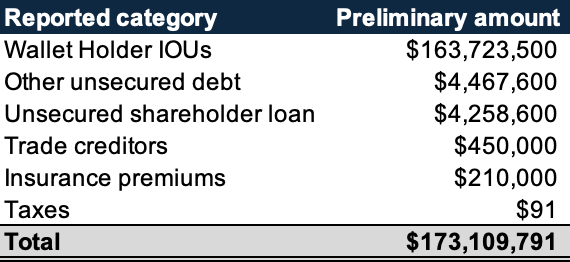
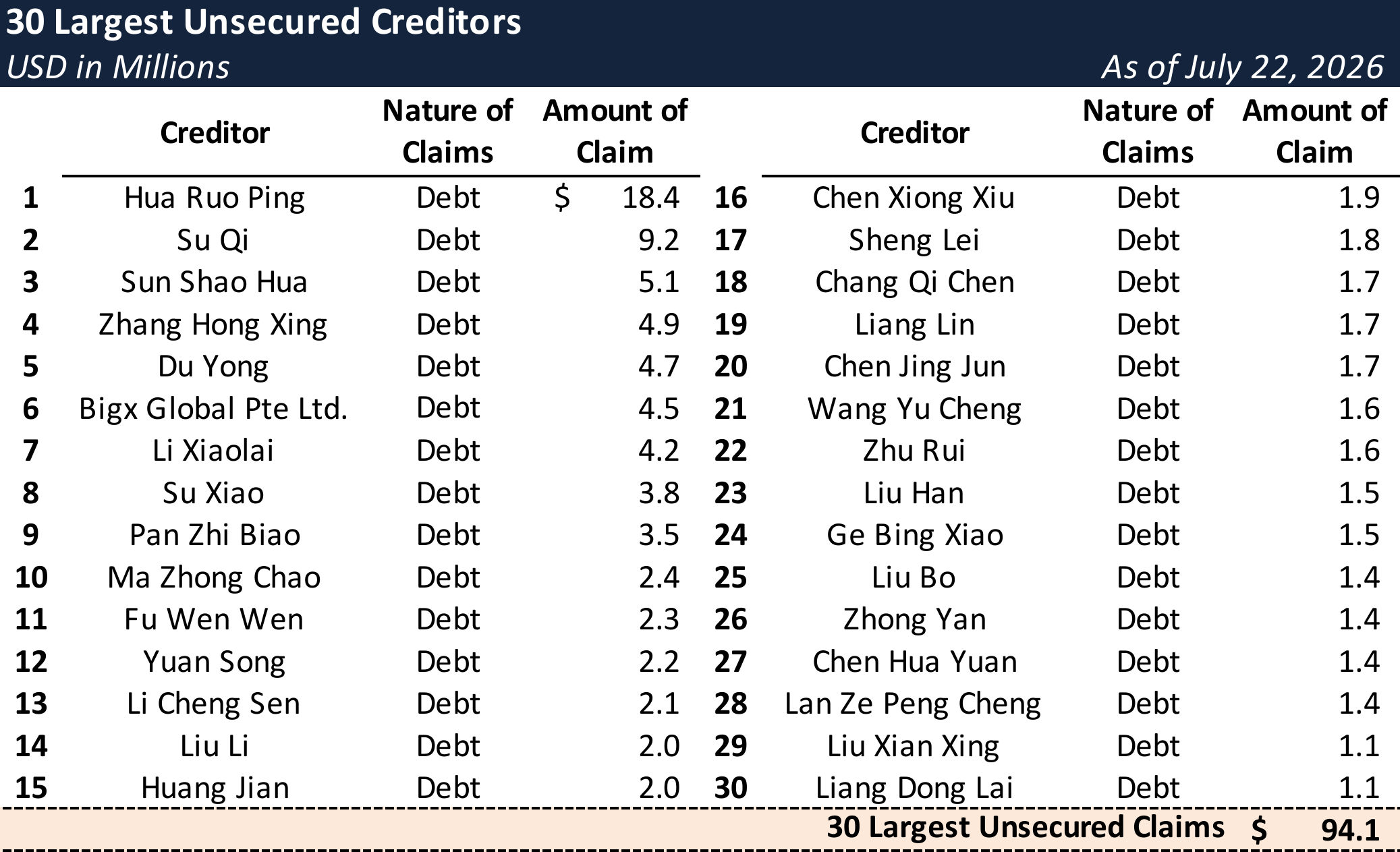
As of the Petition Date, the Debtors’ reported prepetition summary capital structure included approximately $173.1 million of aggregate obligations, with the majority being Poolin Wallet IOUs. The First Day Declaration labels this a prepetition summary capital structure, does not allocate the amounts among the three Debtors, and notes that the Debtors intended to file their Schedules and SOFAs within the next few weeks. Additionally, the list of 30 largest unsecured creditors separately reports a $3.5 million claim under the name "Pan Zhi Biao." The filings do not identify the claimant or reconcile the amount to the $4.3 million unsecured shareholder loan reported in the capital structure.
Wallet Holder IOUs
Poolin Wallet functioned as a deposit-and-lending business layered onto the mining pool. In early September 2022, due to a liquidity crisis resulting from a market downturn and increased demands of withdrawals, Poolin suspended withdrawals. On September 15 it took a snapshot of user balances, reset them to zero, and issued six replacement tokens — IOUBTC, IOUETH, IOUUSDT, IOULTC, IOUZEC and IOUDOGE — at one-for-one against each user's holdings. A customer showing two bitcoin held two IOUBTC instead. The sweep was not limited to the deposit products: Poolin stated that it would calculate balances across both its native wallet and the mining pool, so miners with rewards sitting in pool accounts were caught alongside depositors. The First Day Declaration reports approximately $163.7 million of IOUs outstanding, held by roughly 11,700 accounts with balances above $100 at issuance, and lists that amount as unsecured debt.
Wallet Claim Characterization
The threshold question is whose crypto it was. Money deposited in a bank belongs to the bank, which owes the depositor a debt; property left in a safe deposit box remains the customer's, with the bank merely holding it. Customer crypto accounts can be structured either way, and the answer ordinarily lies in the terms of service. Poolin offered three economically distinct products — collateralized borrowing, demand deposits and time deposits — and the docket contains no operative terms of service, version history, segregation evidence or account-level tracing.
If those terms transferred ownership to Poolin, Wallet Holders rank as general unsecured creditors. In the Celsius Network bankruptcy, Judge Glenn concluded that Celsius's customer terms of use transferred title to the company on deposit, so the crypto belonged to the estate and the customers were left as unsecured creditors. He added that the outcome would not change even if the arrangement were treated as a loan instead — lending property to a company makes you its creditor, and without a perfected security interest, an unsecured one. The court separately upheld Celsius's practice of amending its own terms without asking customers, because the original terms permitted it and continued use of the platform counted as consent. Poolin's terms of service will likely be the key to both issues — whether title passed to Poolin on deposit, and whether Poolin had authority to convert those balances into IOUs — and together those answers will determine how the Wallet Holder claims are ultimately characterized.
Singapore Arbitration on Wallet Claim
In a Singapore arbitration, Li Bei argued that the conversion breached Poolin's terms of service. Arbitrator David Kreider ruled in October 2022 that Poolin had to return some of the claimant's funds immediately — 88 bitcoin, worth roughly $1.5 million at the time — though CoinDesk reported that the order still required approval by an arbitration tribunal. Pan confirmed the order that December, said the company was "working on it," and expected to pay during the first half of 2023 subject to cash flow and market conditions. As of the January 2023 reporting, no IOU payouts had been issued at all. The outcome is consistent with the view that the tokens never displaced the underlying claims — a customer who deposited one bitcoin still holds a claim for one bitcoin, not a claim for a token — though the reporting does not disclose the arbitrator's reasoning, and the bankruptcy docket contains neither the order nor any final award.
Wallet Valuation
Valuation is a separate problem, and it turns on what the claim is denominated in — the original bitcoin, ether or USDT, or the IOU token that replaced it. Section 502(b) requires claims to be fixed in US dollars as of the petition date, here July 22, 2026, nearly four years after the tokens were issued. The First Day Declaration's $163.7 million figure comes with no valuation date, price source or methodology, so there is no way to tell which unit it reflects. The FTX estimation ruling, the first time a bankruptcy court valued crypto assets, estimated the great majority of claims at or near petition-date prices — meaningful discounts applied to only 71 of some 1,321 assets, and none to stablecoins — while establishing that a court need not accept a quoted market price it finds unreliable. Poolin's underlying assets are liquid majors that would likely clear near spot. The IOU tokens are a different instrument: their value derives entirely from what the estate can pay, which makes valuing them as assets in their own right largely circular.
Top Unsecured Claims
Events Leading to Bankruptcy
Poolin's Distress
Poolin Wallet's business model, described above, depended on collateral values holding. When Bitcoin fell below approximately $20,000 in June 2022, the value of the collateral Poolin had pledged declined and margin calls from Tether increased.
- The Antalpha Refinancing — To reduce its reliance on Tether, Poolin transferred substantially all cryptocurrency collateral associated with the time deposits, demand deposits and pledged borrowing collateral to a different lender, Antalpha Technologies Limited. During the summer of 2022, it borrowed approximately $213.0 million from Antalpha against roughly $355.8 million of then-market-value collateral. The First Day Declaration states that those proceeds went to the development and start-up of LSD's operations in the United States, interest payments, purchases of mining machines and other capital assets, honoring withdrawals, and ordinary business expenses — meaning customer collateral helped fund the Texas buildout, and is the origin of the intercompany claim that now stands among Poolin's few remaining assets.
- Collapse and Liquidation — In September 2022 Poolin Wallet announced a liquidity crisis, suspended withdrawals and issued the IOU tokens described under Wallet Holder IOUs above. Two months later Bitcoin fell below approximately $16,800, several major cryptocurrency market participants suspended withdrawals or reorganized, and Poolin was unable to sustain its business model. Antalpha liquidated Poolin's collateral in November 2022; management estimates approximately $260 million was then due on the borrowings against roughly $265 million of digital currency assets. The cushion posted three months earlier — collateral at roughly 1.67 times the loan — had been consumed almost entirely. Wallet Holders had received tokens in September against collateral that was sold to satisfy an institutional lender in November.
- Dormancy — Poolin has not operated in the ordinary course since 2022. Management determined that it was no longer feasible to conduct business as Poolin, and Mr. Pan relocated to the United States. The entity's remaining assets consist of approximately $1.2 million on deposit in a New Jersey bank account, formerly held in the Mixin Wallet; an office space lease in Lawrence, New Jersey; and an intercompany claim. Wallet Holders have since filed legal claims against the Debtors in both the United States and Singapore, and the Debtors have applied to retain Oon & Bazul LLC as Singapore insolvency counsel.
Texas Operations Shortfall
The Texas platform never reached the scale it was built for. Early discussions with Texas New Mexico Power indicated that upwards of 600 MW would be allocated to the Mining Sites, but only 100 MW was initially allocated. Having ordered mining equipment against the larger figure, the Debtors were left over-supplied, straining working capital.
- Equipment Losses — To stem the cash-flow drain from operating losses, the Debtors sold surplus equipment at discounted prices. Their unaudited books reflect approximately $8.8 million in equipment sale losses incurred between FY 2023 and FY 2025.
- Sustained Unprofitability — According to the First Day Declaration, LSD and LST have not been profitable since formation, with cumulative losses of approximately $45.9 million. Additionally, capital sources for digital mining and hosting have evaporated and business development has softened.
- Wind-Down — Operations closed on July 10, 2026, and by the Petition Date LSD had substantially completed the wind-down at both sites. Under an agreement with hosting customer Elektron Energy, LSD discontinued services and began disconnecting and removing Elektron's equipment from the facilities; a motion for approval of the settlement agreement has been filed. The Debtors retained only a limited workforce to preserve estate value, maintain the safety and security of the sites and the assets located there, support the marketing and sale of the assets, and administer the cases through plan confirmation.
Failed LSD Transaction
On December 27, 2023, Pan personally — not LSD — agreed to sell all LSD shares to China Green Agriculture Inc. ("CGA"), later renamed Enlightify Inc., for $49 million. The transaction was a related-party deal: Pan was CGA's co-CEO and beneficially owned 23.01% of its shares as of June 28, 2024. The sale never closed, and a June 13, 2025 rescission agreement unwound it, leaving Pan LSD's owner.
Chapter 11 Filing
Texas Sites Stalking Horse Sale
The Debtors filed these cases with a bidding procedures motion already in hand, designating Thor CALAP LLC as stalking horse bidder for both Texas campuses under separate asset purchase agreements — $37 million for Tarbush and $15 million for Pyote. Both name LSD and LST as sellers, but neither fixes how consideration divides between the two estates; each leaves allocation to the buyer, to be determined within 180 days after closing. Poolin is not a seller under either agreement.
Several transaction terms remain open. The Assumed Contracts and Excluded Assets schedules are blank in both APAs, and Thor may remove any assumed contract before closing. That gap matters most for power: because the Debtors contract through FlowX rather than directly with TNMP, the record does not yet establish which supply, scheduling or interconnection agreements would transfer with the assets. The Assigned Contracts Schedule, with proposed cure amounts, is due August 21, 2026. Consistent with a sale free and clear, Thor assumes no liabilities beyond cure costs; pre-closing, creditor, tax, employee, environmental and seller-conduct liabilities remain with the estates.
Bid Conditionality and Process Economics
Thor funds deposits of $1.85 million for Tarbush and $750,000 for Pyote. Both are credited against — not added to — the purchase price, are expressly excluded from estate property, and are generally refundable. Thor may terminate through August 9 if, in its sole and absolute discretion, it finds diligence unsatisfactory, for any reason or no reason, leaving a no-cause exit three days before the requested bid-procedures hearing. Neither APA contains a parent guaranty or reverse termination fee, and the Bidding Procedures expressly exempt the Stalking Horse Bidder from the Preliminary Bid Documents — including the proof-of-funds showing required of every other bidder. Thor may also assign the agreements to affiliates or designees without seller consent.
- Bid Protections — Thor requests a 3% breakup fee — $1.11 million for Tarbush and $450,000 for Pyote — plus expense reimbursement capped at $250,000 and $150,000, respectively. The filed topping formula adds the stalking horse bid, the expense reimbursement and the minimum increment, but does not expressly add the breakup fee, despite the motion's statement that an overbid must cover the Bid Protections in full. At the caps, minimum simultaneous topping bids would total $53.15 million but net the estates $51.19 million after maximum protections — $810,000 below Thor's $52 million. Thor may additionally credit the Bid Protections against any overbid at auction.
- Closing Conditions — Closing remains subject to substantial asset-specific conditions. Tarbush requires Thor to separately acquire two adjacent parcels in Reeves and Pecos Counties, obtain power-transfer and substation approvals, establish a path to 176 MW under ERCOT Batch Zero BZ-650 by December 31, 2028, and resolve mineral-right issues. Pyote requires acceptable title, resolution of mineral rights, and confirmation satisfactory to Thor of not less than 54 MW of firm power from the utility and qualified scheduling entity. The 176 MW and 54 MW figures are closing conditions, not current operating capacity.
Requested Sales Milestones
- August 9, 2026 — Thor's no-cause diligence exit expires.
- August 12, 2026 — Bid procedures hearing, requested on shortened notice.
- August 21, 2026 — Assumption and Assignment Notice due, with the Assigned Contracts Schedule and proposed cure amounts.
- August 27, 2026 — Nonbinding indications of interest due.
- September 8, 2026 — Qualified bid deadline.
- September 10, 2026 — Auction.
- September 16, 2026 — Sale hearing.
- November 30, 2026 — Outside closing date.
Explore Bondoro Insights for live case dockets and comprehensive coverage of material filings from petition to plan confirmation.
Stay informed on every Chapter 11 bankruptcy case with liabilities exceeding $10 million. Subscribe for free to have our coverage delivered directly to your inbox, and explore our full archive of past summaries.
Subscribers can also opt in to timely filing alerts by updating their email preferences in Account Settings.


