Case Summary: Republic National Distributing Company Chapter 11
RNDC, until recently the second-largest U.S. beverage alcohol distributor, filed Chapter 11 after post-pandemic demand declines and supplier losses eroded liquidity. Having sold 11 markets to Reyes, it now seeks to sell the rest and confirm a plan built on a settlement with its founding families.

A deck version of this summary is also available HERE.
Business Description
Headquartered in Atlanta, GA, Republic National Distributing Company, LLC ("RNDC LLC"), together with its Debtor⁽¹⁾ and non-Debtor affiliates (collectively, "RNDC" or the "Company"), is a wholesale beverage alcohol distributor specializing in wine and spirits, assembled from four family businesses over 125 years. At its peak, the Company generated revenue of more than $12 billion across 40 states and in 2024 was ranked the second-largest beverage alcohol distributor in the United States.
The Company occupied the middle tier of the post-Prohibition three-tier system, buying from suppliers and selling to the licensed retailers and on-premise accounts that serve the ultimate consumer. It relied on over 2,000 suppliers, and off-premise customers — grocery, convenience, and liquor retailers — historically accounted for the vast majority of total sales, most of it through partnerships with well-known national chains. At its height the Company operated a fleet of approximately 1,800 vehicles, delivering more than 390,000 cases of alcohol products daily.
Republic National Distributing Company, LLC and certain affiliates filed for Chapter 11 protection on July 26, 2026 (the "Petition Date") in the U.S. Bankruptcy Court for the Southern District of Texas, reporting $500 million to $1 billion in assets and $1 billion to $10 billion in liabilities.
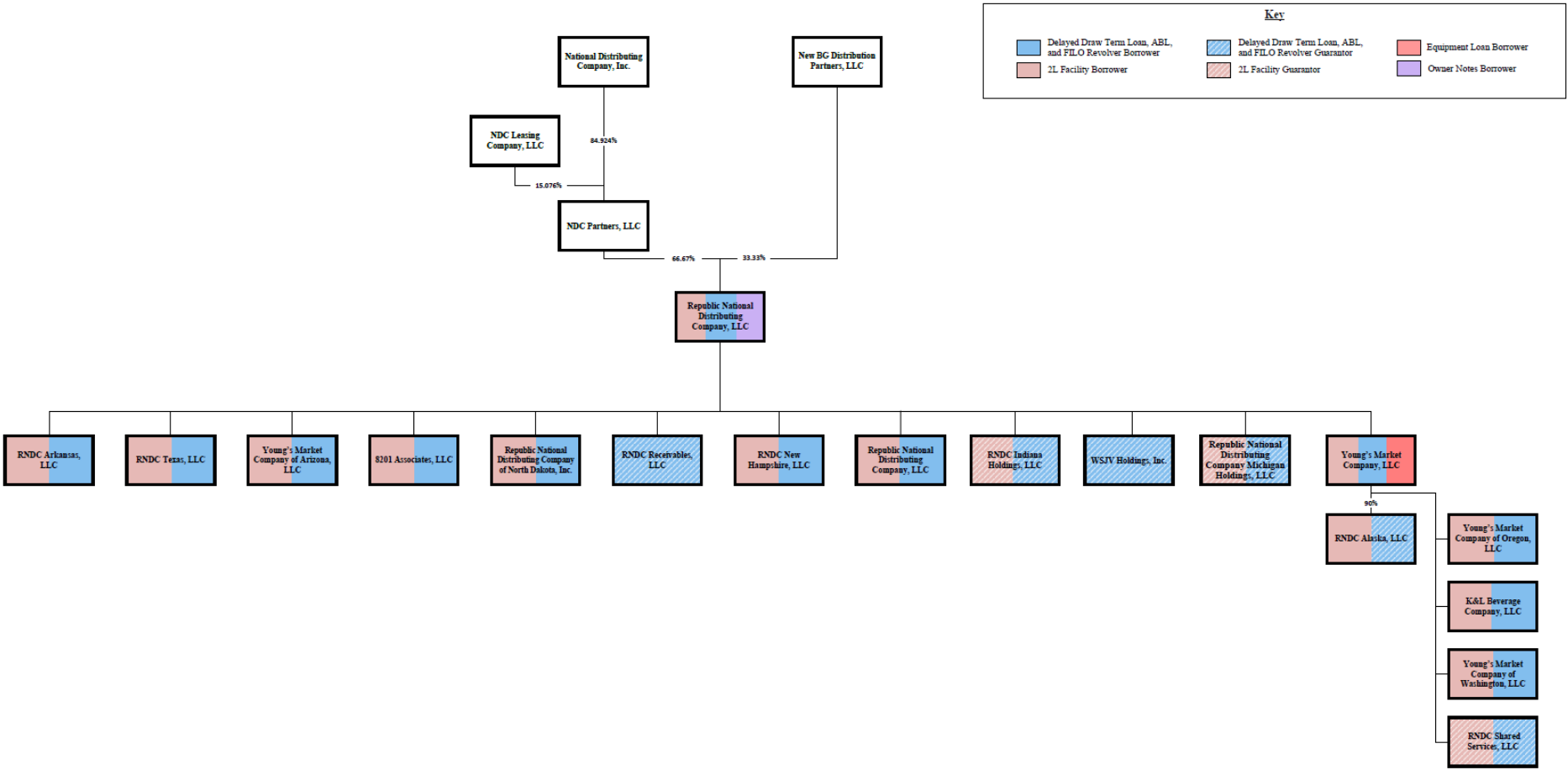
⁽¹⁾ For a complete list of Debtor entities, see organizational structure chart below.
Corporate History
Founding Era and Consolidation to RNDC
- Goldring Family (NGC) — In 1898, Newman Goldring, an immigrant from Eastern Europe, founded N. Goldring Corporation ("NGC") in Pensacola, Florida, which became the first licensed beer distributor in the state. Prohibition halted operations in 1919; following repeal in 1933, Goldring reopened the business with his son's help in 1939.
- Carlos and Davis Families (NDC) — Two years after repeal, Chris Carlos — a Greek immigrant with no money, little English, and no alcohol industry experience — founded the Dixie Wine Company in Atlanta, Georgia. Al Davis, a young alcohol salesman from New York who had worked for distributors in the southeast and Chicago, approached Carlos, and the two grew Dixie Wine together. In 1942 they formed National Distributing Company, Inc. ("NDC"), with Carlos running finances and Davis focusing on sales.
- Block Family (BDC) — In San Antonio, Texas, Edward Block — previously a route-salesman for a liquor distributor — formed Block Distributing Company ("BDC") in 1939 with one delivery truck and a small warehouse.
In 1997, the Block and Goldring families combined their businesses and created Republic Beverage Company ("RBC"). A decade later, RBC and NDC merged nearly all of their businesses to create the Company. However, NDC, a non-Debtor in the case, did not merge entirely and has operated as a distinct legal entity servicing the Georgia and New Mexico markets since 2007.
Notable Transactions
Beginning in 2007, RNDC expanded through more than a dozen strategic acquisitions and joint-venture partnerships with other established alcohol distributorships, entering markets including South Carolina, Nebraska, Indiana, Michigan, Oklahoma, Florida, Illinois, Alaska, and New York, and adding brokerage and control-state capabilities along the way. Certain notable transactions include:
- 2016 California Expansion Attempt — After a joint venture entered in 2011 with Young's Market Company, LLC ("YMC") in Arizona, the Company approached YMC and parent Young's Holdings, Inc. ("YHI") to explore a California expansion, but the parties could not agree on terms.
- 2017 Failed Merger — RNDC entered merger discussions with Breakthru Beverage Group in 2017 to expand its nationwide footprint. The parties terminated in April 2019, after the FTC informed them of significant concerns about likely anticompetitive harm, having gathered extensive evidence that the transaction would likely have produced higher prices and diminished service in wine and spirits distribution in several states.
- 2019 Acquisition of Young's Market — In August 2019, RNDC acquired 50% of YMC and YMC-Arizona for $297 million. The operating agreement gave YHI an option to sell the remaining 50% to RNDC, and gave RNDC an option to acquire it. In August 2022, YHI exercised its put, and despite a significant dispute over the calculation of the put price, RNDC completed the acquisition of the remaining 50% of YMC in November 2022 for approximately $422 million. Payments related to YHI were among the categories examined in the Special Committee's investigation, further discussed below.
- 2026 Sale to Reyes — In 2026, following the financial and operational deterioration described in the Events Leading to Bankruptcy section, RNDC agreed to exit and sell 11 of its markets to Reyes Holdings, L.L.C. ("Reyes"), an established beer distributor. The transactions closed in May 2026, and are described further under the Prepetition Restructuring Efforts below.
Ownership and Organizational Structure
The Goldring family, one of the Company's founding families, reportedly sold its ownership stake in 2010. Forbes reports that the sale followed the 2009 acquisition by Sazerac — a spirits producer chaired by William Goldring and controlled by the family's trusts — of 40 brands from Constellation Brands for $330 million, which put Sazerac in competition with the Company's own suppliers. Forbes estimates the stake sold for $400 million.
As of the Petition Date, the outstanding equity interests of Debtor RNDC LLC are indirectly owned by the Carlos, Davis, and Block families through two non-Debtor affiliates:
- NDC Partners, LLC — 66.67%. Members of the Carlos and Davis families own the equity interests of NDC Partners, which is an affiliate of NDC.
- New BG Distribution Partners, LLC ("New BG Partners") — 33.33%. Members of the Block family own the equity interests of New BG Partners.
Operations Overview
The Three-Tier System
The three-tier system is the regulatory framework that followed Prohibition. The 21st Amendment gave states the power to regulate alcohol distribution within their borders, and most adopted a version of the system, with regulations varying by state. The framework divides the industry into three tiers: (i) Suppliers - meaning distilleries, wineries, and breweries that manufacture or import alcohol; (ii) Distributors - which purchase from suppliers and transport and sell to those who sell or serve alcohol; and (iii) Customers - bars, restaurants, and retail stores that purchase from distributors and sell for consumption.
Each tier must be licensed by a state and/or local regulatory body to operate within a specific state, and each state maintains its own regulatory scheme. States are generally organized into three categories. In open states, private distributors purchase alcohol at wholesale prices and distribute it at a markup. In control states, state government agencies oversee and handle distribution and sale. In franchise states, franchise laws protect distributors against unfair termination of distribution agreements.
Treatment can differ by beverage type within a single state; Oregon, for example, is a control state for spirits and an open state for wine and beer. Under this state-by-state regulatory environment, the Debtors were historically either the dominant distributor or the only distributor capable of serving suppliers at scale in many states.
Suppliers, Customers, and Distribution Network
The Debtors historically supported suppliers with transportation, warehousing and storage, supply chain logistics, marketing and brand management, sales forecasting and analytics, and regulatory compliance. Many of these relationships trace back to the founders' connections with individual winemakers and distillers. As the supplier market consolidated, those connections evolved into long-running partnerships with larger platforms and their expanded product portfolios.
The Company's customers have consisted of on-premise accounts — establishments licensed to sell alcohol for consumption where the product was received, such as restaurants, bars, and hotels — and off-premise customers, meaning retail locations licensed to sell alcohol, such as grocery stores, convenience stores, and liquor stores. Within these categories the Debtors served a diverse base ranging from mom-and-pop liquor stores to national retail chains including Walmart, Costco, and Kroger.
The Debtors historically maintained a supply chain fulfillment network with facilities in most major states. Their warehouses used automated systems to locate products, package them together, and load them onto delivery trucks, enabling 24-hour turnaround on deliveries. The Company also used software to plan delivery routes.
Supplier Agreements
Several terms carry particular weight for the estates:
- Price Supports — Rebates generally triggered when the Debtors sell a supplier's product to a customer at a price point yielding a lower gross margin than agreed, allowing the Debtors to price competitively while preserving margin. The Company recognized approximately $626 million of Price Supports in 2025, roughly 35% of gross profit, and the Debtors state that an inability to enforce them would have an immediate and sizable negative impact on gross margin.
- Inventory Repurchase — Upon termination of a Supplier Agreement, the supplier is typically required to repurchase the Debtors' stock of beverages and related inventory at the Debtors' laid-in cost — a measure accounting for product price and related support provisions, shipping and storage services, and importation and regulatory fees. The Debtors describe these obligations as a meaningful source of liquidity and expect additional Supplier Agreements to terminate in connection with the proposed sale transactions.
- Payment Performance — Because distributor-of-record designations rest on no underlying agreement, the Debtors state that suppliers could revoke that status if the Debtors do not pay them timely, and that in states following the three-tier scheme, losing it could cost the Debtors the right to purchase, sell, and ship the affected products. Counsel separately advised the first-lien lenders that preserving franchise statute protections requires continued compliance with the supplier agreement.
E-commerce Platform
In 2019, the Company launched eRNDC, a business-to-business eCommerce platform connecting customers, sales teams, and suppliers online. The platform allowed customers to browse over 11,500 brands, place orders, communicate with sales representatives, track delivery updates, and pay bills online. Under the sale transaction to Reyes, the Company agreed to support eRNDC until it is migrated to the eCommerce platform operated by Reyes.
Prepetition Obligations
Top Unsecured Claims
Events Leading to Bankruptcy
Post-COVID Macroeconomic and Industry Headwinds
Since 2022, the Company has faced significant challenges attributable to a combination of post-COVID-19 operational difficulties and adverse macroeconomic conditions that eroded margins and tightened liquidity, exacerbated by a substantial debt burden accumulated through years of acquisition and by rising interest costs. Four developments drove the deterioration.
- The pandemic surge — Before the pandemic, the alcohol industry experienced a prolonged period of steady growth. When government shutdowns closed restaurants and bars in April 2020, consumers turned to retail stores for in-home consumption, and retail and online channels saw an approximate 35% increase in retail alcohol sales during the spring of 2020. Distributors including RNDC stockpiled unprecedented levels of inventory to meet the surge. Because retail customers had historically generated the vast majority of RNDC's revenue, and because RNDC was one of the only distributors with an eCommerce sales channel, it was able to fully capitalize on that demand.
- The reversal — As the effects of the pandemic waned in late 2022, so did demand for off-premise consumption, leaving RNDC and other distributors holding excess inventory as demand returned to pre-pandemic levels. Efforts to close the destocking gap were frustrated by a sustained period of high interest rates and persistent inflation, while long-lasting supply chain disruption drove up labor and other costs, increasing expenses and further reducing margins.
- The consumer shift — Americans were not only drinking less at home — many stopped altogether. Since 2022, the percentage of U.S. adults reporting themselves as regular alcohol consumers has fallen to its lowest level in nearly 90 years. Younger generations have become more health-conscious, often opting for alternatives such as CBD-infused or "better-for-you" beverages, and the rise of GLP-1 drugs including Ozempic and Wegovy, which curb alcohol cravings and consumption, has contributed further to the decline. Consumers who do drink have increasingly preferred high-quality, high-end wine and spirits; that premiumization allowed distributors to realize higher per-unit sales in some instances but contributed to declining total sales because fewer total units are purchased. 2023 marked the first year in nearly three decades that overall alcohol sales volumes declined.
- Compounding effects — Excessive inventory levels and declining demand, coupled with persistent inflation and high interest rates, placed severe pressure on the Company's margins, cash flows, and liquidity.
Supplier Pressure
Suppliers were also facing the headwinds — declining consumption, inventory overhangs, and margin compression — and became increasingly focused on their own results. From late 2022 through 2025, RNDC lost several key suppliers that together accounted for more than $3 billion in annual revenue. Suppliers that did not terminate extracted more onerous terms; the renewal of one key contract reduced gross profit by approximately $50 million. Other distributors offered aggressive terms to RNDC's suppliers, intensifying margin compression across the industry. As of the Petition Date, approximately 700 suppliers have transitioned to new distributors.
As described in the Operations Overview, the Debtors' distribution rights in many markets depend on timely payment of supplier invoices. In a January 5, 2026 letter to counsel for the lenders, the Debtors' counsel wrote that outstanding supplier balances were accumulating, that suppliers were sending default and termination notices daily, and that if distribution rights were lost the inventory securing the lenders' claims would be effectively worthless.
Prepetition Restructuring Efforts
Beginning in 2025, the Company retained restructuring advisors and pursued a series of overlapping efforts to address its capital structure and liquidity position: a sale-leaseback, a third-party refinancing, lender financing, and a going-concern sale program. The Debtors engaged AlixPartners, LLP ("AlixPartners") in September 2025 and Kirkland & Ellis LLP ("Kirkland") and Lazard Frères & Co. LLC ("Lazard," and collectively, the "Advisors") in October 2025 to consider paths forward for the Company. The Company subsequently retained Joele Frank, Wilkinson Brimmer Katcher. The Company also retained Porter Hedges LLP as co-counsel and conflicts counsel.
May 2025 — Sale-leaseback
On May 14, 2025, the Board approved the engagement of Eastdil Secured LLC to explore a potential sale-leaseback transaction of substantially all of the Company's owned real estate. According to the First Day Declaration, the transaction did not present a comprehensive solution to the Company's capital structure.
Fourth quarter 2025 — Strategic review
As financial challenges continued, the Company began considering every available strategic alternative, including the sale-leaseback, a refinancing of certain funded indebtedness, one or more going-concern sales of some or all assets and/or equity interests, and any combination thereof. In parallel, the Company implemented cost-cutting initiatives including deferred maintenance at warehouse facilities and workforce reductions, along with liquidity-enhancing measures including stretching supplier payment terms. The Company also worked with the Advisors to develop a long-term business plan and explore strategic and financial alternatives with existing members of the capital structure and potential third-party investors.
November 2025 — Third-party Refinancing Process
Beginning November 3, 2025, Lazard engaged over 15 prospective third-party capital providers to evaluate a potential refinancing of certain funded debt facilities. Many executed non-disclosure agreements and received access to a confidential information memorandum and other diligence materials. The Company received seven non-binding proposals contemplating new term loans and/or refinancing the securitization facility, engaged with interested parties on terms, and received revised proposals from certain parties.
The Debtors state that none of the proposals proved actionable. The first-lien Credit Agreement includes numerous lender consent rights — in many instances requiring the 100% vote of each of the then-existing 16 lenders, a result of the Credit Agreement having been amended 11 times by the end of November 2025 — and those atypical consent rights included the incurrence of additional indebtedness and other forms of financing. The lenders were unwilling to agree to third-party financing on a pari passu or priming basis, and third parties were unwilling to lend on a junior or unsecured basis or otherwise provide sufficient liquidity for a comprehensive solution.
December 2025 — Sale process launched
Subsequently, the Company decided to pursue a sale of some or all of the Company's assets. In early December 2025, the Company began receiving inbound interest for certain markets, including Maryland, Virginia, and Washington, D.C. Between early December 2025 and early January 2026, the Company engaged with 26 parties, 14 of which signed non-disclosure agreements. Lazard commenced a marketing process for certain markets, expanded over time to substantially all of the Company's markets, discussing a potential purchase of some or all assets with over 50 potential acquirers. Over 25 parties executed non-disclosure agreements and received diligence materials, and over 20 submitted non-binding indications of interest to acquire operations in a particular state or across multiple states.
The lenders believed the sale process should occur in a Chapter 11. However, with only indications of interest in hand, the Company did not believe a going-concern sale would come together in Chapter 11 and instead would likely result in liquidation. The Company's view was also grounded in state-specific laws narrowly restricting how collateral such as inventory and licenses may be sold or transferred; a limited universe of potential purchasers in any given state, or in some states a single viable purchaser, most unfamiliar with and wary of Chapter 11; and the risk that suppliers operating on a purchase-order basis without formal agreements could not be compelled to perform after a filing.
January 2026 — The letter and the $250 million facility
Facing continued liquidity constraints, and after weeks of unsuccessful negotiations with the lenders, the Company sent a letter dated January 5, 2026 to the Bank Agent and each of the then-existing 16 lenders, focused on the need for immediate liquidity to facilitate an out-of-court sale process and avoid a disorderly liquidation. On January 8, 2026, the Thirteenth Amendment facilitated the payoff of the Company's then-outstanding accounts receivable securitization facility, following an extension of that facility's maturity from December 1, 2025 to January 9, 2026.
Ultimately, the lenders agreed to provide $250 million of incremental financing to facilitate a sale process, solidify the balance sheet, and fund ordinary course operations, documented in the Fourteenth Amendment on January 16, 2026. The lenders conditioned the financing on RNDC (a) closing the Reyes transactions by May 31, 2026, (b) repaying outstanding funded debt obligations with sale proceeds, and (c) continuing to explore potential sales of other markets.
First Sale Wave & Reyes Transactions
- January 2026 — Reyes proposal. Reyes Holdings, L.L.C. indicated interest in seven markets and ultimately made an expanded offer encompassing 11 states generating more than $1 billion in net proceeds, committed to closing on an expedited timeline to mitigate growing supplier attrition. The Company announced the proposal publicly on January 13, 2026, covering Arizona, Florida, Hawaii, Illinois, Maryland, South Carolina, Virginia, and Washington, D.C.; the offer expanded to add Colorado, Louisiana, Oklahoma, and Texas, with Illinois later removed and the Virginia control-state business excluded.
- April 2026 — Wine Searcher Sale. The Debtors sold the wine-searcher.com entity and business.
- May 2026 — Idaho joint venture. The Debtors sold the Company's equity interests in the Idaho market joint venture.
- May 2026 — Reyes closing. The transactions closed, generating more than $1 billion used to pay down approximately 80% of then-outstanding obligations under the Credit Agreement. $50 million of proceeds was placed in third-party escrow for indemnification obligations, and certain variable components of the purchase price remained subject to a post-closing true-up based on inventory, customer accounts receivable, outstanding amounts payable to suppliers, and additional suppliers' transferred distribution rights. The Reyes TSA, dated the same day, runs through September 30, 2026, at $11 million per month, with optional monthly extensions exercisable by Reyes in its sole discretion through December 31, 2026 — priced at $11 million for October and $12 million for each of November and December.
Additional Sales
Following the Reyes closing, the Company again faced a liquidity shortfall. The lenders provided incremental draws totaling $74 million — $40 million under the Twentieth Amendment on June 18, 2026 and $34 million under the Twenty-First Amendment on July 3 — allowing the Debtors to consummate sales of assets in Washington, Oregon, Nebraska, North Dakota, South Dakota, and Arkansas, which generated more than $70 million in aggregate proceeds. A further $5.5 million followed under the Twenty-Second Amendment on July 17, 2026.
Among those sales, Quality Brands Distribution, LLC purchased the Nebraska, North Dakota, and South Dakota markets on July 10, 2026 for approximately $49.8 million. The accompanying transition services agreement requires the Debtors to provide services through July 31, 2026 for most functions and September 30, 2026 for certain information technology services, at $1.2 million for July and $113,000 per month thereafter.
The Debtors also executed non-binding letters of intent for assets in the Alabama, Alaska, Iowa, Maine, Mississippi, Montana, New Hampshire, North Carolina, Ohio, Pennsylvania, Utah, Vermont, West Virginia, and Wyoming markets, as well as for their control state businesses in Michigan, Idaho, Oregon, and Virginia. The Debtors intend to pursue these as private sales in Chapter 11.
Special Committee Investigation and Equity Holder Settlement
Special Committee Formation
Between November 2025 and June 2026, the Debtors made a series of board appointments creating two committees of disinterested managers.
- Change in management — In mid-October 2025, the Company's then-Chief Executive Officer died unexpectedly. Marc Sachs, a longtime board member and the son-in-law of Alan Dreeben, assumed the CEO role.
- The Special Committee — On November 11, 2025, the board of RNDC LLC appointed Scott D. Vogel and Charles T. Piper as disinterested managers, delegating to them binding decision-making authority over matters involving actual or likely conflicts of interest between the Company and any Related Party — including current and former directors, managers, officers, equityholders, employees, advisors, and affiliates — and authority to investigate all historical transactions between the Company and Related Parties. John T. Young, Jr. joined the Board and the Special Committee as a third disinterested manager on December 21, 2025. The Special Committee has investigated potential claims and causes of action the Debtors may possess.
- The Additional Special Committee — On June 25, 2026, each of the Debtors appointed Jill Frizzley to their boards as a fourth Disinterested Manager and sole member of a newly created committee, granting her sole authority to review and investigate any decisions made or transactions entered into by the Company and the Special Committee since the Special Committee's creation. Porter Hedges represents Ms. Frizzley in that capacity. As of the Petition Date, she was reviewing transactions from the Special Committee's appointment through the Petition Date, including the Reyes sale transactions.
Special Committee Investigations
With the assistance of Kirkland and AlixPartners, the Special Committee investigated potential claims and causes of action the Company may hold against Related Parties, including current and former officers, directors, and equityholders, as well as potential estate causes of action against other parties.
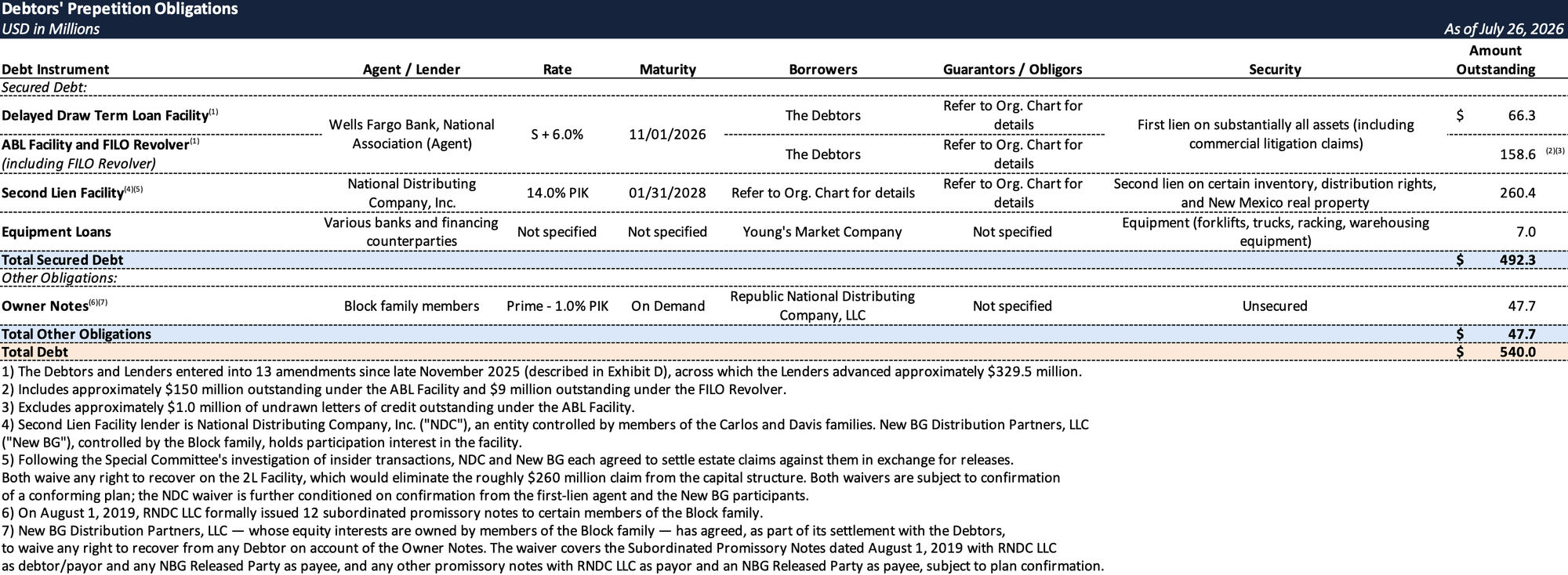
- Insider Debt Payments — The Debtors owe approximately $260 million on the Second Lien Facility with NDC, an indirect equityholder, and approximately $48 million on the Owner Notes to the Block family. The Committee examined the circumstances of incurrence, the consideration received, the interest rates, any changes to terms, and the timing and amount of any payments.
- Provision of Services to NDC — Under a Services Agreement dated May 1, 2007, entered as part of the NDC–RBC merger, RNDC provides NDC with back-office support including finance and accounting, information technology, employee benefits and training, general management, sales, operations, and human resources. The initial annual fee was $5.5 million. The agreement was never formally extended, but NDC has continued paying $5.5 million annually, a price unadjusted since execution. The Committee investigated the circumstances of the agreement, RNDC's continued performance, and whether $5.5 million represents fair market value.
- New Mexico Property — Also in connection with the 2007 merger, RNDC and NDC entered a lease dated May 1, 2007 for property at 5920 Office Boulevard, Albuquerque, under which NDC paid $125,000 per month ($1.5 million annually) to RNDC. The lease was extended in 2017, 2022, and 2024 with no rent increase. In September 2025, RNDC sold the property to NDC for $23 million. The Committee investigated whether the monthly lease rate and the sale price were fair market values.
- Payments to Insiders — Because the Debtors are family-owned and -operated, many members of the equityholder families are former or current Debtor officers, directors, and employees who received salaries, bonuses, and expense reimbursements. The Committee investigated the amounts and timing of those payments, their nature, and the services received in exchange.
- Financial Condition — Because solvency materially affects the assessment of potential estate causes of action, the Committee's advisors assessed the Debtors' financial condition over recent years to identify any periods of insolvency.
- Young's Holdings Transactions — As previously mentioned in the Corporate History section, the Debtors entered California and other west coast markets through a series of transactions involving YHI. The Committee investigated the nature and circumstances of all YHI-related payments, which totaled more than $700 million between 2019 and 2024.
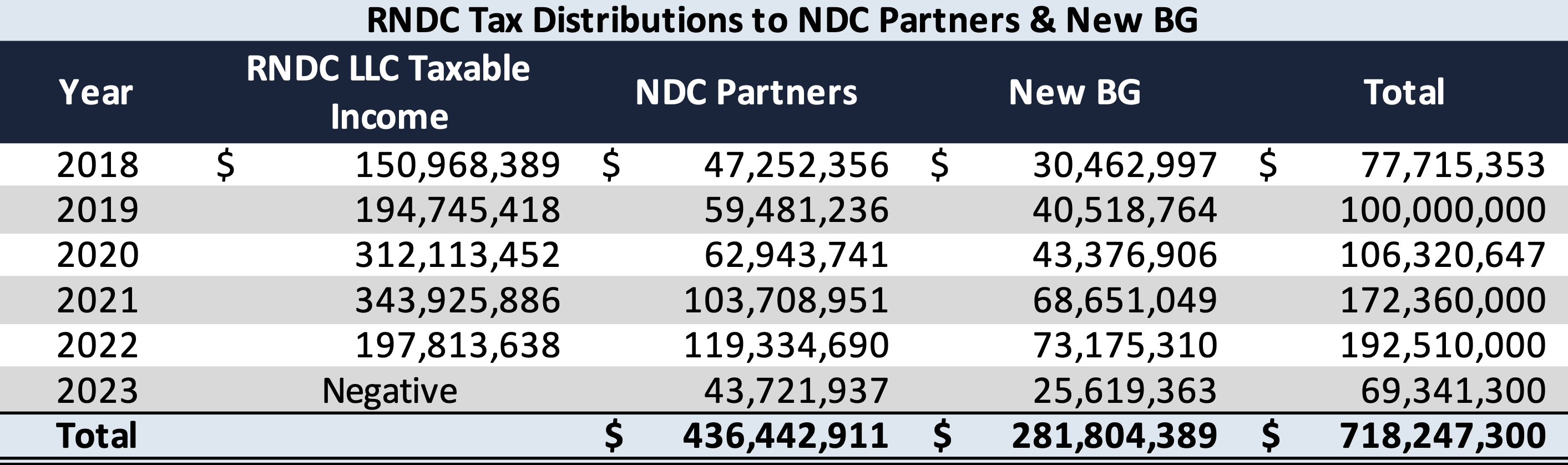
Tax Distributions — RNDC LLC is a partnership for U.S. federal income tax purposes, so income tax liabilities attributable to its income are largely borne by its direct and indirect equityholders. Since 2018, RNDC LLC has made more than $700 million in tax distributions to New BG Partners and NDC Partners in proportion to their ownership, which those entities then distributed to their own equityholders; because New BG Partners maintained no bank accounts, RNDC distributed directly to New BG's equityholders. Distributions were calculated in two steps: prior-year taxable income plus 10% to estimate annual taxable income, then a 50% assumed tax rate applied to that estimate. Quarterly estimated distributions were paid on that basis, with year-end true-up distributions where actual taxable income exceeded the estimate.
Equity Holder Settlement
The Special Committee reached settlements with both indirect equityholders — New BG Distribution Partners, LLC and the NDC parties — under which the two will contribute a combined $50.25 million of cash to the estates and waive debt claims totaling approximately $308 million, in exchange for releases of claims arising from the transactions examined in the Special Committee's investigation. Neither the cash payments nor the releases take effect unless and until a Chapter 11 plan incorporating the settlements is confirmed and becomes effective. Key terms are as follows:
- New BG pays $10.25 million and NDC pays $40 million on the plan effective date, with neither permitted to seek reimbursement of those payments or related professional fees from the Debtors' D&O policies. Under the DIP credit agreement, all cash the Debtors receive during the cases — expressly including settlement proceeds — is delivered to the DIP Agent on receipt and applied to the DIP loans.
- Both waive any recovery on the 2L Facility, the approximately $260 million second-lien claim held by National Distributing Company, Inc. New BG additionally waives recovery on the $48 million Owner Notes issued to Block family members. Named individuals on each side waive claims under the Deferred Compensation Plan — Marc Sachs, Grant Sechler, and Josh Zeller for New BG; Richard J. Davis, Elizabeth A. Davis, Kenneth Rosenberg, and H. Alan Rosenberg for NDC.
- The term sheets sort every claim the estates could bring against them by a single test: a claim is covered only if the defendant is insured under a Debtor D&O policy and the theory of recovery is one that policy covers. Claims failing that test are non-covered and are released permanently — no party may bring them again. Covered claims survive and pass, together with the policies themselves, to a liquidating trust established under the plan for the benefit of general unsecured creditors. The trust may recover only from policy proceeds, and only from what remains after those same policies have funded the released parties' legal defense. No judgment may be recorded against a released party, and no party may reach their personal or trust assets. The term sheets state expressly that this does not release liability or absolve any obligation to pay; it fixes which assets may satisfy it. The insurance backing the trust totals $60 million across twelve policies, all issued to National Distributing Company, Inc. with the Debtors as insureds and all expiring December 30, 2026; the schedule filed with the insurance motion lists no tail or run-off policy.
- Both settlements bind the released parties on signing but expire unless a conforming plan is confirmed within 120 days and effective 30 days thereafter. NDC's 2L waiver additionally requires sign-off from the first-lien agent and from the New BG parties holding participations in that facility. The DIP credit agreement separately prohibits the Debtors from entering into any settlement with NDC, New BG, or any affiliate of either without the prior written approval of the DIP Agent and the Required Lenders.
- The releases run broadly. On the New BG side, 37 enumerated individuals, family trusts, and entities plus New BG itself; on the NDC side, NDC Partners, National Distributing Company, Inc., NDC Leasing, Atlanta Wines International, and 20 named NDC Owners across the Davis, Rosenberg, and Carlos families, together with their spouses, children, trustees, and beneficiaries.
The Chapter 11 Filing
The DIP Facility
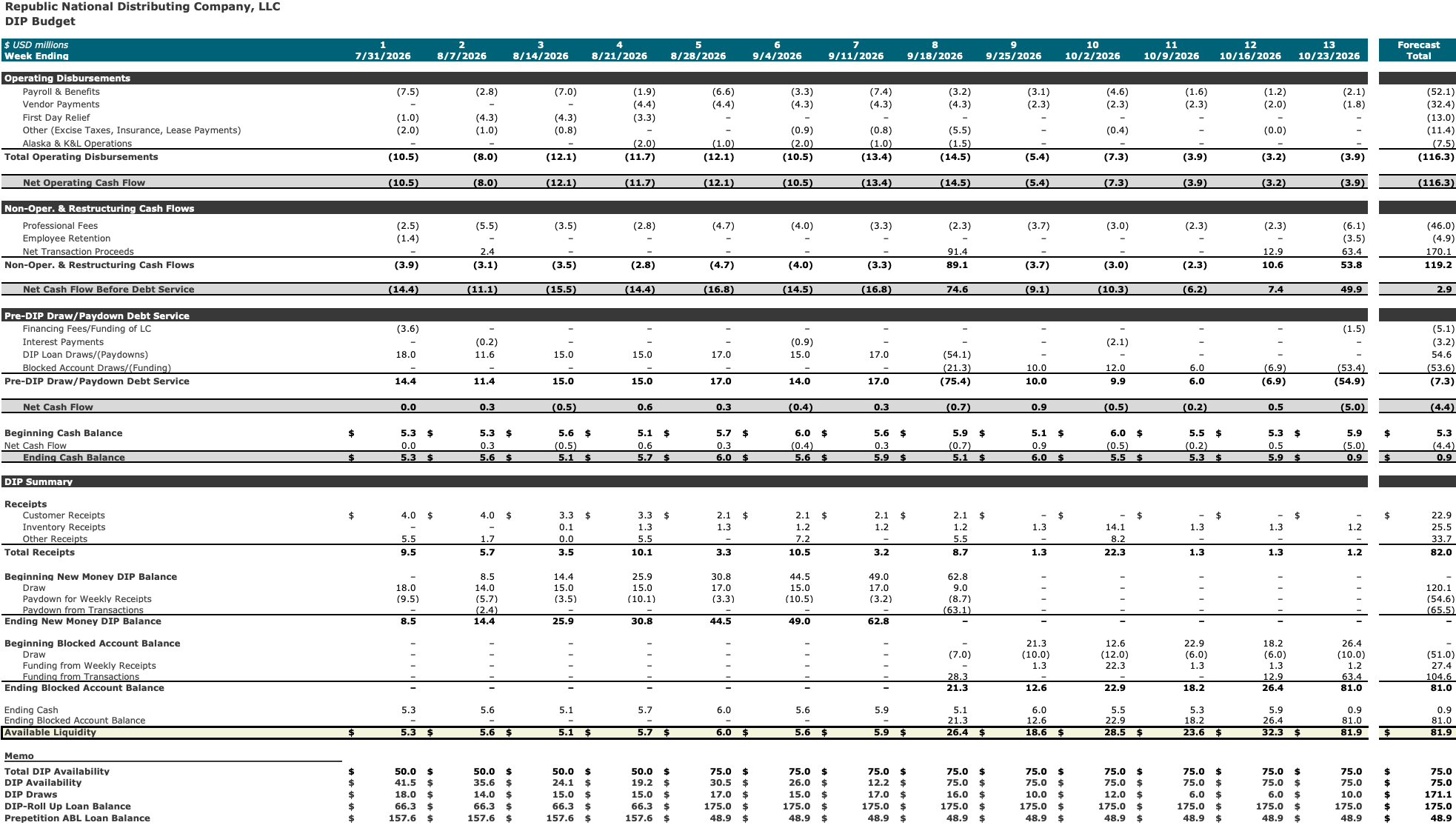
The Chapter 11 cases will be funded with a $250 million DIP facility, provided by certain or all of the prepetition lenders. Prepetition, Lazard recontacted six third parties from its original financing outreach and received no actionable proposals, which the Debtors attribute to their limited unencumbered assets, the lack of interest in funding a wind-down, and uncertainty around the remaining asset sales.
- Sizing — The facility provides $75 million of new money revolving loans, of which $50 million becomes available on entry of the Interim Order and the balance on entry of the Final Order. The remaining $175 million is a roll-up converting existing lender debt into DIP obligations: $66.3 million of January 2026 delayed draw term loans on entry of the Interim Order, and $108.7 million of ABL revolver borrowings on entry of the Final Order.
- Terms & Maturity — The DIP loans bear interest at SOFR plus 8.50%, or the Base Rate plus 7.50% for any loans priced by reference to the Base Rate, and mature 90 days after the Closing Date, subject to a 60-day extension with the consent of the Required DIP Lenders. The rolled-up term loans carry the same pricing as the new money but rank behind it: no amounts may be applied to them until the revolving commitments terminate, all revolving obligations are paid in full, and the Agent retains a reserve for future fees and expenses.
- Fees — A 3.00% closing fee and a 2.00% exit fee, each calculated on the total revolving commitments, along with a $375,000 arranger fee.
- Security — Priming liens on substantially all of the Debtors' assets, together with superpriority administrative expense claims, in each case subject to the Carve Out. Avoidance actions are excluded from the collateral package, though avoidance proceeds are added on entry of the Final Order.
Additionally, the DIP requires the Debtors to deliver executed purchase agreements within 30 days of filing, covering all or substantially all remaining going-concern assets — including every joint venture the DIP Borrowers own — at prices acceptable to the Agent and Required Lenders. At the Petition Date, those assets sat under non-binding letters of intent with nothing executed. Missing the milestone is itself an Event of Default, though the Agent may extend it by five business days.
The Reyes Settlement Motion
The Reyes purchase agreements provided for a customary post-closing purchase price adjustment, and the reconciliation has run against the estates. A June 26, 2026 working draft put the adjustment at approximately $85 million payable by the selling entities, driven primarily by supplier liabilities assumed by Reyes; an updated draft on July 24 reflected approximately $63 million. On July 9, counsel to Reyes demanded adequate assurance of the sellers' ability to pay and requested a litigation hold. The Debtors state that, given their financial condition, the sellers cannot provide that assurance.
At closing, $50 million of the purchase price was deposited into a third-party escrow to secure the sellers' indemnification obligations. Those funds are not property of the estates unless and until released to the Debtors, and none had been released as of the Petition Date. Under the proposed settlement, the sellers would instruct the escrow agent to release to Reyes the amount needed to satisfy the true-up, less the value of the Unsaleable Inventory — approximately $21.5 million of product tied to suppliers that consented to transferring distribution rights to Reyes after closing, which the sellers can neither sell nor move across state lines. The sellers would abandon that inventory to Reyes, the lenders would release their liens on it, and the parties would grant mutual releases in a scope to be mutually agreed upon.
The motion seeks approval of a settlement process rather than the settlement itself; the attached term sheet leaves the true-up amount, the escrow release, and the inventory value blank. The parties agreed to reach a final determination by July 31, 2026, failing which they will ask the Court to fix the amount at a hearing on or before August 14. One of the eleven markets, Hawaii, had not closed as of the Petition Date, and the Debtors state the settlement is expected to enable that closing.
Other First Day Relief
- Insurance (Doc. 5) — The Debtors seek authority to continue 46 policies and pay approximately $520,000 of prepetition obligations, with no premiums outstanding. Among them is the directors and officers program — twelve policies issued to non-Debtor National Distributing Company, Inc. with the Debtors as insureds — which is the only source from which the liquidating trust contemplated by the equity holder settlement may recover. All twelve expire December 30, 2026, and the filed schedule lists no tail or run-off policy.
- Taxes (Doc. 6) — The Debtors seek authority to pay approximately $27.8 million of accrued and unpaid taxes and fees outstanding at the Petition Date — $6.5 million of sales and use taxes, $6.3 million of income taxes, $5.8 million of excise taxes, $5.5 million of property taxes, $1.8 million of franchise taxes, $1.1 million of customs duties, $500,000 of regulatory and licensing fees, and $300,000 to third-party tax service providers.
- Net Operating Losses (Doc. 7) — The Debtors seek approval of procedures restricting transfers of equity to preserve tax attributes — approximately $660.6 million of federal net operating losses and approximately $62.2 million of section 163(j) interest carryforwards as of December 31, 2025, plus attributes generated since — which could otherwise be limited under section 382 if an ownership change occurs.
- Utilities (Doc. 9) — The Debtors spend approximately $1.2 million monthly across roughly 75 utility providers, with approximately $275,000 accrued and unpaid at filing. They propose a $586,390 adequate assurance deposit, equal to roughly half of one month's average cost.
- Schedules and Statements Extension (Doc. 11) — The Debtors seek a 45-day extension of the 14-day deadline to file their schedules of assets and liabilities and statements of financial affairs, for a total of 59 days from the Petition Date, through September 23, 2026. They seek the same 59-day extension for their initial Bankruptcy Rule 2015.3 reports on non-Debtor entities in which the estates hold a controlling interest, in each case without prejudice to seeking further extensions.
- Wages (Doc. 14) — The Debtors seek authority to pay prepetition wages and benefits for approximately 1,460 employees, including roughly 120 represented by three Teamsters locals, plus 250 temporary employees and 20 contractors. Approximately $62 million is outstanding across five non-qualified deferred compensation plans with 294 participants; payments under those plans are currently paused, and the plan named in the equity holder settlement term sheets accounts for 267 of the participants.
- Critical Vendors (Doc. 15) — Of approximately $260.37 million owed to vendors, the Debtors seek authority to pay $39.51 million of Trade Claims — $26.60 million of it owed to vendors supporting the transition services agreements — with $29.64 million on an interim basis. Payment is conditioned on a Trade Agreement requiring continued supply on customary terms and requiring the vendor to honor accrued allowances and credits against future orders.
- Cash Management (Doc. 16) — The Debtors seek to continue their cash management system and intercompany transactions and to grant administrative expense status to certain postpetition intercompany claims. No cash payments or settlements have moved between the Debtors and NDC or the joint ventures in either direction since April 2026, though amounts continue to accrue; the Debtors separately hold approximately $45.5 million of intercompany notes from two joint ventures the DIP milestones require be sold within 30 days.
Issues to Watch
Scope of the Equity Holder Settlement
The sorting test described under the Equity Holder Settlement cannot be applied from the record. Only the schedule of carriers, layers, limits, and dates is on file — no policy forms — so the definition of "Insured," the coverage grants, and the exclusions all remain unknown. That leaves the central question open: whether claims against NDC Partners, LLC, New BG Distribution Partners, LLC, and the family trusts and individuals on the released-party lists are preserved or released.
The distinction is not academic. Several transactions the Special Committee investigated involved money moving to entities — the tax distributions to NDC Partners and New BG, the Services Agreement fee, the New Mexico lease and property sale to NDC — rather than conduct by officers acting as officers. A claim seeking to recover a transfer runs against whoever received it, and a policy insuring directors and officers may not reach a recipient that is neither.
Whatever survives the sort is worth only what the insurance can pay. The $60 million is not a reserve set aside for the trust: it is the Debtors' general D&O program, available for any covered claim asserted before the policies expire, and it funds the released parties' defense before it funds any recovery. Prolonged litigation depletes the same limits the trust is pursuing, and the defendants bear none of that cost personally.
The plan and disclosure statement should identify which claims transfer to the trust. That description, not the term sheets, will establish what creditors actually receive.
Price Support Setoff
The Debtors disclose $626 million of Price Supports recognized in 2025 but never state how much was accrued and unpaid at the Petition Date. That gap matters because many suppliers sit on both sides of the ledger: the Debtors owe them for product, and they owe the Debtors accrued rebates. A creditor in that position can offset the two rather than paying and collecting separately.
The effect is a priority shift. Suppose a supplier is owed $10 million on prepetition invoices and separately owes the Debtors $3 million in accrued rebates. Assume unsecured creditors are recovering ten cents on the dollar. Without offset, the two obligations are handled separately. The supplier pays the estates its $3 million in full, because that's a receivable the estates collect like any other. The supplier's own $10 million claim goes into the unsecured pool and pays out $1 million. The supplier is out $2 million on net, and the estates have $3 million of real cash to distribute. With offset, the supplier nets the two. It cancels $3 million of its claim against the $3 million it owes — full value on that slice, not ten cents — and stands in line for the remaining $7 million, collecting $700,000.
Those receivables are also first-lien collateral, so offset reduces the lenders' collateral base at the same time. The Debtors identify setoff among the steps trade claimants may take if payment is interrupted. The Form Trade Agreement pushes the other way: a vendor accepting payment must apply its accrued credits to future orders rather than netting them against prepetition claims. Two figures would size the exposure, and neither is disclosed: how much accrued Price Support sits behind the $400 million-plus of unsecured claims, and how many vendors decline the Trade Agreement.
Franchise Protection
Counsel advised the lenders that non-payment of supplier invoices is grounds for termination in franchise states. A related point goes unmentioned in the filings. Franchise statutes normally require good cause, written notice, and an opportunity to cure before a supplier can terminate a distributor — but most except the distributor's insolvency. Virginia allows immediate termination with no notice where the reason is the wholesaler's bankruptcy, under both the Wine Franchise Act and the Beer Franchise Act. Wisconsin's notice and cure provisions likewise do not apply where the reason is insolvency, an assignment for the benefit of creditors, or bankruptcy. Coverage also varies by beverage: Wisconsin's Fair Dealership Law reaches distilled spirits but excludes wine, and its separate compensation statute applies only to beer.
Federal law generally blocks this outcome. Section 362 stays acts to obtain or exercise control over estate property, and section 365(e)(1) renders unenforceable any provision permitting a contract to be terminated or modified solely because of a bankruptcy filing or the debtor's insolvency. Whether that reaches a state statute authorizing the same result — particularly one regulating alcohol, where states hold broad authority — has not been settled, and the filings do not address it. Virginia is among the control-state businesses still under a non-binding letter of intent.
The Reyes True-Up
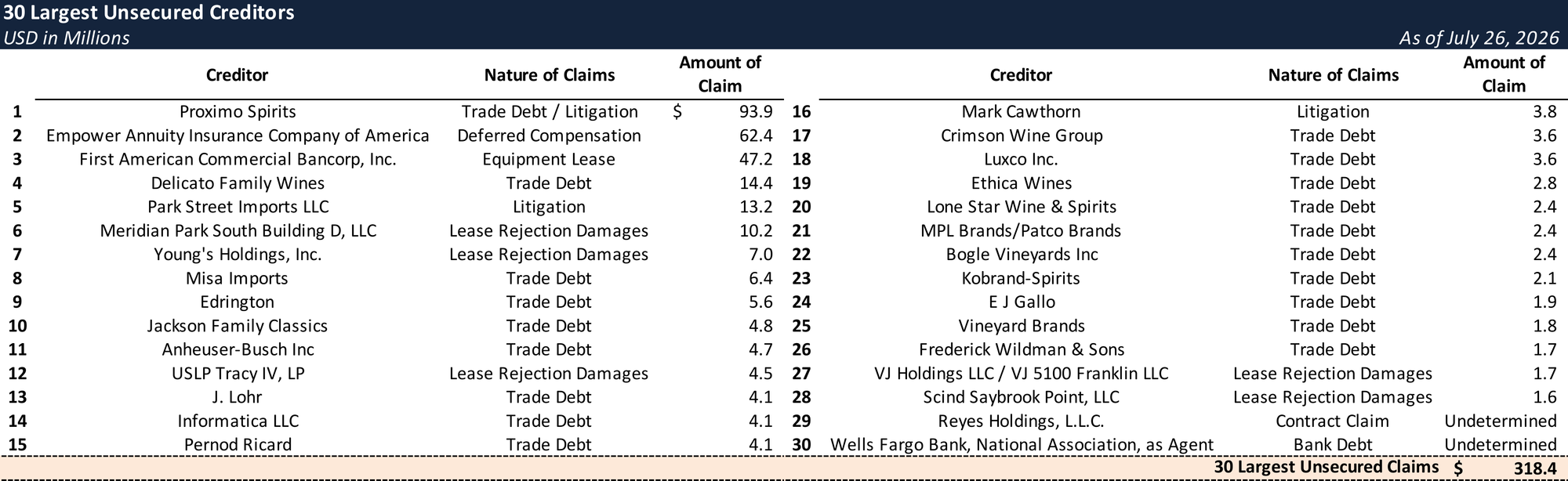
Two questions remain open. Whether the final reconciliation exceeds the $50 million escrow after crediting the inventory — any shortfall would be an unsecured claim, which is why Reyes appears on the Debtors' list of largest unsecured creditors in an undetermined amount. And the scope of the mutual releases, which the motion leaves to be agreed between the parties rather than presented to the Court.
Explore Bondoro Insights for live case dockets and comprehensive coverage of material filings from petition to plan confirmation.
Stay informed on every Chapter 11 bankruptcy case with liabilities exceeding $10 million. Subscribe for free to have our coverage delivered directly to your inbox, and explore our full archive of past summaries.
Subscribers can also opt in to timely filing alerts by updating their email preferences in Account Settings.


