Case Summary: Vi-Jon Chapter 11
Vi-Jon filed for Chapter 11 after talc claims rose roughly 400% since 2023 and nominal projected liability reached $720 million, seeking to channel all talc claims to a 524(g) trust anchored by a $25 million affiliate contribution under a prepetition restructuring support agreement.

A deck version of this summary is also available HERE.
Business Description
Headquartered in St. Louis, Missouri, Vi-Jon, LLC (the "Debtor" or "Vi-Jon") sells private-label "dry bath" products — Epsom salts and body powder — to national retailers including Amazon, Dollar General, Kroger, TopCo, and Walgreens.
The Debtor's net sales were approximately $26 million in 2025 and are projected to fall to about $21 million in 2026, with adjusted EBITDA sliding from approximately $700,000 to $300,000. In both 2024 and 2025, the two largest customers accounted for nearly half of net sales. As of the Petition Date, the Debtor held about $1.65 million in cash.
Vi-Jon employs one full-time salaried person, its Vice President and General Manager, alongside a single independent contractor whose role is limited to supporting the defense and administration of talc claims arising from the Debtor's historical talc products. The Debtor's operations — sourcing, packaging, testing, quality control, warehousing, logistics, accounting, information technology, insurance, and regulatory compliance — are supplied by non-Debtor affiliates through shared services agreements. The Debtor also owns a non-operational former manufacturing plant at 6300 Etzel Avenue in St. Louis (the "Etzel Property"), which is currently held as an idle asset earmarked for sale.
Vi-Jon, LLC filed for Chapter 11 protection on August 2, 2026 (the "Petition Date") in the U.S. Bankruptcy Court for the District of Delaware, reporting $1 million to $10 million in assets and $500 million to $1 billion in liabilities.
Corporate History
From Peroxide Specialty to Private-Label Manufacturer
The business began in 1908 as the Peroxide Specialty Company, founded by John and Viola Burgess Brunner, and rebranded as Vi-Jon Laboratories, Inc. by 1933. The defining turn came in the 1960s, when F.W. Woolworth and other national chains began stocking store brands and Vi-Jon Laboratories shifted to manufacturing private-label goods for retail chains. That model is why the talc products now at issue reached consumers under retailers' brands, and why retailers assert indemnity against the Debtor today.
Berkshire, Cumberland Swan, and the Inherited Talc Book
Berkshire Partners LLC acquired a controlling interest in Vi-Jon Laboratories in 2006 and merged it that July with Cumberland Swan Holdings, Inc., a Tennessee-based private-brand manufacturer, forming Vi-Jon, Inc. under VJCS Holdings, Inc. The merger brought a second line of talc exposure with it. Cumberland Swan's liability traced to its 1999 purchase of certain assets and business from Perrigo Co., and Vi-Jon Laboratories assumed those obligations in the combination — leaving the Debtor associated with Cumberland Swan talc claims for the period from August 1999 through its 2016 discontinuation of talc products.
The 2020 ESOP Sale and the Laidig Litigation
In August 2020, Berkshire exited Vi-Jon by selling the company to its own employees. The buyer was a newly created Employee Stock Ownership Plan ("ESOP") — a retirement plan that holds company stock on workers' behalf — which acquired all of the shares, making Vi-Jon 100% employee-owned. VJCS Holdings became Vi-Jon Holding, Inc., and Vi-Jon, Inc. became Vi-Jon, LLC, the Debtor here.
The transaction is the subject of Laidig v. GreatBanc Trust Company, brought in March 2022 by employee-participants on the ESOP's behalf. The Employee Retirement Income Security Act of 1974 bars a plan from buying employer stock from insiders unless it pays no more than fair market value, and the operative complaint — amended in March 2025 to add the directors and officers who approved the deal — alleges the ESOP overpaid at $398.5 million. Berkshire had shopped Vi-Jon at roughly $400 million since 2014 without finding a buyer; when hand-sanitizer demand spiked early in the pandemic, the complaint alleges, the valuation treated that spike as a durable baseline and the deal closed at 99.5% of the price the open market had declined to pay. The ESOP had no capital of its own and borrowed the full amount, owing it back to Vi-Jon over 49 years, with shares released into employee accounts only as the debt is repaid. Defendants deny the price was excessive and maintain the sale was for adequate consideration. These are allegations, not findings.
A January 2023 ruling largely declined to dismiss the original claims, and the directors and officers added in 2025 lost their own dismissal motion in early 2026, sending the case to discovery. A $1 million partial settlement with John G. Brunner and related family trusts, who deny all liability, was noticed to the class in 2025. The case continues against GreatBanc Trust Company, the ESOP's trustee, Berkshire Fund VI Limited Partnership, eleven former Vi-Jon directors and officers, and three corporate defendants: VJCS Holdings, Inc., Vi-Jon, Inc., and VJ Holding Corp.
The December 2023 Restructuring Transaction
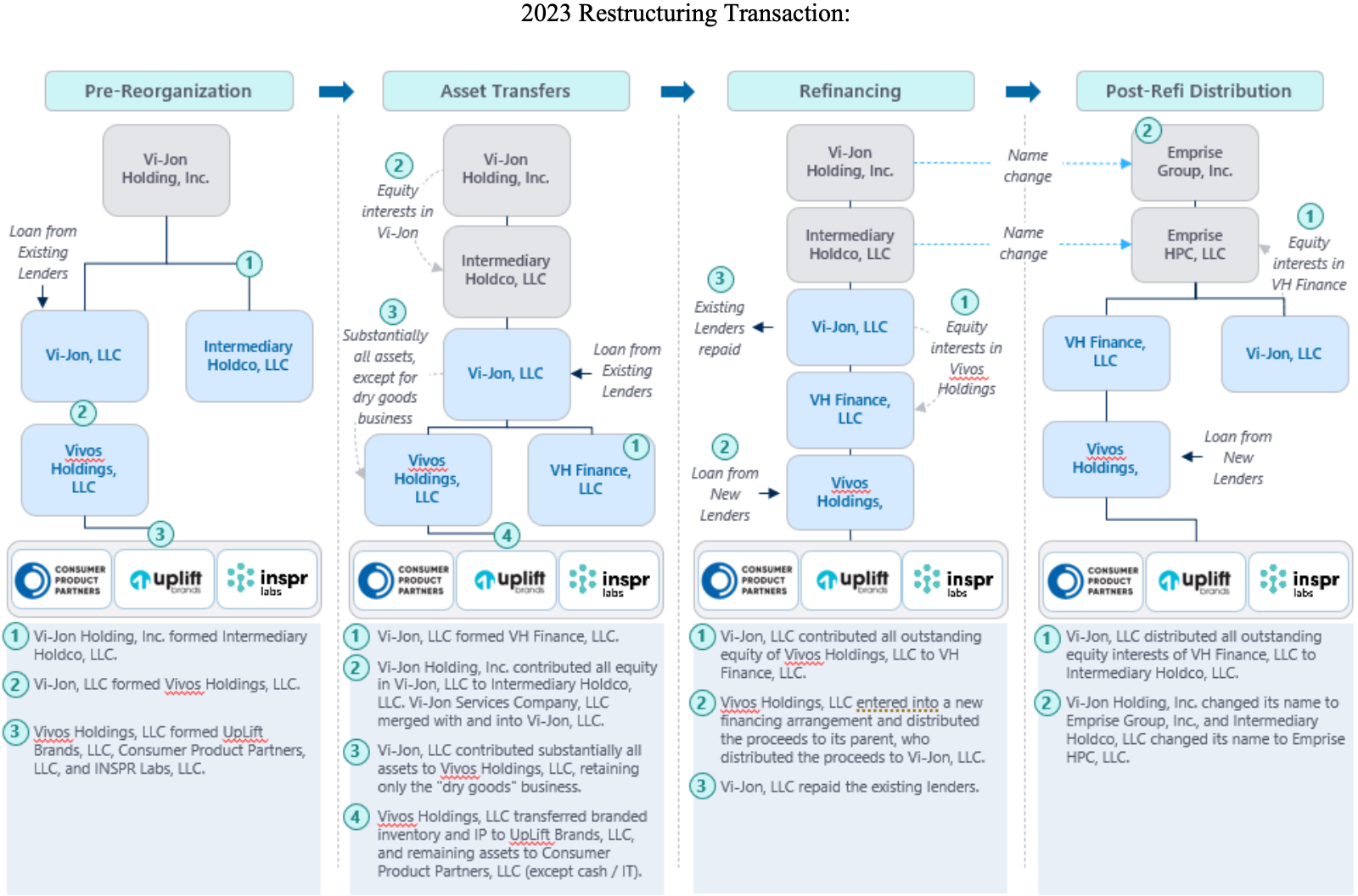
In 2023, the Vi-Jon enterprise reorganized itself internally. The company had three distinguishable product lines: private-brand liquid-fill household and personal care products, private-brand dry bath products, and branded goods such as Germ-X hand sanitizer. The Debtor states the reorganization was undertaken with the help of its former counsel and had two purposes — aligning the corporate structure with those lines, and beginning to manage what it describes as mounting alleged talc-related liabilities.
- Pre-Reorganization — Vi-Jon, LLC was the center of the enterprise. It held the operating business, it carried the lender debt, and it owned the subsidiaries — including Vivos Holdings, LLC, formed in June 2023, which in turn owned the liquid and branded product lines: UpLift Brands, Consumer Product Partners, and INSPR Labs. Above it sat Vi-Jon Holding, Inc., which had formed Intermediary Holdco, LLC alongside the Debtor.
- Asset Transfers — Under a Contribution Agreement dated December 3, 2023, the Debtor contributed substantially all of its assets to Vivos, retaining only the dry goods business — and, by the agreement's terms, all liabilities of that business, including alleged talc-related liabilities. Vivos then passed those assets down to the operating companies beneath it: branded inventory and intellectual property to UpLift, and everything else except cash and IT to Consumer Product Partners. Because the Contribution Agreement left the Debtor holding all dry goods liabilities, including alleged talc claims, Emprise HPC, LLC — its immediate parent, formerly Intermediary Holdco — provided a limited contribution agreement ("Keepwell Agreement") on December 28, 2023. Subject to conditions, Emprise HPC would contribute equity on a qualifying capital call, in amounts set by projected liquidity shortfalls, up to $25 million. The cap was sized on a third-party consultant's forecast of the Debtor's talc exposure.
- Refinancing — The Debtor still owed its existing lenders, but the assets had moved. The Debtor first contributed all outstanding equity of Vivos to VH Finance, LLC, moving Vivos out from underneath it. Vivos, now holding the transferred assets, raised new debt and distributed the proceeds upward — to VH Finance, and from there to the Debtor, which applied them to repay its existing lenders in full.
- Post-Refi Distribution — With its lenders repaid, the Debtor distributed all outstanding equity of VH Finance up to Intermediary Holdco. Vi-Jon Holding then renamed itself Emprise Group, Inc., and Intermediary Holdco renamed itself Emprise HPC, LLC. The Debtor and VH Finance now sat side by side beneath Emprise HPC, with Vivos and the operating businesses held under VH Finance.
Additionally, in connection with the 2023 Restructuring Transaction, the Debtor entered into shared-services and co-manufacturing agreements with its non-Debtor affiliates, which now supply nearly every operational and administrative function of its business. These are discussed further in the Operations Overview section below.
Organizational Structure
Operations Overview
In connection with the 2023 Restructuring Transaction, the Debtor entered three intercompany agreements on December 3, 2023 which together govern nearly every function of the business — manufacturing, logistics, back office, and enterprise-level services such as insurance and benefits.
Co-Manufacturing and Supply Agreement
The Debtor sells directly to its retail customers but does not make its products. Under the Co-Manufacturing Agreement, the counterparty procures raw bulk magnesium sulfate and converts it into finished Epsom salt goods, and separately sources body powder already finished and packaged from third-party suppliers. Goods move to the counterparty's distribution center, where title transfers to the Debtor; the counterparty then manages outbound shipment to customers. It also provides sales, customer service, research and development, and related support, and assists the Debtor in developing additional product lines on request. According to the Debtor, the agreement is its sole means of sourcing and selling product, and without the ability to continue under it the estate would lose its only source of revenue.
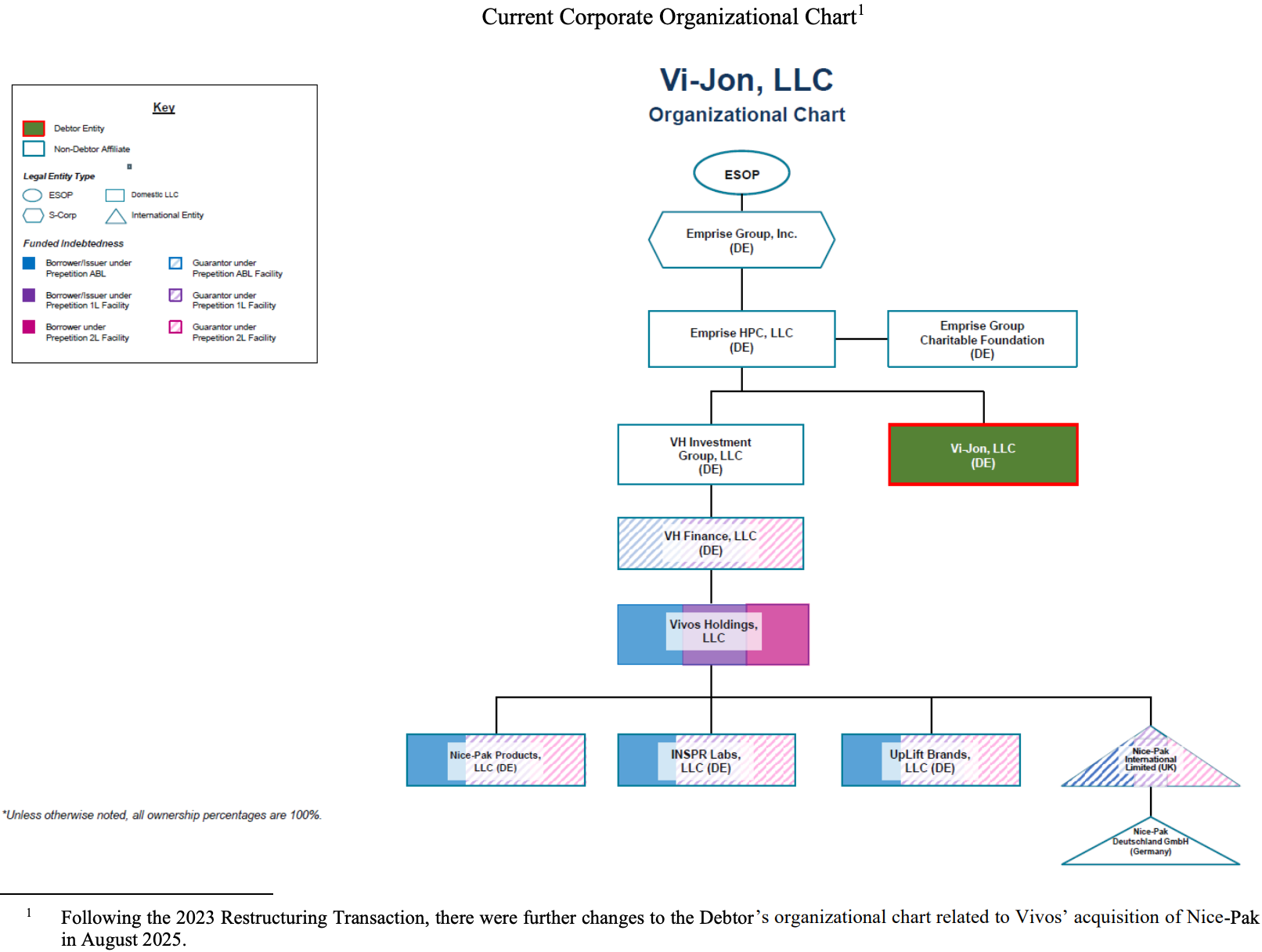
The counterparty was originally Consumer Product Partners, LLC, a subsidiary of Vivos Holdings, LLC. In August 2025, Vivos — CPP's parent — acquired Nice-Pak Products, LLC. In November 2025 Vivos initiated a process to integrate certain subsidiaries, including CPP, into Nice-Pak's U.S. operations, and on January 1, 2026 the integrated subsidiaries began operating as a unified business under the Nice-Pak brand. Nice-Pak is CPP's successor-in-interest under the agreement.
The Debtor pays on four bases: (i) a $400,000 annual SG&A fee covering sales, customer service, sales support, and R&D, reviewed and updated periodically; (ii) per-unit charges for variable overhead ($0.115 per unit), fixed overhead ($0.082 per unit, applicable to Epsom salt only), and distribution ($0.043 per unit), each based on a proportional number of units sold; (iii) pass-through costs for raw materials, components, direct labor, and freight, the last calculated on product weight; and (iv) a 12.5% contract manufacturing fee on the product cost of Epsom salt. Body powder, procured in finished form, bears no manufacturing fee.
Administrative Services Agreements with Vivos and Emprise
- Vivos Administrative Services Agreement — Vivos provides general management, human resources, finance and accounting, order processing, information technology, utility services, legal and regulatory compliance, and ancillary services, for an annual fee of $572,000. The fee is renegotiated each year based on expected costs and the Debtor's relative proportion of expected net sales across the enterprise's product lines, and is not subject to reconciliation against actual costs. Vivos separately pays direct costs on the Debtor's behalf — insurance, taxes, utilities, employee health benefits, and vendor payments — and recovers them through the intercompany reconciliation process. Among those costs is roughly $240,000 a year to carry the Etzel Property: about $18,000 a month in utilities, $17,095.34 of 2025 property taxes, and a $5,000 to $5,500 share of the enterprise's aggregated insurance premium, all on a plant that no longer operates. Vivos also invoices and collects on consolidated customer orders that include both Debtor and affiliate products, with the Debtor's share identified at the SKU and profit-center level.
- Emprise Administrative Services Agreement — Emprise maintains corporate governance and secretarial services, risk management, insurance, employee benefits, and consolidated tax support. The Debtor pays Emprise nothing directly. Vivos funds the third-party benefits providers, tax payments, and related costs and charges the Debtor at cost through intercompany reconciliation. The insurance program is charged at cost; the workers' compensation program and employee benefit program, with their administrative costs, are charged as a fee equal to 21% of the Debtor's gross payroll.
Product Lines
The Debtor's offerings center on Epsom salts and body powders. Additional products are in development as of the Petition Date, including fragranced foot soak, saline laxative, and lawn and garden plant food.
- Epsom Salt — Epsom salt is the Debtor's most profitable line, accounting for approximately 65% of total annual net sales across 2024 and 2025, and it is the one the Debtor intends to build on. It is pursuing additional customers and weighing a broader range of offerings, and its 2026 plan contemplates growth in higher-margin Epsom salt products that would improve gross margin against 2025.
- Body Powder — Body powder ran at approximately $2.4 million in quarterly net sales through 2024 and 2025, until the Debtor lost a significant portion of the business in October 2025. The lost program had represented approximately 28.4% of the Debtor's annual net sales in 2024 and 22.6% in 2025, and its departure costs roughly $1.7 million a quarter. The effect was immediate: quarterly body powder sales fell from approximately $2.1 million in the first quarter of 2025 to approximately $662,000 in the first quarter of 2026, with 2026 revenue projected below $1 million per quarter.
Prepetition Obligations
The Debtor has no secured debt and no accrued third-party trade payables. The Debtor's prepetition obligations are summarized below:
- Trade Debt — The Debtor contracts with no vendors directly. Under the Shared Services Agreements it pays its non-Debtor affiliates, and Vivos, Emprise, or Nice-Pak in turn contract with and pay any third-party vendors, with amounts between the Debtor and the affiliates settled through the intercompany reconciliation process. As of the Petition Date the Debtor had no accrued outstanding third-party trade payables.
- Intercompany Promissory Note — Dated December 3, 2023, among the Debtor, Vivos, and VH Finance, the note makes each party both borrower and lender to the others with respect to intercompany advances, with the outstanding principal reflecting the aggregate advances outstanding at any time. As of July 25, 2026, the Debtor owed $1.46 million.
- Intercompany Advance Agreement — Effective September 5, 2024 and amended a year later, Emprise advanced $675,000 to the Debtor. Repayment falls due on the earlier of a closing on the Etzel Property or September 5, 2026, unless the parties extend. The advance is secured by and repayable from the sale proceeds, though Emprise's security interest in those proceeds has never been perfected.
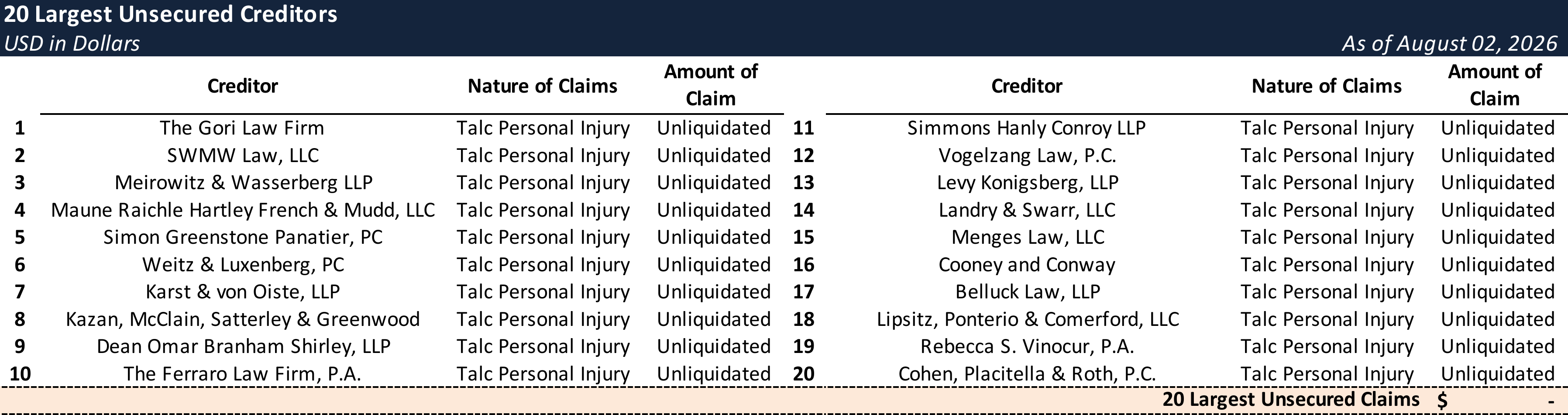
- Other Unsecured Debt — Beyond the ongoing talc litigation itself, roughly $37 million in unsecured obligations had been asserted against the Debtor as of the Petition Date: approximately $20 million in settlements and judgments from talc claims; approximately $15 million in retailer indemnification claims, including disputed, contingent, and unliquidated ones; and approximately $2 million in other unsecured claims, comprising non-restructuring professional fees.
Top Unsecured Claims
Events Leading to Bankruptcy
The Debtor's account is that an operating business generating a few hundred thousand dollars of annual EBITDA cannot fund a mass tort whose projected cost multiplied sevenfold in three years, and it identifies the post-2023 growth in talc claims, which it calls unexpected and unforeseen, rather than commercial decline as the primary driver. The commercial side contributed. The body powder program loss removed roughly $1.7 million of quarterly revenue and narrowed the cash available to absorb legal expense, though the Debtor treats it as a contributor to near-term liquidity constraints rather than a cause of the filing.
Overview of Talc-related Claims
Plaintiffs have historically brought two types of talc claims against the Debtor. The first, the OC Claims, allege ovarian cancer or other gynecological disease from using the Debtor's talc products for feminine hygiene. The second, the Mesothelioma and Lung Cancer Claims, allege non-ovarian cancers and other asbestos-related diseases from exposure to contaminated talc. A minority of plaintiffs in the second category also allege work-related asbestos exposure, through their own work history or that of a family member. As of the Petition Date, no OC Claims are pending; all 367 pending claims are Mesothelioma and Lung Cancer Claims.
The Debtor disputes both categories, maintaining that its talc was safe, that the claims lack medical or scientific merit, and that exposure to its products caused no personal injuries. It states that during the period it manufactured and sold talc, it received certificates of analysis from its raw talc suppliers for each batch purchased, each indicating that no asbestos was detected.
The filings do not identify the testing methods behind those certificates. FDA has separately noted that the two long-established methods for testing talc — the Talc USP monograph and CTFA method J4-1 — have recognized shortcomings in specificity and sensitivity compared with electron-microscopy methods. When FDA's contract laboratory tested 52 talc-containing cosmetic products in 2019 using polarized light and transmission electron microscopy together, it confirmed asbestos in nine.
NERA Liability Forecast
Before the 2023 Restructuring Transaction, the Debtor retained NERA Economic Consulting to forecast its talc exposure, both to scope the liabilities it would retain and to size the Keepwell Agreement. NERA produced a series of forecasts between June 2020 and June 2023, and a further update in May 2026 for this filing. Its work covered the Debtor's talc business from 1963 through the 2016 exit — sales were minimal for most of that period, peaking in 2003 at roughly 20 million units, with average market share of 13.2% between 1975 and 2015.
The exposure window closed in 2016; the claims window did not. Mesothelioma surfaces decades after exposure, so suits arising from talc sold through 2016 will continue to be filed well into the middle of the century. Forecasting the liability therefore means projecting annual filings across that tail, applying a dismissal rate, and multiplying the survivors by an average settlement — then discounting the result back to present value.
The 2023 forecast found ovarian and lung cancer exposure de minimis and mesothelioma claims the principal driver. It modeled two filing-rate scenarios, both discounted at 12.5% annually. The first, extrapolating from non-occupational mesothelioma filings between January 2022 and May 2023, produced $102 million of nominal settlement exposure worth $14 million in present-value terms. The second, drawn from all such filings since 2017 and so averaging in quieter years, produced $59 million and $9 million. Those figures cover settlements alone; adding defense costs, NERA put the combined present value at roughly $16–33 million under the conservative scenario and $25–54 million under the higher one — implying defense expense would exceed the settlements themselves. Underlying all of it was an assumption that 2023 filing rates, dismissal rates, and settlement amounts would hold steady.
The Post-2023 Claim Surge
The Debtor's actual claims experience diverged from those projections. Claims against the Debtor have risen approximately 400% since 2023, driven largely by plaintiffs' counsel adding it to pre-existing cases in which it had not initially been named; 28 law firms have filed against it for the first time, and 367 talc claims were pending as of the Petition Date. Settlement costs have climbed and dismissal rates have fallen against the 2023 assumptions. NERA's 2026 forecast, commissioned after the Debtor concluded its actual experience had substantially exceeded the projections, revised the nominal value of the litigation to $720 million and the net present value to $159 million. The Debtor identifies this shift, which began in 2024, as the primary driver of the filing — a greater catalyst for its liquidity position than the market shifts and customer losses it has also faced.
Heyer and Ludwig Verdicts
A Ramsey County, Minnesota jury returned a $10.2 million verdict in Heyer v. A.H. Bennett Co., apportioning 20% to the Debtor subject to setoffs — roughly $2 million before those setoffs. Reporting on the verdict puts the balance at 50% to Gold Bond, 15% to Perrigo Co. of Tennessee, 10% to Merck, and 5% to Johnson & Johnson. Plaintiffs' counsel identified the Vi-Jon-attributed products as Walmart's Equate, Target's Up & Up, and Walgreens-branded powders — a set overlapping the Debtor's five named current customers only at Walgreens. Simon Greenstone Panatier, PC, co-counsel for the plaintiffs, is now a signatory to the Restructuring Support Agreement. Weeks later, judgment was entered against Vi-Jon in Ludwig v. Sumitomo Corp. of Americas, for approximately $16.8 million.
The filings do not describe how the Ludwig figure was apportioned. The two states allocate differently: Minnesota Statutes § 604.02 generally confines a defendant to its own share of fault, while under New York's CPLR 1601 a defendant 50% or less at fault is severally liable for non-economic damages but remains jointly and severally liable for economic damages.
Perrigo's 15% share is worth noting for a second reason. Cumberland Swan acquired certain assets and business from Perrigo Co. in 1999, and that purchase is the origin of the talc liability Vi-Jon Laboratories assumed in the 2006 merger — the Debtor's exposure on Cumberland Swan products runs from August 1999 to the 2016 discontinuation. How the 1999 agreement allocated liability between the two companies, including any indemnification, is not disclosed in the first-day filings, nor is the nature of the setoffs to which the Heyer apportionment is subject. Together the two judgments account for most of the approximately $20 million in litigation judgments the Debtor lists among its unsecured obligations.
Insurance Coverage
The Debtor holds approximately $900 million in aggregate limits from solvent insurers, purchased between 1965 and October 31, 2016, covering defense and indemnity. Most policies are occurrence-based, responding to injury during the policy period rather than to when a claim is made — the relevant structure for latent disease.
That coverage has not translated into payment. Certain insurers have asserted coverage defenses, including asbestos and pollution exclusions, and the Debtor has not brought coverage litigation to test them. It has therefore received only partial reimbursement of defense and indemnity costs while continuing to fund defense expense, settlements, judgments, and the defense of customers under its indemnification agreements — costs that grow with the case count.
Customer Indemnification Agreements
Certain of the Debtor's retail customers hold indemnification agreements with it. Terms vary, but they generally require the Debtor to defend, indemnify, and hold harmless the customer against any claims, liabilities, losses, and costs — attorneys' fees included — arising in whole or in part from products the Debtor sold them. In practice, that means a talc suit filed against a retailer can become the Debtor's expense.
Customers have asserted such claims both under those agreements and at common law. The two sides often cooperate on the defense, occasionally through shared counsel and otherwise separately, though the Debtor does not always accept the obligation: in certain circumstances it disputes a customer's entitlement and declines to indemnify. As of the Petition Date, asserted retailer indemnification claims — including disputed, contingent, and unliquidated ones — totaled approximately $15 million, the second-largest category of unsecured obligations after the talc judgments.
Special Committee Formation
The Board established a Special Committee on April 1, 2026, appointing independent directors Michael Buenzow — a Managing Member of TURN 180 LLC and Senior Managing Director at ZCGC, previously Vice Chairman of Restructuring at FTI — and Lloyd Palans, a Principal at Palans Consulting LLC who was formerly a law firm partner and taught Chapter 11 reorganizations at Washington University in St. Louis. The charter gave it exclusive authority over strategic transactions of any kind and over the settlement, prosecution, and defense of claims held by or against the Debtor.
- The Investigation — The Special Committee's authority extended to claims arising from the 2023 Restructuring Transaction, and on April 16 the Committee directed Sidley litigation partner Jon Muenz to review them independently — whether the Debtor held viable claims against its equity holders, affiliates, directors, managers, or officers, including alter ego, veil piercing, successor liability, and actual or constructive fraudulent transfer. His team pulled the books and records behind the 2023 transaction and the emails of employees involved in it, and interviewed management at the Debtor, Emprise, and Vivos. Under the Restructuring Support Agreement, the Debtor has agreed to release those claims and every other estate claim against the non-Debtor affiliates, in exchange for their trust contributions, the exit financing, and the Keepwell amendment. The declaration does not state what the Investigation found.
- The Amended Keepwell Agreement — On July 30, 2026, the Debtor and Emprise HPC amended the Keepwell to remove two conditions on drawing the remaining commitment: a forecast test requiring that, absent the infusion, the Debtor's resources would not exceed anticipated liabilities by more than $2 million, and a 45-business-day window for Emprise HPC to fund calls above $2 million.
Prepetition Negotiations
The Debtor built its restructuring team in stages through early 2026. Sidley Austin and Houlihan Lokey came on in late February to evaluate options for addressing the liquidity constraints; BRG followed in mid-May, and Mackenzie Shea was appointed Chief Restructuring Officer at the same time. Their work centered on assessing the pending talc claims and what continued litigation in the tort system would cost.
Alongside that assessment, the Debtor examined whether bankruptcy could resolve the claims by channeling them to a trust under section 524(g). Exploratory work on a Chapter 11 strategy began in April 2026, subject to authorization by the Special Committee. The Debtor entered nondisclosure agreements with eight plaintiffs' firms, which — joined by a ninth that did not sign one — formed the Ad Hoc Plaintiffs' Group, retaining Caplin & Drysdale as counsel and Province, LLC as financial advisor. The group's clients hold more than 80% of outstanding talc claims against the Debtor.
In June, the Debtor engaged former bankruptcy judge Shelley C. Chapman of Willkie Farr & Gallagher as prepetition future claimants' representative ("FCR"), to speak for individuals who may assert talc claims later. The Debtor gave both the ad hoc group and the FCR access to a data room and responded to their information requests. The negotiations ultimately resulted in a restructuring support agreement, executed July 30, 2026, among the Debtor, Emprise, Emprise HPC, the FCR, and the ad hoc group.
The Chapter 11 Filing
The Debtor filed Chapter 11 to settle every talc claim against it at once, rather than defending them one by one in courts around the country. Section 524(g) allows that: a company with asbestos exposure can channel all claims to a trust — including claims from people whose illness has not yet appeared — and receive a court order permanently barring anyone from pursuing the company or its affiliates afterward. Claimants lose the right to sue; the trust becomes their only recourse.
That protection carries a price. Ordinary Chapter 11 plans need a simple majority of voting creditors by head count; section 524(g) requires three-quarters. When the plan goes out for a vote, three-quarters of the claimants who return ballots must accept it. The threshold is measured against ballots cast rather than claims outstanding. The Debtor spent the months before filing negotiating with the law firms that control most of the claims against it, and the Restructuring Support Agreement obliges those firms to recommend acceptance to their clients, use commercially reasonable efforts to secure affirmative votes, and exercise any powers of attorney they hold to vote on a plan.
The Sale Transaction and Exit Financing
The settlement at its core is an exchange. The non-Debtor affiliates fund a trust and the reorganized company; in return they take the operating business and complete protection from talc claims. Under the Plan, a material set of the Debtor's assets — to be scheduled in a Plan Supplement — transfers to Emprise HPC, another non-Debtor affiliate, or their designee. Emprise designates which executory contracts material to the business come along, with the Reorganized Debtor assuming and assigning them and Emprise paying cure costs under the Budget, subject to procedures still to be negotiated and to any contracts rejected under the Plan or by court order.
In exchange, the non-Debtor affiliates contribute $7 million to the Debtor as exit financing on the Effective Date and Emprise will infuse $25 million into the Talc Personal Injury Trust to fund recoveries for talc claimants — together comprising an approximately $32 million Effective Date contribution.
The Talc Personal Injury Trust
On the Effective Date, all direct and indirect talc-related claims would be channeled exclusively to a post-confirmation trust, which would assume the corresponding liabilities. The Term Sheet would fund it with the following.
- Cash Contribution — Emprise contributes $25 million in cash on the Effective Date, an amount the Term Sheet describes as guaranteed and shields from professional fees so that the full sum reaches claimants. What that contribution purchases is finality: releases of every estate claim against the non-Debtor affiliates and their related parties, the 2023 Restructuring Transaction expressly included, together with channeling-injunction protection.
- Note Issuance — The Reorganized Debtor issues a $1 million promissory note, non-interest-bearing, maturing six months after the Effective Date and prepayable without premium. It is secured by a non-recourse first-priority lien on 50.1% of the Reorganized Debtor's equity, and on default the trust's sole remedy is to foreclose on that pledge. The Term Sheet marks the issuer as subject to further discussion.
- Insurance Rights — The Debtor's and Reorganized Debtor's rights under the talc policies transfer to the trust, along with the affiliates' own rights. The definition captures commercial general liability and products-liability coverage only; D&O, property and casualty, and crime policies stay behind.
- Causes of Action — The trust inherits unresolved estate claims tied to the talc policies or to any talc personal-injury claim, unresolved chapter 5 preference actions, and claims from the 2020 ESOP Transaction — but the last category runs only against defined Excluded Parties: Berkshire Partners LLC, Berkshire Fund VI Limited Partnership, Berkshire Investors LLC, Berkshire Investors III LLC, and Brunner-family entities and individuals. Two are defendants in Laidig.
- Etzel Property — The trust receives net proceeds of the Etzel sale after commissions and documented costs, with the affiliates waiving any liens on the property or the proceeds — including the lien securing Emprise's $675,000 advance, which the Debtor discloses was never perfected. The claimant representatives, the future claimants' representative, and Emprise each hold consent rights over a sale; if none closes, or if consent is withheld, the claimant side may elect to take the building instead. According to this listing from Cushman & Wakefield, the Etzel Property is being marketed for $1.5 million.
- Settlement Fee — Emprise owes a settlement fee only if it is itself sold or merged at an enterprise value of $1 billion or more, calculated as 50% of the first $40 million of consideration above that line. The fee therefore scales from zero at $1 billion to its $20 million cap at $1.04 billion, and stays flat above it. The trust holds consultation rights over the computation, including enough information to test the enterprise value.
The trust does not take those assets unencumbered. It must indemnify the non-Debtor affiliates and their related parties against talc claims, and no claimant collects a distribution without first delivering a general release of those affiliates in a form they find acceptable. Its distribution procedures would be drafted by the Talc Claimants' Representatives or the creditors' committee, in consultation with the future claimants' representative, and must be reasonably acceptable to the Debtor and Emprise. The Term Sheet conditions the plan on acceptance by at least 75% in number of talc claimants.
Case Funding and Budget
The case will be funded with cash on hand, ongoing receipts, and equity contributions from the Debtor's parent under the Keepwell Agreement. There is no DIP facility. The Keepwell funding comes in as equity rather than borrowing, and is not repayable.
Before the amendment, funding under the Keepwell was conditioned on the Debtor showing that, over the four quarters following a capital call, its available resources would not exceed anticipated liabilities by more than $2 million — and for calls above that amount, Emprise HPC had up to 45 business days to fund. The Debtor and Emprise HPC executed an amendment on July 30, 2026 removing both conditions. Emprise HPC must now fund the full undrawn commitment within six business days of a call, spent in accordance with a weekly budget, though its obligation to fund does not arise until the Court enters the interim cash management order approving the amendment. It obtained the required lender consent before signing and takes no administrative or postpetition claim against the estate for what it funds.
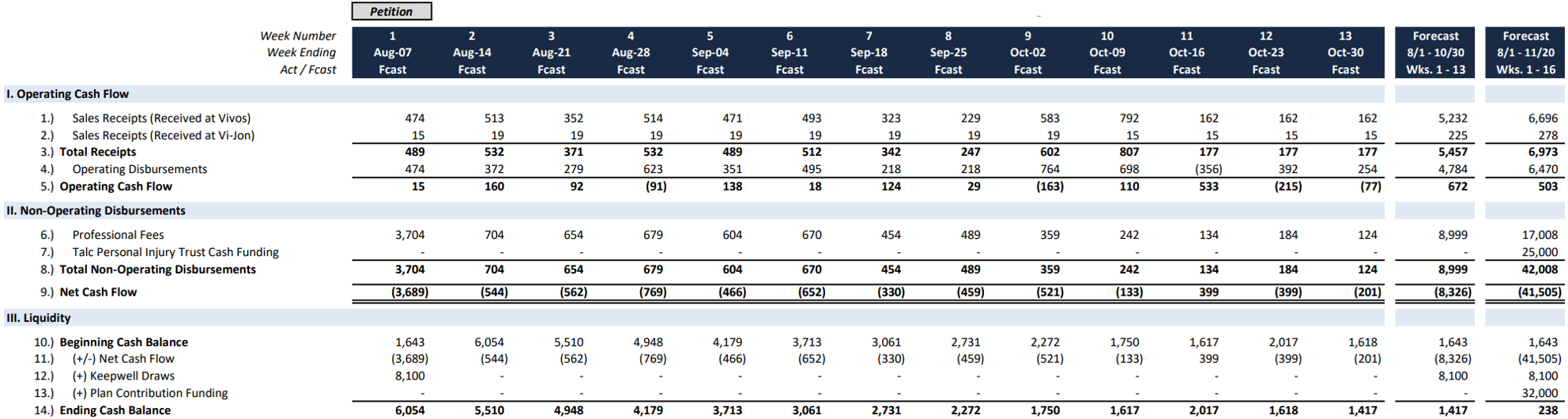
The budget shows the full $8.1 million remaining commitment drawn in week one, against beginning cash of $1.643 million, and forecasts thirteen weeks in detail through October 30 with summary columns to week 16. Professional fees run $9.0 million cumulative through week 13 and $17.0 million through week 16, most of that second leg concentrated in the final three weeks. The $25 million trust contribution does not appear in any individual week, surfacing only in the 16-week column, implying an Effective Date between weeks 14 and 16. That sits against a day-110 confirmation milestone and a day-120 consummation milestone, the latter falling past where the budget stops. Cash ends at roughly $238,000.
Explore Bondoro Insights for live case dockets and comprehensive coverage of material filings from petition to plan confirmation.
Stay informed on every Chapter 11 bankruptcy case with liabilities exceeding $10 million. Subscribe for free to have our coverage delivered directly to your inbox, and explore our full archive of past summaries.
Subscribers can also opt in to timely filing alerts by updating their email preferences in Account Settings.


