Case Summary: Hughes Satellite Systems Chapter 11
Hughes Satellite Systems, EchoStar's broadband and satellite services segment, filed Chapter 11 with $61.2M of cash against ~$1.5B of senior notes that matured prepetition, citing low-earth-orbit competition; noteholders intend to seek standing to pursue estate claims they value above $1.7B.

A deck version of this summary is also available HERE.
Business Description
Headquartered in Englewood, Colorado, Hughes Satellite Systems Corporation ("HSSC") is a direct, wholly owned subsidiary of EchoStar Corporation (NASDAQ: ECHO) ("EchoStar"), which is not a debtor in these cases. HSSC and its Debtor affiliates (collectively, the "Debtors"), together with HSSC's non-Debtor subsidiaries ("Hughes" or the "Company"), constitute EchoStar's Broadband and Satellite Services segment and operate under the HUGHES brand, which includes Hughesnet, HughesON and JUPITER.
The Company runs three lines of business. Consumer broadband sells satellite internet under the Hughesnet brand to residential and small-to-medium business customers in rural and underserved communities across North and South America. Enterprise and government services delivers managed connectivity, defense communications, satellite networking and in-flight broadband to enterprise and government customers worldwide. Satellite technology and manufacturing designs and builds ground systems, antennas, modems, gateways and user terminals deployed by satellite operators and government agencies.
HSSC reports as a single operating segment, disaggregating revenue into service revenue and equipment sales and other revenue, and by geography. For FY2025 consolidated revenue was $1.44 billion, down 8.0% from $1.56 billion in 2024, driven by a 10.4% decline in service revenue to $1.09 billion on lower consumer and North American enterprise broadband sales; equipment sales and other revenue were essentially flat at $351 million. As of the Petition Date, the Debtors employ approximately 1,275 people in the United States.
Hughes Satellite Systems Corporation and certain affiliates⁽¹⁾ filed for Chapter 11 protection on August 2, 2026 (the "Petition Date") in the U.S. Bankruptcy Court for the Southern District of Texas, reporting $1 billion to $10 billion in both assets and liabilities.
The Debtors' sister entities — DISH DBS Corporation, which operates EchoStar's DISH and Sling TV pay-television business, and DISH Wireless L.L.C., which holds EchoStar's legacy 5G network — filed their own Chapter 11 cases on June 30, 2026 in the same court. Those cases are administered separately from these Chapter 11 Cases, and our coverage of them is available here.
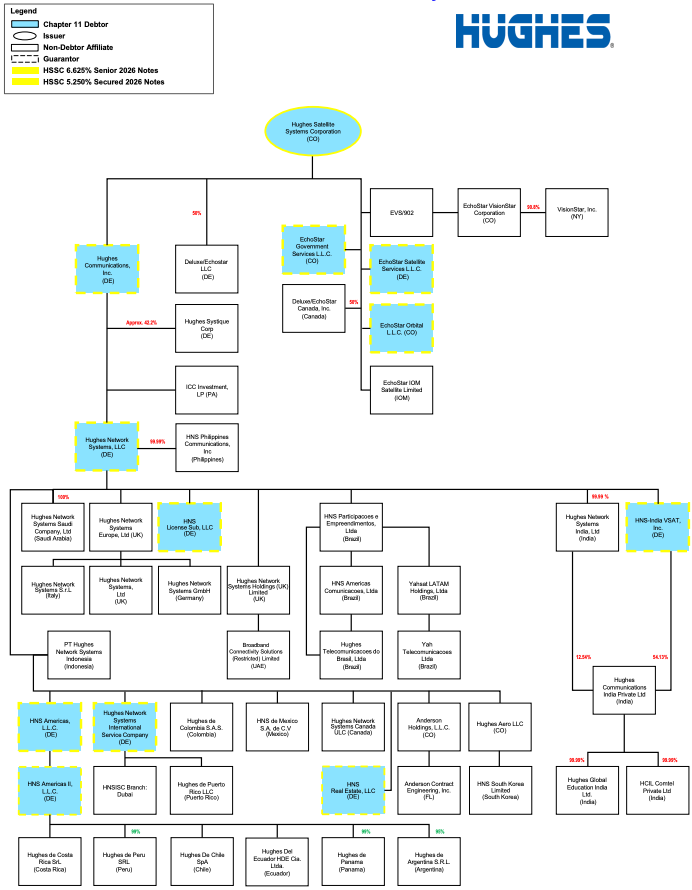
⁽¹⁾ For a complete list of Debtor entities, see organizational structure chart below.
Corporate History
Origins and Initial Ownership Changes
Hughes was founded in 1971 in Rockville, Maryland as Digital Communications Corporation, designing circuit boards for telecom related products. In 1978, Digital Communications Corp was acquired by Microwave Associates and began developing satellite related products. The Company developed and commercialized very-small-aperture terminal ("VSAT") technology in the 1980s — compact, customer-site ground terminals that allowed businesses to connect directly to satellites, replacing the large and prohibitively expensive ground stations previously required — and signed Walmart as its first commercial VSAT customer in 1984.
In 1987, Hughes Electronics Corporation, a General Motors subsidiary, acquired the business for $105 million through its Hughes Aircraft Company unit. In December 2003, News Corporation acquired a 34% controlling interest in Hughes Electronics for approximately $6.6 billion, and Hughes Electronics renamed itself The DIRECTV Group, Inc. in March 2004 — the point at which the business became a "DirecTV" subsidiary, by rebranding rather than by sale.
DirecTV then divested it in two steps in 2005 and 2006, selling half to SkyTerra Communications, Inc., an affiliate of Apollo Management, in April 2005, and the remaining half to SkyTerra subsidiary Hughes Communications, Inc. in January 2006. The business became publicly traded in its own right on February 21, 2006, when SkyTerra separated into two public companies and distributed Hughes Communications to its security holders; the shares traded on NASDAQ under the ticker HUGH.
The 2011 EchoStar Acquisition and the Formation of HSSC
In February 2011, EchoStar Corporation — the satellite communications company co-founded by Charles Ergen — agreed to take Hughes Communications private in a transaction valued at approximately $2 billion including debt. EchoStar incorporated HSSC in Colorado that March, originally named EH Holding Corporation, as the acquisition and financing vehicle, and the deal closed on June 8, 2011. The Security Agreement that still governs the Debtors' secured funded debt was executed the same day by EH Holding Corporation, HSSC's predecessor in interest. EchoStar then contributed its own satellite services business into HSSC, including EchoStar Satellite Services L.L.C., and the combined enterprise became EchoStar's Broadband and Satellite Services segment.
Debtor Group Function
The Debtors comprise HSSC and eleven direct and indirect wholly owned subsidiaries, each of which guarantees HSSC's funded debt:
- Hughes Satellite Systems Corporation — The lead Debtor and issuer of the Senior Notes; a Colorado corporation and direct, wholly owned subsidiary of non-Debtor EchoStar Corporation.
- Hughes Network Systems, LLC — The primary operating subsidiary, through which the Debtors conduct their consumer broadband, enterprise, aeronautical, government, technology, and manufacturing operations; also holds various FCC licenses relating to the Company's orbital and terrestrial satellite assets.
- HNS License Sub, LLC — Holds certain FCC and other regulatory licenses and authorizations used in the Debtors' operations.
- EchoStar Orbital L.L.C. — Holds certain orbital assets used in the Debtors' operations.
- EchoStar Satellite Services L.L.C. — Holds certain legacy orbital assets, including two legacy communications satellites, and continues to receive revenue from customers that purchased capacity on them.
- HNS Real Estate, LLC — Holds certain real property interests used in the Debtors' operations.
- Hughes Network Systems International Service Company — Supports the Debtors' international enterprise operations.
- HNS Americas, L.L.C. — Conducts enterprise and managed services operations across Latin America, with local operating subsidiaries in Colombia, Mexico, Costa Rica, Peru, Chile, Ecuador, Panama, and Argentina, among other countries.
- HNS Americas II, L.L.C. — Holds certain additional Latin American operational assets and equity interests.
- HNS-India VSAT, Inc. — The U.S. holding entity for the Debtors' Indian operations and parent of the local Indian entities.
- Hughes Communications, Inc. — An inactive intermediate holding company.
- EchoStar Government Services L.L.C. — Inactive.
Organizational Structure
Operations Overview
Regulatory Framework
Domestically, the Company's U.S. satellite operations are regulated by the FCC under the Communications Act of 1934, as amended. Its FCC licenses authorize the operation of satellites at specific geostationary orbital positions and in specific spectrum bands, together with the earth stations and gateways that communicate with those satellites in the same bands. The licenses are generally subject to periodic renewal and have historically been renewed on a routine basis. The Company is further subject to FCC rules governing interference protection, signal strength, satellite construction milestones, technical operating parameters, annual reporting, and annual regulatory fees applicable to its orbital assets and ground infrastructure. Separately, its operations must comply with U.S. export control and trade sanctions laws, including the Export Administration Regulations ("EAR"), the International Traffic in Arms Regulations ("ITAR"), and regulations administered by the Treasury Department's Office of Foreign Assets Control ("OFAC").
For international operations, the Company's operations are conducted principally through non-Debtor foreign subsidiaries and joint ventures, each subject to the telecommunications and satellite regulatory regime of its jurisdiction:
- Brazil — local subsidiaries hold authorizations to provide satellite broadband and managed network services under Brazilian telecommunications regulations.
- India — Hughes Communications India Private Limited holds licenses from the Indian Department of Telecommunications to provide VSAT-based satellite communications services.
- Europe — managed network solutions and satellite services are provided to enterprise and government customers subject to EU, UK, and member state telecommunications directives and licensing requirements.
More broadly, the Company must obtain satellite landing rights and market access authorizations in every foreign jurisdiction where it provides satellite services, each dependent on the national regulations of the applicable government or international body.
Consumer Broadband
Under the Hughesnet brand, the Company sells satellite broadband to residential and small-to-medium business customers across the Americas, in communities where cable, fiber, and DSL do not reach. As of the Petition Date, it had approximately 641,000 broadband subscribers.
Service is delivered through three high-throughput Ka-band geostationary orbit ("GEO") satellites, part of a Company-wide GEO network of six satellites and 69 terrestrial gateways worldwide. A GEO satellite matches the Earth's rotation and so remains fixed over the same point on the ground, allowing a subscriber's rooftop dish to be aimed once at a permanent orbital position. Ka-band refers to the frequency range used, which supports higher throughput than earlier satellite broadband bands but is more vulnerable to degradation in adverse weather, and "high-throughput" designates satellites that concentrate capacity into many narrow spot beams rather than a single wide beam, substantially increasing total deliverable bandwidth. The Company's three satellites are positioned across the Americas:
- JUPITER 1 (EchoStar XVII) — a Debtor-owned satellite launched in July 2012, providing 120 Gbps of capacity from 107° West longitude.
- JUPITER 2 (EchoStar XIX) — a Debtor-owned satellite launched in December 2016, providing 200 Gbps of capacity from 97.1° West longitude.
- JUPITER 3 (EchoStar XXIV) — launched in July 2023 and providing 500 Gbps of capacity from 95.2° West longitude, leased from EchoStar XXIV L.L.C., a non-Debtor subsidiary of EchoStar, under a seven-year operating lease effective December 2023 at a monthly charge of approximately $15.9 million. Its deployment addressed capacity constraints and extended coverage into Latin America.
Enterprise and Government Services
The Company describes its enterprise and government business as its fastest growing and currently most strategically important. As of March 31, 2026, contracted enterprise backlog stood at approximately $1.5 billion. The business comprises four lines:
- North America Managed Services — SD-WAN, cybersecurity, and private 5G connectivity delivered to enterprise customer sites across retail, financial services, petroleum, hospitality, and other corporate markets, serving national retailers, restaurant chains, banks, and petroleum companies.
- Aeronautical Connectivity — multi-orbit in-flight internet access for commercial airlines under multi-year agreements, integrating Ka-band GEO and Ku-band (lower throughput than Ka-band but more resilient in adverse weather) low earth orbit ("LEO") satellite service through the Company's proprietary antenna systems. LEO satellites cross the sky rather than holding a fixed orbital position, so terminals must track them and hand off between satellites in a constellation.
- Defense and Intelligence Communications — secure, resilient satellite and 5G communications systems supplied to the U.S. government and allied defense programs.
- International Enterprise — managed satellite and hybrid networks for multinational corporations, telecommunications operators, and government clients across Latin America, Europe, India, and the Middle East.
The Company's enterprise and government business is enabled in part by a fleet of six satellites providing Ka-band and Ku-band coverage across the Americas and Europe, comprising the three JUPITER satellites described above and capacity leases on three additional satellites:
- Eutelsat 65 West A — launched March 2016, positioned at 65° West longitude, under a lease running through July 2031.
- EchoStar 105/SES-11 — launched October 2017, positioned at 105° West longitude, under a lease running through November 2030.
- Telesat T19V — launched July 2018, positioned at 63° West longitude, under a lease running through August 2033.
Satellite Technology and Manufacturing
The Company designs, develops, and manufactures satellite ground systems, electronically steered antennas, modems, gateways, and user terminals for satellite operators, mobile system operators, enterprise customers, and government agencies worldwide. Its proprietary JUPITER ground platform is deployed by operators across six continents, and the JUPITER antenna and gateway product line supports the Company's aeronautical business. The Debtors hold more than 800 active and pending patents spanning satellite waveform technology, phased-array antenna design, multi-transport network architectures, and 5G non-terrestrial network systems.
Manufacturing runs through a 140,000-square-foot facility in Germantown, MD, which the Company states is compliant with ITAR, the EAR, and requirements applicable to Controlled Unclassified Information ("CUI") — qualifying it for defense and national security contracts requiring domestic, controlled-access manufacturing. Certain products are assembled at Company facilities, with a portion of manufacturing outsourced to third parties and certain integrated components developed and manufactured under contract with third-party vendors. The Company owns that site and leases additional manufacturing and testing facilities nearby, and also owns a shared hub, operations, and administrative facility in Griesheim, Germany.
The Company reports activity across U.S. and allied defense programs, including protected satellite communications ground system development, private 5G network deployments for defense customers, satellite communications modems integrated on defense contractors' products, and technology development contracts awarded by the U.S. government.
Prepetition Obligations
Top Unsecured Claims
Events Leading to Bankruptcy
The Shift from GEO to LEO
Historically, demand in the consumer satellite broadband market was driven by necessity rather than preference. Rural households and remote businesses across the United States and Latin America, beyond the practical reach of cable, fiber, or DSL infrastructure, depended on satellite as their only connectivity option, and the Company built its consumer business in those markets. Geostationary satellites, orbiting at approximately 22,300 miles above the Earth, deliver the broad geographic coverage those populations require, but the physics of that altitude impose a round-trip signal latency of approximately 600 milliseconds — which customers historically accepted as the cost of connectivity they could not otherwise obtain.
That calculus changed as competitors deployed low earth orbit constellations. Operating between approximately 340 and 1,200 kilometers, LEO satellites deliver latency in the 20-to-40-millisecond range, approaching terrestrial broadband performance, at speeds competitive with cable and DSL. As those constellations expanded and consumer costs fell, competitors entered the markets the Company historically served with a product that exceeds GEO broadband on the two metrics that matter most to consumers: speed and latency. The Chief Restructuring Officer describes the competition as structural rather than cyclical, and states that the Company does not expect the trend to reverse.
The declaration names SpaceX, Amazon Leo, and other operators as competitors that have deployed LEO constellations. In an order dated June 5, 2026, the FCC's Space Bureau stated that at this time, only one operator, SpaceX, is providing broadband to American consumers from low-Earth orbit (FCC DA 26-553). The Bureau granted Amazon Leo conditional relief from its interim deployment milestone in that same order, reasoning that doing so serves the public interest by promoting a second large satellite broadband constellation.
Subscriber Erosion
Broadband subscribers stood at 739,000 at December 31, 2025 and 681,000 at March 31, 2026, reaching approximately 641,000 as of the Petition Date — a decline of approximately 21.7% from approximately 819,000 as of June 30, 2025. Net losses accelerated within that period: approximately 58,000 subscribers in the first quarter of 2026, against approximately 30,000 in the same quarter of 2025. On a trailing twelve-month basis, the base declined 20.2%.
Financial Impact and Workforce Reduction
The subscriber decline flows through a fixed cost structure — satellite lease obligations, ground infrastructure operating costs, and network operations expenses — that does not decrease proportionately with volumes. For the fiscal year ended December 31, 2025, the Company reported a net loss of approximately $1.274 billion, against a $209 million net loss in 2024, driven by consumer broadband revenue declines and a $1.42 billion non-cash impairment charge writing down the carrying value of its core operating assets. The impairment comprised a $400 million full write-off of the orbital slot authorizations at 95° and 107° West longitude and a $1.01 billion partial write-down of the satellite fleet, satellite lease assets, and related intangibles used alongside them.
Cash and cash equivalents fell from $118.8 million at December 31, 2025 to $101.6 million at March 31, 2026 and approximately $61.2 million as of the Petition Date. KPMG's report on the fiscal 2025 financial statements included a going-concern explanatory paragraph, and both the 10-K and the first-quarter 10-Q disclosed substantial doubt about the Company's ability to continue as a going concern, citing the August 2026 maturities and the absence of cash on hand, projected cash flows, or committed financing.
Between July 24 and July 28, 2026, the Debtors notified approximately 400 employees that their employment would be terminated, with most termination dates falling between September 22 and September 28, 2026, following a 60-day transition period during which the Debtors anticipate continuing to pay salary and benefits.
Senior Notes Maturities and Failed Out-of-Court Negotiations
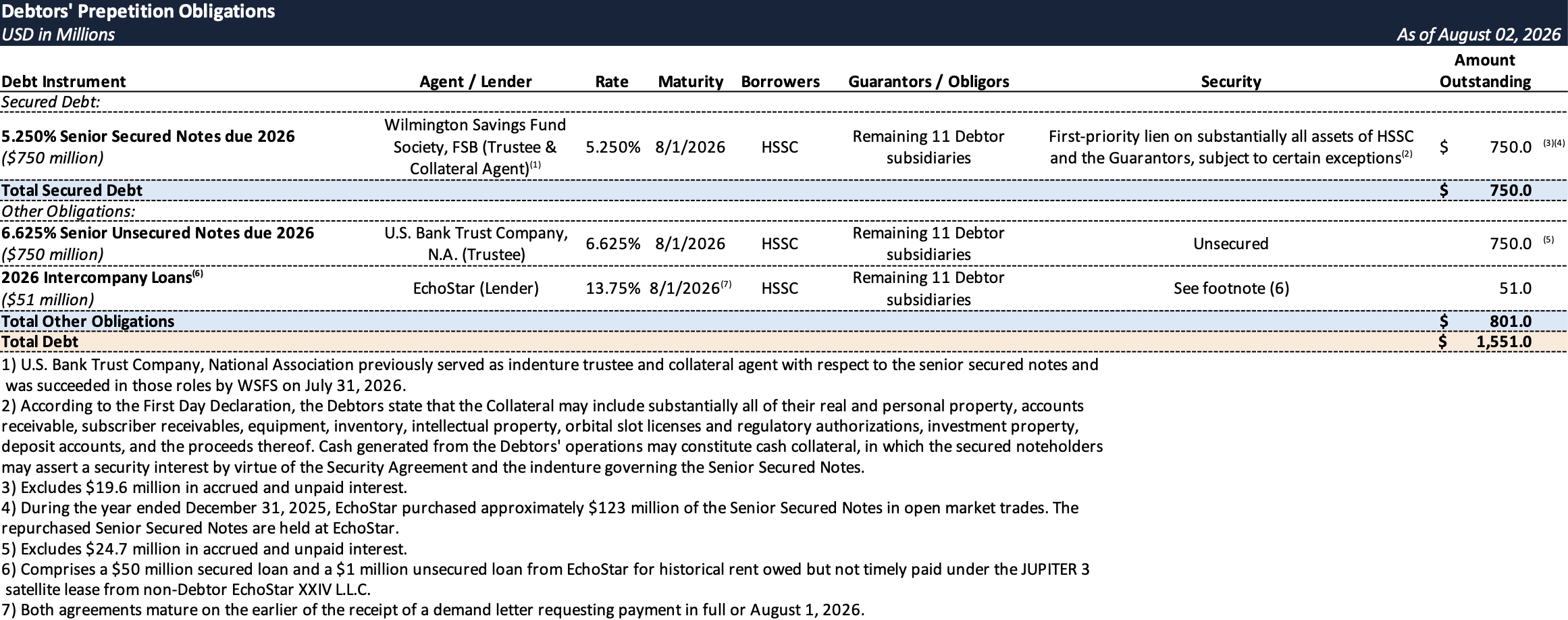
The Senior Notes matured on August 1, 2026, a Saturday; under the indentures a Saturday is a Legal Holiday, so payment was not due until Monday, August 3, with no additional interest accruing. As of the Petition Date the Debtors did not have the approximately $1.5 billion necessary to repay them. They had no committed financing for the obligations and had been unable to access capital markets on terms permitting a refinancing. The indentures governing the Senior Notes limit the Debtors' ability to incur additional indebtedness, make certain investments, and take other steps that might otherwise have supported a refinancing transaction.
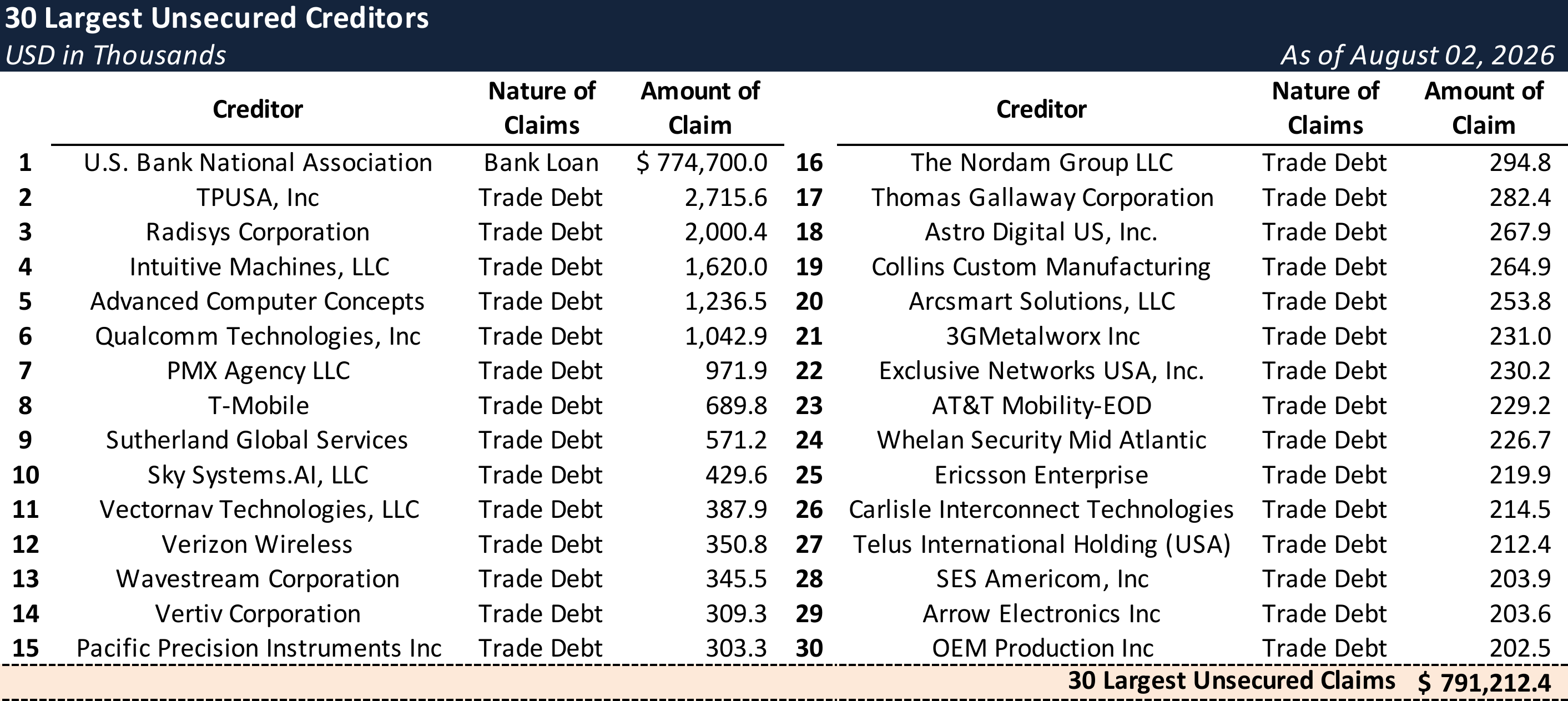
Prior to the Petition Date, the Debtors and their advisors engaged in discussions with an ad hoc group of noteholders (the "Ad Hoc Group"), advised by Jones Day and PJT Partners, regarding a potential restructuring of the funded indebtedness, exchanging term sheets on proposed forbearance terms intended to allow discussions to continue and potentially avoid a filing. The Ad Hoc Group's advisors represented to the Debtors that the group holds approximately 80% of the outstanding aggregate principal amount of the Senior Notes across the two series combined. In its July 21, 2026 letter, the Ad Hoc Group stated that it holds more than 66% of the Senior Secured Notes — more than 80% excluding the approximately $123 million held by EchoStar or its affiliates — and in excess of 82% of the Senior Unsecured Notes. Those discussions did not produce agreement on a standstill, forbearance, or consensual restructuring.
July 21 AHG Letter
On July 21, 2026, the Debtors received a letter from counsel to the Ad Hoc Group raising allegations concerning prepetition transactions between the Debtors and EchoStar and its non-Debtor subsidiaries:
- J3 Satellite Lease — The terms of HSSC's lease of the full capacity of the JUPITER 3 satellite from non-Debtor EchoStar XXIV L.L.C., which the Ad Hoc Group contends requires above-market payments by the Debtors.
- Dividends — Cash dividends totaling approximately $1.029 billion paid by the Debtors to EchoStar in February and March 2024.
- Tax reimbursements — Income tax reimbursements of approximately $196 million made by the Debtors to EchoStar in 2024.
- Subscriber referrals — The referral of the Company's consumer subscribers to SpaceX in connection with EchoStar's sale of certain spectrum assets to SpaceX. That sale was one of two FCC-directed spectrum dispositions by EchoStar in 2025, the consequences of which drove the separate Chapter 11 filings of EchoStar's DISH DBS and DISH Wireless on June 30, 2026.
The letter asserted that these transactions may give rise to claims for fraudulent transfer and breach of fiduciary duty against EchoStar, certain of its subsidiaries, and the individuals serving as the Debtors' directors and officers at the time — certain of whom, including Charles Ergen, were concurrently directors or officers of EchoStar. The Debtors do not concede the merit of the allegations, reserve all rights against all parties, and state that the relief sought in the first day motions will not prejudice any party's rights with respect to those matters. The special committee formed to investigate them is described below.
The Ad Hoc Group estimated that the claims could generate well in excess of $1.7 billion including prejudgment interest, and cited the decline in Hughes's cash, cash equivalents and marketable securities from nearly $1.7 billion at December 31, 2023 — comfortably in excess of the Senior Notes — to $204 million a year later. On the J3 Satellite Lease specifically, it contended that payments run approximately $191 million annually above market and that the Debtors will have paid EchoStar XXIV the full construction cost of the satellite in just over 2.1 years. The letter also stated that the noteholders do not consent to the use of cash collateral securing the Senior Secured Notes, that they are not proposing any alternative arrangement with respect to the Notes, and that they expect payment in full at maturity.
On July 28, 2026, counsel to the Ad Hoc Group wrote to the Clerk of the Court objecting to any request by the Debtors for an expedited hearing process, including any request to use cash collateral securing the Senior Secured Notes. The letter stated that the Ad Hoc Group had asked the Debtors for drafts of first-day pleadings and advance notice of the relief they intended to seek, and had received no response as of that date. The Debtors note that at the time the letter was sent they had not filed, had not sought relief from any court, and had not determined whether or when to commence the cases or what first-day relief to request.
Governance Change and Special Committee Formation
On July 28, 2026, Anthony Horton and Michael Buenzow were appointed to HSSC's Board of Directors as independent directors. Horton currently serves as Chief Executive Officer of AR Horton Advisors, Lead Independent Director of Team, Inc., and an Independent Director of Talen Energy Corporation. Buenzow spent 23 years at FTI Consulting, Inc., where he served as Senior Managing Director and Vice Chairman of Restructuring through 2025, and is currently the founder of Turn 180 LLC. Following the appointments, the Board consists of Horton, Buenzow, and Charles Ergen — HSSC's Principal Executive Officer and the Co-Founder, Chairman, President, and Chief Executive Officer of EchoStar.
That same day, the Board unanimously approved the formation of a special committee comprised of the two Independent Directors (the "Special Committee"), having concluded that neither has any material business relationship, close personal relationship, or other affiliation, present or historical, with the Company or its related parties that would prevent the exercise of independent judgment.
The Board delegated to the Special Committee authority to:
- Evaluate and negotiate transactions. Review the Debtors' capital structure, assets, liabilities, operations, liquidity, and general financial condition, and consider, evaluate, negotiate, approve, and implement financing, restructuring, sale, or other strategic transactions — in each case to the extent the Board or the Special Committee reasonably determines the matter presents an actual or potential conflict of interest between the Debtors and EchoStar or its non-Debtor subsidiaries.
- Investigate claims against EchoStar. Conduct an independent investigation and assess the merits and potential value of any claims and causes of action held by the Debtors against EchoStar or its subsidiaries, with sole power and authority to act upon, prosecute, settle, or release such claims.
- Retain advisors. Take any actions necessary or desirable in connection with the foregoing, including retaining independent advisors.
The Special Committee retained Kirkland & Ellis. On July 31, 2026, HSSC appointed Ramesh Ramaswamy as Executive Vice President, General Manager; Ramaswamy joined HSSC in 1985 as a software engineer and rose through management roles in engineering, operations, marketing, and sales. On August 2, 2026, the Board, including the Independent Directors, unanimously authorized the commencement of the Chapter 11 Cases.
The Chapter 11 Filing
The Debtors filed on August 2, 2026 — one day after the Senior Notes matured and one day before payment was due under the indentures — with no restructuring support agreement, no prepetition plan, and no committed DIP financing, proceeding on the use of cash collateral to which the Ad Hoc Group has not consented. White & Case LLP is proposed counsel to the Debtors, with FTI Consulting, Inc. as proposed financial advisor and FTI Senior Managing Director Robert Del Genio serving as Chief Restructuring Officer. Kirkland & Ellis LLP represents the Special Committee, and Jones Day and PJT Partners advise the Ad Hoc Group. Non-Debtor EchoStar appeared at the first day hearing through James Bromley of Sullivan &; Cromwell LLP. Delta Air Lines, Inc., a customer of the Debtors' aeronautical connectivity business, entered an appearance through Hughes Hubbard & Reed LLP on the first day of the cases.
The Cash Collateral Motion
The Debtors seek to fund the cases from operating cash flow and access to cash collateral rather than a debtor-in-possession facility, reserving the right to seek such financing if available cash proves insufficient. They held approximately $61.2 million in cash and cash equivalents on a bank basis at the Petition Date.
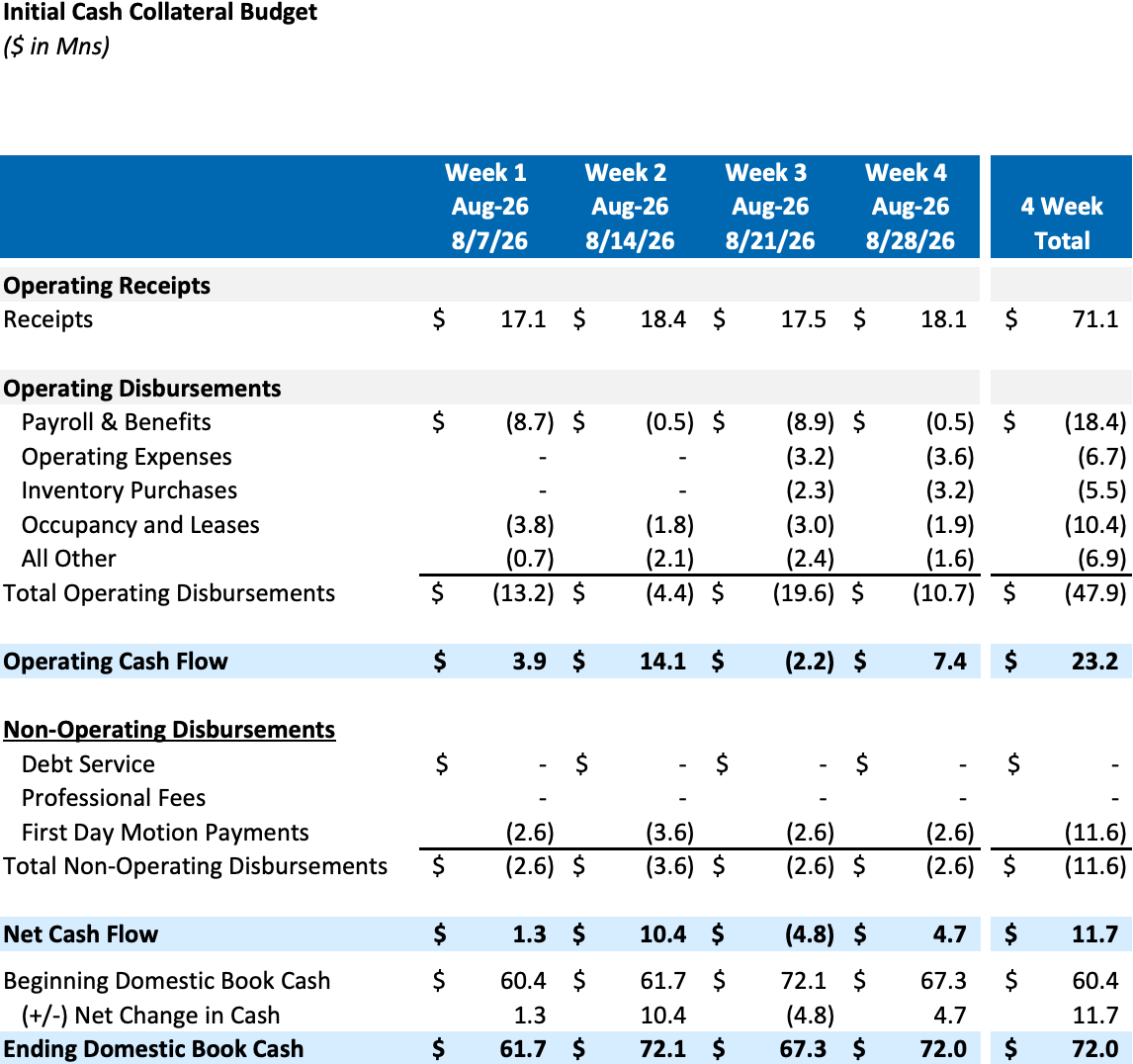
- Budget — The four-week budget attached to the proposed interim order forecasts operating receipts of $71.1 million against operating disbursements of $47.9 million, plus $11.6 million of first-day motion payments, with no debt service and no professional fees in any week. Domestic book cash grows from $60.4 million to $72.0 million across the period. The budget provides for no payments under the J3 Satellite Lease pending the final hearing; one month's rent at the stated rate of approximately $15.9 million exceeds the entire four-week occupancy and leases line of $10.4 million. Annual cash coupon on the two note series is $89.1 million, against operating cash flow of $56.8 million for fiscal 2025 and $(1.0) million for the first quarter of 2026.
- Adequate Protection — The Debtors offer replacement liens on postpetition property that would otherwise constitute prepetition collateral, superpriority administrative expense claims under sections 503(b), 507(a) and 507(b), and budget compliance with variance reporting. Both the liens and the claims are limited to the extent of any diminution in value, and both are expressly conditioned on the Prepetition Liens themselves being valid, perfected and enforceable.
- Carve-out — Clerk and U.S. Trustee fees, up to $100,000 for a chapter 7 trustee, accrued professional fees, and a $5 million cap on fees incurred after a Carve Out Trigger Notice; effective only on entry of a final order, with a Professional Fee Escrow Account funded weekly.
- Variance — Cumulative disbursements over each successive four-calendar-week testing period may not exceed 135% of budget, with a five-business-day cure.
- Remedies — The Required Prepetition Secured Parties must file for and obtain a Stay Relief Hearing on no less than ten business days' notice before any enforcement; no self-help pending that order.
- Reservations — No cross-collateralization, no roll-up, no plan milestones, section 506(c) rights preserved, and all challenges to the validity, perfection, priority and extent of the Prepetition Liens expressly reserved. The order's findings describe the liens as "purported" throughout.
- EchoStar XXIV's position — A $50 million intercompany obligation, designated an Additional Secured Obligation under the Security Agreement in February 2026, makes EchoStar XXIV a Prepetition Secured Party sharing in the adequate protection. It is included within the Required Prepetition Secured Parties but holds no vote in determining whether the requisite majority of Secured Noteholders has acted, and cannot alone block or veto any action they authorize. The character of the obligation is contested. The Debtors describe it as a secured financing; at the first day hearing the Court asked whether the money was lent or was instead a roll-up of past due lease payments, which the Court said was its reading of the declaration. Counsel to the Ad Hoc Group answered that the group does not know and identified it as something it intends to investigate.
Ad Hoc Group Objection to Cash Collateral
On August 3, 2026, the day of the first day hearing, the Ad Hoc Group filed an objection asking the Court to deny the motion in its entirety, supported by a declaration from Jones Day partner Joshua Mester attaching the Secured Indenture, the Security Agreement, documents evidencing perfection of the noteholders' liens, and the first-quarter Form 10-Q. The Ad Hoc Group states that it now holds more than 69% of the Senior Secured Notes, up from the more than 66% stated in its July 21 letter — more than 83% excluding the approximately $123 million held by EchoStar or its affiliates — and more than 82% of the Senior Unsecured Notes, together roughly two-thirds of the Debtors' secured debt even counting EchoStar XXIV's $50 million claim, and about four times the funded debt held by all other creditors combined. Presenting at the hearing later that day, its counsel put the position slightly higher: 69.6% of the secured debt, of which 17.5% is held by EchoStar, and 88.8% of the Senior Unsecured Notes, adding that the group had received further requests to join and expected the figures to rise.
The Ad Hoc Group's argument is that the Debtors are offering nothing of value in exchange for spending cash the noteholders have liens on. Superpriority administrative expense claims, in its view, are expressly excluded by statute from the permitted forms of adequate protection. Replacement liens attach to collateral the noteholders already hold liens on and so add nothing. Liens on receivables the Debtors have not yet generated are too speculative to substitute for cash spent today — particularly where declining revenue means fewer receivables will be generated than are being collected. And the Debtors have not alleged that the collateral is worth more than the debt it secures. The Ad Hoc Group cites In re First Brands Group, in which Judge Lopez of the same court held that speculative future receipts cannot be the indubitable equivalent of cash collateral, and distinguishes In re Worldwide Machine Group, on which the Debtors relied, as a case with broader replacement liens, no professional fee carve-out, and a 15% weekly variance.
The Ad Hoc Group asks the Court to prohibit any payment by the Debtors to EchoStar, naming the JUPITER 3 satellite lease specifically, on the view that such payments continue the value extraction that precipitated the cases rather than preserve collateral. It also asks that no cash collateral be used to fund the independent directors, their advisors, or any investigation they undertake, noting that the directors were appointed less than a week before filing and their advisors retained the day before. Rather than propose no use of cash collateral at all, it submitted its own form of interim order (Doc. 41-1) and stated it would consent to limited use on those terms.
The First Day Hearing & Cash Collateral Contest
Cash collateral was the only contested matter and was heard last. The Ad Hoc Group's economic presentation showed five years of secular subscriber decline that has accelerated this year, Hughes's market share crossing below Starlink's before mid-2023 and diverging since, and cash falling from $101.6 million at March 31 to $61.2 million at the hearing — offered for the propositions that the decline will not reverse during the cases, that receivables consumed now will not be fully replaced, and that the collateral continues to depreciate even after the 2025 write-downs.
The sharpest point was the budget. By the group's count, the four-week projection shows a $13.3 million gain in book cash, but no satellite lease payments are budgeted during the period even though they accrue; adding back the roughly $22.0 million of JUPITER lease payments falling outside the window — $6.0 million on JUPITER 2 and $16.0 million on JUPITER 3 — more than offsets the gain. The Ad Hoc Group's characterization was that the projection had been engineered to appear cash flow positive, and that the business is not generating cash but deferring expenses into the next period.
The Debtors called Chief Restructuring Officer Robert Del Genio to lay the foundation for the budget. The Ad Hoc Group objected to it as hearsay, arguing that a budget assembled by a professional retained three weeks earlier is a special project rather than a routine business record; the Court overruled the objection and admitted the exhibit, leaving weight for cross-examination. Del Genio testified that the Debtors hold approximately $60.4 million of cash with no alternative funding source, and that without access to it the company could not operate and would liquidate at a significant loss of value. Cash is projected to rise to approximately $72.0 million over the four weeks. No payment would be made during the interim period that is not necessary to support the business, and none to non-debtor affiliates. On the lease critique, he testified that the JUPITER 2 payment is debtor-to-debtor and collapses on a consolidated basis, and that JUPITER 3 is excluded pending the 60-day lease decision period, with no cash leaving the company on its account. On receivables, he testified that debtor accounts receivable were flat from March to June and are expected to stay flat, and that consumer customers pay by credit card, leaving the receivables in the government and enterprise business rather than the declining consumer base.
Cross-examination of the Chief Restructuring Officer and argument on adequate protection carried over to the continued hearing, with the balance of the dispute — the carve-out, the variance thresholds, the enforcement notice period, the lien findings, and the treatment of the JUPITER 3 lease — left for the final hearing on August 26.
The Revised Proposal
On August 4, ahead of the continued hearing, the Ad Hoc Group filed a notice of revised cash collateral proposal (Doc. 69) attaching a further-revised form of interim order. The movement runs in one direction — toward the Debtors on the provisions that most constrained operations:
- Variance. 105% for payroll and benefits, occupancy and leases, and first day motion payments, and 125% for operating expenses, inventory purchases, and all other operating disbursements, tested cumulatively over four-week periods, against the Debtors' proposed 135%. There is no cure period.
- Budget. No restriction on line items and no approval right over updated budgets, which become effective on delivery. The order accordingly carries no express prohibition on lease payments to EchoStar; that restraint now rests on the attached budget, which provides for no JUPITER 3 payments during the interim period.
- Carve-Out. Deleted entirely, on the argument that Fifth Circuit law narrowly limits charging administrative expenses against a secured creditor's collateral and that the carve-out would prime the very adequate protection being offered.
- Enforcement Notice. Two business days before a stay relief hearing, against the Debtors' ten.
- Discovery Schedule. Embedded in the order and aligned with the Court's calendar: document production by August 15, depositions by August 20, and a final hearing on August 26 with objections due August 21.
- Lien Findings. "Purportedly" removed from every reference to the Secured Notes' liens, with the qualifier left on EchoStar XXIV's obligations.
Other First Day Relief
- (Doc. 6 — Extension of Time to File Schedules and Statements — Granted) The Debtors sought an additional 45 days to file their schedules of assets and liabilities, statements of financial affairs, and Rule 2015.3 reports for non-Debtor entities in which they hold a controlling interest, extending both deadlines to September 30, 2026. They also sought to reduce the frequency of 2015.3 reporting from monthly to every six months.
- (Doc. 7 — Utilities — Granted) The Debtors sought a determination that their proposed adequate assurance satisfies section 366, an order prohibiting utility providers from altering or discontinuing service, and approval of procedures for resolving adequate assurance requests. They averaged approximately $730,000 per month in utility obligations over the trailing twelve months, with roughly $179,000 outstanding at the Petition Date and $552,000 in deposits already held by providers. The proposed deposit is $180,000, equal to approximately 50% of average monthly cost net of existing deposits.
- (Doc. 9 — Customer Programs — Interim Approval) The Debtors sought authority to maintain and administer their existing customer programs and to honor prepetition customer obligations without assuming any related contracts. The programs comprise new-customer and retention promotions, bill credits, return and warranty programs, outage credits and account adjustments, third-party payment processor obligations, and refund programs. The obligations are largely non-cash, with approximately $5,000 estimated outstanding under the customer promotions and $8,000 under the refund programs.
- (Doc. 10 — Critical Vendors — Interim Approval) The Debtors sought authority to pay prepetition trade claims held by critical vendors, lien claimants, foreign claimants, and holders of section 503(b)(9) claims, and confirmation that outstanding purchase orders carry administrative expense priority. Payment is conditioned on each recipient maintaining customary trade terms at least as favorable as those in effect during the prior twelve months. Interim authority is capped at $10,550,000, and payments to insiders and insider affiliates are excluded. The Ad Hoc Group withdrew its objection at the hearing on the condition that the Debtors identify, within 48 hours, every vendor they regard as critical, the amount proposed to be paid, and the reason for the designation; Debtors' counsel agreed on the record.
- (Doc. 11 — Wages — Granted) The Debtors sought authority to pay prepetition wages, other compensation, reimbursable expenses, and certain severance obligations, and to continue their employee benefits programs in the ordinary course. Payments are capped at the section 507(a)(4) and (a)(5) priority limits per individual, and no insider bonus, incentive, or retention payments may be made absent further order. Independent director compensation drew an objection: the Ad Hoc Group told the Court the Company's annual non-employee director retainer is $60,000 against the $480,000 per director contemplated here, roughly eight times the ordinary rate and close to $1 million a year for the two directors combined. The Court declined to find those payments ordinary course and added qualifying language to that effect, and Debtors' counsel stated the payments would not be made unless a cash collateral order is entered. The order also barred reimbursement of non-Debtor affiliates for Shared Services.
- (Doc. 12 — Insurance — Granted) The Debtors sought authority to maintain and continue their insurance policies, surety bonds, and letters of credit, to pay related prepetition obligations, and to renew or replace coverage, together with limited stay relief permitting employees to pursue workers' compensation claims. They may pay insurance obligations directly if EchoStar and its non-Debtor affiliates fail to do so, but may not reimburse any non-Debtor affiliate.
- (Doc. 13 — Taxes — Granted) The Debtors sought authority to pay prepetition and postpetition taxes, fees, and assessments owed to federal, state, local, and foreign taxing authorities, and to continue accounting for consolidated income tax obligations consistent with prepetition practice. They may satisfy their allocated share directly with the applicable taxing authority if EchoStar fails to pay, but may not pay EchoStar on account of consolidated income tax obligations.
- (Doc. 14 — Cash Management — Interim Approval) The Debtors sought authority to continue their existing cash management system, maintain their bank accounts and business forms, pay related prepetition obligations, and continue intercompany transactions with administrative expense priority, along with relief from the section 345(b) deposit and investment requirements through September 17, 2026. No Debtor may transfer cash to another Debtor or to a non-Debtor subsidiary without CRO approval, and transfers to other non-Debtor affiliates require further order of the Court. The entered order's reservation of rights names the J3 Satellite Lease specifically among the agreements it neither assumes nor rejects. The Ad Hoc Group opposed the relief, arguing that approval by a Chief Restructuring Officer three days into the role was not a meaningful check on intercompany transfers.
Explore Bondoro Insights for live case dockets and comprehensive coverage of material filings from petition to plan confirmation.
Stay informed on every Chapter 11 bankruptcy case with liabilities exceeding $10 million. Subscribe for free to have our coverage delivered directly to your inbox, and explore our full archive of past summaries.
Subscribers can also opt in to timely filing alerts by updating their email preferences in Account Settings.


